It’s been a busy week. On Monday, I made a revisit to a welfare case, Tuesday and Wednesday were spent catching up on paperwork and courses that I should have completed as well as having an appointment with a doctor from occupational health. Thursday I was third duty vet and yesterday, I inspected a chicken farm with a colleague up north of Ayr.
As some of you will know, I had some major neurological issues between 2017 and 2019. These mostly cleared up after I started physiotherapy and had some coincidental corticosteroid injections for a seemingly unrelated issue. I never received a diagnosis, but the problems I had still recur when I’m very tired, and I still tire very easily. My line manager referred me to occupational health as this means that coping with duty vet on top of my day to day work is currently too much.
The doctor has recommended that, though I will still cover nights and weekends, I will be temporarily relieved of the daytime tasks until I am more familiar with what needs to be done. She also recommended I should go to my GP and get myself rechecked. I imagine that could be a long job, involving lots of tests, quite likely with the same end result, but I will keep you posted.
With all that said, I was incredibly touched that another colleague from Lauder, who I’d never met before, invited me to come and do my first ever stint as third duty vet with her and doing it with someone else in the room with me, who was perfectly willing to help, was altogether a different experience. It might be difficult to organize for new starters to do this, partly because so many people still work from home, post Covid, but it would prevent a lot of anguish. So many people I have spoken to describe being in tears when they are stuck on duty vet that I have also reported it as a health and safety issue, but the reality is, we are understaffed and there’s not much that can be done.
Anyway, the best day of last week at work, was actually Sunday. I travelled through to the edge of Edinburgh on Saturday night, and at 07:45 on Sunday morning, I reported for duty as one of the official APHA vets at the Royal Highland Show.
Our routine remit didn’t sound too onerous. We were asked to walk round all the animals once to check on health and welfare. There were other vets at the show to deal with any front line injuries or illnesses. I did read our contingency plans before I went, which detailed what we must do in the event of a foot and mouth outbreak and other unpleasant scenarios, but fortunately none of them happened and instead, it was a lovely day out. The rest of this post then, is going to be taken up with photos from the show. I hope you enjoy them.
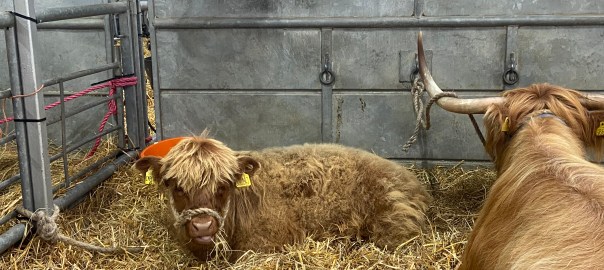
Quite appropriately, the most heavily featured breed in my photos is Highland Cattle. The amount of work it must take to have them clean and tidy for the ring is phenomenal. I chanced upon a young woman wielding a long hairdryer on hers and asked if I could take photos and she agreed.
I also loved the belted Galloways.
Though it must be a lot of work to present such beautifully turned out stock, the Highland Show is a real, family event. Again, I asked if I could take a photo, but here, the whole family were gathered around a calf that was being preened.
The Holsteins, for some reason, are shaved all over, before going in the ring. I watched someone carefully running their clippers along the spine, leaving some of the standing up hair, working to get a perfectly straight line, to give the best effect. I didn’t photograph that one, but it was interesting to compare the slimline, dairy cattle with the sturdy beef cattle. For obvious reasons, one of those is bred to not put on any flesh, but to direct energy into milk production, the other is bred to have as much meat as possible. I saw a breed that I hadn’t come across before – the British Blue – which has double muscles. I give you a baby Holstein, then a rump comparison, Jersey dairy cattle, vs a British Blue.
There were even more breeds of sheep. I don’t have so many photos of them, but I was struck by the fluffy cuteness of these black nose sheep.
And these fabulous horns.
There were ponies and heavy horses…
And right away, at the far end of the show, there were goats, alpacas and chickens.
All in all, checking out all the animals was a very long walk and by the end of the day, I had covered twelve kilometers. I felt very pleased though, at having such a wonderful day out as part of my job. I hope you enjoyed the picture and I will see you all again next week.
After a pleasant weekend in Yorkshire, Andrew, Triar and I returned to Dumfries last Sunday, but I didn’t stay there long. I had booked a trip to Ayr to go out on a welfare cross-compliance visit with a colleague who needed support. I drove up and we worked on the paperwork together on Monday. The visit was planned for Tuesday and I wanted to have plenty of time to go through everything, but it was also good to catch up with some other Animal Health Officer colleagues I had worked with before in Stranraer.
I stayed in the Mercure Hotel, which was clean enough and had a decent breakfast, though the bed and pillow were so hard that I was surprised that I managed to get a reasonable night’s sleep. The British obsession with hard mattresses stopped making sense after a few years in Norway, where the mattresses are all soft and it feels like you are sleeping on a cloud.
I awoke in the morning to a cloudy day and a rather noisy friend outside my bedroom window. I confess I had been quite amused the night before to see a discarded half bottle of some unknown liquor on the flat roof outside my room. It’s so very Scottish to see that. With apologies to my Scottish friends, Scotland really does have a litter problem, as well as a huge penchant for drinking. The streaking of my window with bird poo might have been a hint, but I hadn’t really expected such a close encounter with a seagull.
This was just before I was about to go downstairs and I toyed with the idea of bringing back a slice of toast for the interloper, but out of respect for the hotel windows, I decided any more encouragement was not a good plan.
As this was also my second week on the Second Nature plan and I had pledged to do fifteen minutes exercise each morning, I decided to take a walk before breakfast. Though it’s not obvious from the photo above, if you squint at the area, over the rooftops, to the left of the tree my room did technically have a sea view, so I thought I would walk in that direction.
Wandering the town near the hotel to find a restaurant, the night before, I had been rather put off Ayr. The place had a run down air, though the Tempura restaurant (which Donna had recommended) was very nice, with lovely friendly staff. As I walked down towards the beach, I saw another side to it. While still run down, it was obvious as I walked down the wide street, with its substantial, terraced townhouses, now converted into solicitor’s offices and charity headquarters, that this had once been an attractive and prosperous place.
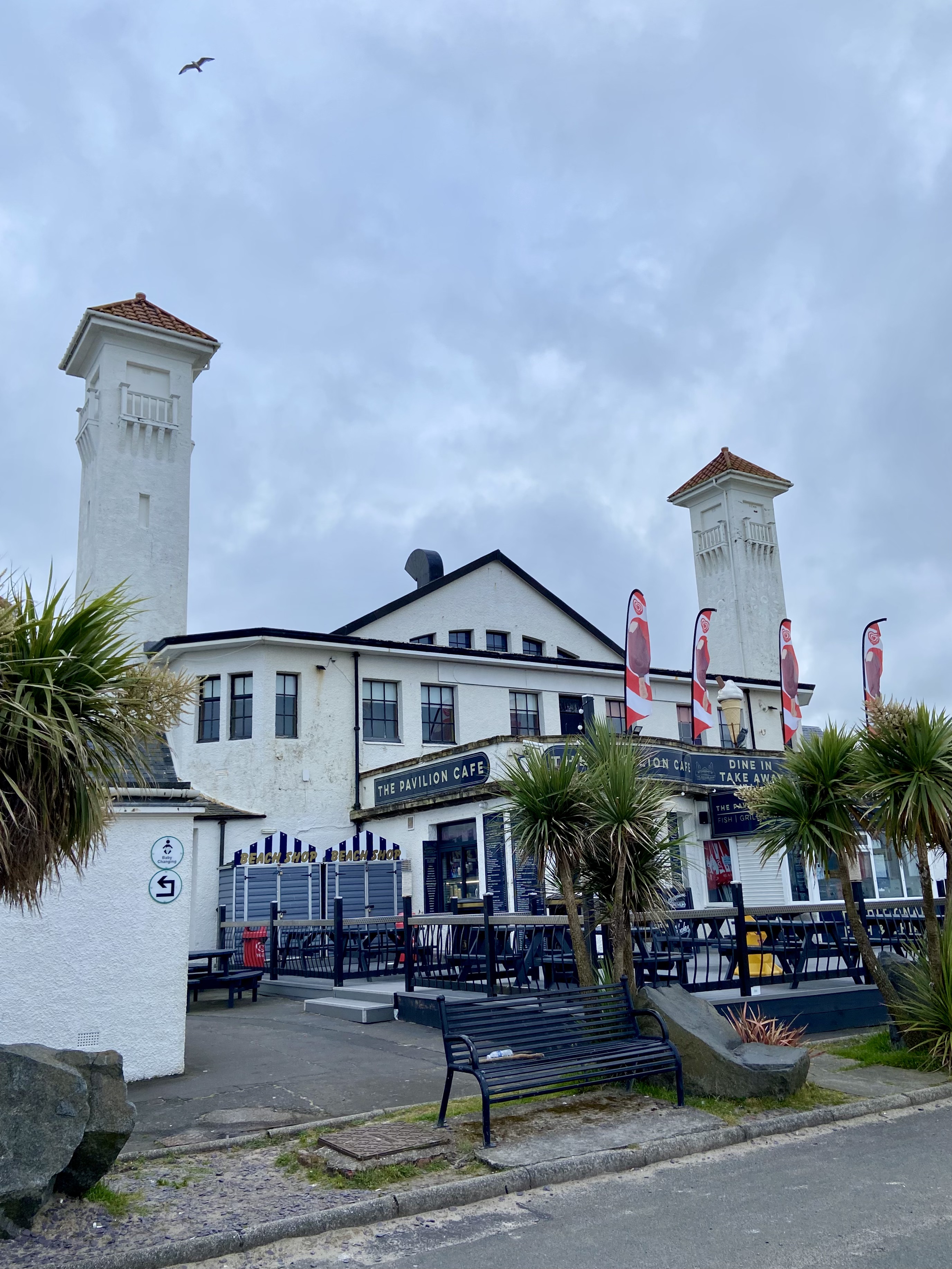
As I cleared the end of the houses, I saw a building that I knew, before I rounded the end of it to see the signs, that it would be called The Pavilion.
To my left, there was a huge swathe of flat green land with pathways crossing it. I thought of Triar and wished he was there.
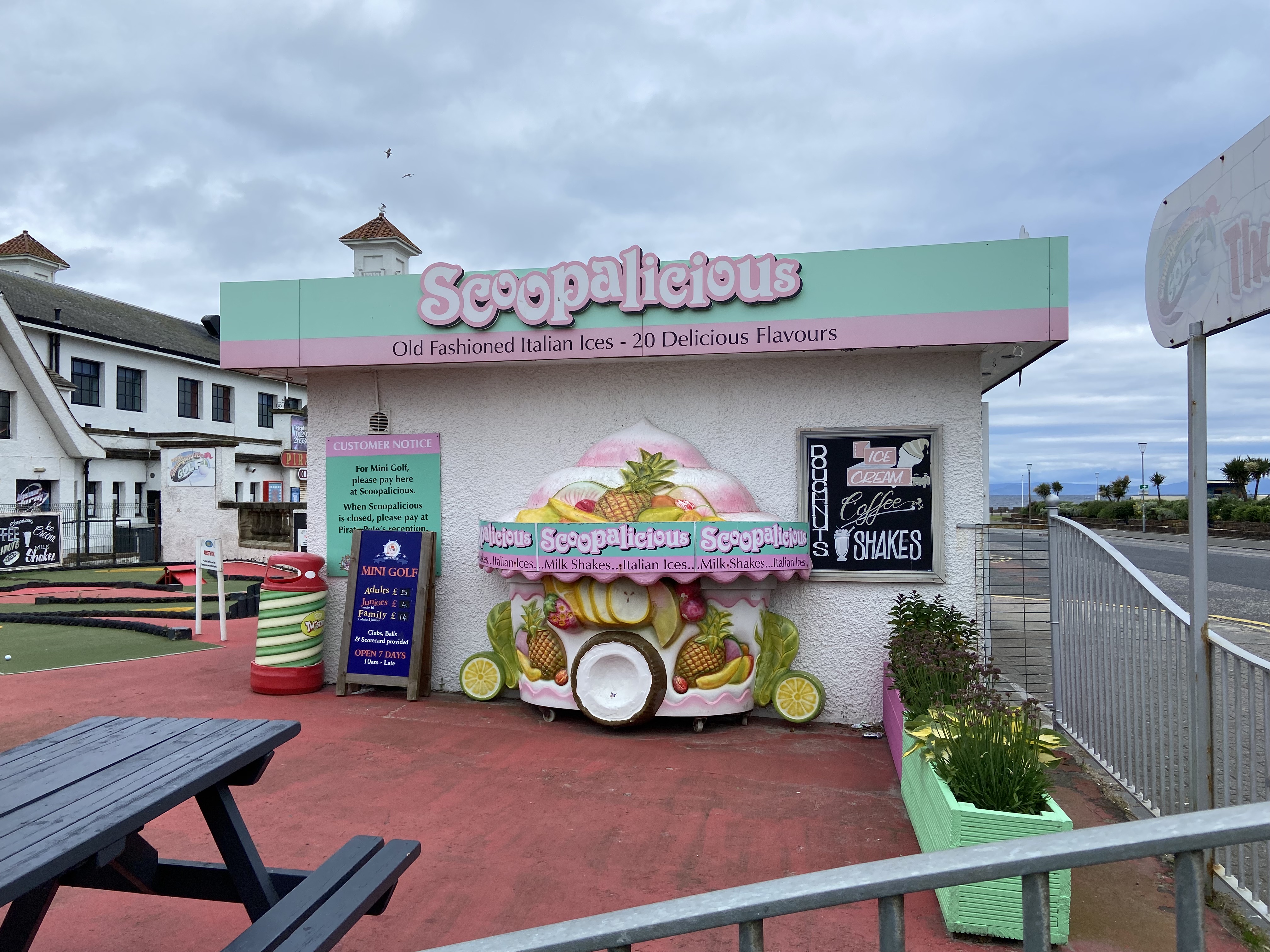
The Scoopalicious Ice Cream company was another nudging reminder of the golden age of Scottish seaside, west coast towns. An ice cream shop run by an Italian family was another staple in all the resorts that the people of Glasgow escaped to.
There was a pleasant sunken garden…
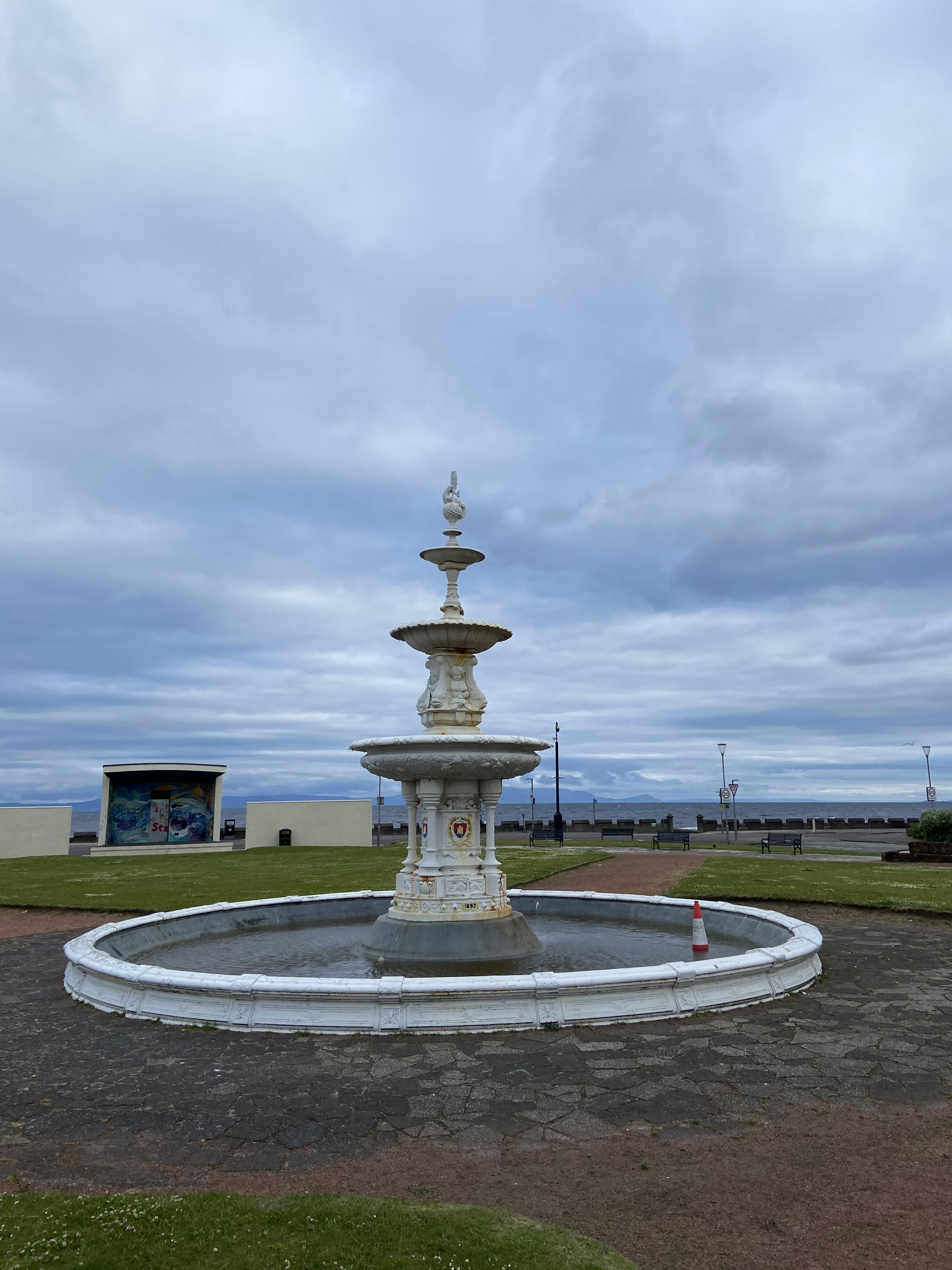
And a fountain, complete with a fairly traditional traffic cone.
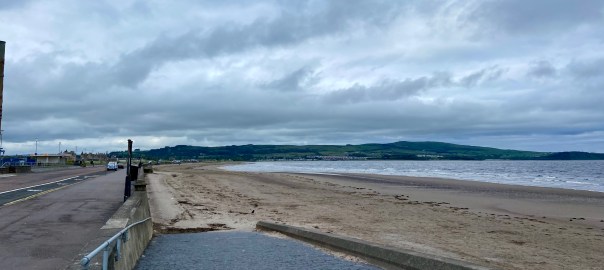
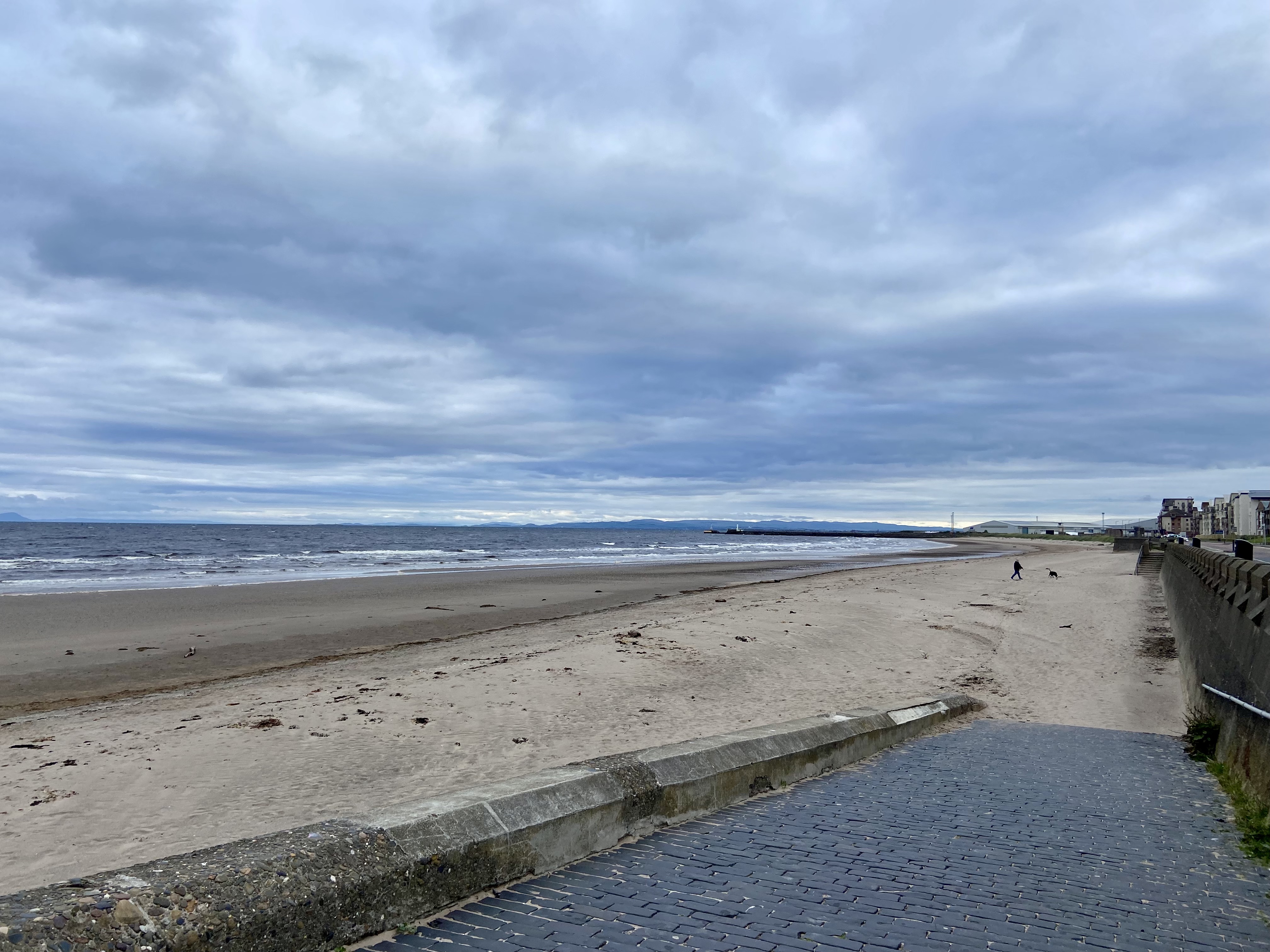
Though the sky was filled with clouds, the mountains of Arran were visible across the water of the wide bay as a reached the sea. To my left and right, there stretched a broad, sandy beach, and again, I found myself wishing Triar was here as he would love to run free across that vast expanse of sand.
I was tempted to venture down onto the sand, but time was limited. Turning back, I was unsurprised to see that The Pavilion was indeed called The Pavilion and was fronted with another southern, Scottish west coast tradition, some rather tired looking palm trees.
As I walked back up the road, I felt that odd sense of sadness and nostalgia such places bring me. Ayr and Largs were not part of my childhood, but many of those my age from Glasgow and other smaller west coast towns can remember visiting those places as children, when they were still popular holiday destinations. I found myself thinking I might come back sometime, for a weekend, and set Triar free on that beach to run.
The rest of my day was taken up with work. The welfare visit went well and I hope I left my colleague with a clearer view of how to carry out an inspection. Back in Dumfries, I have spent the rest of the week catching up with cases. I have written the first draft of a witness statement for a welfare case that might go to court and carried out a disease and cost risk assessment to allow one of my farmers with a TB breakdown to bring a new bull onto the farm.
We can’t go to Yorkshire this weekend as tomorrow, I will be working at the Highland Show. I spent yesterday reading the contingency plan for what we would do in the event of an outbreak of serious disease in the animals at the show. I understood the plans, but found myself hoping we wouldn’t have to implement them as it would be a huge undertaking, trying to sort animals, people and vehicles into groups that could leave and groups that couldn’t, with various stages in between involving gallons of disinfectant and chaotic queues.
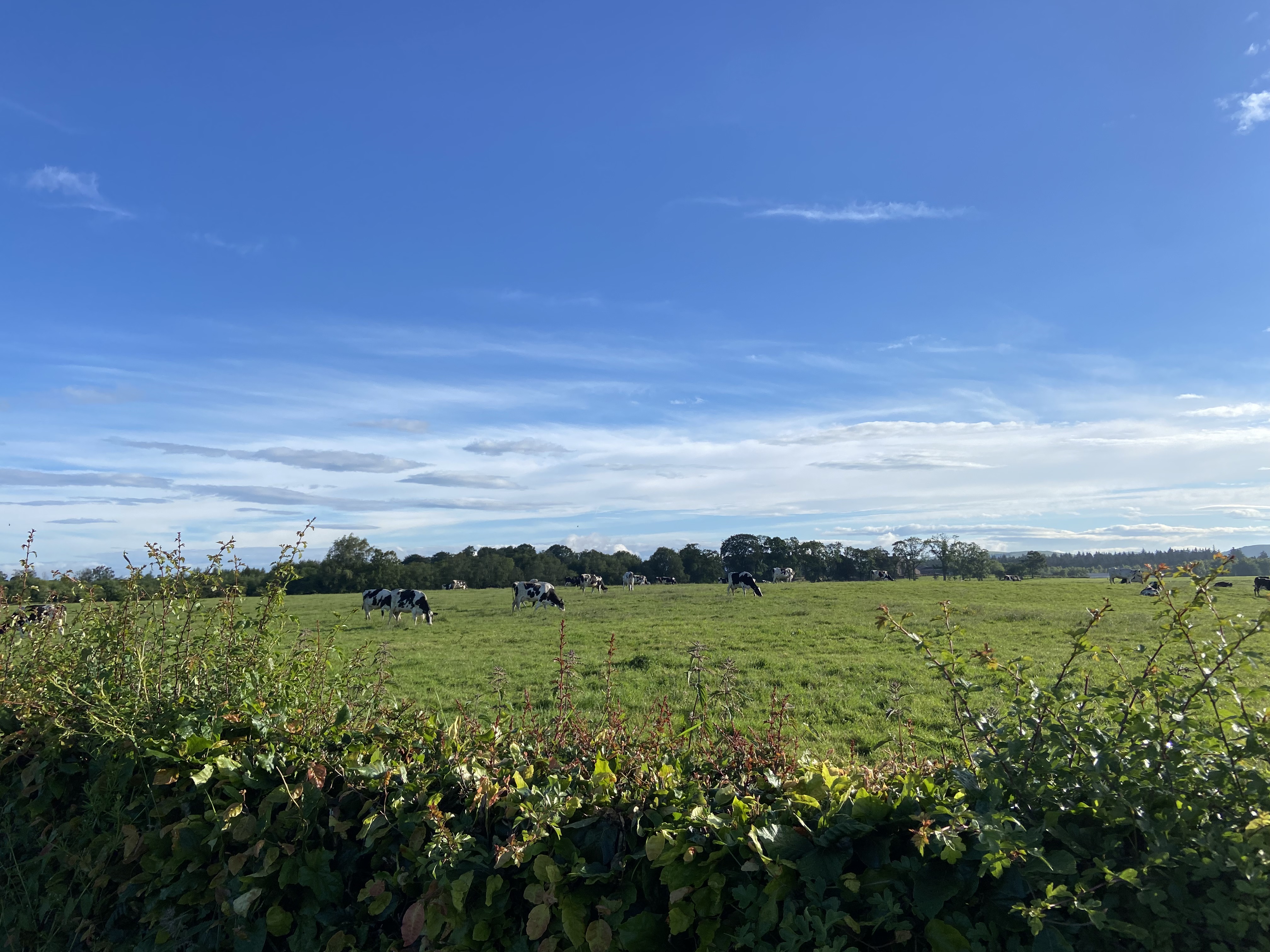
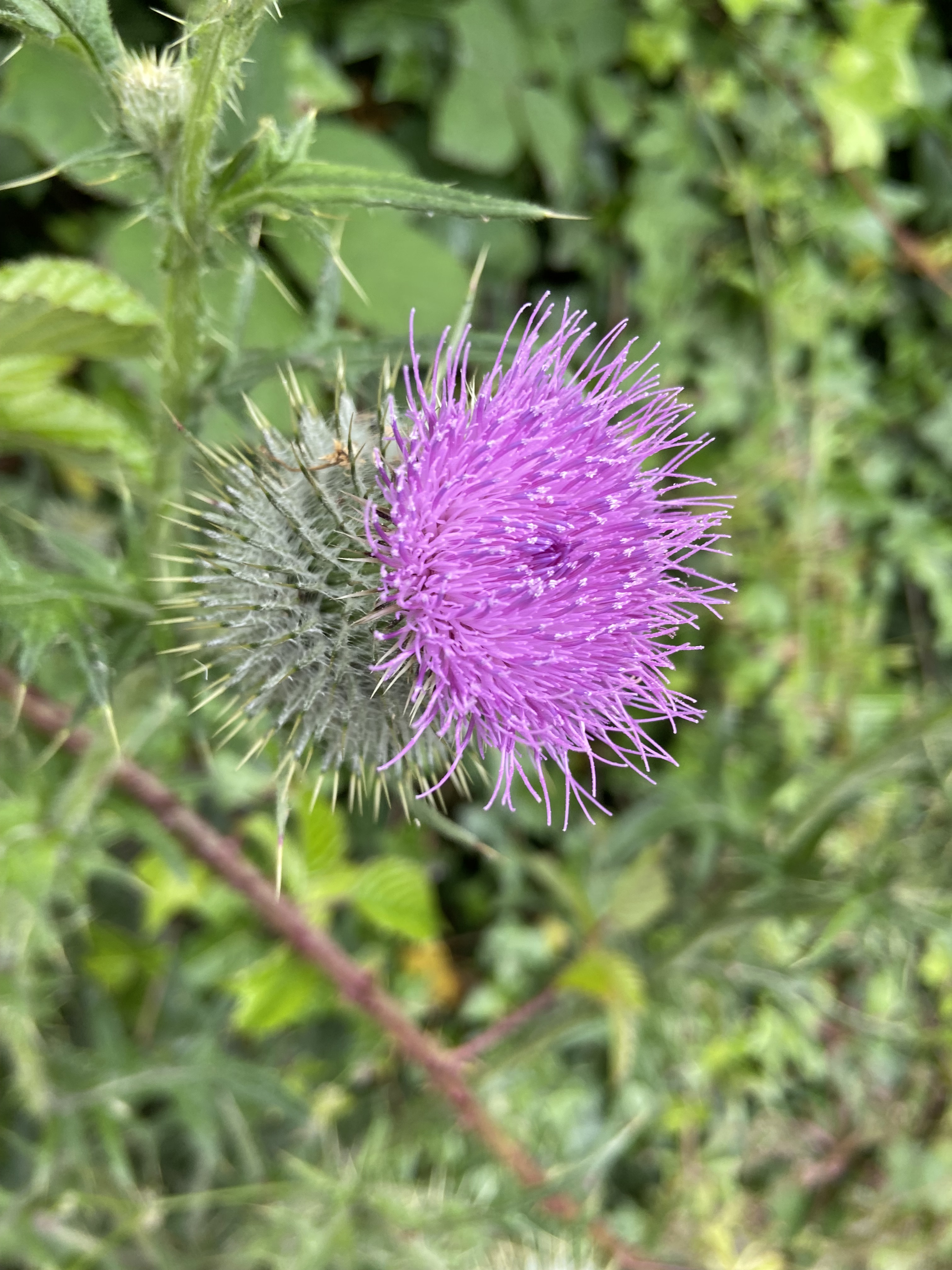
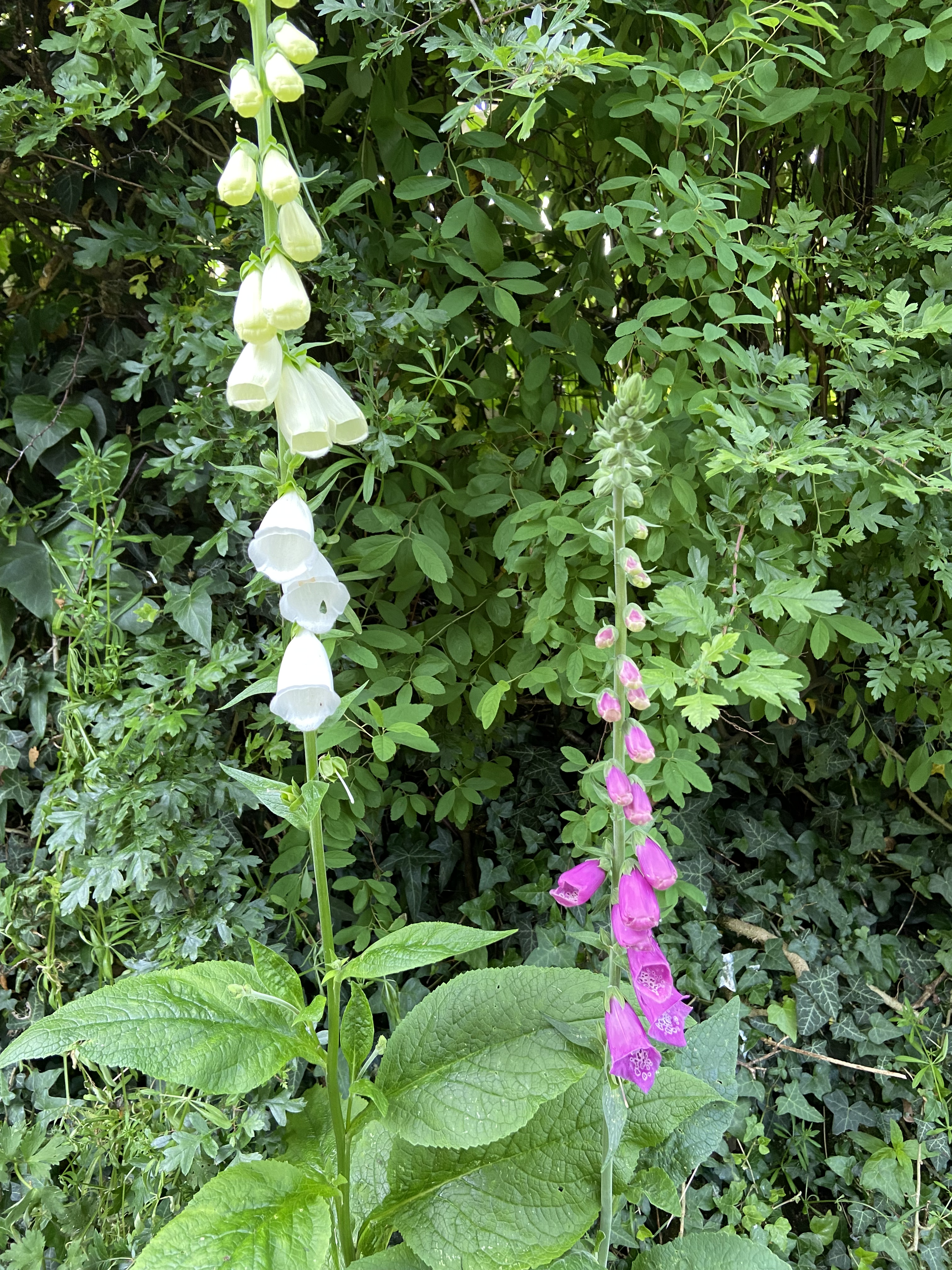
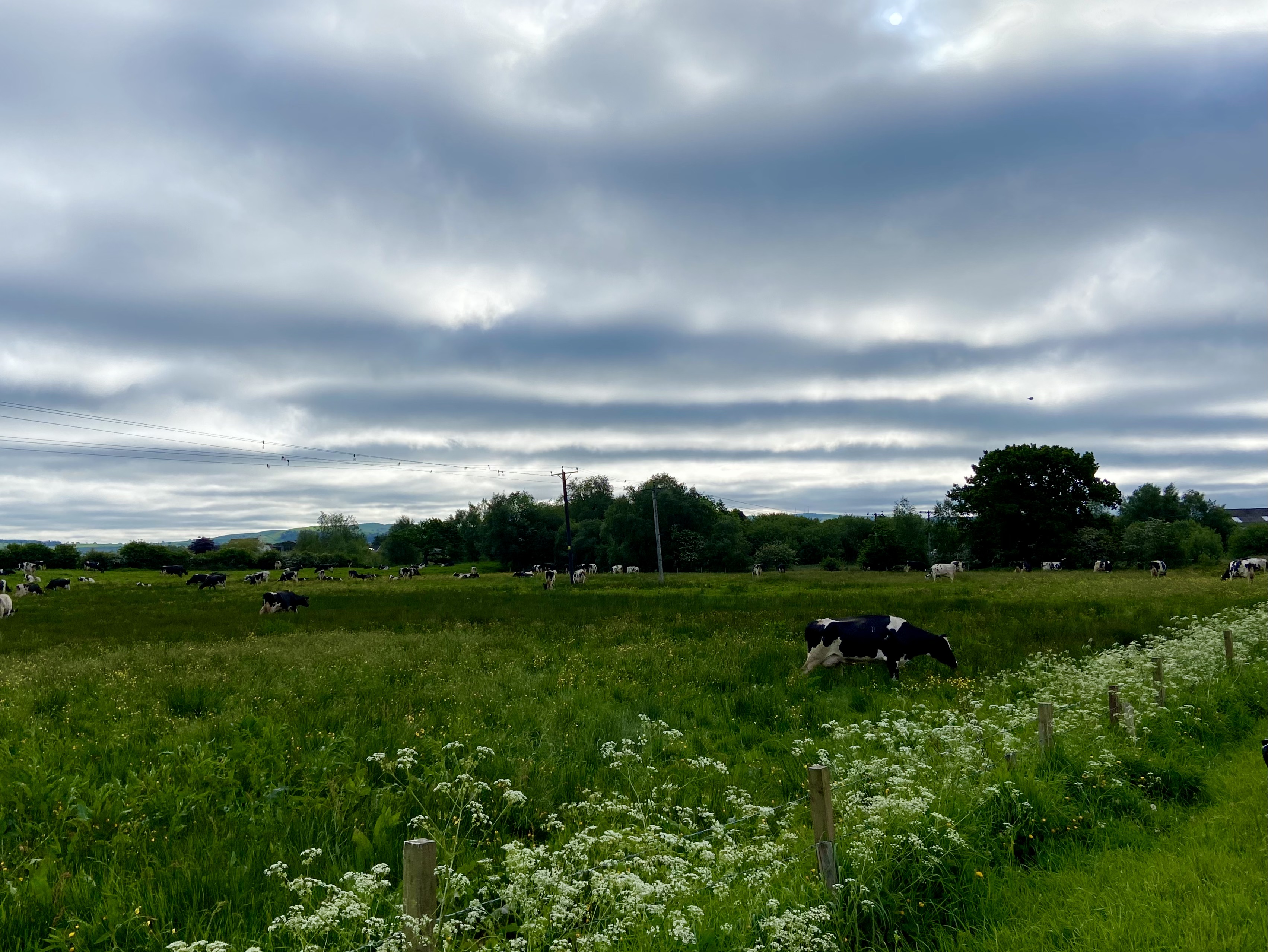
I will finish with some photos from Blackbird Lane. There are cows in the fields now and different wildflowers growing in the hedges. The hawthorn bushes have lost their spiky, white blossom and are beginning to form berries, that for now are a muted, brownish red, but will become bright and red as the autumn nears.
One of the things I enjoy about working as a government vet is travelling to different places. It hasn’t happened yet, but at some point, I will be sent to do detached duty, where I can be sent anywhere in the UK to deal with any emerging notifiable disease. Even in my region though, I get around a bit. On Monday, I am going to Ayr to accompany a colleague on a welfare inspection. She has only been out to one such inspection so far and I’ve already done my three, so hopefully I can help her to do a good job.
I’m also going to be one of APHA’s vets at the Royal Highland Show next weekend, which is exciting. If nothing happens, it’ll be a lovely day out. It’s a long time since I’ve been, but it was always an enjoyable day out. If something happens that I have to deal with, it will be… interesting. Imagine how the day would change if we discover one of the animals is showing signs of foot and mouth. There are contingency plans, which I should get next week. I will make myself familiar with them and keep my fingers crossed that the most exciting thing to happen will be visiting the freshly cooked doughnut stand.
Not that I will be doing that. As I mentioned last week, I have been signed up to a weight loss program called Second Nature by the NHS. So far, it’s been very good. Its focus is on changing habits and not on counting calories, which is appealing to me. I can’t get on board with weighing out food for the rest of my life. It relies on encouraging exercise, eating more vegetables and cutting down on carbs, without cutting them out altogether.
I was meant to do lots of meal planning this past week, but bought pick and mix salad every day from my local supermarket, which handily is a ten minute walk from my office. In the evenings, Andrew and I have been using a delivery service called Hello Fresh. Both Anna and Donna recommended it, so we decided to give it a go. Each week, we select four meal plans, they deliver ready prepared ingredients, and we cook the food together when I get home from work. It’s been quite easy to modify the Hello Fresh meals to fit the Second Nature recommendations, so it’s all been very easy and I love not having to decide what to eat while standing in the supermarket.
I also signed up to an online service called Borrow My Doggy and this week, for the first time, someone new took Triar out for a walk. It did make me realise that he’s not the easiest dog to handle. He’s never been placid – quite the opposite. Also, I’ve not taught him very good manners on the lead.
It went off fine though. I’m hoping to find someone who would be able to take him at short notice if I have to go away unexpectedly for work, but I’m going to have to engage more to do that. I’ve just booked a holiday in November, so perhaps I need to concentrate my efforts more. Triar has never been in a kennel and I’m not sure I really want him to start now.
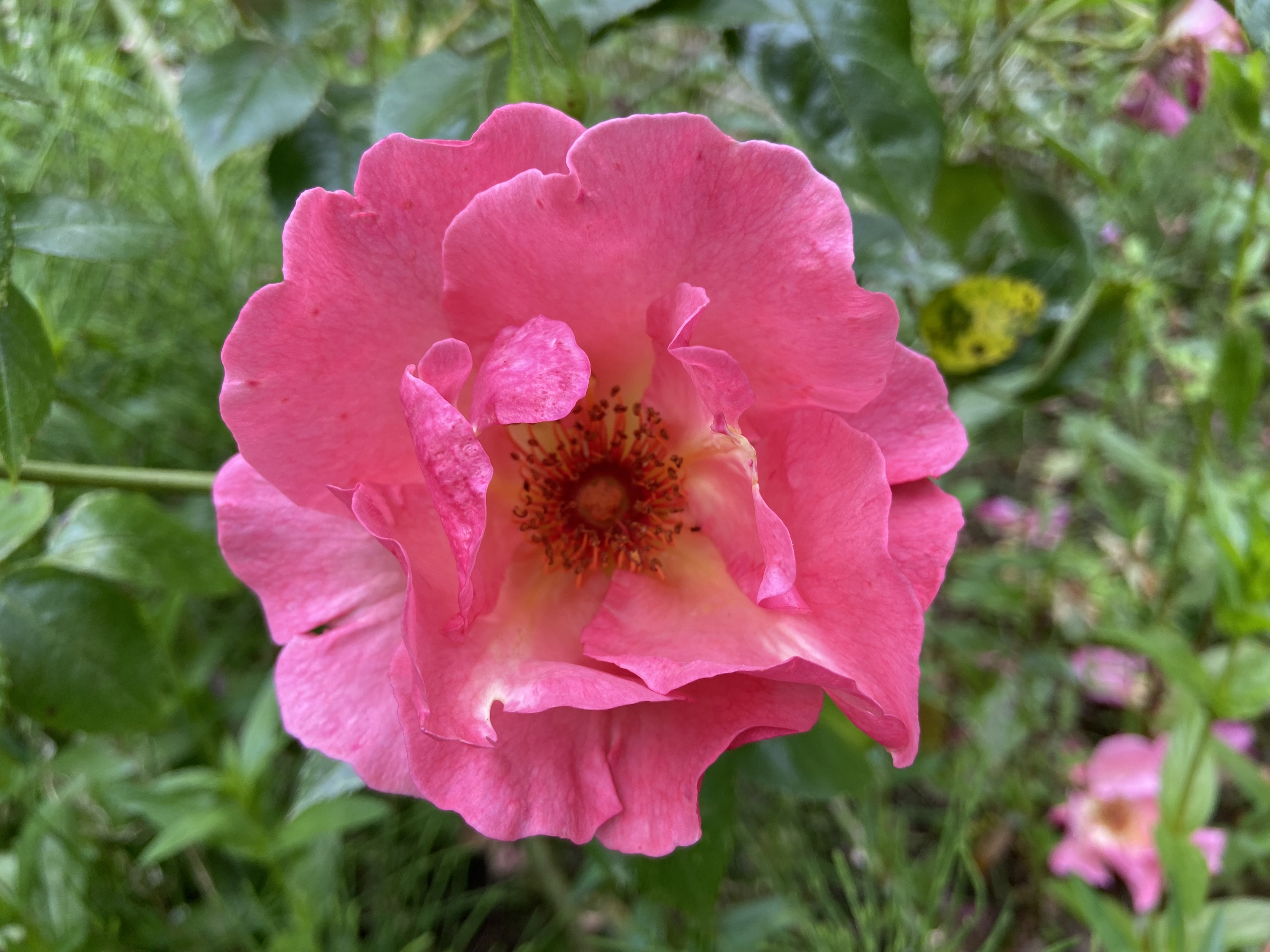
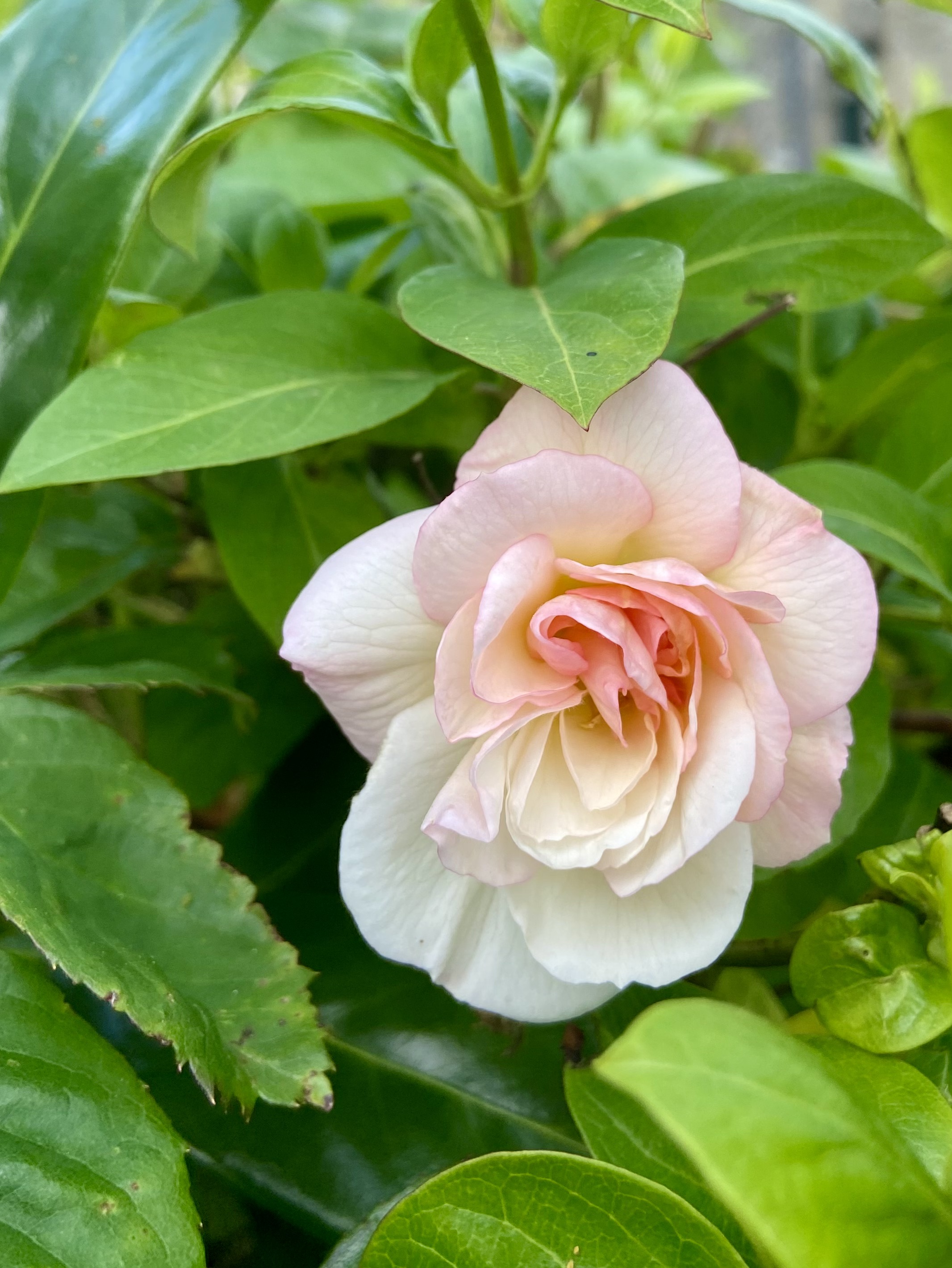
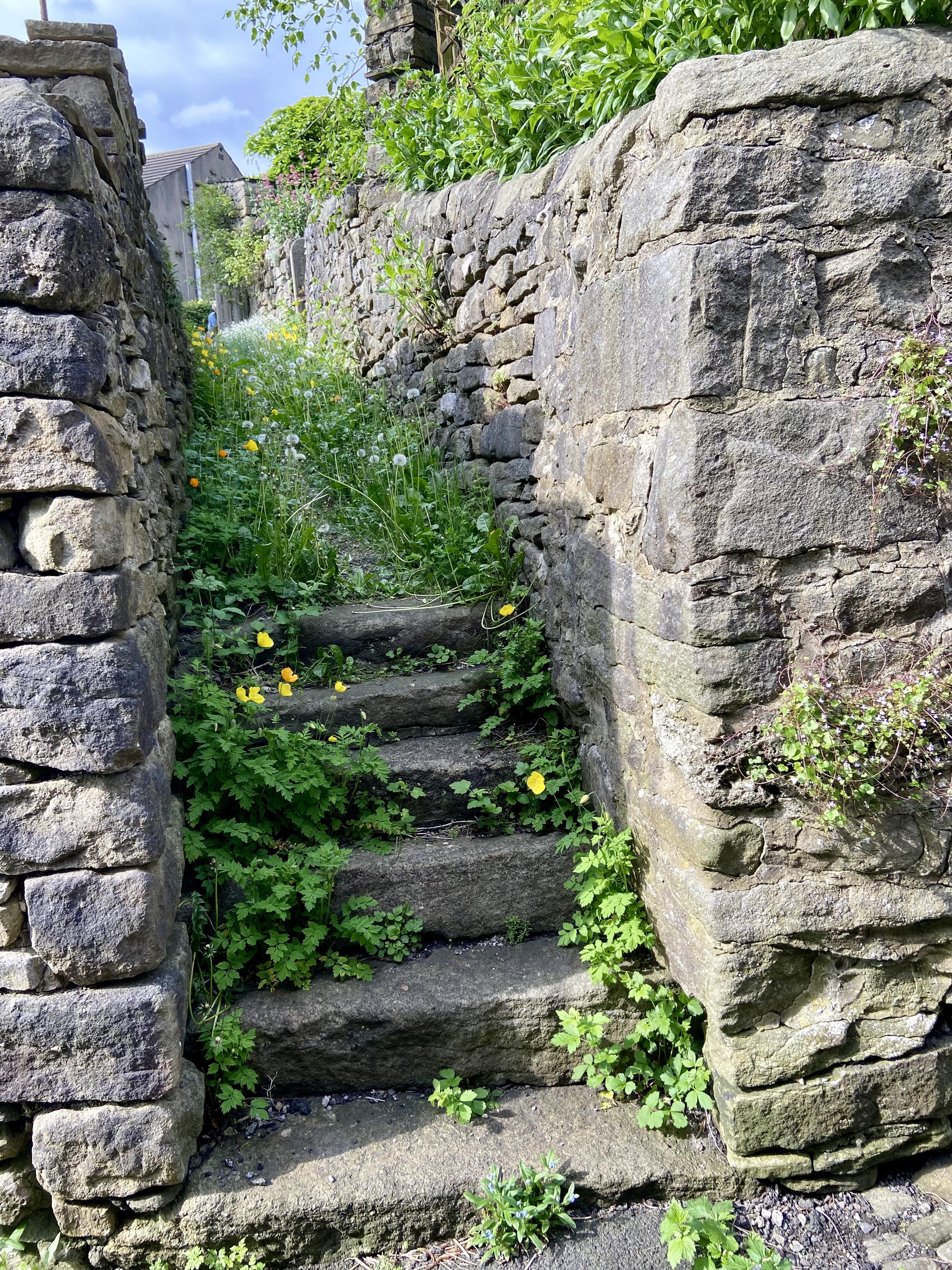
These are some photos from the bottom of my garden, which is running absolutely wild. The garden is full of insects and birds, which I love watching from my kitchen window. I made my way down the broken steps this week and was pleased to find that the overgrown roses have the same, wonderful scent that I remember from the roses in the garden when I was a child. So many these days seem not to have any aroma. “Stop and small the roses” is a good principle in life, I think. We’re down in Yorkshire for the weekend, so I’m going to start with a cup of coffee and take it from there. See you next week!
Andrew and I were in Yorkshire last weekend, which feels like a lifetime ago, but it was a lovely warm day on Saturday and we went on an ice cream hunt, which on the face of it wasn’t very successful. The firstly place we went to was styled like an American Diner, but it was so noisy and there were so many children leaping about that we turned and walked back out. The next place we tried, after consulting the Oracle of Google Maps was a small, village shop, but the only parking we found was in a field, which some canny farmer had mown and was charging £10 per day to enter.
We ended up doing a big circle back to Grassington, where fortunately, we bought a cone, but it wasn’t quite the ice-cream parlour experience we’d been searching for! Grassington is very pretty though and the drive back was too.
On Tuesday afternoon, I met up with some women I met on social media. We’d been chatting online and they were part of a women’s group I wanted to join, so we met for a coffee. I’ve been worried about Andrew being here for the summer with nothing to do, and to my delight, it turns out one of the women owns a small media company in the area. She does some work with young people, so later this morning, Andrew has been invited to a scriptwriting workshop in a cafe in town. He’s read the script they’ll be working on and has some ideas, so hopefully he will enjoy it. If Andrew wants to work in film, the most difficult part might well be finding a way in, so any experience and contacts he can form are a good thing.
I was through in Stranraer again this week, on one of my TB farm cases. We’re still waiting to see if TB is confirmed, but it’s looking more likely and so my Veterinary Advisor and I went to the farm to assess the boundaries and history of animal movements on and off the farm. If TB is confirmed, we will need to move quickly to start tracing where it might have come from and where it could have spread to, so now we are prepared to move to that stage without delay.
I was driving back to Dumfries, when I found myself in a queue of traffic. It’s a fairly difficult road for overtaking long queues, and this one was particularly frustrating as it was going slowly round the bends and speeding up for the straight parts. Seeing a sign for “Holy Cairn” I made a snap decision that this might be a good moment to go and explore one of the historic monuments that are scattered along the A75.
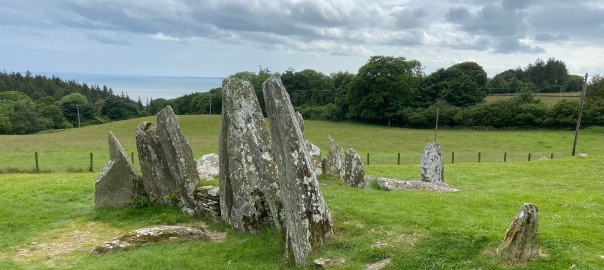
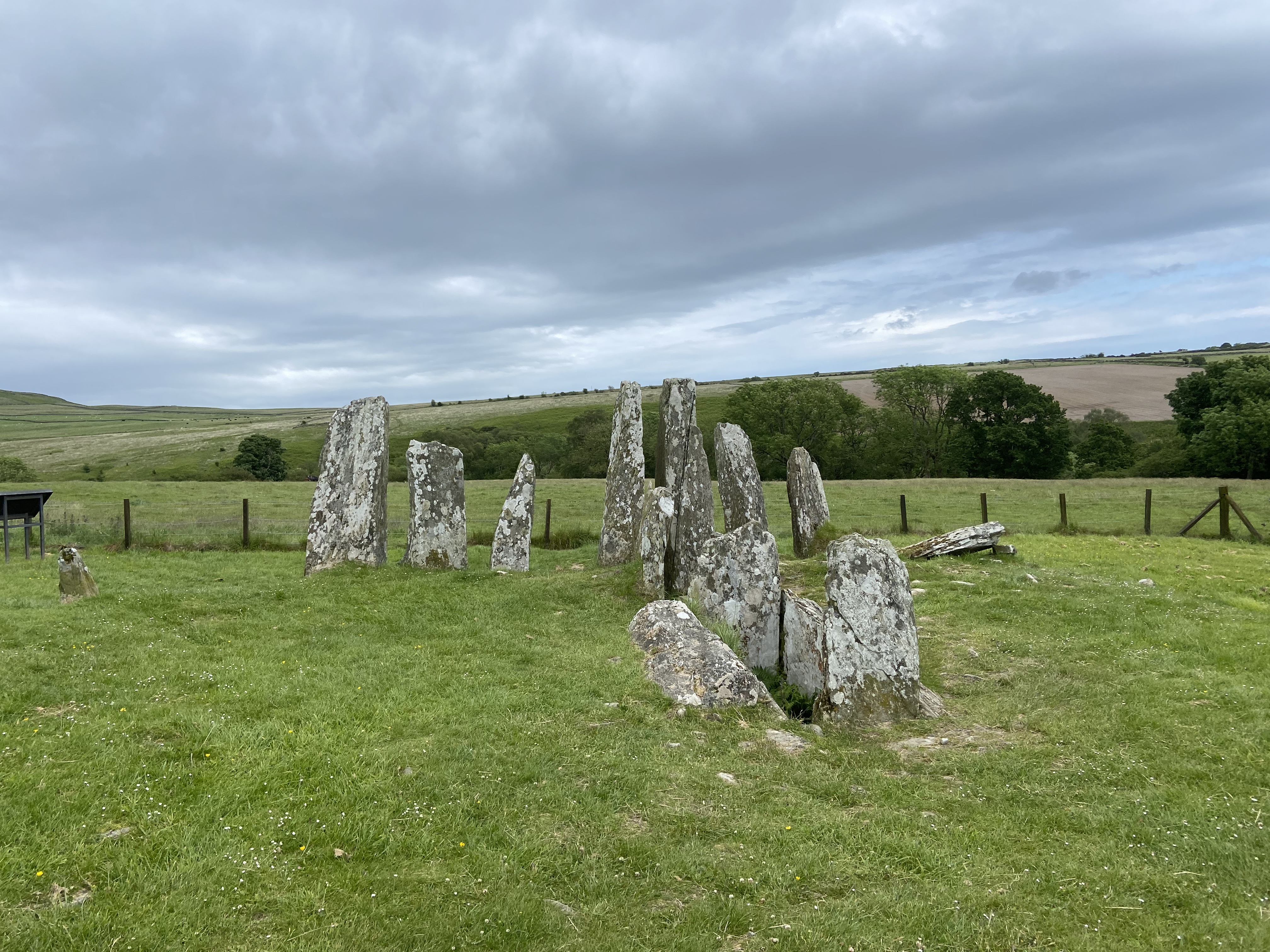
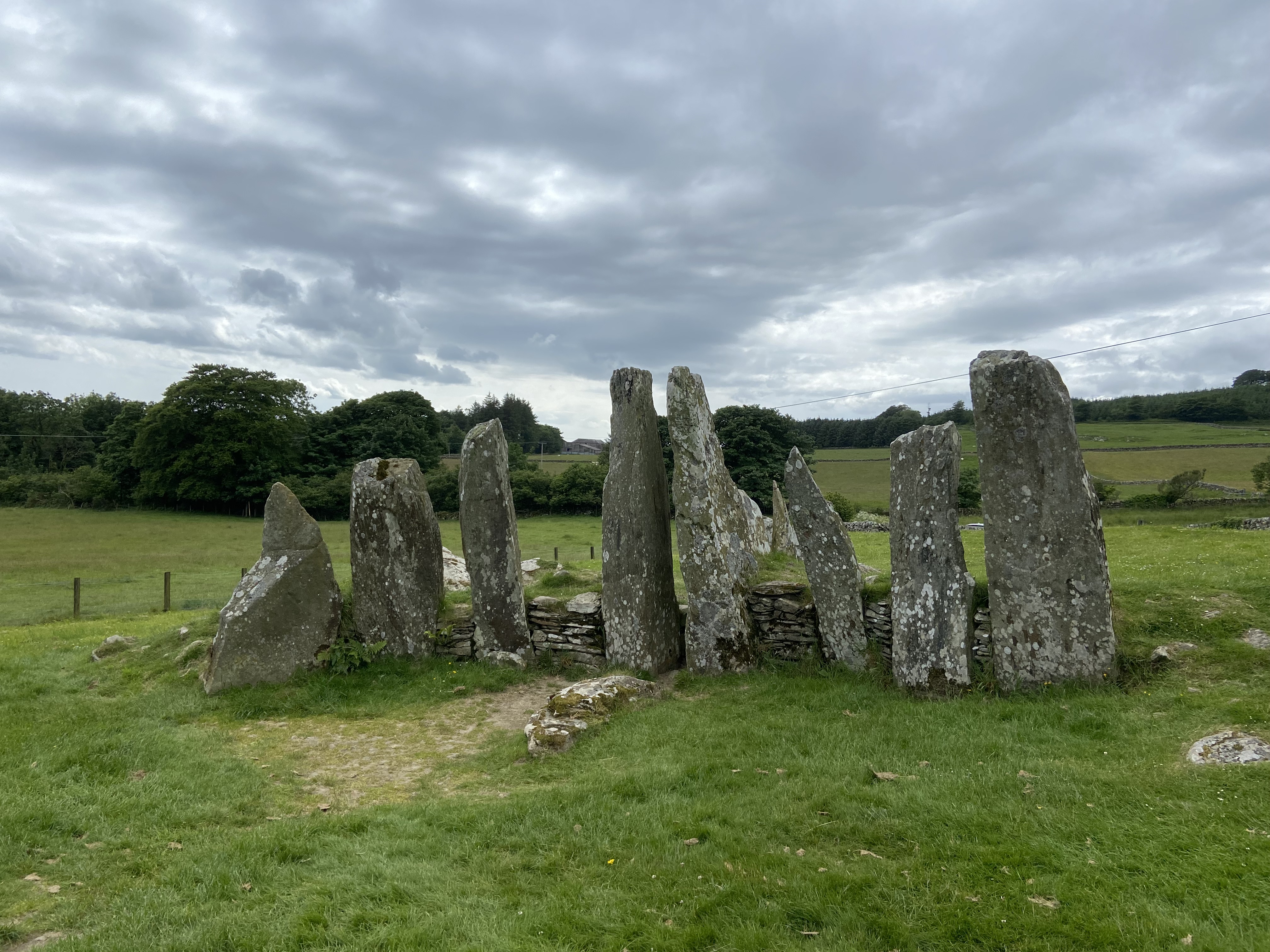
This is a hit and miss activity. Sometimes you can follow side roads for miles and find nothing, or you do arrive, only to find you’re looking at two stones on a hillside. This time, however, I found a good parking space and went through a small gate to find what looked initially like a circle of standing stones…
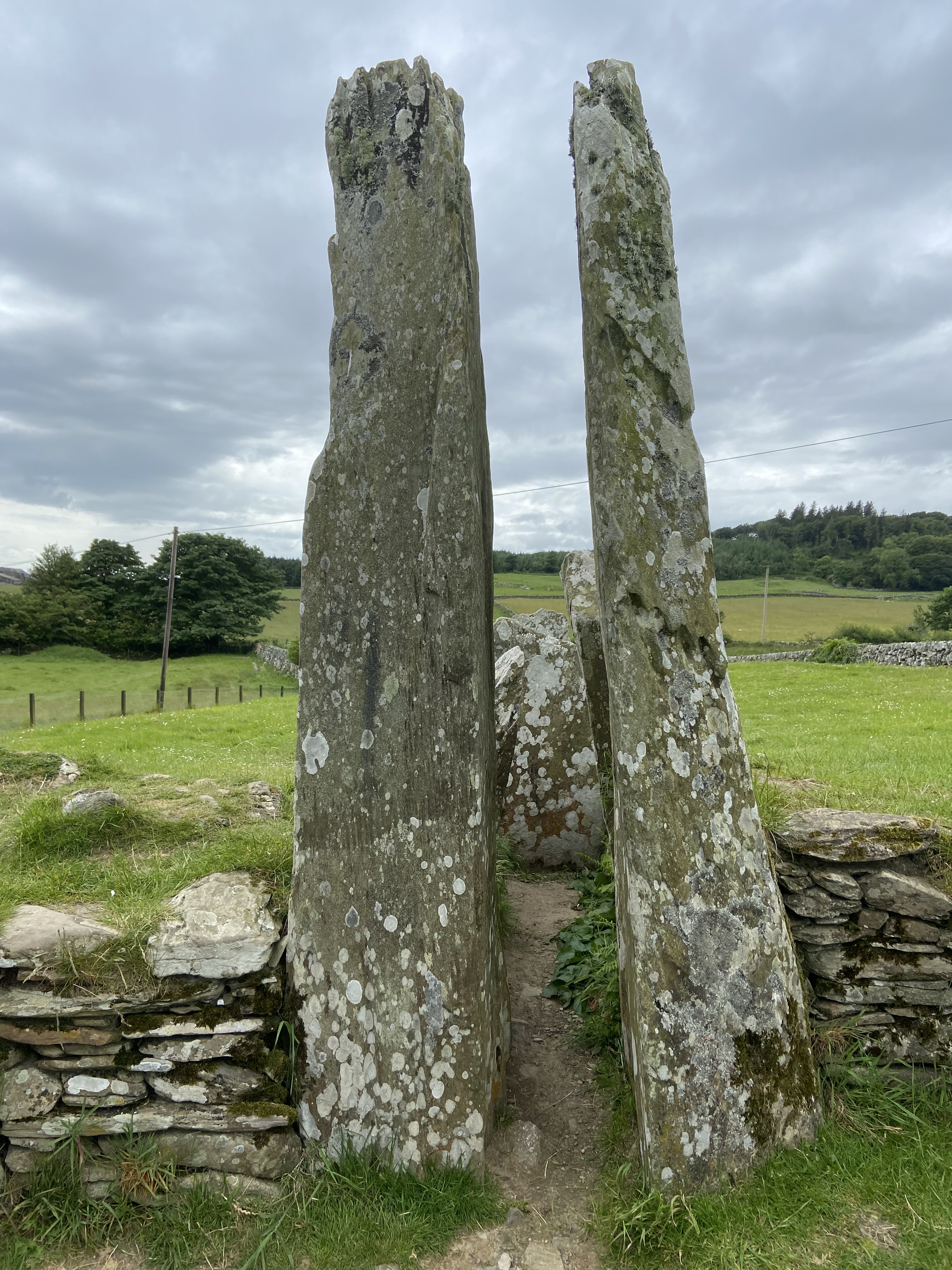
… but which on closer inspection, had been the spectacular entrance to a chambered cairn.
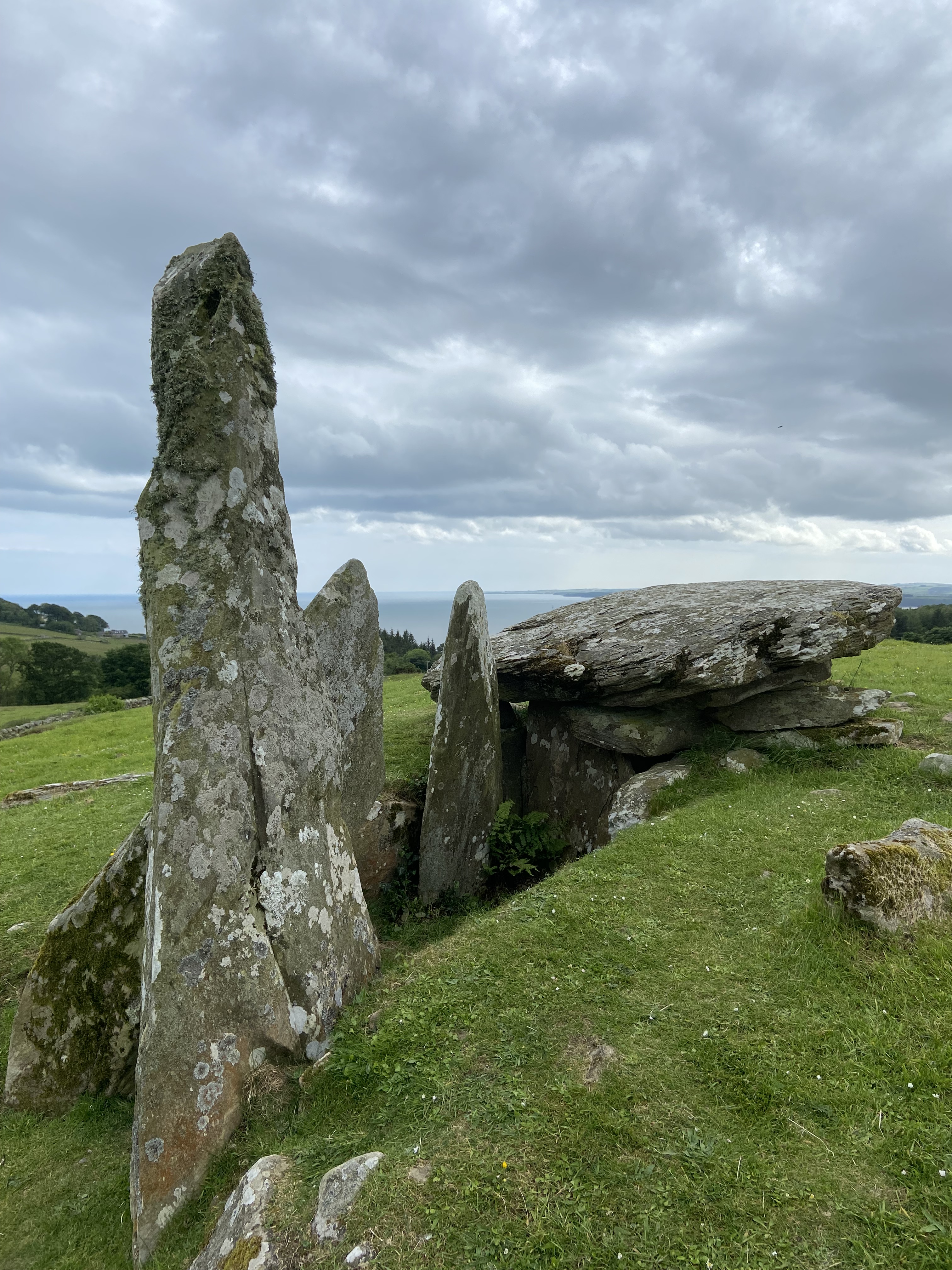
There was an information block in the corner of the enclosure, which told me a little bit about the cairn and its excavation, but the best thing it told me was that there was another cairn, further up the hill. I followed the track up, to find another, rather different cairn. The entrance to this one was a little less spectacular, but it was sited in such a beautiful place that I could only stand and gaze.
I read the information here too. Long-time readers might remember my trip to Stonehenge where I was amazed to discover that animal herders came down from Scotland to celebrate the winter solstice. I found myself wondering whether the people who used these cairns were among those who made that trip.
The plaque told me the cairns dated from 4000 BC. When I looked up Stonehenge later, it is thought to have been started in 3000BC, so these beautiful cairns were in use a thousand years before Stonehenge was begun. As ever, I felt the wonderful calm feeling that I always get when viewing something ancient or ageless. It’s always a wonderful reminder of how short and insignificant my life is in the grand scheme of things.
And finally, I had been gradually gaining weight, ever since I moved to Arctic Norway. Winter hibernation is all very well, but when winter lasts from October to May, it’s a large chunk of the year to take a break from walking, which was something I had done to keep myself healthy for years. I had hoped to break the bad habits when I came back to Scotland, but there is far too much temptation and I haven’t lost anything at all.
I asked at my GP clinic for help and they have signed me up for six months on an app called Second Nature. It tells me it’s going to help me break my bad habits and form some new and healthier ones, so I will be starting that on Monday. My main hope is to lose enough weight so I can start to go up hills again without creaking to a standstill within a few yards. There’s no weighing and measuring foods or calorie counting, which is good as I can never be bothered with all that. I’m also glad they didn’t offer me drugs. I want to improve my lifestyle, so hopefully this will help. I’ll let you know how it goes!
Of course, I am back in Scotland, and true to form, my colleagues in Stranraer, on hearing this, convinced me that it was essential that I should make the most of the last few days before I began, so this was the result. Have a good week all!
I wrote, last week, about my frustrations around the non payment of relocation expenses. They haven’t yet been paid, but K, my line manager, has told me that the big boss I sent my complaint to is now trying to get it paid from the local budget, rather than continuing to fight with DEFRA HR. I will try to keep you updated. Another colleague has suggested I contact the union I joined when I arrived, so that’s another step to consider, though I am hoping it will all be resolved soon and I won’t need to.
For most of this week, including last weekend and the (Scottish) Monday bank holiday, I have been working as duty vet. During the weekend, that meant the APHA national phone line went through to my work phone, or at least any and all calls from the north of Scotland came through to me. In the north, a second vet was taking phone calls for the south. Not many people call the emergency line (thank goodness). I had only a few calls on the Monday, most of which were easily dealt with. The counter to that is that, if something does come in that actually requires me to go out, it is likely to be something serious. Possible reasons would include a suspected outbreak of a notifiable disease (think bird flu or foot and mouth) or a welfare case that’s so bad it can’t wait.
Anyway at least, with mobile phones, being on call no longer requires me to stay in the house, glued to a landline, so Andrew and I decided on Saturday that it was time to go and explore our local ice cream emporium. There are a couple locally. Farmers in the UK have been encouraged to diversify and so we took a short drive out to Drummuir Farm where they make their own ice cream. There were loads of choices of flavour, from biscotti to battenberg, and Andrew and I ended up ordering two glorious fruity sundaes.
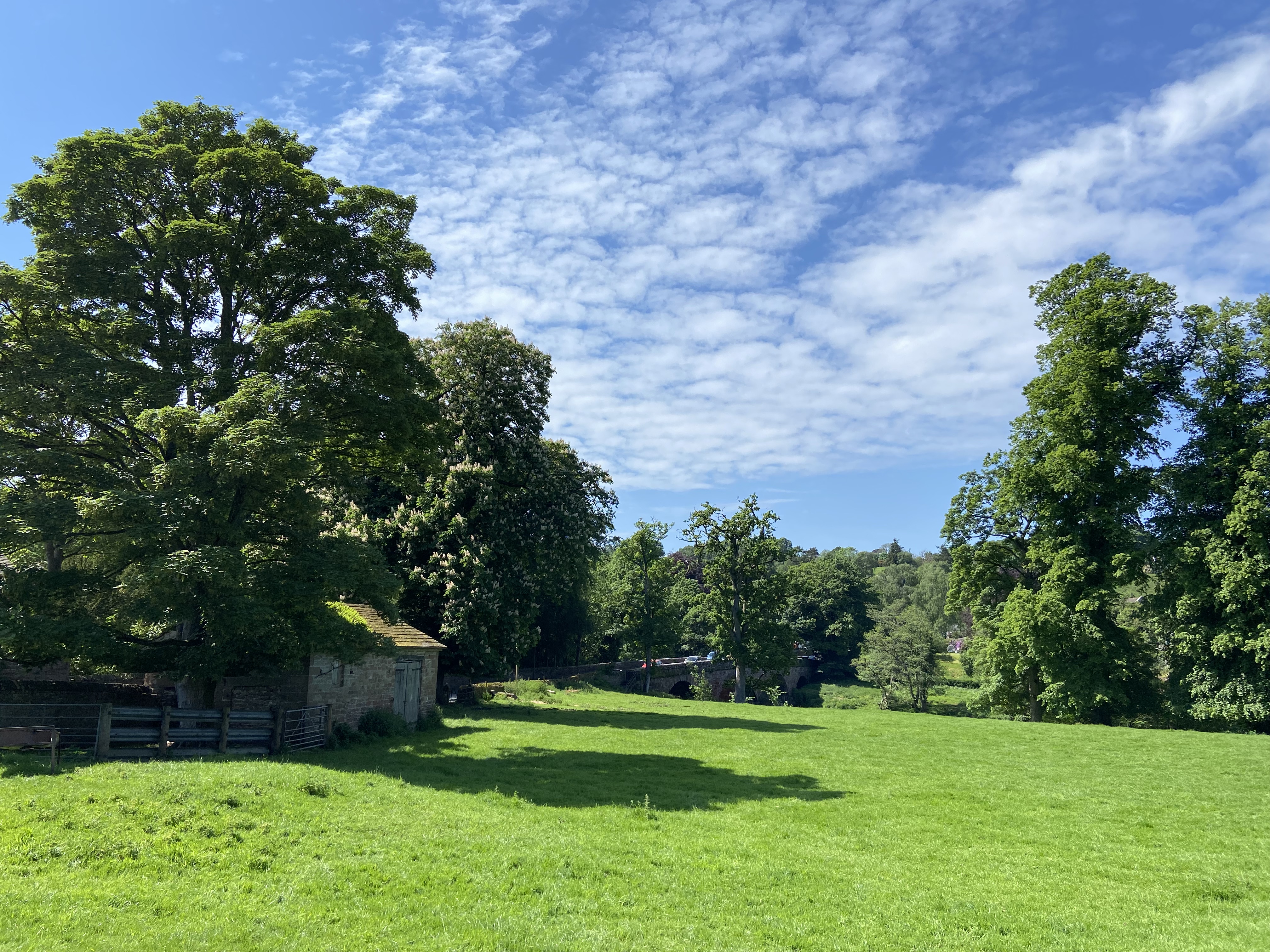
We went for a drive afterwards, including through Dalton, where I stopped to take a photo of this lovely pastoral scene.
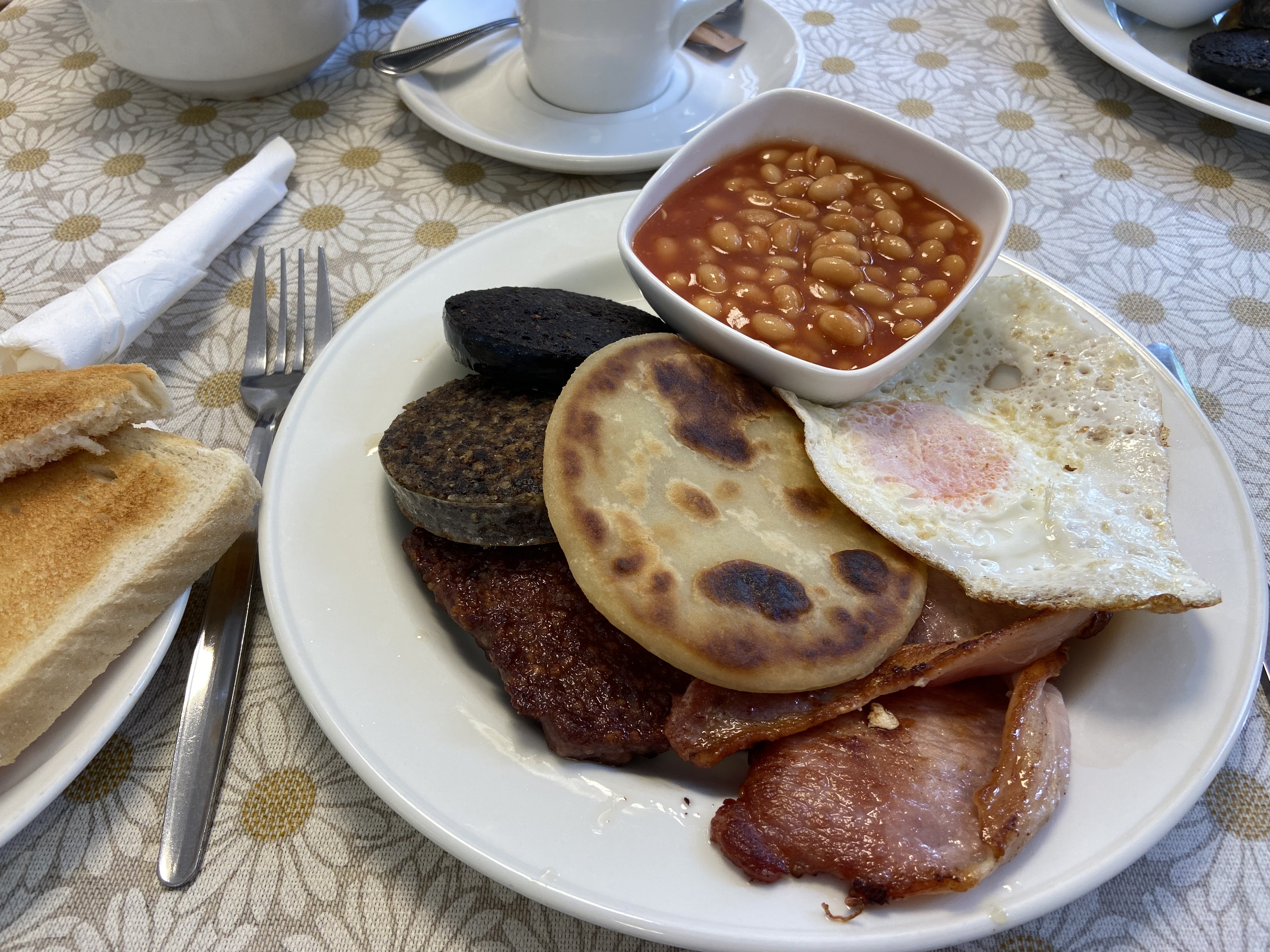
Andrew’s eye was caught at Drummuir by the full Scottish breakfast on the menu, so we returned on Sunday for an early lunch, which I can also recommend!
I don’t know if I’ve written much about being duty vet through the week before, but it’s not an enjoyable part of my job. Part of it is dealing with any queries that come in, either in emails or by phone. We don’t actually have to answer the phone during the day, but the calls are logged with a summary of the question, so then we have to look at what’s being asked and decide what action to take.
Some of these are quite straightforward. If a cow dies suddenly, the local private vet should go out and check whether it died of anthrax. An APHA vet has to okay that, then give them a reference number. This mostly involves form filling and it happens often enough that I already know the ropes.
But APHA covers a lot of ground on the animal front, so I might find myself with a query about an imported horse whose health certificate wasn’t filled in properly, or a farmer who failed to update his online records properly and has now found his farm is under TB restrictions as his test couldn’t be verified. These can take a lot of sorting out and require solid understanding of all the different computer systems we use. The main problem for me there, is that I don’t have a solid understanding of those systems yet.
Fortunately I have lovely colleagues, so I managed to get through, but ex policeman Tommy, who shares an office with me, saw that I was so stressed on Tuesday , Wednesday and Thursday that he arrived on Friday with a bottle of Malbec for me! Next week should be better, I think, My ongoing cases were mostly put on hold while I was on duty, so there’s a bit of catching up to do, but at least I have a better grasp of where I’m going with those.
In the meantime, I’ll finish with some pictures from my daily walks down Blackbird Lane. We’re into summertime now and my little green lane is full of colour and birdsong: a daily oasis to sooth my soul.
Andrew and I were out a fair bit last weekend. Waiting lists for dentists in Dumfries are so long that I have joined my mum’s dental practice in Addingham. Fortunately my teeth are fine and now also clean. Andrew came with me on Saturday when I saw the dental hygienist. We had lunch afterwards. In a deli on the edge of town.
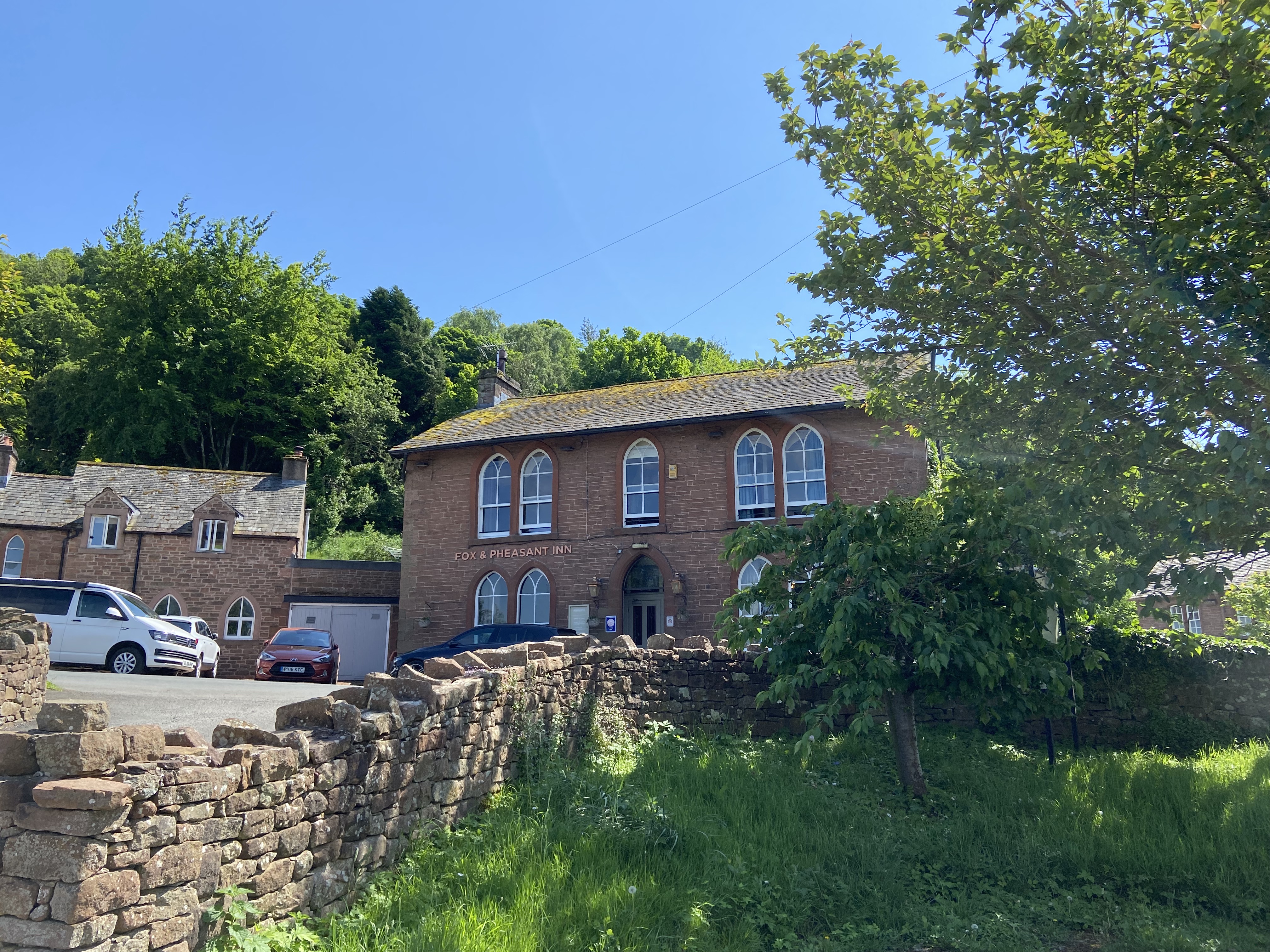
On Sunday, we drove back to Scotland. As it was a lovely day, and there was plenty of time, we decided not to head along the main road to the motorway, but instead drove up through the dales, to Hawes then Kirkby Stephen, then up the old A6 almost to Carlisle. I didn’t stop for many photos as it was warm and we had Triar in the car, but we did stop for lunch in an inn called the Fox and Pheasant at Armathwaite. The roast dinner sounded lovely, but more suited to a chilly autumn day, so we both had pizza, while Triar sat hopefully under the table.
I can’t say my first week back at work has been great. I did have a lovely day out, inspecting a very well-run farm with my colleague Lauren, but that was the only high point.
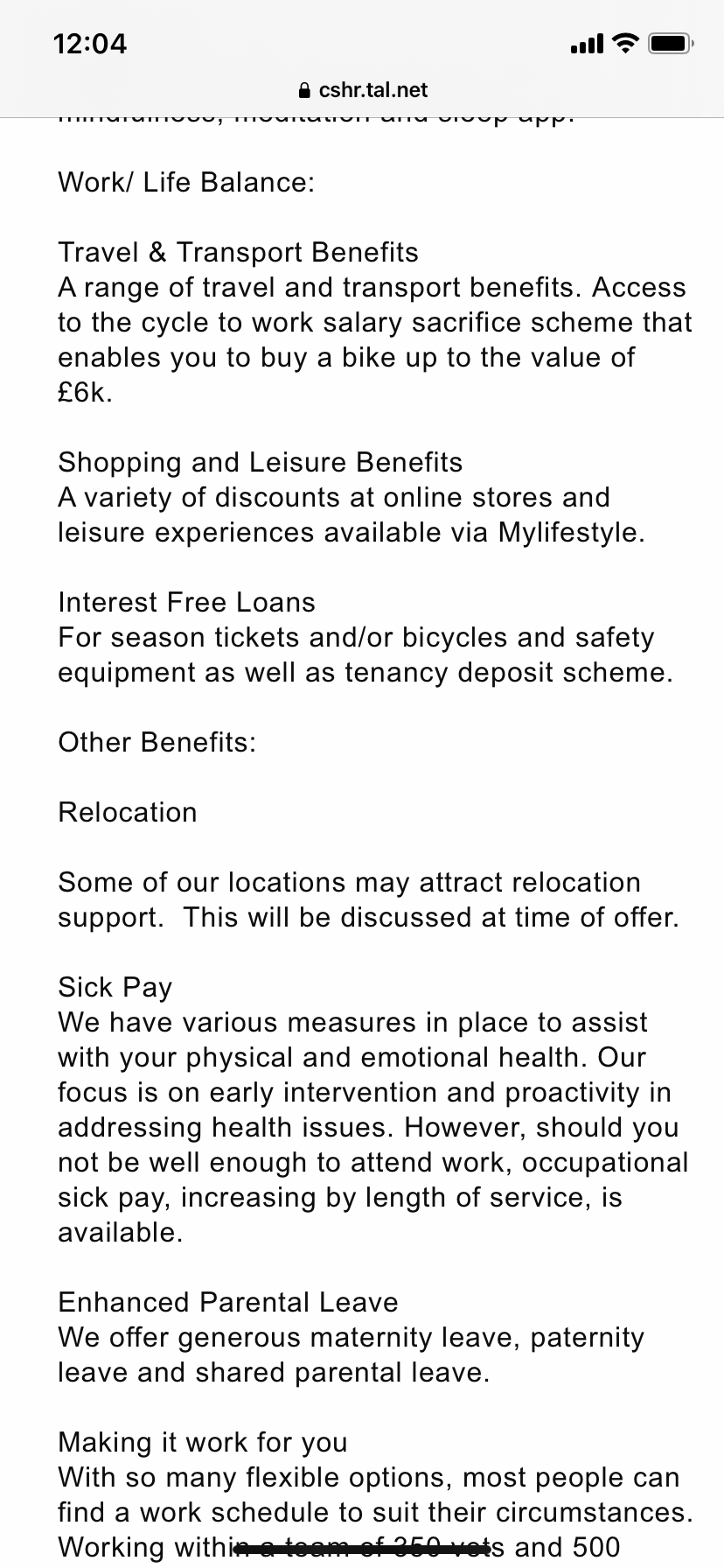
One of the most negative things was receiving an indirect message from the financial service that deals with wages and expenses. When I moved here from Norway, it inevitably cost a lot. One of my considerations when I saw the advert for this job was that they were offering “relocation support” for “some of our locations”. I was originally offered a post in Penrith, which would have been nearer my parents, but I asked about other posts where expenses might be available and I was told Dumfries was one of them.
The offer was made and I accepted, booked in my furniture removal (which in itself, cost more than the £5000 on offer) jumped through the hoop of getting several quotations from different removal companies (quite a faff in itself) and then made the long journey over.
There was an ongoing email discussion about the expenses and I was mildly suspicious when nobody seemed to know exactly how I would go about making the claim. The expenses information I was sent was ten years old, but I kept hoping those in contact with me would be able to find someone who knew how to do it.
That’s often the way in the civil service. There are many different functions and often, it’s about finding the right person, but even when I was in post and began to make the claim, it remained unclear. The form was off putting. It was obviously designed for those who already worked in the civil service and were being compulsorily relocated. Nonetheless, I was assured it was the correct form, so I filled it in as best I could, gathered all the paperwork and sent it to my manager, who sent it onwards to be paid.
That was in January and I have been waiting since. During that time, I have bought a house, thus tying myself down. My manager has been trying to chase it up, but I confess, with my cynical mind, I was wondering whether someone, somewhere, was going to try to weasel their way out of paying me, and the message I received on Monday (directed to my line manager, but sent on for info) made it clear I was right.
It stated that they had been delayed as they were investigating my claim. It went on to say that, as a new entrant, I was ineligible for relocation expenses. It would have had to be explicitly mentioned in the original advertisement, and that they hadn’t been able to find any reference to it. They realised that “Sarah will be disappointed” but there was really nothing they could do.
Reader, I was not disappointed. As any normal human being would predict, I was angry. There is an ongoing problem in the civil service in that everything has been cut to the bone and many of the benefits of working for the service have been slashed away. As I said, when I filled in the form, it was obvious there was no longer provision for relocation for new entrants, however by then, I was already in post and all the expenses incurred.
Back in April, when I was waiting for interview, I realized the advertisement had been taken down. I wanted to make sure I had all the information, so I dug back through a government portal and found it. I took screenshots to make sure I didn’t lose the information while I might still need it. Luckily, I hadn’t deleted it.
Admittedly it uses the word “support” and not “expenses” but I think you will agree, there is no mention made of this not being available to new starters. I was told at the interview that £5000 should be available and that was confirmed in various e-mails afterwards.
Underneath the anger though, what I feel is sad. There are a few people in my part of the civil service who’ve been here a long time and it’s obvious there used to be a lot of benefits and good things that have been taken away. Now there’s a never ending mill of trying to attract new staff, then losing them as demoralization sets in, or they rush for promotion as that is the only way to get a raise, since the wage bands and incremental raises have been removed.
I have been here six months and though I can see there are parts of the job I enjoy, I have half an eye on the job market, looking for other opportunities. Given how much money the civil service has already spent on the process of getting me on board, and given that I have hit the ground running and already am managing a significant workload, it seems very shortsighted to be messing me around like this. Anyway, I have sent my complaint right to the top of my section and we will see where it goes. In the meantime, if anyone knows of any good jobs in Dumfries, I’m all ears!
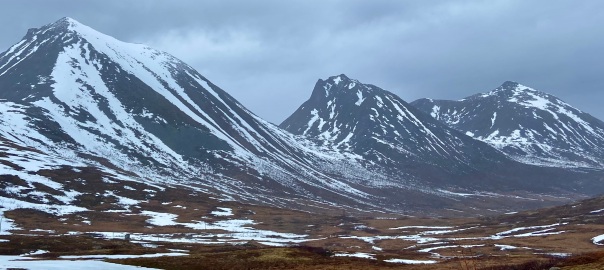
I spent the first part of this week in Tromsø with John and his girlfriend Yoana. Although the weather was much duller than it was in Stavanger and Sørreisa, we still managed a drive out onto Kvaløya, which lies on the seaward side of Tromsø, over one of the arching, concrete bridges that are typical of the area. The sea was blue-grey under a sullen sky, with patches of turquoise closer to the sandy beaches, scattered along the rocky coastline.
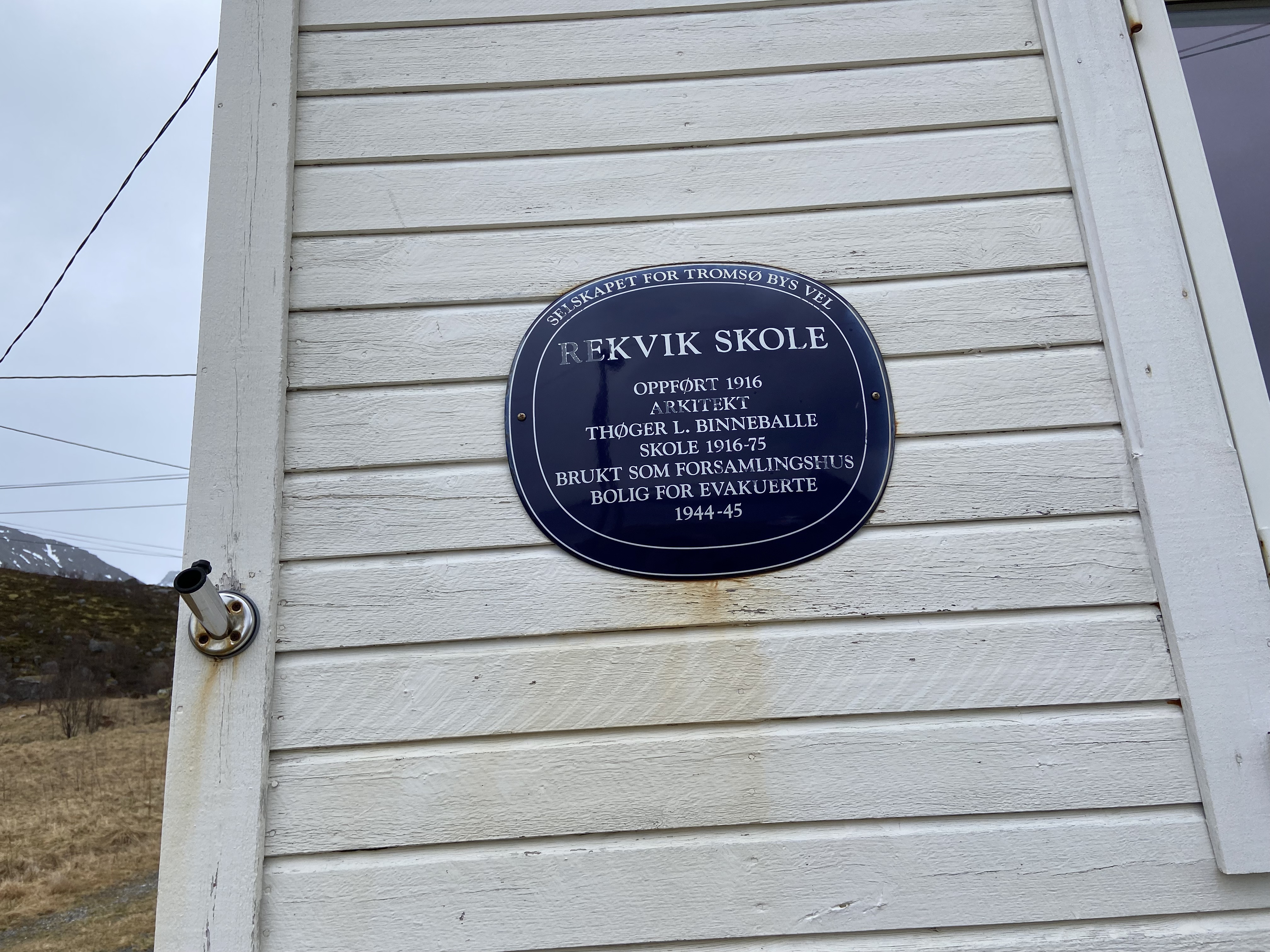
This was an old schoolhouse in the village of Rekvik. The blue plaque says it was used as a school from 1916 to 1975, and it was used as community housing for evacuees in 1944-45.
And of course, a bit of local wildlife…
John, Yoana and I went out for lunch in a grill restaurant near the hurtigboat harbour in Tromsø on my last day. As with most meals, especially in the more northern parts of Norway, it was very meat-centric but delicious nonetheless.
I flew back to the UK on Wednesday and am spending the last few days of my holiday in the beautiful Yorkshire Dales. I have been madly taking photos because there is so much colour here. I hope you enjoy the contrast between the wild and austere Norwegian landscape and the cosiness of the Dales!
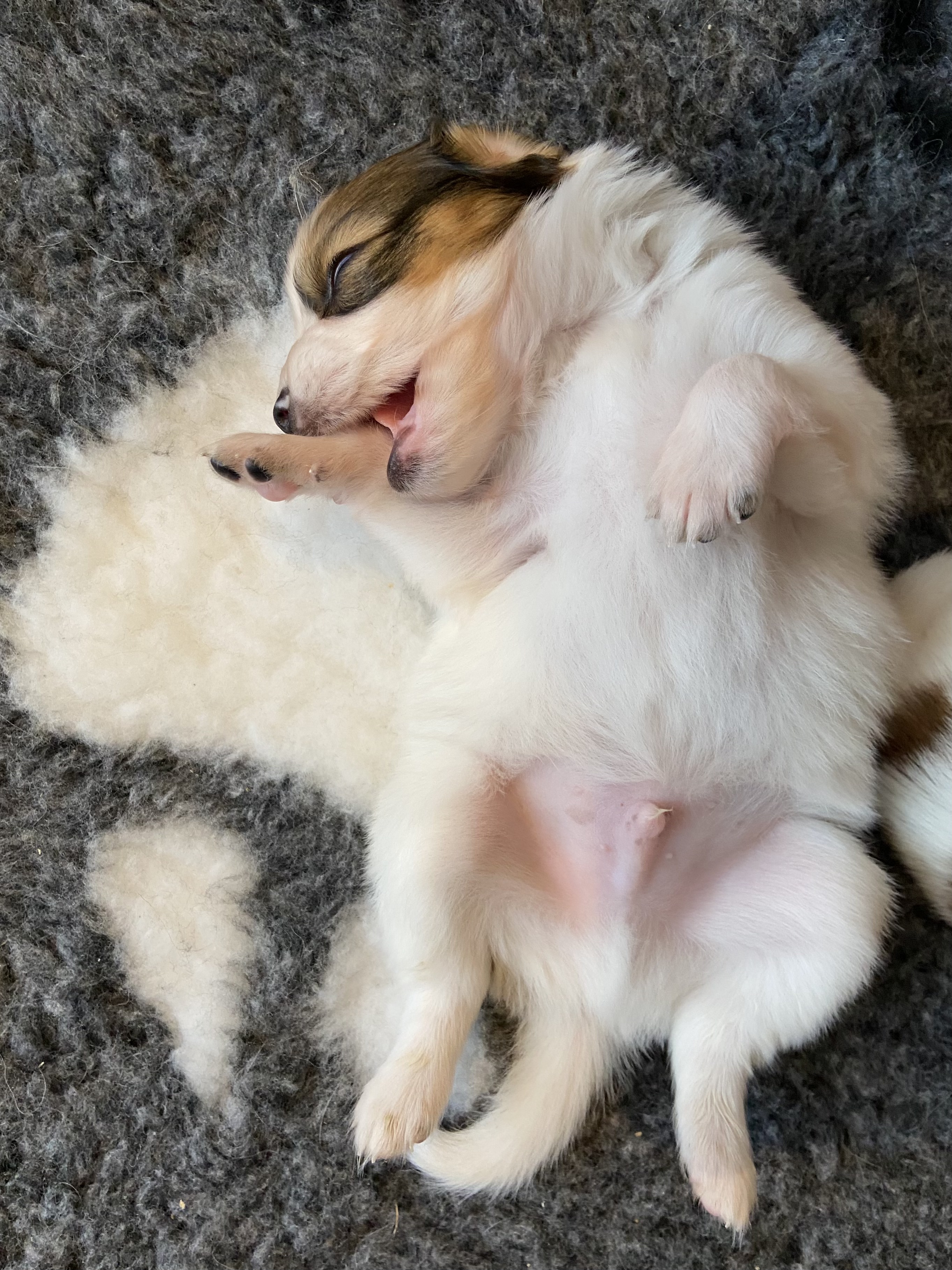
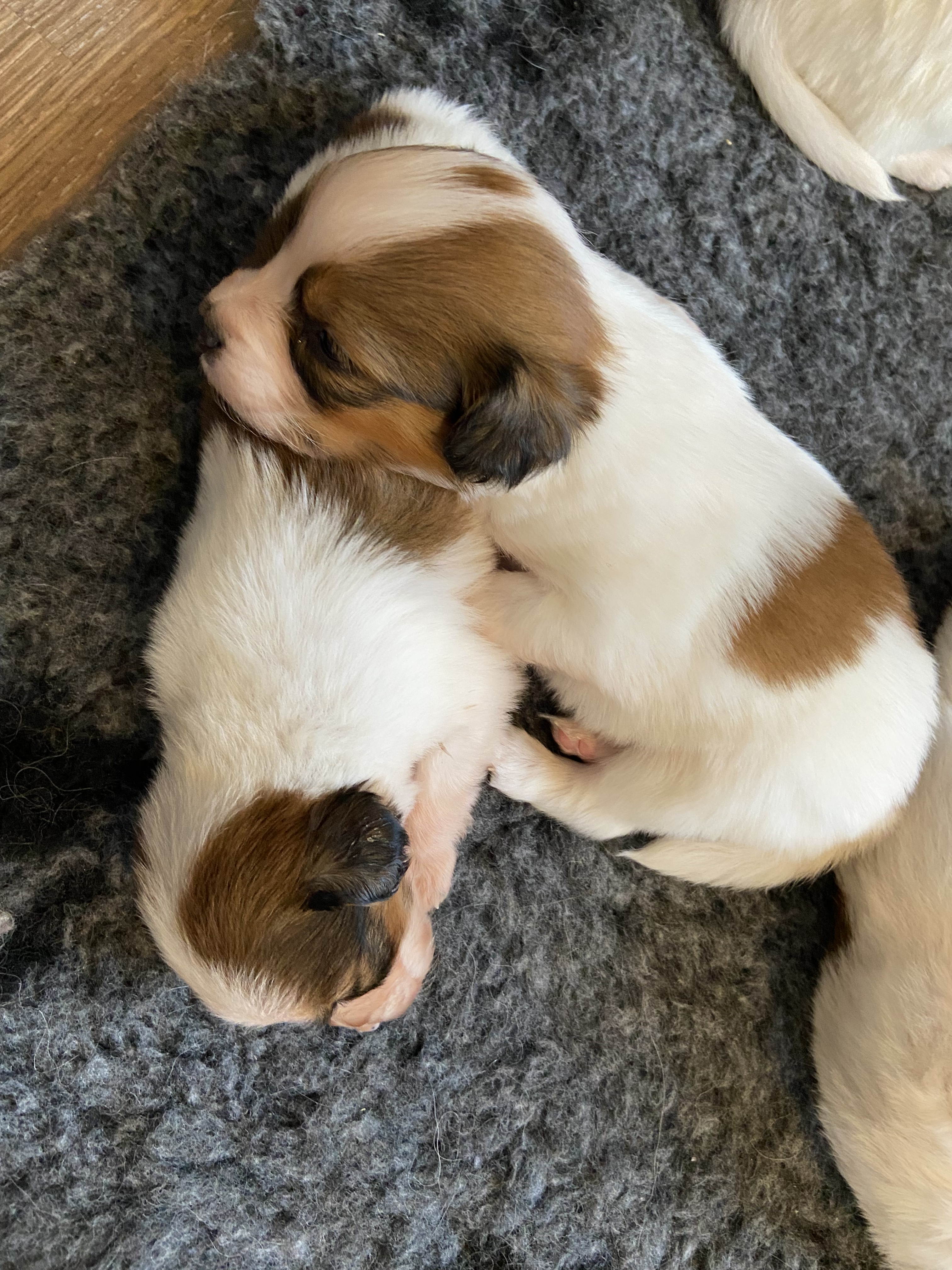
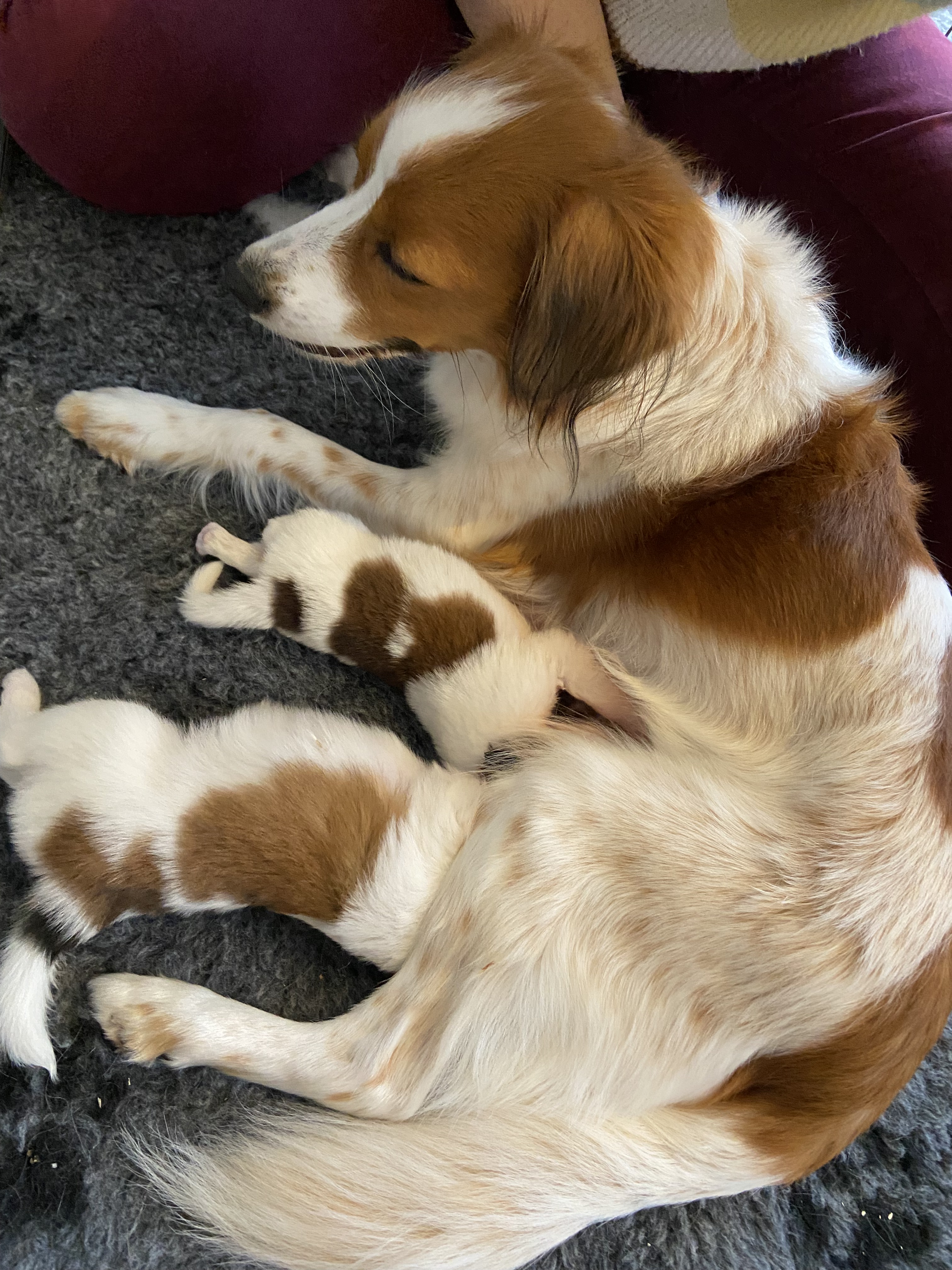
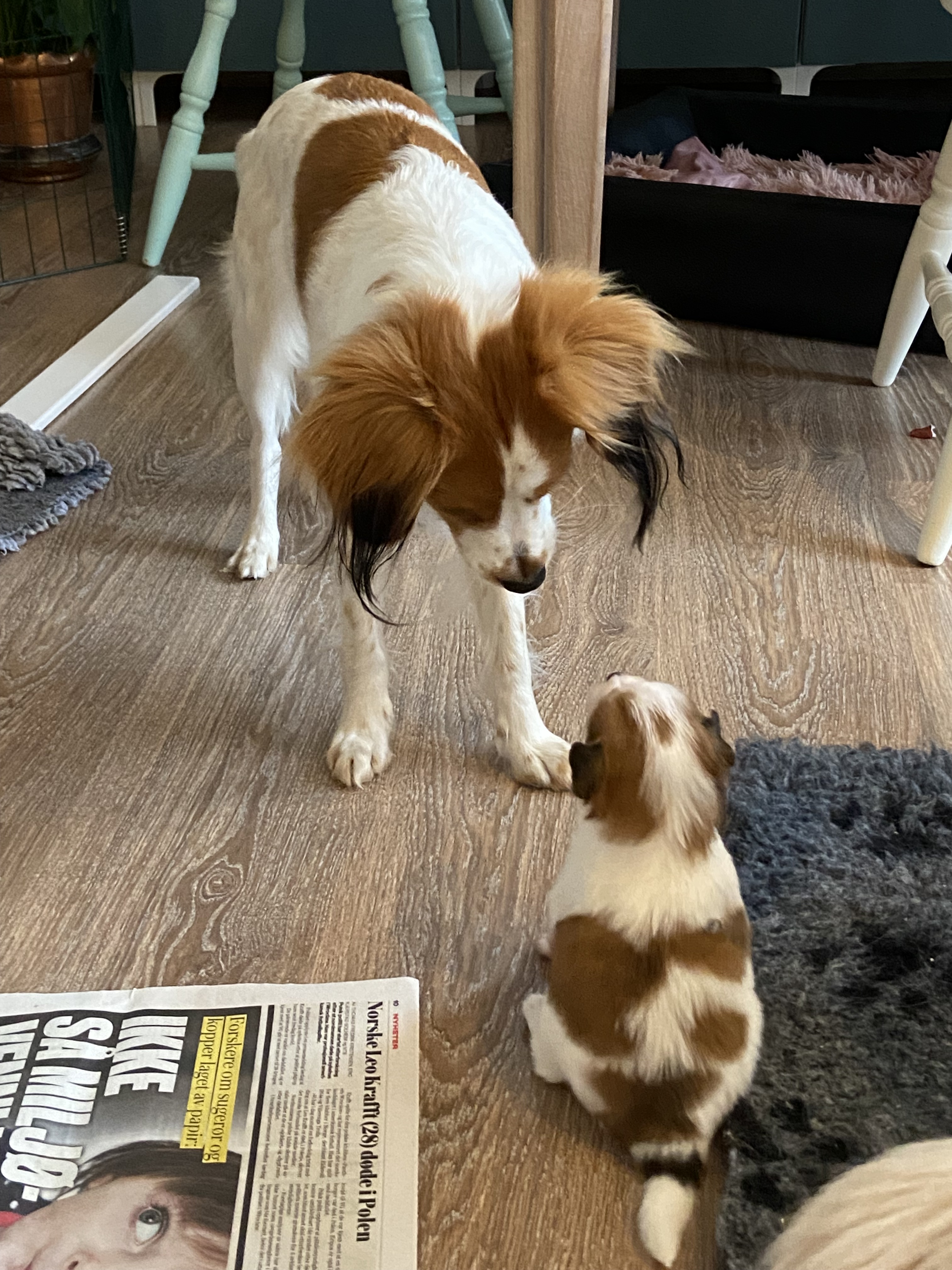
It was lovely being back in Stavanger. As well as catching up with family, I also visited Wivek, who owns Triar’s mum, Trifli. Trifli had another litter three weeks before our visit and the puppies are now on their feet and getting adventurous! The last picture here is of Triar’s half sister, Kløver, who seems fascinated with all these new friends!
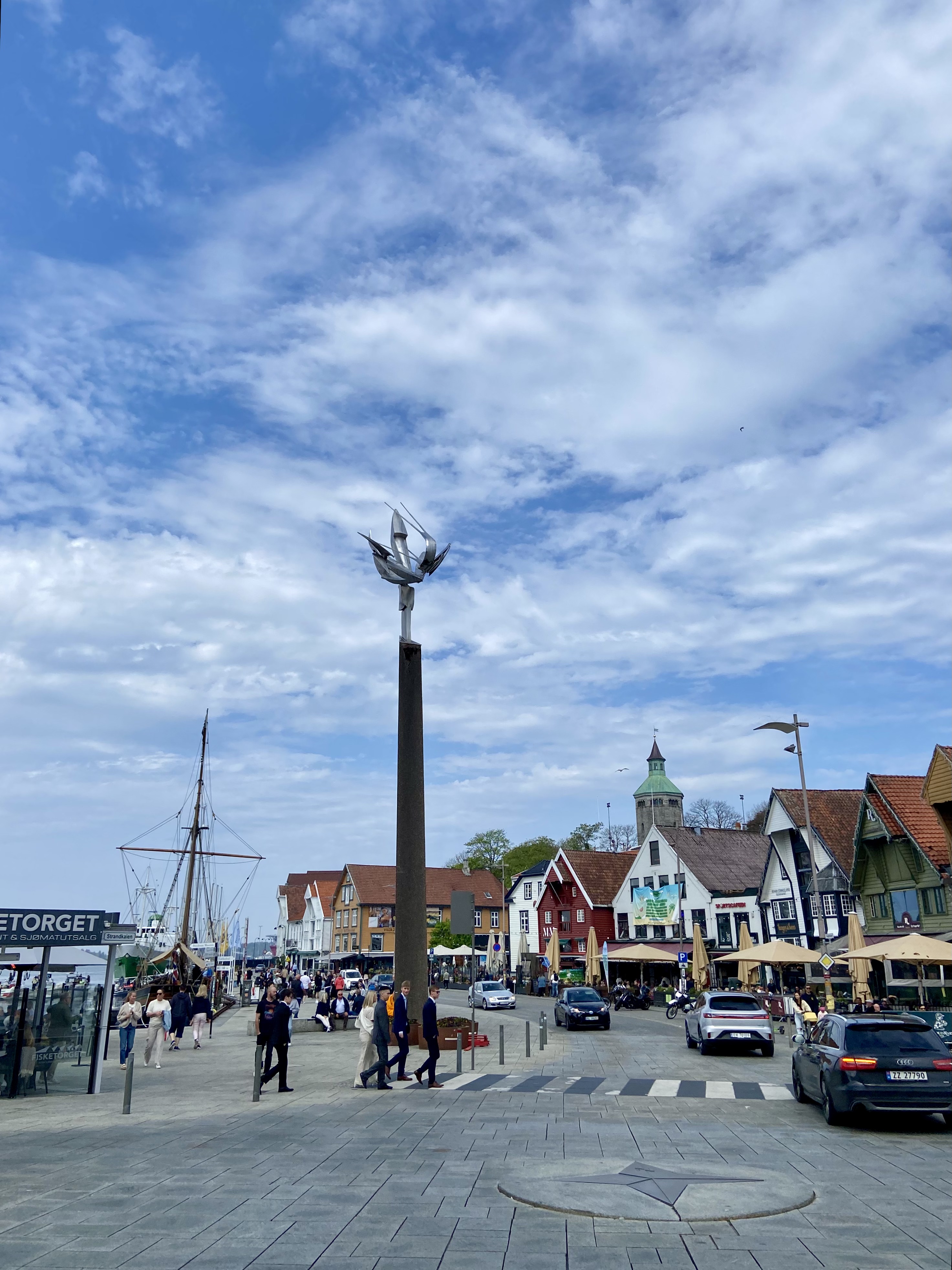
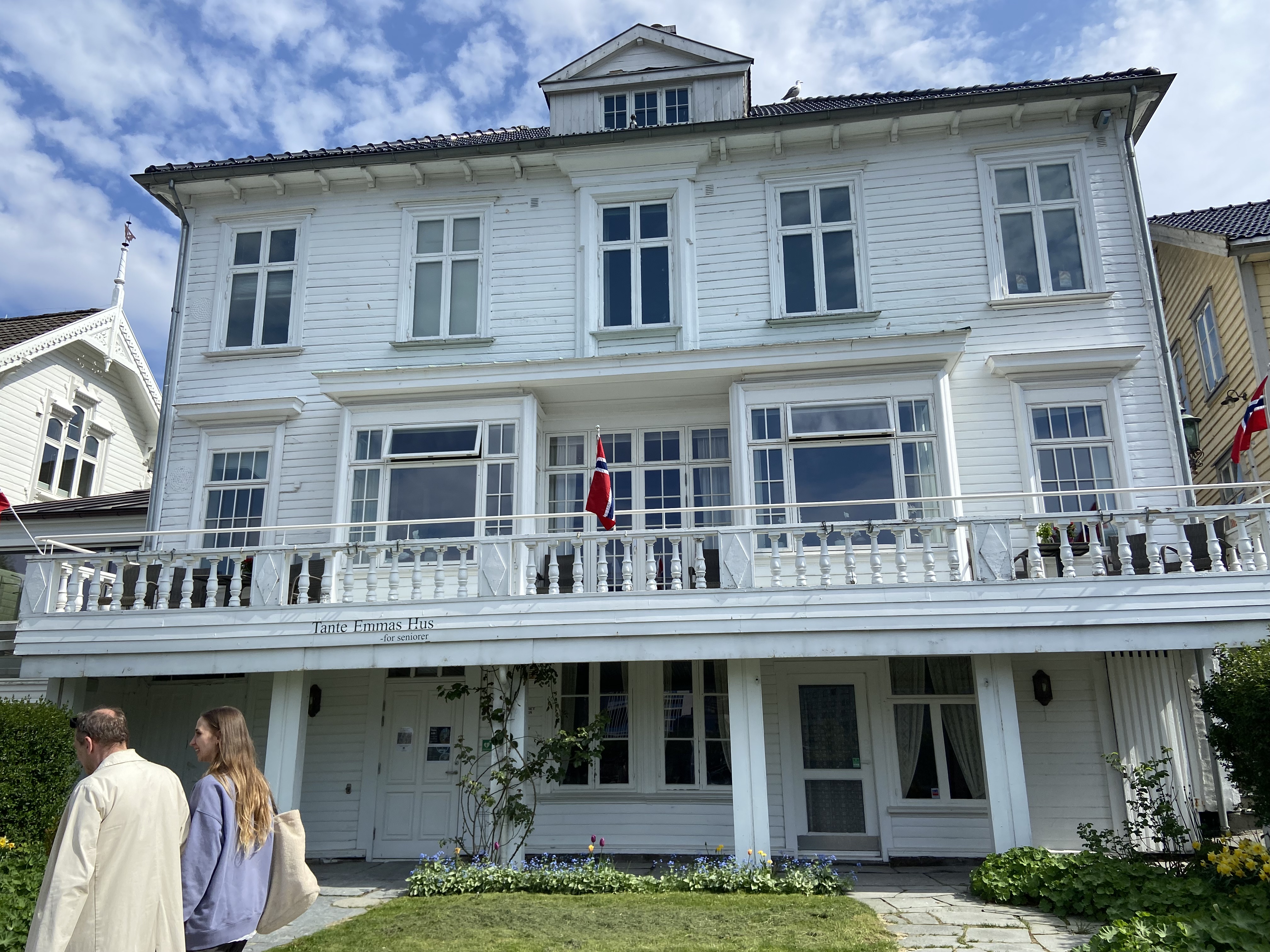
Stavanger looked beautiful under a clear blue sky. I have been very lucky with the weather, which is just as well as I couldn’t find my coat when I was packing. I thought I might have to buy a new one, but so far, I’ve got away with it!
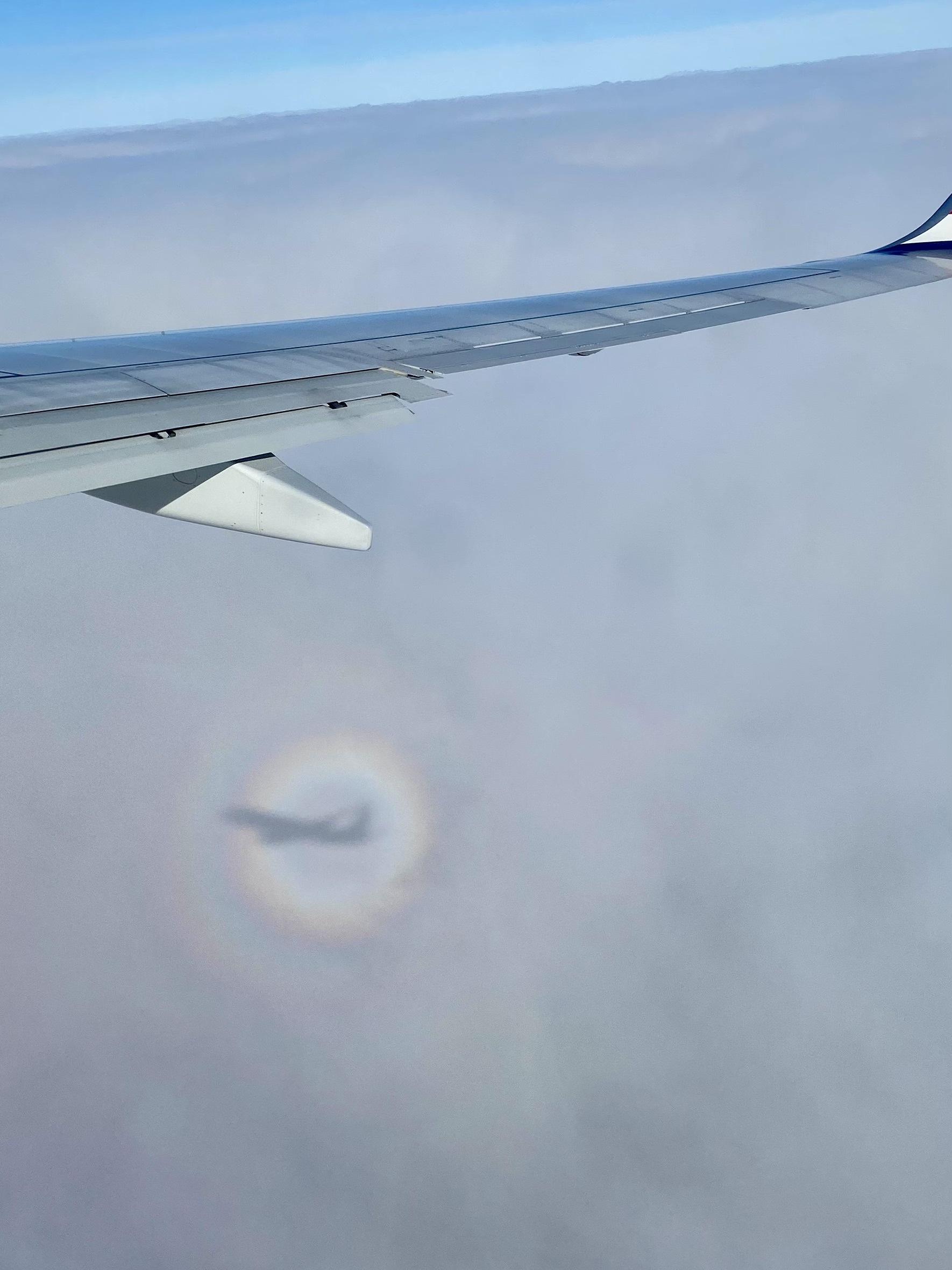
I came north on Monday. The stunning approach to Bardufoss, with its deep blue sea and snowy mountain ranges was a wonderful start to my Northern odyssey and though it clouded over as we neared our destination, I was treated to the sight of a «glory» which is a rainbow-surrounded shadow cast by the plane onto the cloud cover.
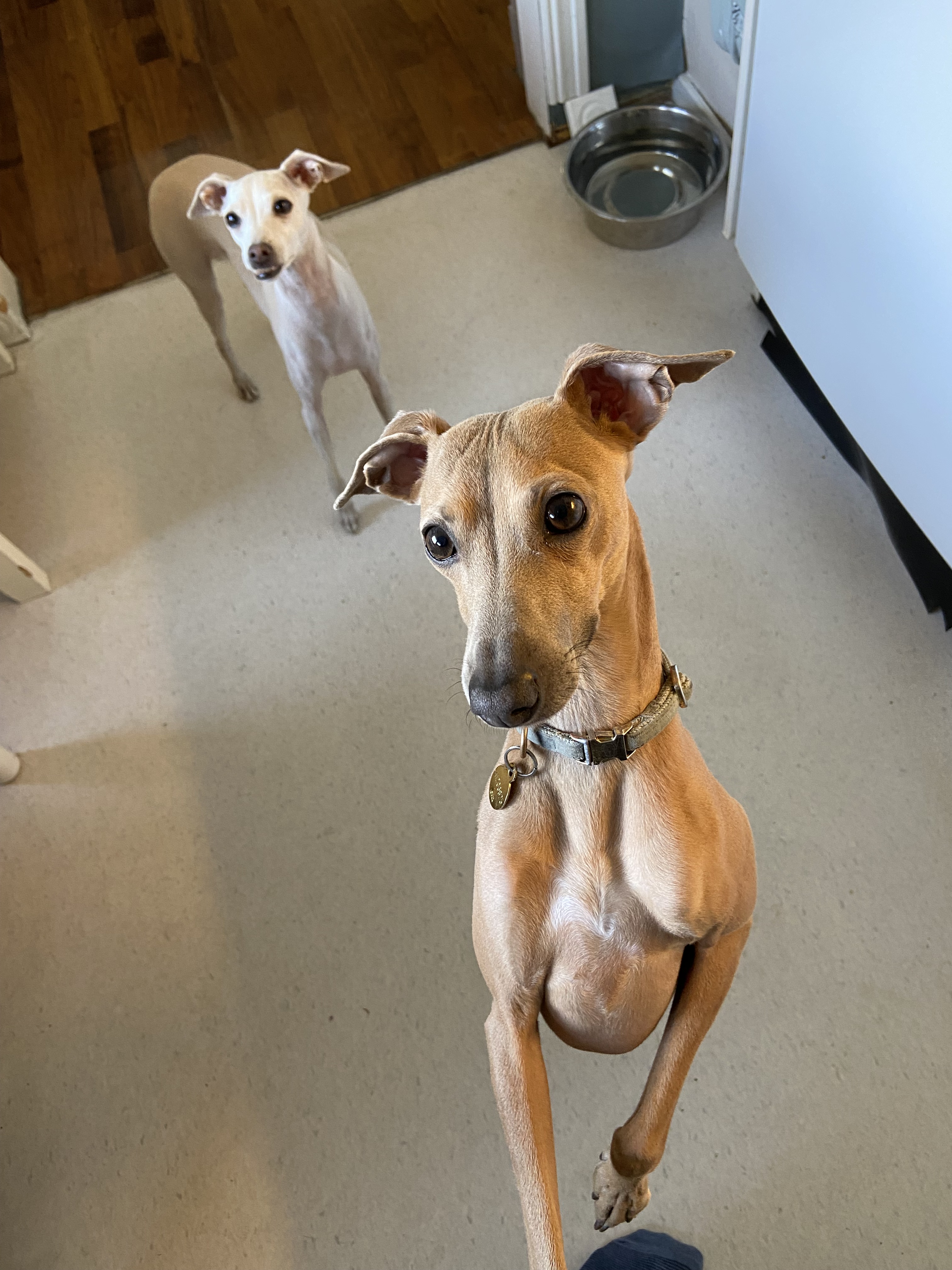
I have been staying with my lovely friend, Shirley, for the past few days. I met Shirley just over a year ago on the fast boat to Tromsø. Hearing people speaking English in this remote area of Norway is rare enough that I turned round to speak to her and her visiting friend, Linda, and we’ve never looked back. Coming back was like returning to a home from home, not least because of the lovely dogs she and her husband Kai own. Here they are: Bailey at the front and Alva in the background.
It’s been interesting coming back. The snow melted on the lower ground quite early this year, but it’s a week or two too early for the incredible summer growth to begin. When I lived here, it always seemed like the least beautiful time of year, with its dead-looking plants and grass, but driving through the valleys, past snowy peaks and still-frozen lakes, it was easy to see the beauty in the landscape, despite the dust that covers the roadsides when all the winter snow has melted away.
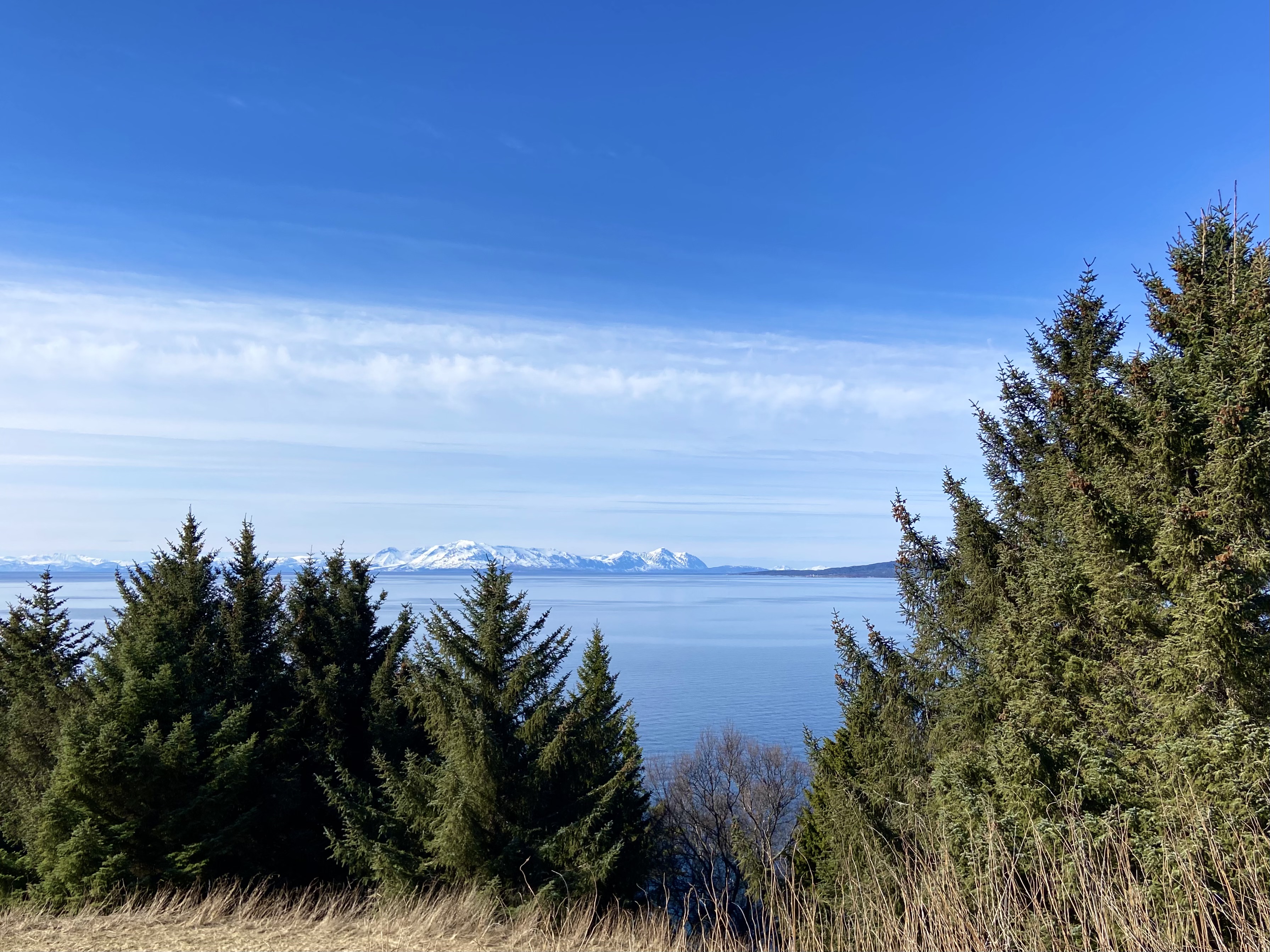
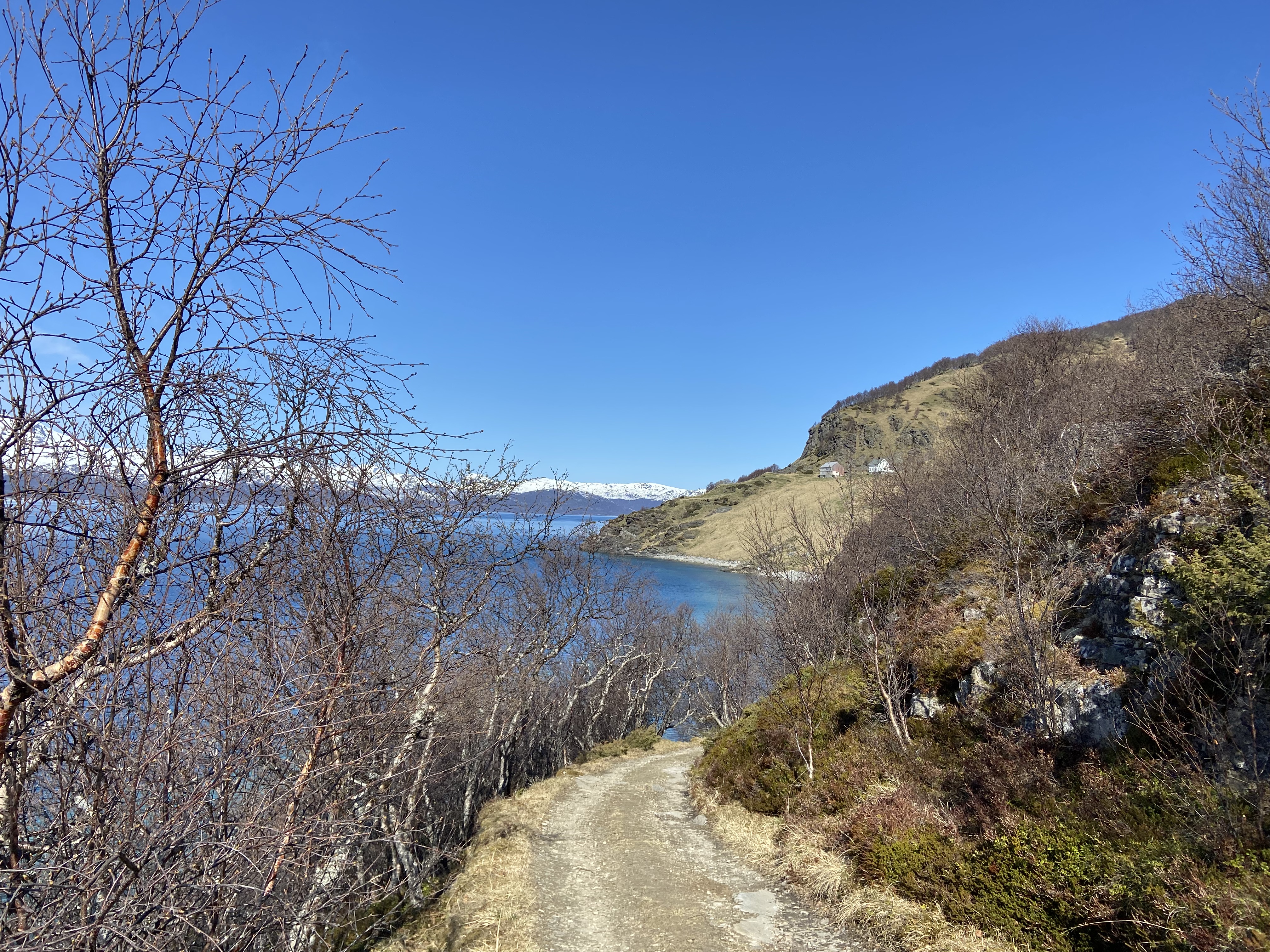
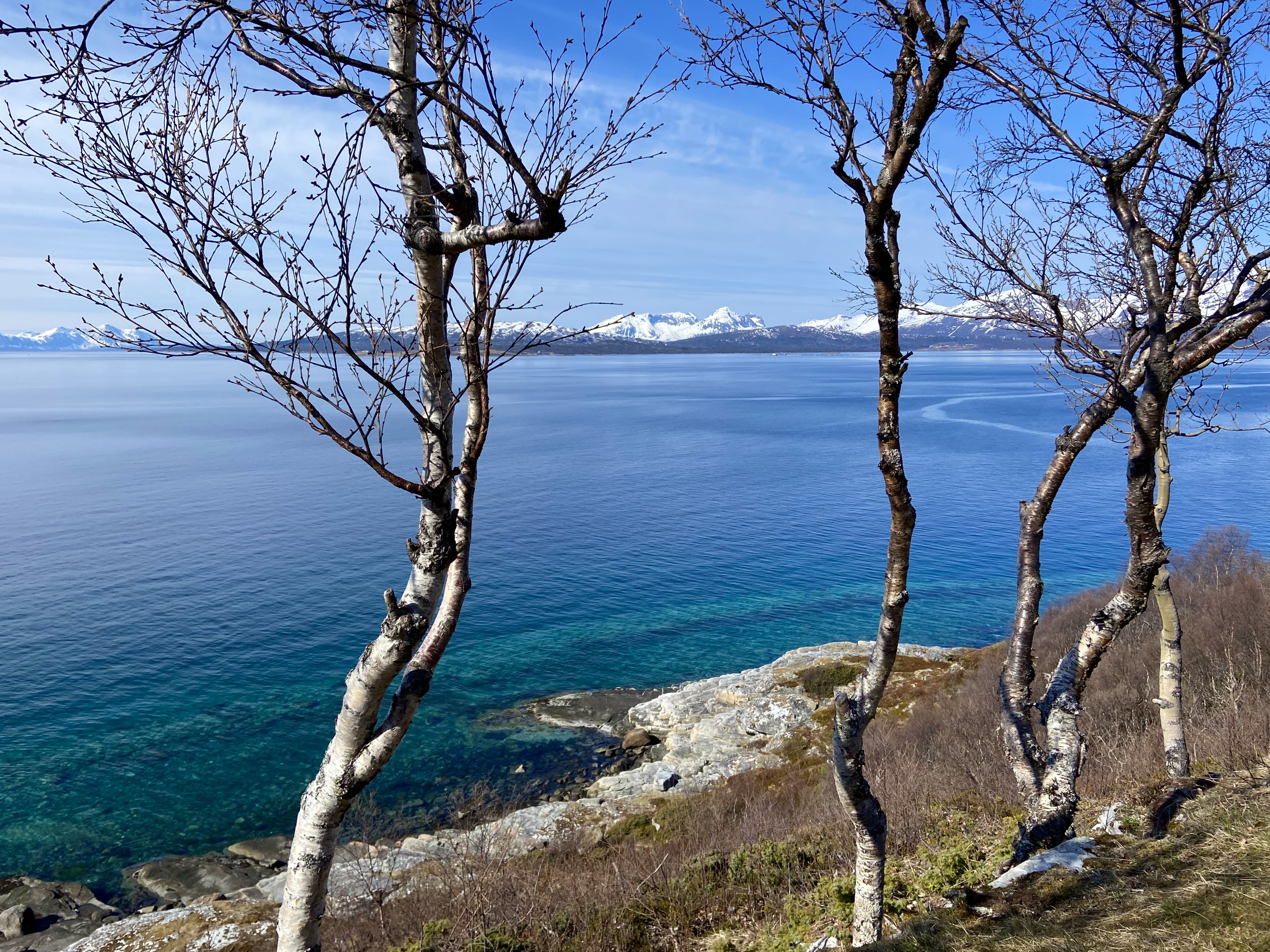
We’ve had a wonderful week of cooking together and wine with dinner, as well as UK comfort TV, like Heartbeat and Judge John Deed. We went on a trip to Dyrøya on Wednesday and walked for an hour along a track above the fjord, with views over to the mountains of Senja to one side and rocky peaks to the other. There was even a sea eagle soaring in the blue sky, far above our heads.
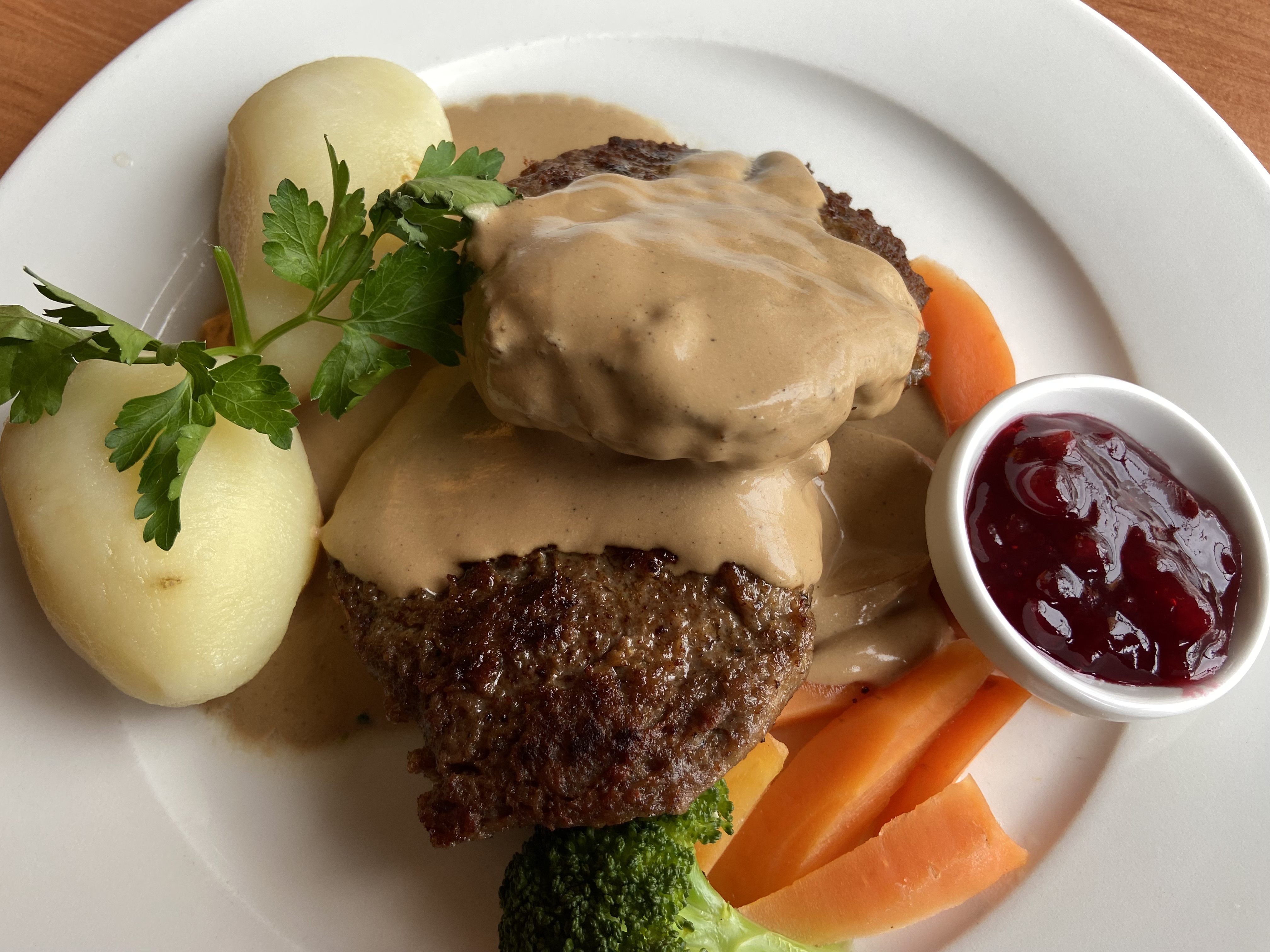
On Friday, we went to Senjastua, a restaurant on the edge of Stavanger, which serves traditional and modern Norwegian food. I chose reindeer karbonader, which came with boiled potatoes and cream sauce. It was the perfect end to a very enjoyable week.
In an hour or so, I am heading north again on the fast boat to Tromsø, where I will be visiting John and Yoana for a few days. Have a good week all and thanks for reading!
This weekend, I’m back in Stavanger. Having lived in Rogaland for twelve years, it all feels very familiar. Better still, Anna is with me and we’re visiting Andrew, whose year at school here is rapidly coming to an end. Today, we’re going to watch some of the films he’s made over the year, and (I think) do a session of singing with the students who have been studying music. We went to a great concert last night, put on by those students, so I hope it’s going to be a fun day.
I’ve quickly slid back into the Rogaland Rhythm. I may have taken too many pictures of food and drink, but that’s just the way it is! My first action at the airport, while waiting for the bus was to buy a hot dog. Norwegian hotdogs are the best. This one is a cheesy hotdog wrapped in bacon. Nam nam! as they say!
Having left a rather chilly Scotland after a long, wet winter and spring, I arrived to sun and twenty degree temperatures. Despite the heat, Anna and I went to one of our old haunts for breakfast. Steam does the best croissants and coffee!
We went for a stroll to the harbour, where a cruise ship dominated the landscape. They really do dwarf the buildings. In the background, there are a couple of oil rigs, presumably brought in for maintenance, and that’s very Stavanger too.
We stopped in a bar by the harbour and spent ten pounds on 400ml of lager! Sometimes you just have to go with it!
And then we had Funky Frozen Yogurt, or as it’s known in the McGurk family, Funky Zen Gurt, because when it first arrived in a shopping centre near us, the logo design highlighted those bits.
Anyway, that’s probably a reasonable summary of the last 36 hours and the crazy whirl since then punctuated, as you can see, by junk food. And now It’d better get up as we’re meeting Andrew in an hour. Have a good week all!
This has felt like the longest week yet. I was duty vet on Monday, Tuesday and Wednesday. At any given time, there are three vets covering direct enquiries in Scotland and these can vary hugely from issues that are directly relevant to other tasks we do (TB, welfare, notifiable or reportable disease, animal by-products) to enquiries that have effectively been sent to the wrong agency or department. For example at one point, I had a question about sheep scab (a reportable mite infestation) alongside another about some brown banded cockroaches that had been seen in a consignment of books brought in from India.
The first of those – the sheep scab – is absolutely our territory. That one I knew I would have to deal with from start to finish. The cockroaches? Really I am clueless. So the first part of my task was to working out which of the tasks was mine to complete and which should be forwarded on. As a complete novice, even making that decision isn’t straightforward. The two other vets on duty with me were busy with their own tasks. There’s a more senior vet on call, but that’s mostly for consultation on serious cases at nights or weekends.
I had thought, before I started, that it was only three days. How bad could it be? But by Monday lunchtime, I was overwhelmed. I was told to follow various checklists, but without prior understanding, they didn’t have enough detail. The instruction, “obtain owner or keeper’s e-mail so restrictions can be served and lifted with fewer delays” sounds straightforward enough, but there are multiple different systems where that e-mail might be recorded. Moreover, those are so complex that looking things up could take an hour and even then, I might still not have found it.
Finally, in desperation, I called my veterinary advisor, Pilar. I probably should have done it earlier, but I knew she was busy and she had already spent hours with me, trying to prepare me. Fortunately she was empathetic and understood how out of depth I was feeling. I had actually reached the stage where I was contemplating switching off computer and phone and walking away, but she talked me through everything in simple steps, told me I could gather most information by calling the vet who diagnosed the scab and the farmer whose sheep were infected and gave me a list of what to ask each. The cockroaches, she directed me to another APHA specialist, who would be able to advise.
It took me a very long time to work through that sheep scab case. Next time, it will be much quicker, but the good news is, that by the time I phoned cockroach guy back afterwards to find out more about his query, he’d already had the Forestry Commission in, who had dealt with the problem. As someone else pointed out, almost none of the enquiries are urgent, but it still feels overwhelming. It will get better over time, but those three days left me feeling wrung out.
Having survived the three days (and nights – no calls, but not relaxing knowing the possibility is there) of duty vet, I was hoping for a good end to the week, but it wasn’t to be. On Friday, I had booked in a welfare investigation with David, the local authority inspector. As regular readers will know, mostly those investigations reveal good welfare, but occasionally the reports are accurate, and this was one of them.
There are two main sets of rules we follow. There’s both the law of the land (Animal Health and Wefare Act, Scotland, 2006) and a more stringent set of welfare guidelines that farmers sign up to in order to receive government subsidies. Up until now, I have mostly visited farms where the farmers were broadly compliant with the guidelines, which represent a higher standard than the law. There have been a couple who met the law but not the guidelines, but until now, I haven’t seen any proper breaches of both.
There are various protocols in place for dealing with breaches, depending on severity. Minor breaches can be corrected with simple guidance. There’s a sliding scale from there, including serving notices for improvement within a specific timeframe, calling for direct action while on the farm (such as calling the private vet or requiring that animals are culled) right up to prosecution, for the most serious cases. The latter is usually (though not always) a last resort after improvements haven’t been made.
Anyway, yesterday I had my first Scottish breach. I’ve dealt with some in Norway before, so the welfare signs and how to record them are similar. However the protocols differ and it’s easy to put your foot in it. One thing I have learned is that, when I come across welfare problems, it’s intense. There’s a lot of pressure to make sure you get stuff right. If you say the wrong thing, the farmer can get prematurely angry or defensive, which makes everything more difficult. On every case I’ve reflected on afterwards, I have looked back and realised there were ways I should have done better and some things I learned. This is my initial list after yesterday. I know more will crop up as the case is processed and followed up.
Firstly, don’t forget to take supplies. There’s a minimum kit I should have had with me and didn’t. In Norway, we used disposable overalls and boot covers on every farm and I would go round the stockroom and pick up measuring implements, microchip readers and other equipment each time. It had become routine. Here there are certain items I am meant to have with me at all times, but I went out with someone from the local authority and (incorrectly) assumed that the LA inspector would have everything I needed. I don’t think it caused any catastrophic problems, but that was only by good fortune. I can easily rectify that for next time.
In addition, I will never again go out without food and drink. Generally such inspections take a few hours at most and we can go and buy lunch, but this time, there was a lot to get through and I was uncomfortably thirsty before we managed to take a break. In Norway there were often no cafes or shops within a two hour drive. Thomas never ever went anywhere without a can of cola and something to eat and I had started to do similar. Again, an easy lesson.
Second, don’t do welfare on a Friday. Graham mentioned this and it’s great advice. Sometimes it’s unavoidable, but in fact, it can cause no end of problems. Vets go onto out-of-hours rates and limited staffing at weekends, so if a call-out is fairly urgently required, it’s more complicated. Worse, abattoirs close for the weekends. They did in Norway too, but we had an emergency slaughter service 24/7. Labs close. If you want to send them anything, and it’s late, you can’t leave it till the next day. Even from the point of view of our own follow-up, it would have been better to go through the case the next day and not have two days in between.
Third (and unexpected). Don’t use the word evidence. It’s a funny thing to reflect on, but I never accidentally used that word in Norway. I didn’t even know the Norwegian word when I started working in Finnsnes! I rapidly learned how important language was when I started out in practice years ago though and now I need to learn what works in this role. The way you phrase things makes a massive difference to how the person on the other side of the exchange reacts.
To me, it felt like a technicality. Evidence is stuff I see and write down. It can be positive or negative, but it was obvious when I used it a couple of times that it instantly conjured the threat of a court case. Next time, I will find alternatives. If I ask to take photos, it’s not for evidence, it’s to get or record a full and accurate snapshot of what I’m seeing. Doing that is easily described as being in everyone’s interest. There are so many police shows now that the rights they read out (that include the word evidence) are probably at the forefront of people’s minds. I’ve always thought it would be easier to do this job in English and there’s no doubt it is, but there are new pitfalls and I need to adjust.
Anyway, as well as the things I got wrong, there were others that I did get right. The habit of using descriptive, observational, factual language, not opinion became second nature in Norway. A cow is not “thin”. Thin is an opinion. Instead I might write that “I can see her ribs and the bony prominences of her pelvis and spine and I rate her body condition score at 2” (with an explanation of what the condition score means). Those are facts. Realistically, “thin” is shorthand for “I observed those things” but it can open up the problem that different people might assess “thin” in different ways.
On my suggestion, David drew a map. I learned that from police in Norway after working on a case with them. It makes it easier to keep track if you have all the farm buildings mapped out and the sheds numbered. You can then describe more accurately where you found various animals and what your photos show.
This is a Scottish/British one; I should record important words verbatim. I learned that on a statement writing course. It’s not easy to do that as conversations go faster than I can write, but writing down someone’s actual words removes any confusion created by a summary of what you thought they said.
And finally, I’m going to end with something David told me. It can feel overwhelming during a welfare case, especially if there are many issues that need to be addressed. Again, harking back to Norway, even if I managed to improve things, I could still get bogged down in what I didn’t achieve, because it could have been done better. But as David pointed out, in the end of the day, if the actions I took relieved the suffering of a single animal, that was still an important achievement.






































 A Vet’s Life