Tag Archives: Mattilsynet

Concerning Welfare

Sunrise/sunset: 09:01/ 16:00. Daylength: 6hr58min

Back in June I wrote a post about complaints from animal rights organisations about Mattilsynet: Trouble in Paradise. Last weekend on my Facebook feed, I found a post from a colleague with a link to a new article from NRK, Norway’s public services broadcaster. It contained the stories of whistleblowers from within Mattilsynet regarding the distress its inspectors are feeling about their inability protect the welfare of the animals they are supposed to oversee.

Link to article in Norwegian: We have to close our eyes to suffering animals. *See note below for translation tips

One of the things I have noticed in my job is that almost every other week, changes are introduced to policies and protocols. There’s a lot to learn in any role and a year in, I feel I’m still picking things up, which would be enough already without the feeling that anything I learn might shift again next week. Then there’s the “paperwork”. Most of it is digitalised now, but there is a whole load of report writing, which often takes up far more time than the actual visit.

I am catching up gradually with some of the politics, and it seems that the current concentration on bureaucracy relates to criticism from the official Norwegian Auditor General in 2019 regarding the poor quality of case processing. It was stated that Mattilsynet lacked good tools and systems to deal with the animal welfare supervision it had to carry out, and that the result was that serious breaches of the animal welfare laws were not being followed up. It also said that Mattilsynet employees were not using the tools they had to penalise those who broke the law, and that it took too long for those who didn’t take proper care of their animals to be banned.

There’s a certain irony to what is happening now as a result of these accusations. I haven’t been here long, but one of the major constraints is the computer system we have to work with when processing cases. We use a system called MATS. I don’t know how old it is, but it is so complicated to use that it slows everything down. It sets out protocols and you have to work through the elements in order and tick off certain actions before you can proceed to the next. So if I receive a message from the public regarding a concern about animal welfare, it comes to me in MATS. I have to process that message and work through various stages on a list, and then at some point I will come to the end of that segment and have to move onto the next.

Once you click through to the new section, you can’t go back and change anything in the previous section if you’ve made an error. Thomas always tells me I have to be very careful before I click onwards, and I often check with him. But as I am trying to stand on my own feet a bit more, there have been cases where I have got as far as writing a report or a response to an animal owner who has asked for permission for something, and then had to go right back to the beginning as I realised I had linked the case to the animal owner’s personal file, and not to their business, or some other easily made system error that cannot be rectified.

MATS is also clunky in other ways. Almost nothing is automatic. Before we leave the farm or home, following an inspection, we have to write a “receipt” with a summary of what we have checked and what our assessments were. This used to be on paper, but now most of them are sent electronically. So we type our observations into an app. This would be very useful if there was an integrated system. If the observations we recorded in the receipt were transmitted automatically into MATS, and then perhaps used in the report, then it would be truly useful. As it is, we have to open MATS and the receipt and copy and paste all the information from one to the other.

The report itself has to comply with strict parameters in how it is set out and before I can send it to the owner, I have to run it past a colleague, and then afterwards past a control team, all the time making amendments, and then often sending it back and forth multiple times until everyone is satisfied.

Instead of rebuilding the system, they are adding things like the receipt system (and another system that allows us to add photo evidence) before the problem of MATS has been addressed. It seems to me, that they are trying to tweak something that is so fundamentally flawed that they are actually making the situation worse instead of better.

Of course all of this really comes back down to funding and monitoring. The argument is that they can’t afford a new system, though not affording it is probably costing millions. I have watched similar events in the public sector in the UK. The health service and school systems have both wandered into this territory where funding is reduced, then criticisms are made, and rather than improving the situation, new systems for monitoring are introduced, which increase the workload in ways that do nothing to correct the problems, but increase the cost of the operation. That the Norwegian government is paying veterinary surgeons to copy-paste long lists of observations and check and recheck whether the reports we write comply exactly with a template, which could presumably be automatically applied if the will and funding was there, seems brainless to me.

In addition, there are certain routine visits we carry out, for example those to check the farmers are following the rules with regard to ear-marks, disease control and traceability. Common sense would suggest that if no breaches of the rules are discovered, the feedback report could be generated automatically. Not only would that save direct work for the vet who did the inspection, but it would sidestep all the report-checks for compliance and would ensure their other aim – that everyone is dealt with the same way, wherever they are in Norway – was met without any effort whatsoever. Reducing the time it takes to process cases would free up time so that we could carry out more inspections. It seems like the system is set up in a way that prevents us from doing the most fundamental part of the job, which should be getting out and checking whether the animals are okay.

Anyway, I’m not going to comment any more on this for now. Our area is actually better off than those in the report, for which I am grateful. The report mentions an area where the inspectors have been told they can’t take on any more cases until the old ones are cleared up and we haven’t reached that stage. Thomas often tells me of his frustration that we are firefighting cases, rather than preventing problems before they start. Because I’ve only been here a short time, I can’t compare it with how things used to be, but he feels things have become more difficult. I am also aware of how much Thomas takes on, in comparison with what I can do at the moment. Though I help as much as I can, I know he is taking responsibility for the worst problems, as I work to follow what he’s doing and ensure the case timelines are kept in order. I am learning a lot about how cases should be handled, but even writing up the timelines shows me how frustrating the system is. There has been a change in government in Norway and the new government is more left-leaning, so I can only hope that some of the budget cuts, that have been happening forever, start to be reversed.

*****

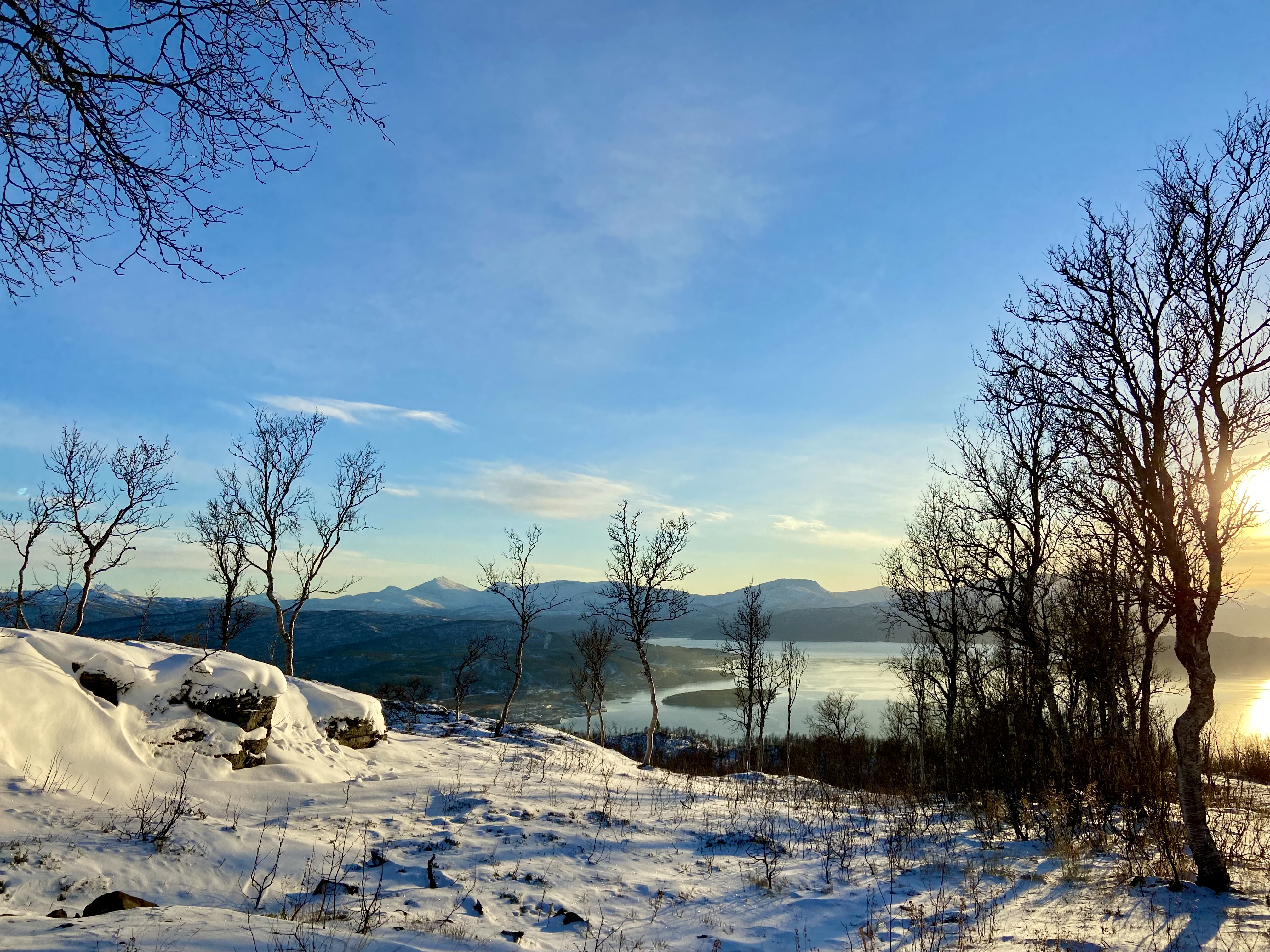
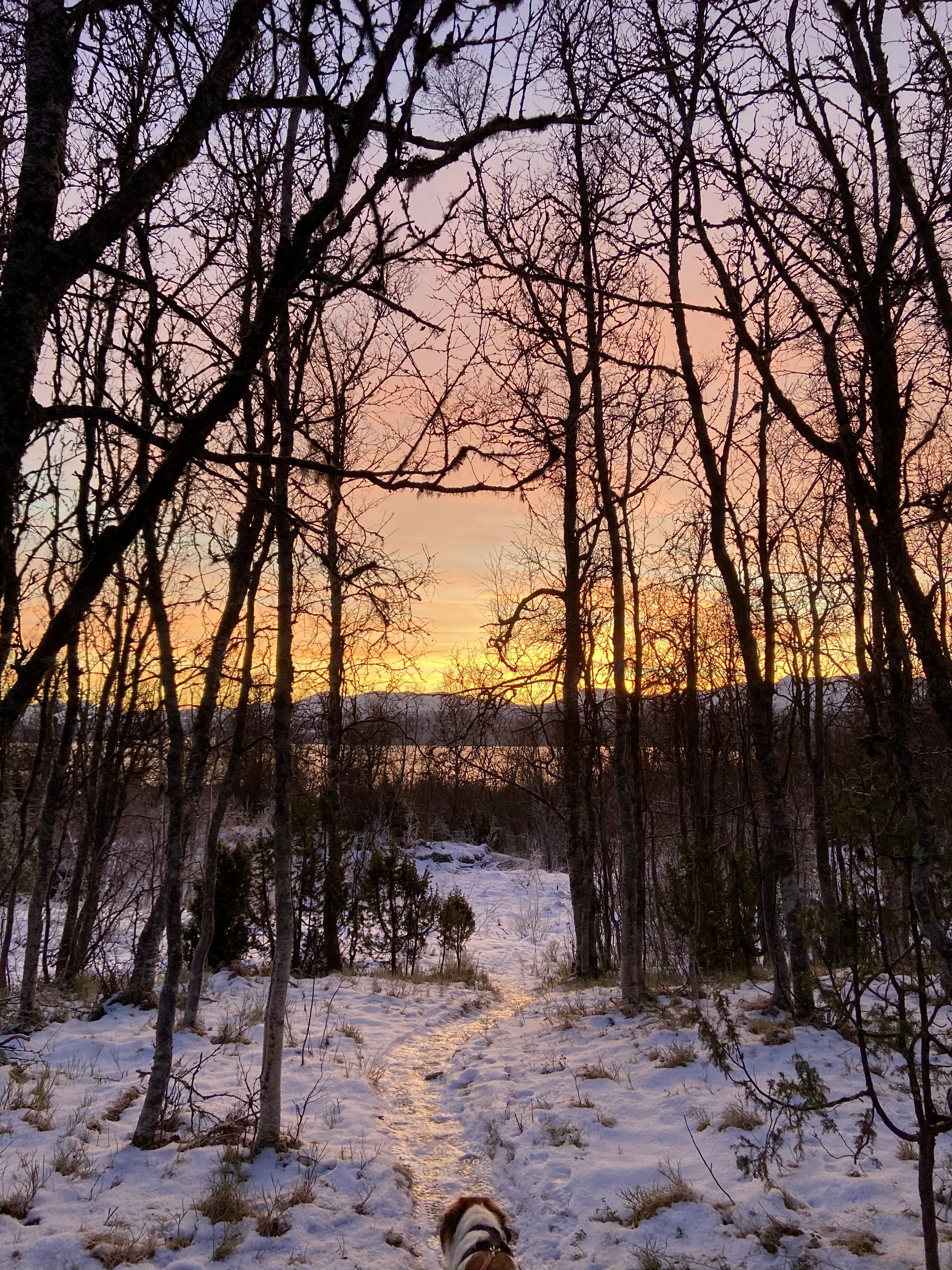
Though the snow has gone for now, it was beautiful while it lasted. Triar and I followed the same trail last Saturday as we had the week before. There were amazing views as I reached the higher ground and I went a little further than last time, though I think I was still only about halfway along the trail to the peak. I need to find someone to go with me before attempting the whole walk.
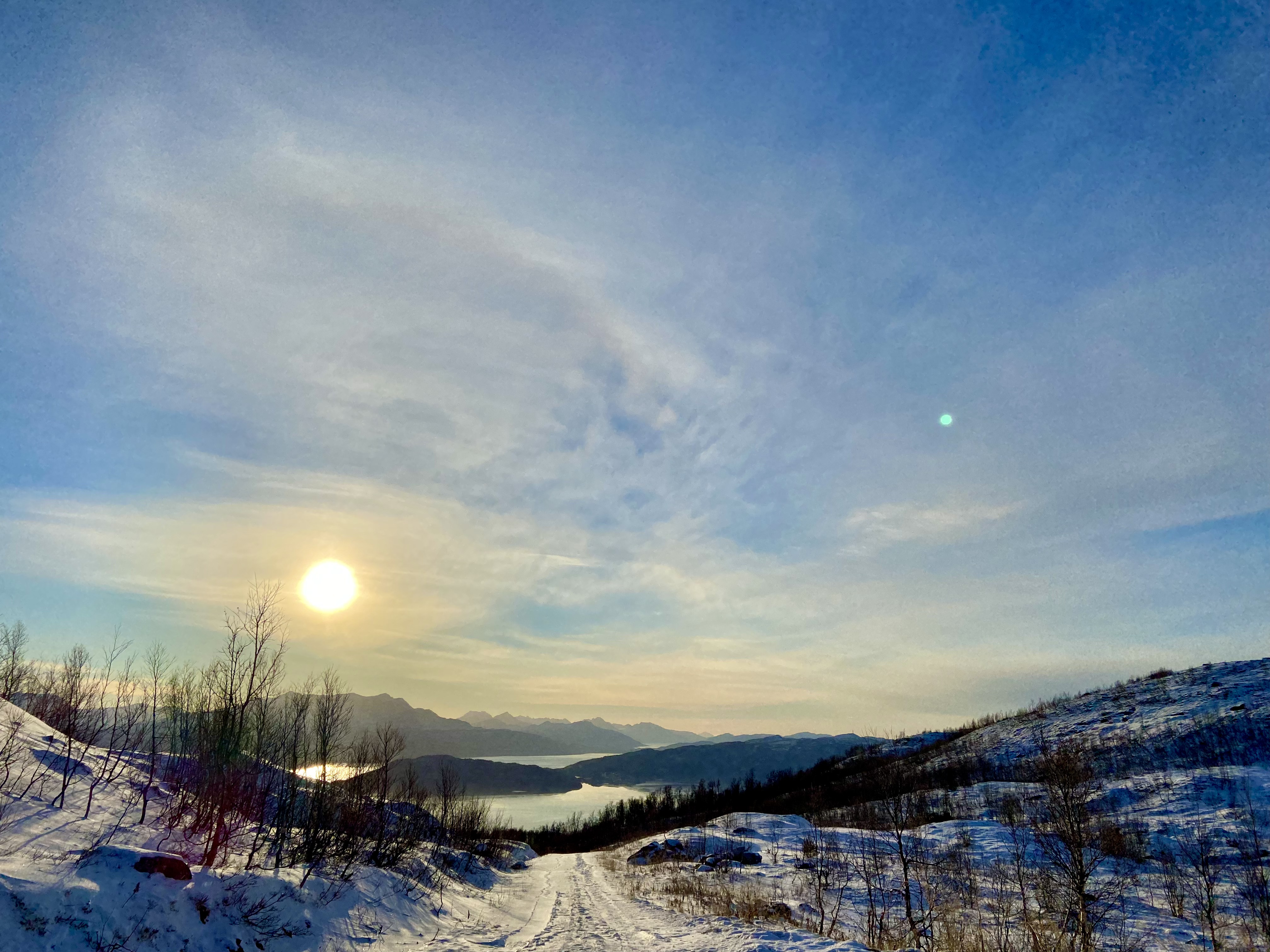
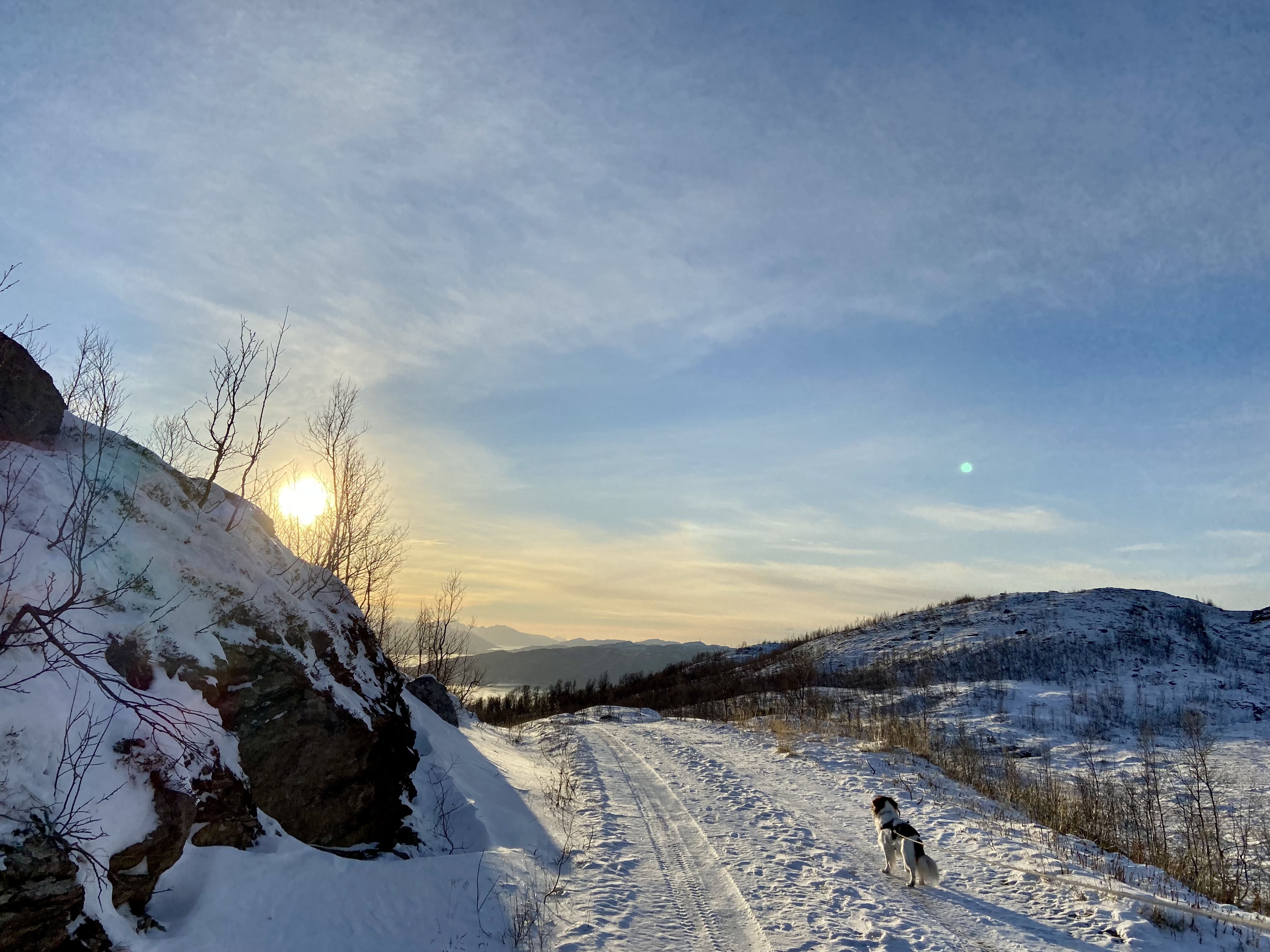
Looking back at the snowy trail up to Kistefjellet

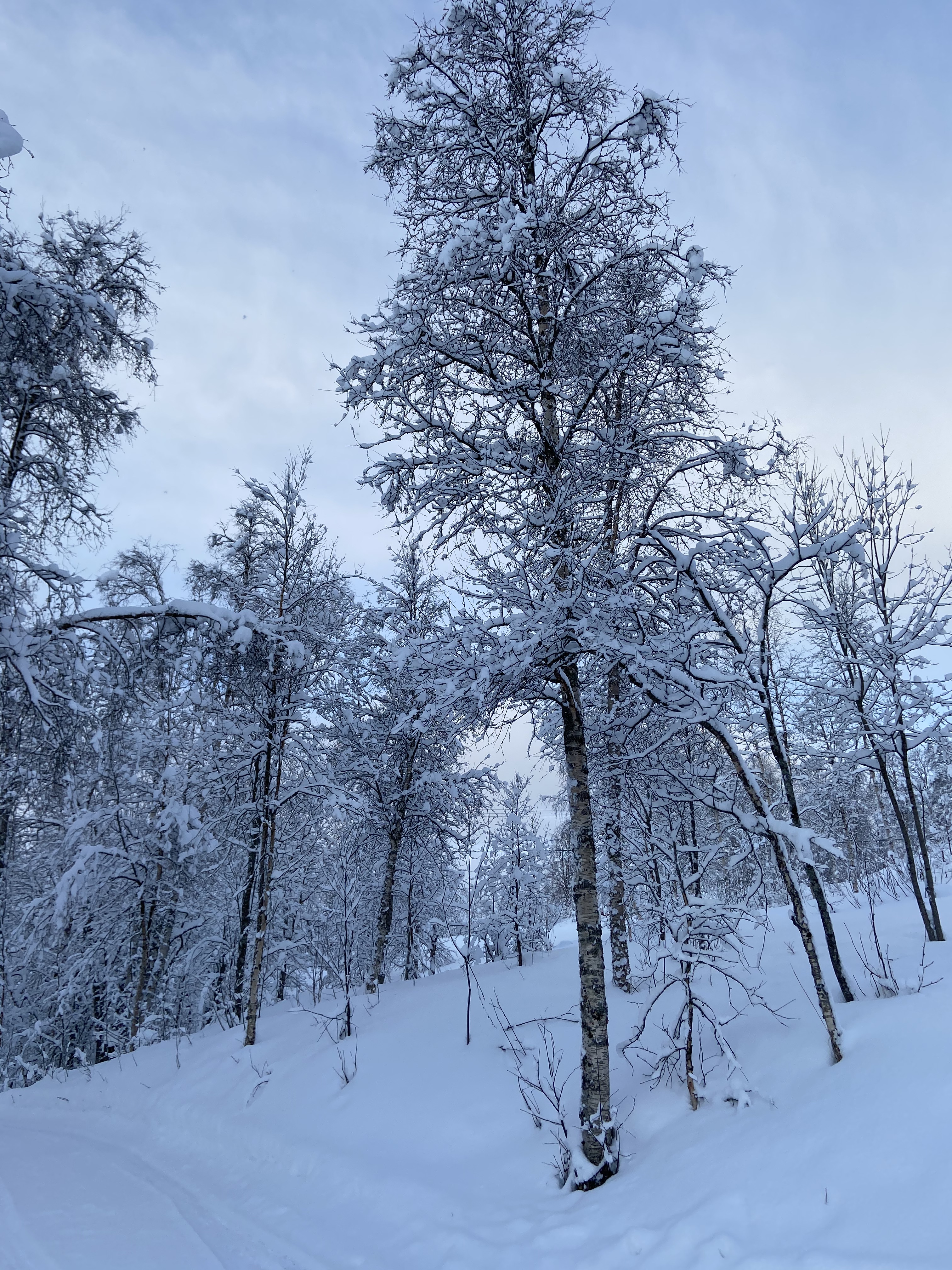
And on Tuesday evening, there was a snowstorm. Though it was windy, the temperature was around zero. When it’s really cold, the snow is powdery, and when the wind blows, it doesn’t stick to anything. But this snow stuck to everything. I went down into the town centre to get something, and had to stop to take photographs of the trees as they were so beautiful against the overcast sky and the streetlights.
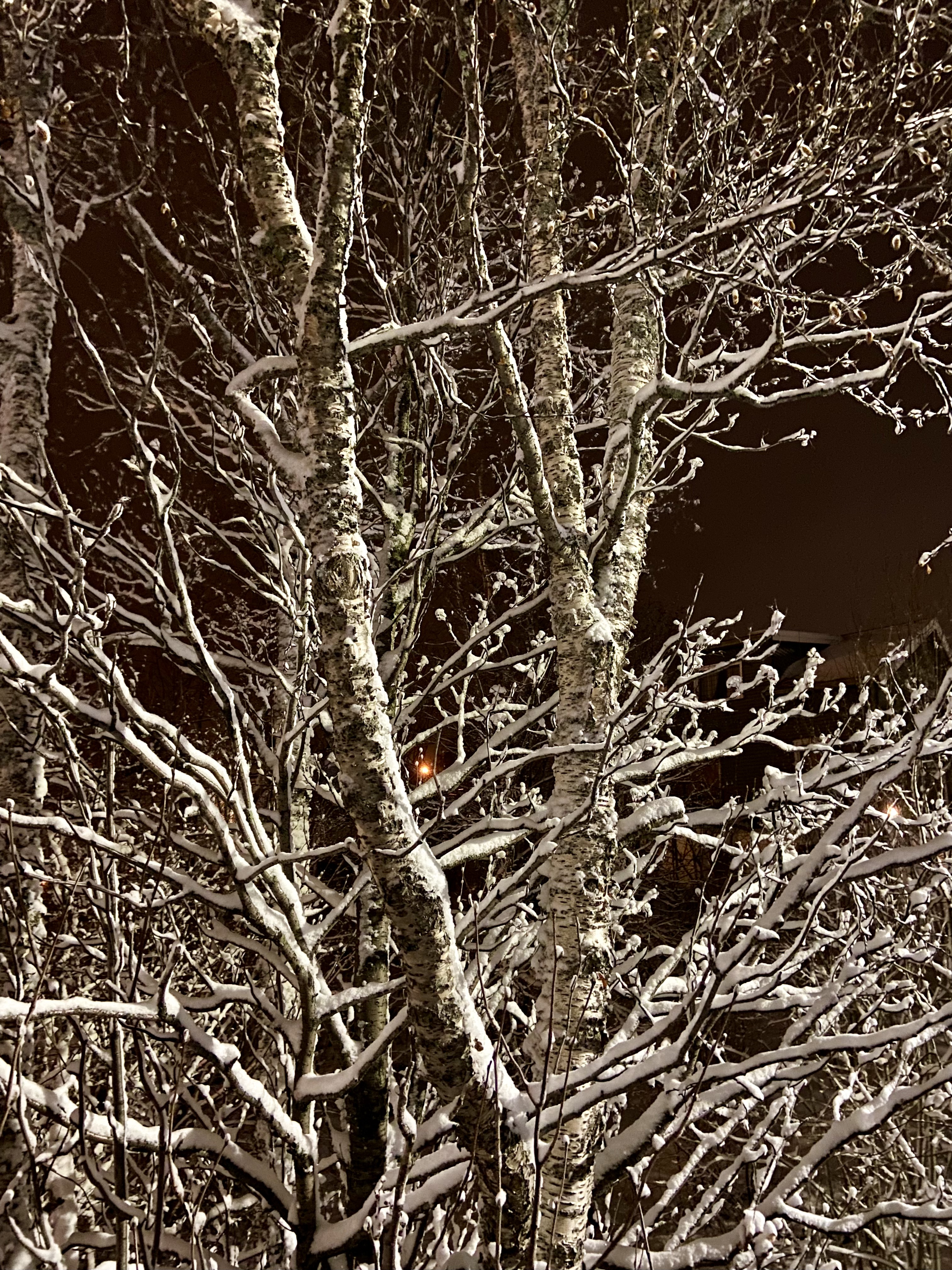
I am looking forward to winter now. Though snow can be inconvenient, I still feel a childlike excitement when I wake up to find the world has turned white. And in a month, the polar night will be here. I hope you will follow and share it with me.

*If you want to read a Norwegian article in English (or any other language) you can paste the URL into Google Translate (set the languages at the top). A link will appear in the “Translation” side. If you click on the link, it should take you to a translated version of the article.
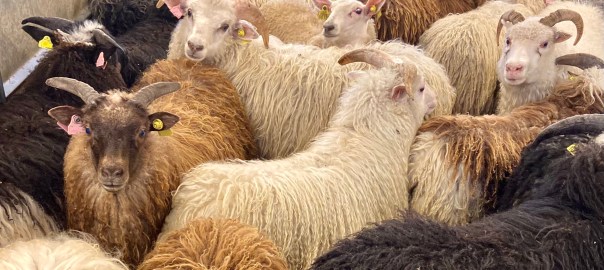
Counting Sheep

Sunrise/sunset: 07:06/ 18:06. Daylength: 10hr59min

Time seems to be rushing by again. Last year, when everything was new, it seemed to move a little more slowly, but I feel I am beginning to feel the rhythm of the place and the seasons, if not yet well, at least with a degree of awareness. We are losing an hour of light each week now. At the end of next month, the Polar Night will be with us again. In the meantime, the progression through autumn continues to be so beautiful that I find myself sighing out loud at just how wonderful it is.

My work is seasonal, as all who work (or have worked) with large animals will understand. This years lambs are being brought in to the abattoir and then their meat is beginning to appear in the shops. That sounds very blunt, I guess, but on some level it feels right that I witness the whole cycle. I have seen a few people on social media express the opinion that all who work in abattoirs (and indeed farming) must be sadistic or macabre, but that isn’t my experience at all. Most of the people I encounter are both down to earth and resilient.

As well as the slaughter season (as it’s called here) I am waiting for the sheep and cattle to be brought in from their summer pastures. Part of our job is to check all aspects of the chain that goes ” frå jord og fjord til bord” (from the land and fjords to the table) and one component of that is traceability. All farm animals must be tagged (or tattoo’d for pigs) shortly after birth, and the tags maintained until they die. All the births and deaths and numbers have to be recorded in the “husdyrregisteret” or livestock register. The vets at Mattilsynet have to go out and check that the farmers are carrying this through, so we will go out and do checks on a number of cattle and sheep farms in the autumn and winter.

As well as looking to see whether all the animals have ear tags, we check the farmers are keeping medical records for all the animals. Medication (and specifically antibiotic/antibacterial use) are much more tightly controlled here than in the UK. We also check that they are entering the details of their herd or flock into the livestock register. Failure to do any of these things results initially in warnings, then fines and (where there is a severe breach of the law) in restrictions on the movement of animals on and off the farm until the traceability requirements are fulfilled. Though we ideally check every farm on our patch over the course of a few years, we also try to integrate these visits with our welfare program. So if we receive a concern message from the general public, or for example one from the electricity suppliers (who give us advance notice if any farmer is at risk of being cut off) and we feel the situation does not sound serious enough to require immediate attendance, then we will try to call them to assess the situation, then add that farm to our list of places where we will carry out “routine checks”.

Life at Mattilsynet can be unpredictable at times, perhaps predictably so! During the season, there are seven members of staff working in the abattoir on any given day. I’m not due there every day, but as well as having the crew of seven, there is always someone listed as back-up. It was me on Monday this week, and so I was not entirely surprised when a colleague called me on Sunday night to explain that one of their children was sick, and therefore they needed me to go in. Because there are so many staff, engaged in different tasks, and we have to cover the whole day (which can often be longer than the standard seven and three quarter hour working day) the start times are staggered. The first vet there, who has to carry out the live animal checks, comes in at 05:45 in the morning. The next wave comes at 06:45, another at 07.45 and the last at 08:15.

I was due to be in with the second wave, starting at 06:45. It takes me about half an hour to get up, and then close to an hour to drive my car to work, grab the keys to one of the work cars from the office (if I haven’t done it the night before) then finish my journey to the abattoir. Rather than starting work at 08:00 locally, I was now going to have to head out at 05:45 and so I had to head to bed almost immediately after receiving the call. I am always worried that I will forget to set the alarm clock on my phone, which of course has a whole range of times to choose from, and so I quickly set it while I remembered, then went to sleep.

It’s always lovely and cool, first thing in the morning, and I enjoy driving in general, and so as I drove in, I was quite happy. As I said earlier, it’s getting dark very quickly, and I found myself musing on the way on just how much darker it was this week. Only a week earlier, on the same shift, I had seen the moose and the detail of its white breath on the air, and I thought that if the same moose was standing there this week, I would barely be able to see it. I even thought that this would be something to tell you in my blog.

It was only when I arrived at the abattoir, that my mind came up against something I thought was odd. When arriving at 06:45, the car park is perhaps half full. But as I drew in on Monday, it was all but empty. It took only a moment to dawn on me that, in my hurry to get to bed the night before, I had selected the 04:15 alarm, rather than 05:15. In fact, I had even arrived before Thomas, who was working that day in Vet 1 position, doing the live animal checks. Thomas was quite surprised when he did arrive, but at least I had already had time to make coffee, which was gratefully received.

Anyway, given that I have raved at the top about how beautiful it is here at the moment, I’d better share some photographs. Seeing the sun out in a perfectly blue sky on Wednesday morning, I decided to use some of my precious flexitime and take Triar out for a walk. We headed up to the ski-slope area and took a walk there. The view was truly dazzling.

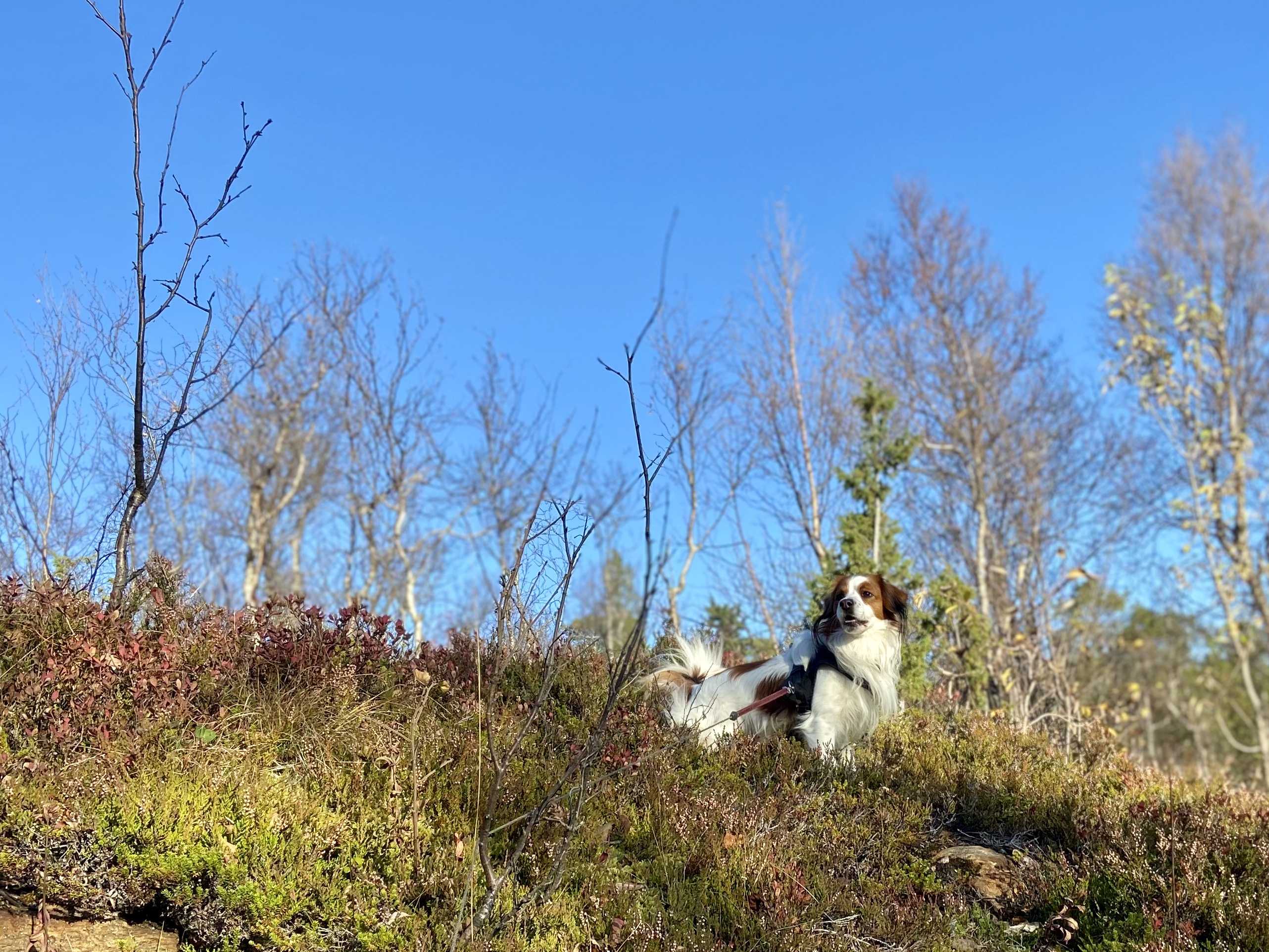
Triar seemed to be enjoying himself, rushing through the undergrowth and up and down the rocky outcrops, walking (as ever) four or five times further than me.

As you can see, higher on the mountainside, the trees are already bare, but looking down into the valley, there is still a riot of autumn colour in amongst the huddle of houses.

I awoke to another beautiful day on Thursday, and felt suddenly that I might as well use some more of those hours to take time off while it was still wonderfully light outside. Though I didn’t go on any significant walks, I decided I should make the house look a little better. Triar goes on the sofas in the house, and we do quite often eat while sitting on them, and therefore I try to keep them lined with fleecy blankets. The old ones were rather grubby and still look grey now after washing, so I bought some new ones. I had also accumulated some autumn candles, but was in danger of not getting round to deploying them. So now, as I go into winter, the inside of the house is looking as well as I can make it look. As the evenings are drawing in, and I will shortly be spending a lot of time indoors, it’s important that I have a space that lifts me up when I am there.

Setting out for work on Friday morning, I noted it was five degrees Celsius as I drove through Finnsnes. We live close to the sea, and even this far north, the Gulf Stream stops the temperature from going down as far as it does inland. So as I drove east, I was unsurprised to see the temperature dropping, quickly to three degrees and then further, down below zero and I could see there was frost on the undergrowth on the edges of the forest.

The sun was also rising slowly behind the mountains, giving them the most incredible molten gold edges and so I stopped to try and capture it. Unfortunately, by the time I found somewhere I could pull off the road, where there wasn’t forest in the way, the gold had mellowed into a normal sunrise, but it was still beautiful.

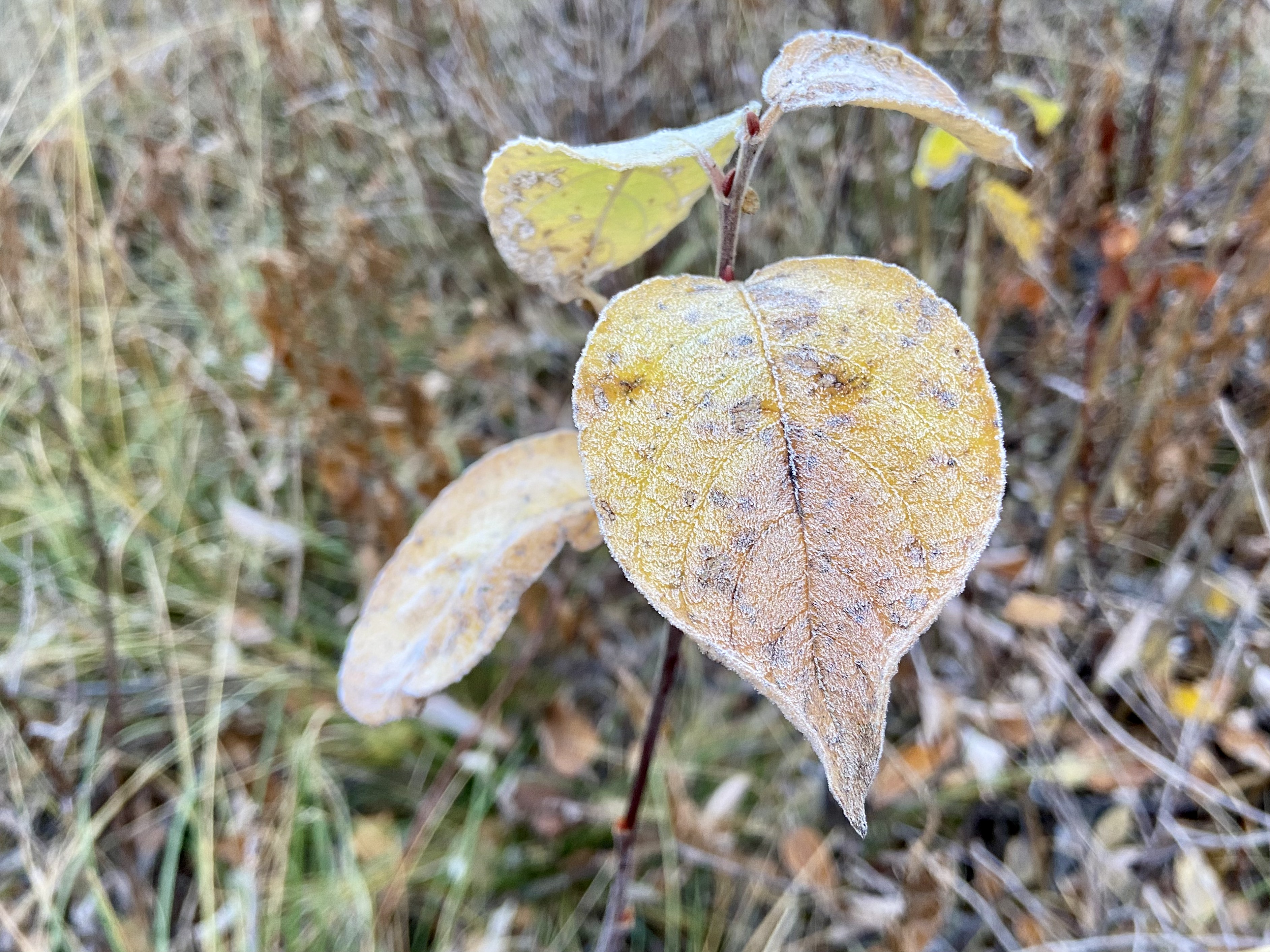
I took a couple of photos of the frost as well, not because it was anything out of the ordinary, but simply because it was the first of the year for me and a reminder that winter will very soon be here.

The Gathering Darkness

Sunrise/sunset: 06:13/ 19:08. Daylength: 12hr54min

I mentioned a couple of weeks back that it was not yet entirely dark, but from Thursday this week there has been full darkness for a short time each night. It’s hard to believe we’re already well into September. The sun is low in the sky for much of the day and the autumn equinox will soon be here.

I took that photo when I was out with Triar, and he very kindly posed for me on an upturned boat, that lies beside the narrow path we walked down.

I’m not sure what the boat is doing here, halfway up a rather steep hill, but I suspect it might be a remnant left over from a children’s play park. They quite often use old boats in playgrounds, when they are no longer any use for fishing.

Though it’s coming up for two years since I’ve been in the UK, I do like to follow what’s happening on social media. So I was interested to see, in the past couple of weeks, that the first mince pies have started to appear in shops over there. Mince pies are one of the Christmas foods I miss most. Of course I could make my own, but it’s nearly impossible to recreate the wonderful cool pastry and spiced mincemeat that you get in the shop bought version.

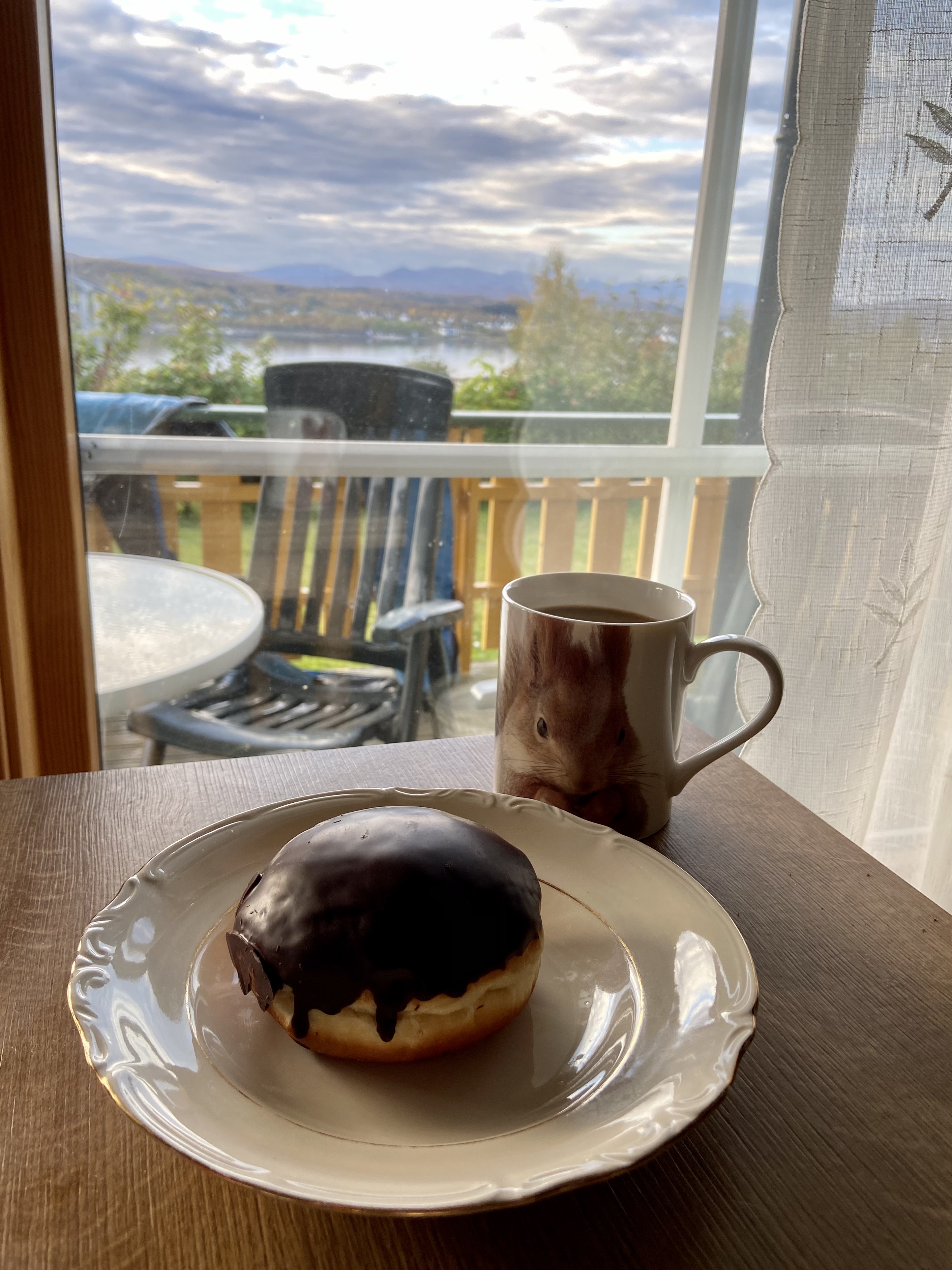
That said, I was pleased to see the return of mørketids boller to the shop I was in yesterday. Mørketid is Norwegian for polar night, which will not arrive until 30th November, so like the mince pies, they are a little early. But I love the seasonality of the foods in the shops here, and this one is specific to the north of Norway. They aren’t as good as mince pies. It’s really a doughnut with dark chocolate and vanilla filling (I have seen pictures with chocolate fillings, but have never located one). Very pleasant with a cup of coffee.

The shorter days at work also ended this week. For a few months in the summer, we work seven hour days, whereas in winter, we work seven and three quarter hours. The difference doesn’t sound much, but I was pleasantly surprised when it began, how much faster the working day passed. It’s a great perk to have shorter working days when the summer is so brief.

There are also some odd quirks in the working hours over Christmas and New Year and there was some discussion about this over morning coffee this week, when there was only me and two Norwegian colleagues present. For example, on New Year’s Eve, our official working day is only two hours. So if you have built up some time off in lieu (TOIL) then that is a good day to use it. If you take the day as holiday, it counts as a whole day off, regardless of how long or short the day is. So if you do that, you took off two hours when you could have taken almost eight if you’d chosen a different day.

I had been thinking about trying to take my one remaining holiday week between Christmas and New Year, but as most of the days then are only five hours, it is worth looking into taking them as TOIL instead. The only downside being that agreed holiday can’t be removed at the last minute, whereas agreed TOIL can.

There are a lot of differences from the UK in the Norwegian way of working, and it can be difficult to find all of them out. I should imagine it’s the same for anyone who lives in a culture they weren’t brought up in, but there are times when I have the feeling I am living in some kind of twilight zone, where all kinds of things are obscure. Nobody tells you about them as they assume everyone knows and of course, as you don’t know they exist, you don’t ask about them.

One thing that I do know about, that is definitely worse in Norway than the UK for permanent employees (and is illegal in EU countries) is that in your first year in any new job, you are not entitled to holiday pay. Last year I worked for Mattilsynet from August and so I was not entitled to any paid holiday at all from them. Technically, I received holiday pay from my last job when I left, but that was eaten up in the expenses of moving up here. This year, I only have ten days paid holiday. I can take unpaid holiday, but three weeks without pay would be quite a hit and I don’t really want to do it unless it’s unavoidable.
I’m not really sure why this rule persists. I believe it has been challenged in Denmark, which is in the EU, while Norway is technically not. But Norway does adhere to most of the other EU rules, as expected under the EEA agreement, so I am unsure why they have not implemented this one. For my part, it’s a bad rule. Given that the only “holiday” I had last year was taken up with driving up here, it feels like a long time since I’ve had a proper rest. It’s not as easy to bounce back at fifty two as it was when I was younger either. Roll on next year, when I will be back up to five weeks plus bank holidays again. I guess anyone from the US reading this might think I’m a wuss, but there it is!
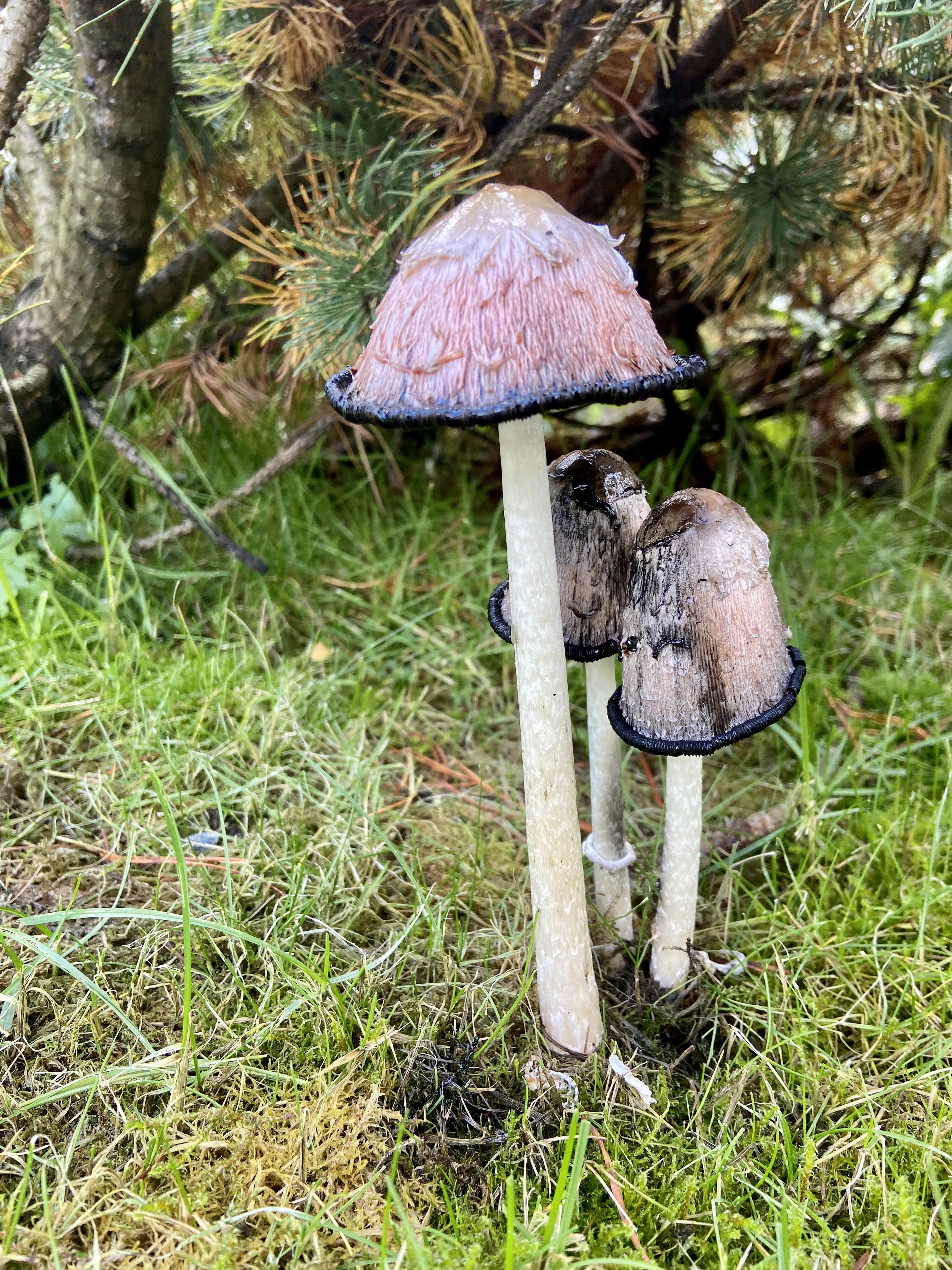
Fungi are odd things. A rather cute looking mushroom appeared one day under the hedge beside my driveaway. I took a few photos over several days. It looked tasty, and at the same time rather demure, with its closed head, all neat and dry. This was taken on the tenth of September and I think it had been there a few days. I assumed this was its final form. I rather liked it.

So I was bemused to come home on Wednesday to find it had seemingly doubled in height. The cup was now opened and its edge had a grim wet look to it! I guess it had to open as its spores must be inside, but any feelings I had that it might taste good disappeared instantly!

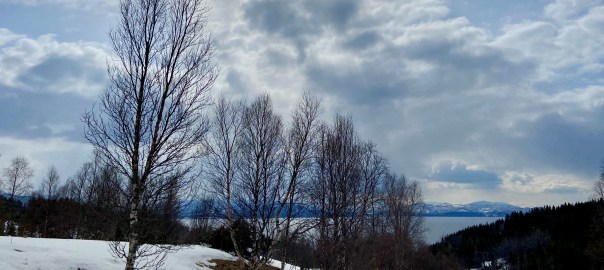
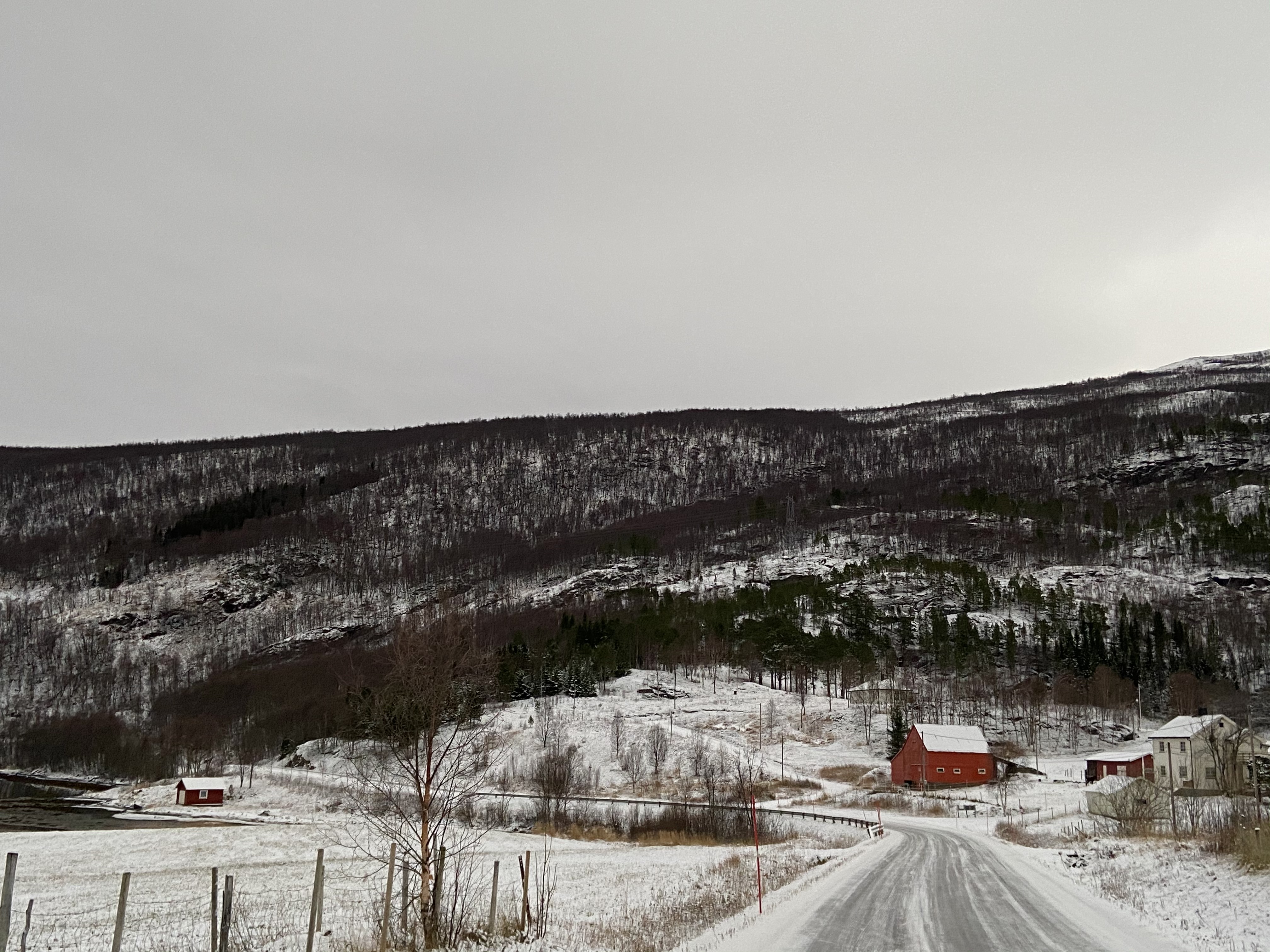
I will leave you with a couple of pictures from my drive home yesterday. There’s a falling down barn that I have been passing every time I drive to the abattoir. I decided I wanted to photograph it in the autumn of last year, but it was difficult to find anywhere to park, and then winter came and the parking possibilities reduced even further. It’s impossible to pull off the road when there’s a wall of scraped snow on either side. I drove past yesterday morning, when I didn’t have time, and thought that by the time I drove home again, the sun would have moved. But I had forgotten that the sun is now permanently in the south and doesn’t move so much from east to west as from south-east to south-west. So here it is in the autumn sun, in all its dilapidated glory. And I’ll throw in one of trees and snow topped mountains for good measure. Hope you enjoy them!

Trouble in Paradise

Sunrise/sunset: Up all day.

This isn’t going to be an easy post to write. I tend to keep these entries upbeat, but sometimes there are issues that go so deep that they shouldn’t be ignored. There has been a great deal of discussion over animal welfare in Norway in recent weeks, especially concerning the welfare of pigs. Back in 2019 NRK (the Norwegian national broadcaster) aired an exposé of problematic practices on pig farms in Norway. Using undercover footage taken over five years, it was revealed that despite Norway’s strong legal rules around animal welfare, there were farmers in the pig industry who were flouting them. Some of them seemed to be taking pleasure in the fact that they were doing so.

Mattilsynet responded by increasing welfare visits in Rogaland, the area highlighted in the program, and this year the Pig Welfare Campaign has been rolled out across Norway. I spent a great deal of time at the beginning of the year learning about the program and about signs to watch out for that might indicate that an investigation should be carried out. It is part of my job to monitor the welfare of pigs coming in through the abattoir. There are certain signs that indicate possible welfare breaches which should trigger further investigation. So far, in my time working there, the general condition of the pigs coming through has been high, but it is an important tool in the chain, particularly for pig farms, which produce meat, reared over a relatively short period, and must therefore send animals through the abattoir with much higher frequency than, for example, dairy farmers.

But of course, monitoring procedures at the abattoir are not sufficient to ensure that good welfare is being practiced. It stands to reason that farmers might not send in animals that show clear signs of abusive practices. And despite the increased inspections carried out by Mattilsynet in Rogaland, there was another report aired recently on NRK regarding animal activists who had broken into pig farms and had taken photographs of animal welfare violations.

I confess I have very mixed feelings regarding animal activists. On the one hand, if there are welfare problems within farming, it is important that those are highlighted. But on the other side of the equation, their practices in breaking in place animals at risk. There is a strong commitment to biosecurity in Norwegian farming, which obviously is ignored by those breaking and entering.

According to a virtual Mattilsynet meeting on Friday, those same activists had held pictures showing evidence of animal welfare breaches from as far back as 2016. They had not reported those breaches to the authorities, which would suggest they are more interested in creating a scandal than in addressing those issues. It is important to remember that the aim of these groups is not to improve welfare by working with the farming industry and the authorities, but to close down the animal farming industry altogether.

Accordingly, these groups always highlight the worst. How many farms did they break into? How many of those were farms with very high welfare standards? It would be much more useful to have a balanced view of the whole picture. Without that, it is impossible to tell whether they have revealed that problems are occurring in a very high percentage of farms, or whether there is huge negativity being created around “a few bad apples”.

Mattilsynet have also come under fire. It is said that we are working too slowly in closing down those farms where animal welfare is chronically poor. Perhaps that is true, in some cases, but in many circumstances there has to be a period of assessment, of attempted education and/or enforcement, before taking the huge step of removing someone’s source of income.

These kinds of scandals are always both depressing and demoralising, not least because they are a reminder that there are some very unpleasant people in the world, and that some of them actually seem to revel in creating animal suffering. It frightens me that as well as those who are careless, lazy and ignorant (which I would say are the main drivers of animal welfare issues) there are also a few who are actively malevolent. I try not to dwell on it, but there has been a case in our region which might have fallen into that category. Those people make me feel sick to my stomach and because they will lie and work hard to conceal what they are doing, I think we will never gain full control over what they do.

However, it is important not to dwell too much on the things we can’t fix. I visited a farm on Friday where there were pigs running around in the open air, digging their snouts in the earth and obviously having a great life. Birgit and I carried out the first of our Pig Welfare Campaign visits on the same farm and it was a wonderful salve to the negativity. Reports like the one above can easily make it seem that we have an uphill and sometimes impossible task in trying to police all matters within the animal welfare sphere. But it’s essential to remember there are a lot of good people in the farming industry in Norway, who are doing their very best to uphold the excellent welfare standards that are required in law.

I drove a long way on Friday to complete the visit with Birgit. Despite the distance, it’s important that we work as a team. When I see the links between the scattered offices and the abattoir and all the knowledge held by veterinarians such as Birgit, Thomas, Ammar and Hilde, all of whom have worked in this area for a long time, I am reminded of how important that web of knowledge can be. I’ve been here almost a year now and I am beginning to build up my own map. I will continue to fight for better conditions for all animals in my own capacity. And though my contribution is small, I am not fighting alone.

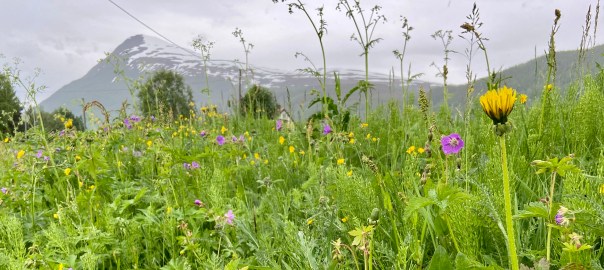
I am going to finish with a few photographs from Friday. As well as all the wonderful flowers that are brightening the verges, I drove along the side of a steep fjord, where the melting snow is creating myriad waterfalls as the twenty four hour sunlight warms the landscape.

Mixed

Sunrise/sunset: 02:50/ 22:44. Daylength: 19hr 54mins

Last week, I sent the manuscript of a new book I’ve written to a friend. It’s always a nerve wracking moment, showing something you’ve created to another person. Lara is very well read and I was optimistic that if there was any storyline or character that was completely off key, she would tell me.

It’s been a tough project. I started it a couple of years ago in a lull between the last two Hope Meadows books. It’s about a veterinary practice in Scotland: partly wish fulfilment, I think, but also an exploration the life of older women. In this modern world, where women are supposedly able to have everything, they often end up juggling job and family and find themselves trapped in situations rooted in decisions made years ago when their children were young. I was aiming for a cross between James Herriot and Sally Wainwright (the scriptwriter behind the TV series Last Tango in Halifax and Happy Valley) and I hope I’ve achieved it.

To my intense joy (and relief) Lara loved it. Practically minded and knowledgeable, she also pointed out one or two technical points about veterinary practice and rules and regulations. Once I’ve ironed those out, I will be faced with the search for an agent.

In the UK, it’s close to impossible to get a novel published without an agent. In this age of computers, so many people write that all the major publishers have inserted a buffer between them and the great writing public. They will only look at fiction sent to them by an author’s agent, so now I have to look for one. Those who have followed my progress for a very long time might know that I was with Peter Buckman at the Ampersand agency (he put me in contact with Victoria Holmes, who led me through all six Hope Meadows books) but he admitted before we set off that Womens’ Commercial Fiction (which is what I write) wasn’t really his thing, and so at the end of Hope Meadows, we parted. He has since contacted me when he got wind of another vet project, so we remain on good terms, but what I really need is someone I can bounce ideas off, so that is what I’m going to look for.

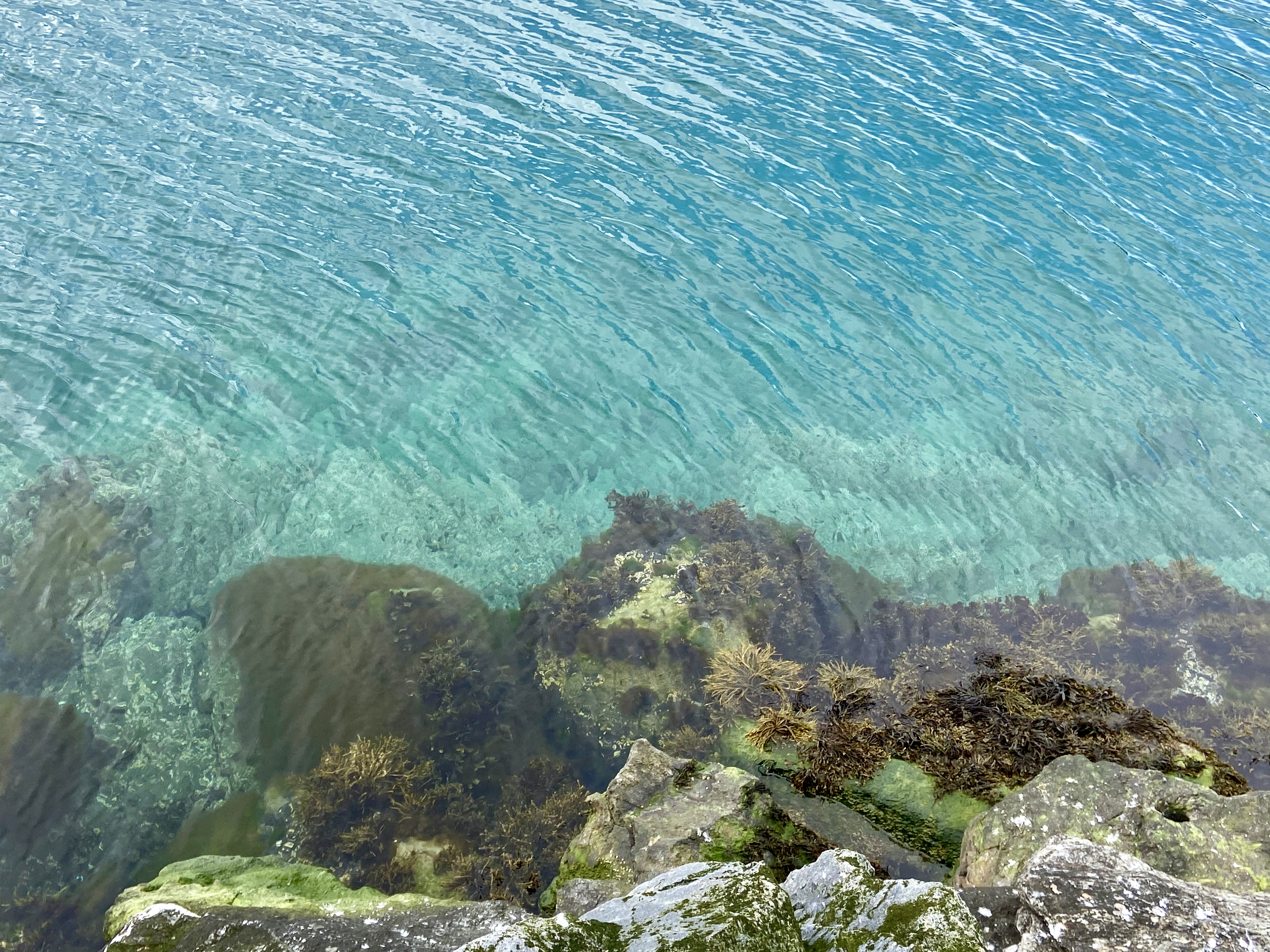
John has been home for the weekend for the past three weeks and as it was lovely weather yesterday morning, I took the afternoon off and we went out with the dog on Senja. Serious walking is out for the moment. The deep snow on the mountains is beginning to melt. Water begins to run underneath it, and so as well as being slushy and almost impossible to walk through, there’s also a risk of avalanches. So for now, we contented ourselves with a stroll near Vangsvik. We found a lovely little harbour where the water was so clear that both John and I thought it would be a lovely place for a scuba dive. Though we have some kit in the flat, it’s so long since I’ve been that I will need to contact a club for retraining if I decide I want to jump back in.

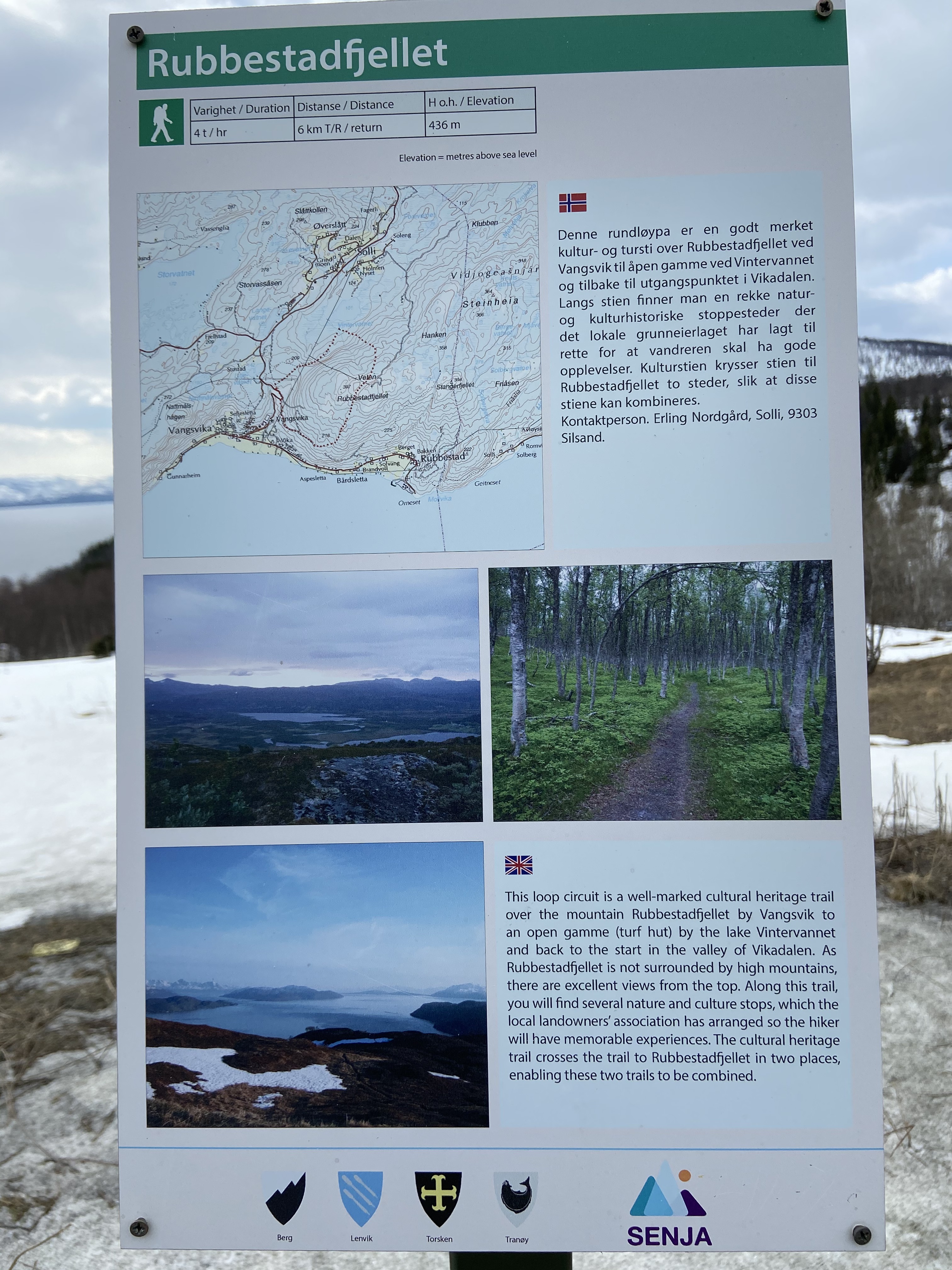
I also stopped on the way back to take some pictures and was delighted to find the start of a hike which I had never noticed before. At four hours (probably five or six at my pace – Norwegians walk everywhere much faster than I do) and with a well marked path, it sounds perfect.

If the view at the beginning is anything to go by, the outlook from the top must be stunning. In a few weeks time, we will have 24 hour daylight, and even though I’ve woken to snow again this morning, it can’t last forever. Though spring is still trying to hide, there are definitely leaf buds on the trees now. Maybe a midnight hike will be in order. Roll on summer!

Learning

Sunrise/sunset: 04:39/ 20:58. Daylength: 16hr 19mins

I had a phone call this week from a member of the public who had sent a “concern message” and wanted some follow up. In the UK, this is the kind of report someone might send to the RSPCA (SSPCA in Scotland) when they have seen an animal or animals that they are worried about and want someone in authority to do something about it. Here messages are made online via an official form.

One of the challenges in a new job where there is contact with the public is being put on the spot before you are fully genned up on how everything should be managed. Due to coronavirus, the learning process has been slow for me, but I feel I am finally getting a handle on things. Phone calls are rare (I can only remember receiving three or four) and as they can be redirected from a central line, they don’t always go to the person best placed to give an answer.

For me there’s also a language issue. As others who regularly use a language that is not their mother tongue have confirmed, if a topic of conversation arises where the context is unclear, it can take a minute or two to catch up. On one occasion when I was rushing out to a doctor’s appointment, I was called by a man about a visit someone else had made to carry out meat inspection on a wild moose. As I had no context, I thought we were discussing a call Thomas and I had made the day before. Luckily as I was in a hurry, I accidentally redirected them to the appropriate person, but as you can imagine, all the ingredients for creating some kind of Fawlty Towers level farcical misunderstanding are present.

Fortunately there was no such misunderstanding in this case, though having answered the phone without any opportunity to prepare myself, I did manage to forget almost everything I had learned.

I took down what I thought were the salient issues: details of the nature of the report (horses standing in mud with no food) and the name and number of the person who had sent the report.

Running through my head was the knowledge that Thomas would almost certainly know more because the concern messages in our area currently come in to him and he shares the details with or (on one occasion so far) delegates them to me.

I ended the call and thought through my next steps. Obviously I had to call Thomas, but I wanted to work through as much as I could on my own before doing so. There is a shared file within the DyreGo department of all current and ongoing concern messages and so my next step was to look them up. It was at this point, I realised the first of my errors.

Quite often when people make reports, they choose to be anonymous and the online form gives anonymity as a clear option. Ongoing cases are not listed under the details of the person reporting: rather they are recorded under the name and address of the animal owner. None of the cases on the list fitted perfectly. Worse still, I realised that the central bod might not have even redirected the call to our office, but to the wider Troms and Svalbard team. The horses in question could easily be hours away in Tromsø and Thomas might know no more than I did. Still, having done what I could, I went ahead and called him.

Thomas is very patient with me. He told me early on that he wasn’t, but being aware there were many things I couldn’t do, I made an effort to take on the things I could, even if it was something as mundane as coming in early to clean snow off the car we were going to use. Sometimes I get ahead of myself (MATS, the computer system we work with, is very unforgiving if you make an error – it’s designed to work through things in order and going back to correct can be “challenging”) and then he rolls his eyes and tells me not to go so fast, but mostly we laugh together.

We weren’t far into the call when my second error became clear. I had received a request for information from someone who was worried about some animals, and so of course I wanted to help. But as Thomas reminded me, as soon as we begin investigating welfare cases, we are obliged by law to keep all the details secret. Even if I could work out which case it was, I couldn’t tell my enquirer what was happening.

Nevertheless, as he knew no more about this case than I did, he advised me to call one of the members of our team who receive and review all the cases when they first come in. They carry out a preliminary investigation, examine any evidence from previous interactions with the animal owner, assess the severity of any welfare issues highlighted, and then either close the case immediately or pass it on to the nearest office for further assessment.

And so I called Birgit and explained the situation and as well as managing to find and update me on the case, she explained how to deal with the enquiry as well. One of the things the enquirer had asked was whether we’d received the report. I know from dealing with veterinary cases that when calling people, it’s often true that if you haven’t got, or aren’t able to give them the information they want, it’s helpful to have at least one positive point you can emphasise, even if it’s minor in the grand scheme of things. And so I called the enquirer back and explained that I was unable to give details about what was happening, but at least we had received the message and it had been assessed.

I was relieved to have put the enquiry to bed, as it were. I hate having unresolved things hanging over me. But a number of thoughts went through my head following the call about how I could have dealt with it if the caller hadn’t been satisfied with my response. I could have explained more about the processes we have, and perhaps how such a case would be handled.

The initial assessment would look at whether one of our team had investigated similar allegations before and the results. Where there is no history, or where the history indicates the case should be taken further, the case is sent to the local office where the inspectors decide whether it can be handled over the phone – better in these covid times in simple cases where the animal owner can send a picture or video during or shortly after the call to demonstrate whether something is true or untrue – or through a visit.

Some thoughts crossed my mind about that possible visit too. I was called out to a similar case years ago by the SSPCA. They were trying to put together a court case against an owner and I remember going out and looking at all these poor horses, standing up to their knees in mud, and thinking that if it did go to court, I would be happy to stand up for them to try and stop their suffering. But I’m not sure, with hindsight, that I would have done them much good. I can’t remember what examinations I carried out, but I do have vague memories of warnings at vet college that giving evidence in court was something of a specialist activity and we should be wary if we weren’t experienced, which I wasn’t. Perhaps fortunately for me and the horses, it was resolved without reaching court.

It crossed my mind though now, that what Mattilsynet are doing is akin to training me to be the kind of expert witness I needed to be back then. I would no longer go out to such a case and ask for guidance from the SSPCA. I would go out armed with the exact wording of the laws and by-laws that govern animal ownership in Norway.

I also have a better understanding of how you could prove or disprove an allegation. To assess whether a horse or horses were indeed without food, we would start by asking the owner. We would find out through questioning, whether they had enough theoretical knowledge to know how often you should feed a horse and how much. But that would only be the first step.

After that, we would examine the food they had available and how it was stored. We might take pictures of that. More importantly, we would examine and photograph the animal and compare it to a prescriptive scale based on anatomical features. If you can see various bony structures, you can assess where the animal falls on the scale where 1 is way too thin and 9 is very much too fat. We would look at other details as well to assess more general health and welfare. I’m not sure yet about how it would work if we ended up in court (or indeed whether that happens) but all these processes allow us to be very specific in being able to back up our claim that “the animal looks like it is suffering” with verifiable and objective facts to demonstrate that it is.

The great thing is though, that having worked through all that, the next time I get a similar phone call, I will deal with it easily. Even if the enquirer is difficult to work with, I will have a raft of background information to help me deal with it. That is the nature of being a vet. When you start out, almost everything is a challenge, but as you deal with challenges every day, managing them becomes routine.

In my current role, with coronavirus and working from home, I’ve received so much intensive theoretical training that it’s nearly coming out of my ears. This phone call and last week’s practical training with Thomas has led to all that information clicking into context. I am finally beginning to believe I will one day be good at this job. On Monday, I am going on my long-delayed week-long trip to Troms and Svalbard’s most northerly office in Storslett. I hope Birgit is prepared for the onslaught of the three million questions that have become apparent with my increasing knowledge. It’s very true that the more you learn, the more you realise you don’t know.

To finish up, I wanted to talk a little about daylight and about spring. The quality of the light here continues to surprise me. As you can see at the top of the page, we have full daylight for over sixteen hours each day. By the end of the month, there will be just over half an hour of what is called civil twilight around midnight. Civil twilight is the brightest form of twilight where the sun is just below the horizon: the same kind of light we had during the polar night.

The speed with which the changes occur probably shouldn’t surprise me. After all, we had it in the opposite direction only a few months back, but the daylength changes are so fast that the weather doesn’t really keep up. Though there have been a lot of days where the temperature has made it above zero, when rivers of melt water have run down the middle of roads and rushed down newly visible mountain streams, there is still a thick layer of snow on the ground.

Back in Scotland, it wasn’t impossible to have the odd day of snow in April, but it was a rare occurrence. I tend to associate snow with short winter days and near permanent twilight. But now I look out on all this wonderful light and the snow is still on the ground and it’s almost magically white. The picture at the top of the page shows the wonderful warm twilight as the moon rises over Gisundet Sound and the island of Senja. But the day time is equally rare and magical, and I hope that I caught something of that in this second picture.

Have a lovely weekend everybody.

Boxes

Sunrise/sunset: 05:12/ 20:29. Daylength: 15hr 17mins

Anyone else love hotels? For me there are few things more pleasurable than travelling somewhere and checking in to a hotel with a comfortable bed with clean white sheets. Better still is waking up in the morning to a lovely breakfast someone else has cooked. I will add that if you have spent a long day working out on farms in cold weather, then stepping under a powerful shower with sweet-scented soap to wash away the chill and the farmyard smells is blissful.

The only imperfection for me, was that I had forgotten to take my book. I am trying to cut down my internet time and take up reading again. There is something about escaping into the world of a book that can never be simulated by online conversation.

Things are, of course, slightly odd at the moment. I spent Thursday night at Vollan Gjestestua (pictured above) with five colleagues from the DyreGo Team, which covers animal health and welfare. Business travel in Norway is limited at the moment, but there is a certain amount of work we have to carry out over the course of the year. The area we cover between us is too large to do it easily and then drive home afterwards. In addition, lockdown and working from home is increasingly wearing, so although we had to all sit at separate tables in the restaurant and communicate by lip reading and sign language, it was good for my mental health to see my working colleagues in the flesh and not just on a screen. Yesterday we had a similarly distanced meeting.

Birgit, Thomas and Anja. Astrid was to my left and I couldn’t fit her into the photo – socially distanced pictures are hard to take!

I read a blog entry earlier in the week by Iceland Penny. It draws attention to some of the contradictions in life, things she came across that held both good and bad/beauty and ugliness. Both/And by Iceland Penny. I was reminded of the post by a discussion in the meeting we had about technology.

I have come to Mattilsynet at a time of upheaval. Some of it is driven by the drive to use less paper and more technology, but the process has been speeded up by coronavirus. If you hand over a pen and paper for a signature, you increase the risk of infection.

When we carry out a visit, whatever the reason for it, we summarise our observations on a Tilsynskvittering. This is an outline of the visit and what was checked, split into different sections related to Norwegian law, stating whether the things we saw fulfilled the legal requirements. This receipt, until very recently, was written on paper, which you then photographed before handing it over to the owner. But since December, we have moved over to using an App.

Astrid pointed out that the new technology could be rendered useless if, for example, you were in an area with no phone signal. I would add that with the small screen on a mobile phone, it is hard to do a lot of typing. In theory you could take along your laptop and connect it to the phone, but then you are still reliant on being connected and anyway, there comes a point when you have to remember to take so many things that the entire process becomes unwieldy. “There’s a lot to be said,” she commented, “for pencil and paper.”

I guess this might be partly influenced by age. I mentioned escaping into a book upthread, and said I never managed to escape into another world online, but I know there are immersive games where my children manage to do just that. But most of the DyreGo team, like me are upwards of fifty.

While I can see that all this new technology has benefits, I also see that it’s challenging when change is brought in so fast. There was an older farmer we visited last year who had been asked to make a number of improvements and Thomas had asked him to send photos once he had done so. Having not received any, Thomas arranged a revisit, assuming the work had not been carried out. When we arrived, Thomas was delighted to find out that it had. When he asked the elderly farmer why he hadn’t sent the proof along, the farmer told us he didn’t have a phone with a camera. I think when we are so connected ourselves, sometimes it’s easy to forget that others are not.

Personally I am on the fence. There is increasing connectedness that I feel ought make us more free, but instead sometimes ties us down. In the meeting, I found myself thinking about the issue of traceability in farming and food production. When an outbreak of food-borne illness breaks out, it’s an advantage that we can find out more easily where it came from. But there is an enormous amount of work in ensuring all the information is put into the system within a very short timeframe. To me that seems like a lot of pressure on farmers who grew up in a time when most of the connections were with family, local farmers and the vet, and the only technology was your machinery and the weather forecast on the radio.

There are periods when I find myself hankering after pre-internet, pre-mobile phone times. It was way easier to go “off-grid”. Anyone else remember those announcements on the wireless (BBC Radio 4) appealing to people on holiday to get in touch as their relative was seriously ill?

I worked in large animal practice, and once you were out on your calls, there was a kind of freedom, though of course that could be inconvenient if you went all the way back and then found there was another visit in the same direction. I think there was less pressure in practice to be right all the time and to know everything. You built up knowledge through experience, through speaking to colleagues, through reading books that were probably already out of date as they had been sitting on the shelf in the practice for several years.

Nowadays, if you know where to look online, there are answers to be found and groups you can join. Anaesthetists discuss the intricacies of different protocols, breed and species differences and how to achieve perfect pain relief. There’s good and bad in that. Better specialisation, increased cost. Some things are lost as well, in this new world. A safe path can be equally well achieved with long familiarity with drugs and techniques, built up over a lifetime of experience. Sometimes I feel everything is now moving too fast.

That said, I can’t put aside the positives. I wrote six books while living in Norway with a co-author in Somerset for a company based in London. Victoria Holmes and I batted ideas across the ether in e-mails in a way that allowed thinking time without excessive delays. We couldn’t have done that over a traditional telephone line or in letters. I am also connected to friends I went to school with and teachers who would otherwise only be a pleasant memory (hello Mr Gorski!). I would never have heard from them again without it.

Even so, despite the positives, I find myself wishing that we could insert a grandfather clause into modern life. A grandfather clause, for those who don’t know, is an exemption from following new laws if doing so would be too costly or difficult. The most obvious example would be with building regulations that require new business premises to follow certain rules with regards to toilet provision, but don’t require that older buildings are brought up to the same standard.

I can’t help feeling that if staff who have worked adequately for years with a pen and paper are retiring within the next ten years or so, they could be allowed to continue without it doing a great deal of harm. It would save them a lot of grief. There is an aspiration that wherever you are in Norway and whatever your business, Mattilsynet will assess and deal with your case in the same way. I can see the value in that when it comes to assessing whether legal requirements are fulfilled.

But whether the report is sent online or on paper? When it really comes down to it, that doesn’t make a whole lot of difference, in the grand scheme of things.

The Open Road

Sunrise/sunset: 06:49/ 17:11. Daylength: 10hr 21mins

The feature photograph above is of a message Anna left me on Tuesday, having watched the snow gradually deepen as she sat up into the early hours, knowing I had an early start. She left it propped against the cream in the fridge, correctly surmising I’d see it when I made my coffee before heading out. She knows me so well!

I read an interesting report this week. The Organisation for Economic Co-operation and Development (OECD) have carried out an assessment on Norway’s food safety, which includes an assessment of agricultural practices. I’ve probably mentioned before that when I visit farms in Norway, a lot of attention is paid to biosecurity. There are laws requiring certain measures, including notices placed outside the barn or shed to say that entry is restricted and a “lock” area with some kind of physical barrier or line which requires a change of footwear (and often clothing) to enter.

I don’t know the current situation in the UK. Presumably in some areas, such as poultry production, they employ a similar system and change clothes on the way in and out, but when I went on cattle or sheep farms, I would travel around using the same wellingtons and waterproofs with only a quick wash between each visit. Even during the Foot and Mouth outbreak in 2001, the only difference was that the wellie wash was a bit more thorough; disinfectant was used and sloshing down the car tyres was added in.

So I was interested to see what the OECD had to say. Unsurprisingly, Norway scored very highly on food security. This is surely a good thing, you would imagine. But the feedback messages were mixed. Despite the high score, the OECD criticised the system for being too expensive. The word “overfulfilling” was used. The rules don’t allow enough potential for increased value, apparently. Of course, that is business bunk for “your food is too expensive and therefore not competitive in our international markets”.

The Norwegian response to this was rather predictable. They know (of course they do) that their food is not competitive. I have been reading a lot around pig farming in Norway and it is specified and fully accepted that almost all the pork produced in Norway goes directly into the Norwegian market for exactly that reason. But they feel it’s a price worth paying to ensure health and welfare are prioritised. Biosecurity in the food industry is the cornerstone of the Norwegian government’s agricultural policy. Meat in Norway is, of course, notoriously expensive, but perhaps it should be. The recent discussions during Brexit about chicken washed in chlorine were an eye opener for many people. There are lots of ways to keep food safe and ensuring your animals are as free of disease as possible is, in my opinion, beyond criticism.

Anyway, enough politics. This week has been noteworthy because after two months of working almost exclusively from home, there has been a big change this week. Birgit, Thomas and I have been visiting our local veterinary practices. Building up links is a useful thing to do. Mattilsynet carry out some routine inspections on farms, but we can’t check everywhere and rely on reports from other people to direct us to places where there are concerns about welfare. There’s a very human side to that, of course. Animal welfare doesn’t always suffer because of intentional negligence. Sometimes animal owners are ill or unable to cope. Sometimes they are uncertain of how to care for their animals too, and part of our job is to step in when there are problems.

So we want the vets who cover our patch to be part of something bigger than Mattilsynet. We need a network of support. During the visits, Birgit explained that there are now two dedicated “animal crime” police officers in Tromsø who form part of a new initiative . This is important when it is potentially unsafe for us to carry out visits, for example, and in the other direction, when police activity leads to the discovery of neglected pets during the course of carrying out their routine duties.

And so, I have been out and about a lot more, and of course here in Northern Norway, that requires assessment of (and allowances for) the weather conditions. After a huge thaw at the beginning of the week, with landslide warnings all over the place, it has now settled back into seemingly perpetual snow showers. The thaw, while rather alarming, was beautiful. Instead of a huge flat expanse of snow, the lakes took on some colour, though the thaw was not long enough for the ice to melt.

But now the snow has returned with a vengeance. One of the veterinary practices we visited was up a narrow track between snow-capped trees. I confess I was rather envious of the vet who had set up her one-woman practice in such a wonderful place.

The Norwegian road agency do a great job keeping the roads clear. On the way to my last visit, I was a little early and I stopped in a layby and took a photograph of the E6 road. This is the main trunk road that stretches down through the whole of Norway and then to the southern tip of Sweden. One day, perhaps I will drive the length of it. But that will be a whole new project.

A Road Trip… and a Walk

Sunrise/sunset: Down all day.

A lot to get through this week, but come with me first on a road trip. Thomas and I took off into the darkness on Tuesday morning on a three day mission. With coronavirus, the Mattilsynet team that covers Troms and Svalbard was a little behind on one of the annual campaigns that had been set at the end of last year. The plan was to roll up unannounced at a number of farms to check whether the animals had their full complement of ear tags . In Norway, farm animals are closely tracked from the time they are born until the time they die. All of them should have two tags, one in each ear, and that was what we were going to check.

Being efficient, Thomas had added other parameters onto the list. If we were lucky enough to find some sheep or goat farmers in, we were to check whether the farmer knew the symptoms of scrapie (a disease like BSE that causes neurological problems) and what systems they used to monitor the movements of animals on and off the farm.

It’s a bit of a hit and miss affair rocking up at farms unannounced. Farming is a job with irregular hours and it’s common here, where farms tend to be much smaller than those in the UK, for farmers to have other jobs in addition to their animals. Nonetheless, by the end of a fairly long day, we had managed to get round two herds of cattle and three flocks of sheep. I hadn’t reckoned on it being quite so exhausting. When I worked in the UK, we travelled round farms pulling on the same pair of waterproof trousers and wellington boots at each place. A quick wash at the end and good to go. Here, before entering each barn or byre, we have to enter what’s called the sluse, step over a bench or line of some sort in your stockinged feet, then pull on a papery jumpsuit, big white boot covers and a face mask. For all those who wear glasses and have worn a mask in cold weather, you will appreciate how hard it is to check anything once your glasses are well and truly steamed up. What with that and the freezing air and rough snowy roads, I was very tired by the time we arrived at the hotel where we were to meet Birgit who had been on a similar expedition of her own.

It may have been the best shower I’ve ever had. By the end of it, I could feel my toes again and the aroma of animals had been washed out of my hair. Birgit had retired early, so it was just Thomas and I that met in the hotel restaurant for dinner. After that, we retired as well, having arranged to meet for breakfast to plan the next day’s manoeuvres.

We set out in darkness again on day two. When the light did come it was lacklustre and overcast with the kind of distant, undefined sky that often heralds snow. Though the countryside was beautiful, it was close to monochrome with only the occasional splash of colour of the traditional red-painted barns.

One of the farms we visited was very impressive. As well as some 250 well-kept Norwegian white sheep, there was a brand new barn where they are building a glassed in warm room with leather armchairs for watching the sheep overnight at lambing. You can see the window of it here on the right of the picture.

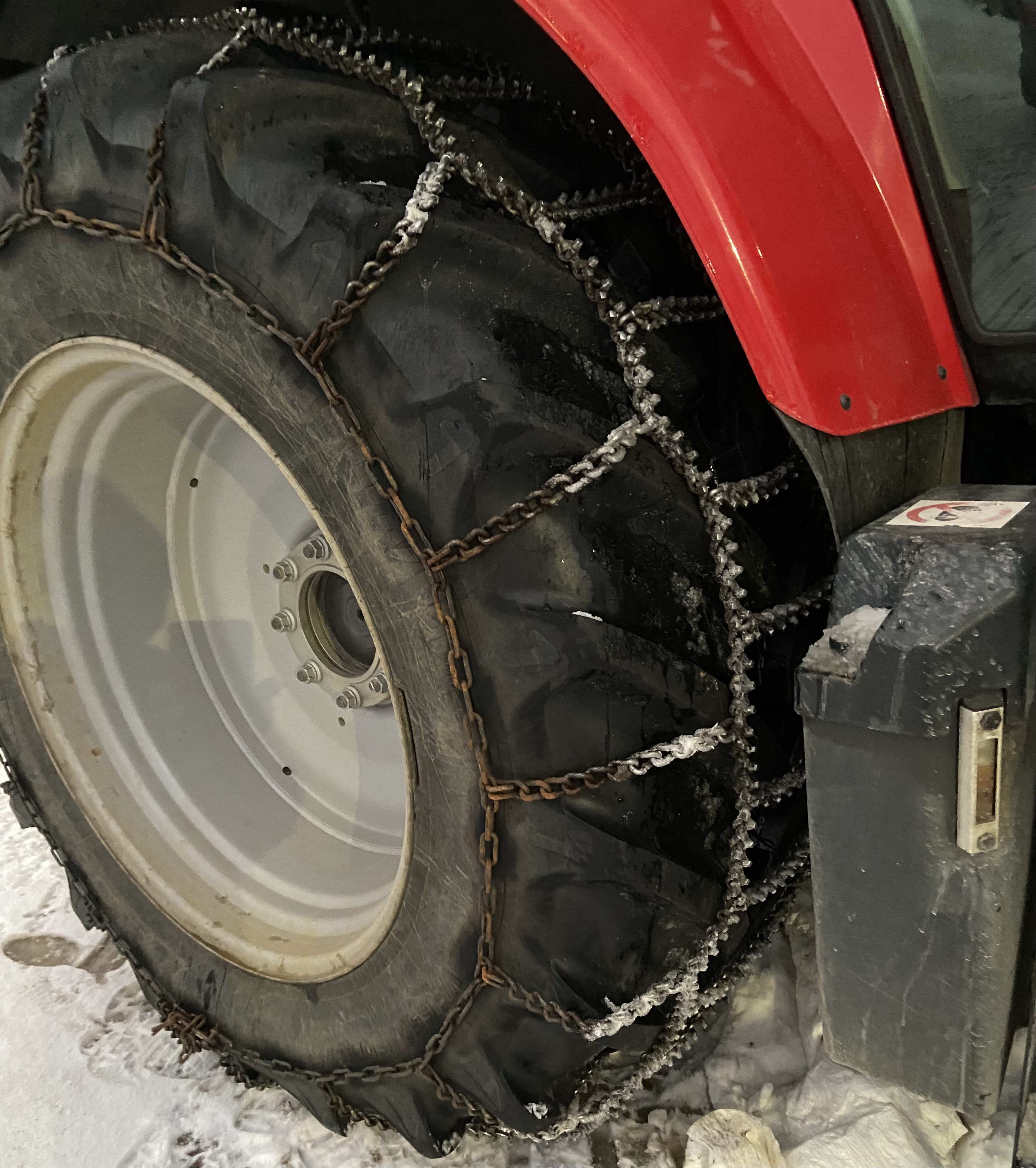
I had been intrigued on the drive north to see a layby that was designed for lorry drivers to stop and put chains on their lorries, but I was even more fascinated to see that even tractors need them here.

Back at the hotel, more of Mattilsynet’s staff were arriving. There was a departmental meeting in the morning where the work would be planned for next year, but tonight the plan was to enjoy some food together.

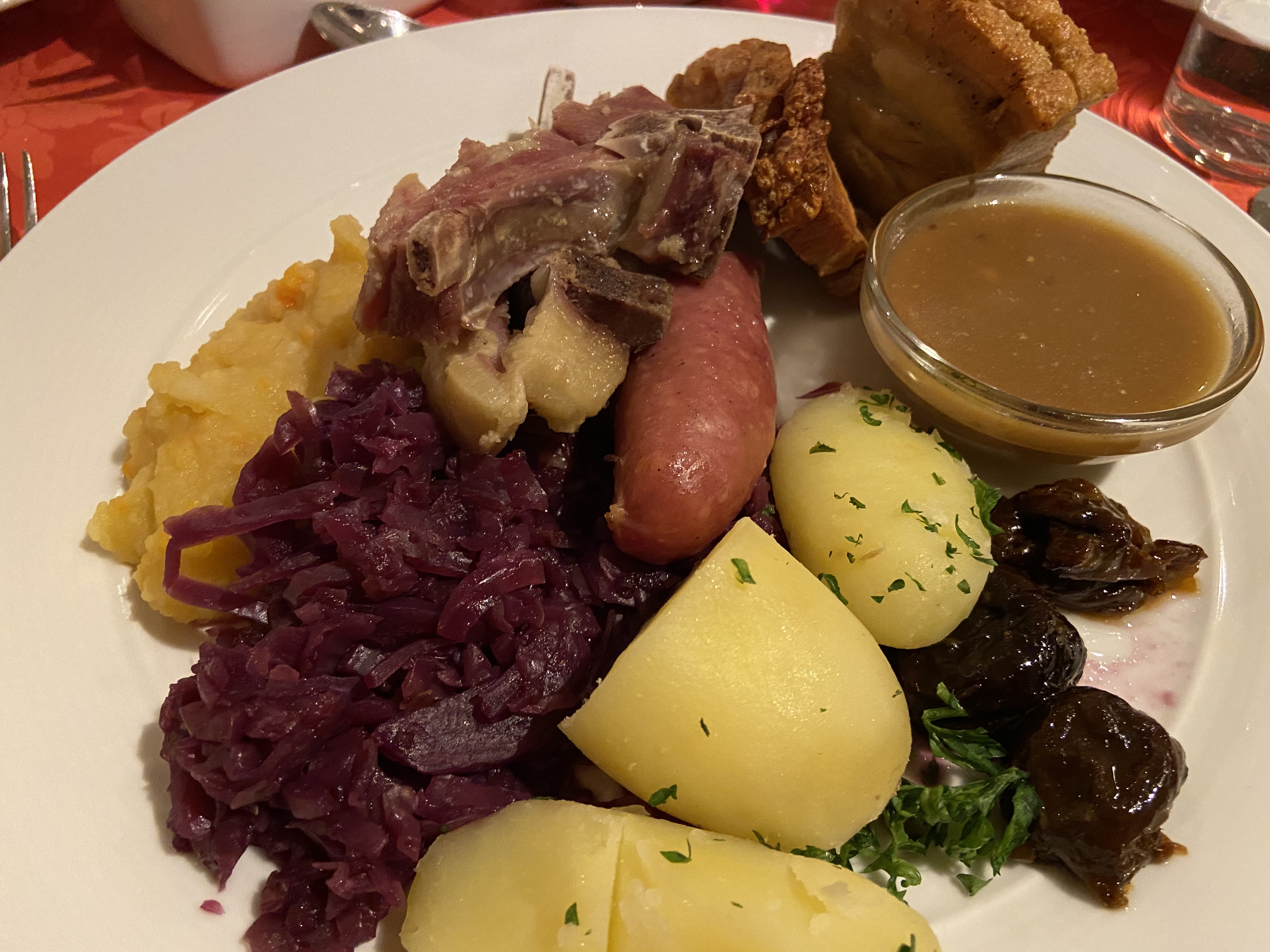
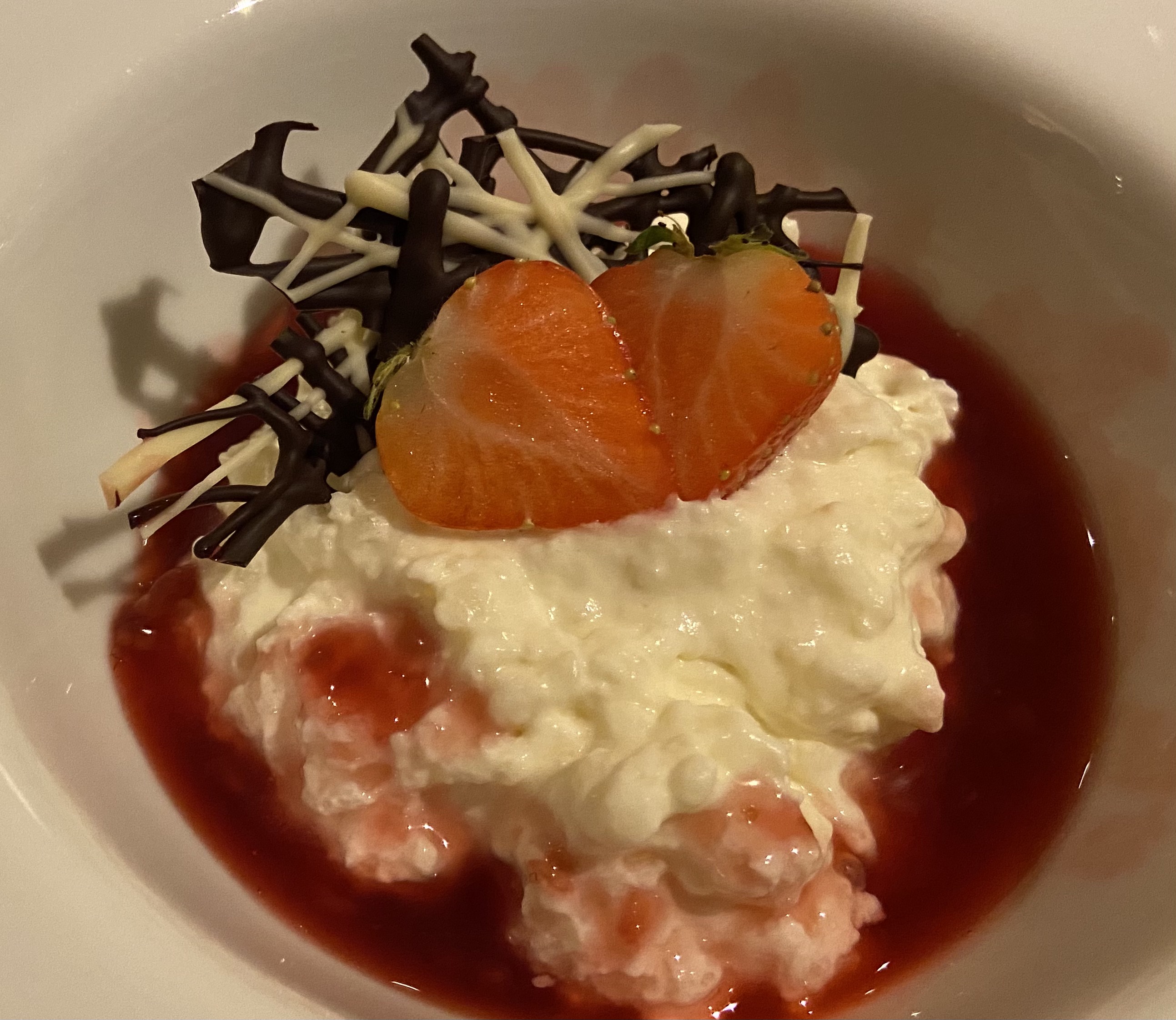
Everyone was very cheery as we sat down and enjoyed a fairly traditional Norwegian Christmas feast: two different kinds of fish pate, a selection of meats including ribbe (a cut of pork from the flank) pinnekjøtt (salted lamb cutlets and ribs) mutton sausage and various vegetable accompaniments, then rice pudding with raspberry sauce.

Social distancing with Anya, Astrid, Ann, Birgit, Ammar and Thomas

It was great to meet up with other staff from the offices in Tromsø and Storslett and I returned after all the visits and the meetings feeling I had a better understanding of how everything works.

And to finish off, let me invite you for a walk on Senja with John, Triar and me. Imagine the still, frosty air and the crunch of snow underfoot. The sky in one direction is a cool duck-egg blue. The other way there’s a wonderful sunrise that melts into sunset without the sun ever making it over the horizon. There is hoar frost on the trees and animal and bird tracks in the snow. And after that, I’ll let the photos speak for themselves.

Goaty

Sunrise/sunset: Down all day.

Another interesting week at work. On Monday, Thomas and I made a visit in response to an anonymous “Concern Message”. I was nervous as we drove out. This was, in part, due to the nature of the visit. Obviously nobody wants to be reported and it’s quite possible that some of the recipients might be angry. But it was also because I was unsure whether Thomas would want me to lead the inspection and interview. He had shown me how to print out the point-by-point sheet which we use to guide us through and I went in clutching a clipboard. However, by the time I had struggled into my tissue-thin jumpsuit, huge white foot covers (tied with a bow) mask and gloves he had already begun and so I followed him round, listening carefully as he asked questions and noted down the replies.

I felt much more relaxed on the return journey. The presence of my clipboard was explained when he told me I should fill it in on our next time out as he pointed out having two separate records rather than one makes it less likely that anything will be missed. Next time out, I will also ask any questions that come into my head. There were some I thought of while we were out that I didn’t ask. With hindsight they were genuinely pertinent and could have been useful.

Back in the office, Thomas helped me through the next stage, which was writing a letter to the owner explaining the results of the inspection, and any actions considered necessary. This was another first for me, though I was aware of some of the rules we have to follow. These include all sorts of factors, such as ensuring that every action we ask the owner to take is backed up with the exact clause in Norwegian law that we are relying on, making sure the wording is simple to understand and perfectly clear, and ensuring the language we use is factual and not a value judgement. For example, we can note that an animal has been urinating and defaecating on the floor, but should never state that the house is disgustingly dirty.

I also discovered, as I worked through the response process, that there are many checks and balances in place to ensure we get things right. Once the letter was finished, we sent it to a Norwegian colleague to ensure the language was correct. After that it will be sent for official assessment by a dedicated group… and after that, it will be sent to Hilde, in whose name it will be sent out, assuming she also feels it passes muster. Though this sounds intimidating, I’m very glad that there will be plenty of help ensuring that I don’t make any errors due to the fact that Norwegian is not my mother tongue.

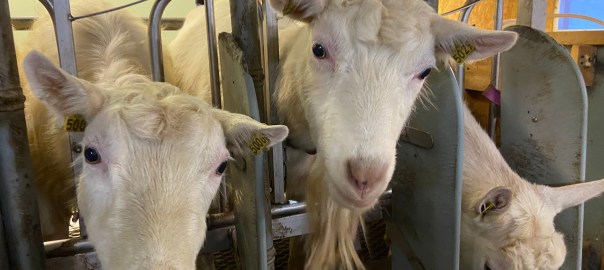
On Tuesday I drove out to meet Birgit, who works in the Storslett office. Our task was to blood sample forty goats to check for brucellosis as part of the annual OK Program. Brucellosis is a bacterial infection that can pass between animals and people and can cause long term fluctuations of fever, joint pain and various other nasty symptoms. As in Britain, there is currently no brucellosis in Norway and hopefully it will stay that way.

While I don’t think I have blood sampled many (any?) goats before, I spent several years in mixed practice in the UK. Back then, all mature cattle were tested for brucella every four years and I found myself quickly falling back into the rhythm of it. The test tubes we use come with a vacuum. If you push the needle through the rubber bung in the top and allow air to be sucked in instead of blood, then you waste the test tube. Brigit seemed very pleased with me as I managed to complete forty samples without losing a single one. On my part, I felt delighted that the skill I learned many years ago was finally being used again.

We are now almost at the end of the first week of the polar night. As you might have spotted in the windows in the picture above, it is not completely dark all day. Indeed for a short time between eleven and half-past one, it feels very much like full daylight. I stopped to take a photograph on the way back from the blood test to share here. This was taken at about 1pm, though a very short time afterwards it started to snow heavily, and the darkness drew back in.

On Thursday, we put up the Christmas decorations in the office and Andrew and I brought out a few of our decorations at home, though the tree will wait for Anna’s arrival on Monday. Most workplaces in Norway put up some decorations. Like the Danes, Norwegians take a lot of pride in encouraging comfort during the dark winter months.

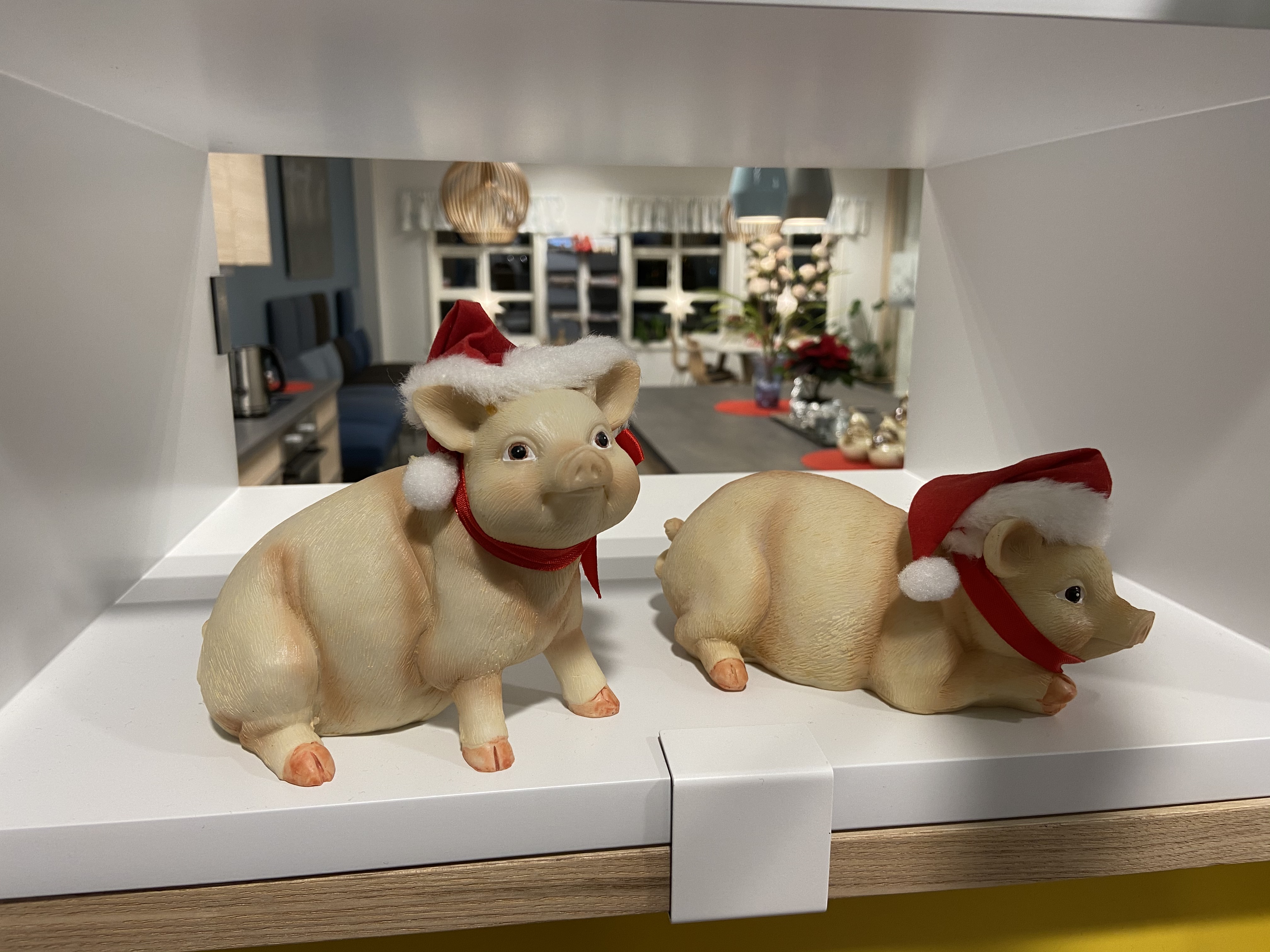
I was struck afresh, when I looked at the photographs, that in some ways they are quite different from British decorations. Pigs play a big part here. A stocking is surely not complete without a marzipan pig. And the little hatted “nisse” are a regular feature. Nisse look a bit like garden gnomes and shouldn’t be confused with Santa. According to tradition, you have to feed the nisse creamed rice or other treats or they will play tricks on you.

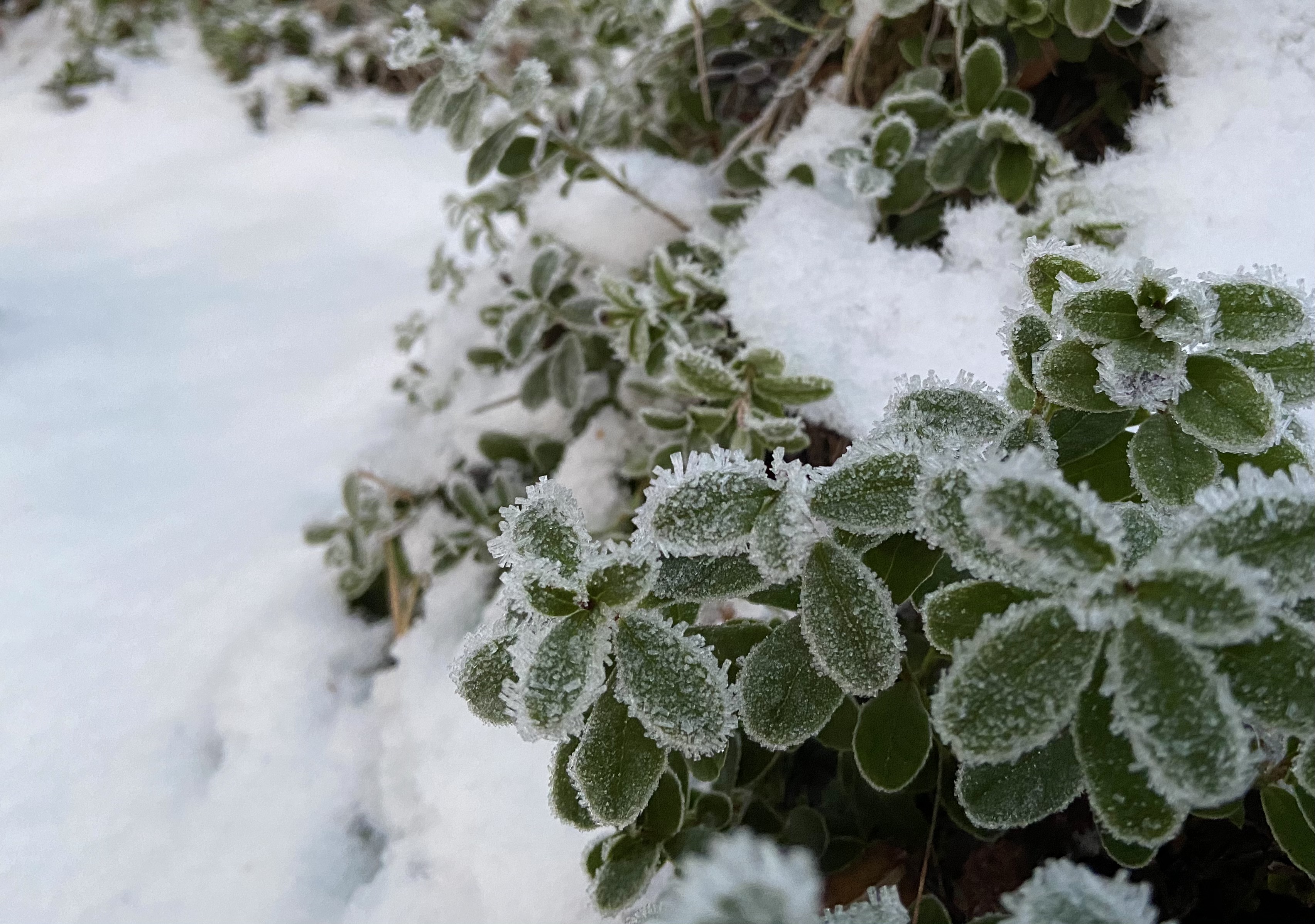
On Friday I was on the early shift at the abattoir. We live close to the coast and even this far north, there is some warming effect from the gulf stream, but just a forty minute drive inland can mean a ten degree difference in temperature. I met John in the evening after work and we went out for a pizza, but as the restaurants didn’t open for an hour after we finished, I stopped to fill the car up with diesel and was struck by the beauty of the ice formations that the frost had etched onto the car. And so, being me, I grabbed my phone and took a photo to share with you. Have a lovely weekend.