Only another three days and we will reach the point where the sun officially doesn’t drop below the horizon until 24th July. I know now that there will be a delay due to the height of the surrounding mountains. For a few days, it will continue to sink behind them, but after that, on sunny days, we should be able to see the midnight sun.
John told me yesterday about a conversation with a friend. John was trying to express how it felt to see the sun again after the polar night. Although it never reached the point of being dark 24/7 there was an ethereal quality to the light and for a month and a half, there were no shadows, even when the sky was clear. The return of the sun felt like a catharsis. John tells me his friend commented that you have to appreciate the small things, but up here, it didn’t feel small at all.
I feel a bit the same now we are waiting for spring. It’s a long time coming. I’m not sure what I was expecting. After all, I lived in a more southern part of Norway for ten years and spring didn’t arrive until May even there, but with the long daylight hours, it feels strange that things are not further forward. I find myself searching for signs and they are appearing.
All around I hear water running where in winter there was frozen silence. Where there is a rise in the forest floor or a slope that faces the sun, there is a noticeable green tinge. Yellow flowers that look like a cross between daisies and dandelions are pushing through the dirt that has been deposited on the roadsides from five months of snow clearing.
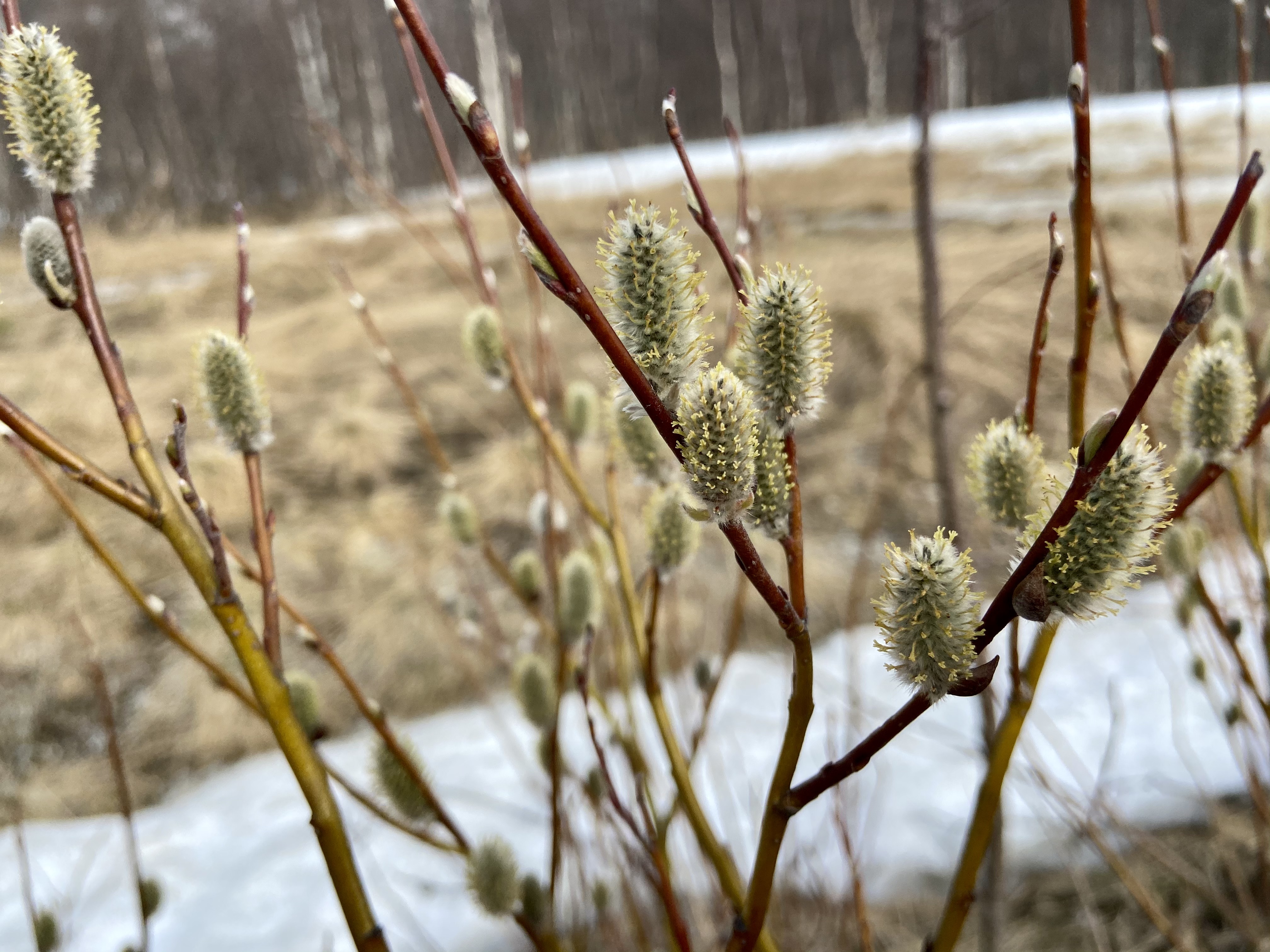
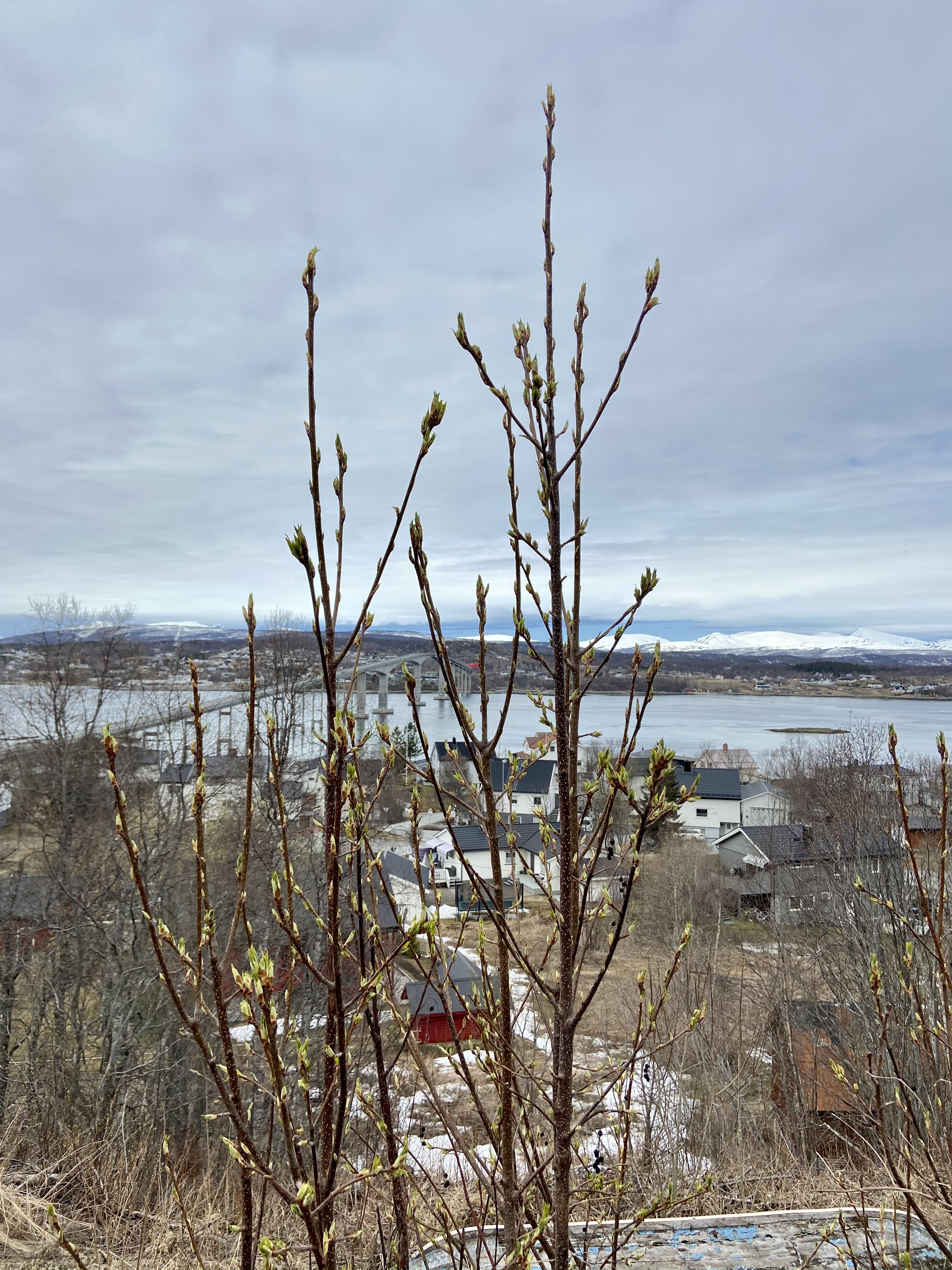
Two days ago, one of the small trees behind the house sprung new leaf buds. I trust that the others will not be far behind. There are a lot of deciduous trees here. The lower slopes of the mountains are swathed in forests and many of them still look black. Surely the change must come soon. I find myself hoping that the lower slopes will be green while the upper slopes are still swathed in snow.
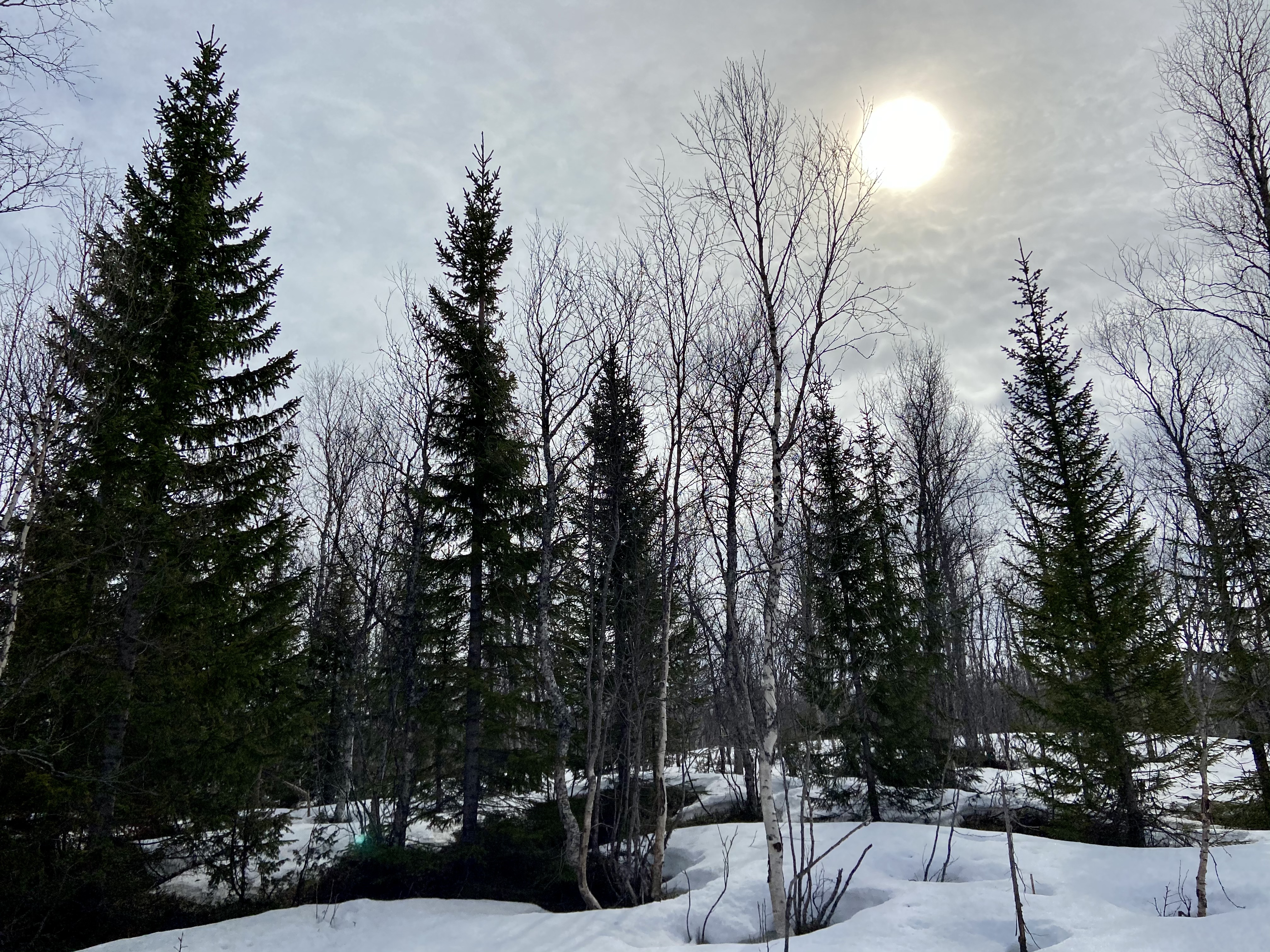
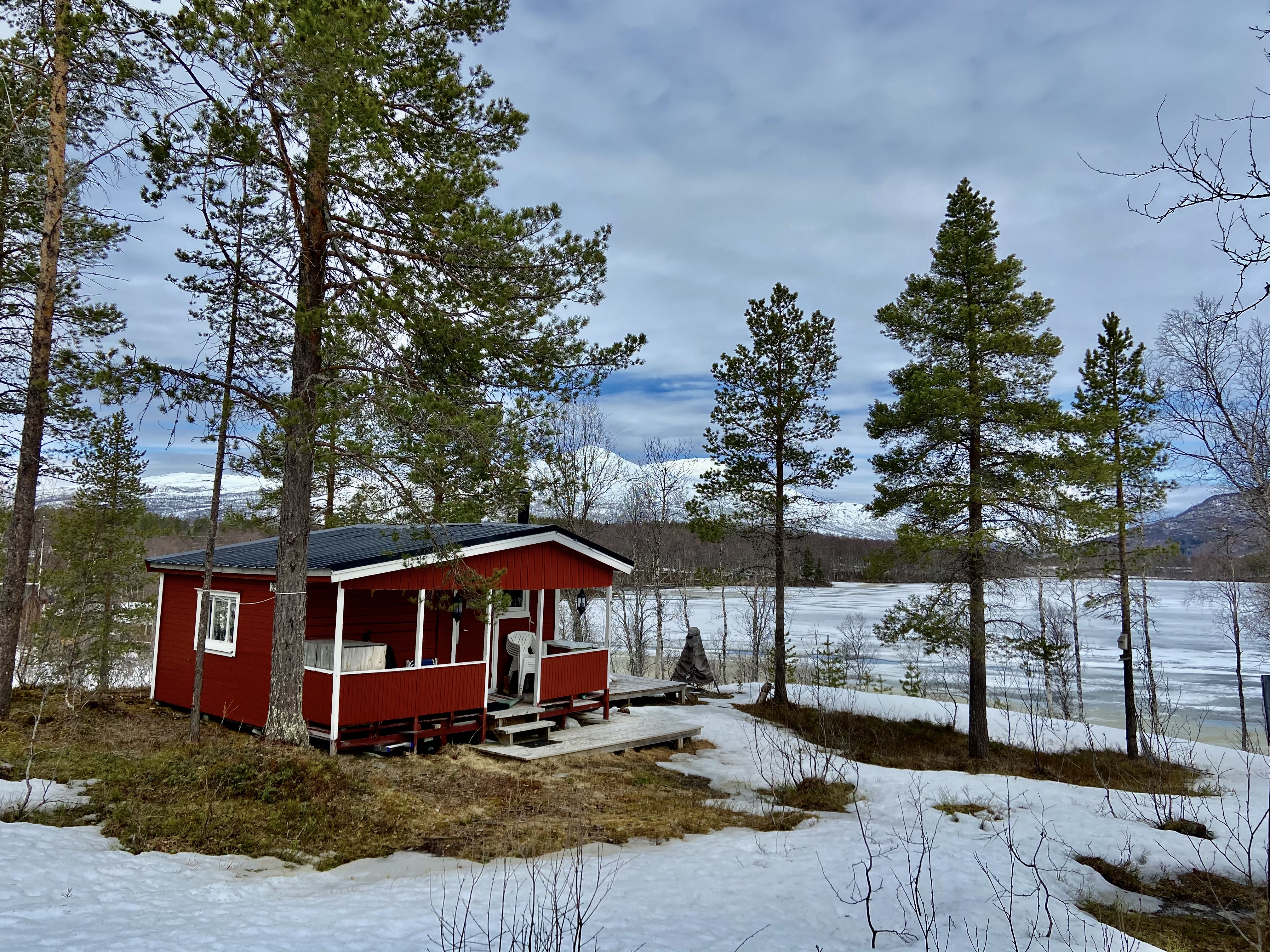
Elsewhere, it seems like winter still has a hold, albeit one that is weakening. Lakes are still frozen, the forests are still filled with snow.
I remember John commenting in August last year that winter never really leaves here. Instead it retreats up into the shadowy corners of the mountains. But that will do for me. Tomorrow is May 17th, which is Norway’s national day. We will be going down into the centre of town to see the children march. As is traditional here, we will be feasting on Norway’s national dish: hot dogs. I hope the sun will be shining for us all.
Last week, I sent the manuscript of a new book I’ve written to a friend. It’s always a nerve wracking moment, showing something you’ve created to another person. Lara is very well read and I was optimistic that if there was any storyline or character that was completely off key, she would tell me.
It’s been a tough project. I started it a couple of years ago in a lull between the last two Hope Meadows books. It’s about a veterinary practice in Scotland: partly wish fulfilment, I think, but also an exploration the life of older women. In this modern world, where women are supposedly able to have everything, they often end up juggling job and family and find themselves trapped in situations rooted in decisions made years ago when their children were young. I was aiming for a cross between James Herriot and Sally Wainwright (the scriptwriter behind the TV series Last Tango in Halifax and Happy Valley) and I hope I’ve achieved it.
To my intense joy (and relief) Lara loved it. Practically minded and knowledgeable, she also pointed out one or two technical points about veterinary practice and rules and regulations. Once I’ve ironed those out, I will be faced with the search for an agent.
In the UK, it’s close to impossible to get a novel published without an agent. In this age of computers, so many people write that all the major publishers have inserted a buffer between them and the great writing public. They will only look at fiction sent to them by an author’s agent, so now I have to look for one. Those who have followed my progress for a very long time might know that I was with Peter Buckman at the Ampersand agency (he put me in contact with Victoria Holmes, who led me through all six Hope Meadows books) but he admitted before we set off that Womens’ Commercial Fiction (which is what I write) wasn’t really his thing, and so at the end of Hope Meadows, we parted. He has since contacted me when he got wind of another vet project, so we remain on good terms, but what I really need is someone I can bounce ideas off, so that is what I’m going to look for.
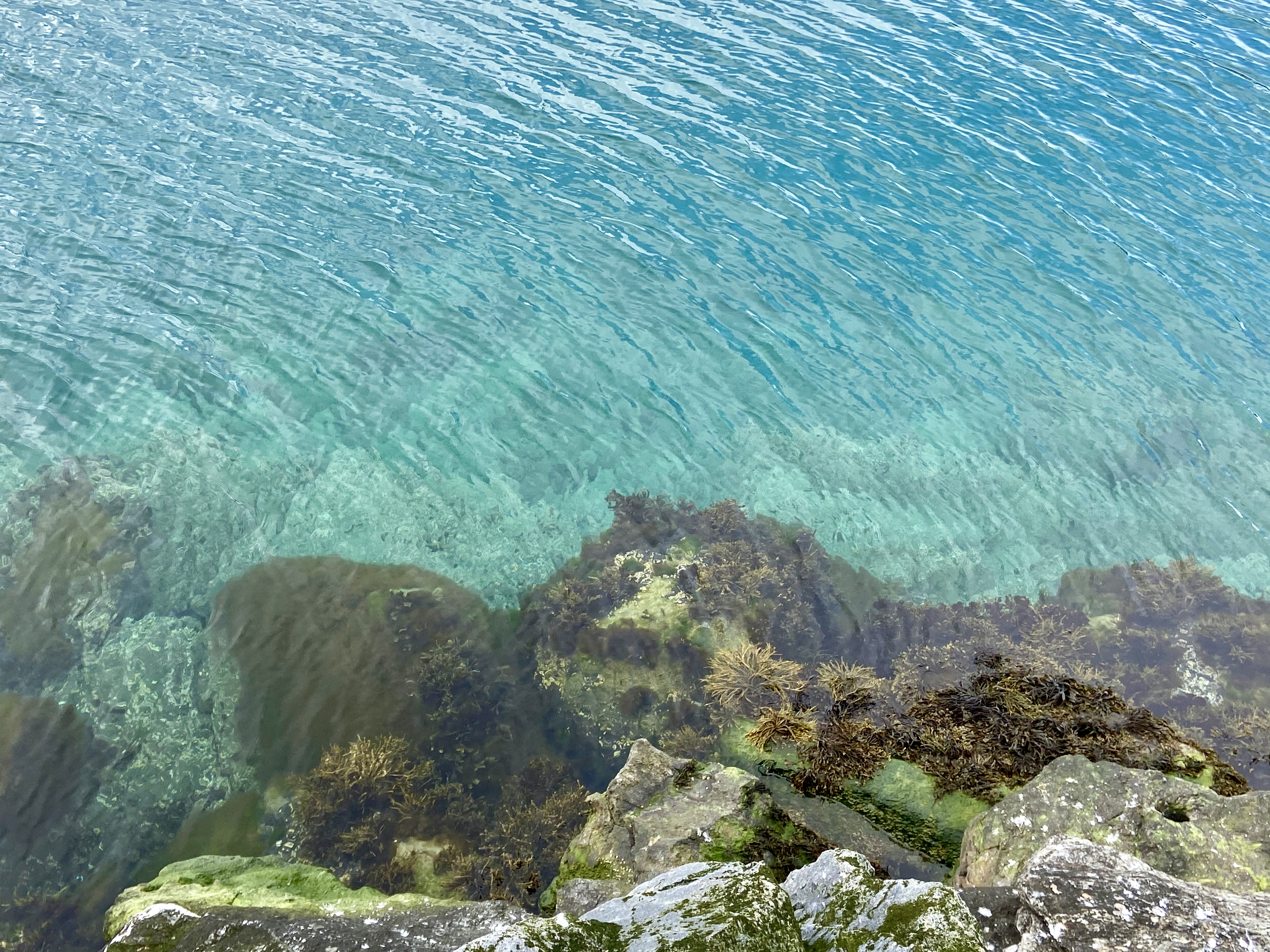
John has been home for the weekend for the past three weeks and as it was lovely weather yesterday morning, I took the afternoon off and we went out with the dog on Senja. Serious walking is out for the moment. The deep snow on the mountains is beginning to melt. Water begins to run underneath it, and so as well as being slushy and almost impossible to walk through, there’s also a risk of avalanches. So for now, we contented ourselves with a stroll near Vangsvik. We found a lovely little harbour where the water was so clear that both John and I thought it would be a lovely place for a scuba dive. Though we have some kit in the flat, it’s so long since I’ve been that I will need to contact a club for retraining if I decide I want to jump back in.
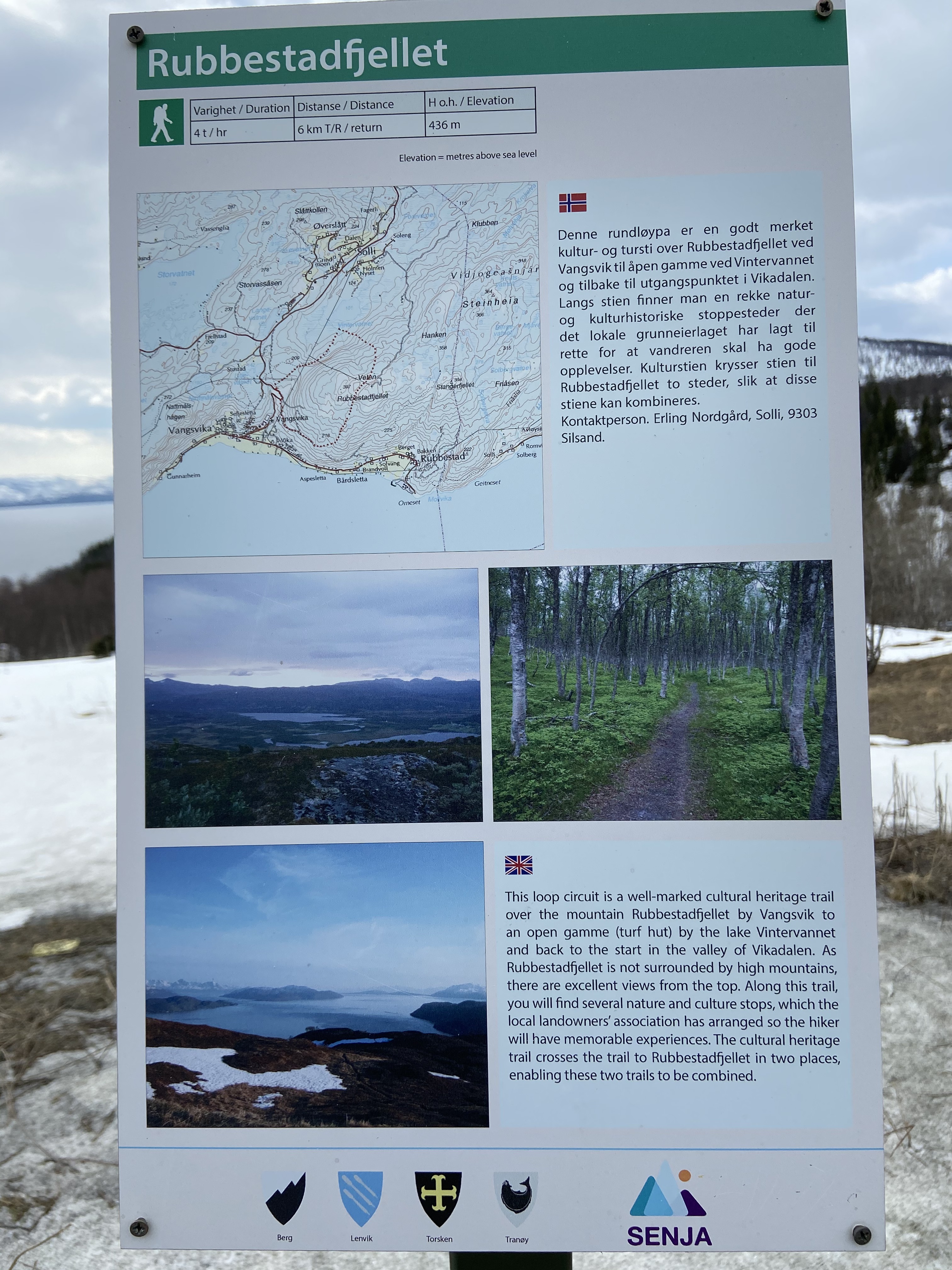
I also stopped on the way back to take some pictures and was delighted to find the start of a hike which I had never noticed before. At four hours (probably five or six at my pace – Norwegians walk everywhere much faster than I do) and with a well marked path, it sounds perfect.
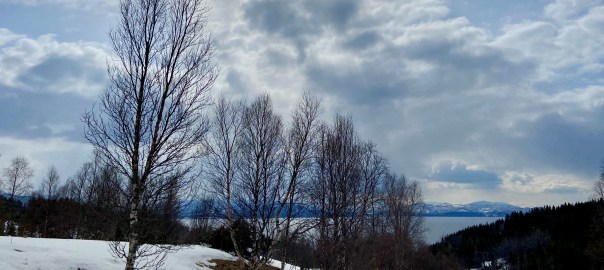
If the view at the beginning is anything to go by, the outlook from the top must be stunning. In a few weeks time, we will have 24 hour daylight, and even though I’ve woken to snow again this morning, it can’t last forever. Though spring is still trying to hide, there are definitely leaf buds on the trees now. Maybe a midnight hike will be in order. Roll on summer!
I drove home from Storslett on Friday last week, but not before taking a photograph of fish hanging outside to dry. Birgit and I were inspecting a goat herd and another flock of sheep, and on the way I finally spotted some racks that were in use. Norwegian stockfish is dried cod, usually of the prime seasonal Arctic variety that is called skrei. It hangs outside between February and May and has been a traditional foodstuff and an export since Viking times. It is the main ingredient in the Italian dish Bacalao. John and I saw much bigger drying racks last summer as we drove through Lofoten, but as that was in August, there were no fish back then. So having spotted these on the way, I asked Birgit to stop on the way back and I ran along the road, hopped over the barrier and staggered down a grassy bank to get a picture.
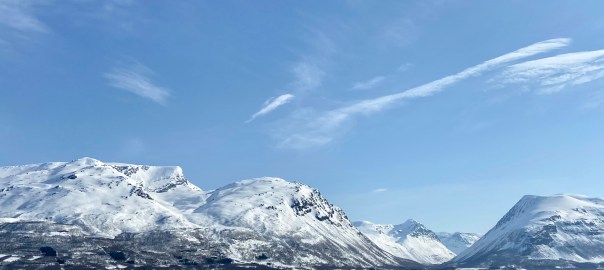
I took a couple of photos of the mountains as well. It is such a beautiful area and the mountain tops were decked with fluffy white clouds.
By the time I got home, the false spring weather had disappeared. Anna and I went for a walk on Senja on Saturday. There were a couple of reindeer standing in a field and we stopped to take a rather distant photo. Though the grass isn’t growing vigorously yet, I have seen other reindeer taking advantage of the temporarily uncovered pastures this week while driving around.
One of our favourite walks starts beside a school and Anna spotted some skis standing in a rack on the side of the building, so I took some pictures of them and the bike rack that is currently not in use. Outdoor living and exercise is very much encouraged and embraced here, whatever the weather.
On Tuesday I worked the early shift at the abattoir. It’s much easier driving over at 5am now it’s light. It was a particularly beautiful sunrise on Tuesday and I paused on the empty road to take a picture.
On Wednesday, with Birgit’s (long distance) help, I finished the course work and the report for the inspections I mentioned in Across the Lyngen Fjord. On Thursday morning there was a summing up meeting. On Thursday afternoon, having finished my homework for the week, I was free to turn my attention to my e-mails. Most of my e-mails contain information about meetings or outbreaks of controlled diseases, but now and then I am sent fascinating updates on the complicated interplay between large predators and domesticated and semi-domesticated animals in Norway.
In the past fifty years, there has been a movement from culling to preservation of species such as bears, wolverine, lynx, wolves and golden eagles. Wonderful as that is, it does have an impact and the Norwegian government have to work with farmers and herders to try to ensure balance.
Most of the domesticated animals such as sheep and cattle, are kept on pastures near to a farm. If they are moved, they go in lorries. Though some sheep (and especially lambs) are taken by predators, in general it is possible to keep the protected predator wildlife areas and farming regions separate. But the situation is much more complicated when it comes to reindeer.
Reindeer herding in Norway is carried out by Sami people using a mixture of traditional and modern methods. The reindeer are semi-domesticated: they are not fenced in, but are moved around to different pastures, depending on the season, food availability and the weather. Unfortunately, some of the important grazing areas, that have been used for thousands of years, overlap with some of the priority areas where there are targets set for these predatory animals.
The political situation is particularly difficult as there continues to be a lot of tension between the Sami and the Norwegian government. Until relatively recently, strong attempts were made to enforce integration into the more modern Norwegian lifestyle, but the creation of a Sami parliament in 1989 and the recognition of the language and way of life has not removed all conflict. Traditional herding methods are not only affected by predators, but by roadbuilding, property development and even wind farms. The grazing areas are mostly in land that is considered to be “state owned” but if that is land that your people have been using for more than a thousand years, I feel it is unreasonable to expect a full acceptance of that claim of ownership.
Anyway, back to the report. Apparently, lynx, wolverine and golden eagles are the biggest predatory threat to reindeer in Norway. Information from NINA, the Norwegian Institute for Nature Research shows that the wolverine diet is 95% reindeer and lynx 65%. Some of the herders report many of their calves are taken, sometimes up to 75% of the years progeny. And because of the nomadic lifestyle, it is not only direct predation that can be problematic.
In January this year, a herd of up to two hundred reindeer took fright when they were being moved and it was strongly suspected that this was triggered by predators. Instead of travelling safely to their winter pasture, they headed up into the mountains. The terrain was frozen and largely impassable, and of course there was no grazing. A small group of them returned, but without their calves. Eventually a helicopter was arranged so the herders could get an overview and the herd was recovered, but there’s no doubt that these predators, alongside climate change, have a huge impact on traditional ways of life.
Regular readers might also be interested to hear an update on the female bear with a taste for lamb and mutton that I mentioned in the very first blog post I wrote when I started work here (Piece of Cake). It was too late last year to move the mother bear to a different area where there were no sheep. Now they are waiting to see whether the bear is pregnant and/or whether she will emerge from hibernation with yearling cubs.
Though moving her might prove to be a long term (or even impossible) project, other solutions are also sought. One of the farmers who reported the greatest losses has been granted funds to restructure and he will change from farming sheep to beef cattle. The farmers who lose animals are compensated for their losses, but of course the picture isn’t simply one of monetary cost.
One of the focuses of the report was on the animal welfare issues caused by the hunting of domesticated animals by these predators. In general, domesticated animals are kept safe from that type of harm. The idea that living in nature is some kind of idyllic haven for animals is overly simplistic.
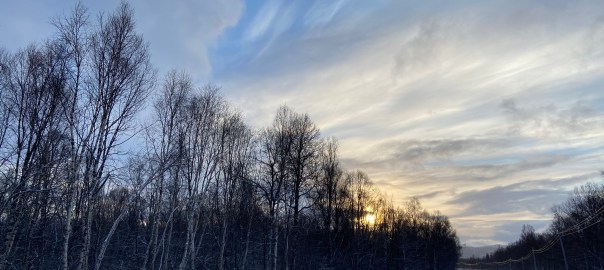
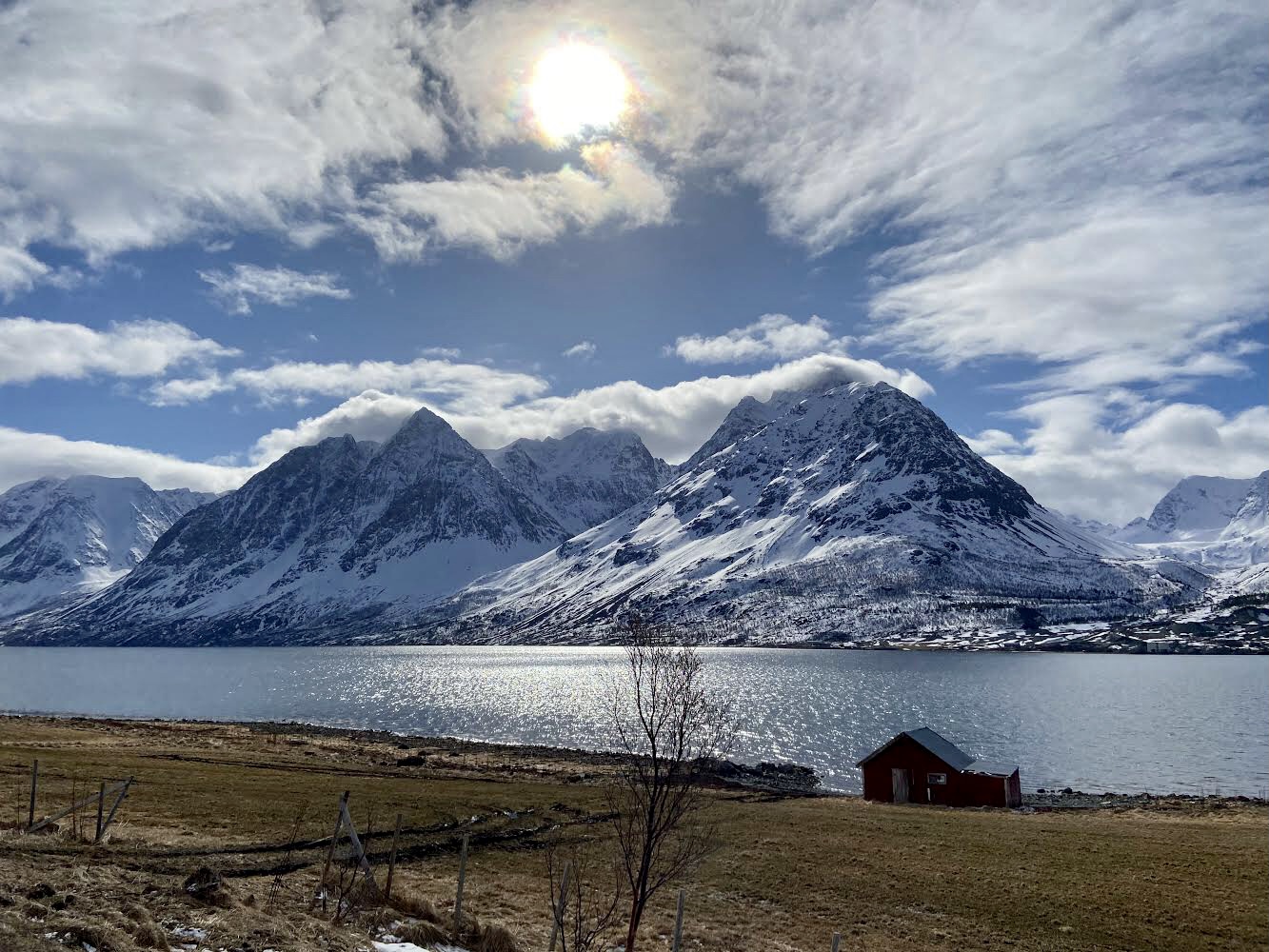
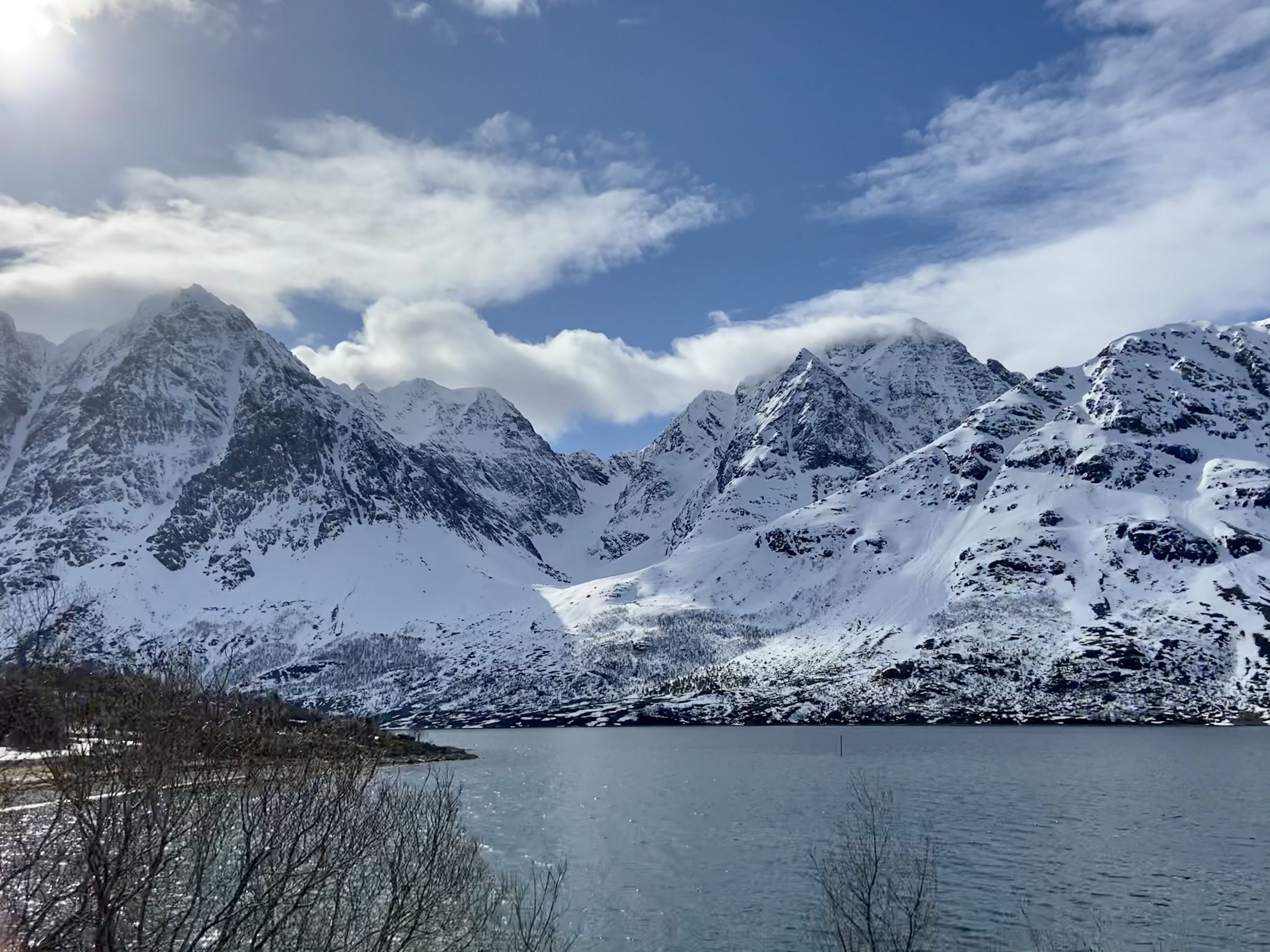
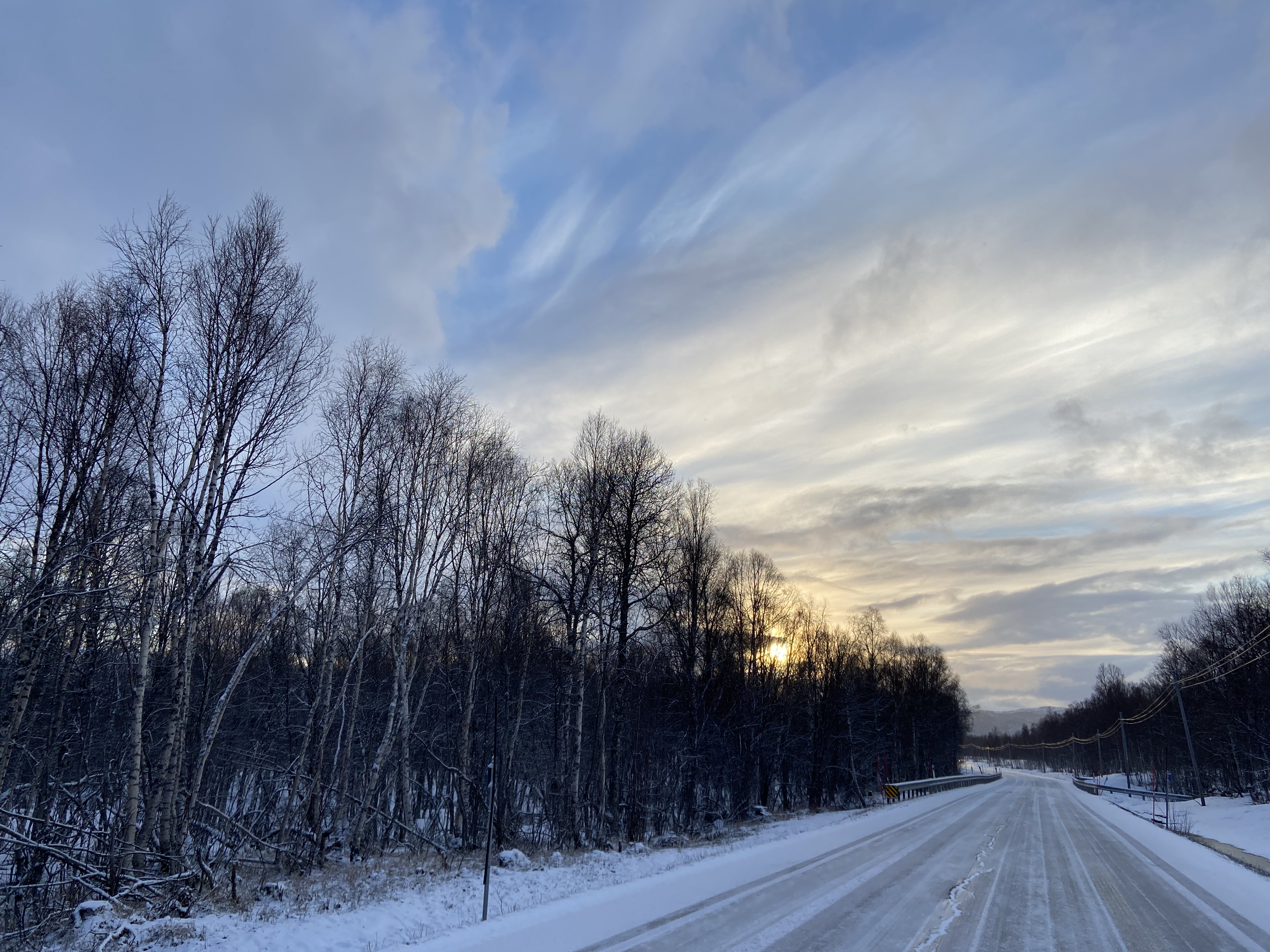
I will finish up with a couple of photographs taken yesterday. The days are now very long and light, but after a week or two of rapid melting, the snow has returned. In the middle of the day, when the sun is high, it is so bright as to be almost unbearable. I really must buy some sunglasses! These pictures were taken at seven fifteen in the morning and at eleven forty five in the evening. Twenty four hour sunlight (and hopefully summer) is just around the corner.
I said earlier in the week that if I didn’t post, I’d be swimming in photos by the weekend. Despite doing so, I still have so many things I want to share with you that this will be a whistle stop tour of Tuesday and Wednesday evenings.
There are lots of tunnels in Norway. Many roads which used to go through mountain passes, or clung to cliff edges around insane bends, have been rerouted to go through or under. Sometimes, the old road stays open, either because there is a village or walking area, or otherwise to provide an alternative route in the event that the tunnel is closed.
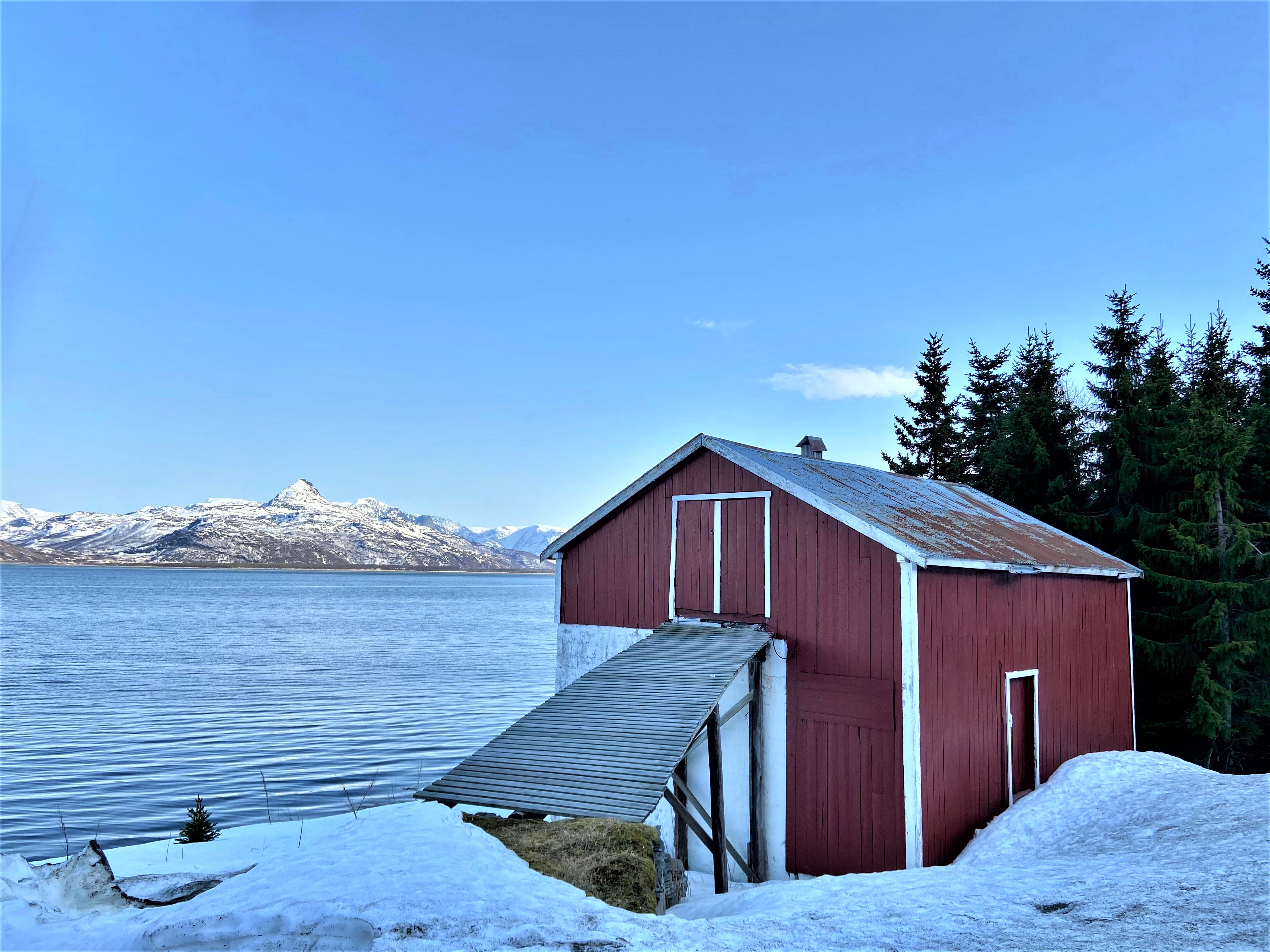
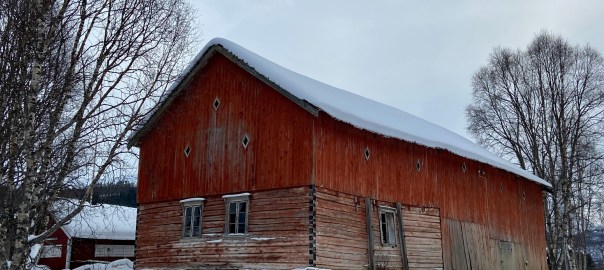
There is a tunnel on the E6 just south of Sørkjosen and Birgit recommended, on Tuesday evening, that I explore the road it replaced. The first section was flat and of the clinging to the cliff face variety. There were road signs reminding drivers not to forget to go round the bends and I wondered how many unwary tourists, distracted by the scenery, had gone over the edge before they decided they really ought to put up notices. The view really was worth looking at. One of the first things I saw was this classic red barn, built into the mountainside above the fjord.
Red barn with fjord and mountains on Jubelen.
The road itself is called Jubelen and Birgit told me that like “Rest and Be Thankful” in Scotland, it was probably named by people who were heartily glad to reach the top of a stiff climb. Shortly after the barn, the road began twisting its way up the fellside. There was a car park at the top, where a frozen lake was surrounded by warnings that it was drinking water and shouldn’t be polluted. The way onwards was blocked for cars and impassable without skis, so I climbed out of the car and decided to take a walk back down the road to take some pictures.
The road onwards was closed to traffic.
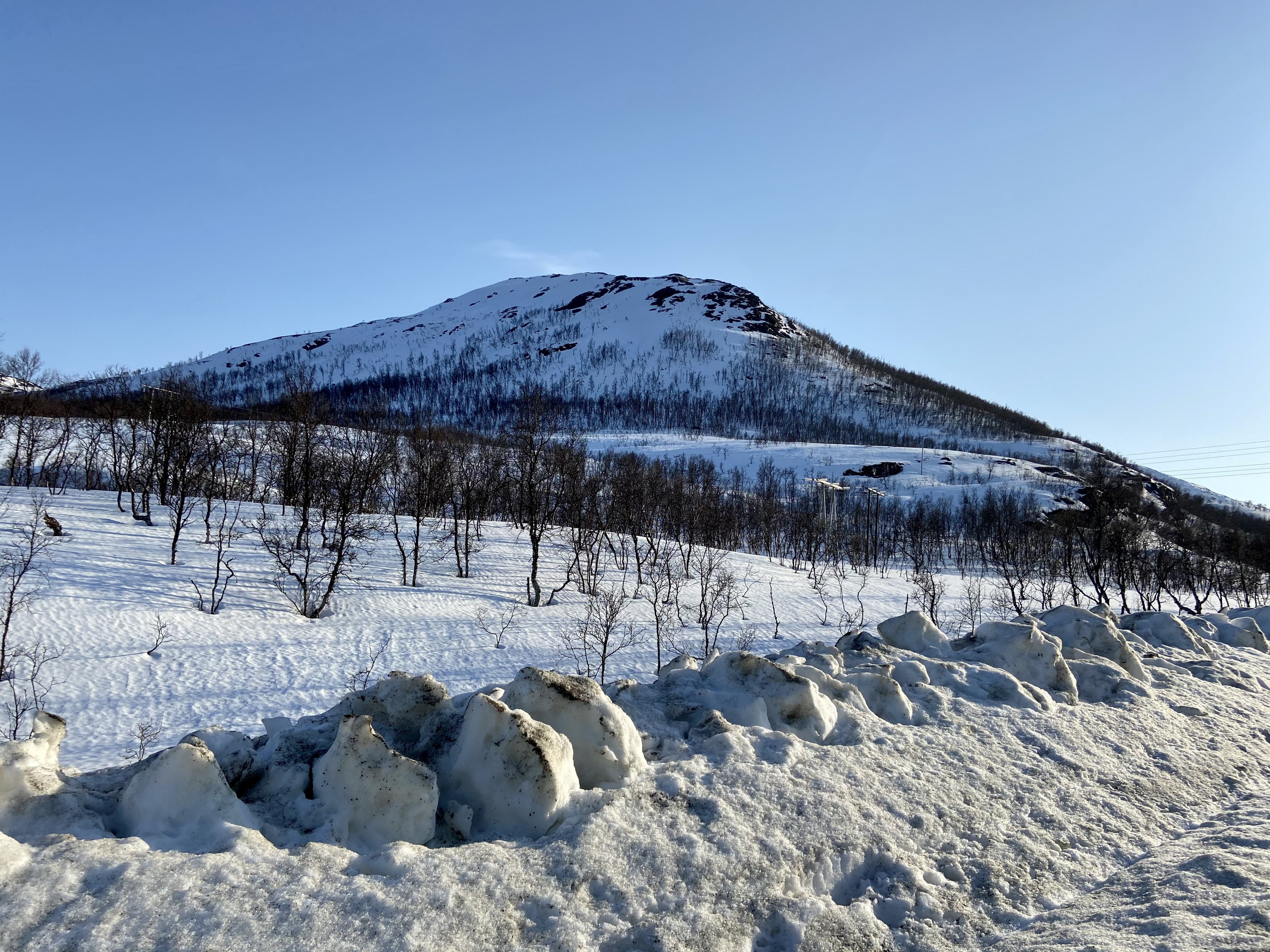
I walked quite a way down the road. It was a bright day and the sunshine warmed my back as I tramped down the hill. I have been noticing, for the past week or so, that there are patches of green appearing through the snow, particularly on banks that face the sunlight. Often when snow disappears, there can be weeks where everything looks brown and dead, but some of the ground cover here is so hardy that in places it is pushing its way through the snow. After months of white, these intense patches of colour are very cheering, as is the wonderful chatter of newly flowing streams that fills the air.
Further down the road, there were beautiful views across Reisafjord to the mountains beyond.
Reisafjord from JubelemReisafjord from Jubelem
There was also this wonderful frozen waterfall. I guess it doesn’t get much sunlight, being on the north side of the mountain. A mixed blessing for me as it was hard to photograph with the bright sky above and behind, but I hope you can get some idea of the blue, icy beauty.
It was slower, walking back up the hill. I noticed a few things I thought I’d like to share with those of you who live in warmer places. The roads in Norway are kept remarkably clear, even when there is heavy snow. Gradually the snow builds up on the verges until there are piles so high that in places, you can’t see over them. A friend commented on Facebook that if she was driving here, she’d never get anywhere as she would stop so often, but once the snow arrives, there are very few places you can pull off the road. The laybys and passing places all have to be cleared and side-roads and entrances become narrow and hemmed in.
As the snow has begun to melt, I have noticed that it happens unevenly. Quite often the piled up snow has begun to resemble castle ramparts with regularly spaced clumps of ice perched along the top of the wall.
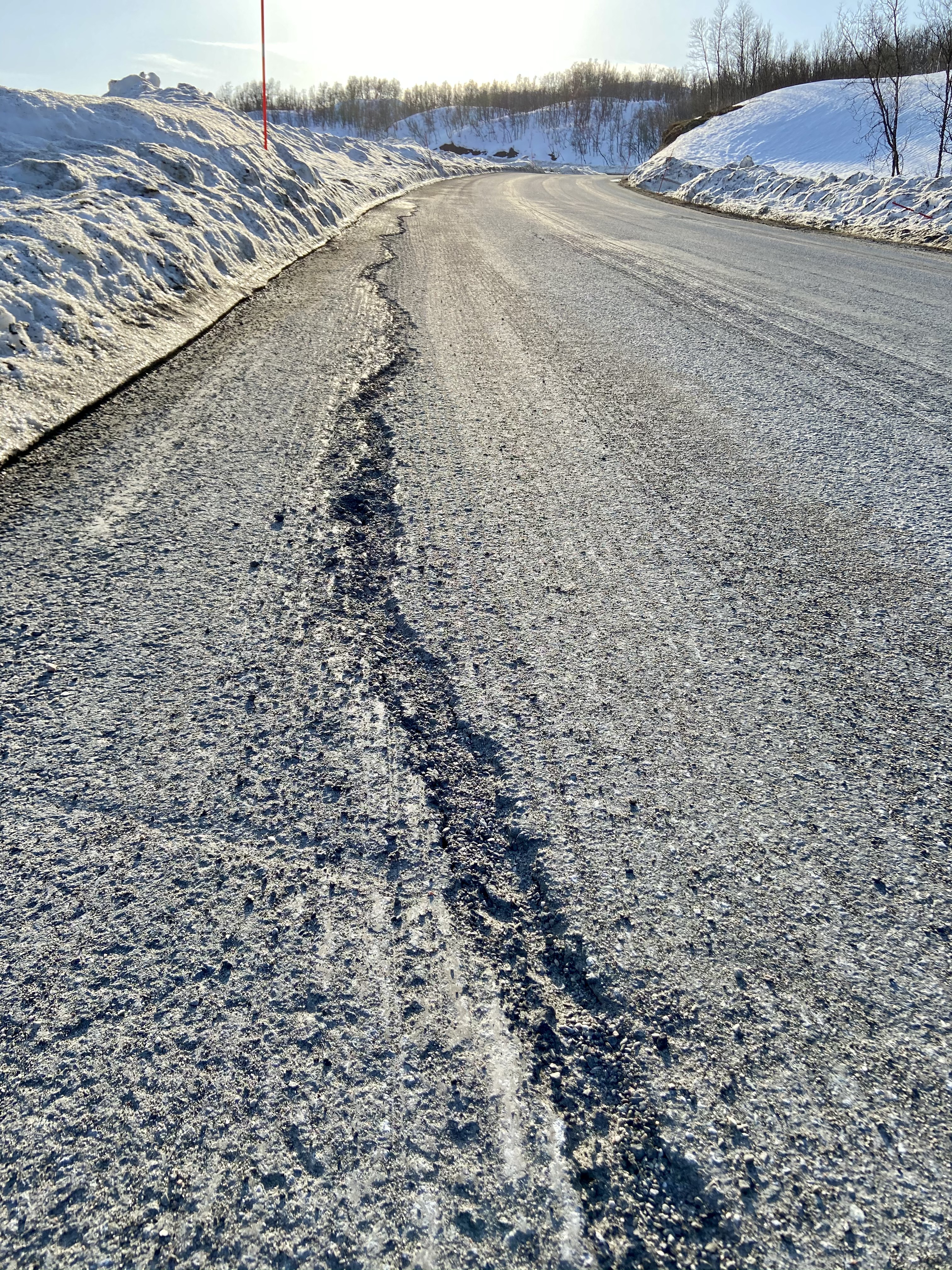
Winter is obviously hard on asphalt. Lots of the newly-revealed roads have deep holes. During winter, they were filled and masked by the hard packed snow and are only becoming apparent as it melts. Long cracks also appear, many of which look like they were patched up last summer, only to have widened again.
For now, the roads are dry, but when it rains, or the snow melts, there is nowhere for the water to escape. And so as we begin to approach spring, those clearing the roads have begun to create gaps in the ramparts so that some of the water can escape into the ground.
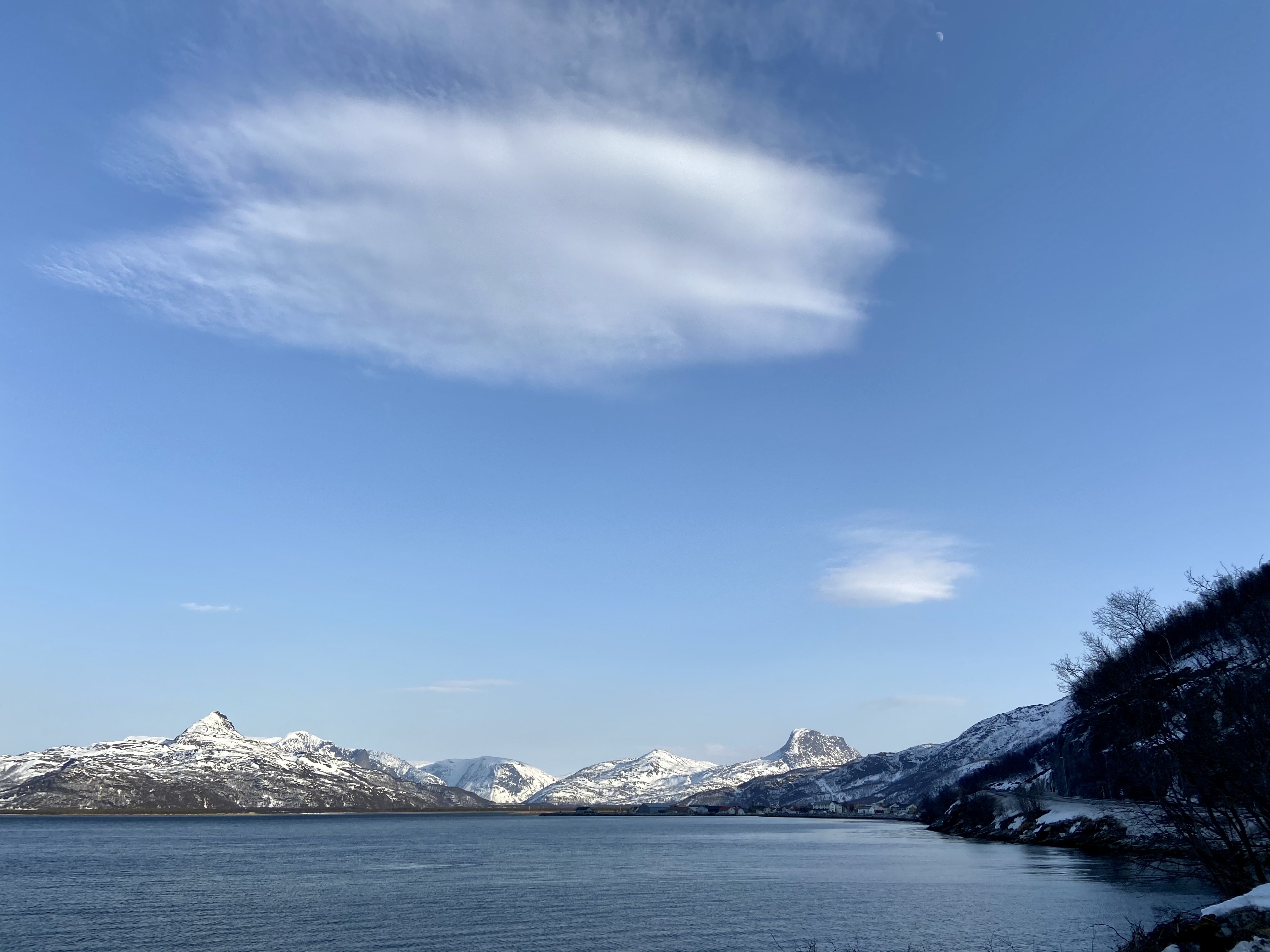
One last picture. As I drove back down and reached the bottom of the hill, I stopped to take another photo, looking back towards Sørkjosen. If you zoom in to the bottom right (thank you Lara!) corner of this picture, you can see the hotel where I was staying!
Zoomed in shot – hotel on the left and the surviving pre-war building opposite
Wednesday night was quite the contrast. As Birgit had warned me on Tuesday, the weather closed in and by Wednesday evening the skies were heavy and there was snow in the air. Birgit had invited me to eat with her at home and so after work, I followed her on the road that led north from Storslett and out to her house.
I have posted about the wonderful red barns here before, and to my delight, Birgit has one of her own.
Birgit’s fjos.
Birgit has a small herd of Lyngshest that she and her partner use for breeding and riding. She tells me that once a week, a group of local pensioners come and ride out with her partner, Geirmund. I have often thought Norway is a good place to grow old (often the ski slopes are free for over 70s) and this sounds like one more wonderful discovery of active retirement. She led me into the barn where we found the farrier working.
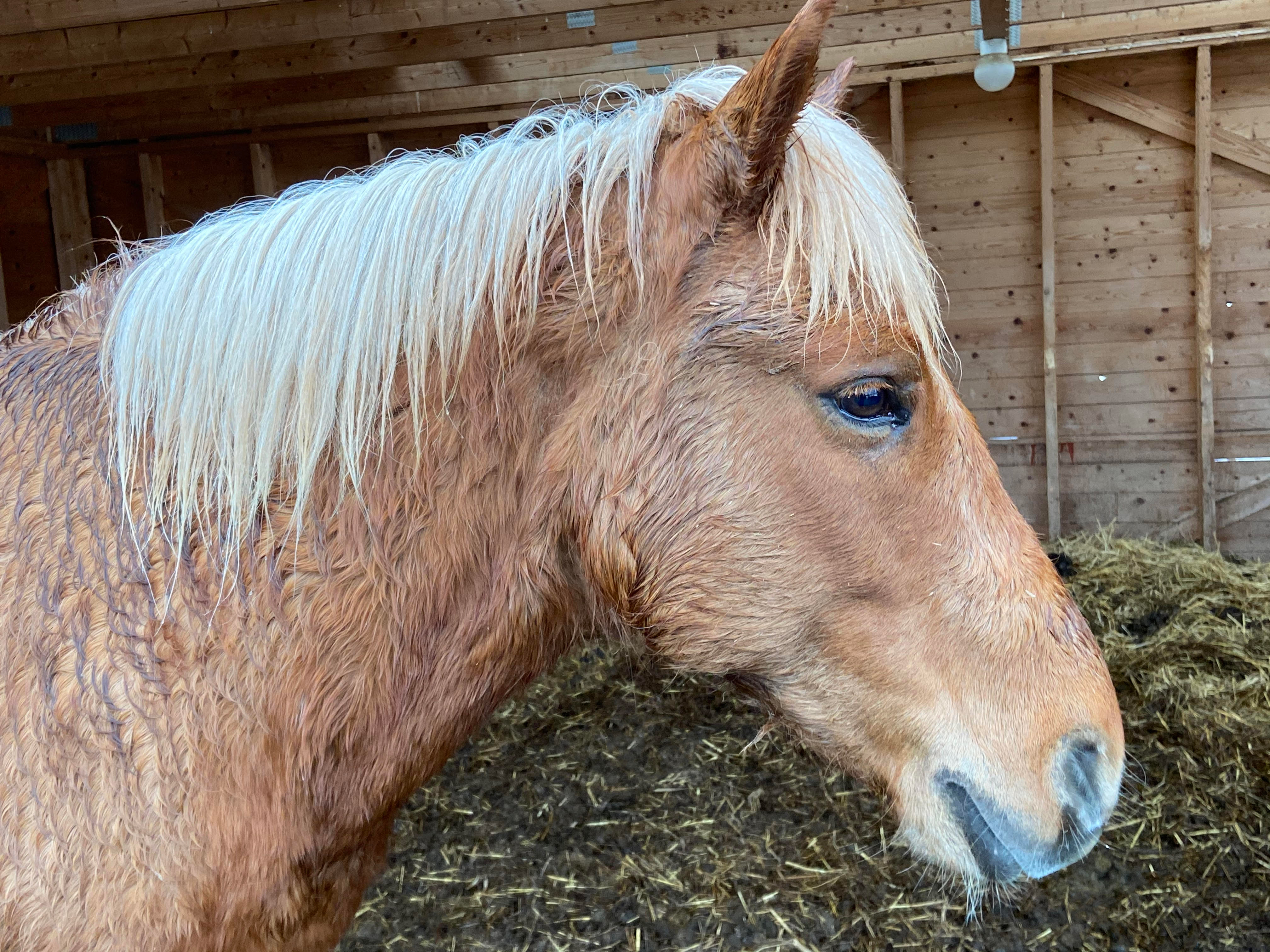
This is Rein, who is 22 years old
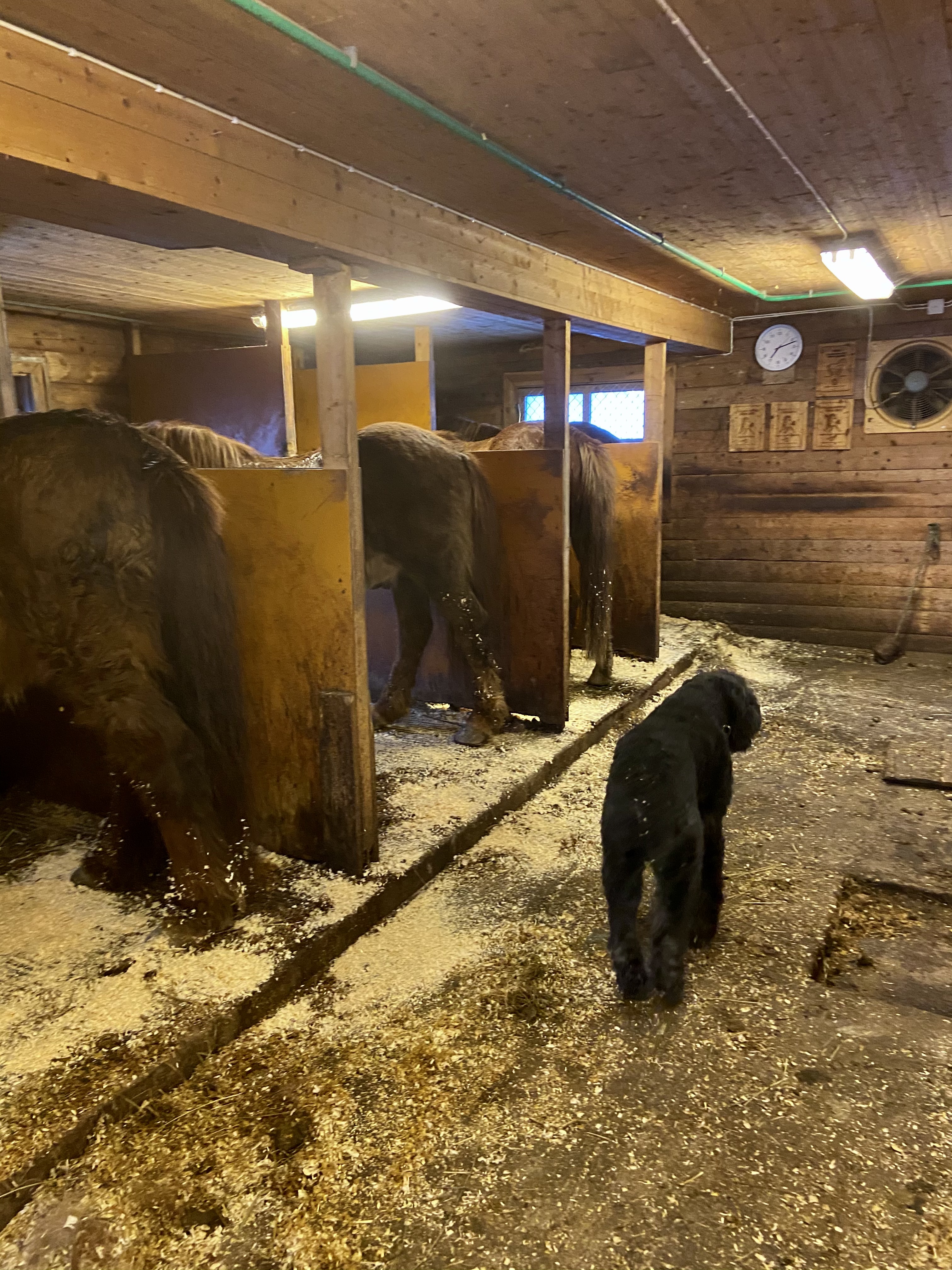
We went in the house and were greeted by the lovely aroma of food in the oven, and by Birgit’s seven year old Bouvier de Flandres , I Mo. He was as warm and friendly as Birgit herself and very soon, as we stood in the kitchen, he lay down on my feet to keep them warm.
Birgit’s house was wonderfully cosy and filled with photographs of horses and Birgit and Geirmund’s family. Her children, like mine, are mostly grown up, but as we walked into the living room, we were greeted by one of her two cats.
Tigra is three years old.
Once the farrier was finished, Geirmund came in and we ate together. After that, Birgit took me on a proper tour of the barn, or fjos, as it is called here.
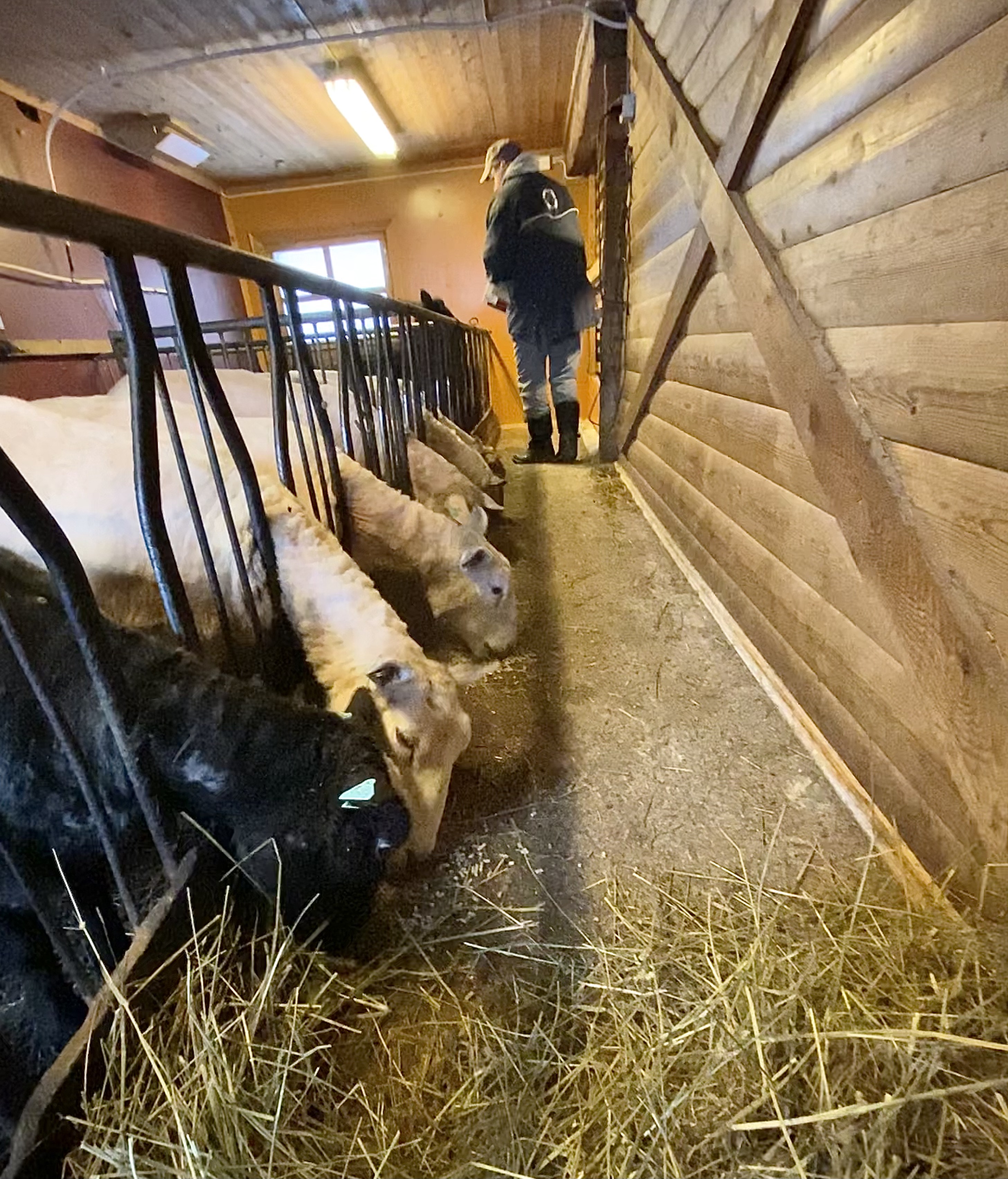
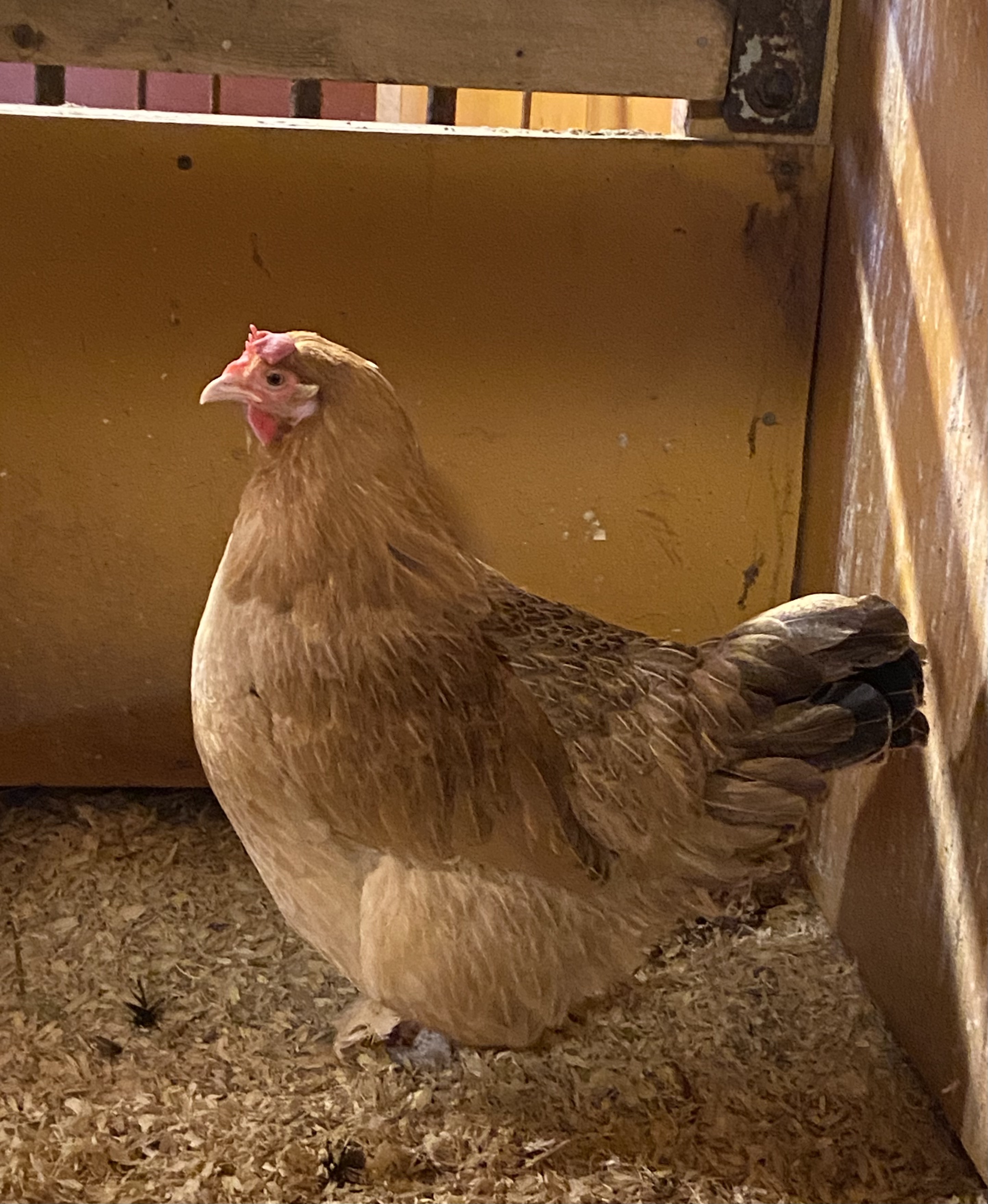
It felt like a slice of heaven to me. As well as the older of the Lyngehest tied up in stalls there were chicken and sheep. Lead ropes and sheep-bells hung on the walls and there was the sweet smell of horses and hay.
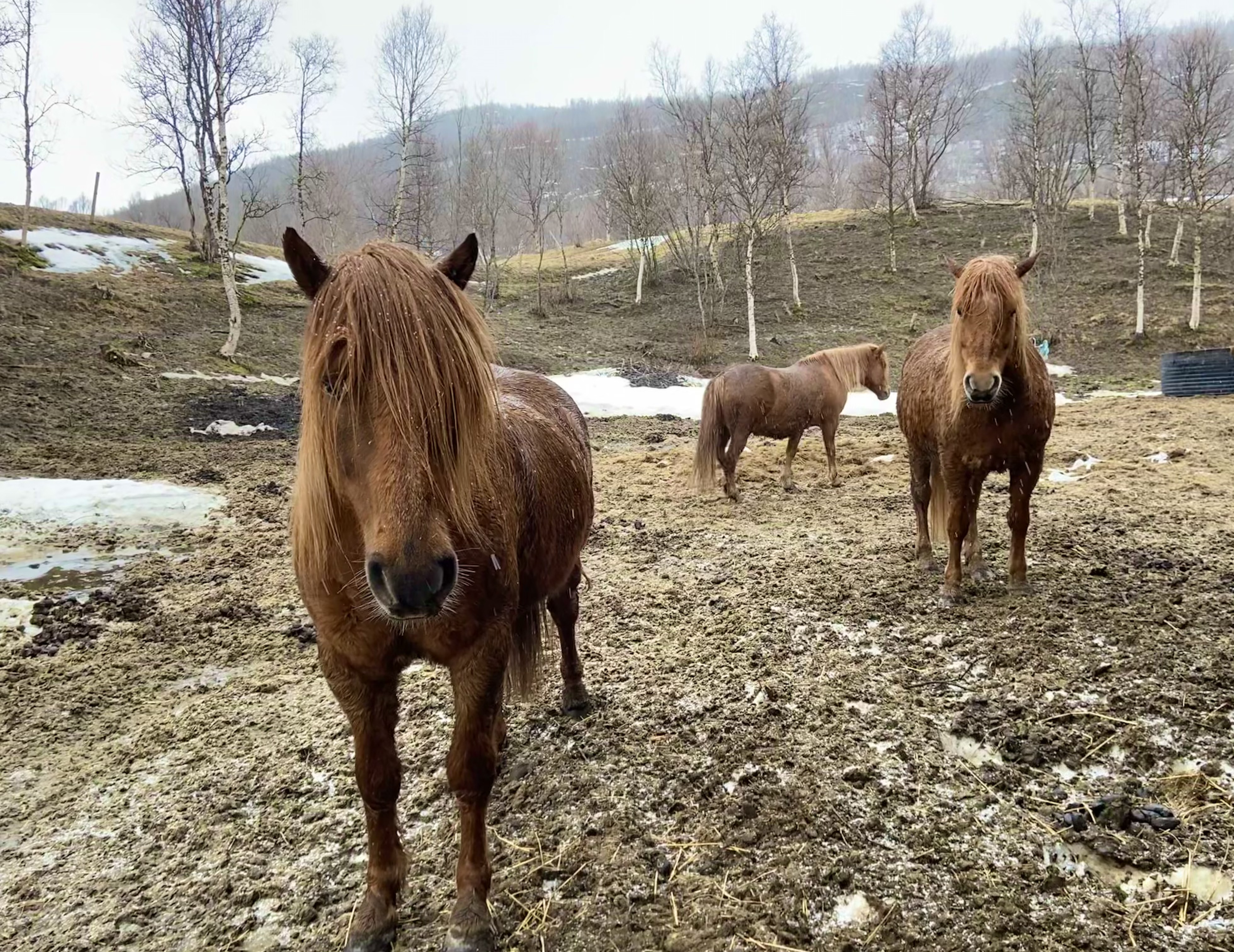
The younger horses are outside. Despite the patches of snow and the dampness of the ground as it melts, they too seemed to be thriving. Birgit tells me they are very even tempered and cheerful, even when faced with injury or difficulties.
This beauty is Reisa Virko. Virko is Sami and means lively.
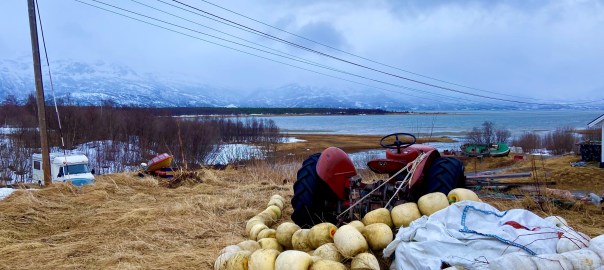
Despite the mud and the snow, we went for a short walk afterwards down towards the fjord. I stopped to take the photograph of the tractor and floats. I saw them on top of a bank as we walked past and I couldn’t resist. Farming and fishing, thrown together, old, but probably still working. Note also the boat with the green deck in the background. The far side is filled with holes, but perhaps there are parts that can be used. And you can also see the ubiquitous wires that spread over so much of the landscape in Norway. Often I try to photograph round them, but here I felt they were very fitting.
As we passed the tractor again on the way back, Birgit told me that in winter, there was an otter slide on the bank beside it. Presumably the otters will head into the fjord shortly for the summer, if they haven’t already gone. As for me, I hope that I will be back here very soon. Thank you Birgit for a lovely evening.
Yesterday was another of those gorgeous days of endless blue skies. Birgit and I drove south in the morning sunshine and then took the ferry across Lyngen Fjord.
Our destination was Lyngseidet in Lyngen Kommune. Though it is possible to drive round, it would take several hours. The crossing took about forty minutes and as well as taking photographs, Birgit and I bought drinks from the small cafe on board. I had a slightly surreal moment when I approached the lady behind the counter and she spoke to me in English. Given that I was wearing a Mattilsynet jumper with a Mattilsynet badge hanging from a Mattilsynet lanyard, and was waving a Norwegian credit card, I was slightly taken aback. Perhaps my face looked British, but I didn’t ask so I guess I’ll never know.
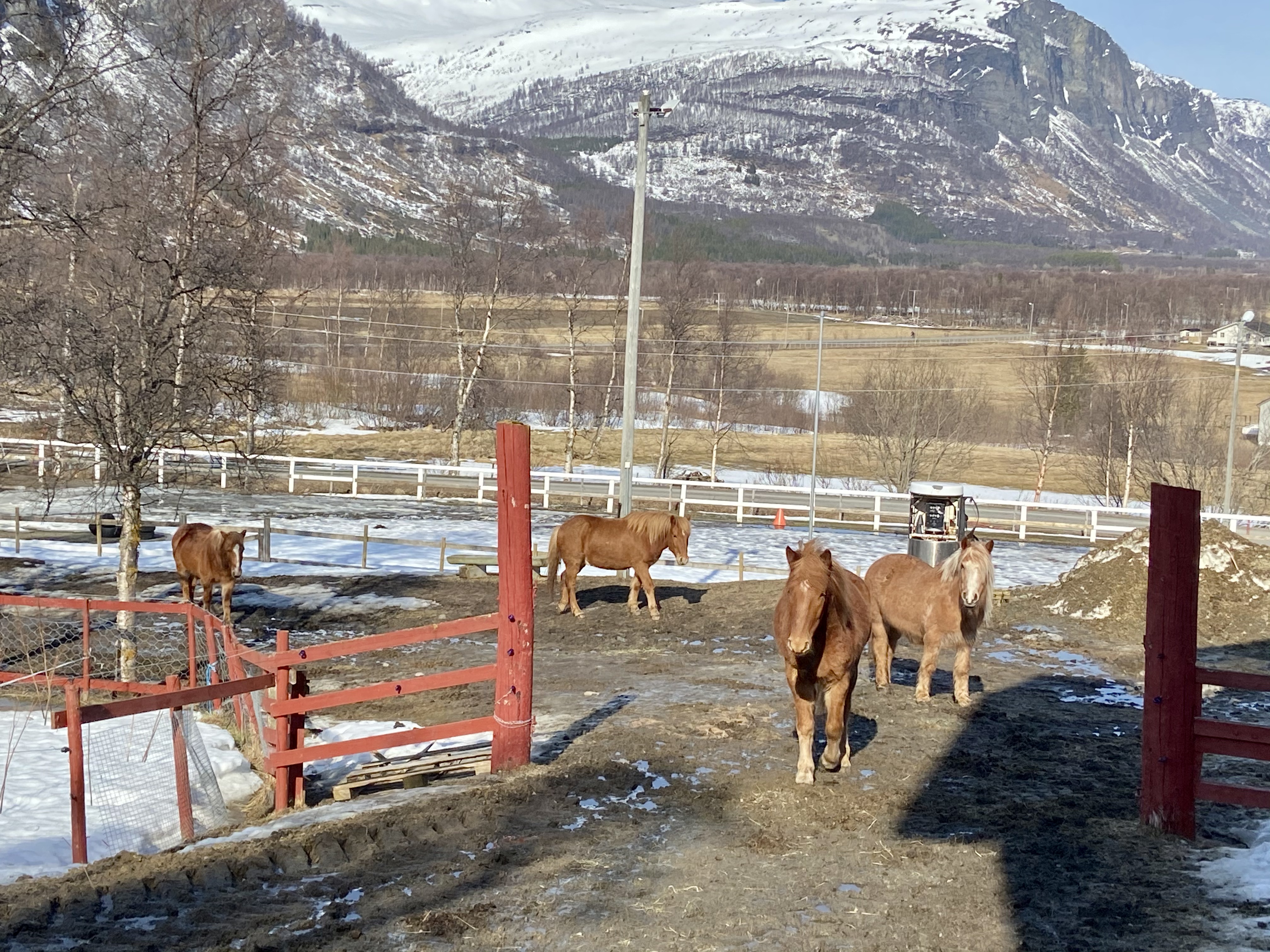
Birgit had planned two visits to blood sample goats, but there were some last minute cancellations and so we visited some sheep farms to check ear tags instead. I am taking a course at the moment on inspections, and so Birgit let me lead both of them. Better still on the first farm, as well as the sheep, the owner had some Lyngshest/Nordlandshest. These wonderful little Norwegian horses are immensely strong and hardy. Most of them are between 12.3 and 13.3 hands (130-140 cm) but Birgit assured me they can easily carry an adult’s weight. She had told me before we arrived about the little horses – she has some herself – and so when we had checked the sheep, I asked the farmer whether we could see them. He led us outside, and to my delight, he called them and they began slowly to walk towards us.
Despite being a little shy at first (he told us they were suspicious that we were vets) very soon we were making friends. Considering the bizarre protective clothing we wear, I think they were surprisingly courageous!
The second visit was great too. The farmer gave us a warm welcome and was very positive about having a visit from Mattilsynet. She seemed rightly proud of her mixed flock, half of them tiny Norsk Villsau (literally Norwegian wild sheep) the other half being the sturdier Norsk Kvit Sau, or White Sheep.
Once we were finished, we headed back to the village where we had landed. After stopping to take a photo of Lynseidet church with its friendly red roof and one of the irresistible mountain behind the Co-Op, we ate lunch outside on a scarlet-painted table beside the fjord. Birgit pointed out the curlews flitting over the water. The arrival of the curlews on their migration to the north means that spring has arrived, she told me. With the warm sun on my face, I could well believe it.
After that it was time for our return journey across the Fjord. As I looked back towards Lyngseidet, I was already making plans in my head to visit again in the summer. It will all look very different in a few weeks time when (most of) the snow has melted.
As we drove around, Birgit told me a bit about the local area. Norway has, of course, a great seafaring tradition. With its long coastline and sheltered fjords, it was the perfect place to create a trading hub. And here in the north, we are also very close to the Finnish, Swedish and Russian borders. She tells me that traders created their own language, which is a mixture of the various languages and dialects, so that they can all understand one another.
I had heard of the Sami before, but not of the Kven people. Descendants of Finns who moved to Norway in the 18th and 19th centuries, they too have their own language. So just as in Scotland, where many road sign have Gaelic alongside the English spelling and in Wales where Welsh names are shown, up here there are road signs with three different languages: Norwegian, Sami and Kvensk.
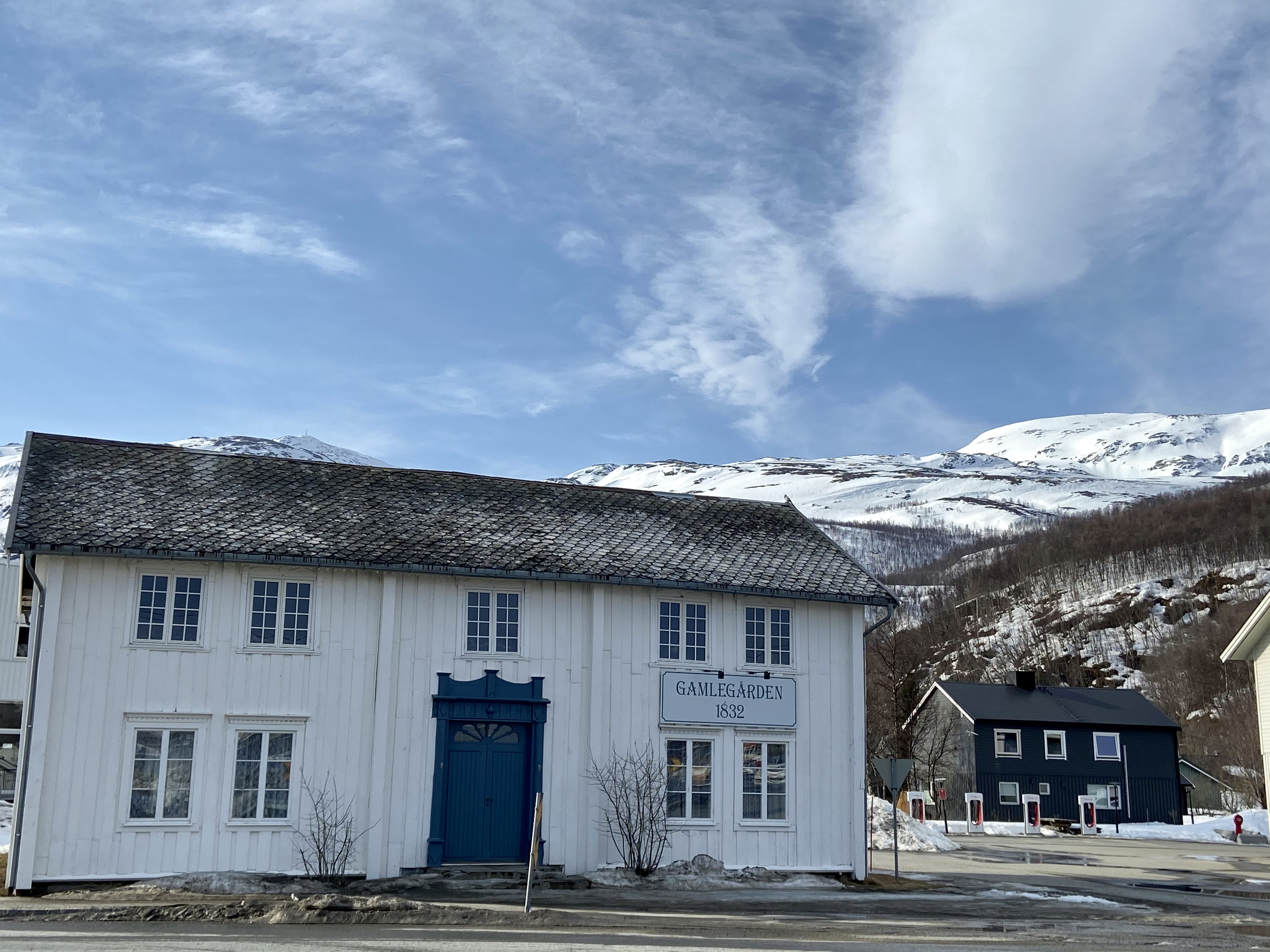
As we arrived back in Sørkjosen where I am staying, Birgit told me that the building opposite my hotel was one of the few in the area that was not burned down by the Germans as they retreated towards the end of the second world war. I had taken a picture of it in the morning as it was a beautiful old building.
And so, with all the new information whirling in my head, I stopped for a moment to look at the boats that were safely tide up in the harbour. Despite the desperate thought of past destruction, so far I have found nothing but peace and happiness here in Nordreisa.
I had a phone call this week from a member of the public who had sent a “concern message” and wanted some follow up. In the UK, this is the kind of report someone might send to the RSPCA (SSPCA in Scotland) when they have seen an animal or animals that they are worried about and want someone in authority to do something about it. Here messages are made online via an official form.
One of the challenges in a new job where there is contact with the public is being put on the spot before you are fully genned up on how everything should be managed. Due to coronavirus, the learning process has been slow for me, but I feel I am finally getting a handle on things. Phone calls are rare (I can only remember receiving three or four) and as they can be redirected from a central line, they don’t always go to the person best placed to give an answer.
For me there’s also a language issue. As others who regularly use a language that is not their mother tongue have confirmed, if a topic of conversation arises where the context is unclear, it can take a minute or two to catch up. On one occasion when I was rushing out to a doctor’s appointment, I was called by a man about a visit someone else had made to carry out meat inspection on a wild moose. As I had no context, I thought we were discussing a call Thomas and I had made the day before. Luckily as I was in a hurry, I accidentally redirected them to the appropriate person, but as you can imagine, all the ingredients for creating some kind of Fawlty Towers level farcical misunderstanding are present.
Fortunately there was no such misunderstanding in this case, though having answered the phone without any opportunity to prepare myself, I did manage to forget almost everything I had learned.
I took down what I thought were the salient issues: details of the nature of the report (horses standing in mud with no food) and the name and number of the person who had sent the report.
Running through my head was the knowledge that Thomas would almost certainly know more because the concern messages in our area currently come in to him and he shares the details with or (on one occasion so far) delegates them to me.
I ended the call and thought through my next steps. Obviously I had to call Thomas, but I wanted to work through as much as I could on my own before doing so. There is a shared file within the DyreGo department of all current and ongoing concern messages and so my next step was to look them up. It was at this point, I realised the first of my errors.
Quite often when people make reports, they choose to be anonymous and the online form gives anonymity as a clear option. Ongoing cases are not listed under the details of the person reporting: rather they are recorded under the name and address of the animal owner. None of the cases on the list fitted perfectly. Worse still, I realised that the central bod might not have even redirected the call to our office, but to the wider Troms and Svalbard team. The horses in question could easily be hours away in Tromsø and Thomas might know no more than I did. Still, having done what I could, I went ahead and called him.
Thomas is very patient with me. He told me early on that he wasn’t, but being aware there were many things I couldn’t do, I made an effort to take on the things I could, even if it was something as mundane as coming in early to clean snow off the car we were going to use. Sometimes I get ahead of myself (MATS, the computer system we work with, is very unforgiving if you make an error – it’s designed to work through things in order and going back to correct can be “challenging”) and then he rolls his eyes and tells me not to go so fast, but mostly we laugh together.
We weren’t far into the call when my second error became clear. I had received a request for information from someone who was worried about some animals, and so of course I wanted to help. But as Thomas reminded me, as soon as we begin investigating welfare cases, we are obliged by law to keep all the details secret. Even if I could work out which case it was, I couldn’t tell my enquirer what was happening.
Nevertheless, as he knew no more about this case than I did, he advised me to call one of the members of our team who receive and review all the cases when they first come in. They carry out a preliminary investigation, examine any evidence from previous interactions with the animal owner, assess the severity of any welfare issues highlighted, and then either close the case immediately or pass it on to the nearest office for further assessment.
And so I called Birgit and explained the situation and as well as managing to find and update me on the case, she explained how to deal with the enquiry as well. One of the things the enquirer had asked was whether we’d received the report. I know from dealing with veterinary cases that when calling people, it’s often true that if you haven’t got, or aren’t able to give them the information they want, it’s helpful to have at least one positive point you can emphasise, even if it’s minor in the grand scheme of things. And so I called the enquirer back and explained that I was unable to give details about what was happening, but at least we had received the message and it had been assessed.
I was relieved to have put the enquiry to bed, as it were. I hate having unresolved things hanging over me. But a number of thoughts went through my head following the call about how I could have dealt with it if the caller hadn’t been satisfied with my response. I could have explained more about the processes we have, and perhaps how such a case would be handled.
The initial assessment would look at whether one of our team had investigated similar allegations before and the results. Where there is no history, or where the history indicates the case should be taken further, the case is sent to the local office where the inspectors decide whether it can be handled over the phone – better in these covid times in simple cases where the animal owner can send a picture or video during or shortly after the call to demonstrate whether something is true or untrue – or through a visit.
Some thoughts crossed my mind about that possible visit too. I was called out to a similar case years ago by the SSPCA. They were trying to put together a court case against an owner and I remember going out and looking at all these poor horses, standing up to their knees in mud, and thinking that if it did go to court, I would be happy to stand up for them to try and stop their suffering. But I’m not sure, with hindsight, that I would have done them much good. I can’t remember what examinations I carried out, but I do have vague memories of warnings at vet college that giving evidence in court was something of a specialist activity and we should be wary if we weren’t experienced, which I wasn’t. Perhaps fortunately for me and the horses, it was resolved without reaching court.
It crossed my mind though now, that what Mattilsynet are doing is akin to training me to be the kind of expert witness I needed to be back then. I would no longer go out to such a case and ask for guidance from the SSPCA. I would go out armed with the exact wording of the laws and by-laws that govern animal ownership in Norway.
I also have a better understanding of how you could prove or disprove an allegation. To assess whether a horse or horses were indeed without food, we would start by asking the owner. We would find out through questioning, whether they had enough theoretical knowledge to know how often you should feed a horse and how much. But that would only be the first step.
After that, we would examine the food they had available and how it was stored. We might take pictures of that. More importantly, we would examine and photograph the animal and compare it to a prescriptive scale based on anatomical features. If you can see various bony structures, you can assess where the animal falls on the scale where 1 is way too thin and 9 is very much too fat. We would look at other details as well to assess more general health and welfare. I’m not sure yet about how it would work if we ended up in court (or indeed whether that happens) but all these processes allow us to be very specific in being able to back up our claim that “the animal looks like it is suffering” with verifiable and objective facts to demonstrate that it is.
The great thing is though, that having worked through all that, the next time I get a similar phone call, I will deal with it easily. Even if the enquirer is difficult to work with, I will have a raft of background information to help me deal with it. That is the nature of being a vet. When you start out, almost everything is a challenge, but as you deal with challenges every day, managing them becomes routine.
In my current role, with coronavirus and working from home, I’ve received so much intensive theoretical training that it’s nearly coming out of my ears. This phone call and last week’s practical training with Thomas has led to all that information clicking into context. I am finally beginning to believe I will one day be good at this job. On Monday, I am going on my long-delayed week-long trip to Troms and Svalbard’s most northerly office in Storslett. I hope Birgit is prepared for the onslaught of the three million questions that have become apparent with my increasing knowledge. It’s very true that the more you learn, the more you realise you don’t know.
To finish up, I wanted to talk a little about daylight and about spring. The quality of the light here continues to surprise me. As you can see at the top of the page, we have full daylight for over sixteen hours each day. By the end of the month, there will be just over half an hour of what is called civil twilight around midnight. Civil twilight is the brightest form of twilight where the sun is just below the horizon: the same kind of light we had during the polar night.
The speed with which the changes occur probably shouldn’t surprise me. After all, we had it in the opposite direction only a few months back, but the daylength changes are so fast that the weather doesn’t really keep up. Though there have been a lot of days where the temperature has made it above zero, when rivers of melt water have run down the middle of roads and rushed down newly visible mountain streams, there is still a thick layer of snow on the ground.
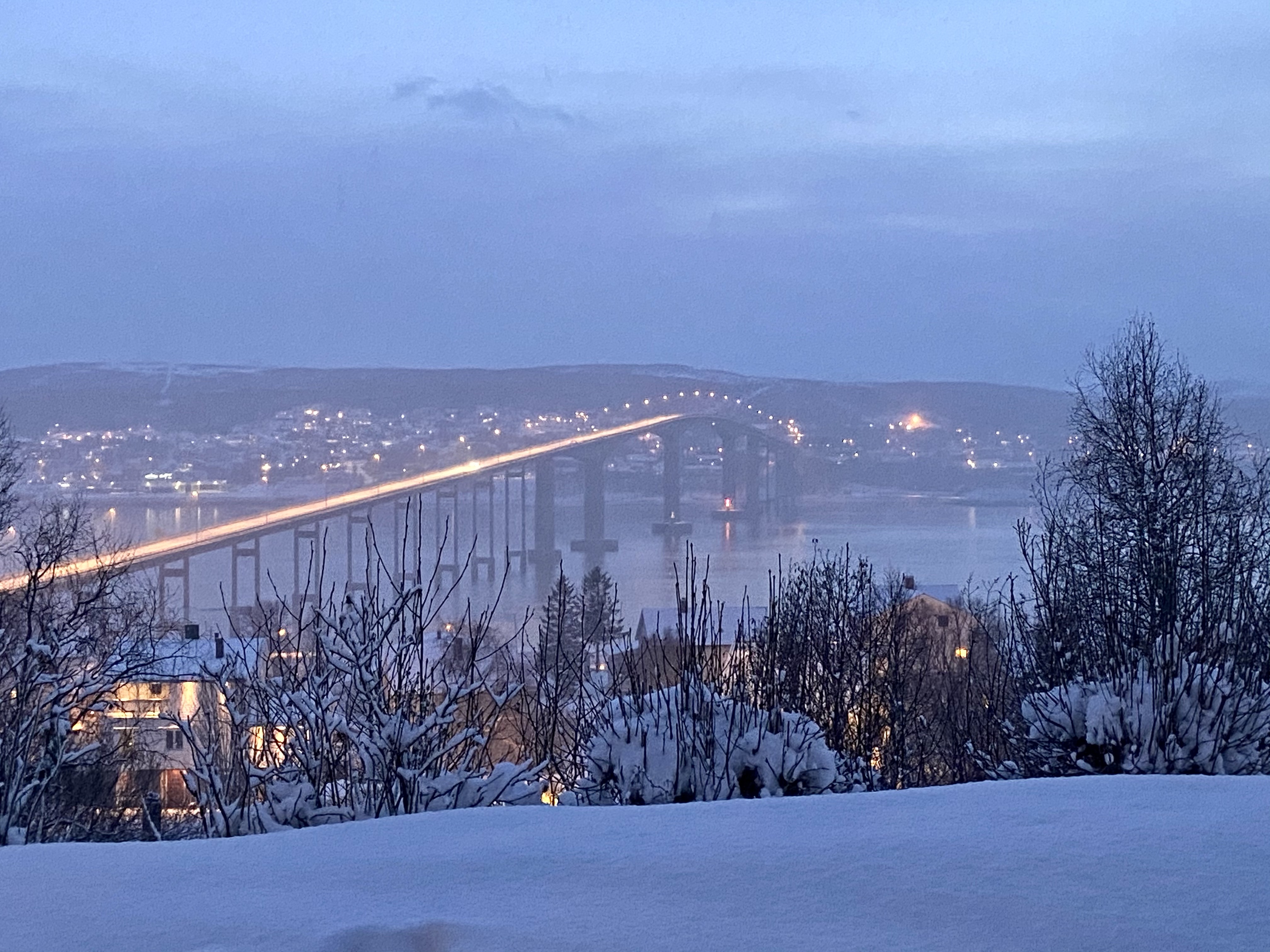
Back in Scotland, it wasn’t impossible to have the odd day of snow in April, but it was a rare occurrence. I tend to associate snow with short winter days and near permanent twilight. But now I look out on all this wonderful light and the snow is still on the ground and it’s almost magically white. The picture at the top of the page shows the wonderful warm twilight as the moon rises over Gisundet Sound and the island of Senja. But the day time is equally rare and magical, and I hope that I caught something of that in this second picture.
Anyone else love hotels? For me there are few things more pleasurable than travelling somewhere and checking in to a hotel with a comfortable bed with clean white sheets. Better still is waking up in the morning to a lovely breakfast someone else has cooked. I will add that if you have spent a long day working out on farms in cold weather, then stepping under a powerful shower with sweet-scented soap to wash away the chill and the farmyard smells is blissful.
The only imperfection for me, was that I had forgotten to take my book. I am trying to cut down my internet time and take up reading again. There is something about escaping into the world of a book that can never be simulated by online conversation.
Things are, of course, slightly odd at the moment. I spent Thursday night at Vollan Gjestestua (pictured above) with five colleagues from the DyreGo Team, which covers animal health and welfare. Business travel in Norway is limited at the moment, but there is a certain amount of work we have to carry out over the course of the year. The area we cover between us is too large to do it easily and then drive home afterwards. In addition, lockdown and working from home is increasingly wearing, so although we had to all sit at separate tables in the restaurant and communicate by lip reading and sign language, it was good for my mental health to see my working colleagues in the flesh and not just on a screen. Yesterday we had a similarly distanced meeting.
Birgit, Thomas and Anja. Astrid was to my left and I couldn’t fit her into the photo – socially distanced pictures are hard to take!
I read a blog entry earlier in the week by Iceland Penny. It draws attention to some of the contradictions in life, things she came across that held both good and bad/beauty and ugliness. Both/And by Iceland Penny. I was reminded of the post by a discussion in the meeting we had about technology.
I have come to Mattilsynet at a time of upheaval. Some of it is driven by the drive to use less paper and more technology, but the process has been speeded up by coronavirus. If you hand over a pen and paper for a signature, you increase the risk of infection.
When we carry out a visit, whatever the reason for it, we summarise our observations on a Tilsynskvittering. This is an outline of the visit and what was checked, split into different sections related to Norwegian law, stating whether the things we saw fulfilled the legal requirements. This receipt, until very recently, was written on paper, which you then photographed before handing it over to the owner. But since December, we have moved over to using an App.
Astrid pointed out that the new technology could be rendered useless if, for example, you were in an area with no phone signal. I would add that with the small screen on a mobile phone, it is hard to do a lot of typing. In theory you could take along your laptop and connect it to the phone, but then you are still reliant on being connected and anyway, there comes a point when you have to remember to take so many things that the entire process becomes unwieldy. “There’s a lot to be said,” she commented, “for pencil and paper.”
I guess this might be partly influenced by age. I mentioned escaping into a book upthread, and said I never managed to escape into another world online, but I know there are immersive games where my children manage to do just that. But most of the DyreGo team, like me are upwards of fifty.
While I can see that all this new technology has benefits, I also see that it’s challenging when change is brought in so fast. There was an older farmer we visited last year who had been asked to make a number of improvements and Thomas had asked him to send photos once he had done so. Having not received any, Thomas arranged a revisit, assuming the work had not been carried out. When we arrived, Thomas was delighted to find out that it had. When he asked the elderly farmer why he hadn’t sent the proof along, the farmer told us he didn’t have a phone with a camera. I think when we are so connected ourselves, sometimes it’s easy to forget that others are not.
Personally I am on the fence. There is increasing connectedness that I feel ought make us more free, but instead sometimes ties us down. In the meeting, I found myself thinking about the issue of traceability in farming and food production. When an outbreak of food-borne illness breaks out, it’s an advantage that we can find out more easily where it came from. But there is an enormous amount of work in ensuring all the information is put into the system within a very short timeframe. To me that seems like a lot of pressure on farmers who grew up in a time when most of the connections were with family, local farmers and the vet, and the only technology was your machinery and the weather forecast on the radio.
There are periods when I find myself hankering after pre-internet, pre-mobile phone times. It was way easier to go “off-grid”. Anyone else remember those announcements on the wireless (BBC Radio 4) appealing to people on holiday to get in touch as their relative was seriously ill?
I worked in large animal practice, and once you were out on your calls, there was a kind of freedom, though of course that could be inconvenient if you went all the way back and then found there was another visit in the same direction. I think there was less pressure in practice to be right all the time and to know everything. You built up knowledge through experience, through speaking to colleagues, through reading books that were probably already out of date as they had been sitting on the shelf in the practice for several years.
Nowadays, if you know where to look online, there are answers to be found and groups you can join. Anaesthetists discuss the intricacies of different protocols, breed and species differences and how to achieve perfect pain relief. There’s good and bad in that. Better specialisation, increased cost. Some things are lost as well, in this new world. A safe path can be equally well achieved with long familiarity with drugs and techniques, built up over a lifetime of experience. Sometimes I feel everything is now moving too fast.
That said, I can’t put aside the positives. I wrote six books while living in Norway with a co-author in Somerset for a company based in London. Victoria Holmes and I batted ideas across the ether in e-mails in a way that allowed thinking time without excessive delays. We couldn’t have done that over a traditional telephone line or in letters. I am also connected to friends I went to school with and teachers who would otherwise only be a pleasant memory (hello Mr Gorski!). I would never have heard from them again without it.
Even so, despite the positives, I find myself wishing that we could insert a grandfather clause into modern life. A grandfather clause, for those who don’t know, is an exemption from following new laws if doing so would be too costly or difficult. The most obvious example would be with building regulations that require new business premises to follow certain rules with regards to toilet provision, but don’t require that older buildings are brought up to the same standard.
I can’t help feeling that if staff who have worked adequately for years with a pen and paper are retiring within the next ten years or so, they could be allowed to continue without it doing a great deal of harm. It would save them a lot of grief. There is an aspiration that wherever you are in Norway and whatever your business, Mattilsynet will assess and deal with your case in the same way. I can see the value in that when it comes to assessing whether legal requirements are fulfilled.
But whether the report is sent online or on paper? When it really comes down to it, that doesn’t make a whole lot of difference, in the grand scheme of things.
Easter is a big deal in Norway. The first year we came, we were looking forward to the Easter break. The children were off school and work stopped right through from the Wednesday afternoon until the following Tuesday. Thursday morning dawned bright and sunny and I recall we headed into Stavanger, thinking we would go swimming in the outdoor swimming pool. We were disappointed to find it was closed. Who would close a swimming pool in the school holidays, we wondered, in our quaint British ignorance? Many swimming pools in Norway, we have discovered since, close during school holidays. That still seems bizarre to me as in the UK they are thought of as an entertainment and teaching venue and a useful and healthy one at that.
But the realisation that it wasn’t just the pools that were closed but also the shops was the real show stopper. While we probably had enough in the freezer to get by, we had assumed we could buy Easter eggs and all the celebratory food during the first day of our break. It wasn’t our finest hour.
Nowadays I am a little more prepared. I spent Monday out on a visit with Thomas and Tuesday at the abattoir. Charlie had originally been due to arrive on Wednesday, but due to coronavirus the planes continue to be erratic, so in fact he came on Tuesday evening. I had already planned for five days of dinners. Not for the Tuesday itself though, so Charlie bought us a meal from the local Chinese restaurant, which we ate at home due to lockdown regulations. Travel around Norway wasn’t recommended, but as Charlie hadn’t seen John or Anna for months, both our region and his have low infection rates and the planes were already booked, we had decided to go ahead, but take extra care to avoid contact outside the family while he was here.
Because he had arrived early, we were able to take a trip around Senja on Wednesday. We were lucky with the weather. It has been snowing on and off most of the time here, in between massive almost daily thaws, but there was an oasis of calm on the far side of Senja island and at one point, the sun even came out!
We made a stop at Steinfjord rest stop, a sandy bay at the end of a short fjord. The tiny village of Steinfjord nestles right at the base of the steep mountains. It’s a beautiful place.
Triar was, of course in his element, though he did have to wait patiently with his ball as Charlie spent some time taking drone footage of the surroundings.
The drive back was also beautiful, though as we rounded the north end of the island, the snow set in and after one final picture of another mountain range receding into clouds, I didn’t get any more worth sharing.
The end of Triars day was not so cheery. He had rolled in something or other back at the beach and so when he came home, he went straight into the shower and emerged, clean but not delighted.
And so for now, I will wish a very happy Easter to you all. See you again soon.
If you were raised in the United Kingdom, as I was, you might occasionally have found yourself wondering why all the barns in picture books and on those alphabet pictures on the wall of your classroom were painted red. Barns in the UK tend to fall into two types. Traditional farmhouses often have a yard surrounded by byres or a steading where the animals were kept before farming was industrialised. They are often constructed of brick or stone, depending on the area.
Those traditional buildings are often now used for stock which require a lot of close attention, for example calves that need to be fed twice a day, cows that are about to calve, or which have recently done so, and animals which are sick.
The newer barns, which have been built to house the main herd or flock, tend to be huge affairs, built high, with solid walls at the base to reduce draughts and open spaces or slats higher up to allow good air circulation. Red paint doesn’t feature in either the old or the new.
I had concluded, when I thought about it, that the red barn picture-book phenomenon was probably a US import. But why were so many barns painted red? They certainly look attractive, but how did the tradition begin?
When I moved to Norway, one of the very obvious differences from the UK was the way houses are built. Here, most houses are made of wood. Nowadays, they are painted many different colours, but in contrast with that, most barns are painted red. One of my neighbours in south-west Norway explained to me that traditionally houses had also been painted mostly in two different colours: red and white.
A white house was a sign of wealth. White paint was more expensive, red was cheaper, both because the paint was less expensive and also because it was less obvious if it became dirty or discoloured. Quite often, the houses of well-to-do farmers would be painted white, but the barn continued to be decorated with the cheaper red paint.
And so it seems likely that the reason barns in the United States are red is because the tradition (and the methods of making paint or stains) were taken over from Scandinavia. Presumably red barns in children’s picture books will remain that way, even if the tradition stops. They are, after all, much more distinctive and picturesque than modern barns in the UK.
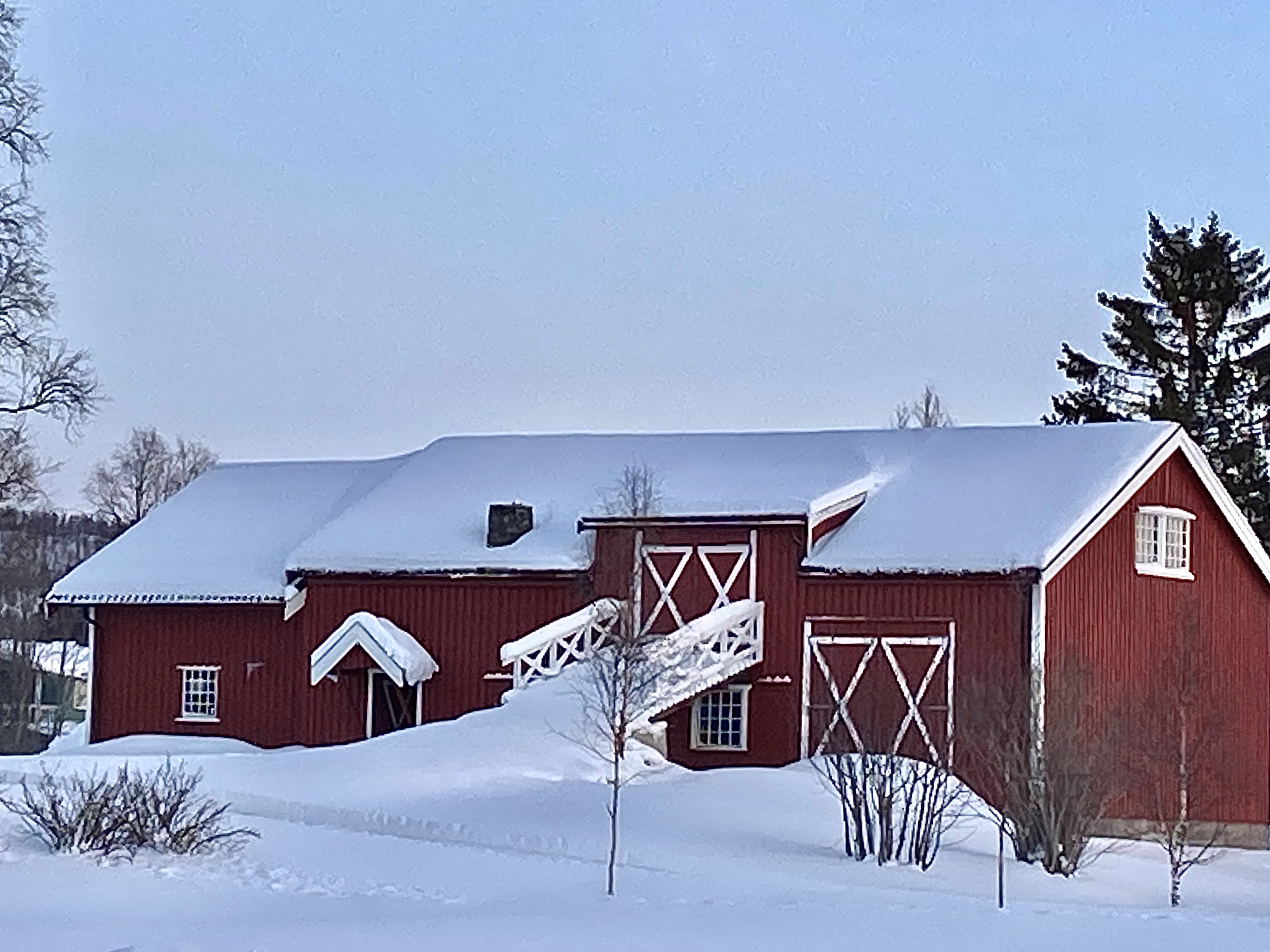
Anyway, I have been meaning for a while to get photographs of some of the barns I see as I am driving around as I work and yesterday I took the afternoon off to do it. They are a very distinctive part of the landscape. Some of them are old, some look newer. Unlike most British barns, they are built on different levels and as you will see, many have a kind of bridge through which you can enter the upper levels. Building to fit the steep, mountainous landscape is definitely a feature.
I have been saddened to find that quite a number of these barns are no longer in use. I hope that they will not gradually disappear, although I confess I have seen a few which are falling down and in a state of decay, they still hold onto their romance and beauty. I didn’t get any photographs yesterday of those, but hopefully at some point, I will.
Anna was with me on my trip and she couldn’t resist taking a snap of this buried van with its tiny house and the wonderful backdrop.
And though today it is snowing again, this was the sunset behind the gathering clouds as we drove home from our trip yesterday. The mountains of Senja taken from Sørreisa.
The feature photograph above is of a message Anna left me on Tuesday, having watched the snow gradually deepen as she sat up into the early hours, knowing I had an early start. She left it propped against the cream in the fridge, correctly surmising I’d see it when I made my coffee before heading out. She knows me so well!
I read an interesting report this week. The Organisation for Economic Co-operation and Development (OECD) have carried out an assessment on Norway’s food safety, which includes an assessment of agricultural practices. I’ve probably mentioned before that when I visit farms in Norway, a lot of attention is paid to biosecurity. There are laws requiring certain measures, including notices placed outside the barn or shed to say that entry is restricted and a “lock” area with some kind of physical barrier or line which requires a change of footwear (and often clothing) to enter.
I don’t know the current situation in the UK. Presumably in some areas, such as poultry production, they employ a similar system and change clothes on the way in and out, but when I went on cattle or sheep farms, I would travel around using the same wellingtons and waterproofs with only a quick wash between each visit. Even during the Foot and Mouth outbreak in 2001, the only difference was that the wellie wash was a bit more thorough; disinfectant was used and sloshing down the car tyres was added in.
So I was interested to see what the OECD had to say. Unsurprisingly, Norway scored very highly on food security. This is surely a good thing, you would imagine. But the feedback messages were mixed. Despite the high score, the OECD criticised the system for being too expensive. The word “overfulfilling” was used. The rules don’t allow enough potential for increased value, apparently. Of course, that is business bunk for “your food is too expensive and therefore not competitive in our international markets”.
The Norwegian response to this was rather predictable. They know (of course they do) that their food is not competitive. I have been reading a lot around pig farming in Norway and it is specified and fully accepted that almost all the pork produced in Norway goes directly into the Norwegian market for exactly that reason. But they feel it’s a price worth paying to ensure health and welfare are prioritised. Biosecurity in the food industry is the cornerstone of the Norwegian government’s agricultural policy. Meat in Norway is, of course, notoriously expensive, but perhaps it should be. The recent discussions during Brexit about chicken washed in chlorine were an eye opener for many people. There are lots of ways to keep food safe and ensuring your animals are as free of disease as possible is, in my opinion, beyond criticism.
Anyway, enough politics. This week has been noteworthy because after two months of working almost exclusively from home, there has been a big change this week. Birgit, Thomas and I have been visiting our local veterinary practices. Building up links is a useful thing to do. Mattilsynet carry out some routine inspections on farms, but we can’t check everywhere and rely on reports from other people to direct us to places where there are concerns about welfare. There’s a very human side to that, of course. Animal welfare doesn’t always suffer because of intentional negligence. Sometimes animal owners are ill or unable to cope. Sometimes they are uncertain of how to care for their animals too, and part of our job is to step in when there are problems.
So we want the vets who cover our patch to be part of something bigger than Mattilsynet. We need a network of support. During the visits, Birgit explained that there are now two dedicated “animal crime” police officers in Tromsø who form part of a new initiative . This is important when it is potentially unsafe for us to carry out visits, for example, and in the other direction, when police activity leads to the discovery of neglected pets during the course of carrying out their routine duties.
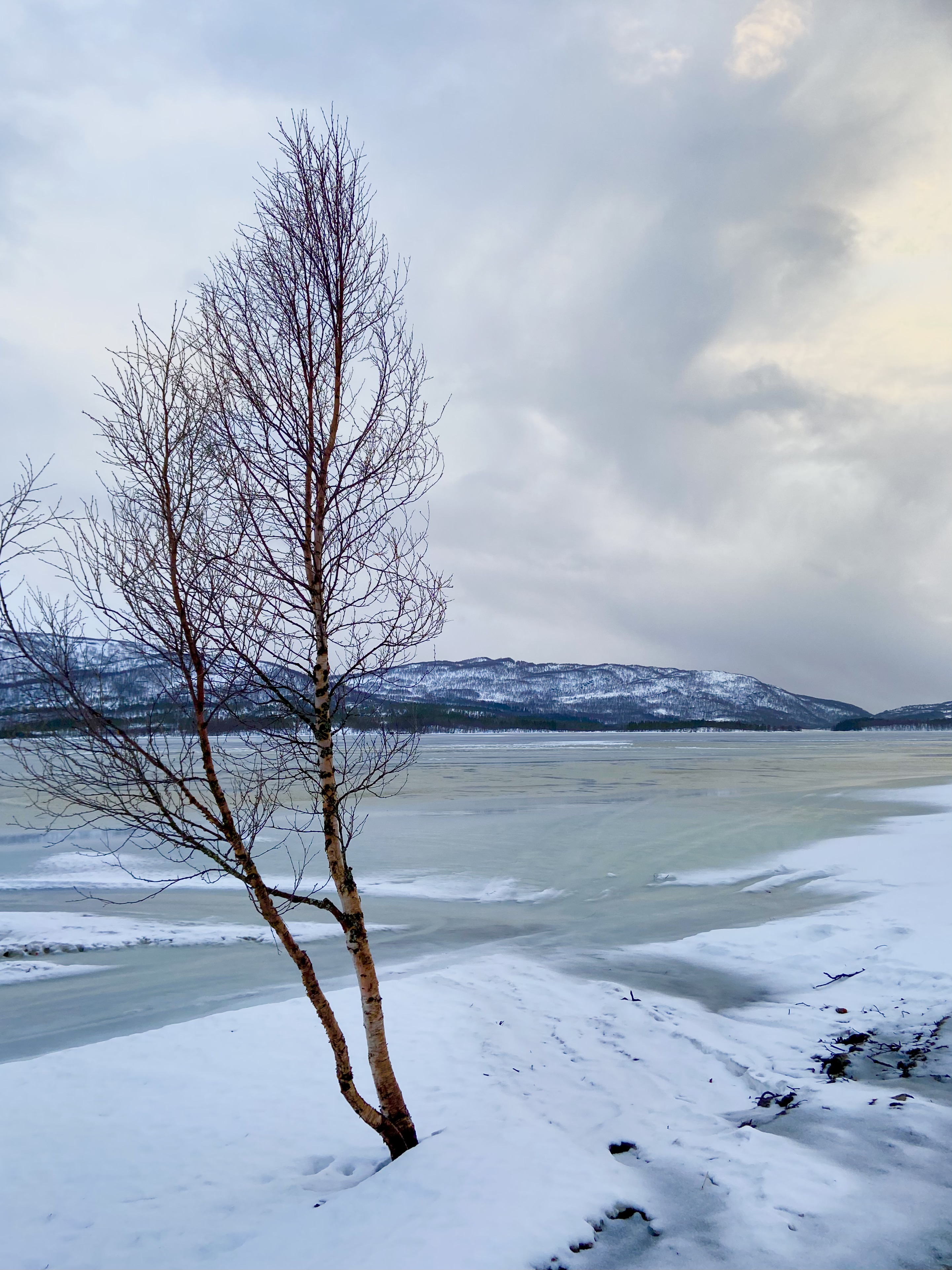
And so, I have been out and about a lot more, and of course here in Northern Norway, that requires assessment of (and allowances for) the weather conditions. After a huge thaw at the beginning of the week, with landslide warnings all over the place, it has now settled back into seemingly perpetual snow showers. The thaw, while rather alarming, was beautiful. Instead of a huge flat expanse of snow, the lakes took on some colour, though the thaw was not long enough for the ice to melt.
But now the snow has returned with a vengeance. One of the veterinary practices we visited was up a narrow track between snow-capped trees. I confess I was rather envious of the vet who had set up her one-woman practice in such a wonderful place.
The Norwegian road agency do a great job keeping the roads clear. On the way to my last visit, I was a little early and I stopped in a layby and took a photograph of the E6 road. This is the main trunk road that stretches down through the whole of Norway and then to the southern tip of Sweden. One day, perhaps I will drive the length of it. But that will be a whole new project.





































 A Vet’s Life