It’s been a busy week. On Monday, I made a revisit to a welfare case, Tuesday and Wednesday were spent catching up on paperwork and courses that I should have completed as well as having an appointment with a doctor from occupational health. Thursday I was third duty vet and yesterday, I inspected a chicken farm with a colleague up north of Ayr.
As some of you will know, I had some major neurological issues between 2017 and 2019. These mostly cleared up after I started physiotherapy and had some coincidental corticosteroid injections for a seemingly unrelated issue. I never received a diagnosis, but the problems I had still recur when I’m very tired, and I still tire very easily. My line manager referred me to occupational health as this means that coping with duty vet on top of my day to day work is currently too much.
The doctor has recommended that, though I will still cover nights and weekends, I will be temporarily relieved of the daytime tasks until I am more familiar with what needs to be done. She also recommended I should go to my GP and get myself rechecked. I imagine that could be a long job, involving lots of tests, quite likely with the same end result, but I will keep you posted.
With all that said, I was incredibly touched that another colleague from Lauder, who I’d never met before, invited me to come and do my first ever stint as third duty vet with her and doing it with someone else in the room with me, who was perfectly willing to help, was altogether a different experience. It might be difficult to organize for new starters to do this, partly because so many people still work from home, post Covid, but it would prevent a lot of anguish. So many people I have spoken to describe being in tears when they are stuck on duty vet that I have also reported it as a health and safety issue, but the reality is, we are understaffed and there’s not much that can be done.
Anyway, the best day of last week at work, was actually Sunday. I travelled through to the edge of Edinburgh on Saturday night, and at 07:45 on Sunday morning, I reported for duty as one of the official APHA vets at the Royal Highland Show.
Our routine remit didn’t sound too onerous. We were asked to walk round all the animals once to check on health and welfare. There were other vets at the show to deal with any front line injuries or illnesses. I did read our contingency plans before I went, which detailed what we must do in the event of a foot and mouth outbreak and other unpleasant scenarios, but fortunately none of them happened and instead, it was a lovely day out. The rest of this post then, is going to be taken up with photos from the show. I hope you enjoy them.
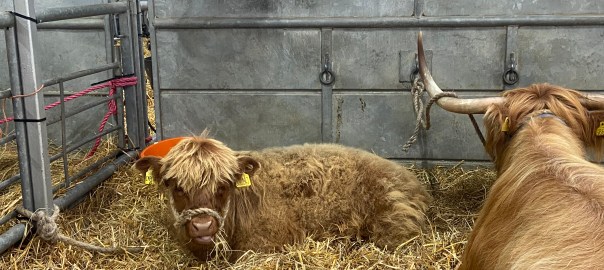
Quite appropriately, the most heavily featured breed in my photos is Highland Cattle. The amount of work it must take to have them clean and tidy for the ring is phenomenal. I chanced upon a young woman wielding a long hairdryer on hers and asked if I could take photos and she agreed.
I also loved the belted Galloways.
Though it must be a lot of work to present such beautifully turned out stock, the Highland Show is a real, family event. Again, I asked if I could take a photo, but here, the whole family were gathered around a calf that was being preened.
The Holsteins, for some reason, are shaved all over, before going in the ring. I watched someone carefully running their clippers along the spine, leaving some of the standing up hair, working to get a perfectly straight line, to give the best effect. I didn’t photograph that one, but it was interesting to compare the slimline, dairy cattle with the sturdy beef cattle. For obvious reasons, one of those is bred to not put on any flesh, but to direct energy into milk production, the other is bred to have as much meat as possible. I saw a breed that I hadn’t come across before – the British Blue – which has double muscles. I give you a baby Holstein, then a rump comparison, Jersey dairy cattle, vs a British Blue.
There were even more breeds of sheep. I don’t have so many photos of them, but I was struck by the fluffy cuteness of these black nose sheep.
And these fabulous horns.
There were ponies and heavy horses…
And right away, at the far end of the show, there were goats, alpacas and chickens.
All in all, checking out all the animals was a very long walk and by the end of the day, I had covered twelve kilometers. I felt very pleased though, at having such a wonderful day out as part of my job. I hope you enjoyed the picture and I will see you all again next week.
I was tempted to call this week’s entry TB, or not TB but that feels wrong. Although I have enjoyed this week, the subject is serious and there are sad overtones. I suppose the animals that go to slaughter following our test would have ended up there anyway eventually, but their lives will be cut short and it is a loss for the farmer, though he will receive some financial compensation for the cattle which are culled. It can’t be easy, knowing there is disease in your herd.
Though the aim to wipe out TB is laudable, for each farmer affected it can be a major headache. When we find TB on a farm, all cattle movements on and off that farm are limited. Restrictions are put in place and the only place those animals can go, is direct to the slaughterhouse. This means that if there are more animals on the farm than grass for them to eat, the farmer can’t send the excess stock to market. He either has to buy in food for them, or send them to be killed, even if they are animals that would be more valuable sold live. A young breeding cow has more value than the price of its meat, for example.
So it’s a difficult juggling act for the farmer. Throw in there the fact that our tests aren’t perfect, the disease is unpredictable and eliminating it can be difficult and you have the perfect combination for resentment of the people coming on the farm to do the testing and represent the government who put all these rules in place. We were very lucky this week that the farm owners were philosophical. It’s time consuming for the farmer as well. We tested close to four hundred animals this week. It took the best part of four days and even then, there are some retests that need to be done. Then in a couple of months, the whole thing will need to be repeated. On and on until the tests come back clear.
I met up with the team on Sunday night in the hotel where I would be sleeping for the best part of a week. I had met S the vet before. She took me out on some welfare visits a couple of weeks back, but there were two animal health officers coming too to carry out the blood testing and keep the paperwork in order. There was also another TB team, who would be skin testing at another farm in the area, so we were quite a big group. Though the food and conversation were good, we all retired early, ready for the hard work that was coming the next day.
It was interesting to me to go out testing. Thirty years ago, I used to carry out TB skin tests in the area, though in those days, there was no known TB in the area and all the tests were routine herd tests where we didn’t expect to find anything. The farm where we tested this week has already had TB confirmed. Culled animals had been found to have TB lesions present and culture results – where they attempt to grow bacteria in a lab from a possibly infected source – had shown that bovine TB to be present.
As far as I could see, the skin test hasn’t changed much at all. Two patches of skin on the neck are clipped (so you can see where you injected) and two types of tuberculin are injected: avian and bovine. Tuberculin contains purified proteins from the tuberculosis bacteria and in the UK, two types are used.
Because other harmless bacteria can be present in the environment, avian tuberculin is also injected, to try to rule out animals which have developed an immune reaction to those harmless bacteria, but still capture those that are infected with the harmful cattle strain. What this means, in terms of the test, is that if the animal produces an immune response, a lump develops at the injection site. If the lump at the bottom (bovine tuberculin) is bigger than the lump at the top (avian tuberculin) then the animal is classified as a “reactor”. That animal must then be slaughtered and checked for disease.
What was new to me though, was doing blood testing for TB in addition to the skin test. The blood tests are relatively new, very expensive, and there is a limited capacity for doing them in the UK. The animal health officer – SW – who arranged the test, had to call the lab in advance and book in our samples. The blood in the tubes also has to be kept within a certain temperature range and as it is winter, that meant that as soon as the sample was taken, it had to be placed in an insulated box with a heat pad. At the end of the day, a courier came, who would drive the samples directly to the lab.
Though it was a dull day on Monday, the test started well. SW was taking bloods and was wonderfully efficient at it. The arrangement with the needles was a bit different from what I remember in the old days. We used to use a test tube, a needle and a small, plastic needle holder. In between blood tests, you would unscrew the needle from the holder and replace it with a new one, so the holder was reused. Now, presumably due to the number of needle stick injuries that caused, a new needle holder is used for each animal. In addition, you don’t put the protective cap back on the needle. Instead there’s a green plastic flap that you flip into place to cover the needle. Doubtless it saves a lot of sore thumbs, but there is an immense amount of plastic waste.
This is K, the other animal health officer, taking a sample from the cow’s tail.
I had forgotten how messy blood testing cattle is. It was a beef farm, so the animals are always a lot wilder than dairy cattle. The animals are run up a race (a narrow fenced passage) and into a crush, where their neck is trapped so that they can’t move forward or back. That doesn’t stop them fighting it though, and as they scrabble about, the air fills with flying dungbombs. Of course, when you’re taking a sample from the tail, you’re also directly in the splat zone. I did a few samples and was briefly proud of how clean everything was… and then a cow sent the traditional jet of liquid shit directly at me and I spent the rest of the day with half my jacket and one trouser leg well and truly coated.
SW and K made a wonderful team. I was worried at the start that I would be a complete spare part, but they quickly involved me. Despite all the flying faeces, and the potentially serious nature of our visit, it was wonderful being back out on a farm, in the thick of the action, doing the job that I trained for all those years ago.
We had bought packed lunches in the shop in the morning. As we walked back to the cars, I was reminiscing with S the vet about the old days. When you spent the day on a farm testing, it was normal when you broke for lunch, to find a wonderful three course meal waiting for you in the farmhouse, courtesy of the farmer’s wife. Though it was already starting to be more common for farmer’s wives to work, it was still a regular part of that life back then, but I had been told it was uncommon now.
Of course, with four of us there, it would also be a big ask, but to my delight, we were invited into the farmhouse, where there was delicious, warming farmhouse soup, sausages, cheese and rolls and pancakes with butter and jam. Given what we were there to do, it was fantastically generous and it added to that feeling of deja vu I had all week.
We spent all day on Monday and Tuesday, injecting the skin test and taking blood samples, then on Thursday and Friday, S went out to read the skin test and I accompanied her, partly to do the writing (making sure you record the numbers and make sure the right animals are identified is crucial) and partly to see what the skin reactions are like and how they should be read. Though I’d seen a few avian reactions years ago, I never found any reactors and I was half hoping we wouldn’t find any.
But that hope only got as far as the third cow. Unfortunately, she had a lump where the bovine tuberculin had been injected, but no reaction at the avian injection site, which meant that she was a reactor. It was quite a chilling feeling for me, partly because the cow would have to be slaughtered and partly because I now knew that here was an animal with an infection that could be passed to humans. We’re not allowed out on farms to test without having had a BCG vaccine, but it was an unexpectedly sobering thought.
Things went relatively well from there, though there was one other reactor, and that was last years calf from the infected cow. Interestingly, the blood tests came back on Friday, and though it had picked up TB in the calf, the cow tested as negative. It will be interesting to see what is found when the two of them are culled. Though it’s not nice to see a young, recently weaned beast being sent off, it was some consolation that the cow would have company. Cattle tend to be stressed when they are isolated from the herd, and the farmer is required to isolate reactors as soon as possible.
There were also some more positives from the blood test, so they will be sent off too. Then, as I said back at the start, the herd will need to be tested again, and maybe several more times, but hopefully it will eventually be cleared. Officially Scotland is TB free, but in southwest Scotland, where animals are regularly brought in from Ireland, it’s always going to be a problem until they find a better solution. And as this is part of my patch, it looks as though we will be working on it for some time yet.
And for those of you that have made it this far, here are some gratuitous food photos from the Craignelder Hotel, where we stayed.


 A Vet’s Life