Yesterday was another of those gorgeous days of endless blue skies. Birgit and I drove south in the morning sunshine and then took the ferry across Lyngen Fjord.
Our destination was Lyngseidet in Lyngen Kommune. Though it is possible to drive round, it would take several hours. The crossing took about forty minutes and as well as taking photographs, Birgit and I bought drinks from the small cafe on board. I had a slightly surreal moment when I approached the lady behind the counter and she spoke to me in English. Given that I was wearing a Mattilsynet jumper with a Mattilsynet badge hanging from a Mattilsynet lanyard, and was waving a Norwegian credit card, I was slightly taken aback. Perhaps my face looked British, but I didn’t ask so I guess I’ll never know.
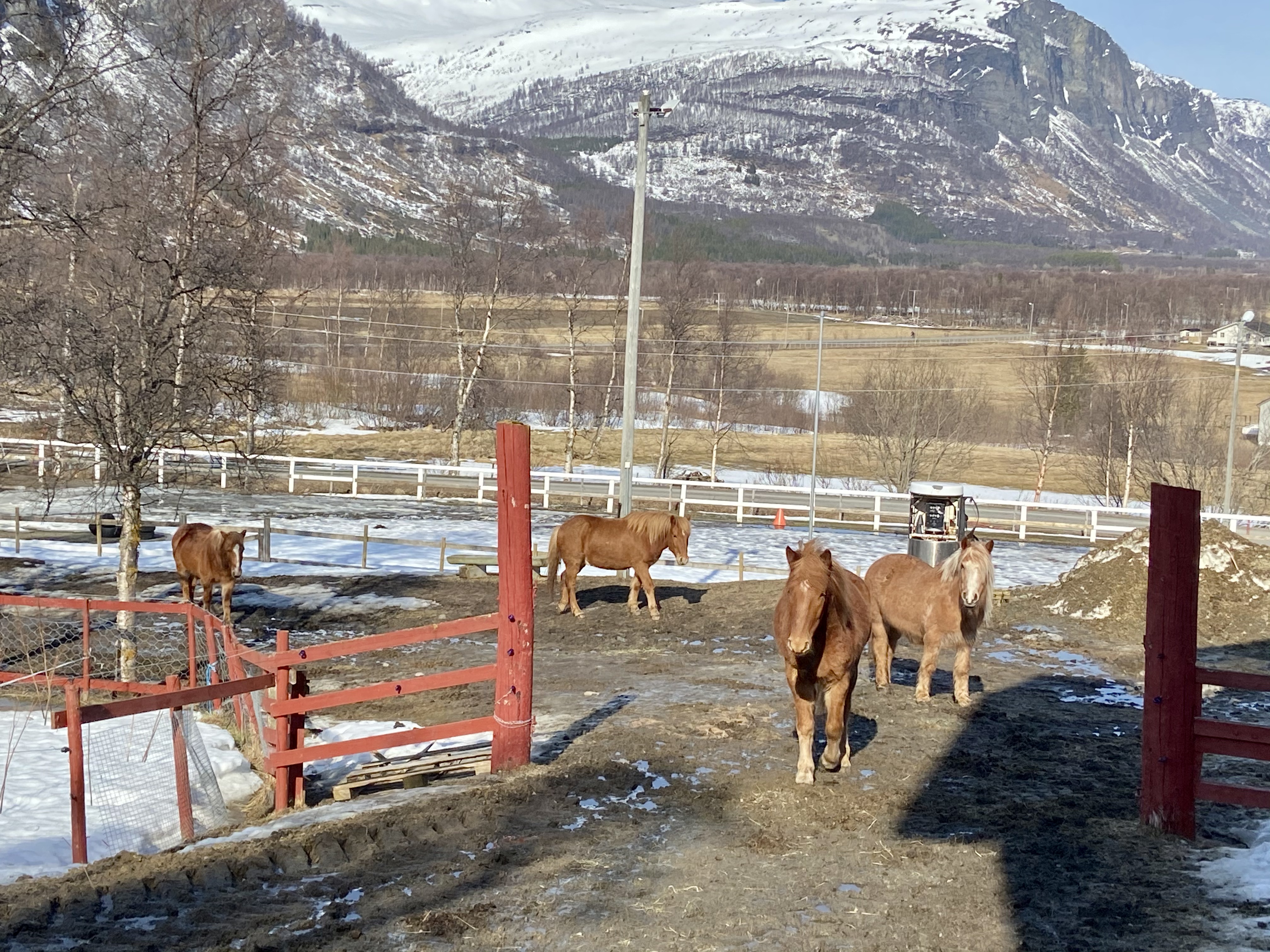
Birgit had planned two visits to blood sample goats, but there were some last minute cancellations and so we visited some sheep farms to check ear tags instead. I am taking a course at the moment on inspections, and so Birgit let me lead both of them. Better still on the first farm, as well as the sheep, the owner had some Lyngshest/Nordlandshest. These wonderful little Norwegian horses are immensely strong and hardy. Most of them are between 12.3 and 13.3 hands (130-140 cm) but Birgit assured me they can easily carry an adult’s weight. She had told me before we arrived about the little horses – she has some herself – and so when we had checked the sheep, I asked the farmer whether we could see them. He led us outside, and to my delight, he called them and they began slowly to walk towards us.
Despite being a little shy at first (he told us they were suspicious that we were vets) very soon we were making friends. Considering the bizarre protective clothing we wear, I think they were surprisingly courageous!
The second visit was great too. The farmer gave us a warm welcome and was very positive about having a visit from Mattilsynet. She seemed rightly proud of her mixed flock, half of them tiny Norsk Villsau (literally Norwegian wild sheep) the other half being the sturdier Norsk Kvit Sau, or White Sheep.
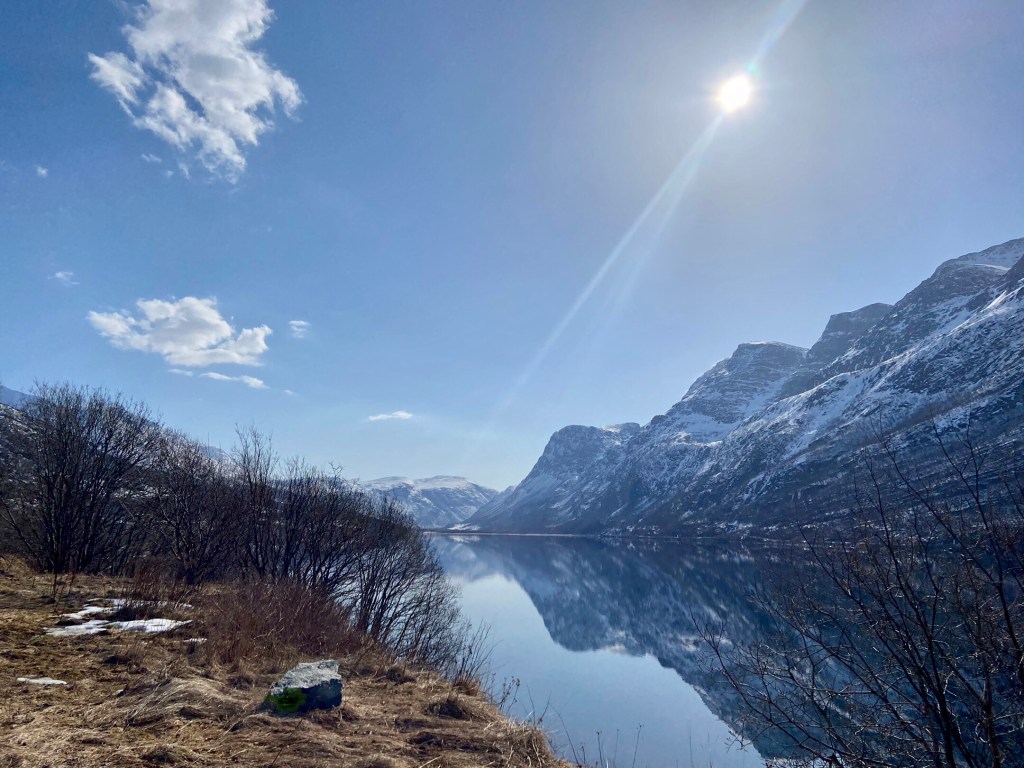
Once we were finished, we headed back to the village where we had landed. After stopping to take a photo of Lynseidet church with its friendly red roof and one of the irresistible mountain behind the Co-Op, we ate lunch outside on a scarlet-painted table beside the fjord. Birgit pointed out the curlews flitting over the water. The arrival of the curlews on their migration to the north means that spring has arrived, she told me. With the warm sun on my face, I could well believe it.
After that it was time for our return journey across the Fjord. As I looked back towards Lyngseidet, I was already making plans in my head to visit again in the summer. It will all look very different in a few weeks time when (most of) the snow has melted.
As we drove around, Birgit told me a bit about the local area. Norway has, of course, a great seafaring tradition. With its long coastline and sheltered fjords, it was the perfect place to create a trading hub. And here in the north, we are also very close to the Finnish, Swedish and Russian borders. She tells me that traders created their own language, which is a mixture of the various languages and dialects, so that they can all understand one another.
I had heard of the Sami before, but not of the Kven people. Descendants of Finns who moved to Norway in the 18th and 19th centuries, they too have their own language. So just as in Scotland, where many road sign have Gaelic alongside the English spelling and in Wales where Welsh names are shown, up here there are road signs with three different languages: Norwegian, Sami and Kvensk.
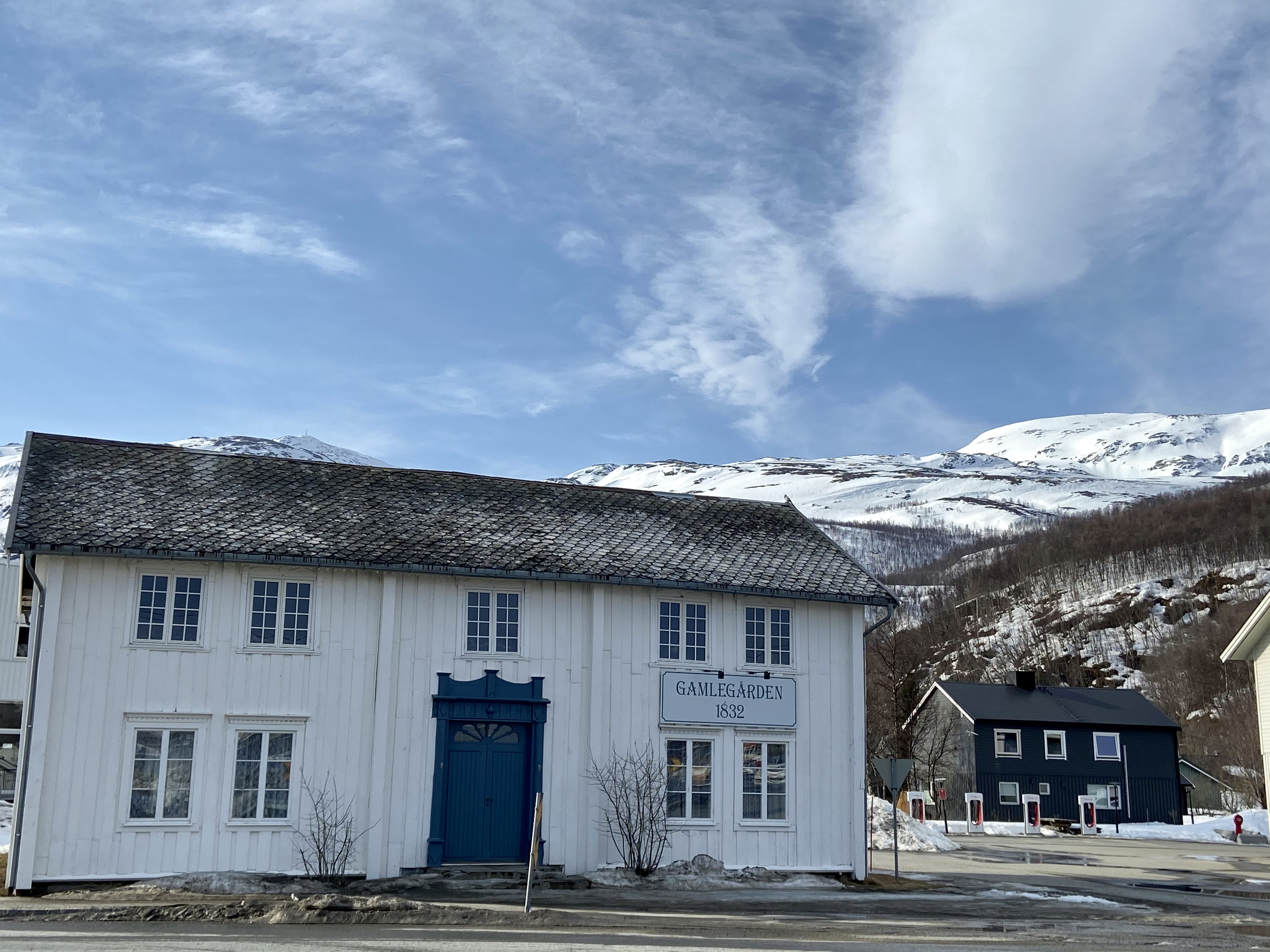
As we arrived back in Sørkjosen where I am staying, Birgit told me that the building opposite my hotel was one of the few in the area that was not burned down by the Germans as they retreated towards the end of the second world war. I had taken a picture of it in the morning as it was a beautiful old building.
And so, with all the new information whirling in my head, I stopped for a moment to look at the boats that were safely tide up in the harbour. Despite the desperate thought of past destruction, so far I have found nothing but peace and happiness here in Nordreisa.
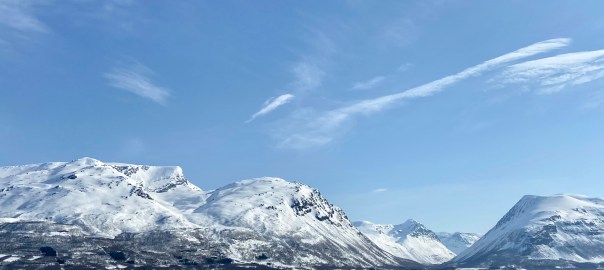
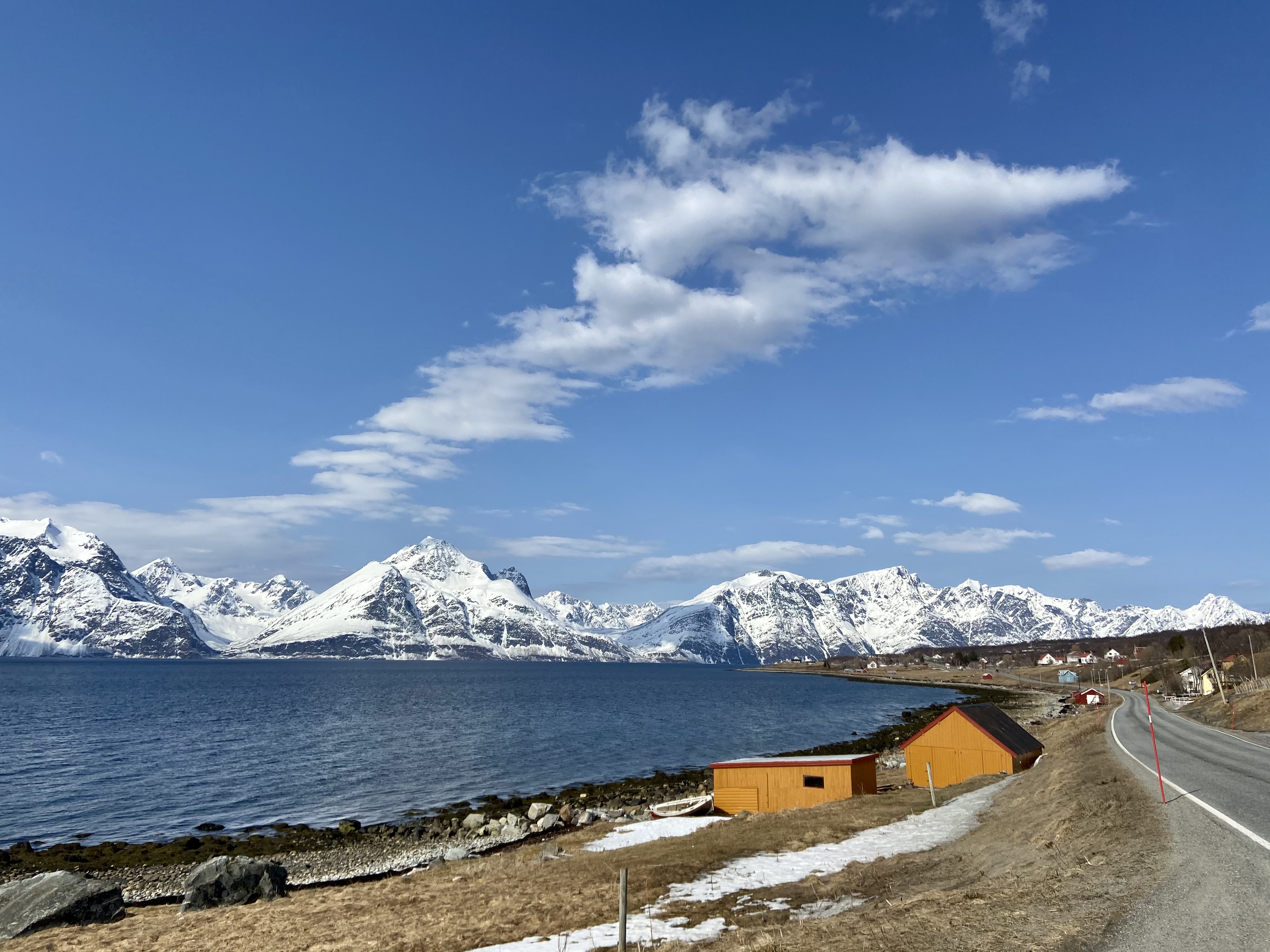
I know I usually update on Saturdays, but this week is special. My long awaited, coronavirus-postponed trip to Mattilsynet Troms and Svalbard’s most northerly outpost in Storslett is finally here. It was a wonderful drive up through glacier carved mountain ranges and along the steep edges of fjords.
The sun was shining on the snow-capped peaks, and waterfalls are beginning to appear, mostly at present as tiny droplets falling from mossy rocks, but soon there will be torrents as the ice melts and the world turns green.
As I neared Storslett, the land beside the fjord stretched out. Small boat sheds, cheerfully painted, stood beside ramshackle frames where cod would be hung to dry in winter. I didn’t manage to take a picture of the frames, but I will try to do so on the drive back, or when I’m out and about with Birgit, who is my mentor for this week.
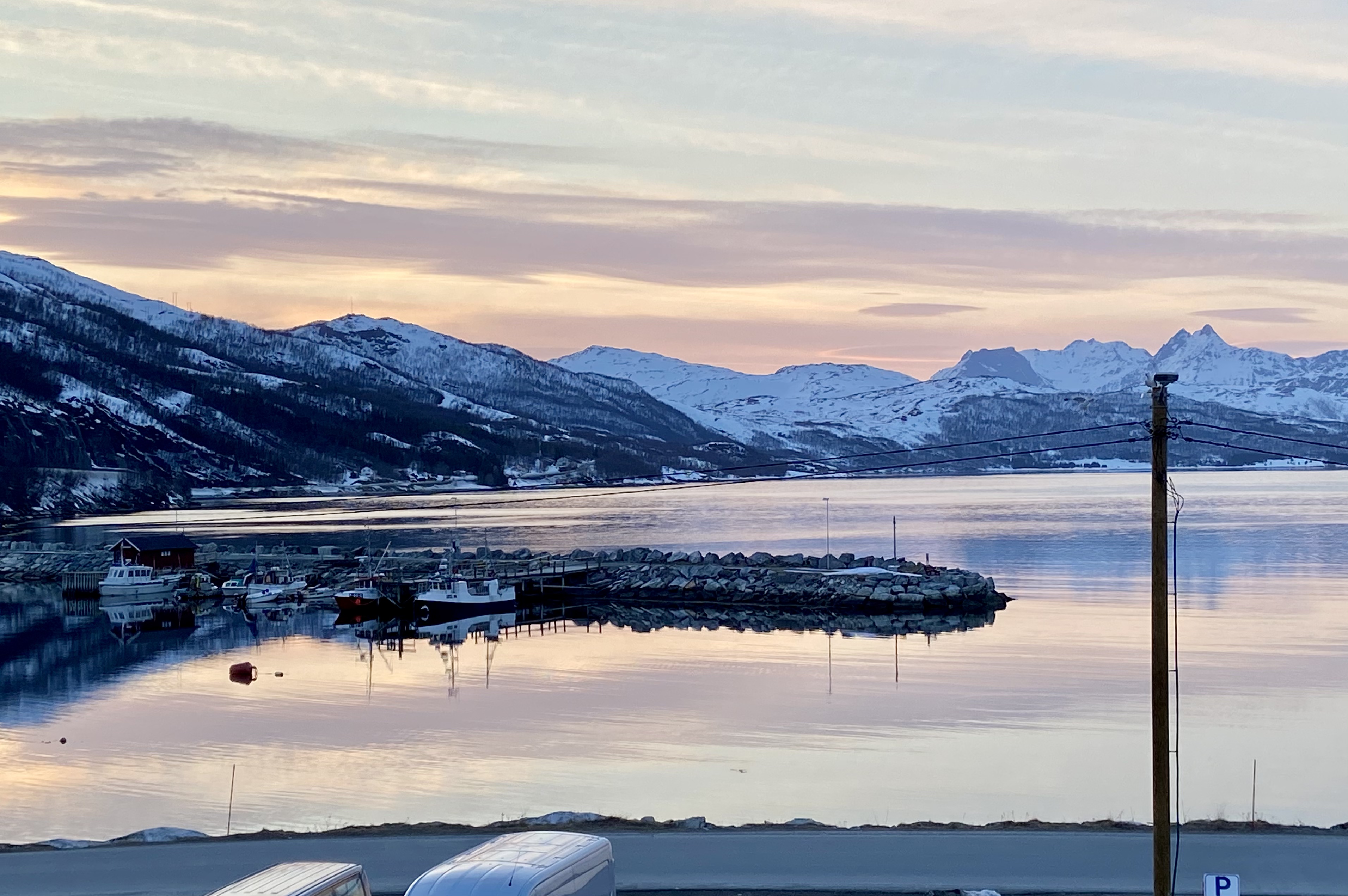
By the time I got to my hotel I was tired and fell asleep for an hour, but I woke to the most wonderful evening sky. Goodnight all!
I had a phone call this week from a member of the public who had sent a “concern message” and wanted some follow up. In the UK, this is the kind of report someone might send to the RSPCA (SSPCA in Scotland) when they have seen an animal or animals that they are worried about and want someone in authority to do something about it. Here messages are made online via an official form.
One of the challenges in a new job where there is contact with the public is being put on the spot before you are fully genned up on how everything should be managed. Due to coronavirus, the learning process has been slow for me, but I feel I am finally getting a handle on things. Phone calls are rare (I can only remember receiving three or four) and as they can be redirected from a central line, they don’t always go to the person best placed to give an answer.
For me there’s also a language issue. As others who regularly use a language that is not their mother tongue have confirmed, if a topic of conversation arises where the context is unclear, it can take a minute or two to catch up. On one occasion when I was rushing out to a doctor’s appointment, I was called by a man about a visit someone else had made to carry out meat inspection on a wild moose. As I had no context, I thought we were discussing a call Thomas and I had made the day before. Luckily as I was in a hurry, I accidentally redirected them to the appropriate person, but as you can imagine, all the ingredients for creating some kind of Fawlty Towers level farcical misunderstanding are present.
Fortunately there was no such misunderstanding in this case, though having answered the phone without any opportunity to prepare myself, I did manage to forget almost everything I had learned.
I took down what I thought were the salient issues: details of the nature of the report (horses standing in mud with no food) and the name and number of the person who had sent the report.
Running through my head was the knowledge that Thomas would almost certainly know more because the concern messages in our area currently come in to him and he shares the details with or (on one occasion so far) delegates them to me.
I ended the call and thought through my next steps. Obviously I had to call Thomas, but I wanted to work through as much as I could on my own before doing so. There is a shared file within the DyreGo department of all current and ongoing concern messages and so my next step was to look them up. It was at this point, I realised the first of my errors.
Quite often when people make reports, they choose to be anonymous and the online form gives anonymity as a clear option. Ongoing cases are not listed under the details of the person reporting: rather they are recorded under the name and address of the animal owner. None of the cases on the list fitted perfectly. Worse still, I realised that the central bod might not have even redirected the call to our office, but to the wider Troms and Svalbard team. The horses in question could easily be hours away in Tromsø and Thomas might know no more than I did. Still, having done what I could, I went ahead and called him.
Thomas is very patient with me. He told me early on that he wasn’t, but being aware there were many things I couldn’t do, I made an effort to take on the things I could, even if it was something as mundane as coming in early to clean snow off the car we were going to use. Sometimes I get ahead of myself (MATS, the computer system we work with, is very unforgiving if you make an error – it’s designed to work through things in order and going back to correct can be “challenging”) and then he rolls his eyes and tells me not to go so fast, but mostly we laugh together.
We weren’t far into the call when my second error became clear. I had received a request for information from someone who was worried about some animals, and so of course I wanted to help. But as Thomas reminded me, as soon as we begin investigating welfare cases, we are obliged by law to keep all the details secret. Even if I could work out which case it was, I couldn’t tell my enquirer what was happening.
Nevertheless, as he knew no more about this case than I did, he advised me to call one of the members of our team who receive and review all the cases when they first come in. They carry out a preliminary investigation, examine any evidence from previous interactions with the animal owner, assess the severity of any welfare issues highlighted, and then either close the case immediately or pass it on to the nearest office for further assessment.
And so I called Birgit and explained the situation and as well as managing to find and update me on the case, she explained how to deal with the enquiry as well. One of the things the enquirer had asked was whether we’d received the report. I know from dealing with veterinary cases that when calling people, it’s often true that if you haven’t got, or aren’t able to give them the information they want, it’s helpful to have at least one positive point you can emphasise, even if it’s minor in the grand scheme of things. And so I called the enquirer back and explained that I was unable to give details about what was happening, but at least we had received the message and it had been assessed.
I was relieved to have put the enquiry to bed, as it were. I hate having unresolved things hanging over me. But a number of thoughts went through my head following the call about how I could have dealt with it if the caller hadn’t been satisfied with my response. I could have explained more about the processes we have, and perhaps how such a case would be handled.
The initial assessment would look at whether one of our team had investigated similar allegations before and the results. Where there is no history, or where the history indicates the case should be taken further, the case is sent to the local office where the inspectors decide whether it can be handled over the phone – better in these covid times in simple cases where the animal owner can send a picture or video during or shortly after the call to demonstrate whether something is true or untrue – or through a visit.
Some thoughts crossed my mind about that possible visit too. I was called out to a similar case years ago by the SSPCA. They were trying to put together a court case against an owner and I remember going out and looking at all these poor horses, standing up to their knees in mud, and thinking that if it did go to court, I would be happy to stand up for them to try and stop their suffering. But I’m not sure, with hindsight, that I would have done them much good. I can’t remember what examinations I carried out, but I do have vague memories of warnings at vet college that giving evidence in court was something of a specialist activity and we should be wary if we weren’t experienced, which I wasn’t. Perhaps fortunately for me and the horses, it was resolved without reaching court.
It crossed my mind though now, that what Mattilsynet are doing is akin to training me to be the kind of expert witness I needed to be back then. I would no longer go out to such a case and ask for guidance from the SSPCA. I would go out armed with the exact wording of the laws and by-laws that govern animal ownership in Norway.
I also have a better understanding of how you could prove or disprove an allegation. To assess whether a horse or horses were indeed without food, we would start by asking the owner. We would find out through questioning, whether they had enough theoretical knowledge to know how often you should feed a horse and how much. But that would only be the first step.
After that, we would examine the food they had available and how it was stored. We might take pictures of that. More importantly, we would examine and photograph the animal and compare it to a prescriptive scale based on anatomical features. If you can see various bony structures, you can assess where the animal falls on the scale where 1 is way too thin and 9 is very much too fat. We would look at other details as well to assess more general health and welfare. I’m not sure yet about how it would work if we ended up in court (or indeed whether that happens) but all these processes allow us to be very specific in being able to back up our claim that “the animal looks like it is suffering” with verifiable and objective facts to demonstrate that it is.
The great thing is though, that having worked through all that, the next time I get a similar phone call, I will deal with it easily. Even if the enquirer is difficult to work with, I will have a raft of background information to help me deal with it. That is the nature of being a vet. When you start out, almost everything is a challenge, but as you deal with challenges every day, managing them becomes routine.
In my current role, with coronavirus and working from home, I’ve received so much intensive theoretical training that it’s nearly coming out of my ears. This phone call and last week’s practical training with Thomas has led to all that information clicking into context. I am finally beginning to believe I will one day be good at this job. On Monday, I am going on my long-delayed week-long trip to Troms and Svalbard’s most northerly office in Storslett. I hope Birgit is prepared for the onslaught of the three million questions that have become apparent with my increasing knowledge. It’s very true that the more you learn, the more you realise you don’t know.
To finish up, I wanted to talk a little about daylight and about spring. The quality of the light here continues to surprise me. As you can see at the top of the page, we have full daylight for over sixteen hours each day. By the end of the month, there will be just over half an hour of what is called civil twilight around midnight. Civil twilight is the brightest form of twilight where the sun is just below the horizon: the same kind of light we had during the polar night.
The speed with which the changes occur probably shouldn’t surprise me. After all, we had it in the opposite direction only a few months back, but the daylength changes are so fast that the weather doesn’t really keep up. Though there have been a lot of days where the temperature has made it above zero, when rivers of melt water have run down the middle of roads and rushed down newly visible mountain streams, there is still a thick layer of snow on the ground.
Back in Scotland, it wasn’t impossible to have the odd day of snow in April, but it was a rare occurrence. I tend to associate snow with short winter days and near permanent twilight. But now I look out on all this wonderful light and the snow is still on the ground and it’s almost magically white. The picture at the top of the page shows the wonderful warm twilight as the moon rises over Gisundet Sound and the island of Senja. But the day time is equally rare and magical, and I hope that I caught something of that in this second picture.
Anyone else love hotels? For me there are few things more pleasurable than travelling somewhere and checking in to a hotel with a comfortable bed with clean white sheets. Better still is waking up in the morning to a lovely breakfast someone else has cooked. I will add that if you have spent a long day working out on farms in cold weather, then stepping under a powerful shower with sweet-scented soap to wash away the chill and the farmyard smells is blissful.
The only imperfection for me, was that I had forgotten to take my book. I am trying to cut down my internet time and take up reading again. There is something about escaping into the world of a book that can never be simulated by online conversation.
Things are, of course, slightly odd at the moment. I spent Thursday night at Vollan Gjestestua (pictured above) with five colleagues from the DyreGo Team, which covers animal health and welfare. Business travel in Norway is limited at the moment, but there is a certain amount of work we have to carry out over the course of the year. The area we cover between us is too large to do it easily and then drive home afterwards. In addition, lockdown and working from home is increasingly wearing, so although we had to all sit at separate tables in the restaurant and communicate by lip reading and sign language, it was good for my mental health to see my working colleagues in the flesh and not just on a screen. Yesterday we had a similarly distanced meeting.
Birgit, Thomas and Anja. Astrid was to my left and I couldn’t fit her into the photo – socially distanced pictures are hard to take!
I read a blog entry earlier in the week by Iceland Penny. It draws attention to some of the contradictions in life, things she came across that held both good and bad/beauty and ugliness. Both/And by Iceland Penny. I was reminded of the post by a discussion in the meeting we had about technology.
I have come to Mattilsynet at a time of upheaval. Some of it is driven by the drive to use less paper and more technology, but the process has been speeded up by coronavirus. If you hand over a pen and paper for a signature, you increase the risk of infection.
When we carry out a visit, whatever the reason for it, we summarise our observations on a Tilsynskvittering. This is an outline of the visit and what was checked, split into different sections related to Norwegian law, stating whether the things we saw fulfilled the legal requirements. This receipt, until very recently, was written on paper, which you then photographed before handing it over to the owner. But since December, we have moved over to using an App.
Astrid pointed out that the new technology could be rendered useless if, for example, you were in an area with no phone signal. I would add that with the small screen on a mobile phone, it is hard to do a lot of typing. In theory you could take along your laptop and connect it to the phone, but then you are still reliant on being connected and anyway, there comes a point when you have to remember to take so many things that the entire process becomes unwieldy. “There’s a lot to be said,” she commented, “for pencil and paper.”
I guess this might be partly influenced by age. I mentioned escaping into a book upthread, and said I never managed to escape into another world online, but I know there are immersive games where my children manage to do just that. But most of the DyreGo team, like me are upwards of fifty.
While I can see that all this new technology has benefits, I also see that it’s challenging when change is brought in so fast. There was an older farmer we visited last year who had been asked to make a number of improvements and Thomas had asked him to send photos once he had done so. Having not received any, Thomas arranged a revisit, assuming the work had not been carried out. When we arrived, Thomas was delighted to find out that it had. When he asked the elderly farmer why he hadn’t sent the proof along, the farmer told us he didn’t have a phone with a camera. I think when we are so connected ourselves, sometimes it’s easy to forget that others are not.
Personally I am on the fence. There is increasing connectedness that I feel ought make us more free, but instead sometimes ties us down. In the meeting, I found myself thinking about the issue of traceability in farming and food production. When an outbreak of food-borne illness breaks out, it’s an advantage that we can find out more easily where it came from. But there is an enormous amount of work in ensuring all the information is put into the system within a very short timeframe. To me that seems like a lot of pressure on farmers who grew up in a time when most of the connections were with family, local farmers and the vet, and the only technology was your machinery and the weather forecast on the radio.
There are periods when I find myself hankering after pre-internet, pre-mobile phone times. It was way easier to go “off-grid”. Anyone else remember those announcements on the wireless (BBC Radio 4) appealing to people on holiday to get in touch as their relative was seriously ill?
I worked in large animal practice, and once you were out on your calls, there was a kind of freedom, though of course that could be inconvenient if you went all the way back and then found there was another visit in the same direction. I think there was less pressure in practice to be right all the time and to know everything. You built up knowledge through experience, through speaking to colleagues, through reading books that were probably already out of date as they had been sitting on the shelf in the practice for several years.
Nowadays, if you know where to look online, there are answers to be found and groups you can join. Anaesthetists discuss the intricacies of different protocols, breed and species differences and how to achieve perfect pain relief. There’s good and bad in that. Better specialisation, increased cost. Some things are lost as well, in this new world. A safe path can be equally well achieved with long familiarity with drugs and techniques, built up over a lifetime of experience. Sometimes I feel everything is now moving too fast.
That said, I can’t put aside the positives. I wrote six books while living in Norway with a co-author in Somerset for a company based in London. Victoria Holmes and I batted ideas across the ether in e-mails in a way that allowed thinking time without excessive delays. We couldn’t have done that over a traditional telephone line or in letters. I am also connected to friends I went to school with and teachers who would otherwise only be a pleasant memory (hello Mr Gorski!). I would never have heard from them again without it.
Even so, despite the positives, I find myself wishing that we could insert a grandfather clause into modern life. A grandfather clause, for those who don’t know, is an exemption from following new laws if doing so would be too costly or difficult. The most obvious example would be with building regulations that require new business premises to follow certain rules with regards to toilet provision, but don’t require that older buildings are brought up to the same standard.
I can’t help feeling that if staff who have worked adequately for years with a pen and paper are retiring within the next ten years or so, they could be allowed to continue without it doing a great deal of harm. It would save them a lot of grief. There is an aspiration that wherever you are in Norway and whatever your business, Mattilsynet will assess and deal with your case in the same way. I can see the value in that when it comes to assessing whether legal requirements are fulfilled.
But whether the report is sent online or on paper? When it really comes down to it, that doesn’t make a whole lot of difference, in the grand scheme of things.
Easter is a big deal in Norway. The first year we came, we were looking forward to the Easter break. The children were off school and work stopped right through from the Wednesday afternoon until the following Tuesday. Thursday morning dawned bright and sunny and I recall we headed into Stavanger, thinking we would go swimming in the outdoor swimming pool. We were disappointed to find it was closed. Who would close a swimming pool in the school holidays, we wondered, in our quaint British ignorance? Many swimming pools in Norway, we have discovered since, close during school holidays. That still seems bizarre to me as in the UK they are thought of as an entertainment and teaching venue and a useful and healthy one at that.
But the realisation that it wasn’t just the pools that were closed but also the shops was the real show stopper. While we probably had enough in the freezer to get by, we had assumed we could buy Easter eggs and all the celebratory food during the first day of our break. It wasn’t our finest hour.
Nowadays I am a little more prepared. I spent Monday out on a visit with Thomas and Tuesday at the abattoir. Charlie had originally been due to arrive on Wednesday, but due to coronavirus the planes continue to be erratic, so in fact he came on Tuesday evening. I had already planned for five days of dinners. Not for the Tuesday itself though, so Charlie bought us a meal from the local Chinese restaurant, which we ate at home due to lockdown regulations. Travel around Norway wasn’t recommended, but as Charlie hadn’t seen John or Anna for months, both our region and his have low infection rates and the planes were already booked, we had decided to go ahead, but take extra care to avoid contact outside the family while he was here.
Because he had arrived early, we were able to take a trip around Senja on Wednesday. We were lucky with the weather. It has been snowing on and off most of the time here, in between massive almost daily thaws, but there was an oasis of calm on the far side of Senja island and at one point, the sun even came out!
We made a stop at Steinfjord rest stop, a sandy bay at the end of a short fjord. The tiny village of Steinfjord nestles right at the base of the steep mountains. It’s a beautiful place.
Triar was, of course in his element, though he did have to wait patiently with his ball as Charlie spent some time taking drone footage of the surroundings.
The drive back was also beautiful, though as we rounded the north end of the island, the snow set in and after one final picture of another mountain range receding into clouds, I didn’t get any more worth sharing.
The end of Triars day was not so cheery. He had rolled in something or other back at the beach and so when he came home, he went straight into the shower and emerged, clean but not delighted.
And so for now, I will wish a very happy Easter to you all. See you again soon.
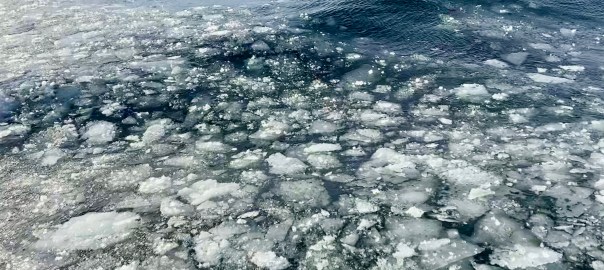
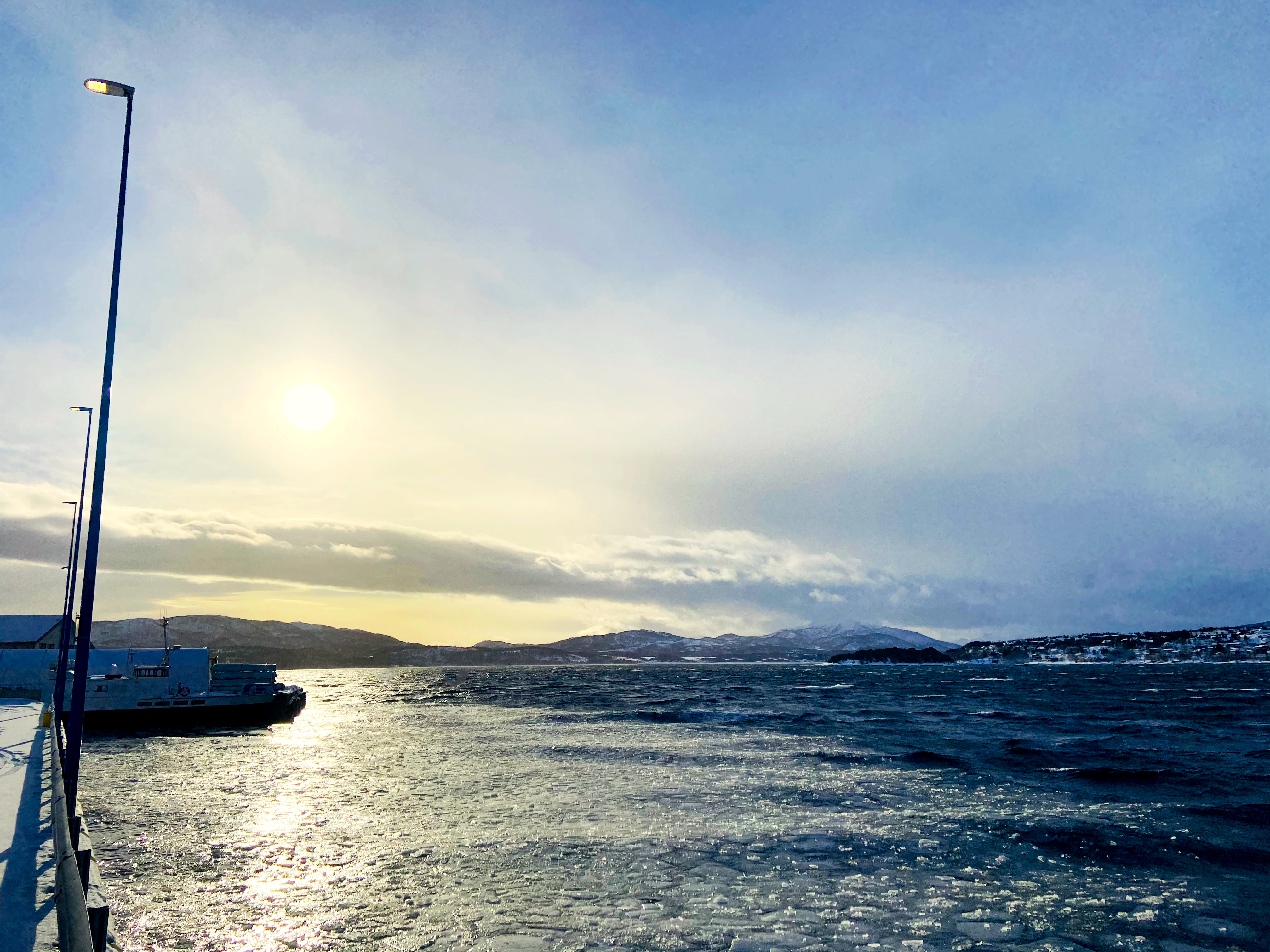
For the first time this winter I have seen ice in Gisundet, the sound that runs between the island of Senja and the mainland. I had wondered whether it would freeze in winter, but this year it hasn’t been cold enough. I could ask someone local, of course, but it’s not the kind of thing that has come up in conversation so far.
Rather than being a sign of impending freezing, this ice appears to be what I have discovered is called brash ice. Brash ice is an accumulation of floating ice made up of smallish fragments, not more than two meters across. It appeared after a long warm day, when the sun was up for twelve hours and the temperature reached five degrees. The heat must have broken up some of the areas of ice that had formed in the bays around the edges of the sound, where the water moves less. Later in the day there was also wind, which was moving the ice along. You can see the the ice in these photographs, some caught along the shoreline in the first picture, and in the second, the flow right along the middle as it passes under the bridge.
Moving back to the topic of work, I have always had a weird fascination with infectious diseases and outbreaks. I confess that last year, when the pandemic began, that I spent far too much time searching the internet for the latest news from Wuhan, then later watching the spread across the world. I had always wondered what it would feel like to live through a pandemic, and though this one has been way less deadly than bubonic plague or Spanish flu, I would now say that living through one is periodically terrifying, with long periods of boredom and frustration. If I survive this one (and I realise my chances are relatively good) then I will be happy if there isn’t another in my lifetime.
That said, my interest remains and I have been watching the news recently as there has been an outbreak of salmonella in Norway. As Mattilsynet is Norway’s food safety authority, it has been involved in trying to trace the source of the infection. When it is a localised outbreak, it is often easy to trace the source. If all the affected people ate at the same hotel or restaurant, or bought food from the same shop, then the situation is generally clear.
This outbreak however, seemed to be spread across Norway and some other countries in Europe. This was confirmed by serotyping the bacteria – assessing the outside surface to check for distinctive structures that allow us to separate them into different groups.
When an outbreak is so widespread, it can be difficult to work out what food it was that caused it. The assessment is made more difficult with a bacterial infection such as salmonella as the time from eating the food to the time when infection causes illness can vary from six hours to six days. Trying to find out what a very sick patient ate almost a week ago can be nigh on impossible, however there can be some indication from examining which groups of people were affected. For example in another recent outbreak, most of the patients were children and that one was eventually narrowed down to chicken nuggets. Earlier outbreaks in Norway have related to chocolate bars, salad and black pepper so you can’t even concentrate only on meat products.
In this case, the infection has been found to come from a batch of beef imported from Germany and processed as mince. Now follows a process of trying to track down any remaining packs. Though they will by now be out of date, a few people might have taken them home and frozen them. Freezing will not kill the bacteria, though thorough heating would. As with any other outbreak, Mattilsynet must now also try to assess whether its internal procedures can be improved from the information collected. We will never stop all outbreaks of illness, but it is part of our job to try to ensure they occur as rarely as possible.
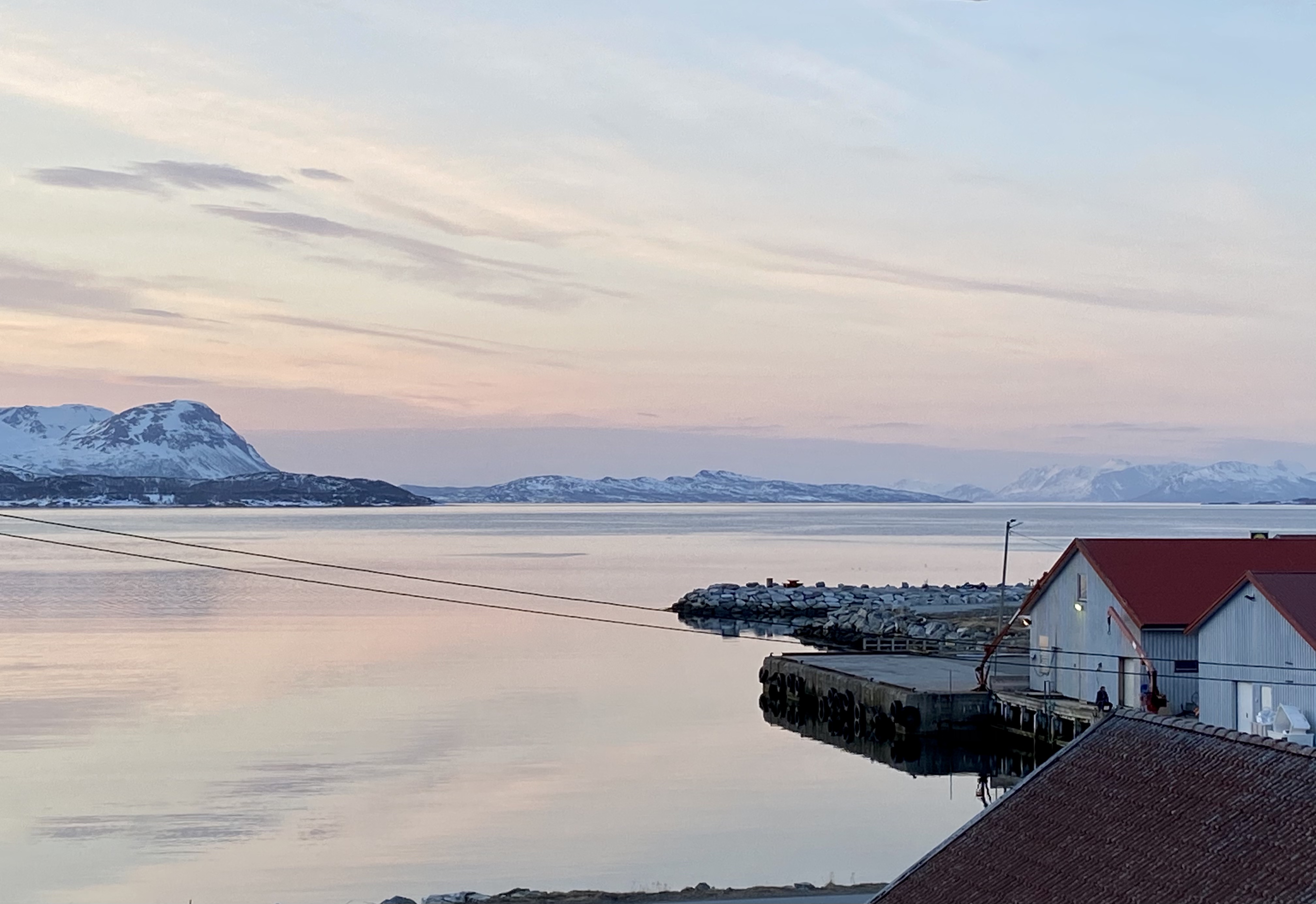
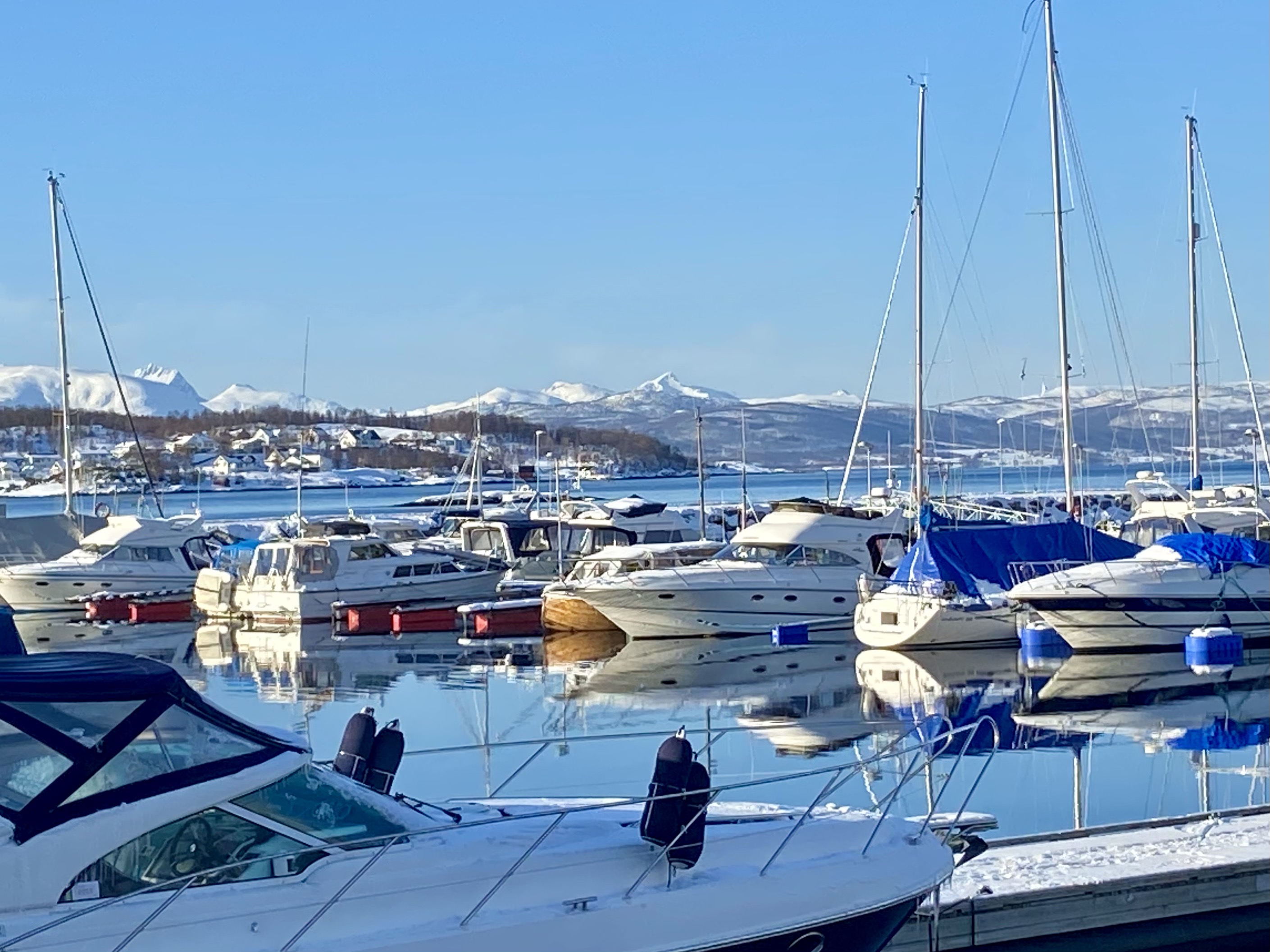
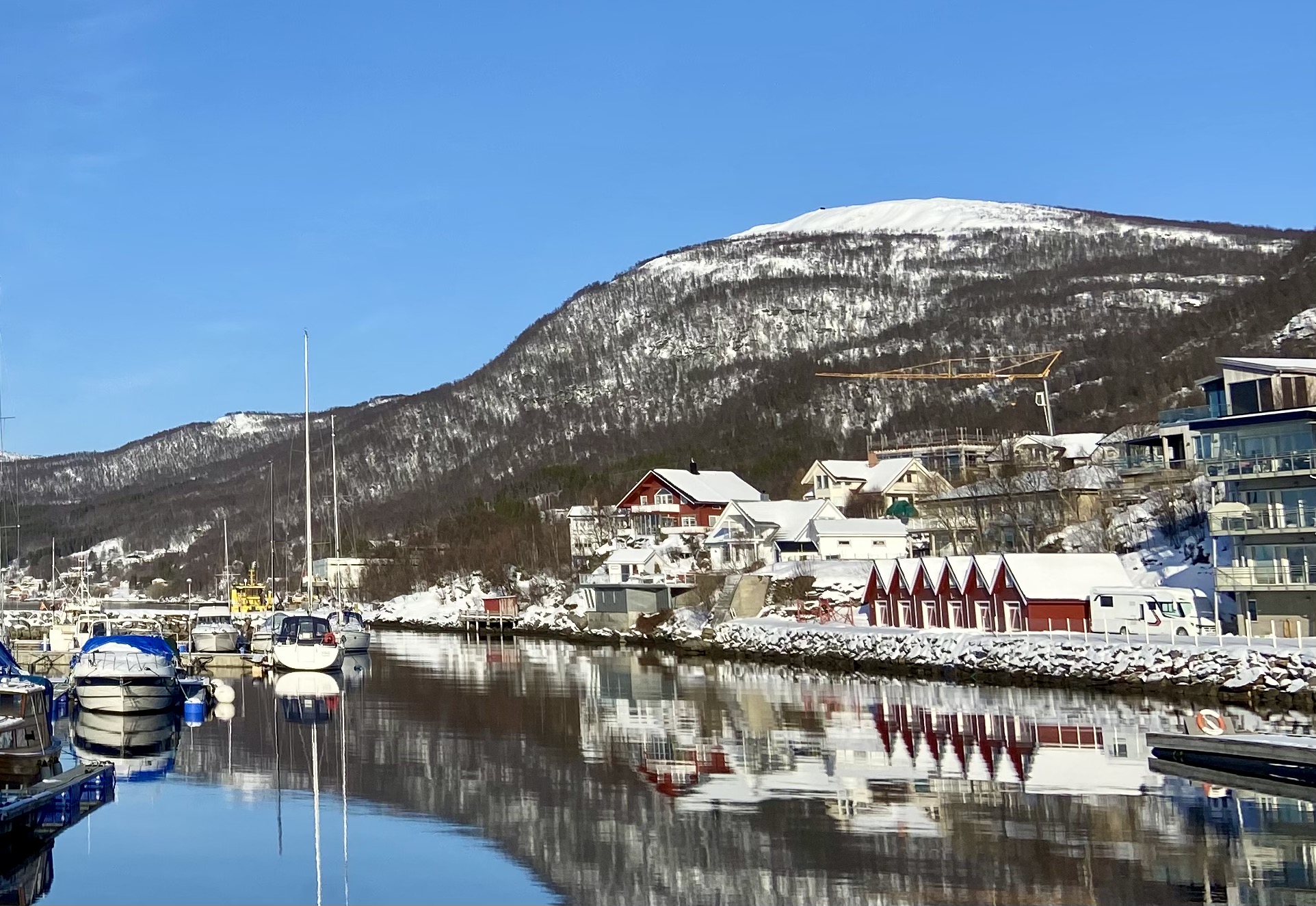
I will end on a more cheery note. It was lovely and sunny this week and I walked down to the little harbour on the edge of Gisundet below where we live. The water was wonderfully still and clear, as was the light and so I took a few photographs. I hope you enjoy them.
If you were raised in the United Kingdom, as I was, you might occasionally have found yourself wondering why all the barns in picture books and on those alphabet pictures on the wall of your classroom were painted red. Barns in the UK tend to fall into two types. Traditional farmhouses often have a yard surrounded by byres or a steading where the animals were kept before farming was industrialised. They are often constructed of brick or stone, depending on the area.
Those traditional buildings are often now used for stock which require a lot of close attention, for example calves that need to be fed twice a day, cows that are about to calve, or which have recently done so, and animals which are sick.
The newer barns, which have been built to house the main herd or flock, tend to be huge affairs, built high, with solid walls at the base to reduce draughts and open spaces or slats higher up to allow good air circulation. Red paint doesn’t feature in either the old or the new.
I had concluded, when I thought about it, that the red barn picture-book phenomenon was probably a US import. But why were so many barns painted red? They certainly look attractive, but how did the tradition begin?
When I moved to Norway, one of the very obvious differences from the UK was the way houses are built. Here, most houses are made of wood. Nowadays, they are painted many different colours, but in contrast with that, most barns are painted red. One of my neighbours in south-west Norway explained to me that traditionally houses had also been painted mostly in two different colours: red and white.
A white house was a sign of wealth. White paint was more expensive, red was cheaper, both because the paint was less expensive and also because it was less obvious if it became dirty or discoloured. Quite often, the houses of well-to-do farmers would be painted white, but the barn continued to be decorated with the cheaper red paint.
And so it seems likely that the reason barns in the United States are red is because the tradition (and the methods of making paint or stains) were taken over from Scandinavia. Presumably red barns in children’s picture books will remain that way, even if the tradition stops. They are, after all, much more distinctive and picturesque than modern barns in the UK.
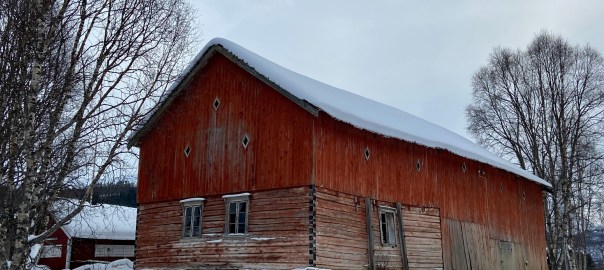
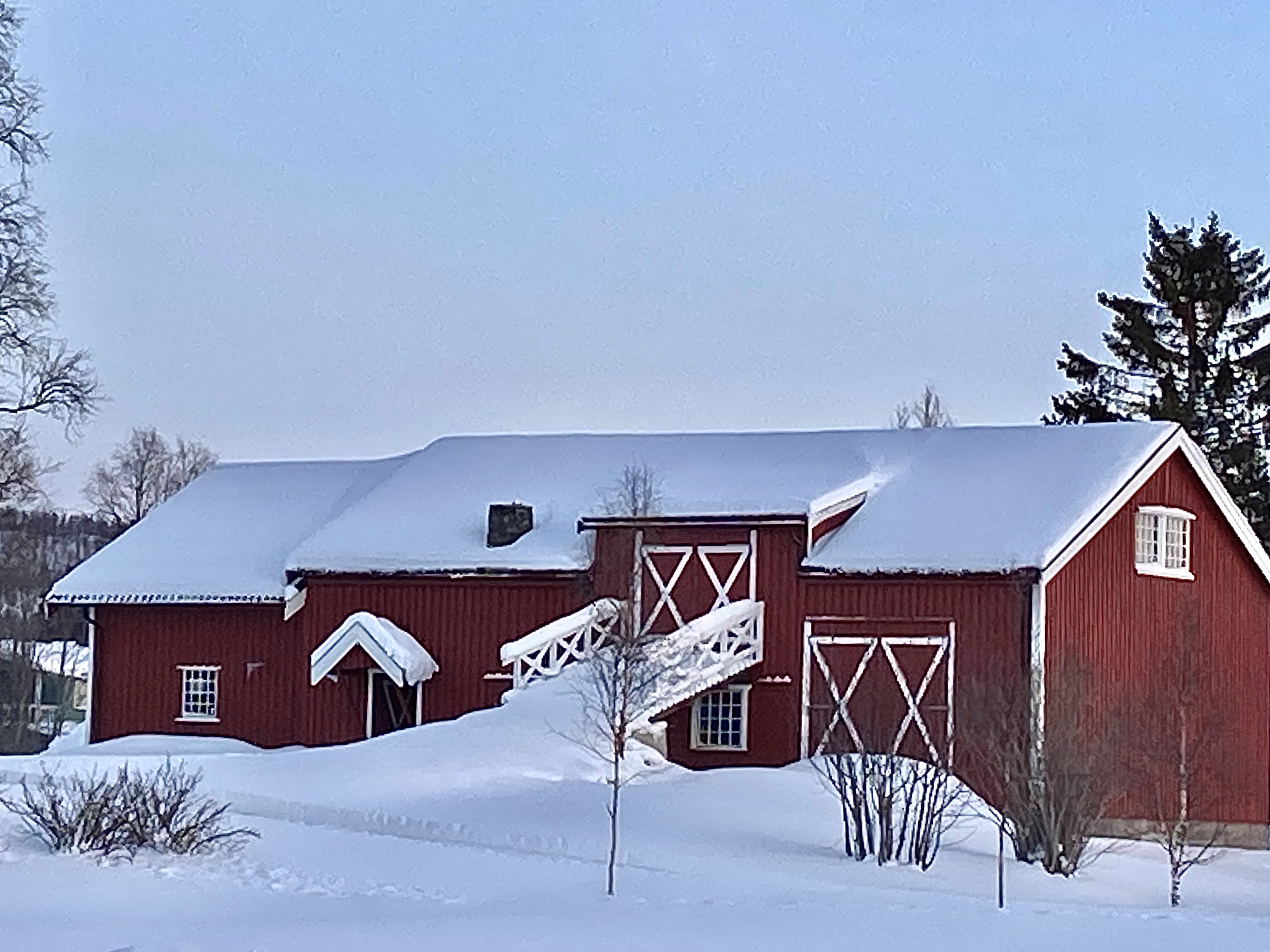
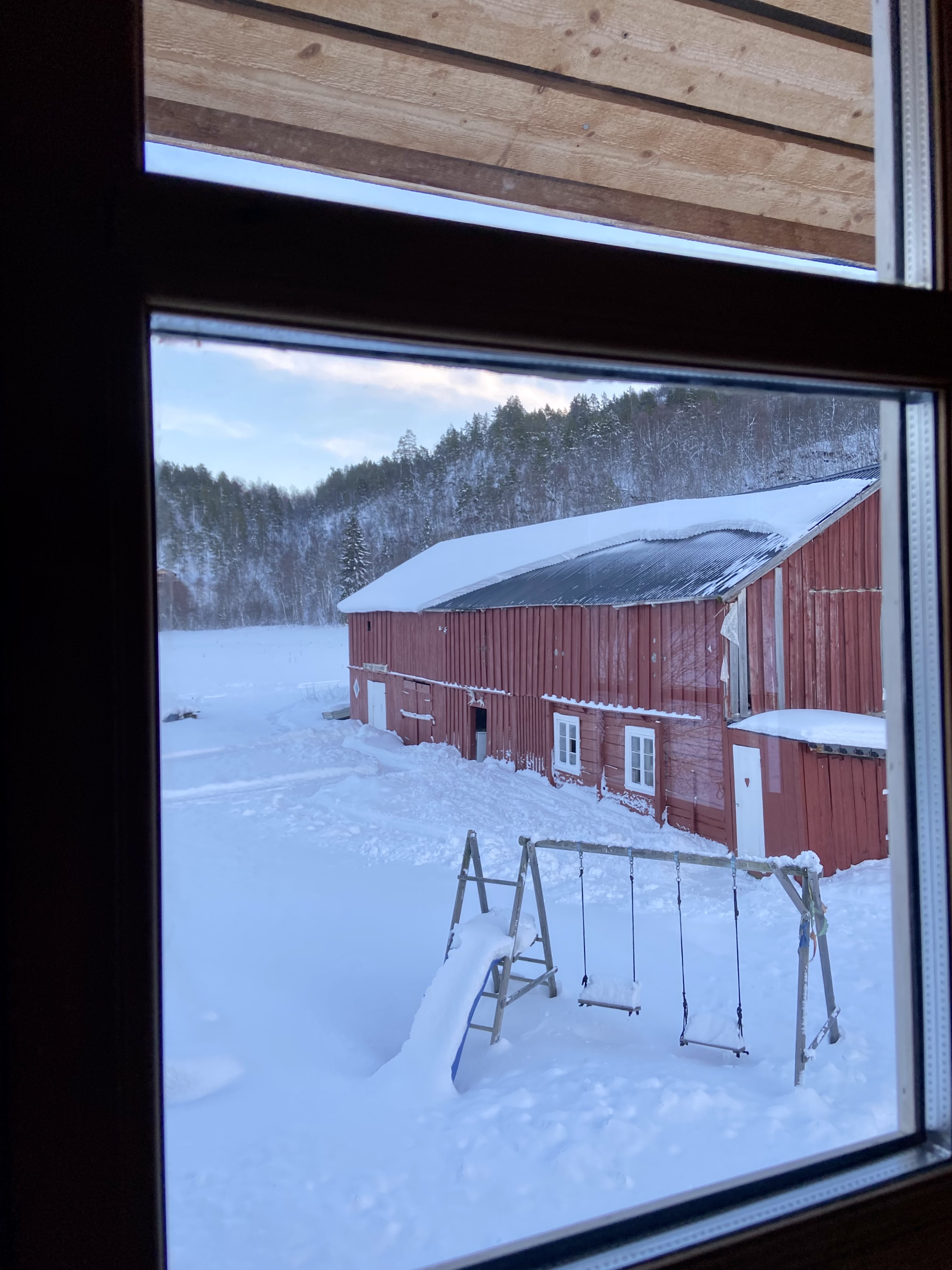
Anyway, I have been meaning for a while to get photographs of some of the barns I see as I am driving around as I work and yesterday I took the afternoon off to do it. They are a very distinctive part of the landscape. Some of them are old, some look newer. Unlike most British barns, they are built on different levels and as you will see, many have a kind of bridge through which you can enter the upper levels. Building to fit the steep, mountainous landscape is definitely a feature.
I have been saddened to find that quite a number of these barns are no longer in use. I hope that they will not gradually disappear, although I confess I have seen a few which are falling down and in a state of decay, they still hold onto their romance and beauty. I didn’t get any photographs yesterday of those, but hopefully at some point, I will.
Anna was with me on my trip and she couldn’t resist taking a snap of this buried van with its tiny house and the wonderful backdrop.
And though today it is snowing again, this was the sunset behind the gathering clouds as we drove home from our trip yesterday. The mountains of Senja taken from Sørreisa.
The feature photograph above is of a message Anna left me on Tuesday, having watched the snow gradually deepen as she sat up into the early hours, knowing I had an early start. She left it propped against the cream in the fridge, correctly surmising I’d see it when I made my coffee before heading out. She knows me so well!
I read an interesting report this week. The Organisation for Economic Co-operation and Development (OECD) have carried out an assessment on Norway’s food safety, which includes an assessment of agricultural practices. I’ve probably mentioned before that when I visit farms in Norway, a lot of attention is paid to biosecurity. There are laws requiring certain measures, including notices placed outside the barn or shed to say that entry is restricted and a “lock” area with some kind of physical barrier or line which requires a change of footwear (and often clothing) to enter.
I don’t know the current situation in the UK. Presumably in some areas, such as poultry production, they employ a similar system and change clothes on the way in and out, but when I went on cattle or sheep farms, I would travel around using the same wellingtons and waterproofs with only a quick wash between each visit. Even during the Foot and Mouth outbreak in 2001, the only difference was that the wellie wash was a bit more thorough; disinfectant was used and sloshing down the car tyres was added in.
So I was interested to see what the OECD had to say. Unsurprisingly, Norway scored very highly on food security. This is surely a good thing, you would imagine. But the feedback messages were mixed. Despite the high score, the OECD criticised the system for being too expensive. The word “overfulfilling” was used. The rules don’t allow enough potential for increased value, apparently. Of course, that is business bunk for “your food is too expensive and therefore not competitive in our international markets”.
The Norwegian response to this was rather predictable. They know (of course they do) that their food is not competitive. I have been reading a lot around pig farming in Norway and it is specified and fully accepted that almost all the pork produced in Norway goes directly into the Norwegian market for exactly that reason. But they feel it’s a price worth paying to ensure health and welfare are prioritised. Biosecurity in the food industry is the cornerstone of the Norwegian government’s agricultural policy. Meat in Norway is, of course, notoriously expensive, but perhaps it should be. The recent discussions during Brexit about chicken washed in chlorine were an eye opener for many people. There are lots of ways to keep food safe and ensuring your animals are as free of disease as possible is, in my opinion, beyond criticism.
Anyway, enough politics. This week has been noteworthy because after two months of working almost exclusively from home, there has been a big change this week. Birgit, Thomas and I have been visiting our local veterinary practices. Building up links is a useful thing to do. Mattilsynet carry out some routine inspections on farms, but we can’t check everywhere and rely on reports from other people to direct us to places where there are concerns about welfare. There’s a very human side to that, of course. Animal welfare doesn’t always suffer because of intentional negligence. Sometimes animal owners are ill or unable to cope. Sometimes they are uncertain of how to care for their animals too, and part of our job is to step in when there are problems.
So we want the vets who cover our patch to be part of something bigger than Mattilsynet. We need a network of support. During the visits, Birgit explained that there are now two dedicated “animal crime” police officers in Tromsø who form part of a new initiative . This is important when it is potentially unsafe for us to carry out visits, for example, and in the other direction, when police activity leads to the discovery of neglected pets during the course of carrying out their routine duties.
And so, I have been out and about a lot more, and of course here in Northern Norway, that requires assessment of (and allowances for) the weather conditions. After a huge thaw at the beginning of the week, with landslide warnings all over the place, it has now settled back into seemingly perpetual snow showers. The thaw, while rather alarming, was beautiful. Instead of a huge flat expanse of snow, the lakes took on some colour, though the thaw was not long enough for the ice to melt.
But now the snow has returned with a vengeance. One of the veterinary practices we visited was up a narrow track between snow-capped trees. I confess I was rather envious of the vet who had set up her one-woman practice in such a wonderful place.
The Norwegian road agency do a great job keeping the roads clear. On the way to my last visit, I was a little early and I stopped in a layby and took a photograph of the E6 road. This is the main trunk road that stretches down through the whole of Norway and then to the southern tip of Sweden. One day, perhaps I will drive the length of it. But that will be a whole new project.
One of the things I liked about living in Scotland was the good condition of the major roads and its relatively small size. Sure, if you drove from Jedburgh to Dunnet Head, it took about six and a half hours, but living in central Scotland, as we did for a while, it was easy to explore other cities on weekend trips. When the children were young, we may have spent more time running around castles than city centres, but the point remains; it was easy to find budget hotels in all kinds of different places within a three to four hour drive.
On the first weekend we arrived in Norway, our friendly landlord invited us to his cabin. He had a beautiful house in Stavanger, but had kept his mother’s house on an island in Flekkefjord after she had died. Though Flekkefjord was no city, the idea seemed similar, if not better. This was the chance to escape to a different area, weekend life on an island with a boat and as many crabs as you could eat. We learned that it was common in Norway to have a second home. Sometimes they were inherited, but not always. It offered the chance to escape to the sea or the mountains. Not that those were particularly lacking in or near the cities I’ve visited in Norway, but the idea of travelling to somewhere distant and different resonated with me. Cheap hotels like Premier Inn or Travel Lodge, where you can comfortably fit a family of four in a room are definitely not a feature in Norway.
But as I lived in Norway longer, I began to find out that it was quite common to have a cabin much closer to home. People would have a weekend home only half an hour from where they lived. I confess this seemed bizarre to me. Surely the idea of a weekend break is to explore somewhere different? Perhaps eat out in a restaurant you haven’t tried before or go to a museum you haven’t visited two or three times already? But with time, I began to understand it better. Eating out in Norway is becoming more common, but it’s still an expensive treat and not a weekly event. Your cabin is somewhere you go to relax, probably enjoy the outdoors, and simply to have a change of scene. Unless you specifically want it near a ski resort or in a particular area, why not have it only half an hour’s drive from home? Better still, if you have it fully stocked with clothes, there isn’t even a need to pack.
For now, having my own cabin is only a dream, but with coronavirus still at the forefront of every travel opportunity, we decided that a weekend away would be a change of scene. Andrew was away, so John, Anna and I made our preparations. Rather than choosing a city to explore, with a long drive, we decided that comfort was key. What could be better than spending some time in a cosy cabin with a wood stove, Norwegian curios on the walls and sheepskin rugs on deep cushioned sofas?
And so last weekend, we drove about an hour from home to spend the weekend in a log cabin on a husky farm.
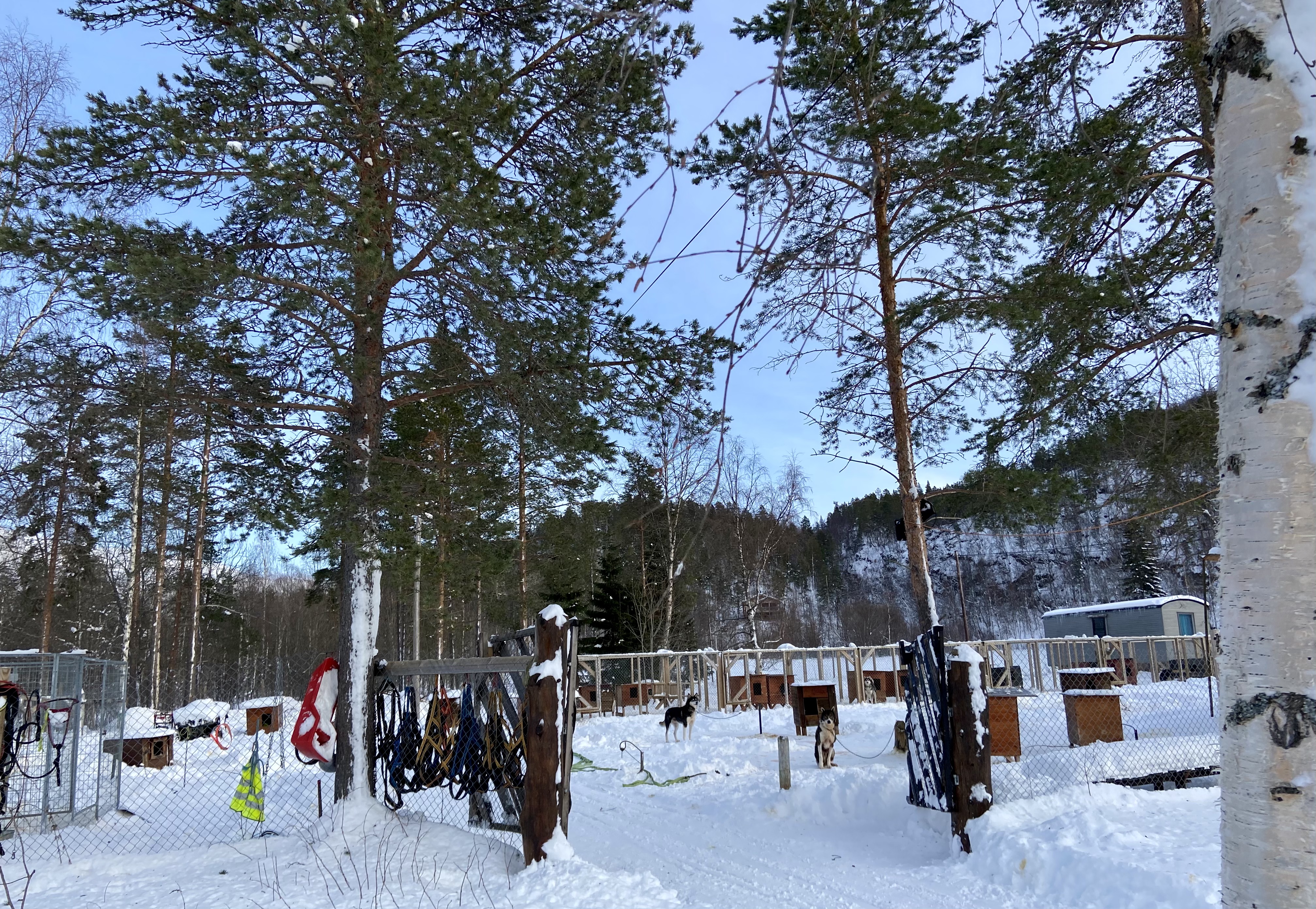
The husky enclosure
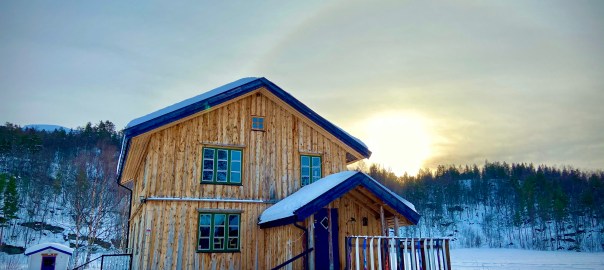
Our arrival at the farm was wonderful. We stopped the car and climbed out into the silence of a Norwegian winter in the middle of nowhere. There were snow filled fields all around and the log cabin with its warm yellow wooden walls looked just as inviting as it had in the pictures on the website.
We had brought Triar along and so we rushed round to the boot of the car to let him out of his travel cage. Though the sight of a car and humans had been greeted with silence, on Triar’s appearance, the huskies began to raise their voices. And what a wonderful sound it was, howling and yodelling, a wonderful crescendo rising in the crisp still air.
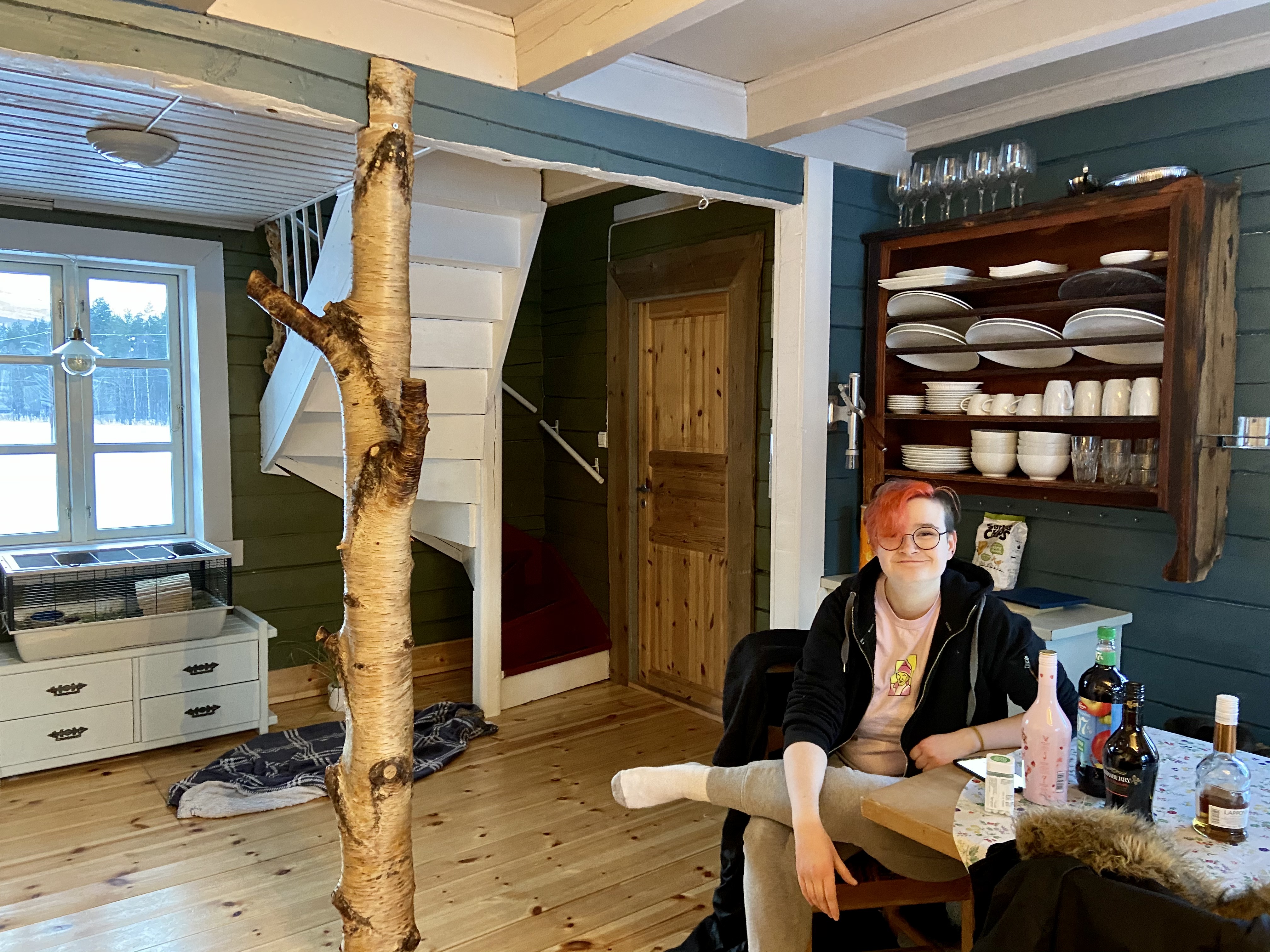
We felt even more at home as we explored inside. The range in the kitchen had been lit and it was wonderfully cosy. There were pans on the walls and a huge table. The range was complemented by a modern cooker, coffee machine, toaster and kettle. John and Anna were with me and I couldn’t resist starting to cook on the range. It reminded me of a friends farms back in Scotland, where the kitchen was the heart of the home. There was always a huge kettle on the Aga on the edge of boiling so family and guests alike could grab a hot drink at any time of the day or night.
There were loads of quirky features. As you can see, there is silver birch trunk holding up one of the beams in the kitchen. The little twisted staircase in the corner leads up to the living room where there is another wood stove and wonderful couches with animal themed cushions. Off that room there was a bedroom that Anna and I shared.
It truly was a wonderful place. It was minus ten outside and Espen, who runs the farm with his wife Delphine, had advised us to light the stove in the kitchen as soon as we rose each morning. The house was built upwards, so heat rose from the kitchen, up those rickety stairs to the living room and from there into a quirky loft bedroom under the rafters. Life somehow slows down when you have to feed a wood stove all day.
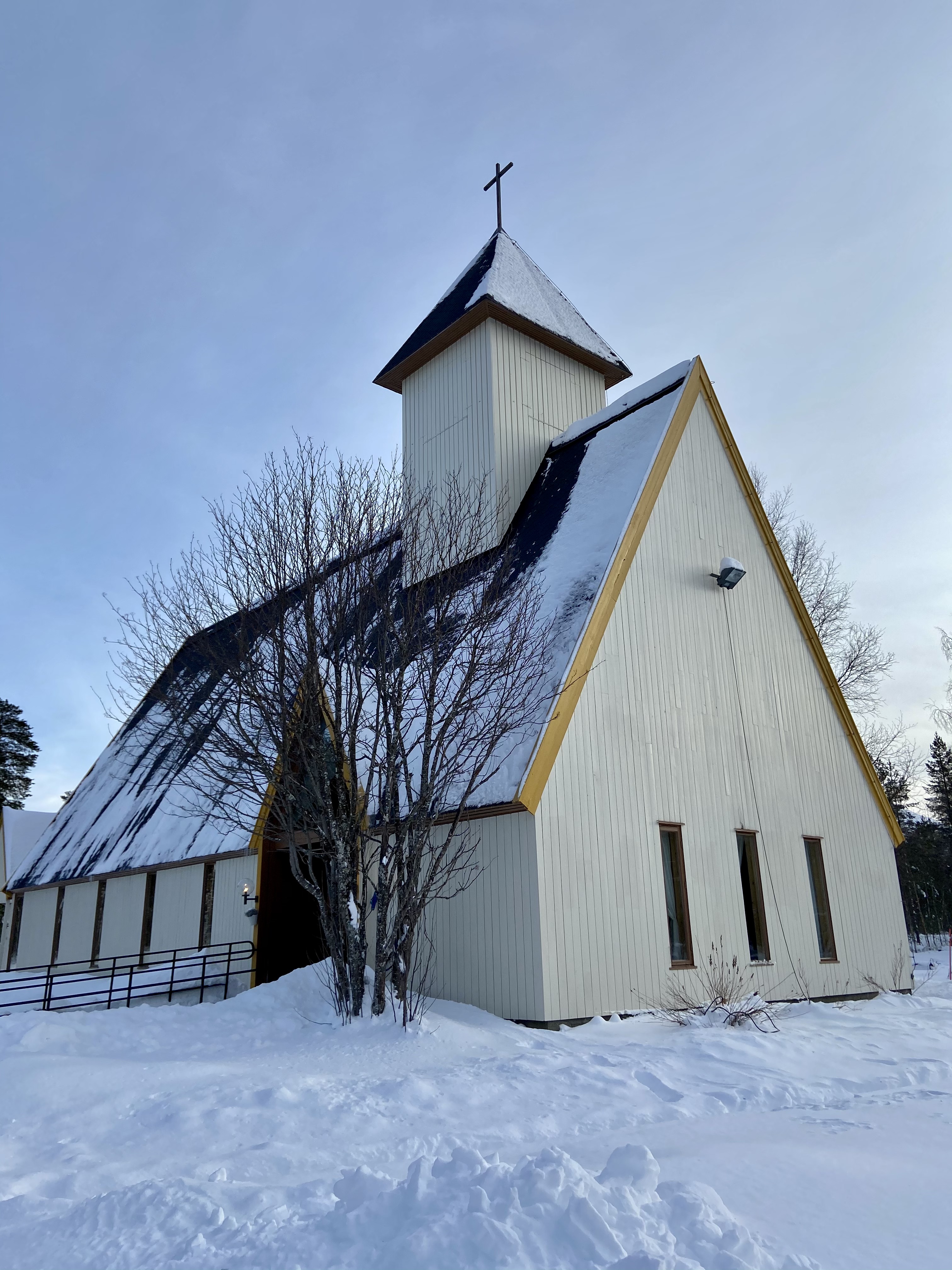
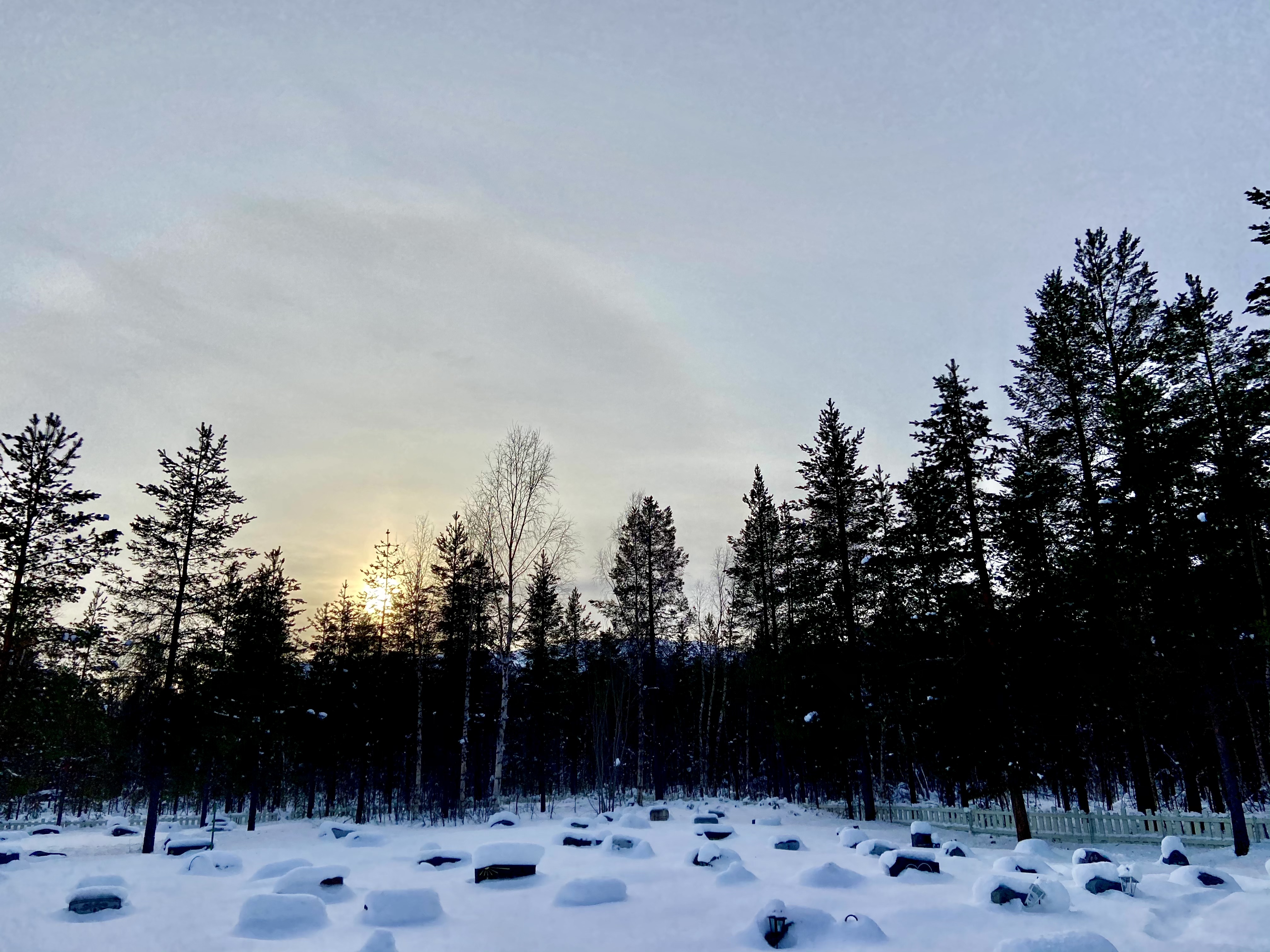
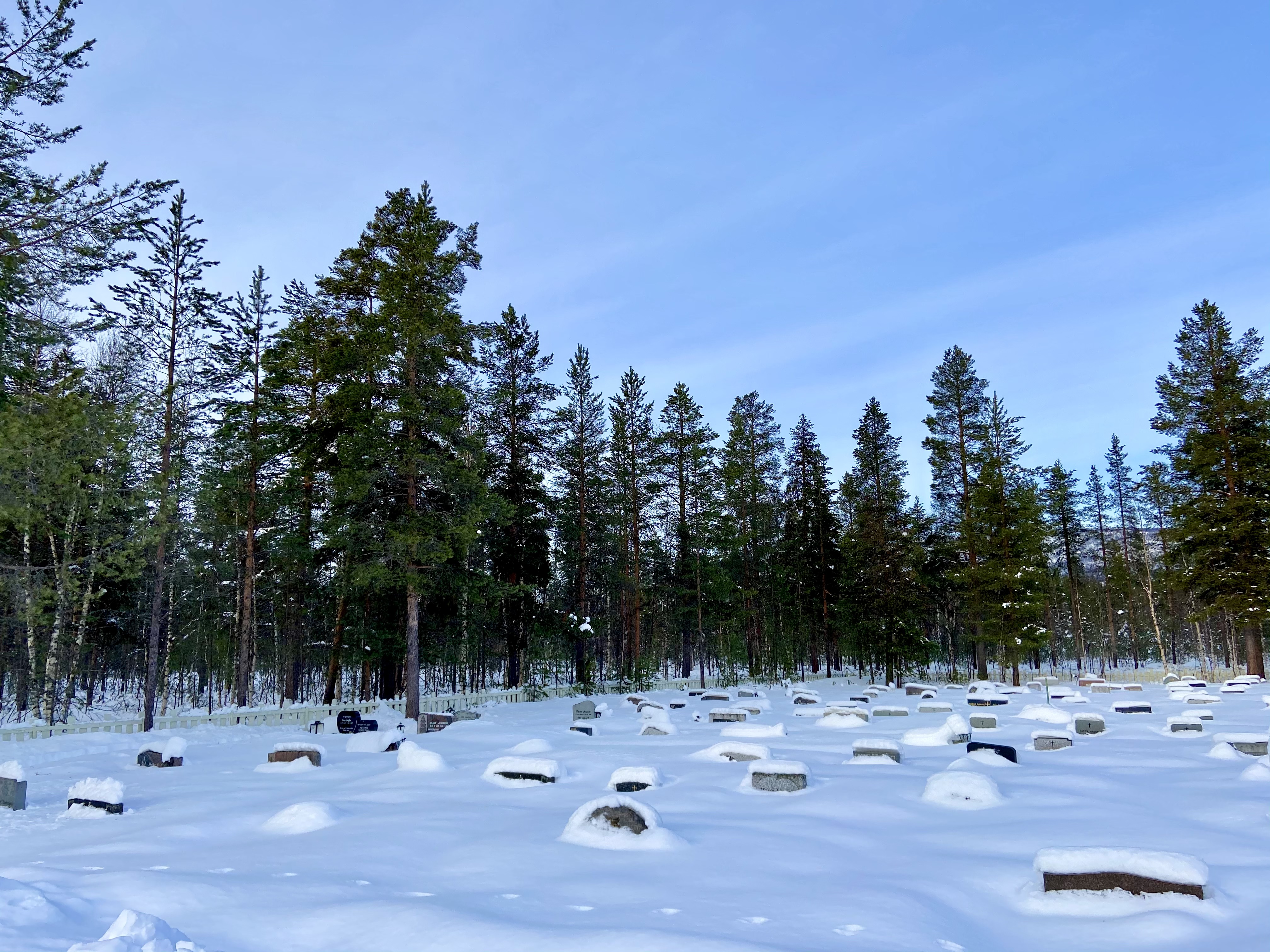
Our only trip was a visit to Bardufoss to buy John some warmer trousers. John and Anna humoured me as I stopped on the way back to take some photographs of a rural church with its snow-covered graveyard. You can see it was cold. The halo of light around the sun here, and in the pictures of the house, is formed by tiny ice crystals in the air.
It was good to have some time away. Easy in these winter months and lockdown times to stay at home more and more. Lovely though the view is from the windows of the apartment, it was great to have a change of scene. And perhaps in future, it might provide a wonderful backdrop for a new novel.
The weather changed over the weekend. The wind began to rise and the snow began to drift, but we stayed cosy and warm inside. As I lay in bed on Sunday morning, listening to the wind gusting against the thick wooden walls, I contemplated calling to see whether we could stay another night.
But I was due to work on Monday, and even if I didn’t have to put in an appearance in the office, it wouldn’t be possible to combine work with packing up and going home. And so reluctantly, I pulled myself out from under the covers and began to get ready to depart. But I hope to return in future. The farm runs dogsledding trips, traditional food in a Sami lavvo (similar to a wigwam) and tours to meet and make friends with the huskies. We will definitely be going back one day.
I started the week in Bardufoss. John was here last weekend and I took him back on Monday night and stayed over until Wednesday. The temperature is much lower inland and it was -24°C when I parked the car.
You really find out how good your vehicle is in those conditions. After a few short journeys, my lovely BMW started to tell me that its battery was not very happy (it’s a very chatty car and likes to forewarn me before things get out of hand – though sometimes I wish it wasn’t quite so fussy about seatbelts when I want to shuffle the car on the driveway). A quick check on the internet told me there was probably no real problem, but for the last twenty four hours of my stay, I was worried that I might not make it back without complications. When I returned home (where it was a balmy -4°C) the warning light was still on, so I decided to get it checked out. It was snowing hard and the weather forecast was warning me that it wasn’t going to stop any time soon. The garage Hilde recommended was busy, but they kindly arranged for me to go to the petrol station next door. After a quick trip home to remove the dog cage from the boot (because that’s where the battery is apparently) the mechanic very kindly checked that the battery was indeed fully functional and then waved me on my way without charging anything. He’s definitely gained a new client!
When I’m not in the abattoir, I’m still working from home and for now, I’m concentrating hard on trying to qualify as the Norwegian equivalent of an Official Veterinary Surgeon. This will allow me to work in the abattoir without another (already qualified) vet. The course really does cover a lot of material, mostly to do with welfare, but some of it is very technical. On Friday I found myself learning about stunning chickens with electricity, which actually isn’t a method used here in Norway. Nonetheless, I found myself back at school learning all about Ohm’s Law, current, resistance and voltage, only this time it was all in Norwegian. Life here does sometimes throw up unexpected challenges!
I was, as you can imagine, quite relieved to arrive home safely on Wednesday and I decided that having got there, going back out again should be kept to a minimum. Here’s a summary of the weather forecast from Thursday lunchtime.
By Thursday morning, it looked like this.
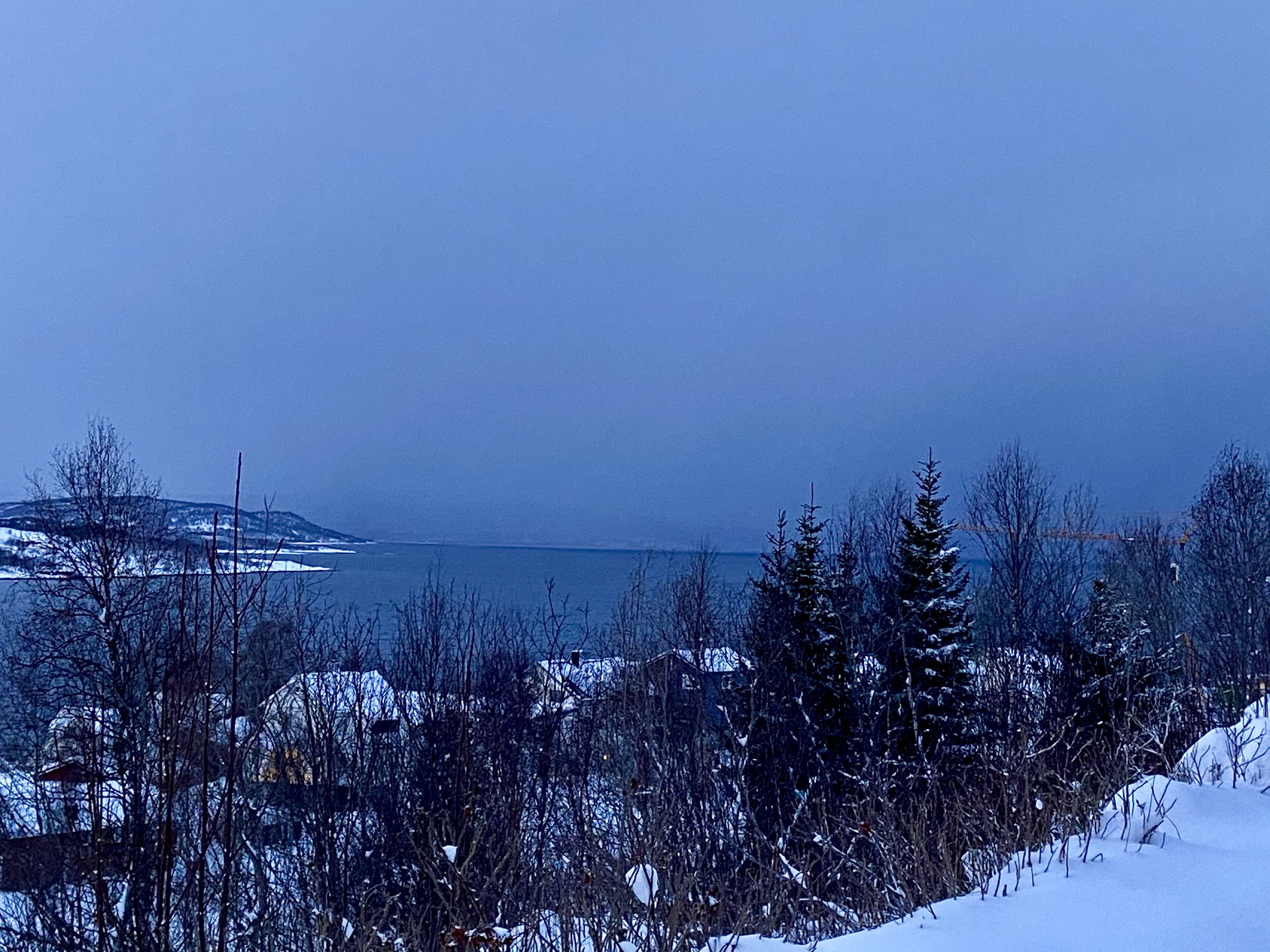
It soon clouded over again though. Wave after wave of snow has passed. They come in from the North, slipping in over Gisundet, the sound between the mainland and Senja.
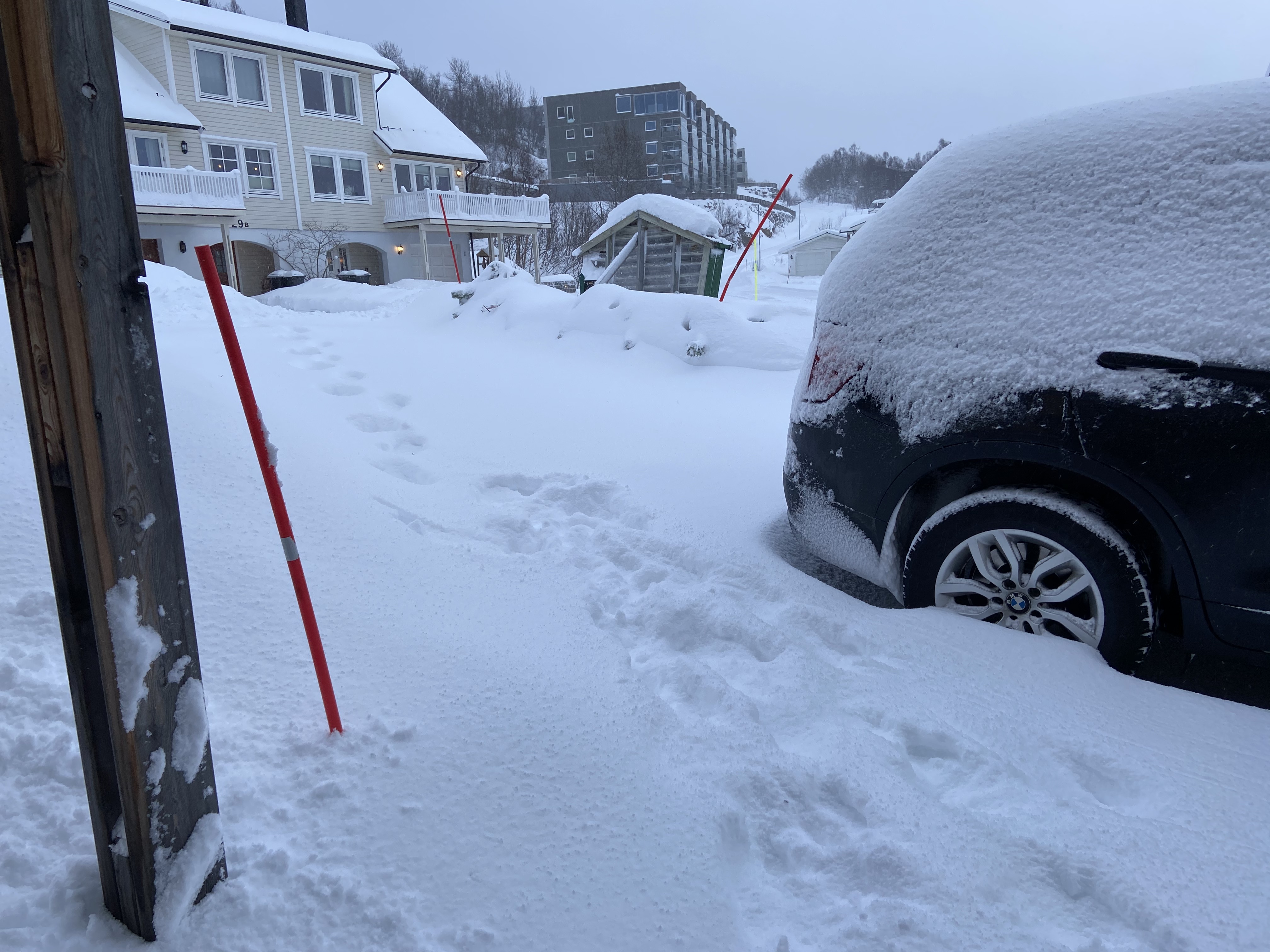
There has been quite some digging of the driveway to be done, though happily my landlord keeps popping over with his snow blower to remove some of it. It’s getting harder to dig out though as the snow at the sides gets higher.
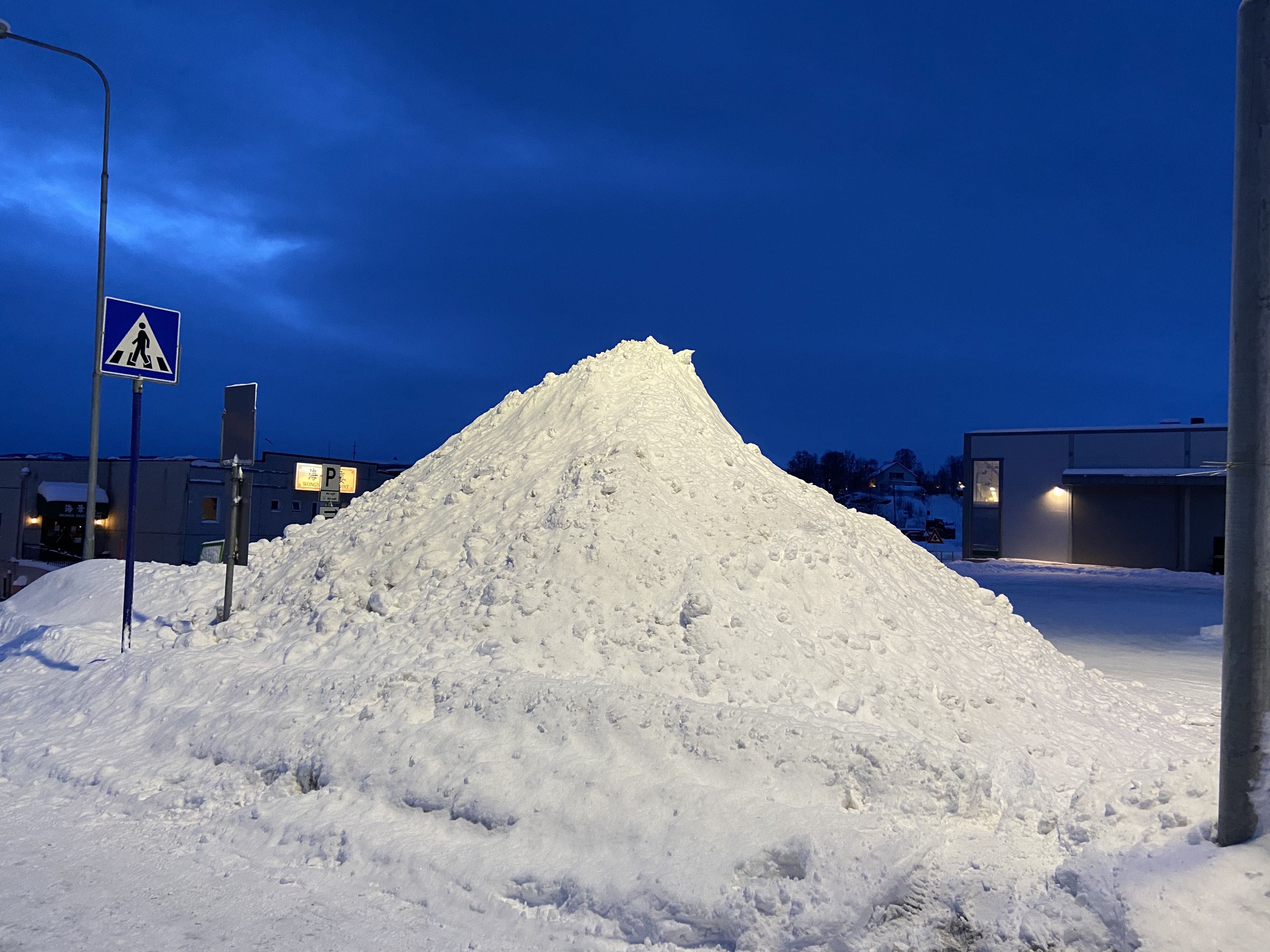
Though of course my driveway has nothing on the public car parks down in the town itself. For reference, the zebra-crossing sign is a good deal taller than me.
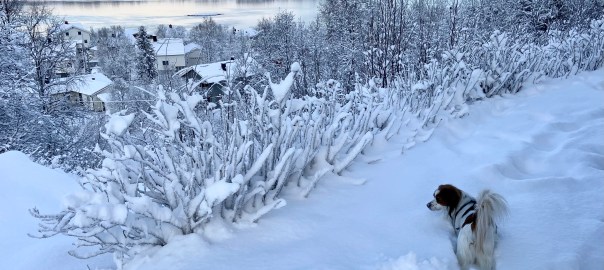
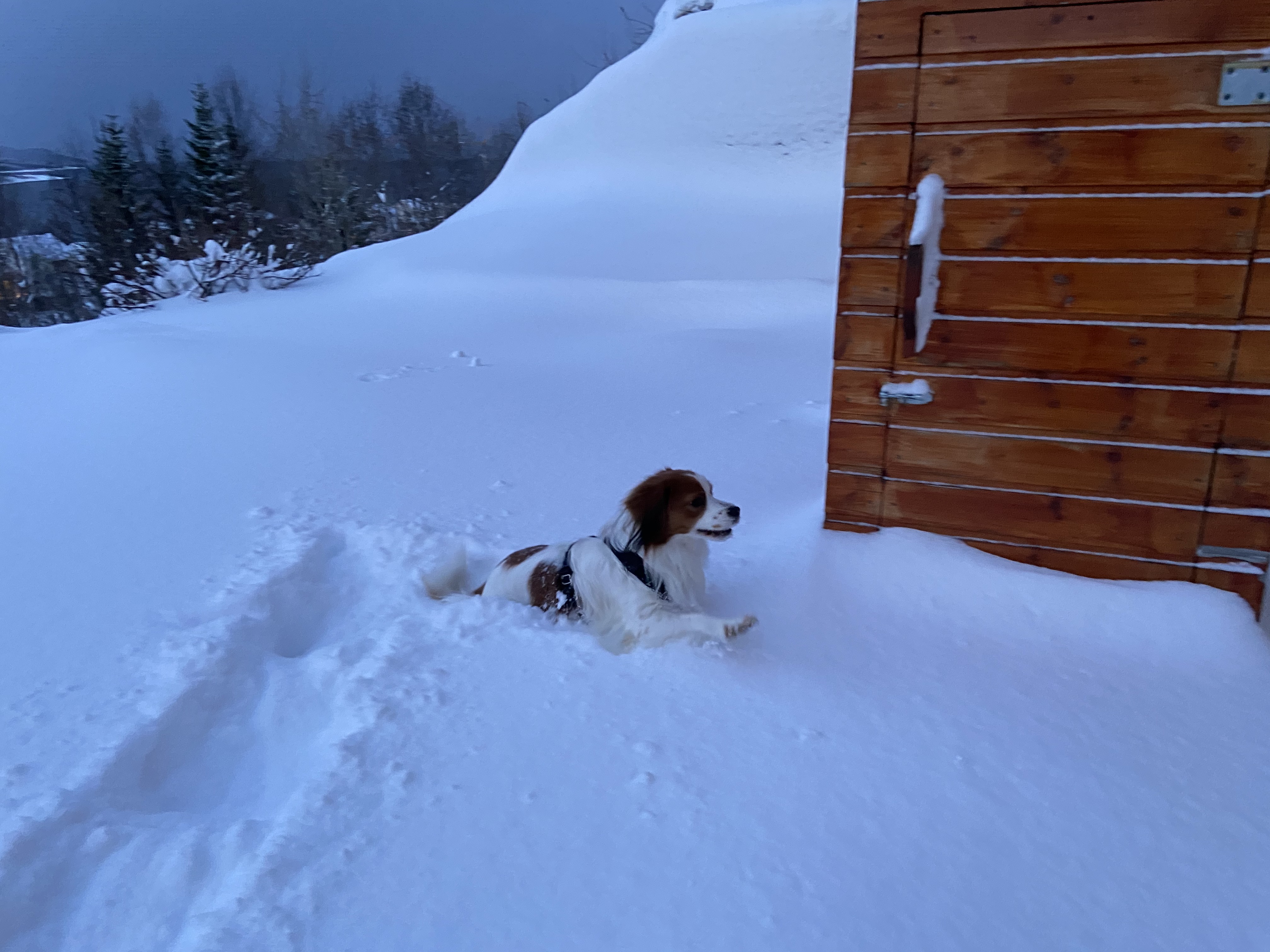
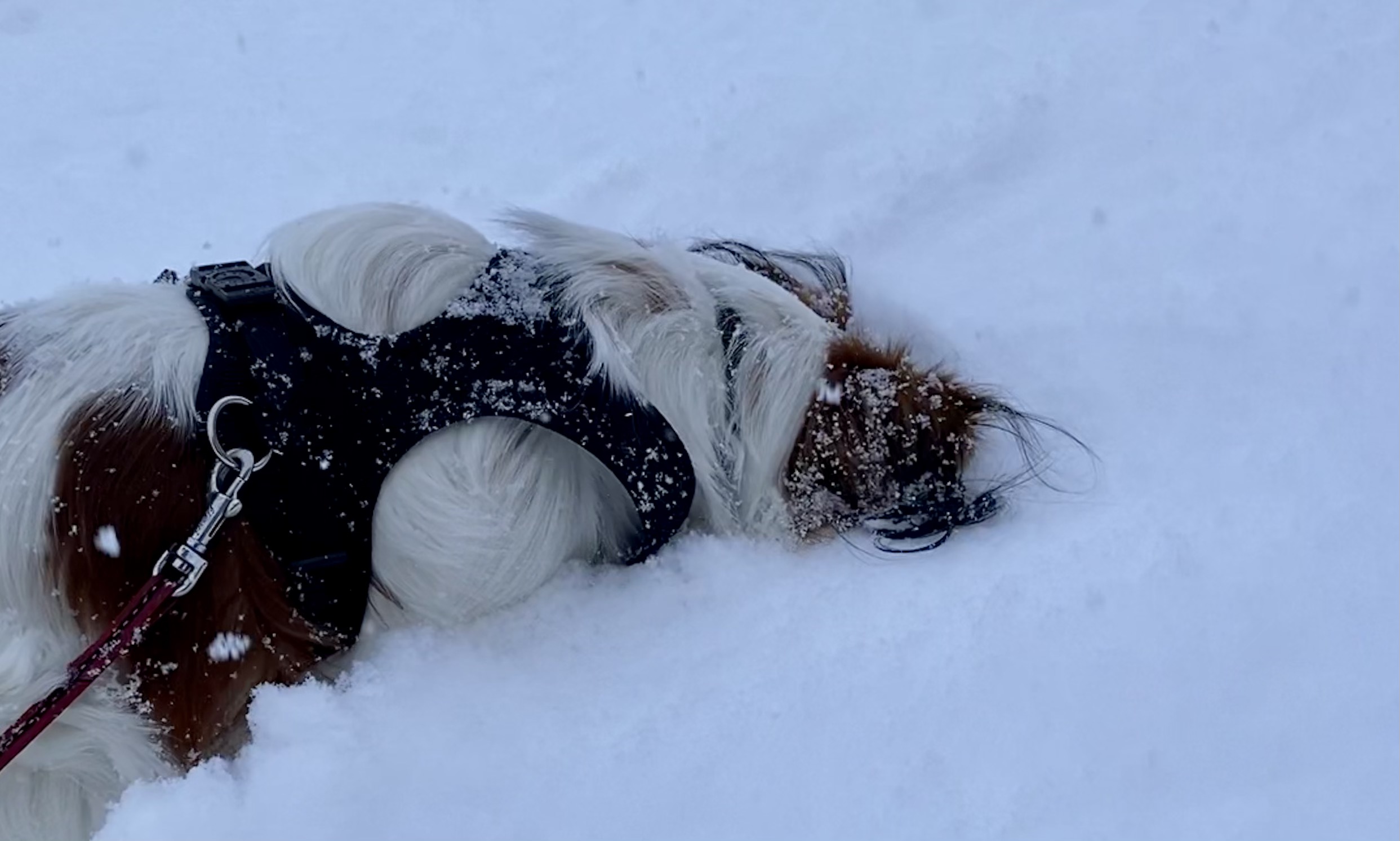
But one of the best things about the snow is watching Triar playing. He loves going outside and flolloping through the deep snow, burying his face and emerging cheerfully covered. He will happily play outside for ages and doesn’t seem to feel the cold.
And of course, after all that play, it’s time for Triar to go to bed. Sleep well Triar!


































 A Vet’s Life