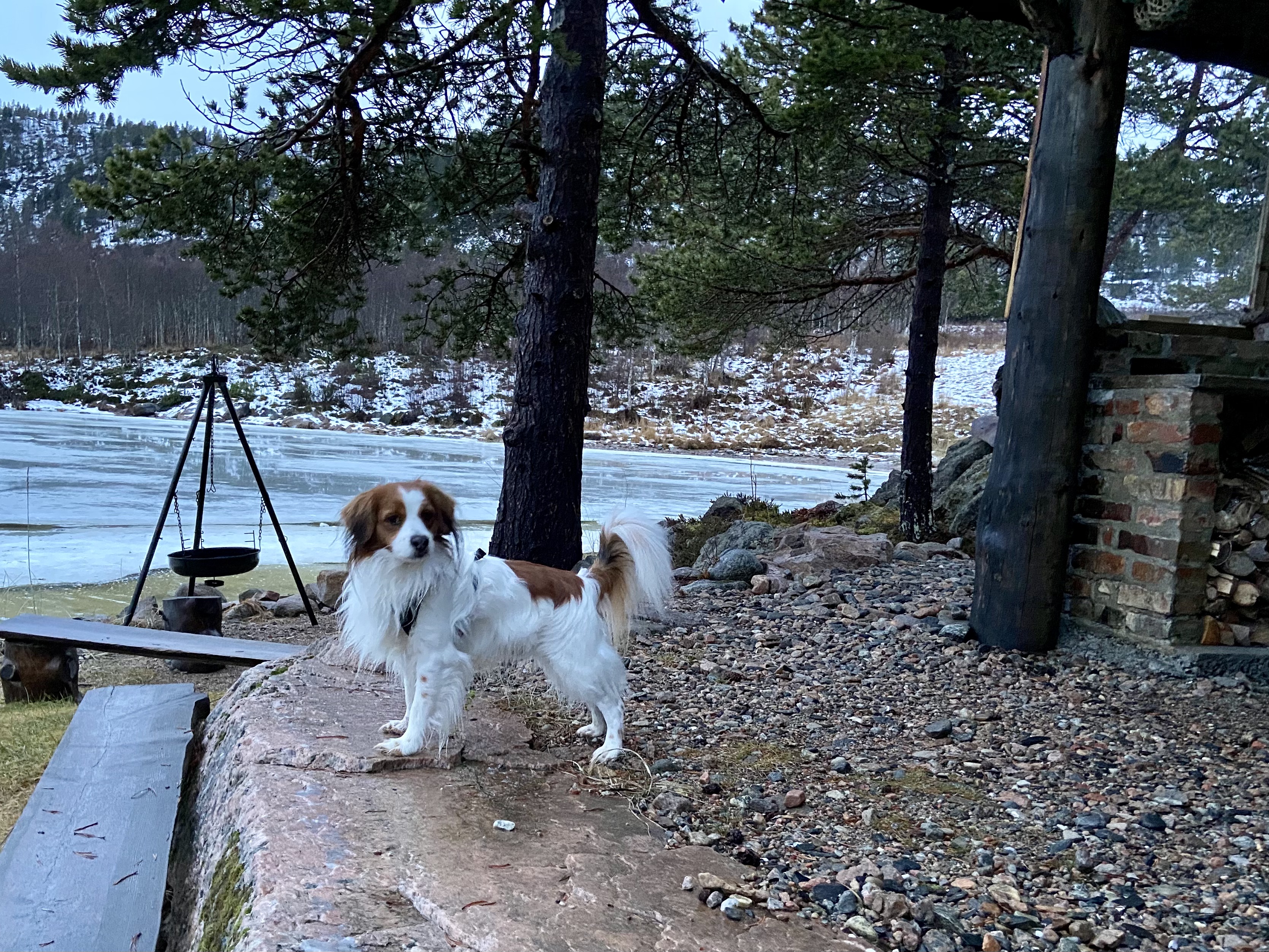
My last advent post and with it, another tour to the south of Senja. With the snow melting at speed, it would be easy to lose the Christmas feeling, but we were determined to enjoy our trip. Anna, Triar and I seized the moment between rain showers to explore a not-too muddy track that went down to the shoreline.
Though the snow was mostly gone, the distant mountain top is still covered.
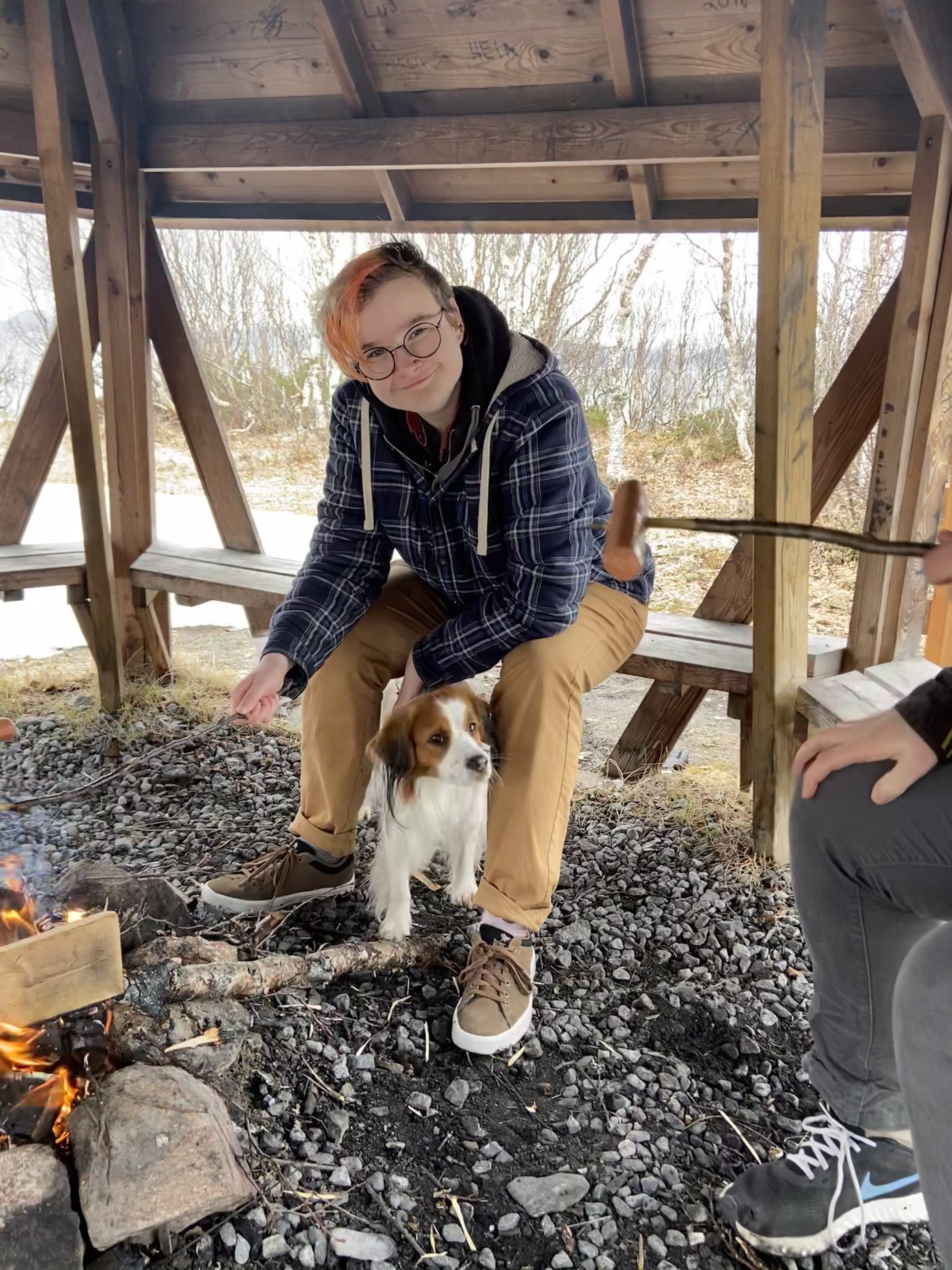
There, we found a wonderful decorated hut, obviously someone’s barbecue place for summer days. Despite that, the decor seemed to fit so well with Norwegian Christmas vibes, I thought I’d share it with you.
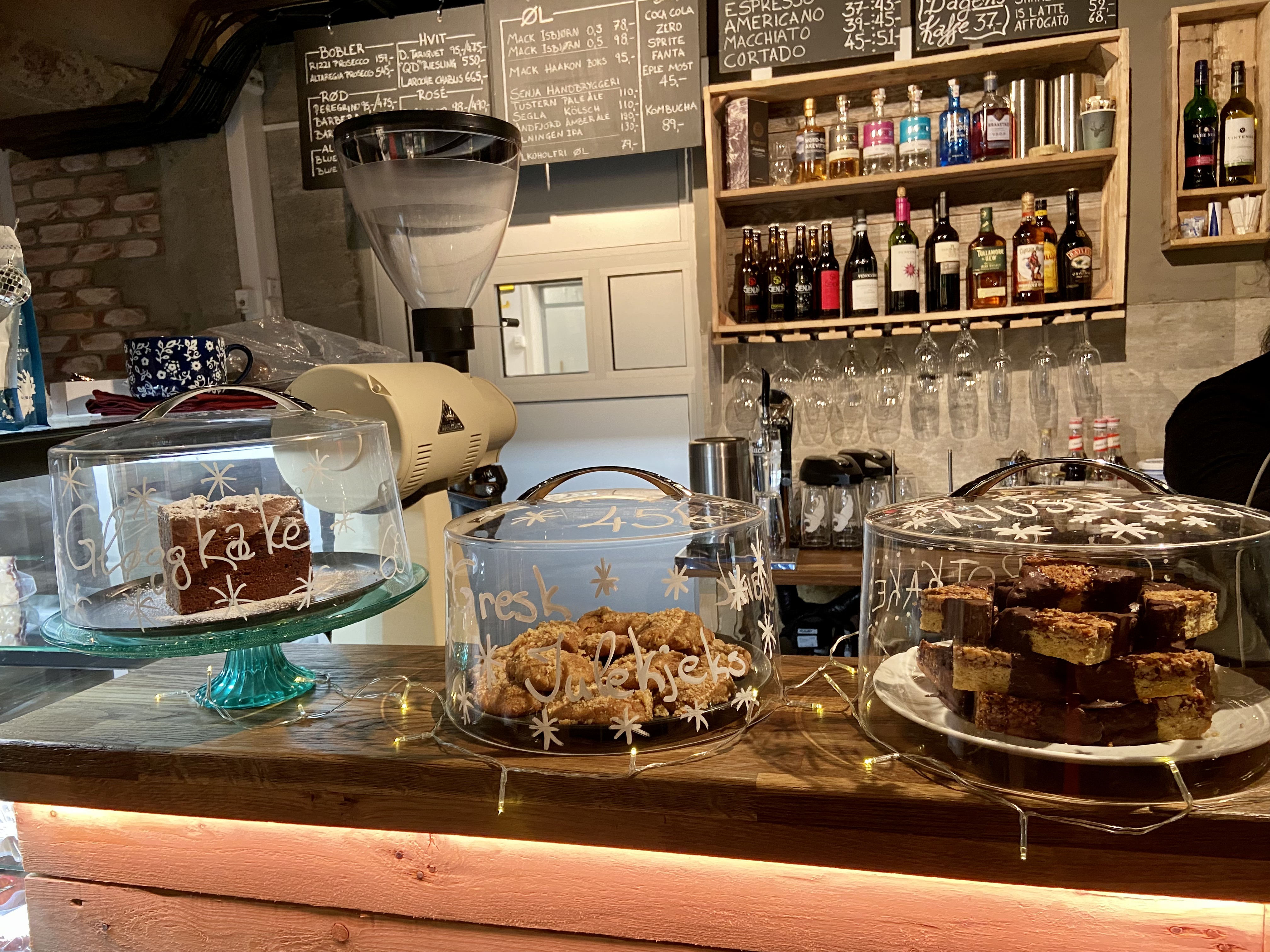
There was sleet hammering on the windscreen when we arrived at Senja Roasters. It was empty as well, but no less welcoming for that. I had come with the intention of trying the nussecken I had seen when I went before, but this time there were three kinds of Christmas cakes lined up on the counter, so Anna and I decided we would share a piece of each between us.
From left to right, gløg cake, Greek biscuits and nussenecken.
We sat down and enjoyed the cosy decorations against the backdrop of the half light outside the window, where the wind was flitting across the bay, stippling the water in wild flurries.
A tealight and a lantern light up the pine cones in the window.
The cakes were as wonderful as they looked. As well as the nussecken, there were soft Greek Christmas biscuits and a gløg flavoured sponge cake. They went perfectly with my Christmas spiced latte.
A triplet of Christmas cakes from round the world.
We came home and put on the Christmas tree lights and it wasn’t too hard to forget the weather.
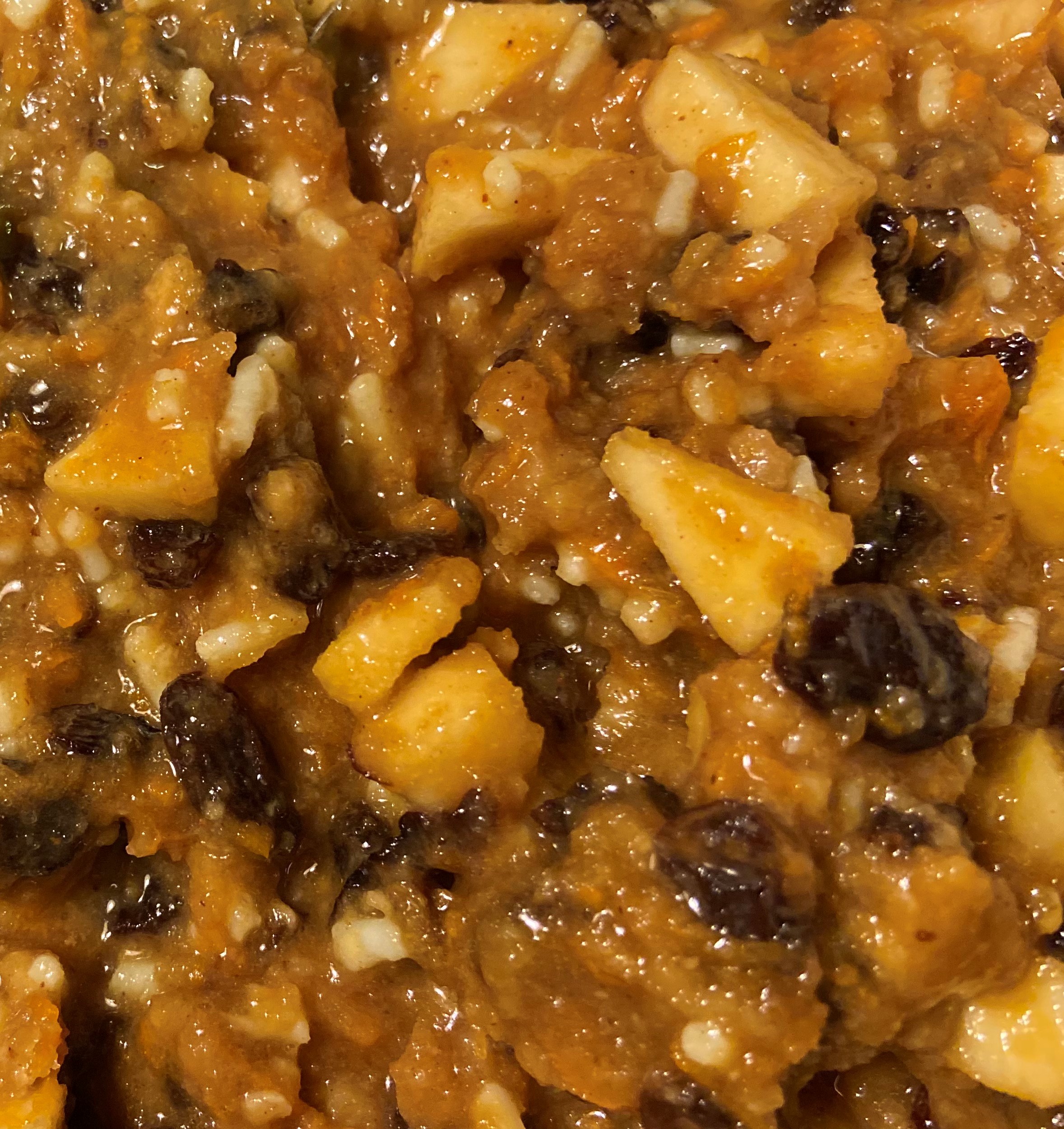
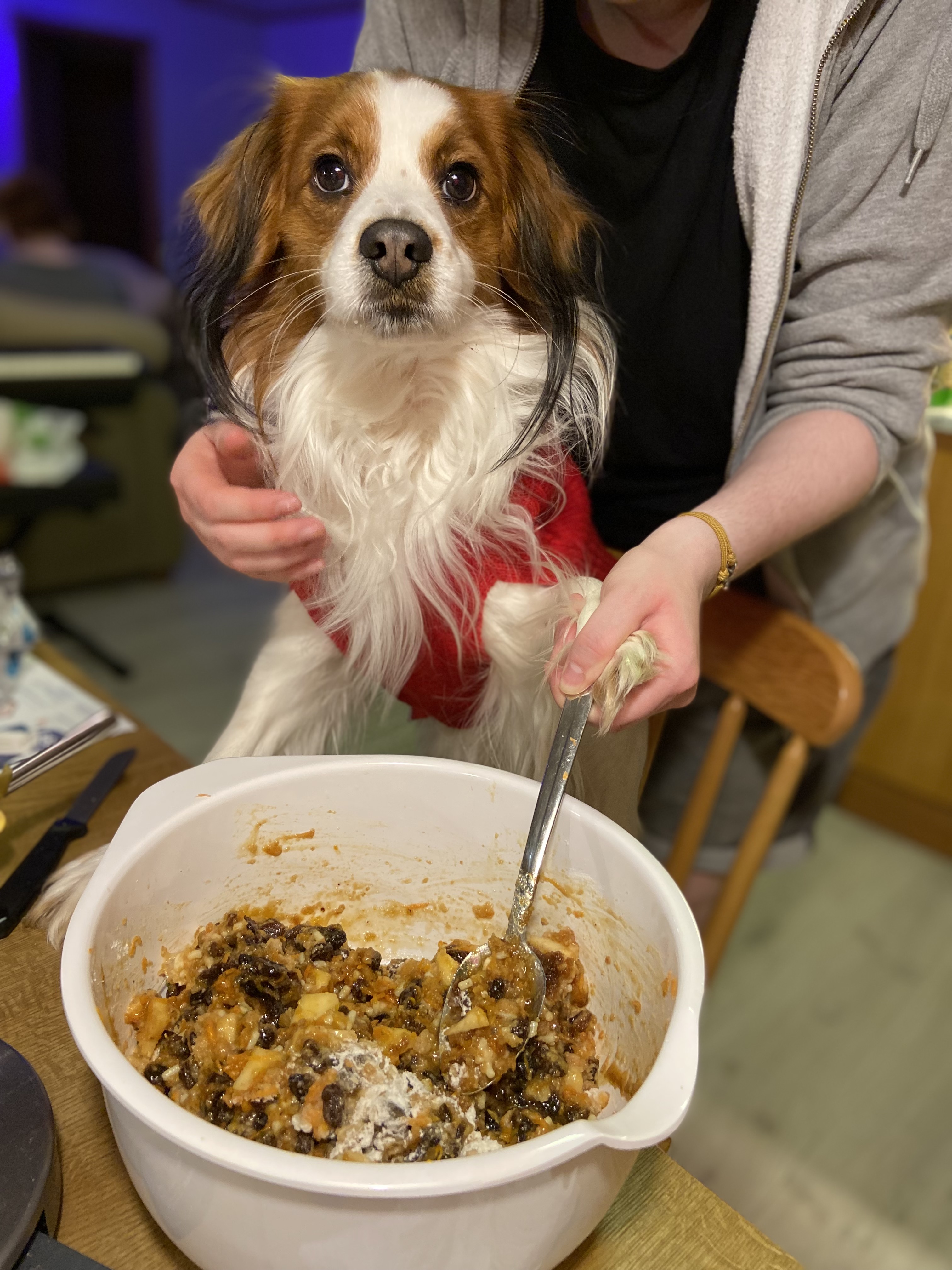
Yesterday was a hard day to follow, but this afternoon, we put on some Christmas music, cracked open the Red Velvet Cupcake Baileys and made the Christmas pudding mixture. Usually I leave it a in the fridge for a few days before cooking, but as I’m so late this year, it’ll be done tomorrow. But for now, the kitchen if filled with the wonderful scents of spices and rum.
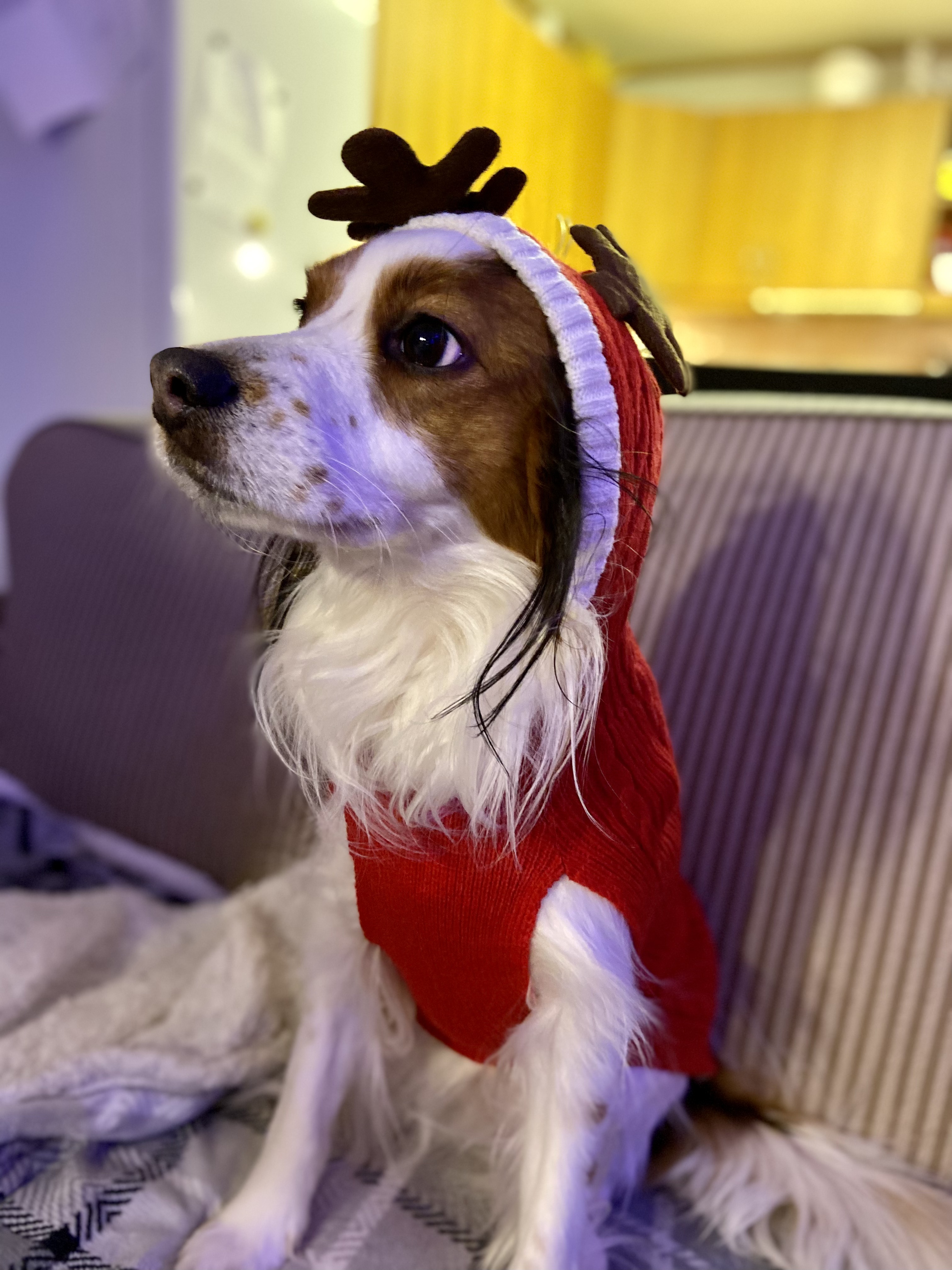
Of course, it’s traditional that everyone in the house has to stir the pudding and Triar put on his special Christmas jumper before he took his turn.
And now the last of the advent candles is lit. Soon Christmas will be with us. John is coming, as is Charlie (John, Anna and Andrew’s dad, for those who don’t know). My next update will be on Boxing day. And so for now, I will wish all my English speaking friends and relatives a peaceful Christmas. And en riktig god Jul to all my Norwegian friends.
I was sure we were going to have a white Christmas this year. There has been snow on the ground for weeks and the temperatures were securely in double minus figures, or so I thought. And then a day of rain appeared on my weather forecast app. The temperature was to bounce right up, round about the date that Anna was due to come home on Wednesday the 15th. When the first day appeared, I hoped they’d got it wrong. And the temperature wasn’t to go that high. Wholly possible they’d be out by a couple of degrees and we’d have snow instead.
But then another day of forecasted rain appeared and another. The temperature was higher too. This was the screenshot I sent to Anna last Sunday.
They don’t use much grit on the pavements and roads round here. Mostly they concentrate on keeping them relatively clear of snow. So when I went out on Wednesday morning and saw that the pavements, roads and carparks were densely strewn with the small stones they use in place of salt and grit, I knew that they thought that a major thaw was on the way. This was the carpark at work. They may not grit often, but when they do, they do a proper job!
Still, life had to go on. Monday and Tuesday this week were a little hair-raising. On the Friday of the week before, I felt like everything was well on track. I’d done three visits and written two reports. We have to send them past a colleague first for quality control and then an official quality control team checks them. After that, they go to my boss, who sends them out. These two reports were past the checks and I’d sent them to Hilde, so all I had left was one report to write. It was complicated and I would need help, but I had four days to do it. So when Line sent a shout out to see if someone could translate an official document from Norwegian to English, I said that I would be happy to do so. Kristen, my colleague in Storslett had got in first, but I indicated that if anything cropped up, I would be more than willing to step in.
My peace was slightly disturbed late on Friday afternoon when, for the first time ever, Hilde sent back my two reports for amendment. It didn’t sound like anything too major, but I had to include a short summary of what Gry had observed. Still, hopefully Thomas would help me with that.
So I wasn’t too worried when I opened up my case inbox on Monday morning. I had two reports to amend and the complicated case to write up, but I had until Thursday. But when I looked through the list, I saw another case had come in. Some cases you can leave for a few days. For example, if someone isn’t walking their dog often enough, it’ll probably be okay if you leave it a week or two. But if someone is leaving their animals outside in all kinds of weather, without food or water, then “It’ll be fine, I’ll leave it until after my holiday,” really isn’t an option. And of course, it was one of those cases.
To make matters worse, Kristen had bowed out of the translation. So now I had three reports, a new case, and a complicated document to wade through.
Thomas came to the rescue. He could fit in my new case on Tuesday, if I wanted. Hilde was on holiday by now and he was having to sort out all the paperwork around an outbreak of strangles in a horse in our region, but he could fit me in between that, a bunch of reindeer rampaging around a housing estate over Tromsø way, and a case of his own that he was tackling on Wednesday. He also found the time to help me sort out my two returned reports.
Anyway, all’s well that ends well. I stayed late on Monday evening to get the translation done. I asked Line to help me with my complicated case report and she made everything so wonderfully clear that by the time I sent it off for the first check with another colleague, there were almost no errors. Hooray for that! And to my relief, the case on Tuesday turned out to be much less complicated than I had feared. So I was able to collect Anna from the airport on Wednesday afternoon.
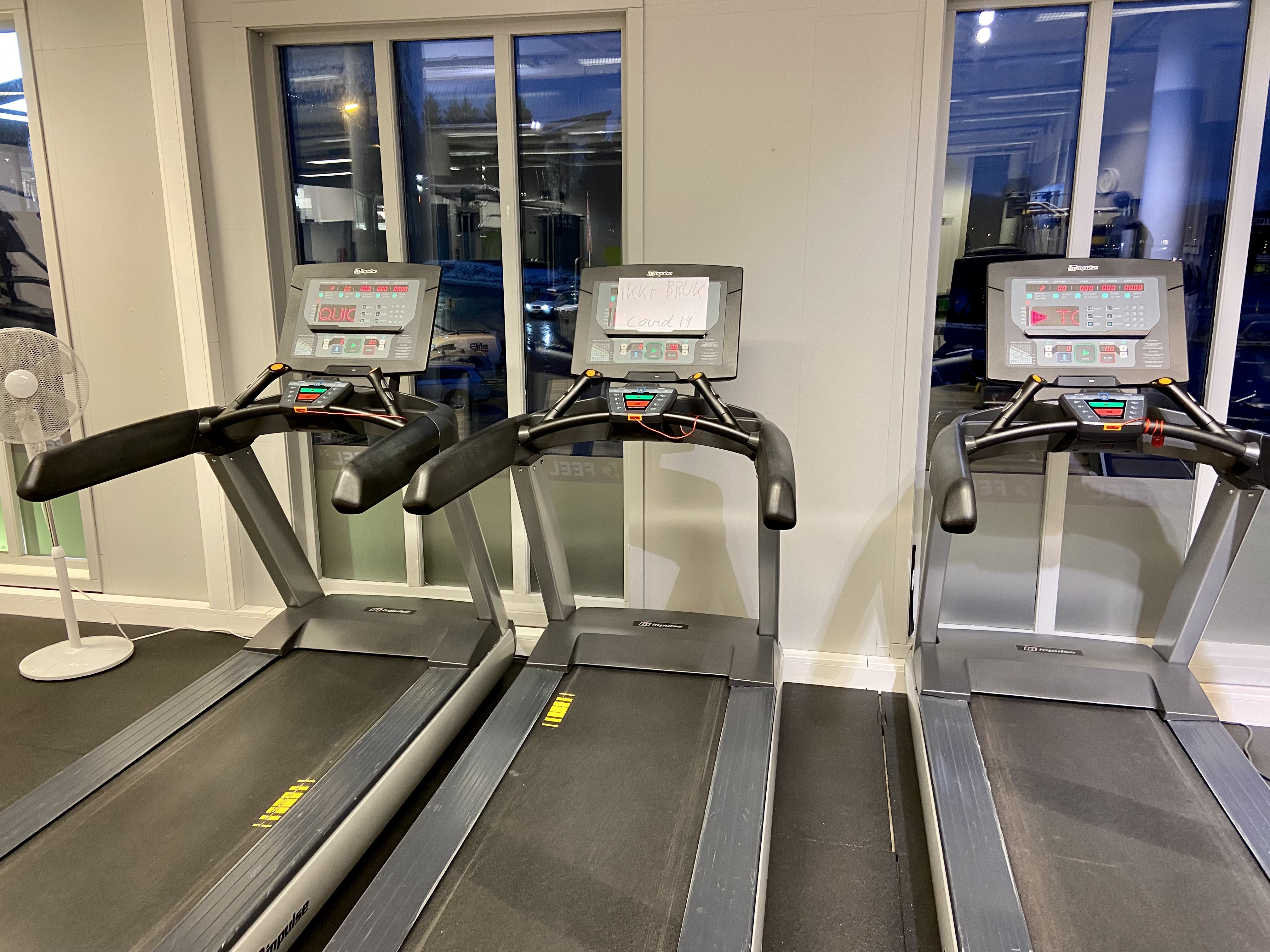
And all this was going on against the backdrop of increasing rumblings about locking down again due to Omicron. From next week, Andrew will be homeschooling. Working from home is now the norm again. And when I went to the gym, I was surprised to see notices on some of the running machines that said not to use them. For a bizarre moment, I wondered whether they had been contaminated somehow. Had someone with Covid used them? Should I leave quickly and rush home? And then I remembered that it was nothing to do with that. It was just a return to the stricter distancing rules. The machines were too close together. Similar notices will have reappeared on pub and restaurant seats and in the waiting room at the doctors. Life can continue for now… but don’t get too close.
So there are no lovely pictures of pink and blue skies this week. The garden is a muddy mess. There is a tiny ray of hope on the weather forecast. It’s to turn cold again from Monday and there might be a little snow on Wednesday. I live in hope! Even if it doesn’t snow, Anna got here safely from the UK. And I’m on holiday for a week and there are presents to wrap and cakes to make.
I’ll leave you with a picture I took on Thursday evening when I was out walking Triar. It had been raining, but the ground has had weeks to become very chilly and huge chunks of ice take a long time to disperse. The sky cleared briefly and the moon was shining through. I loved the way the blue moonlight gleamed on the frozen waterfall. Whatever the weather, there is always beauty to be found somewhere.
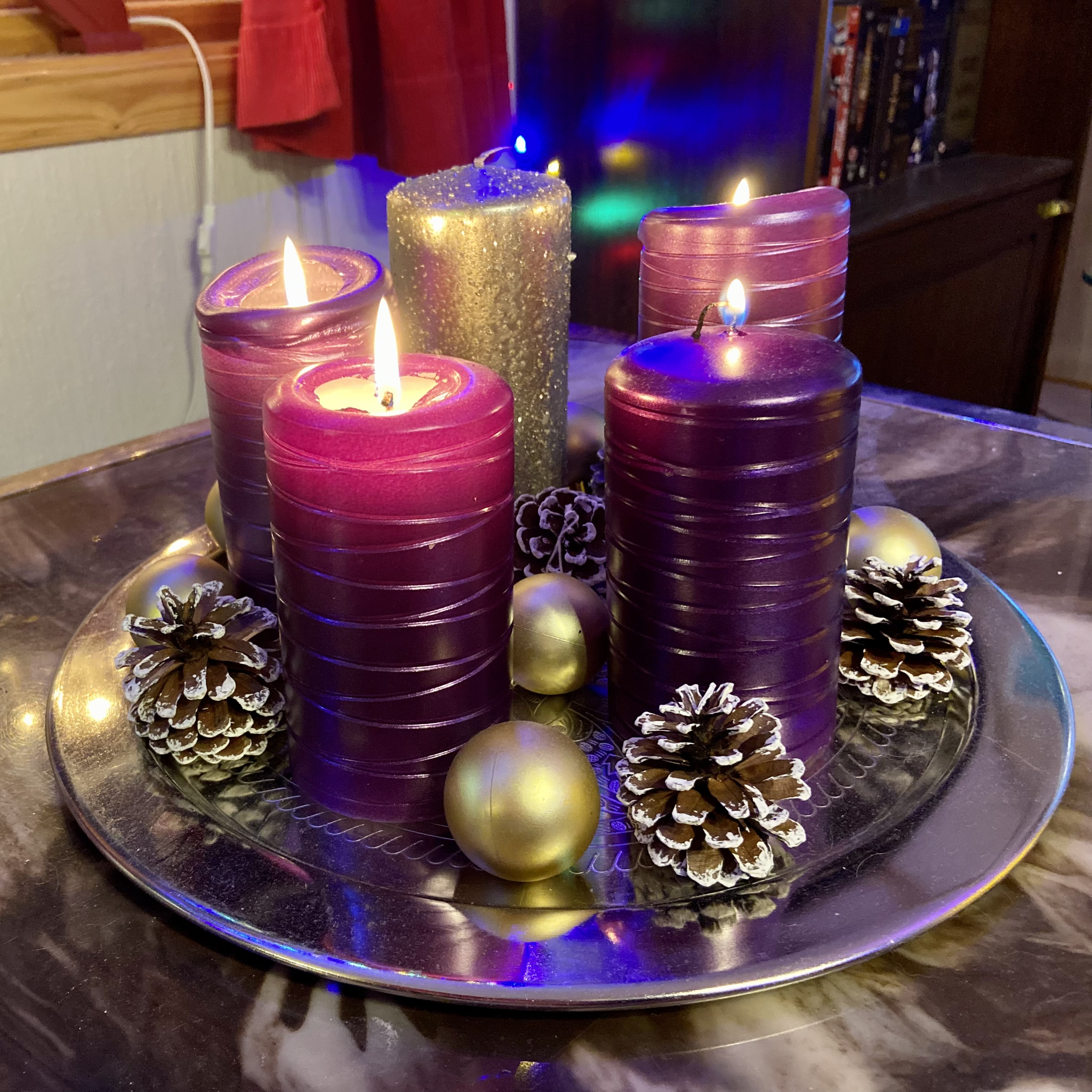
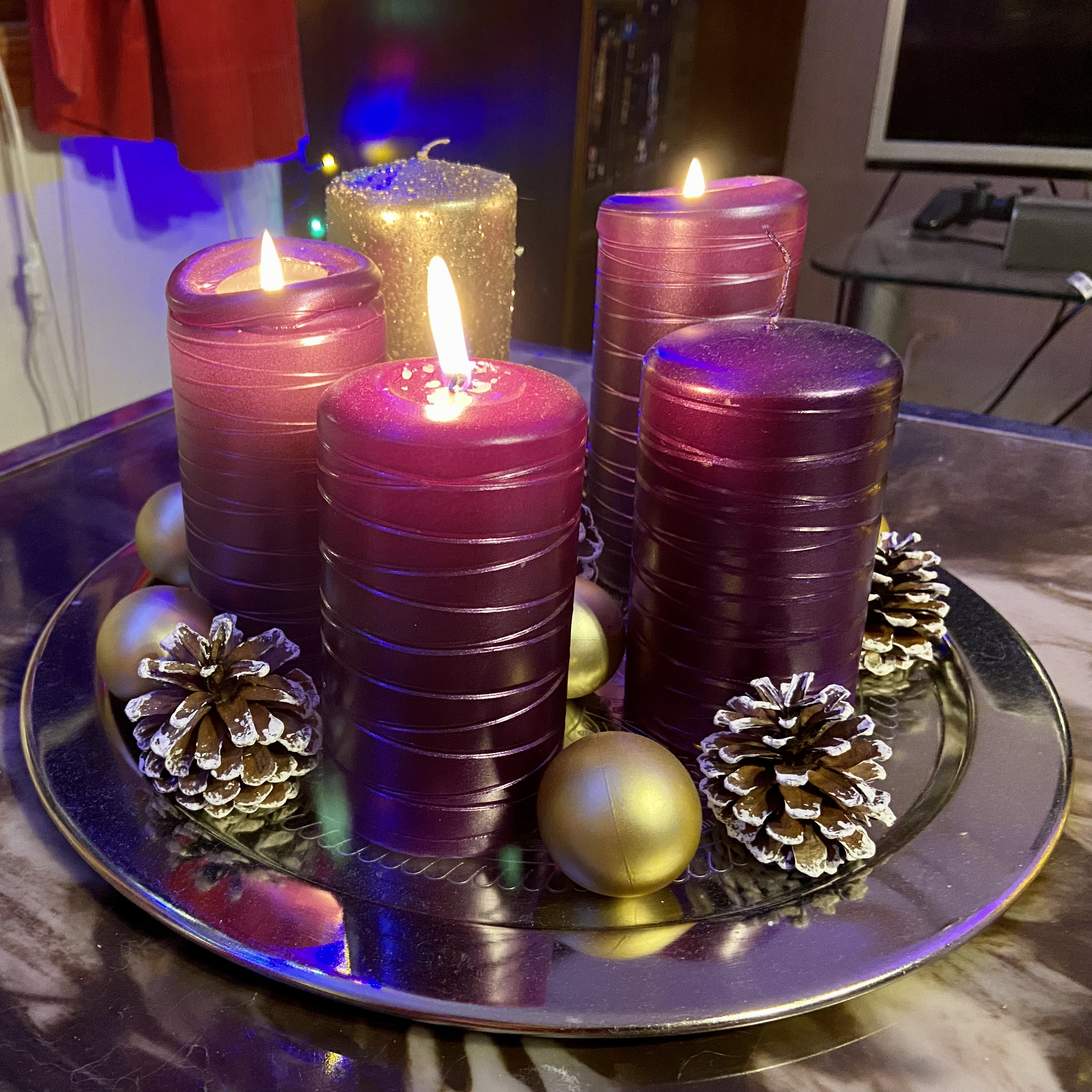
The third purple candle is now lit on the advent crown.
Not really a Christmas thing, but the sledge-like object in the picture at the top of the page is a spark, or sparkstøtting. As you can see, it has a handle at waist height and long runners behind the seat, so you can walk and push a child, or carry something. It’s not uncommon to see people taking them to the shops and around the town and children sometimes play with them on the road to our apartment. The pavements are rarely gritted, so sliding about isn’t too difficult. That said, at minus ten, there tends to be less ice and even though the snow is hard-packed, it often has powder on top. When the temperature rises above zero and it begins to melt, that’s when it is at its most treacherous.
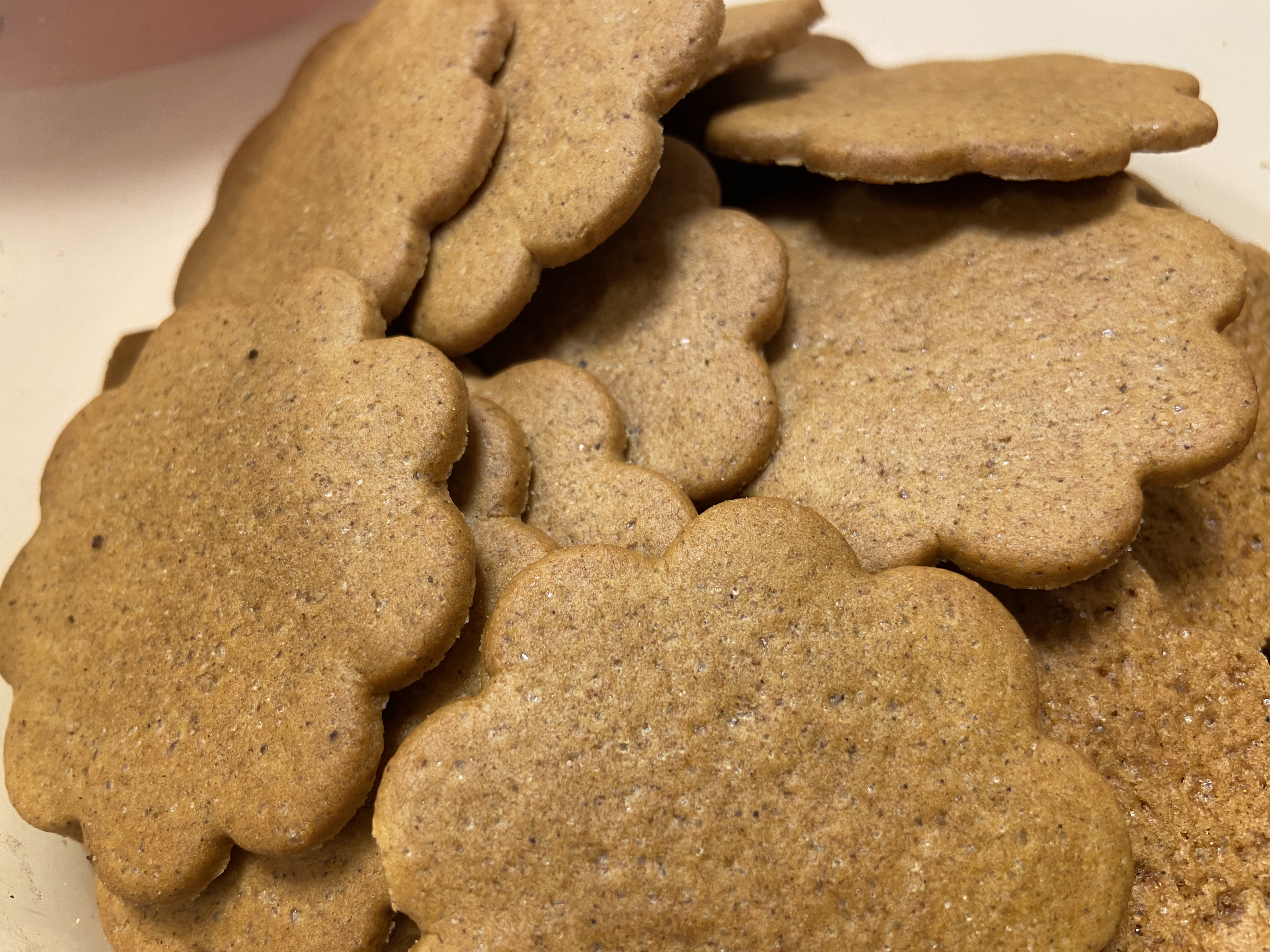
The office is now filled with Christmas cheer. These three nisser look a bit more cosy than the one in the hotel last week. I was hoping to bring pictures of our Christmas lunch, but I ended up working elsewhere on Thursday. I did take pictures of some of the most common Christmas “biscuits” though. On the left are kokosboller, top right are pepperkaker and bottom left are havreflarn.
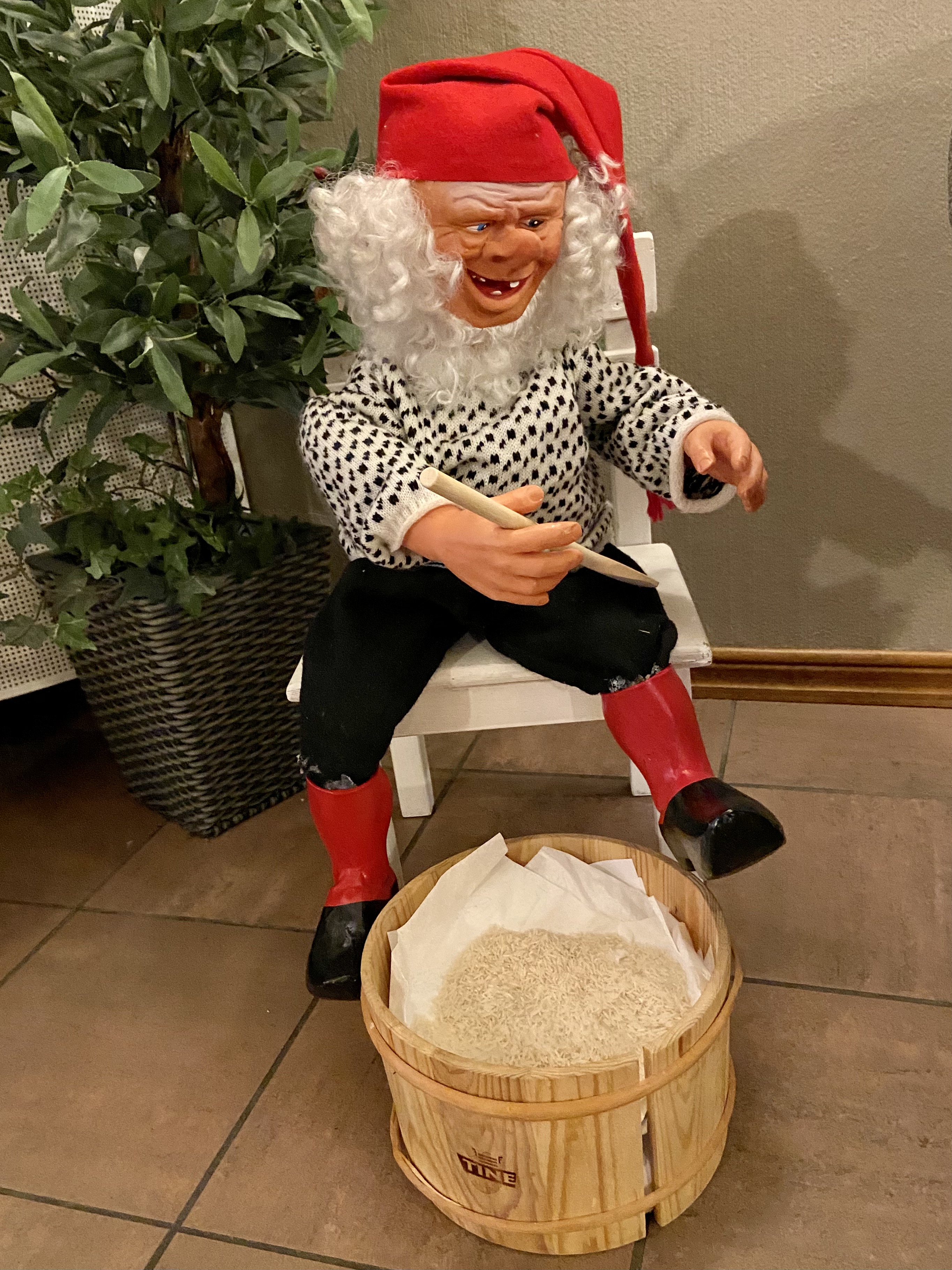
And this is risgrøt – basically rice porridge. This is what the nisser should be fed on Christmas Eve (Julaften). I had mine with butter, sugar and cinammon, but John tells me they eat it up here with spekemat – dried meats and sausages. One day I’ll have to give it a try.
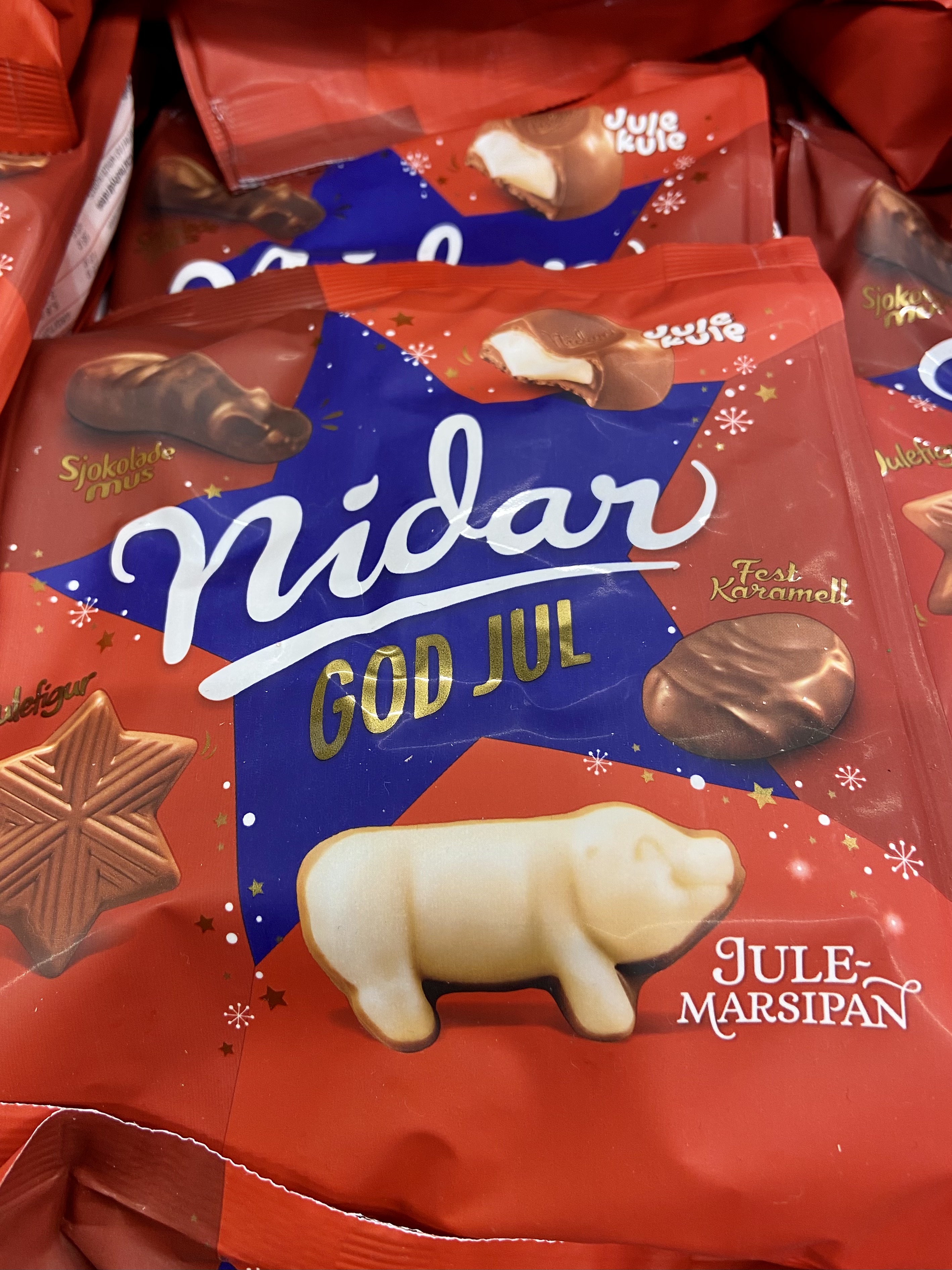
As in the UK, there are lots of Christmas sweets and snacks in the shops. Many are marzipan based, with a particular slant towards marzipan pigs. There is also the delicious sounding Juleskum though, if you’re feeling brave. I also had to take a photo of a packet of salted caramel crisps. Salted caramel is lovely, but this is one of those moments when even I think they’ve taken it a step too far!
If you’re thirsty, the classic drink is gløg, which is a warm, spiced wine drink, a little like mulled wine, though there is an alcohol free version for children.
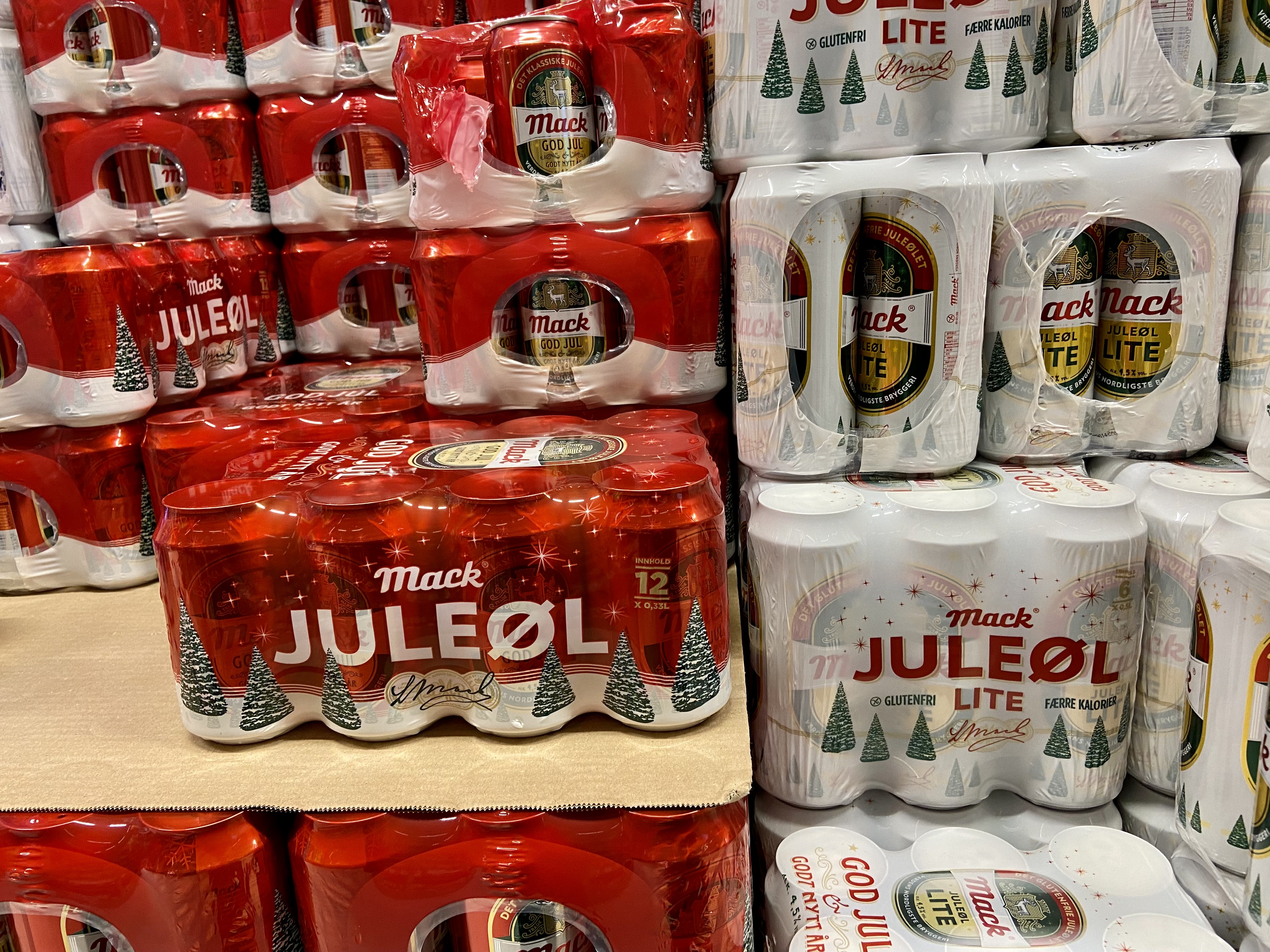
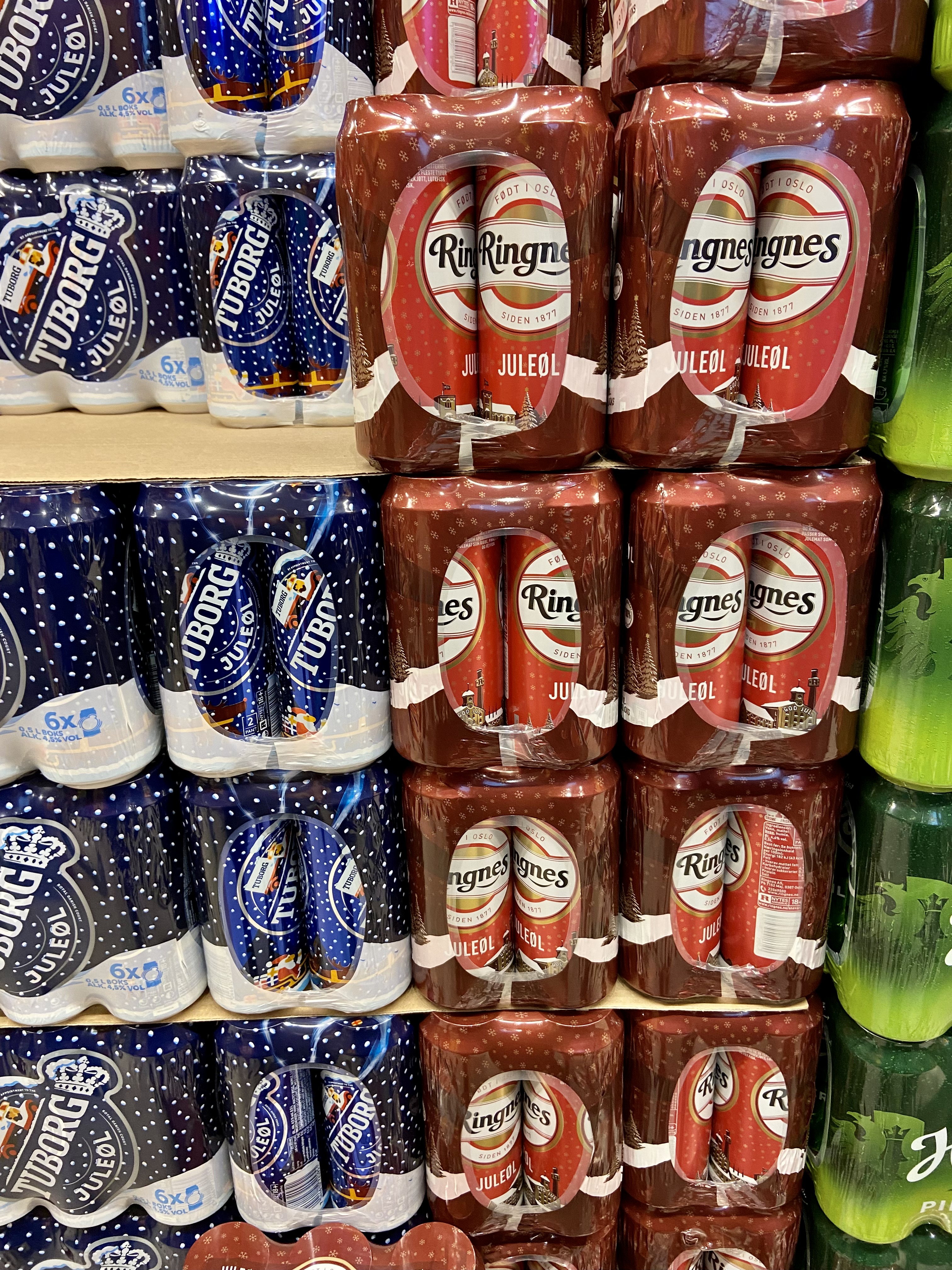
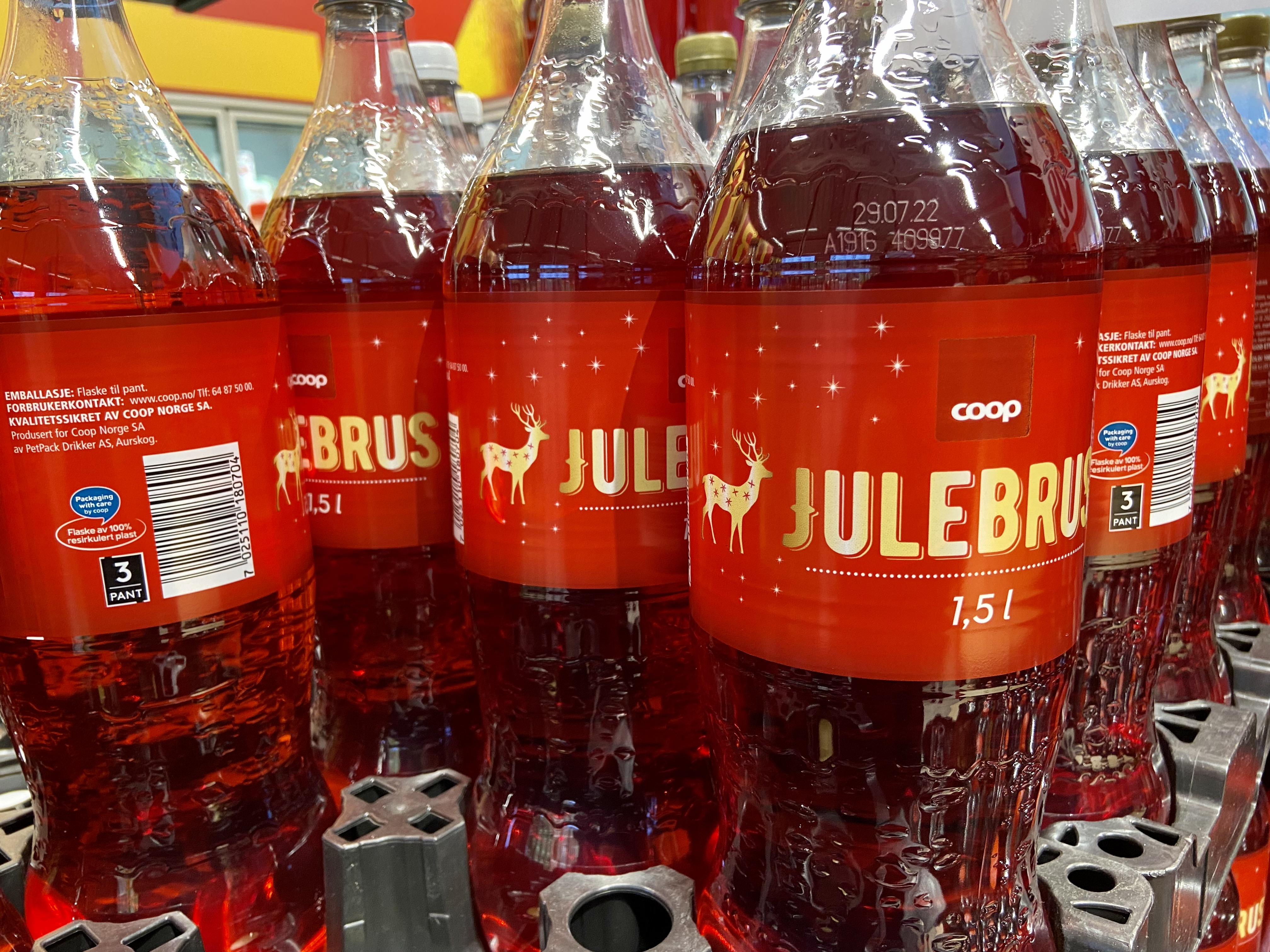
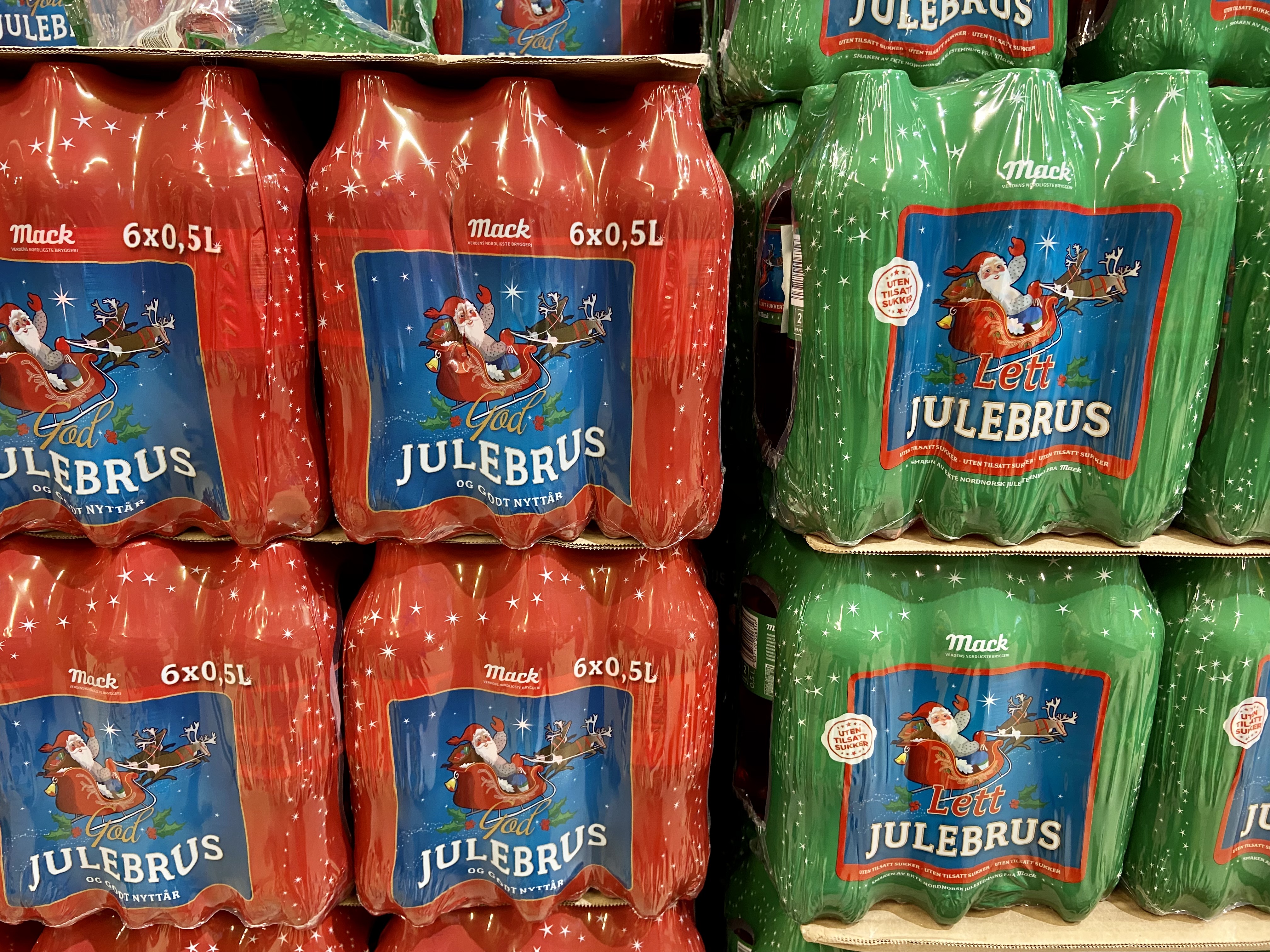
Alternative drinks include Christmas beers, made by all the bigger beer-makers and also Julebrus, which is a sweet, fizzy drink in either red or brown flavours. Mack is our “local” brewery (it’s in Tromsø) and it’s the most northern brewery in the world. As you can see, they make Julebrus as well as beer. The Julebrus here is different from the brands we used to buy when we lived much further south.
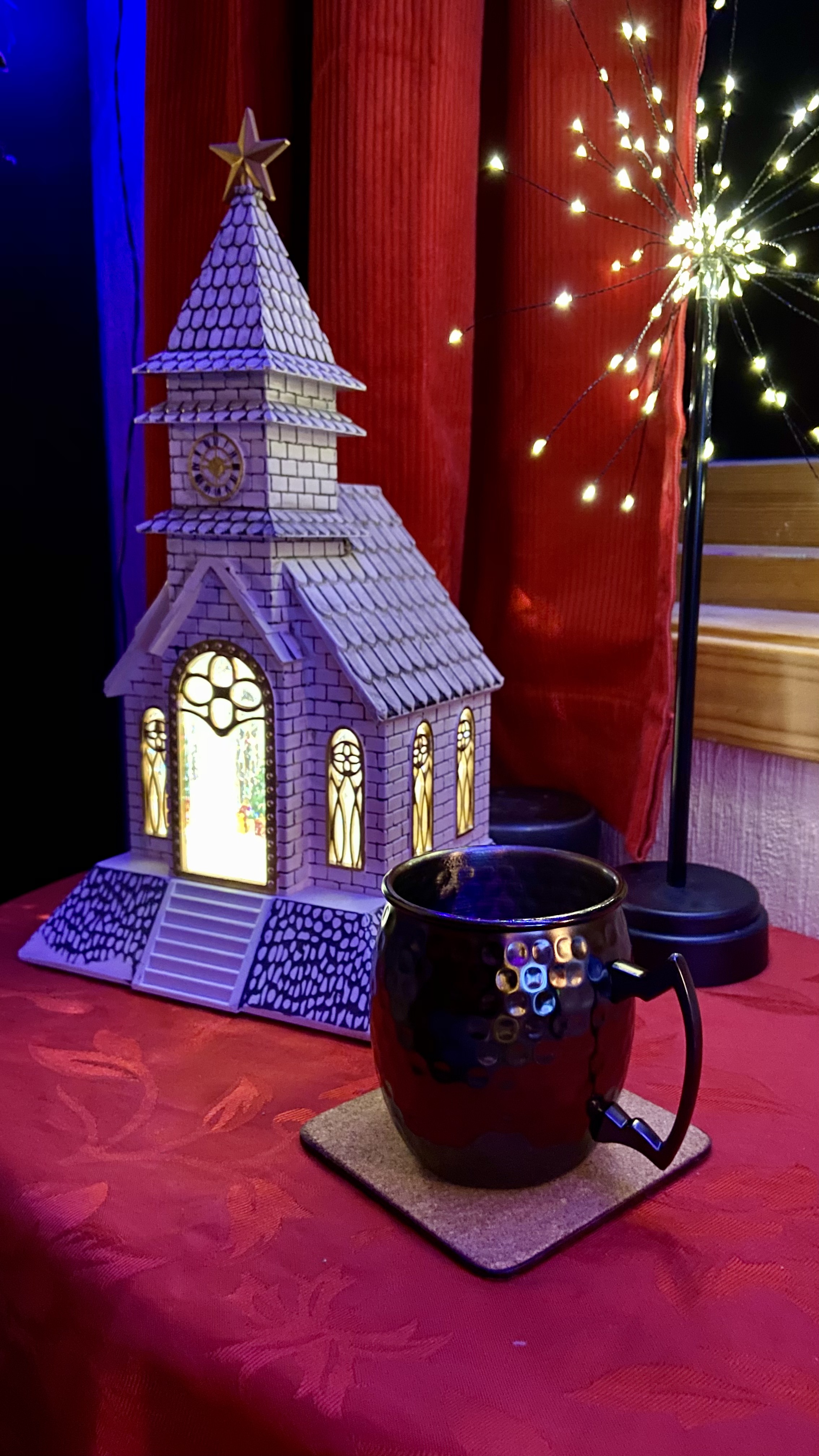
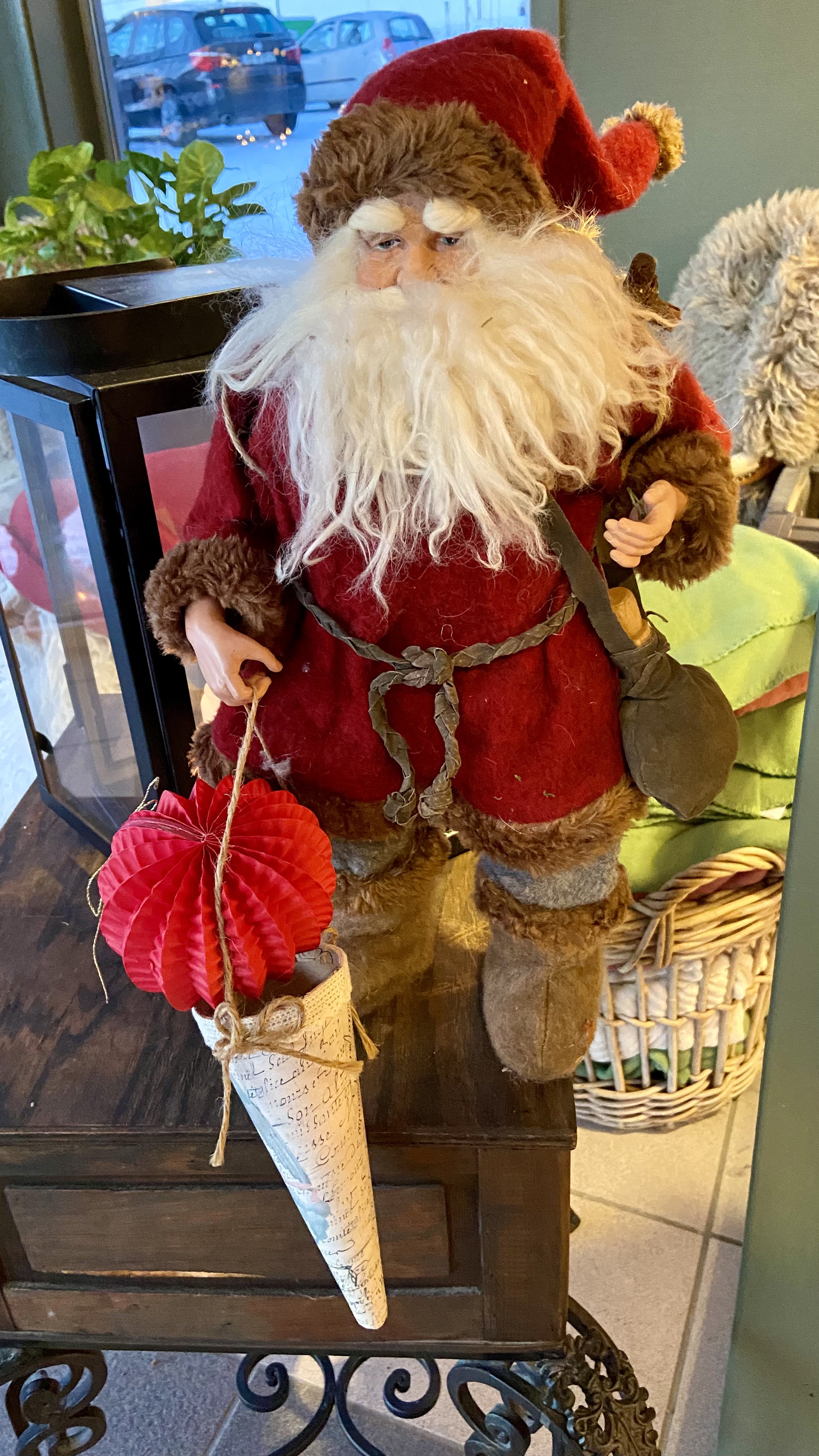
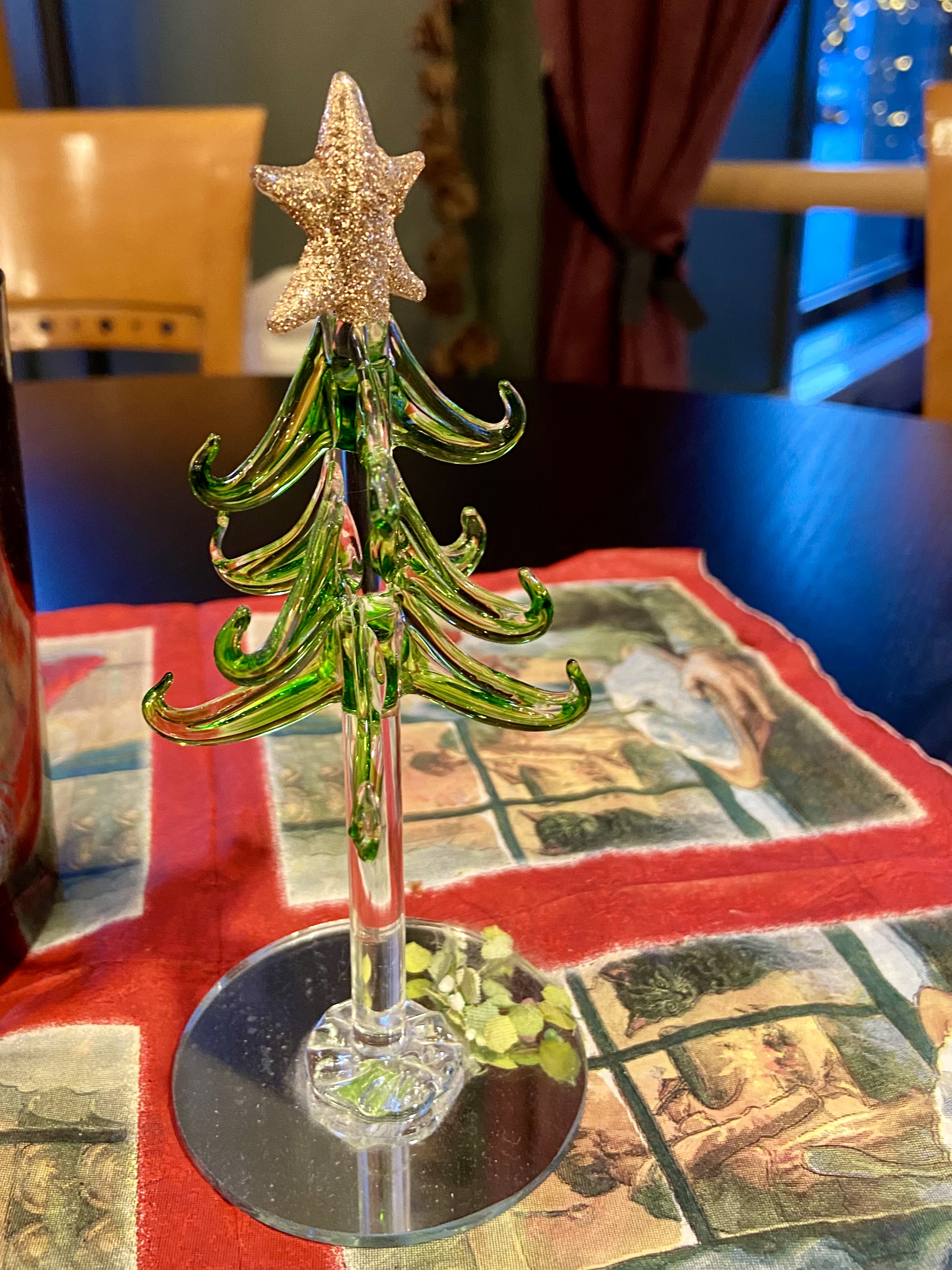
I’ll finish off with a few decorations. These are from a cafe we visited yesterday in Bardufoss. I was hoping they’d have some more Christmassy food, but nothing was leaping out at me, so I had a coffee instead, which was very pleasant.
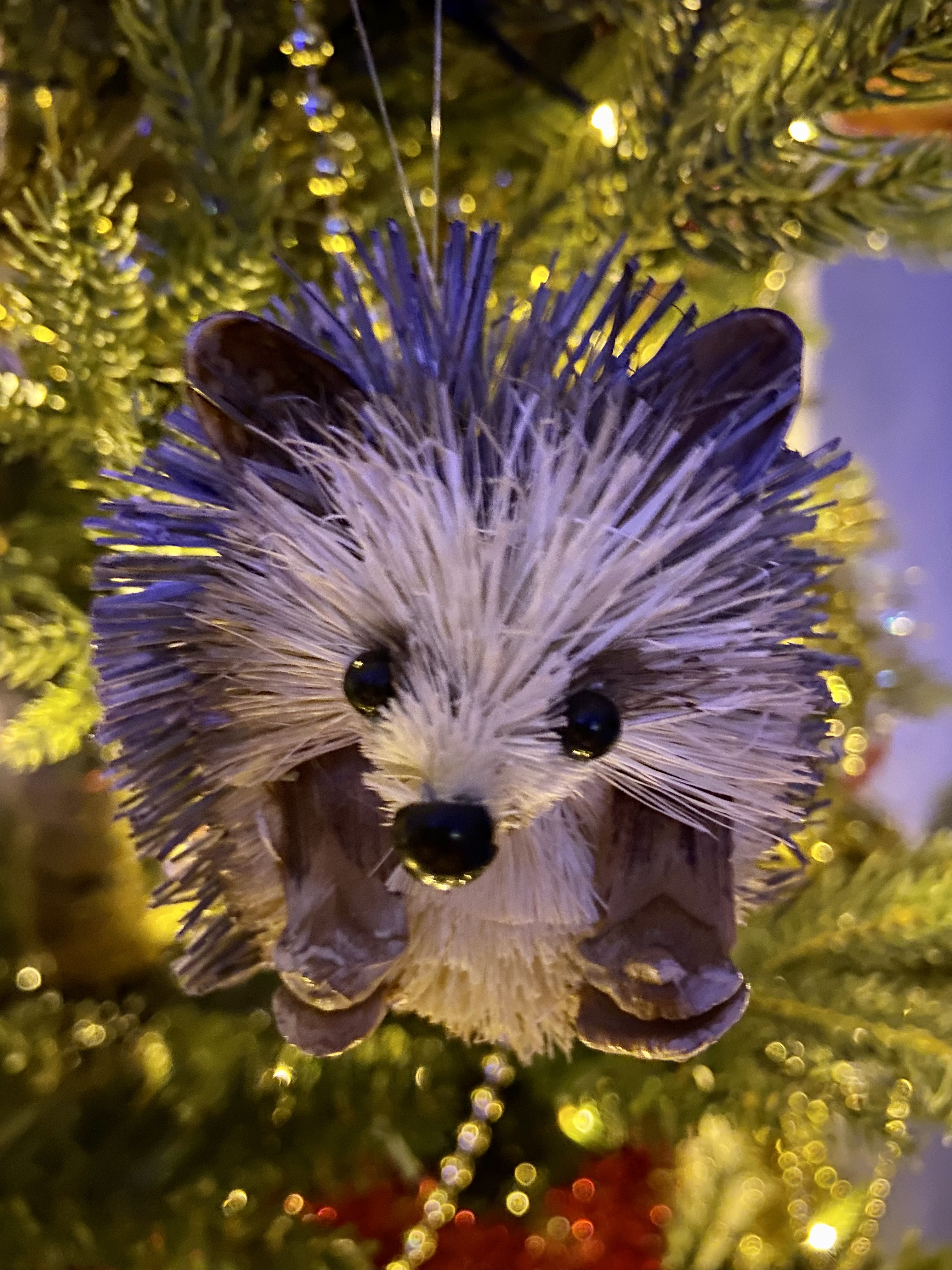
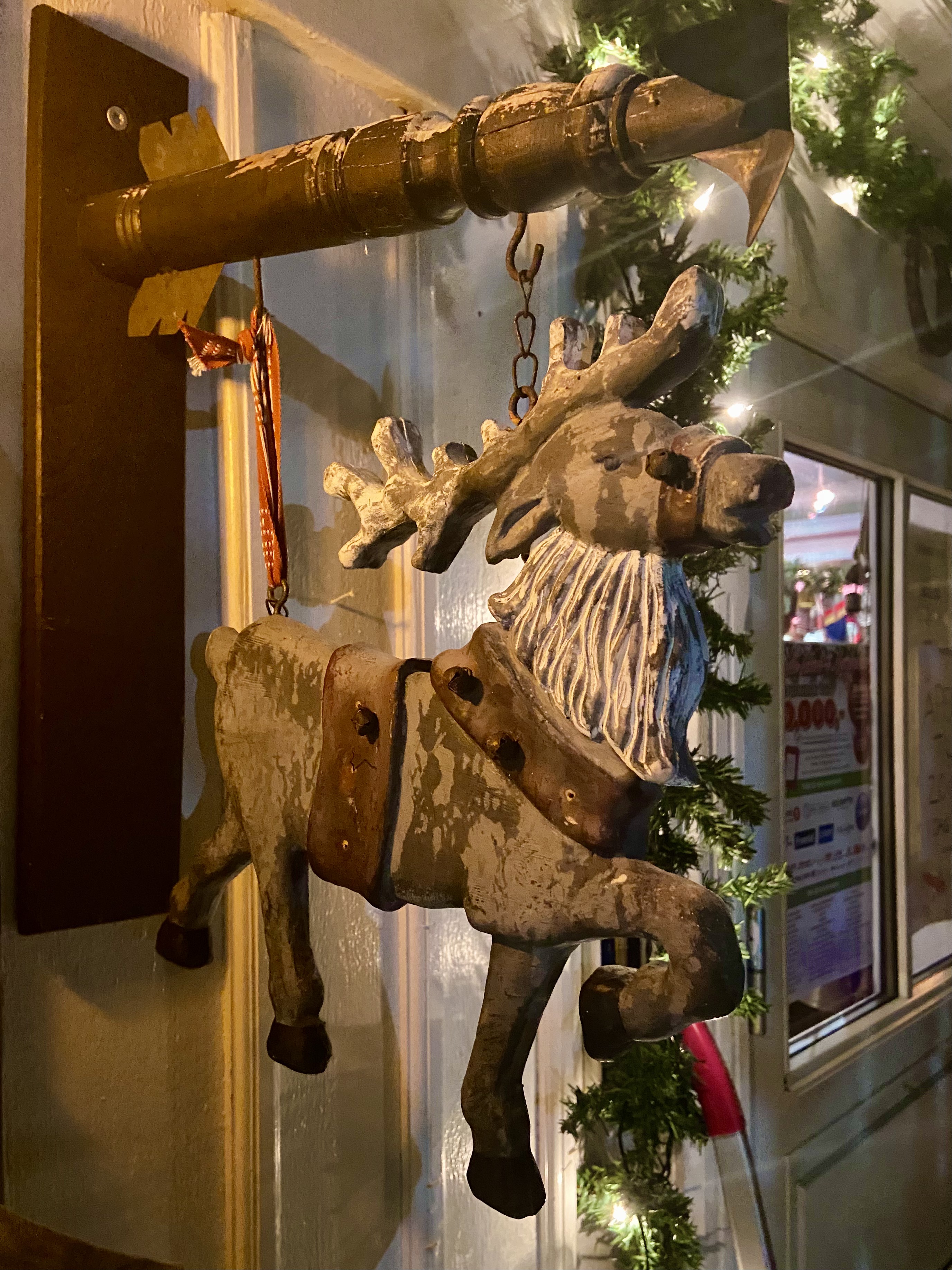
And these are from my own Christmas tree. My mum sent me these tree critters, so they’re not actually Norwegian, but they are definitely now part of my Norwegian Christmas.
Christmas in Norway wouldn’t be complete without Nisser. There’s a programme on Netflix about them at the moment, and the name has been translated into English as “Elves”. But Nisser are nothing like the elves in British and American tradition, which assist Father Christmas or Santa at the North Pole. Nisser are definitely not helpful. Indeed if you forget to give them rice porridge on Christmas Eve, they can apparently become cantankerous. I should imagine they’re a bit like John when he’s expected to put up a Christmas tree with insufficient Pedro Ximenes. Anyway, I found one in the hotel up in Storslett. The poor critter has been given uncooked rice, which will probably give it a terrible stomach ache, but at least they tried.
I have a few more photos from Storslett. The candlelit lavvo we ate in was beside a beautifully decorated Sami shop. The log cabin at the top of the page (under a sky that was green with aurora) was nearby too.
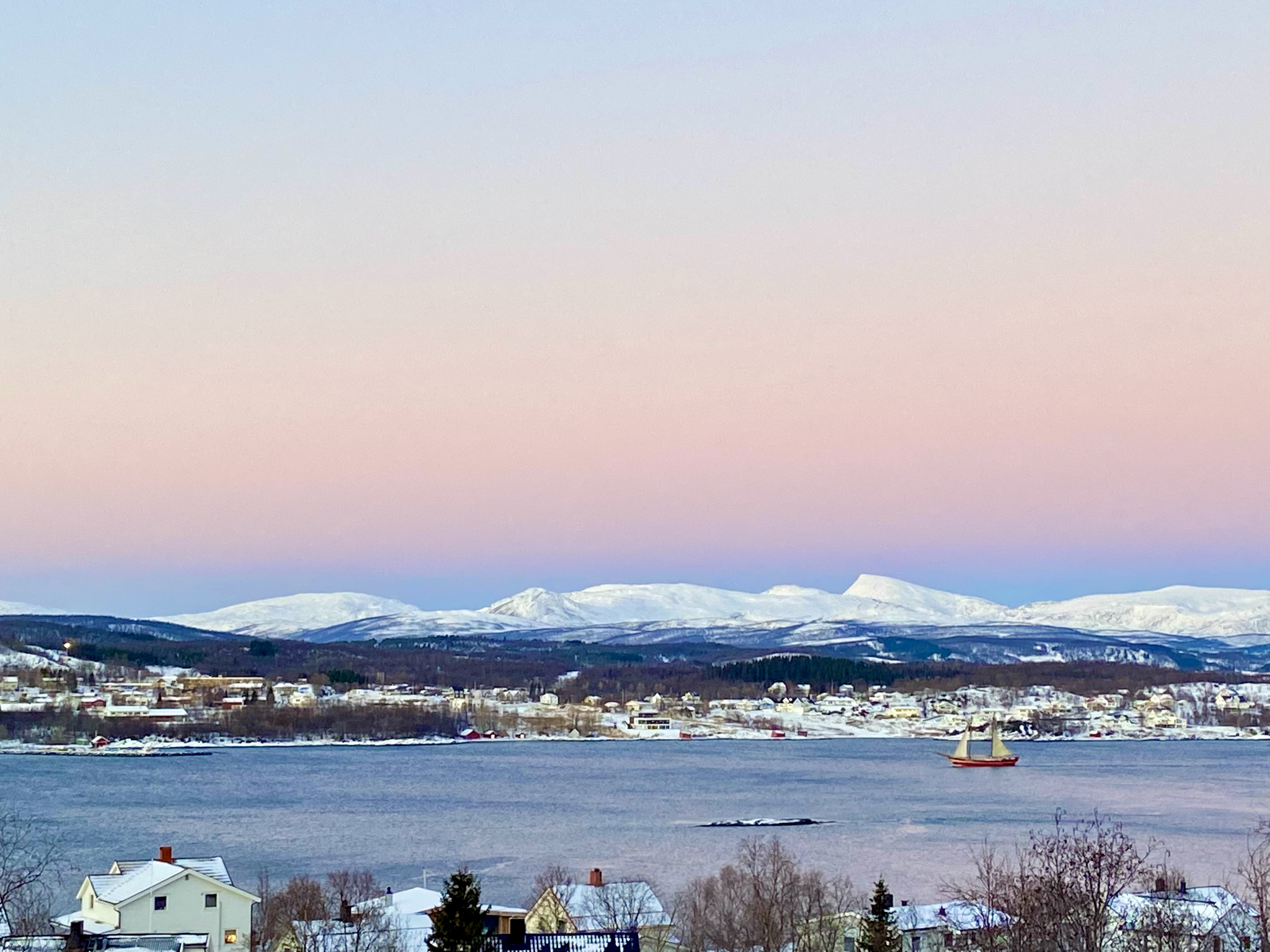
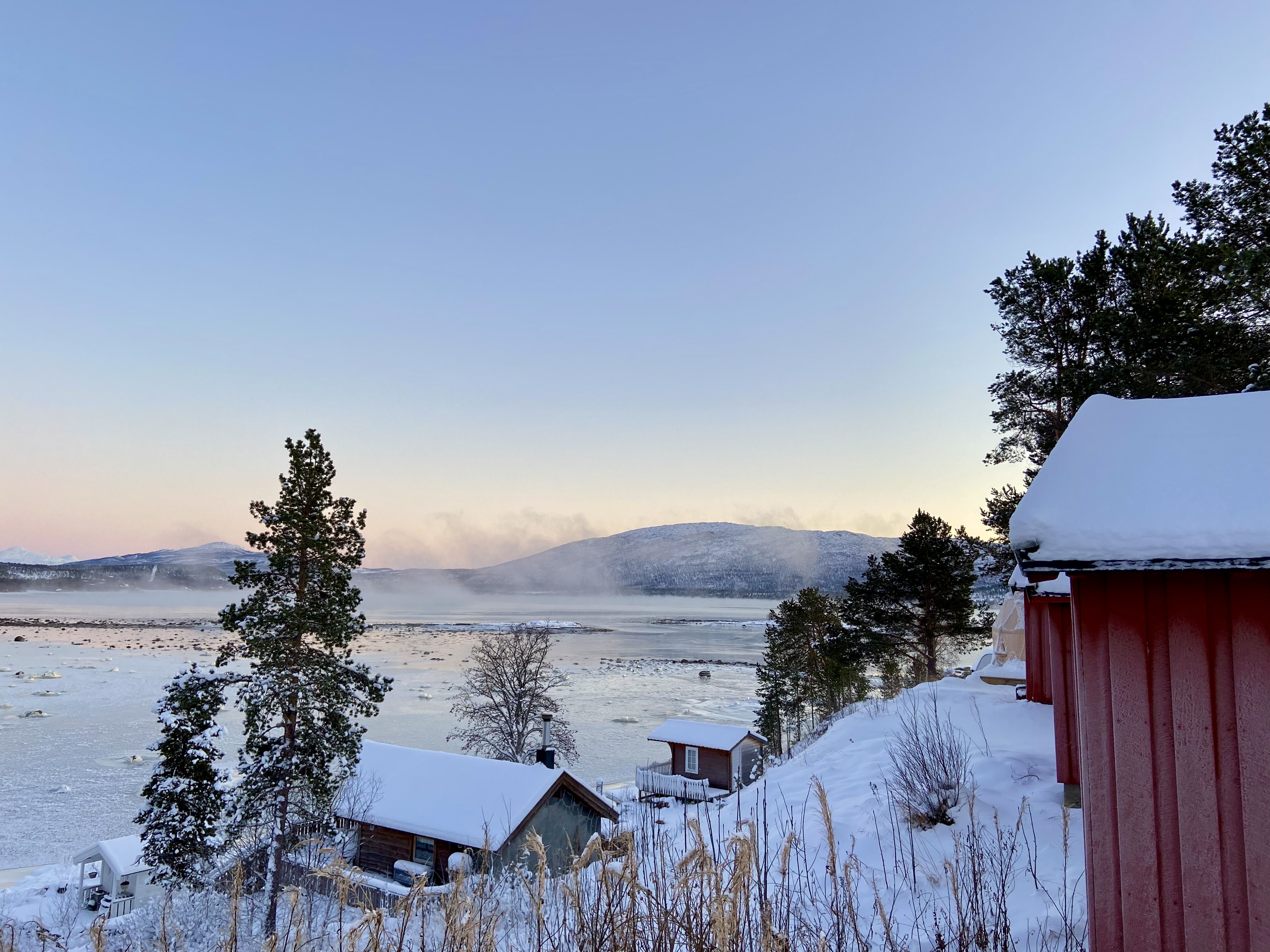
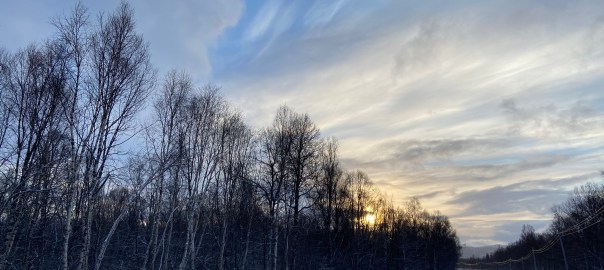
We’re a few days into the polar night now and when the sky is clear, it is layered with pale blue and pink. The temperature has remained low all week and the snow creaks when you walk on it. Often you can smell wood smoke in the crisp air as you walk. This is the view from my garden at eleven o’clock in the morning.
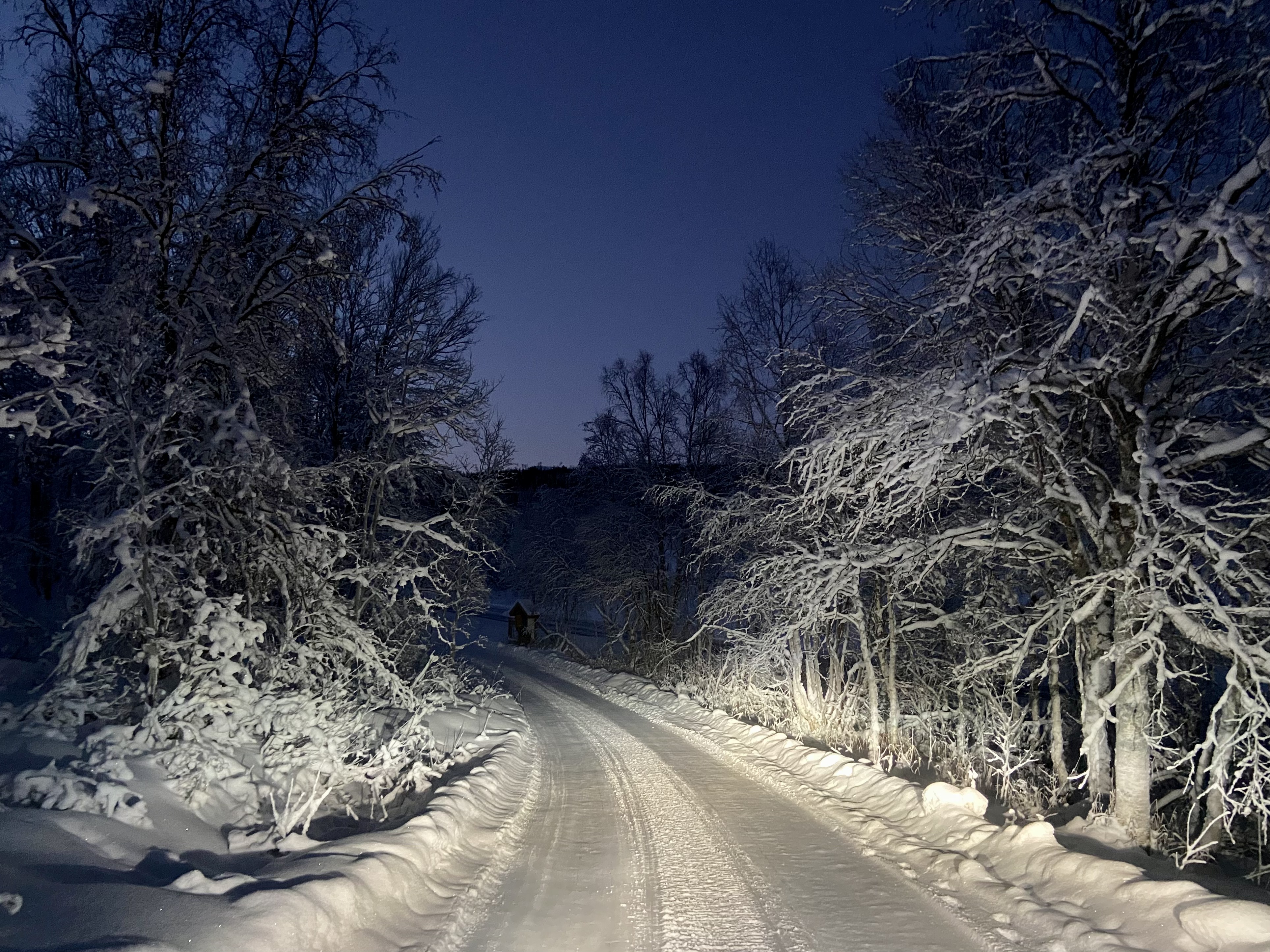
Another snow picture for you, this time from a drive inland, where it’s generally colder. My car reminds me that its battery isn’t happy as soon as it drops below minus twenty, and here it was nine degrees below that, but fortunately, despite the objections, the car brought us safely home.
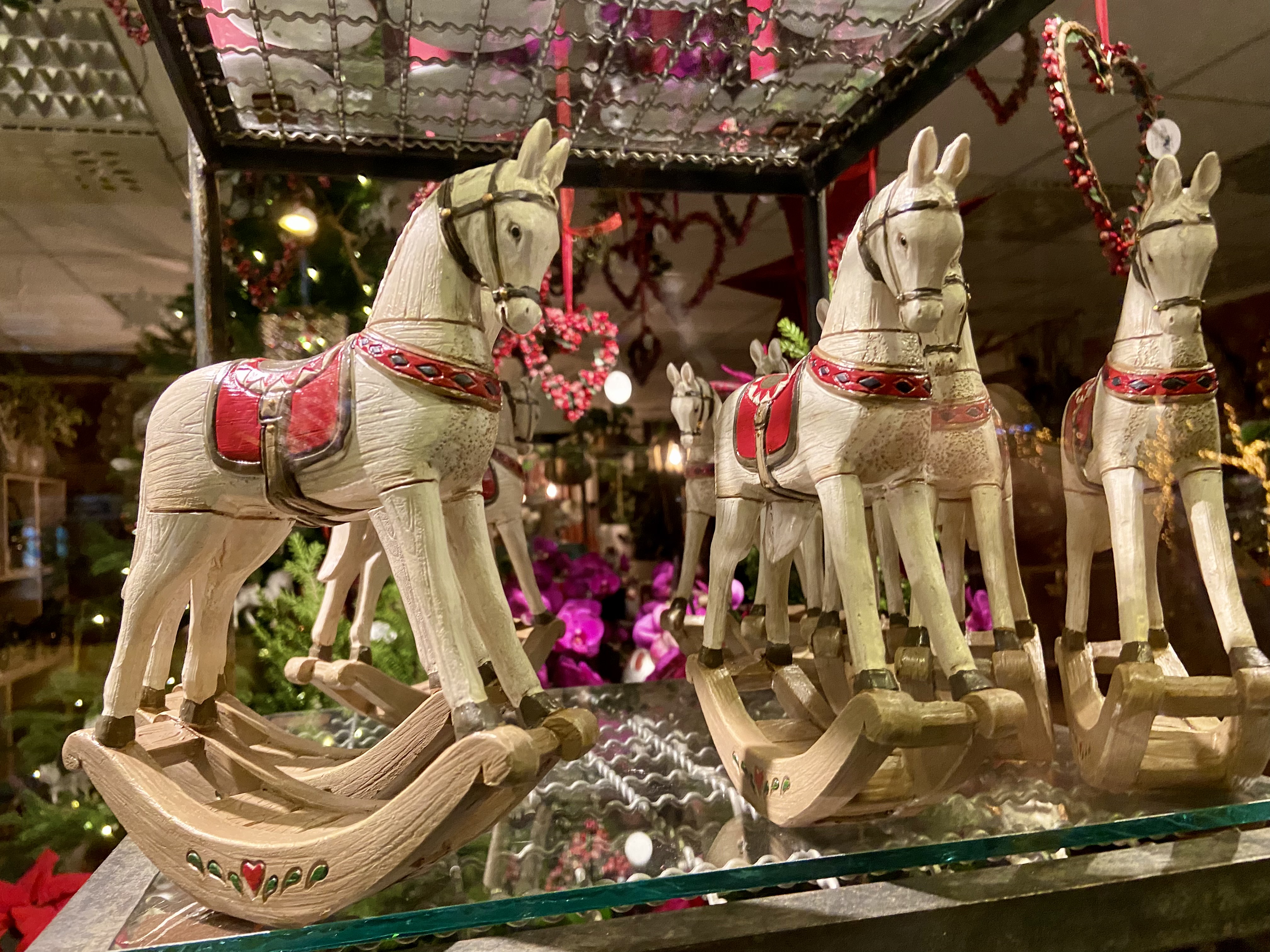
And just in case you were thinking that Christmas in Norway is all tasteful (Nisser aside) here’s a wonderfully over the top display I found, in the toy shop in our local shopping centre. I took a still photograph, but if I say there was plinky-plonky music playing and they were swaying their heads in time, you’ll be able to imagine the scene in full.
Given all the uncertainty at the moment around the pandemic, I thought it would be nice to share some images from my life over the next four weeks in the lead up till Christmas. I had hoped to spend Christmas in the UK with my parents this year. It wasn’t to be but Christmas in Norway is beautiful, so hopefully I can share some of it with you.
Back in Scotland, in the lead up to Christmas, we used to go round the village where we lived to find the “crazy houses” – those wonderfully over-the-top places where there were inflatable snowmen in the garden, where a spotlit Santa was ascending the wall on a makeshift ladder and the entire house was lit up with flashing lights that would put Blackpool Illuminations in the shade.
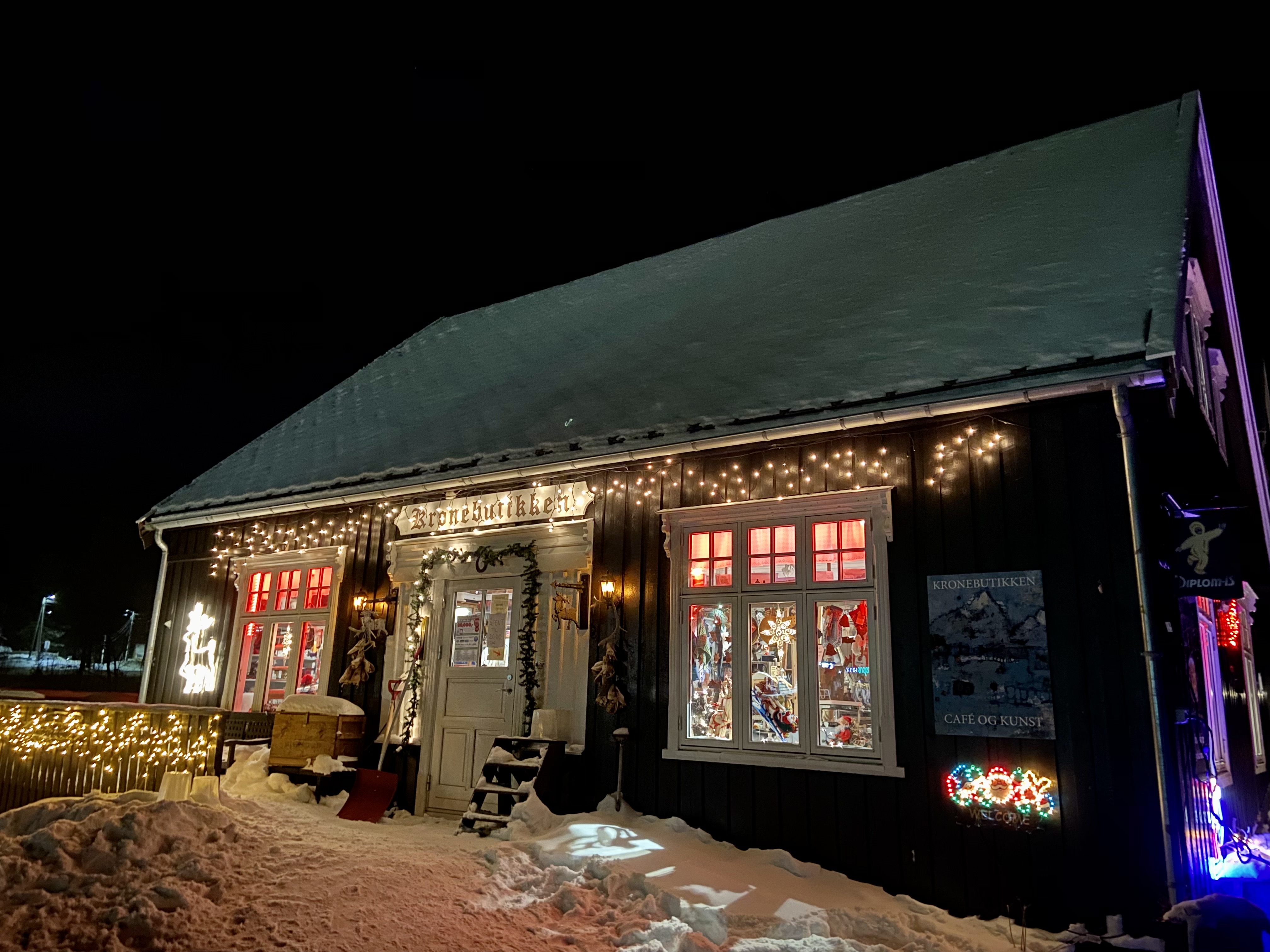
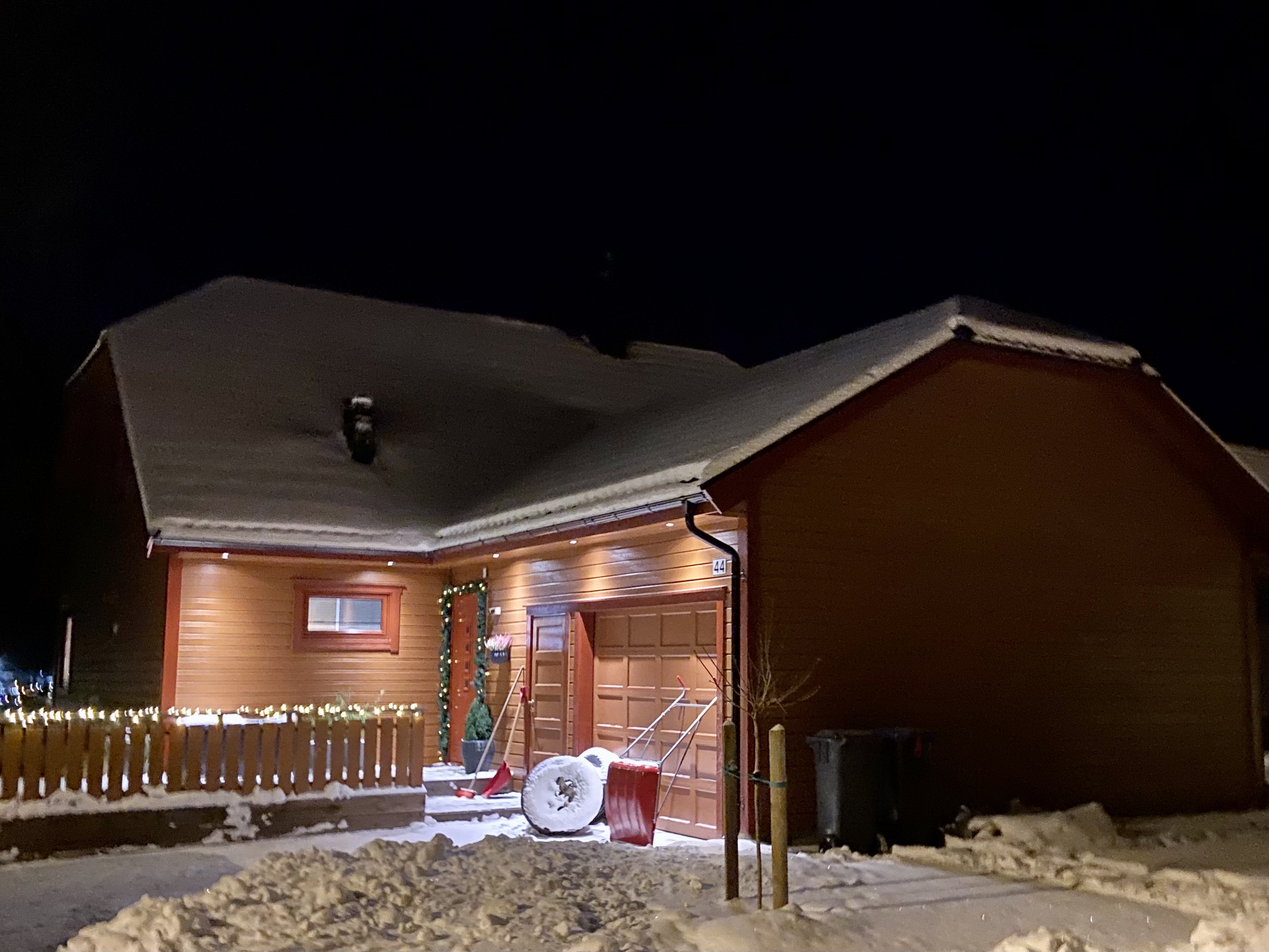
Here in the north of Norway, there are a lot of lights, but most of them are warm white. The painted wooden houses look very cosy in the darkness.
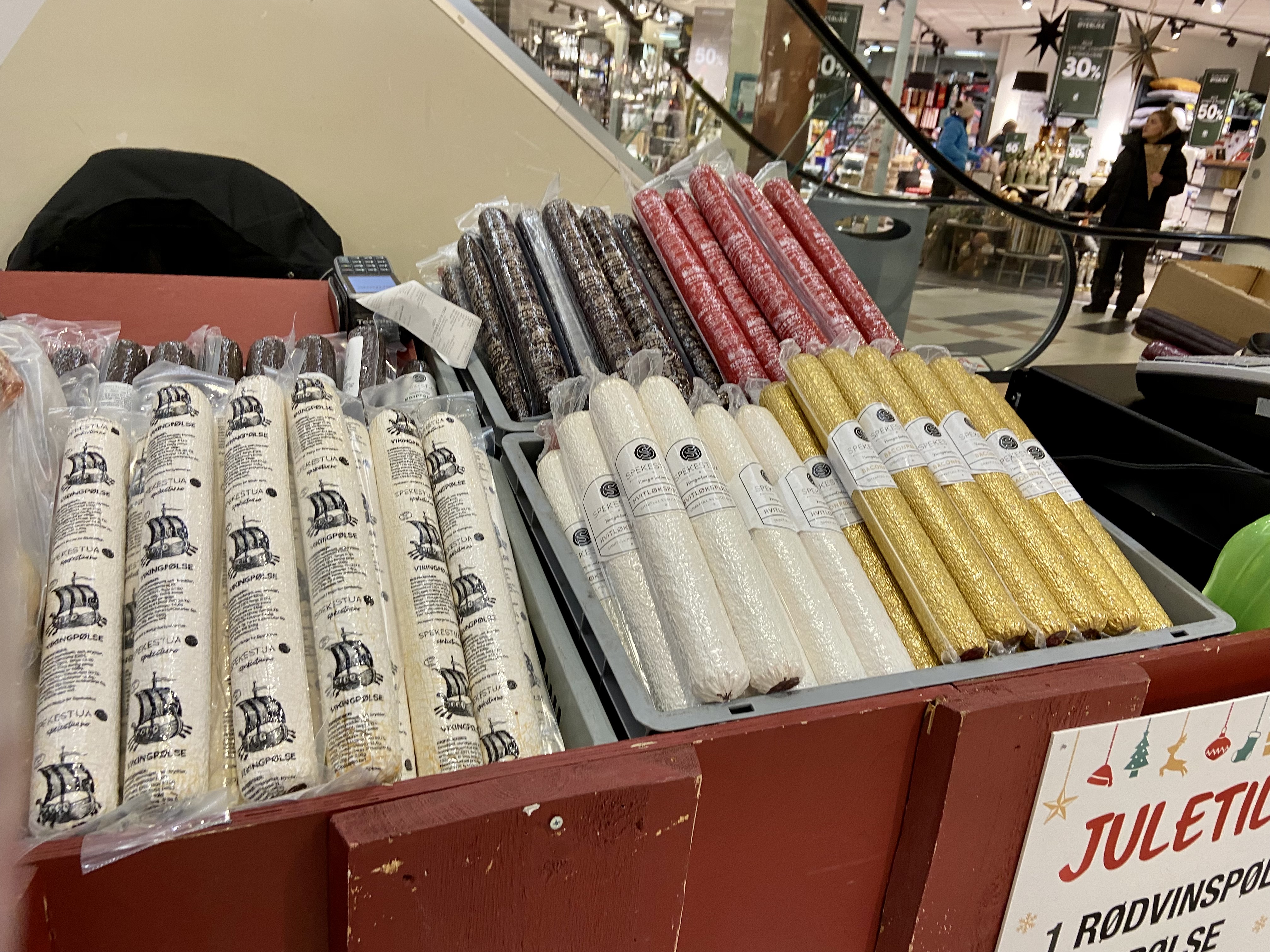
In the town centre yesterday afternoon, my eye was caught by some lovely shop window displays and by a rather drunken looking Christmas tree, lingering beside a door. There was also a stall in the local shopping centre, selling cured sausages.
We decided to take a walk in Ånderdalen national park and then have coffee at Senja Roasters but our plans were foiled by the cold temperature. It was minus twenty two when we set off for our walk. Triar has always been surprisingly resilient in the snow, so it hadn’t crossed my mind that perhaps minus twenty two might be a step too far. We managed less than two minutes before his natural enthusiasm left him, and instead of racing ahead, he came back and walked in front of me looking very uncertain. We carried him back to the car and he seemed relieved. I paused to take a photograph of the fjord, which was already starting to freeze in the shallow bay.
We weren’t sure whether we would be able to go into Senja Roasters. We did contemplate leaving the car running for Triar while we galloped in for coffee ( it was a balmy minus eleven in Stonglandseidet – the temperature changes as we drove around were astonishing) but happily, they allowed us to take Triar inside, so we could have a somewhat more relaxed lunch.
It was beautifully decorated with candles and coffee beans, and a few other cosy Christmas touches.
The food was great, of course, as well as the company.
And happily for Triar, we have hopefully found a solution to the cold-toe problem. See you next week!
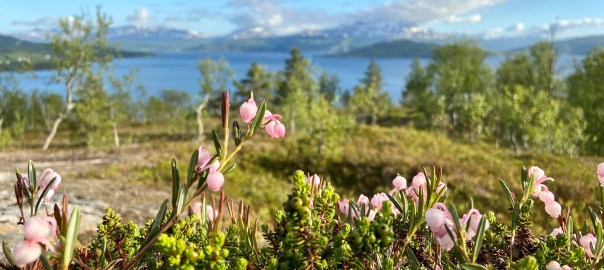
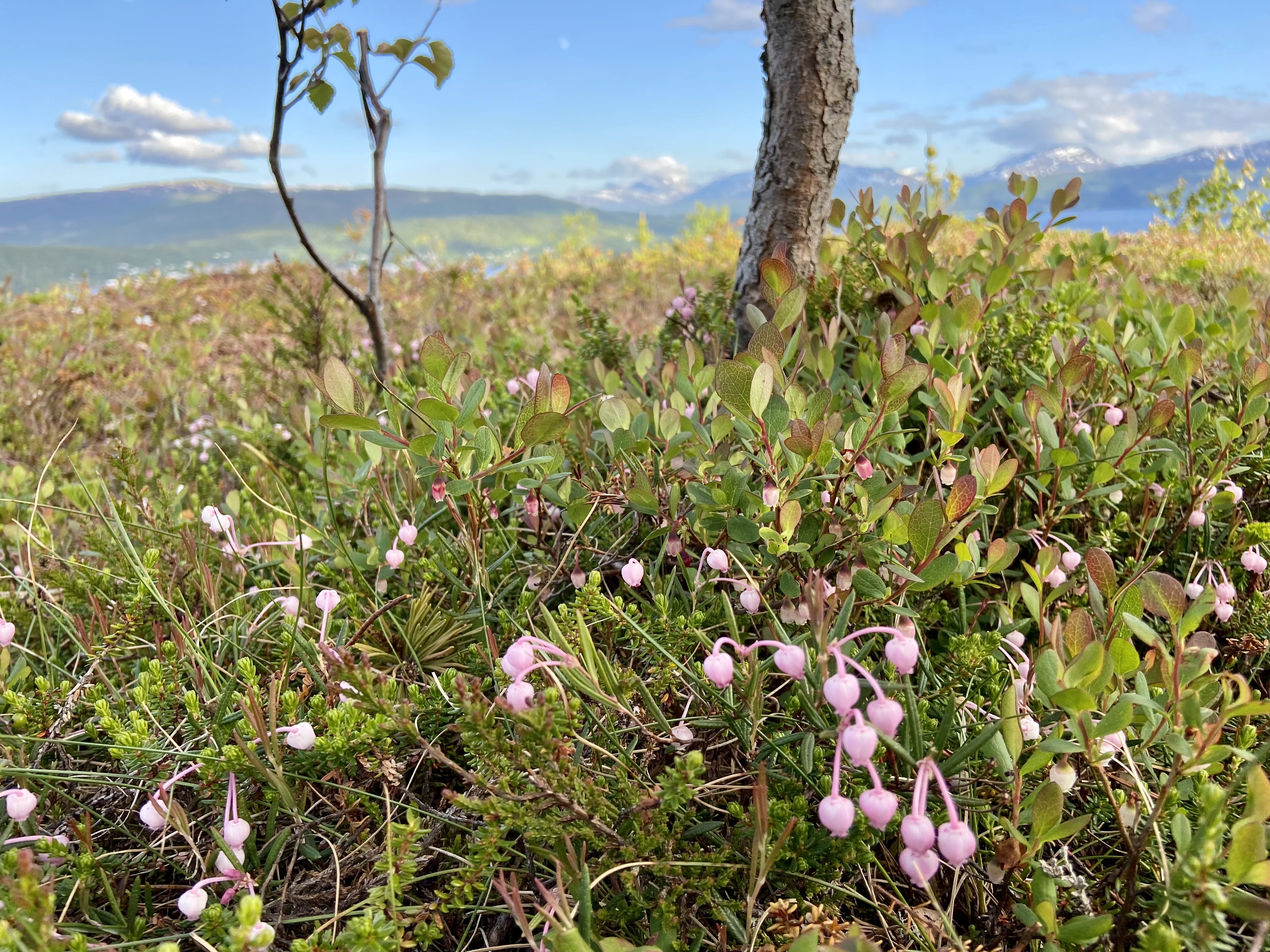
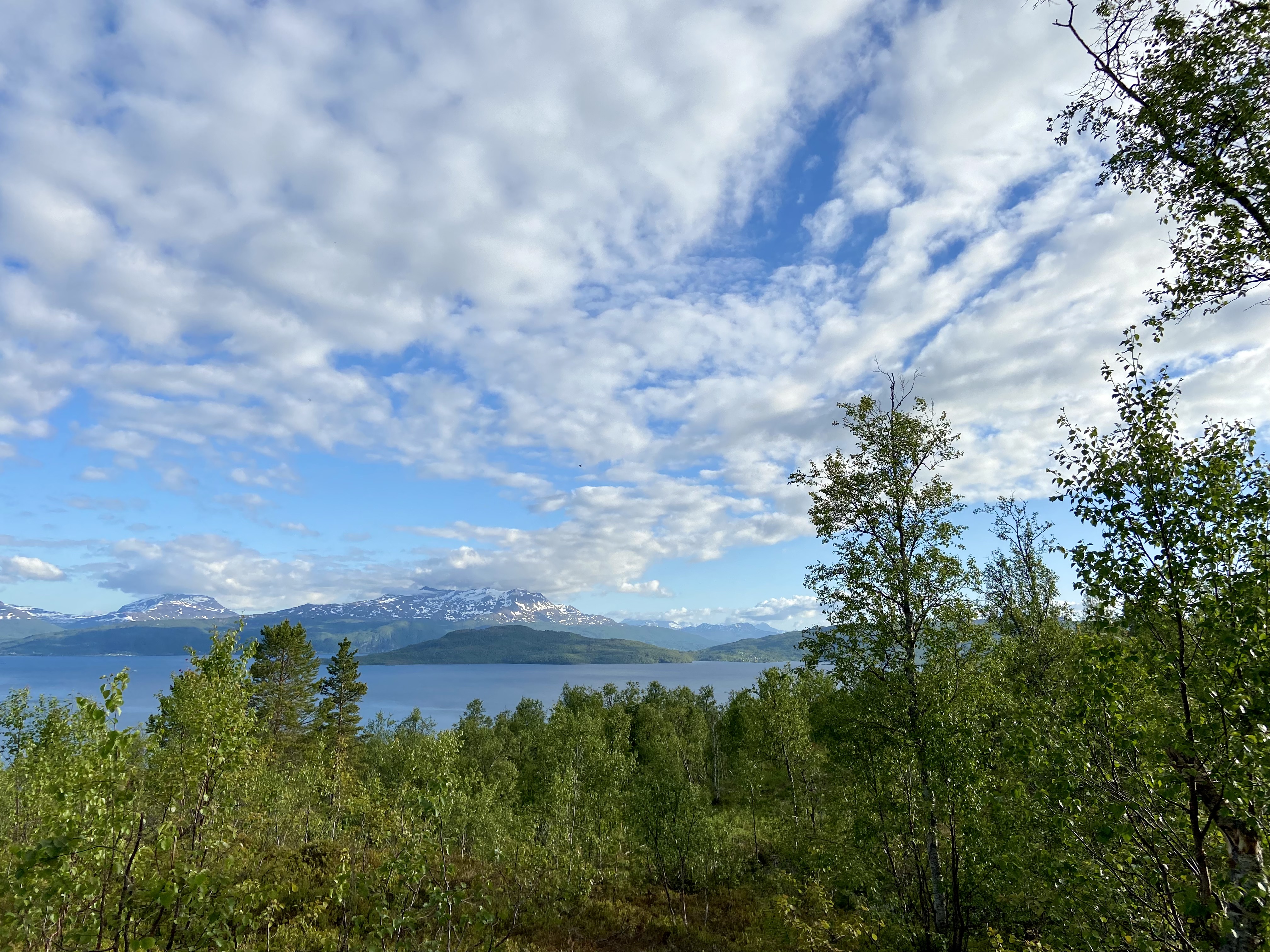
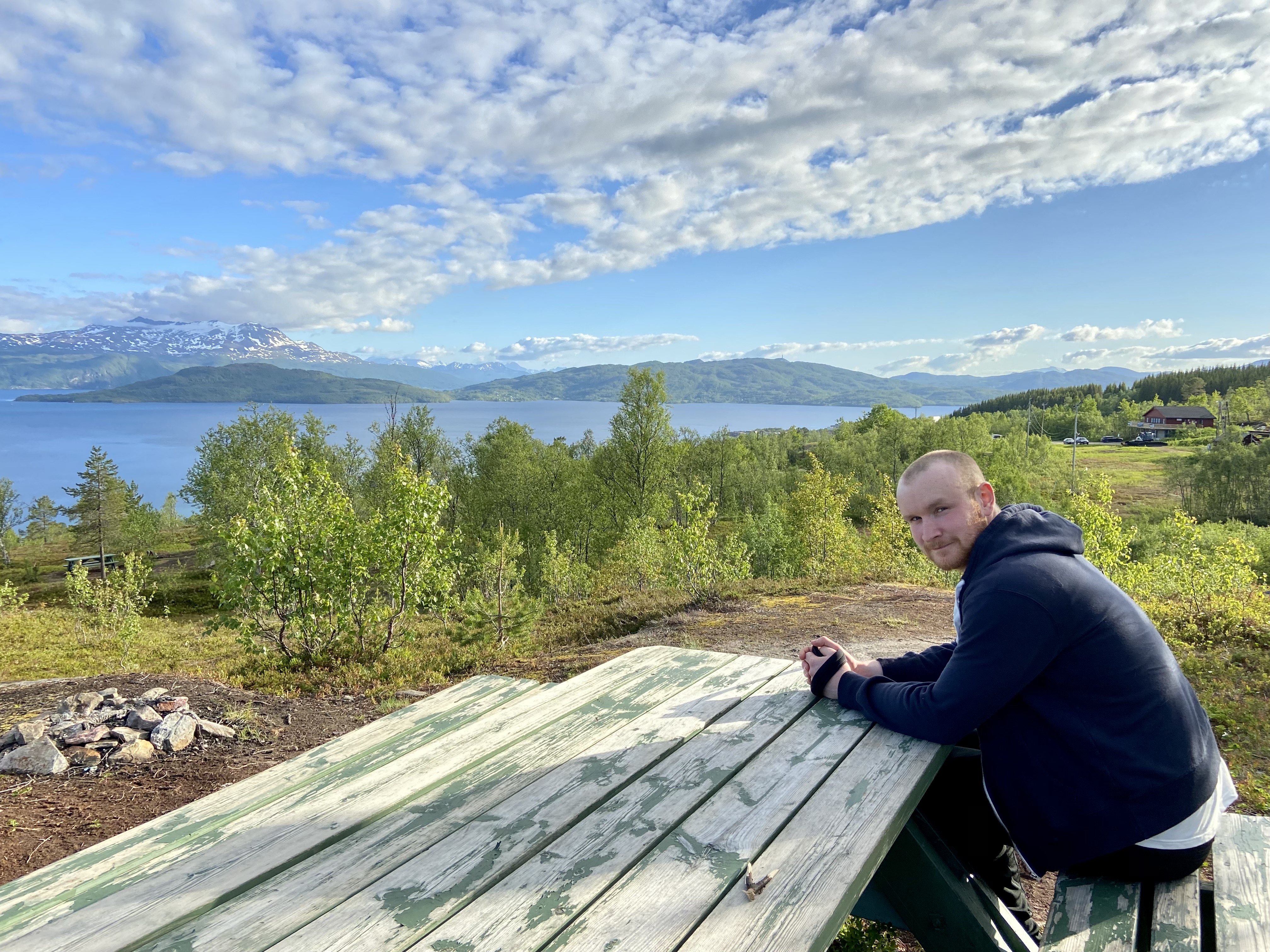
I took Anna and Andrew to the airport on Monday morning. They will be away for another week and a half, staying with Charlie down in the more southern regions of Norway. John and I have spent more time together. As well as the visit to Roasters, we spent some time exploring the southern end of Senja and have also taken a couple of walks up around the local ski area, which looks very different without snow. I haven’t much by way of commentary. There must be bloggers who can tell you all the names of the flowers and the mountains, but I am happy for now just to gaze and wonder… and share the photographs with you in blissful ignorance.
I’ll start with the ski slope. It’s small, I believe: just one tow. Next winter, I hope that Andrew and I will get season tickets, but for now, it’s open for hiking. Triar was with us, of course. When is he not?
While Anna and Andrew are away, John and I are hoping to get a night or two away camping. Weather permitting, I still hope to take a midnight hike up one of the easier hills on Senja. We found a possible campsite as we were driving down to Roasters. It’s down by the edge of the fjord, by the side of a river. Wild camping is allowed in Norway, so we hope to make our base here.
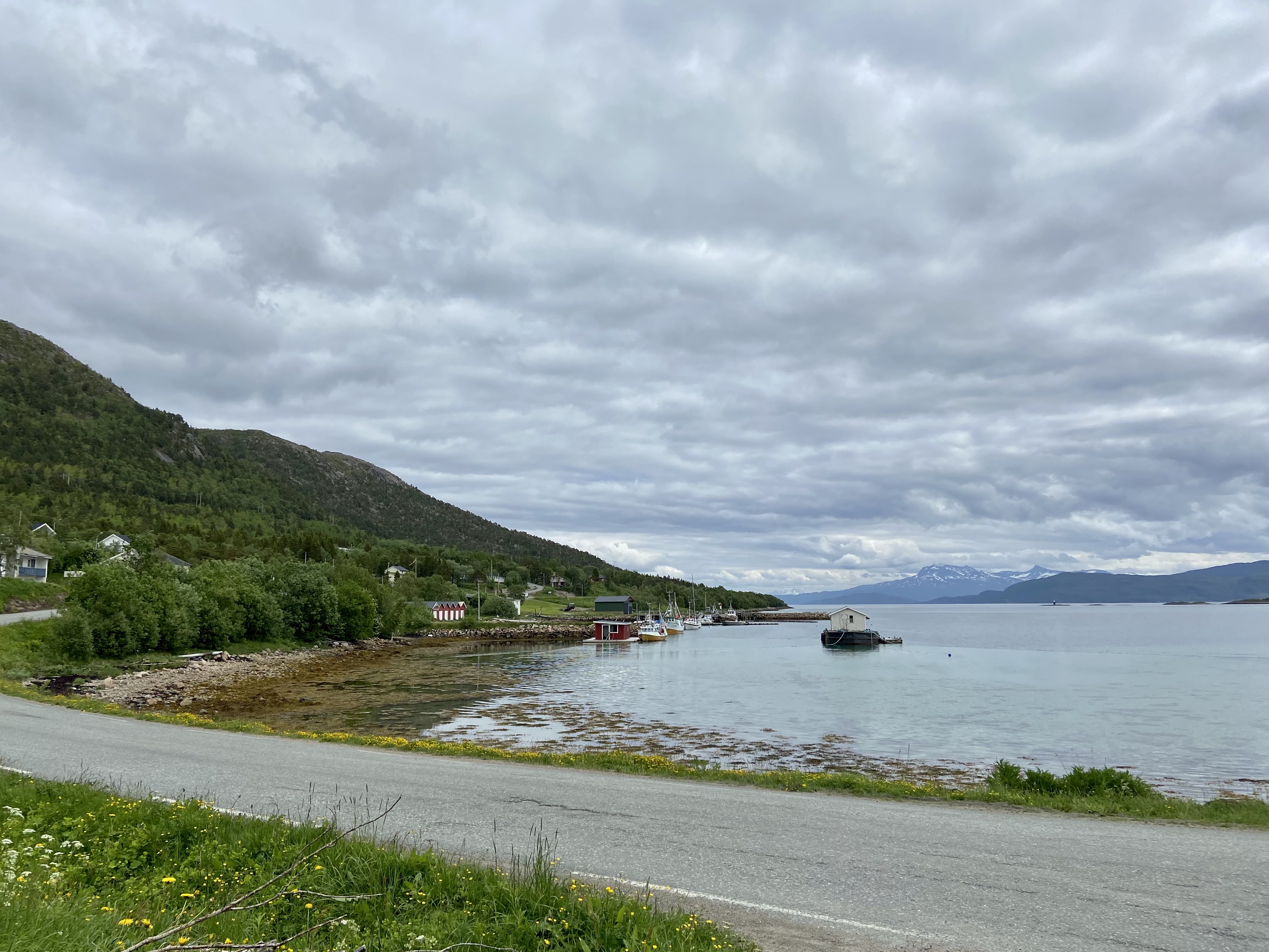
John, Triar and I also went for a wander around Stonglandseidet and back to the beach where Thomas and I were taken on our reindeer hunt.
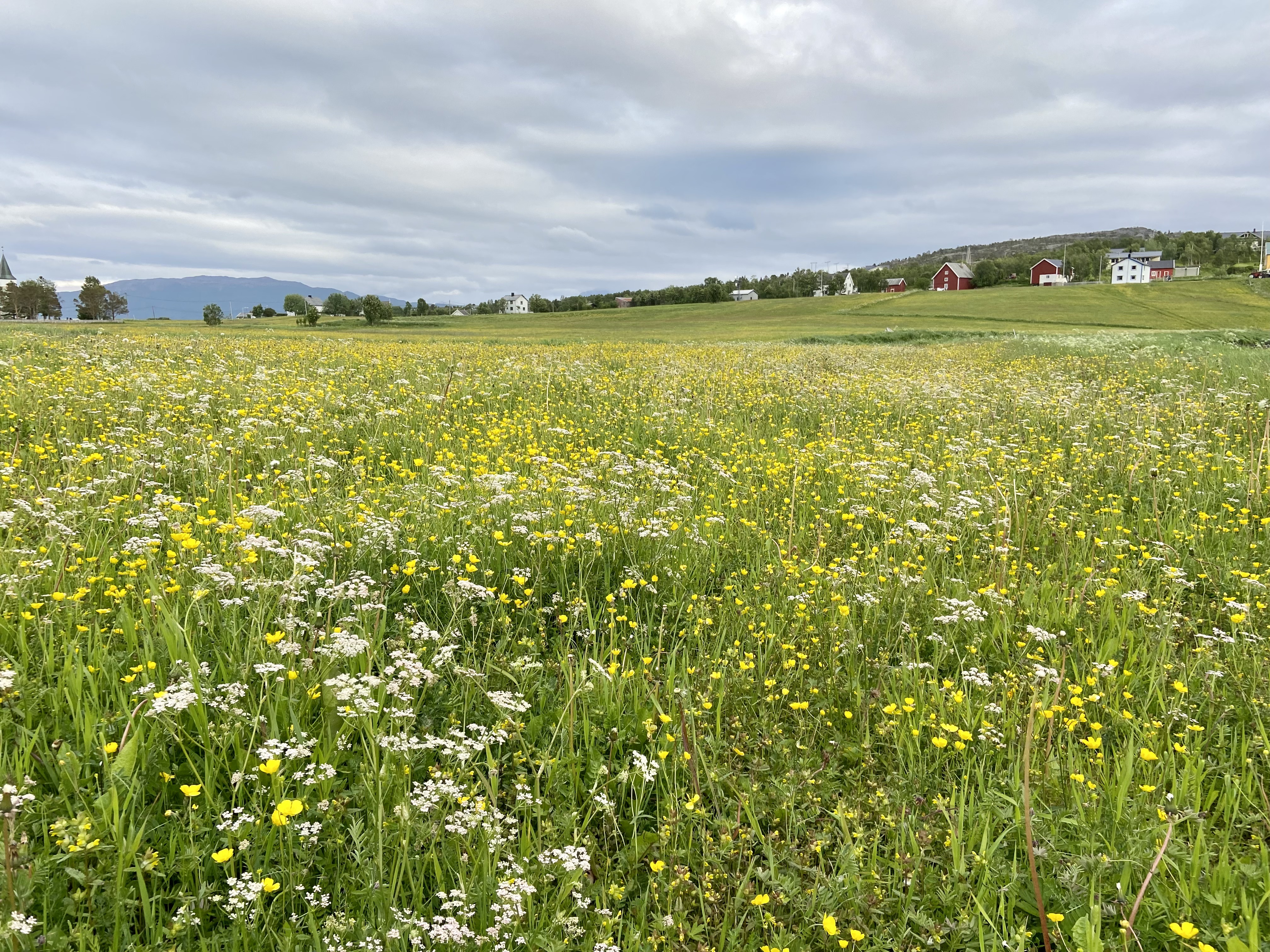
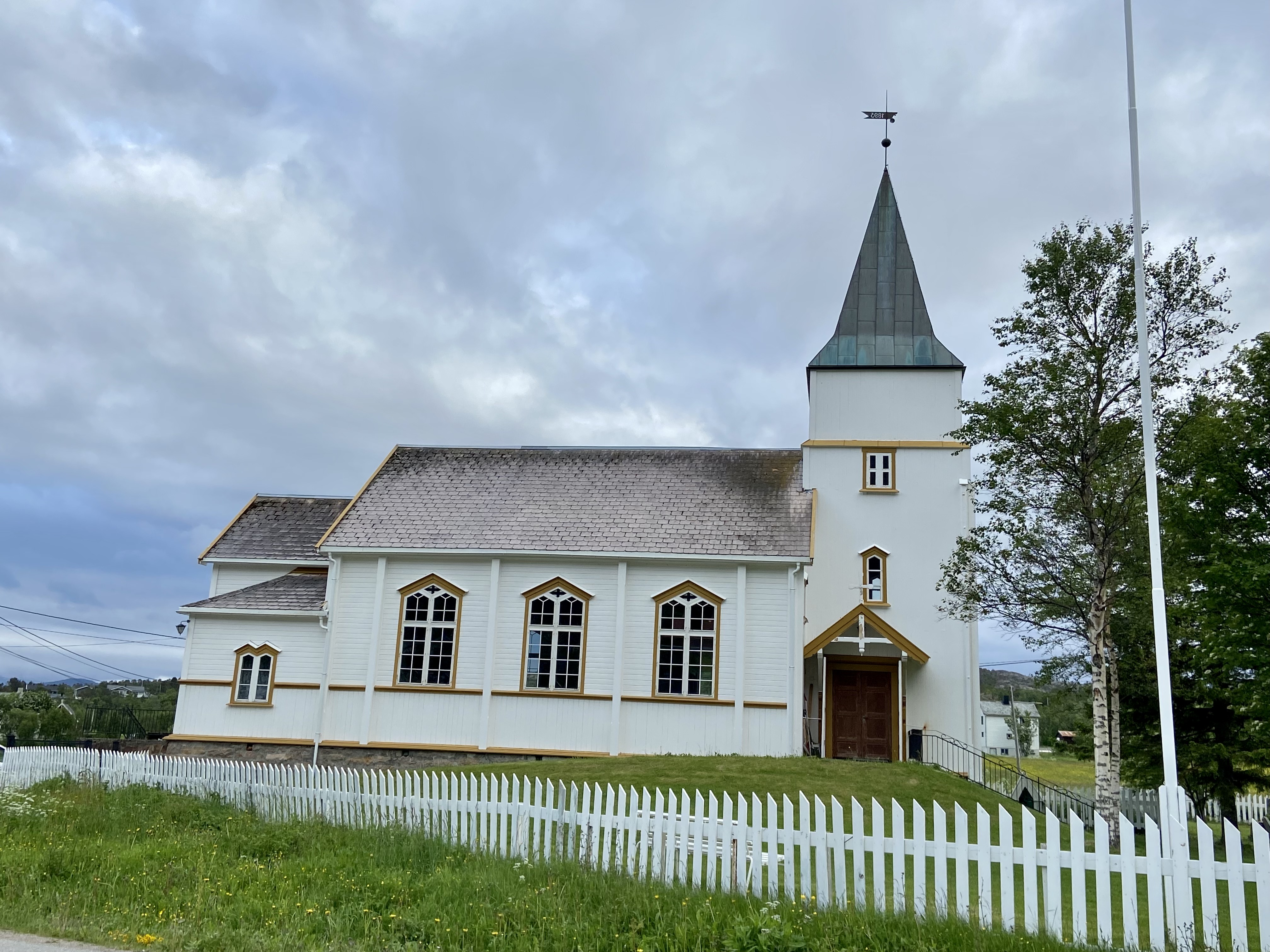
Stonglandseidet has a lovely church. It’s spread out around flower meadows, between two stony bays with a mountainous backdrop.
After a short stroll there, we went back to the beach, which is also surrounded by velvety meadows and grass verges, stippled with flowers.
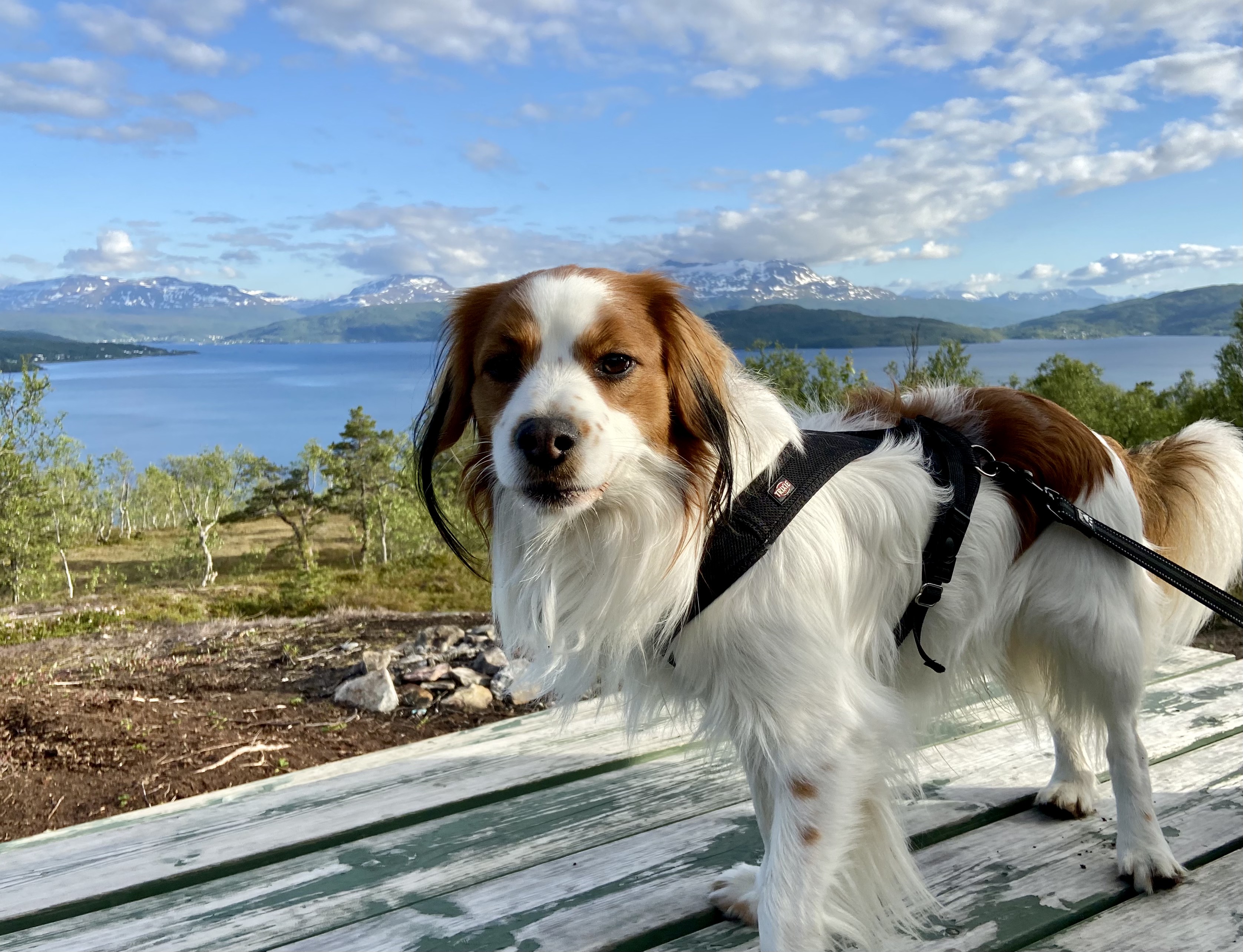
And finally, this is possibly the happiest photograph of Triar I’ve taken. He really brings a huge amount of cheer into my life.
In many ways, living here in the north of Norway, it’s easy to get complacent about coronavirus. The Norwegian government has stipulated that nobody should go to work or school with a cold, or any symptoms of a respiratory illness. Some people take this seriously. Quite a few ignore it. A colleague of John’s announced last week at work that he had a cold. John came over on Saturday to stay for the weekend, but by the evening, he had developed a sore throat. I took him for a test on Sunday, then very sadly took him home. Andrew is entering exam time and the last thing he needs is to have to stay at home because of the coronavirus rules.
It is frustrating when there are rules and people ignore them. And here in Norway, there isn’t anything like the pressure for presenteeism that exists in the UK. I was amazed years ago, when working at Tu Clinic, to find that if one of the vets had a cold, they would stay home and the receptionist would ring round the clients and rearrange the appointments for another day. Back in the UK, it was an unwritten rule in all the practices I worked in that unless you were actively vomiting or unable to get out of bed, you should drag yourself into work. If you did take a sick day, nobody would ring any clients. The other vets were expected to manage.
It wasn’t coronavirus, happily. It is easy to get complacent, living up here in isolation. I no longer feel the fear I did when I was further south and living in an area where many people travelled because of the oil industry. But there is currently a significant outbreak of British variant COVID in Hammerfest, which is about as out-of-the-way as it gets. It’s a reminder that nowhere is completely safe.
Having said all that, it was a pleasure to attend a real-life meeting in Tromsø on Tuesday this week. It was a training session for Dyrevernsnemnda, who are a group of lay people with an interest in and knowledge of animal husbandry. They work alongside the veterinary surgeons on welfare cases, providing a different perspective and improving balance in decision making. For me, it was a very useful meeting. Those working for Dyrevernsnemda come out on inspections with us and so the information was a whizz through of the laws and practices that govern us. It was very well presented.
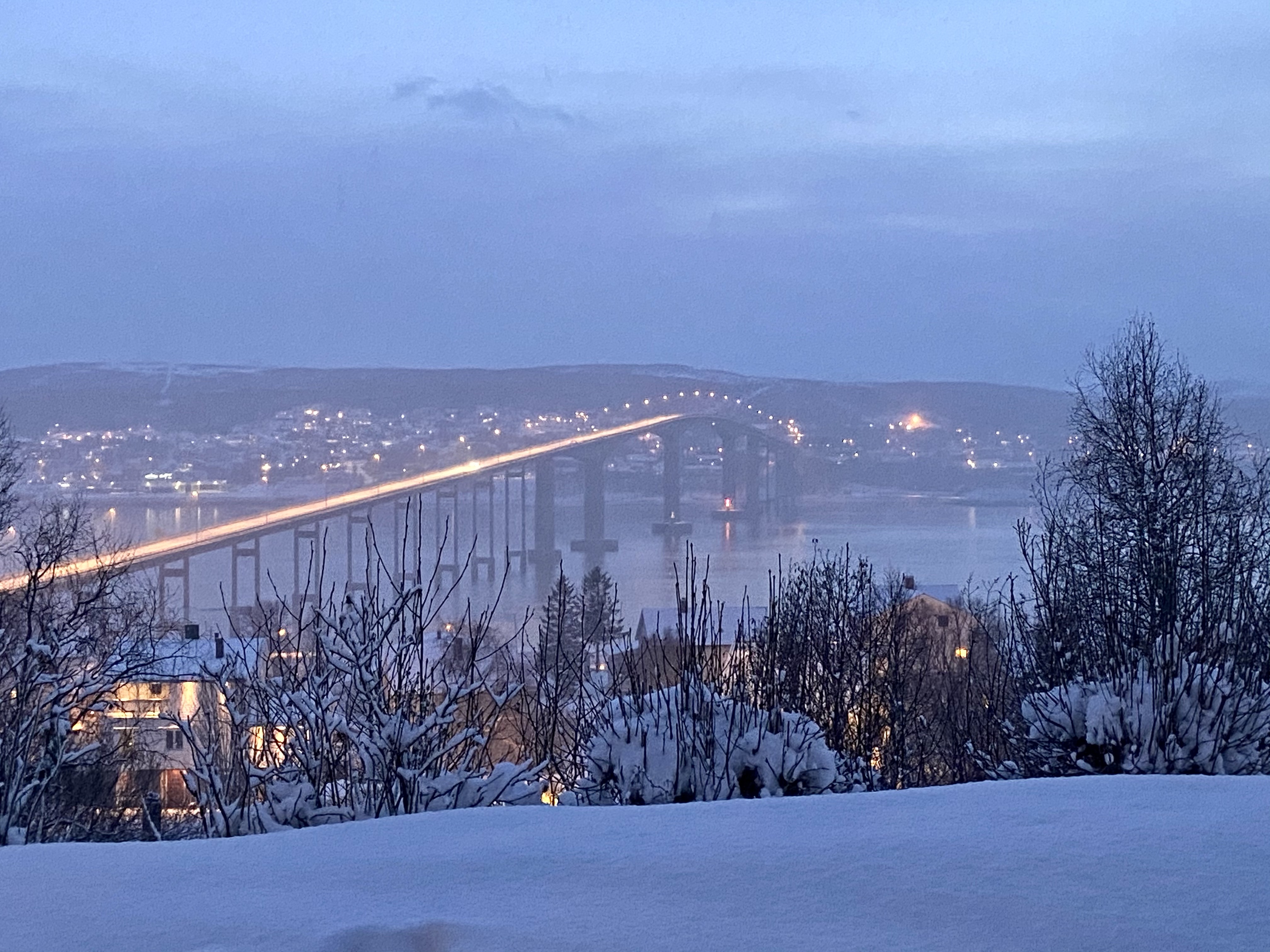
It was also lovely to travel to Tromsø. Though it’s only two hours away, I have only been once before on an emergency mission to find a companion guinea pig. Another reminder that we are not living in normal times. I drove up with Thomas. Tromsø is on an island and we entered the city over this bridge.
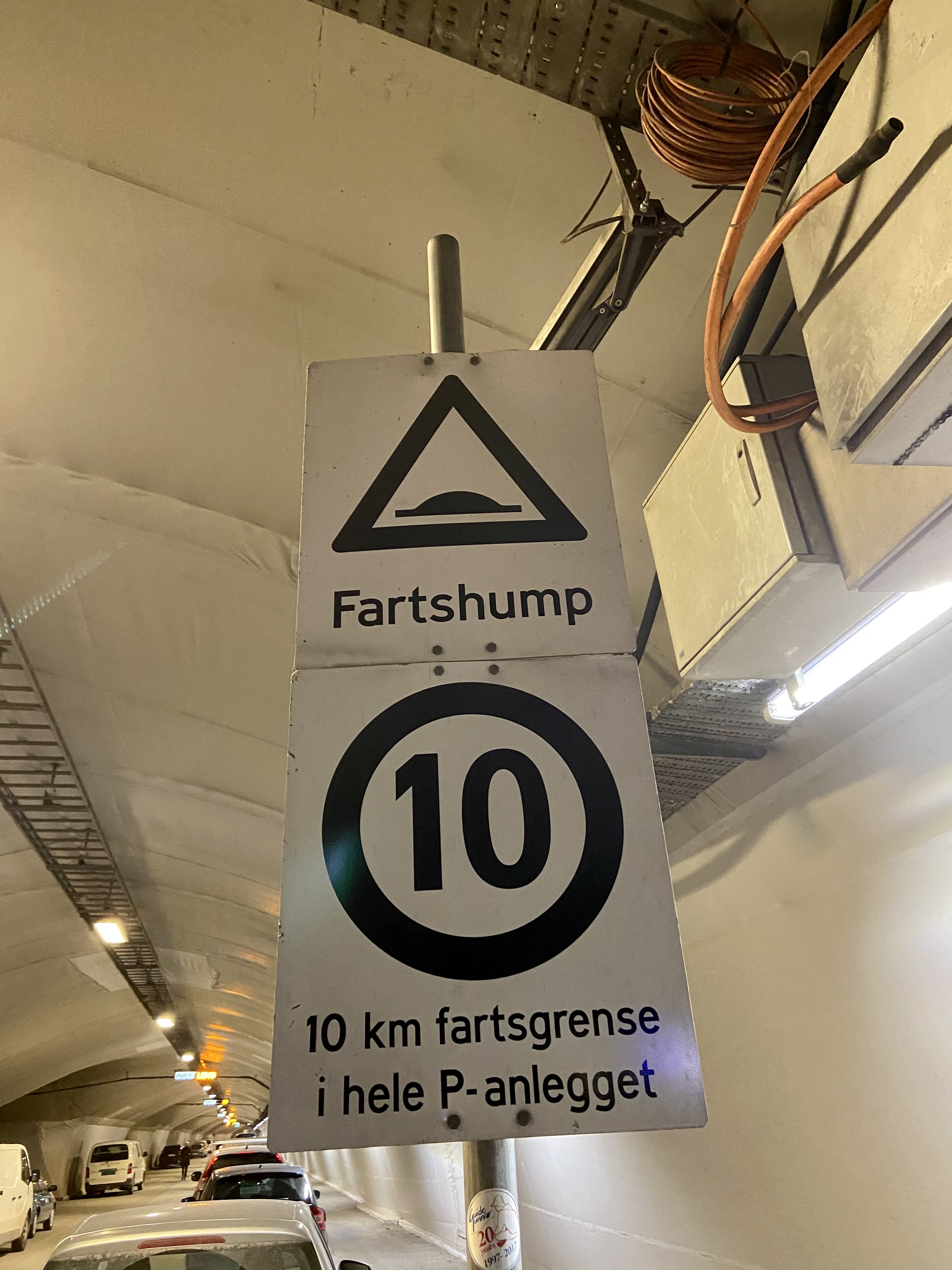
I was glad that Thomas knew his way around. The city is on a hill and he pulled into a car park built into it. I was surprised to find a row of arches cut into the rock and lined with some kind of material. After the meeting, when we returned, I was even more amazed when I discovered the car-park was connected to the tunnel system that runs under the city. Norwegians are very skilled at building tunnels, but it still fascinates me when there are miles of roads underground, with junctions and roundabouts. I was also pleased to find a speed-bump sign in Norwegian. Obviously my sense of humour is very basic!
Wednesday was lovely. I travelled up to Laksvatn with Ammar to blood test some goats and we have arranged to do some more next week. I love going out to farms and doing practical work. There is none of the pressure that exists with the welfare side of the job and it is a lovely reminder of the time when I was working as a farm vet, which was what I always wanted to do. I gave it up after having children because the lifestyle doesn’t fit easily with family life when both parents are vets. I thought about returning to it last year, but didn’t feel certain I could manage calvings and some of the other more physical work now. Odd how life turns out.
Speaking of goats, we received an interesting e-mail this week. A couple from Germany, or perhaps the Netherlands have been travelling in Sweden. They have been hillwalking, which would be all very well, except for the fact that they have taken their pet goat with them. They’ve been seen out and about with the goat on a lead and it is rumoured they might be heading to Norway. I’m not sure what the rules are in Sweden, but in Norway there are very strict rules attached to importing animals. It’s one thing taking your dog with its passport, but the idea of roaming around Europe with a tame goat is something I found amusing.
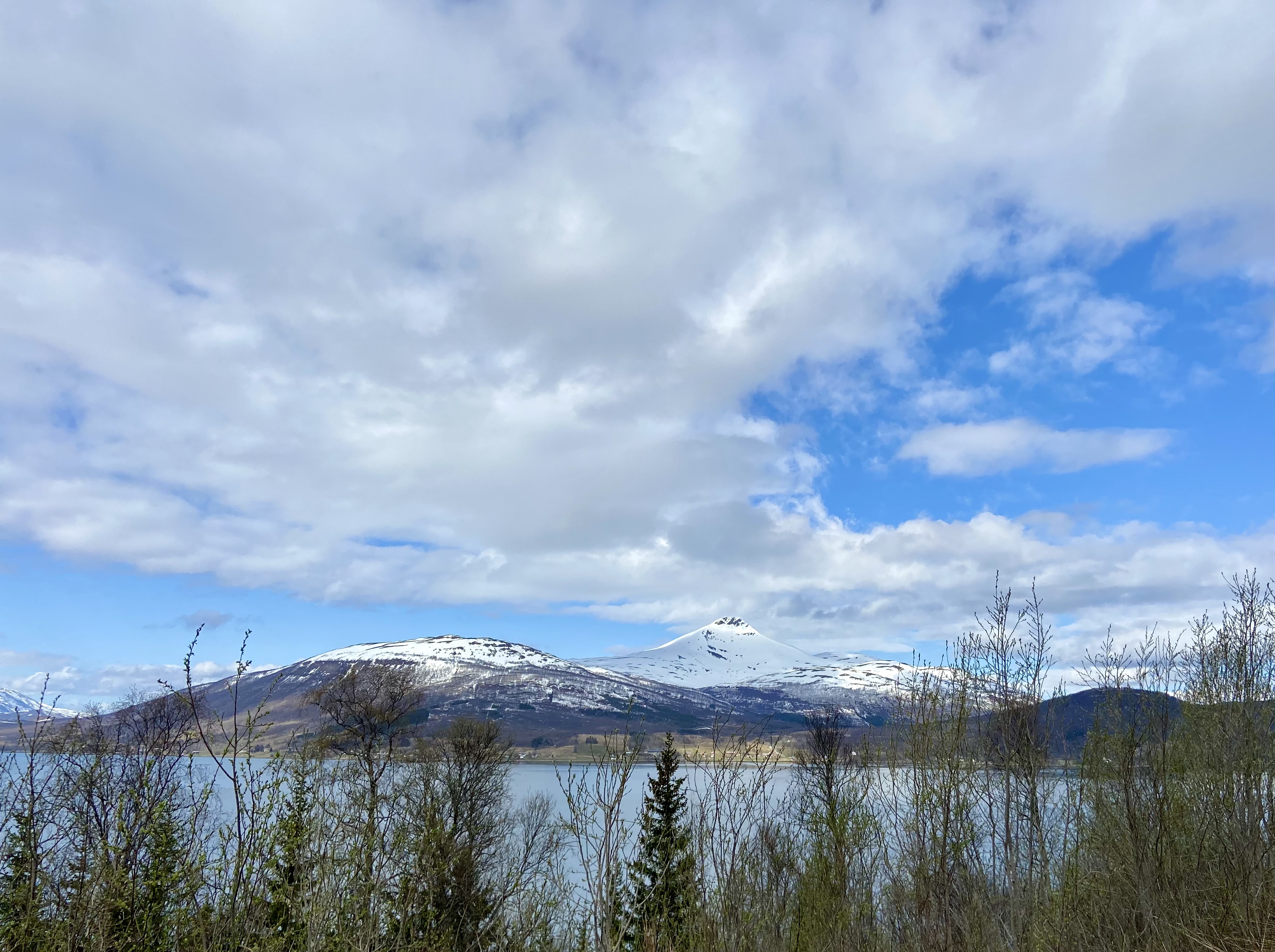
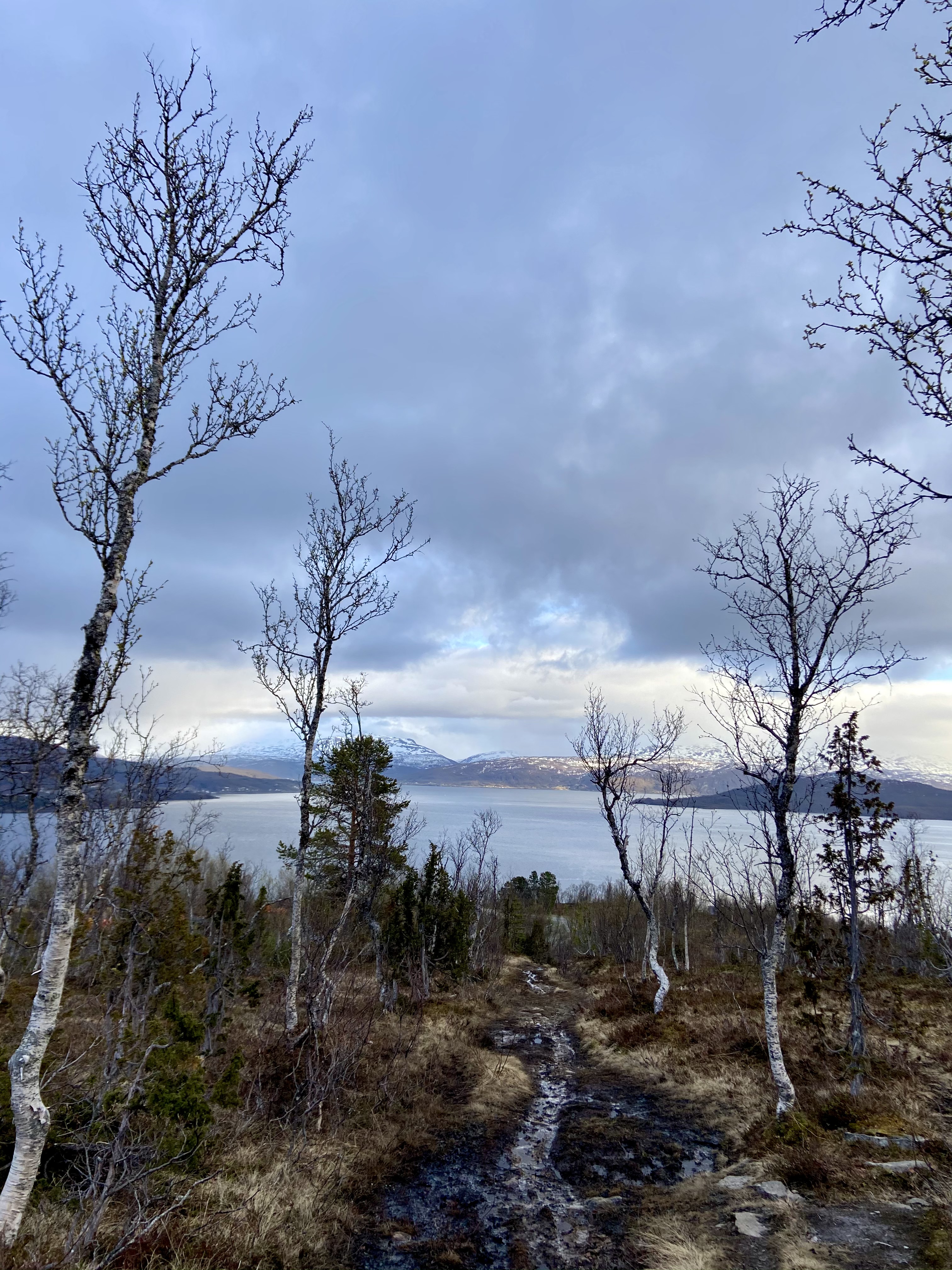
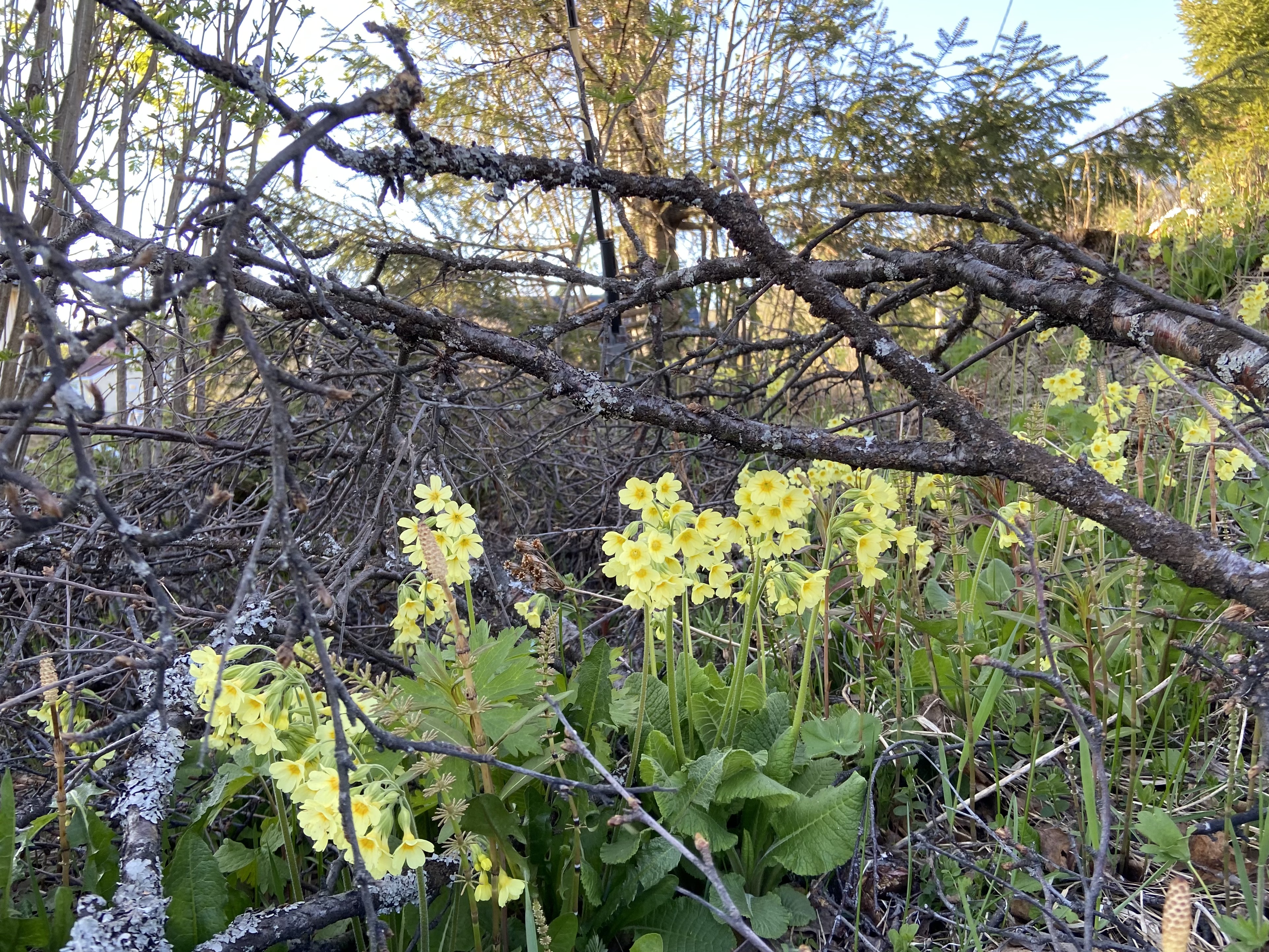
I’ll finish off with a few photographs I took while continuing my walking program this week. More spring flowers are pushing through the ground and this week, cowslips seem to have taken over from the coltsfoot. Now it’s summer, more people are flying flags. It’s quite common for Norwegians to have a flag pole of some sort. There are strict rules around flying the Norwegian flag. If you put it up, you are supposed to take it down again at nightfall. Perhaps the Norwegian flag doesn’t like to be darked on. Presumably up here, in summer, you could leave the flag up all day because it doesn’t actually get dark, but it still seems to be common to fly a wimple, which has the Norwegian colours, but isn’t technically a flag that needs to be taken up and down. And although it’s very spring like, as you can see in the picture at the top of the page, and the one below, there are still lots of places where the trees have no leaves. Have a lovely weekend everybody.
Only another three days and we will reach the point where the sun officially doesn’t drop below the horizon until 24th July. I know now that there will be a delay due to the height of the surrounding mountains. For a few days, it will continue to sink behind them, but after that, on sunny days, we should be able to see the midnight sun.
John told me yesterday about a conversation with a friend. John was trying to express how it felt to see the sun again after the polar night. Although it never reached the point of being dark 24/7 there was an ethereal quality to the light and for a month and a half, there were no shadows, even when the sky was clear. The return of the sun felt like a catharsis. John tells me his friend commented that you have to appreciate the small things, but up here, it didn’t feel small at all.
I feel a bit the same now we are waiting for spring. It’s a long time coming. I’m not sure what I was expecting. After all, I lived in a more southern part of Norway for ten years and spring didn’t arrive until May even there, but with the long daylight hours, it feels strange that things are not further forward. I find myself searching for signs and they are appearing.
All around I hear water running where in winter there was frozen silence. Where there is a rise in the forest floor or a slope that faces the sun, there is a noticeable green tinge. Yellow flowers that look like a cross between daisies and dandelions are pushing through the dirt that has been deposited on the roadsides from five months of snow clearing.
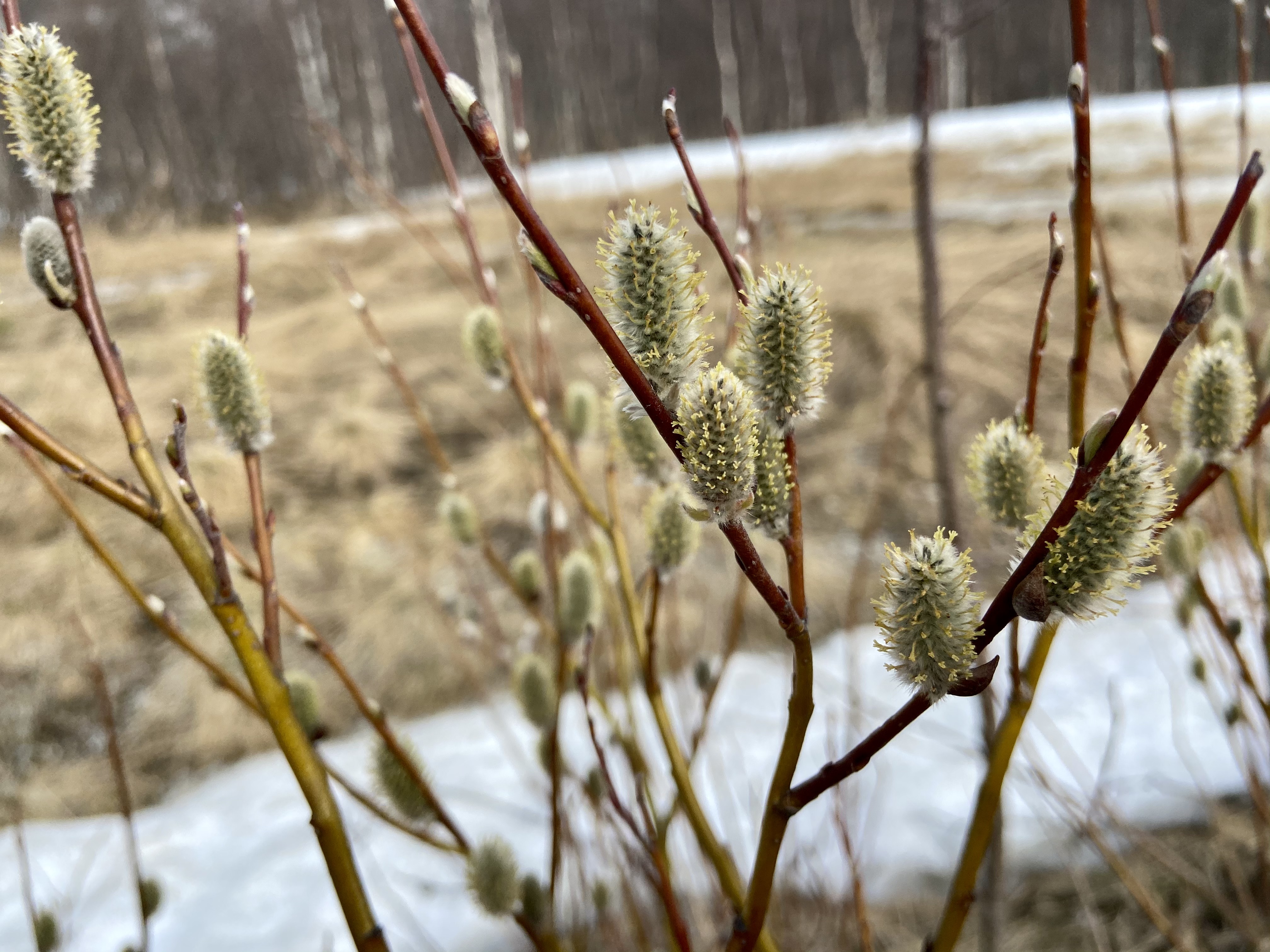
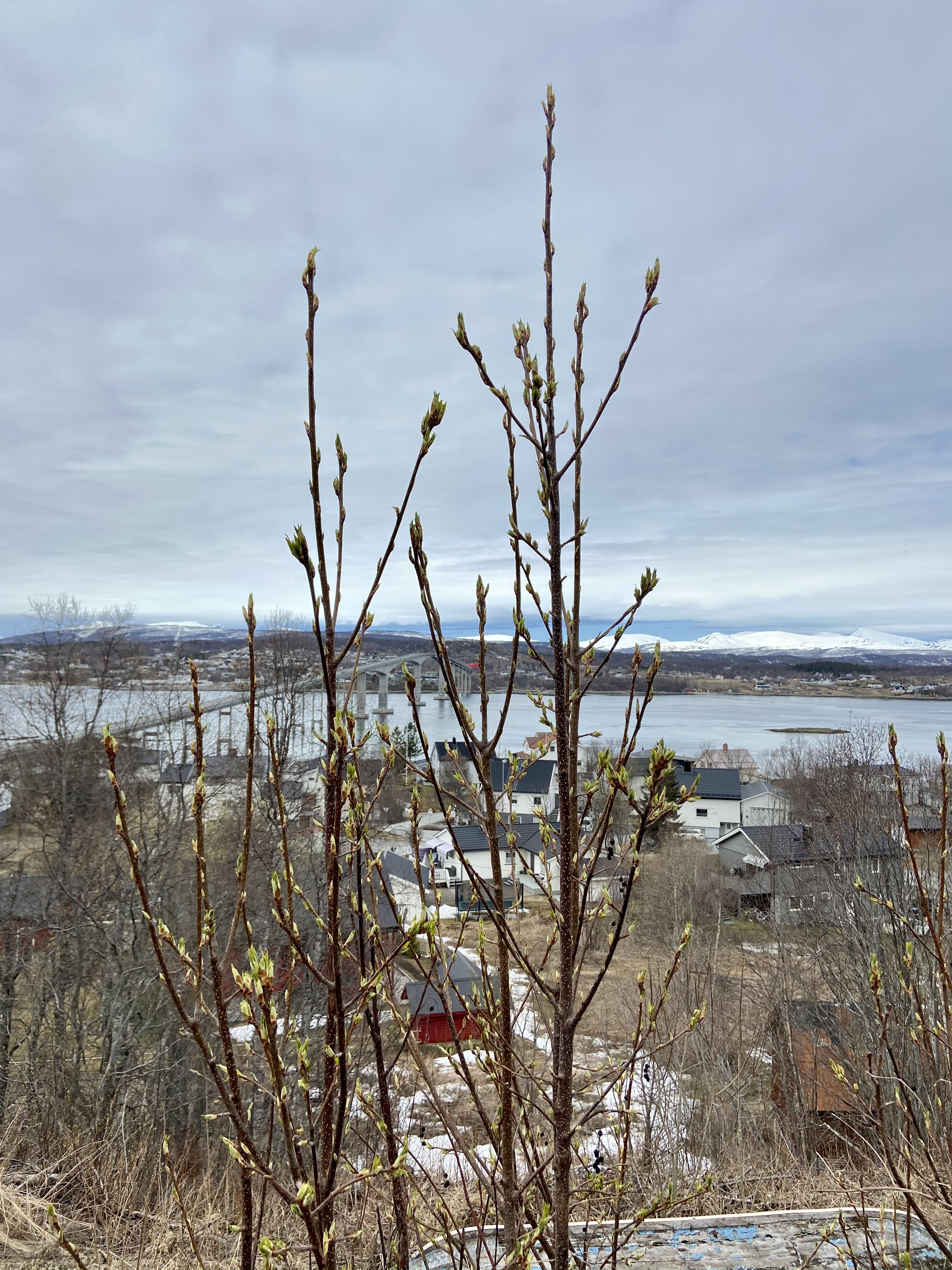
Two days ago, one of the small trees behind the house sprung new leaf buds. I trust that the others will not be far behind. There are a lot of deciduous trees here. The lower slopes of the mountains are swathed in forests and many of them still look black. Surely the change must come soon. I find myself hoping that the lower slopes will be green while the upper slopes are still swathed in snow.
Elsewhere, it seems like winter still has a hold, albeit one that is weakening. Lakes are still frozen, the forests are still filled with snow.
I remember John commenting in August last year that winter never really leaves here. Instead it retreats up into the shadowy corners of the mountains. But that will do for me. Tomorrow is May 17th, which is Norway’s national day. We will be going down into the centre of town to see the children march. As is traditional here, we will be feasting on Norway’s national dish: hot dogs. I hope the sun will be shining for us all.
I drove home from Storslett on Friday last week, but not before taking a photograph of fish hanging outside to dry. Birgit and I were inspecting a goat herd and another flock of sheep, and on the way I finally spotted some racks that were in use. Norwegian stockfish is dried cod, usually of the prime seasonal Arctic variety that is called skrei. It hangs outside between February and May and has been a traditional foodstuff and an export since Viking times. It is the main ingredient in the Italian dish Bacalao. John and I saw much bigger drying racks last summer as we drove through Lofoten, but as that was in August, there were no fish back then. So having spotted these on the way, I asked Birgit to stop on the way back and I ran along the road, hopped over the barrier and staggered down a grassy bank to get a picture.
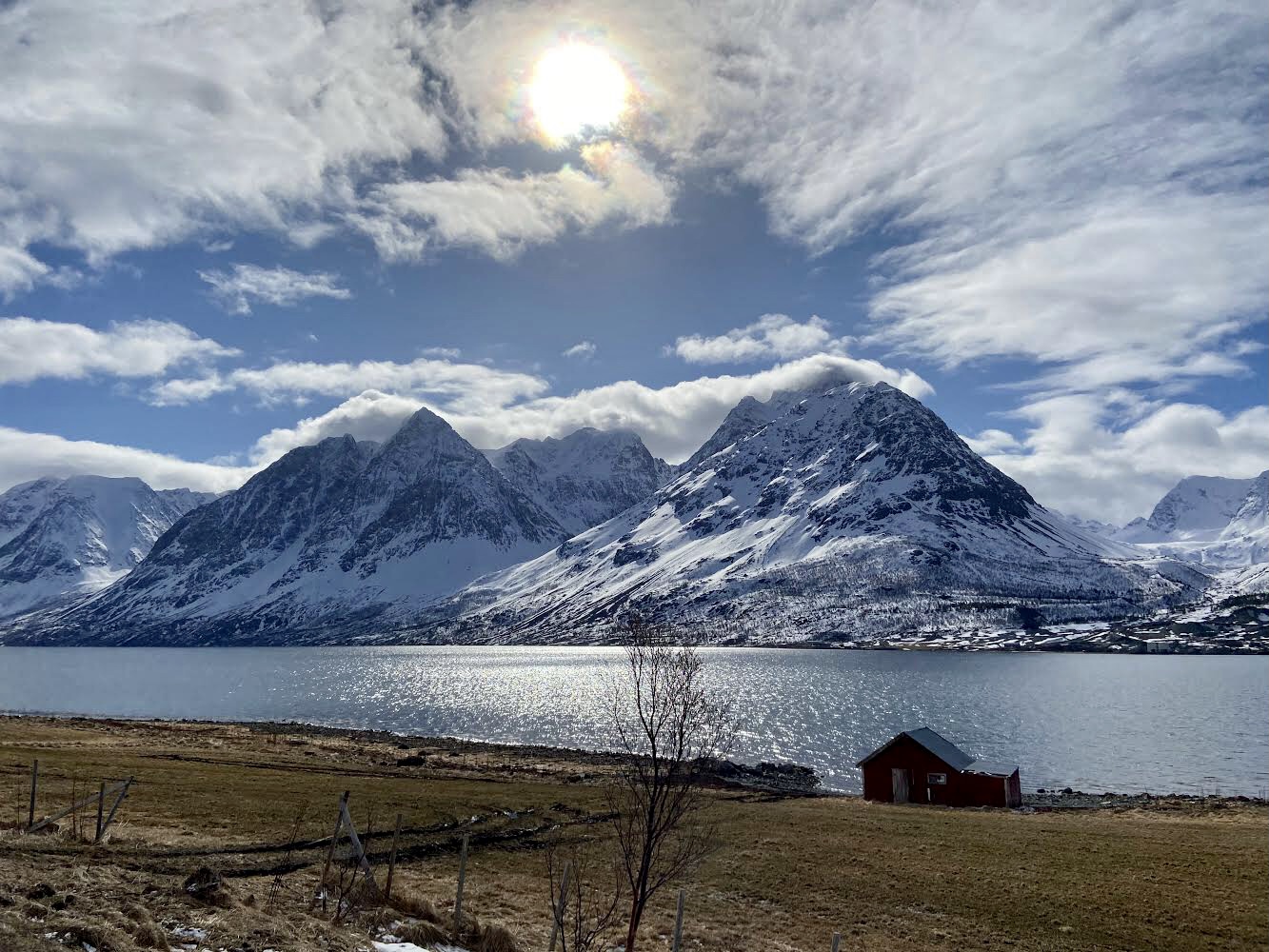
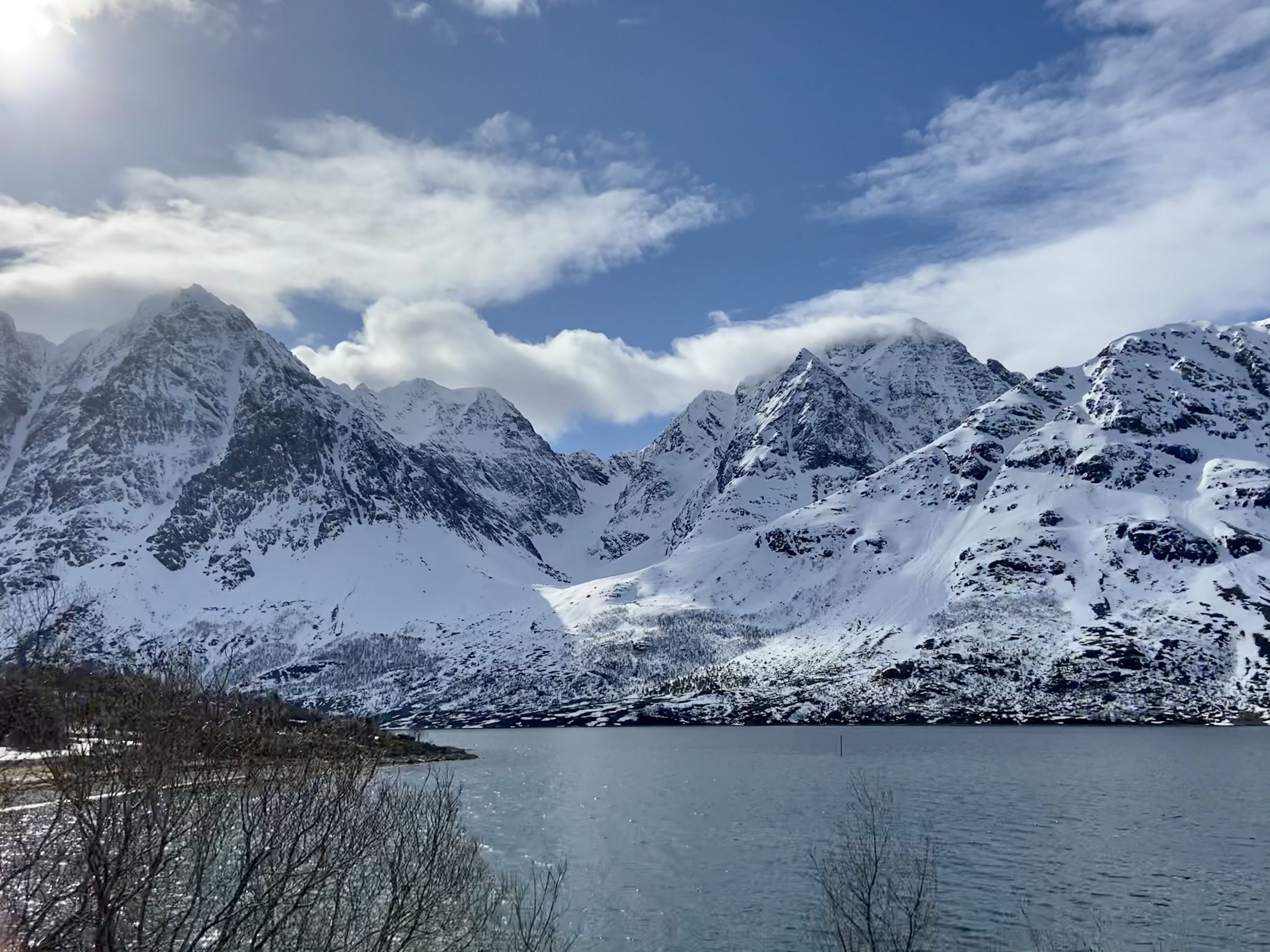
I took a couple of photos of the mountains as well. It is such a beautiful area and the mountain tops were decked with fluffy white clouds.
By the time I got home, the false spring weather had disappeared. Anna and I went for a walk on Senja on Saturday. There were a couple of reindeer standing in a field and we stopped to take a rather distant photo. Though the grass isn’t growing vigorously yet, I have seen other reindeer taking advantage of the temporarily uncovered pastures this week while driving around.
One of our favourite walks starts beside a school and Anna spotted some skis standing in a rack on the side of the building, so I took some pictures of them and the bike rack that is currently not in use. Outdoor living and exercise is very much encouraged and embraced here, whatever the weather.
On Tuesday I worked the early shift at the abattoir. It’s much easier driving over at 5am now it’s light. It was a particularly beautiful sunrise on Tuesday and I paused on the empty road to take a picture.
On Wednesday, with Birgit’s (long distance) help, I finished the course work and the report for the inspections I mentioned in Across the Lyngen Fjord. On Thursday morning there was a summing up meeting. On Thursday afternoon, having finished my homework for the week, I was free to turn my attention to my e-mails. Most of my e-mails contain information about meetings or outbreaks of controlled diseases, but now and then I am sent fascinating updates on the complicated interplay between large predators and domesticated and semi-domesticated animals in Norway.
In the past fifty years, there has been a movement from culling to preservation of species such as bears, wolverine, lynx, wolves and golden eagles. Wonderful as that is, it does have an impact and the Norwegian government have to work with farmers and herders to try to ensure balance.
Most of the domesticated animals such as sheep and cattle, are kept on pastures near to a farm. If they are moved, they go in lorries. Though some sheep (and especially lambs) are taken by predators, in general it is possible to keep the protected predator wildlife areas and farming regions separate. But the situation is much more complicated when it comes to reindeer.
Reindeer herding in Norway is carried out by Sami people using a mixture of traditional and modern methods. The reindeer are semi-domesticated: they are not fenced in, but are moved around to different pastures, depending on the season, food availability and the weather. Unfortunately, some of the important grazing areas, that have been used for thousands of years, overlap with some of the priority areas where there are targets set for these predatory animals.
The political situation is particularly difficult as there continues to be a lot of tension between the Sami and the Norwegian government. Until relatively recently, strong attempts were made to enforce integration into the more modern Norwegian lifestyle, but the creation of a Sami parliament in 1989 and the recognition of the language and way of life has not removed all conflict. Traditional herding methods are not only affected by predators, but by roadbuilding, property development and even wind farms. The grazing areas are mostly in land that is considered to be “state owned” but if that is land that your people have been using for more than a thousand years, I feel it is unreasonable to expect a full acceptance of that claim of ownership.
Anyway, back to the report. Apparently, lynx, wolverine and golden eagles are the biggest predatory threat to reindeer in Norway. Information from NINA, the Norwegian Institute for Nature Research shows that the wolverine diet is 95% reindeer and lynx 65%. Some of the herders report many of their calves are taken, sometimes up to 75% of the years progeny. And because of the nomadic lifestyle, it is not only direct predation that can be problematic.
In January this year, a herd of up to two hundred reindeer took fright when they were being moved and it was strongly suspected that this was triggered by predators. Instead of travelling safely to their winter pasture, they headed up into the mountains. The terrain was frozen and largely impassable, and of course there was no grazing. A small group of them returned, but without their calves. Eventually a helicopter was arranged so the herders could get an overview and the herd was recovered, but there’s no doubt that these predators, alongside climate change, have a huge impact on traditional ways of life.
Regular readers might also be interested to hear an update on the female bear with a taste for lamb and mutton that I mentioned in the very first blog post I wrote when I started work here (Piece of Cake). It was too late last year to move the mother bear to a different area where there were no sheep. Now they are waiting to see whether the bear is pregnant and/or whether she will emerge from hibernation with yearling cubs.
Though moving her might prove to be a long term (or even impossible) project, other solutions are also sought. One of the farmers who reported the greatest losses has been granted funds to restructure and he will change from farming sheep to beef cattle. The farmers who lose animals are compensated for their losses, but of course the picture isn’t simply one of monetary cost.
One of the focuses of the report was on the animal welfare issues caused by the hunting of domesticated animals by these predators. In general, domesticated animals are kept safe from that type of harm. The idea that living in nature is some kind of idyllic haven for animals is overly simplistic.
I will finish up with a couple of photographs taken yesterday. The days are now very long and light, but after a week or two of rapid melting, the snow has returned. In the middle of the day, when the sun is high, it is so bright as to be almost unbearable. I really must buy some sunglasses! These pictures were taken at seven fifteen in the morning and at eleven forty five in the evening. Twenty four hour sunlight (and hopefully summer) is just around the corner.
Yesterday was another of those gorgeous days of endless blue skies. Birgit and I drove south in the morning sunshine and then took the ferry across Lyngen Fjord.
Our destination was Lyngseidet in Lyngen Kommune. Though it is possible to drive round, it would take several hours. The crossing took about forty minutes and as well as taking photographs, Birgit and I bought drinks from the small cafe on board. I had a slightly surreal moment when I approached the lady behind the counter and she spoke to me in English. Given that I was wearing a Mattilsynet jumper with a Mattilsynet badge hanging from a Mattilsynet lanyard, and was waving a Norwegian credit card, I was slightly taken aback. Perhaps my face looked British, but I didn’t ask so I guess I’ll never know.
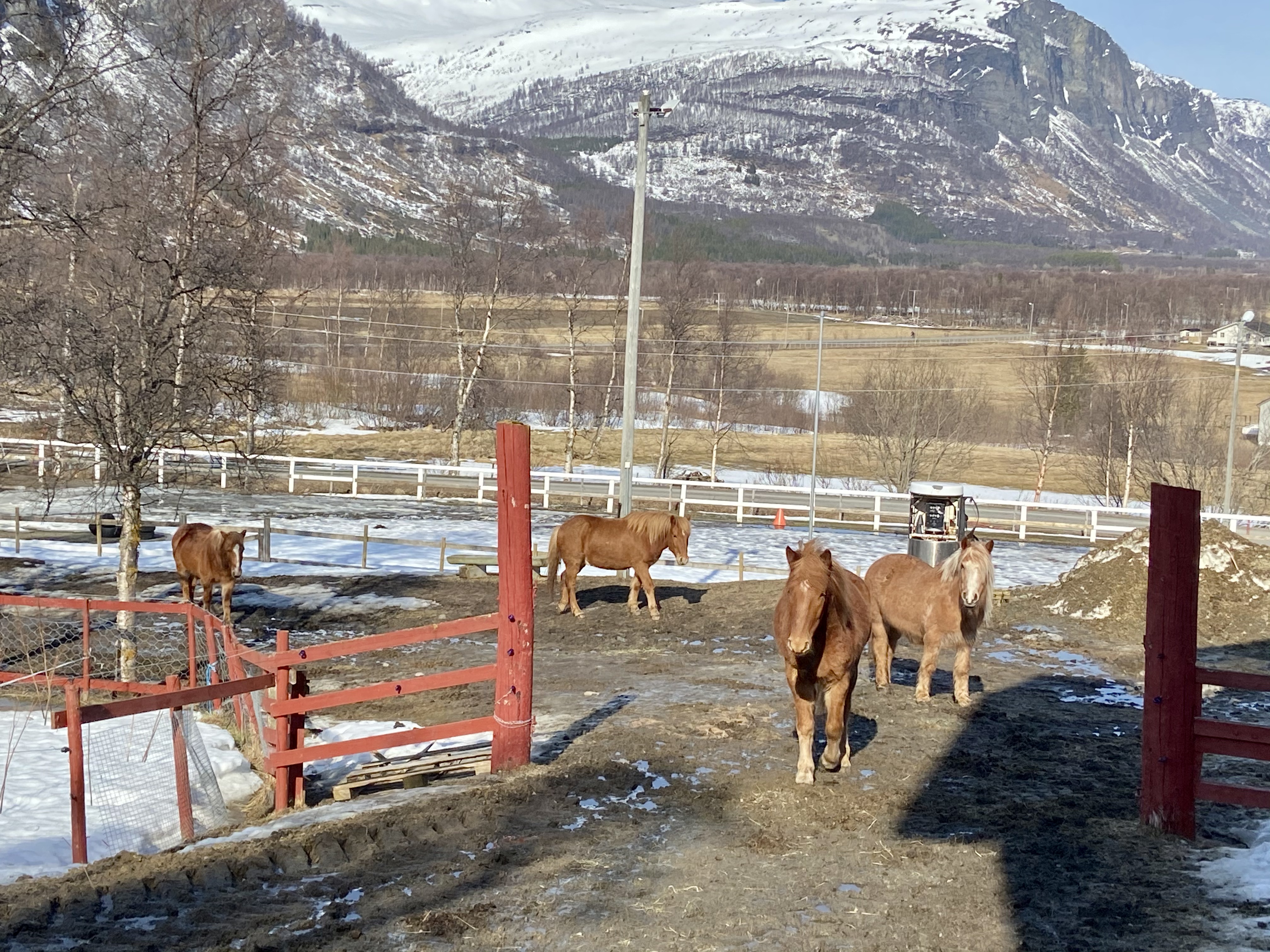
Birgit had planned two visits to blood sample goats, but there were some last minute cancellations and so we visited some sheep farms to check ear tags instead. I am taking a course at the moment on inspections, and so Birgit let me lead both of them. Better still on the first farm, as well as the sheep, the owner had some Lyngshest/Nordlandshest. These wonderful little Norwegian horses are immensely strong and hardy. Most of them are between 12.3 and 13.3 hands (130-140 cm) but Birgit assured me they can easily carry an adult’s weight. She had told me before we arrived about the little horses – she has some herself – and so when we had checked the sheep, I asked the farmer whether we could see them. He led us outside, and to my delight, he called them and they began slowly to walk towards us.
Despite being a little shy at first (he told us they were suspicious that we were vets) very soon we were making friends. Considering the bizarre protective clothing we wear, I think they were surprisingly courageous!
The second visit was great too. The farmer gave us a warm welcome and was very positive about having a visit from Mattilsynet. She seemed rightly proud of her mixed flock, half of them tiny Norsk Villsau (literally Norwegian wild sheep) the other half being the sturdier Norsk Kvit Sau, or White Sheep.
Once we were finished, we headed back to the village where we had landed. After stopping to take a photo of Lynseidet church with its friendly red roof and one of the irresistible mountain behind the Co-Op, we ate lunch outside on a scarlet-painted table beside the fjord. Birgit pointed out the curlews flitting over the water. The arrival of the curlews on their migration to the north means that spring has arrived, she told me. With the warm sun on my face, I could well believe it.
After that it was time for our return journey across the Fjord. As I looked back towards Lyngseidet, I was already making plans in my head to visit again in the summer. It will all look very different in a few weeks time when (most of) the snow has melted.
As we drove around, Birgit told me a bit about the local area. Norway has, of course, a great seafaring tradition. With its long coastline and sheltered fjords, it was the perfect place to create a trading hub. And here in the north, we are also very close to the Finnish, Swedish and Russian borders. She tells me that traders created their own language, which is a mixture of the various languages and dialects, so that they can all understand one another.
I had heard of the Sami before, but not of the Kven people. Descendants of Finns who moved to Norway in the 18th and 19th centuries, they too have their own language. So just as in Scotland, where many road sign have Gaelic alongside the English spelling and in Wales where Welsh names are shown, up here there are road signs with three different languages: Norwegian, Sami and Kvensk.
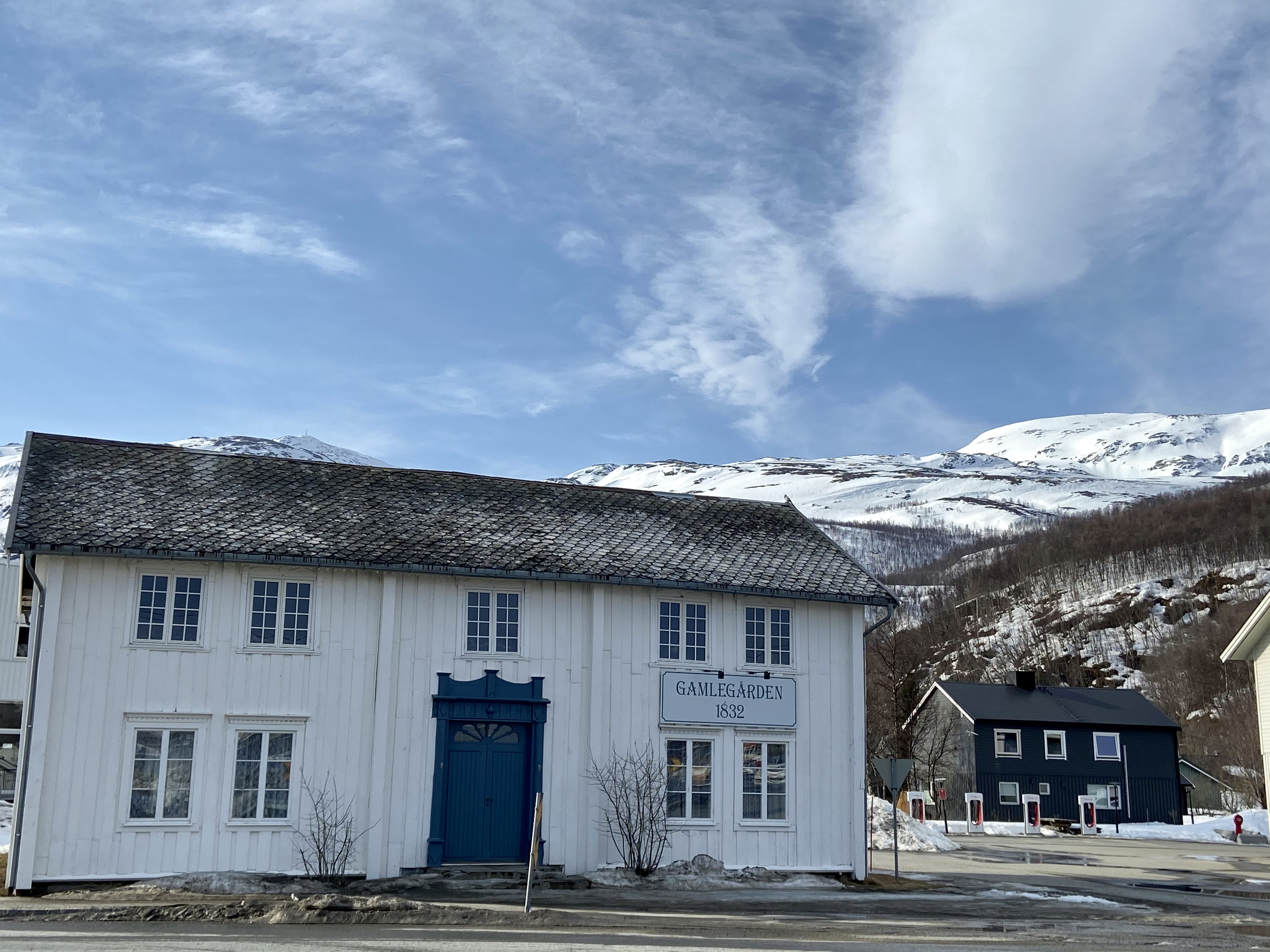
As we arrived back in Sørkjosen where I am staying, Birgit told me that the building opposite my hotel was one of the few in the area that was not burned down by the Germans as they retreated towards the end of the second world war. I had taken a picture of it in the morning as it was a beautiful old building.
And so, with all the new information whirling in my head, I stopped for a moment to look at the boats that were safely tide up in the harbour. Despite the desperate thought of past destruction, so far I have found nothing but peace and happiness here in Nordreisa.


















































 A Vet’s Life