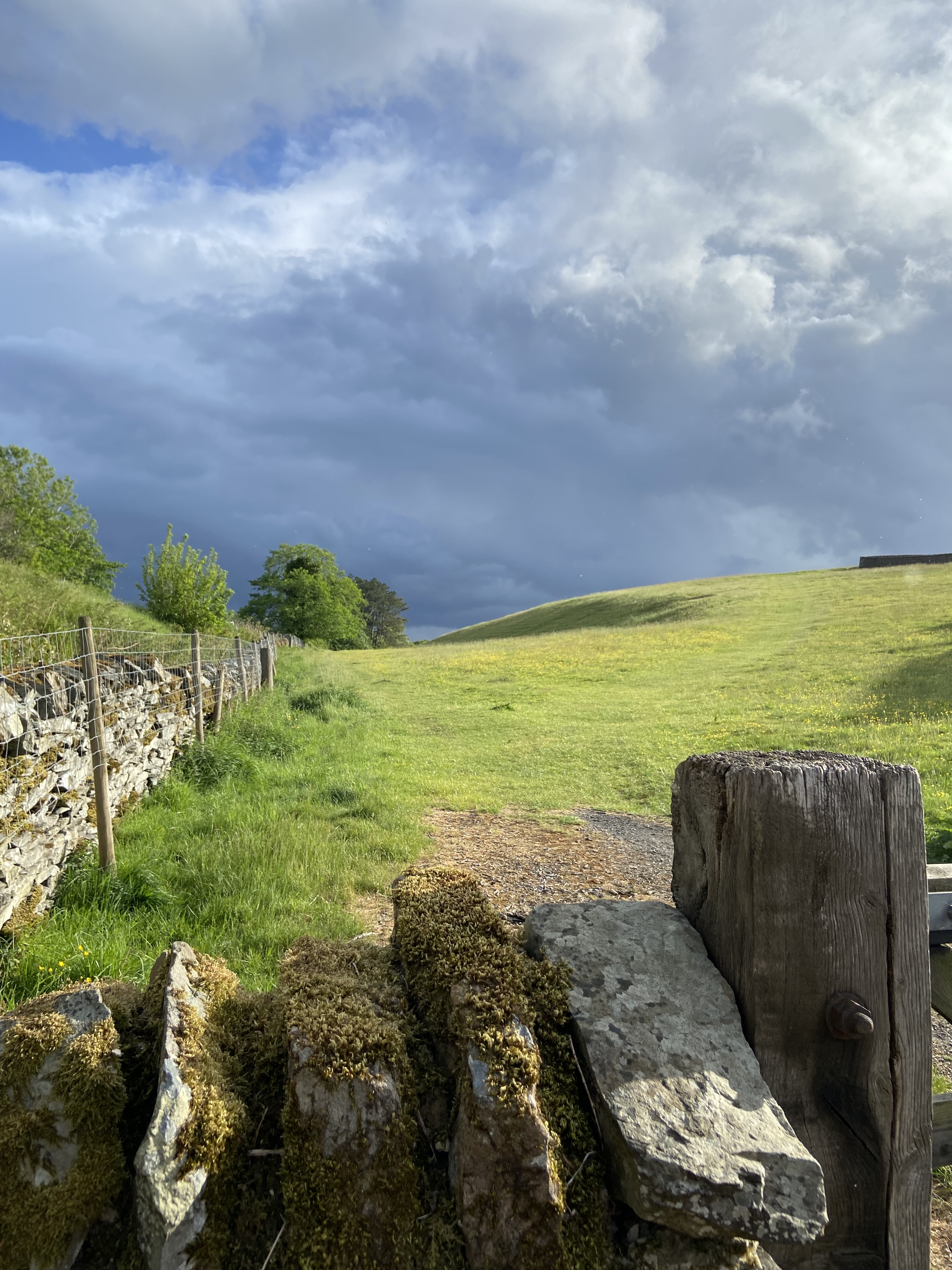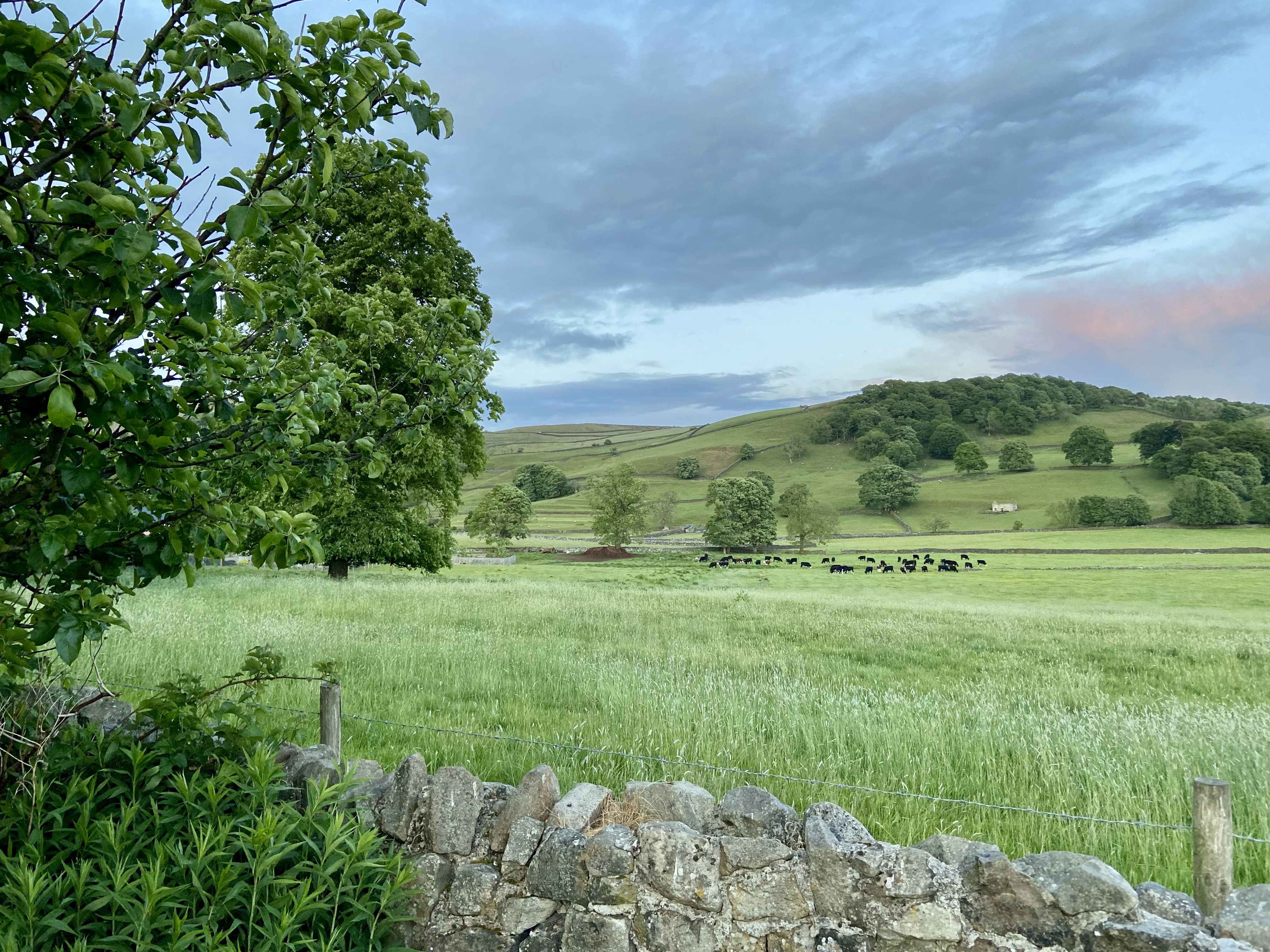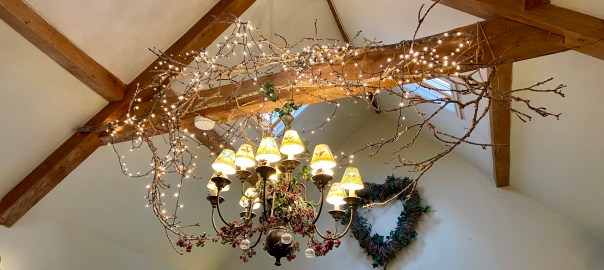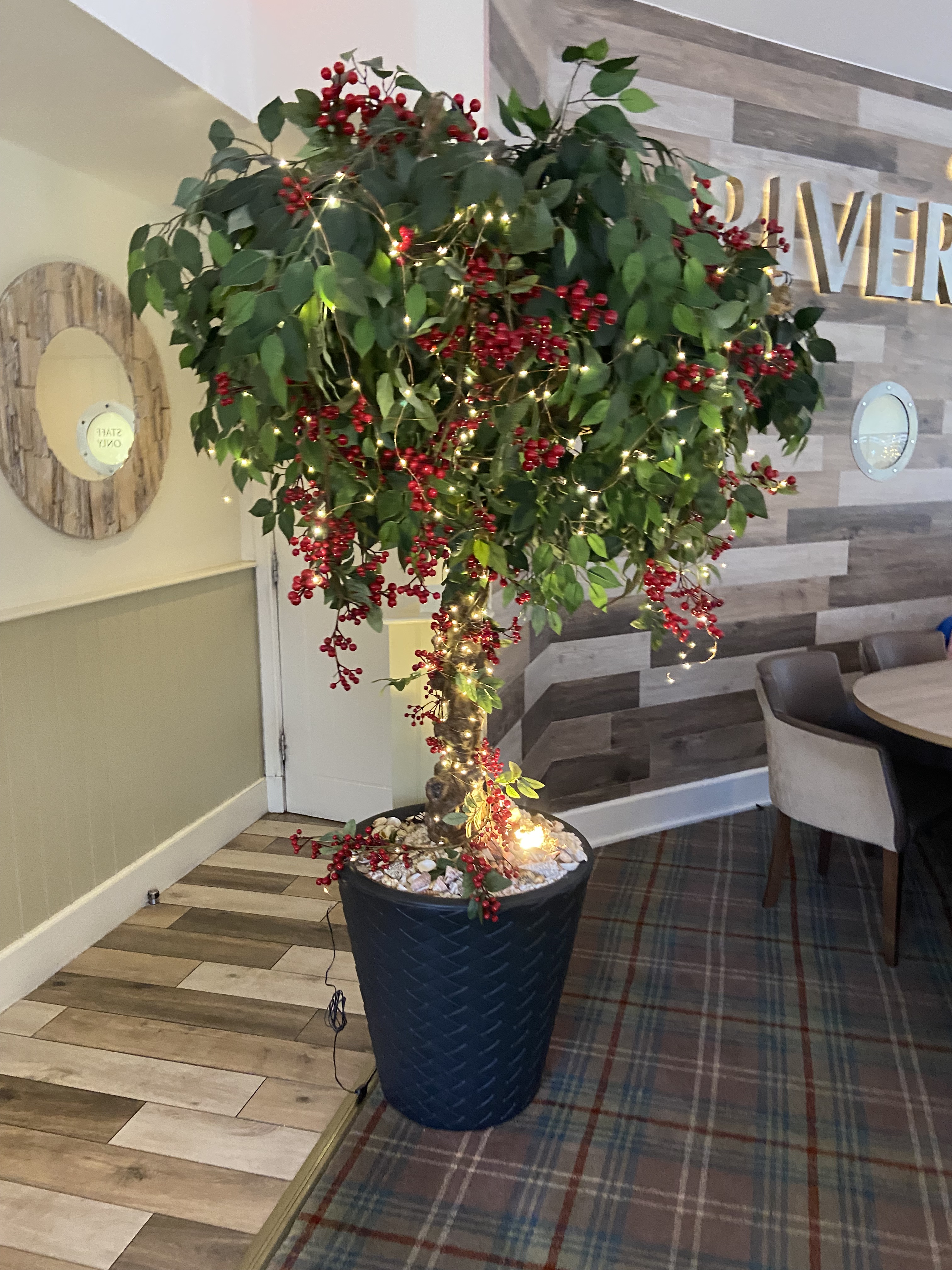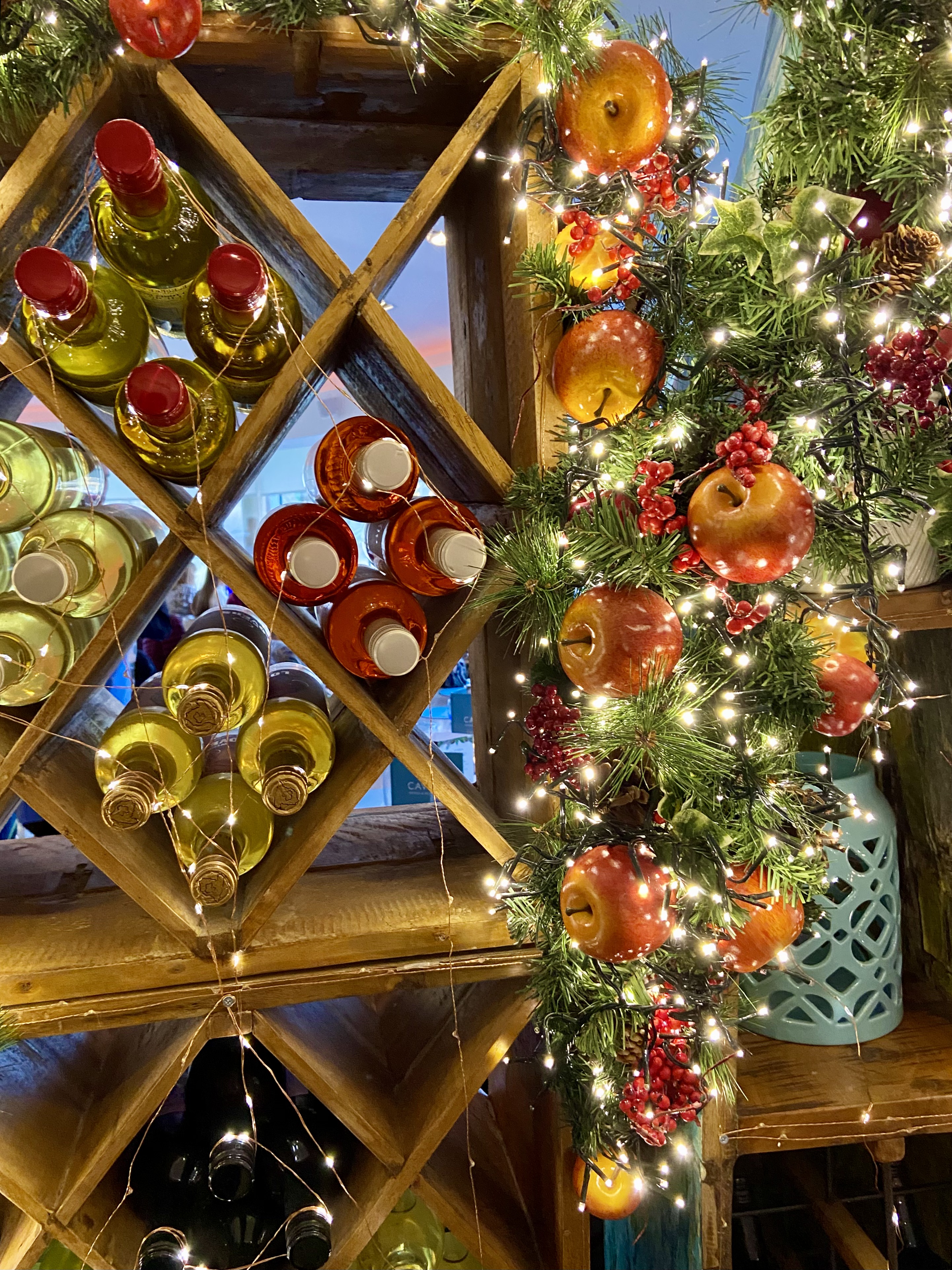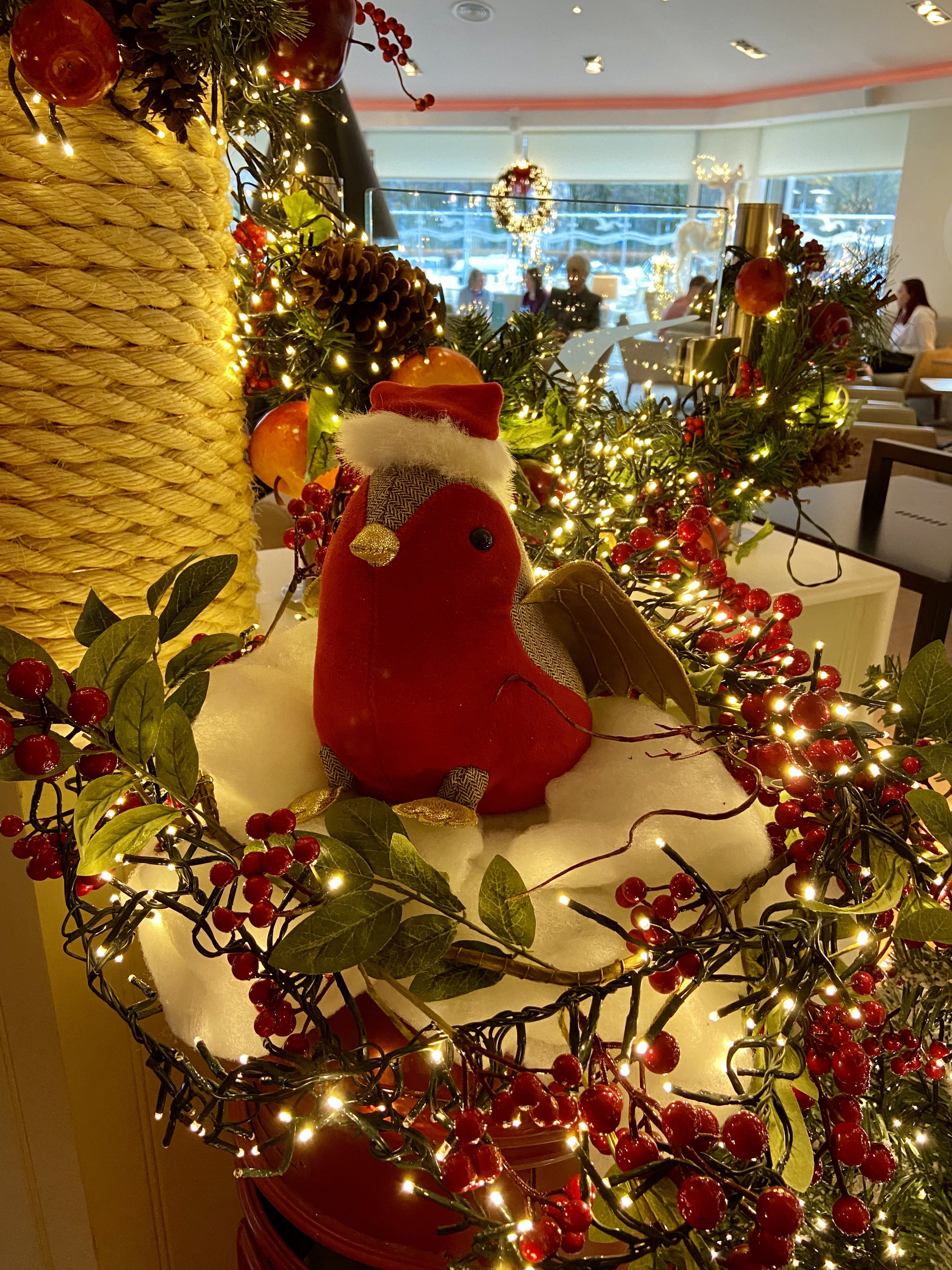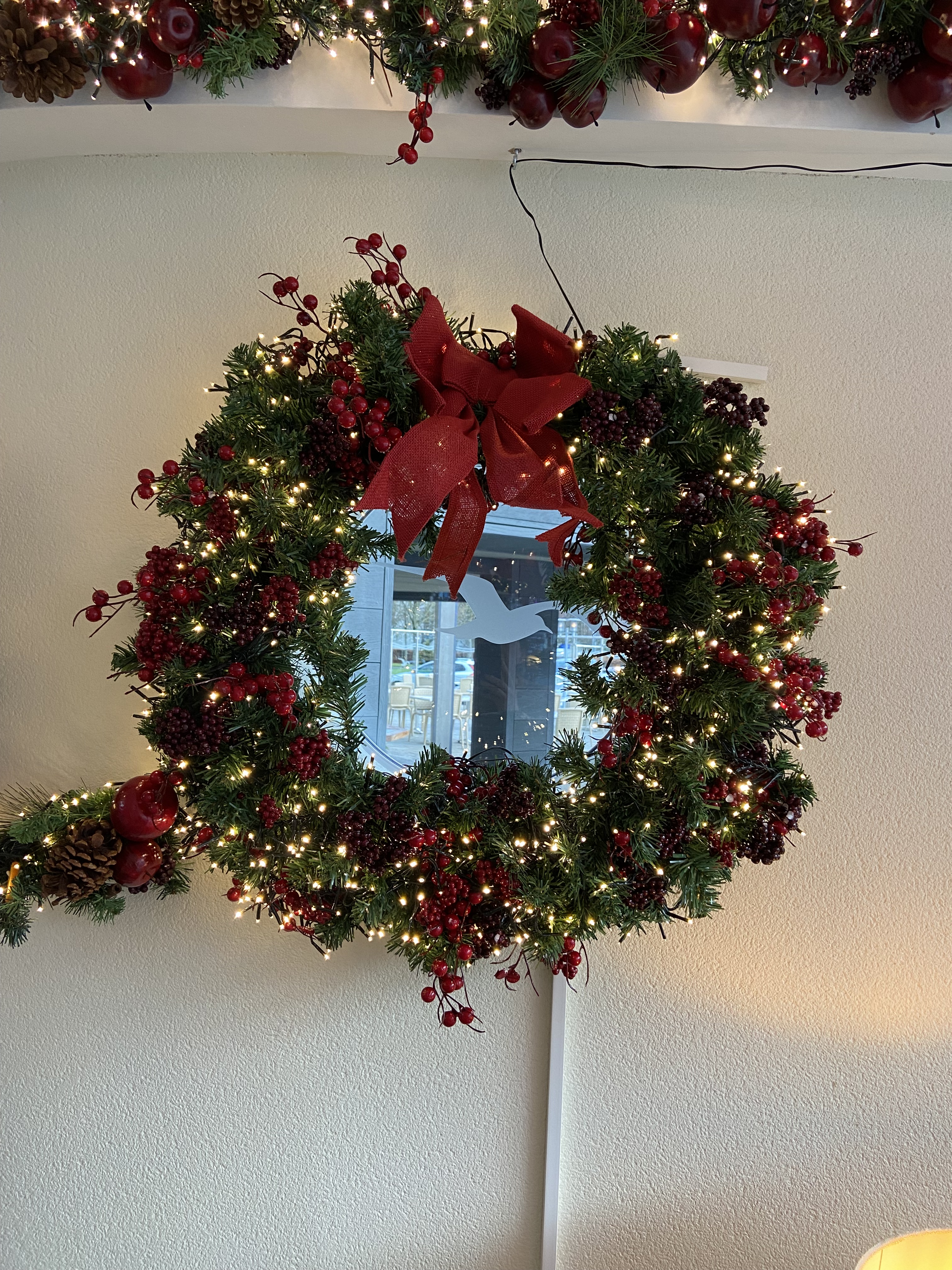
It feels a long time ago now, but last weekend with Valerie and Charles was wonderful. Having slept well after hot chocolate laced with brandy in the hot tub with Valerie, we all headed out on a drive through Kippen to Fintry. It’s a beautiful area of Scotland and one with some special memories for me. Thirty five years ago, as a vet student, I saw practice in Kippen. It was there that I was first sent in to do a consultation on my own on a lovely grey rabbit. There was also a parrot in the waiting room that used to meow at the dogs, then tell them to shut up, if they started to bark.
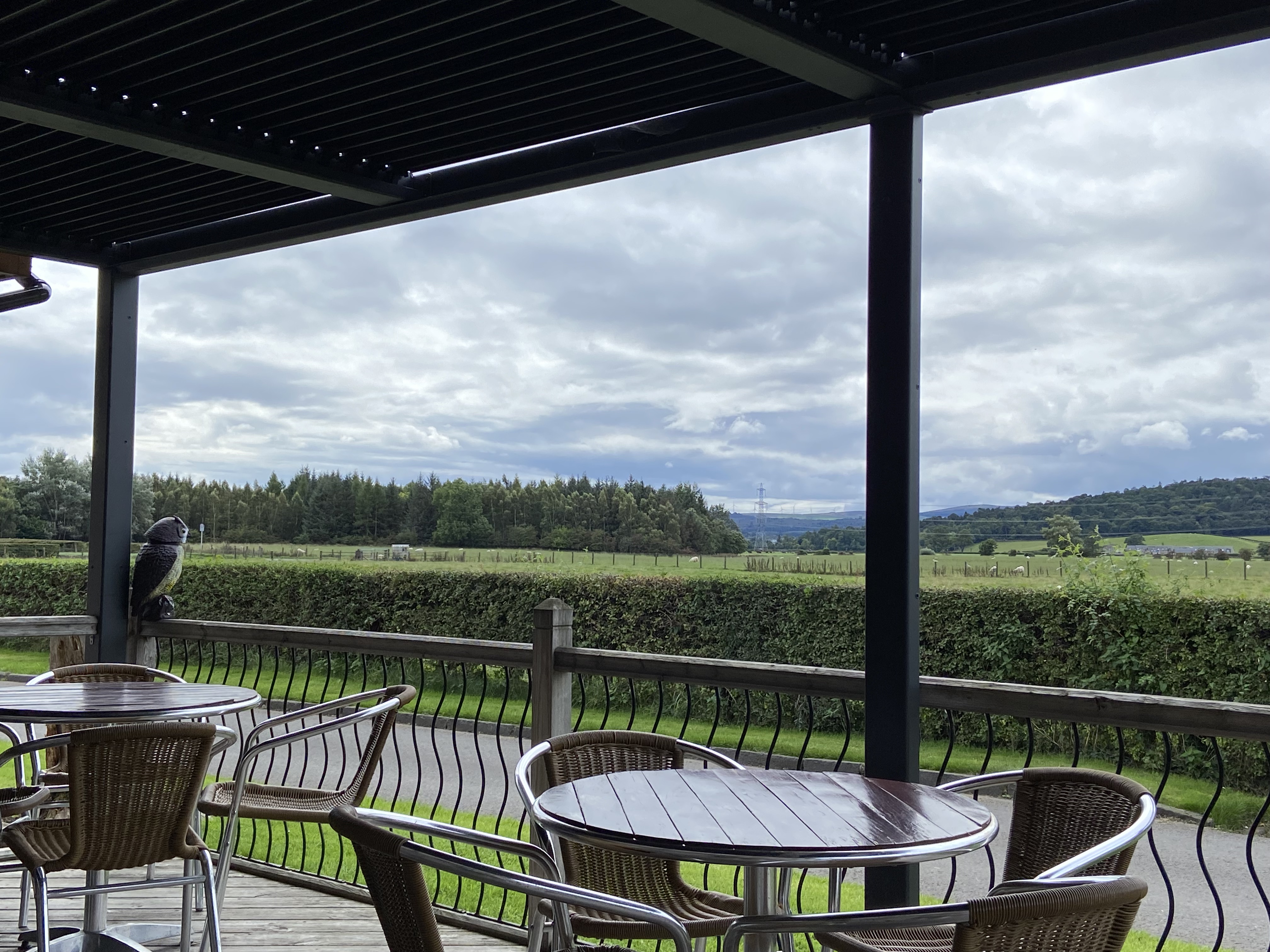
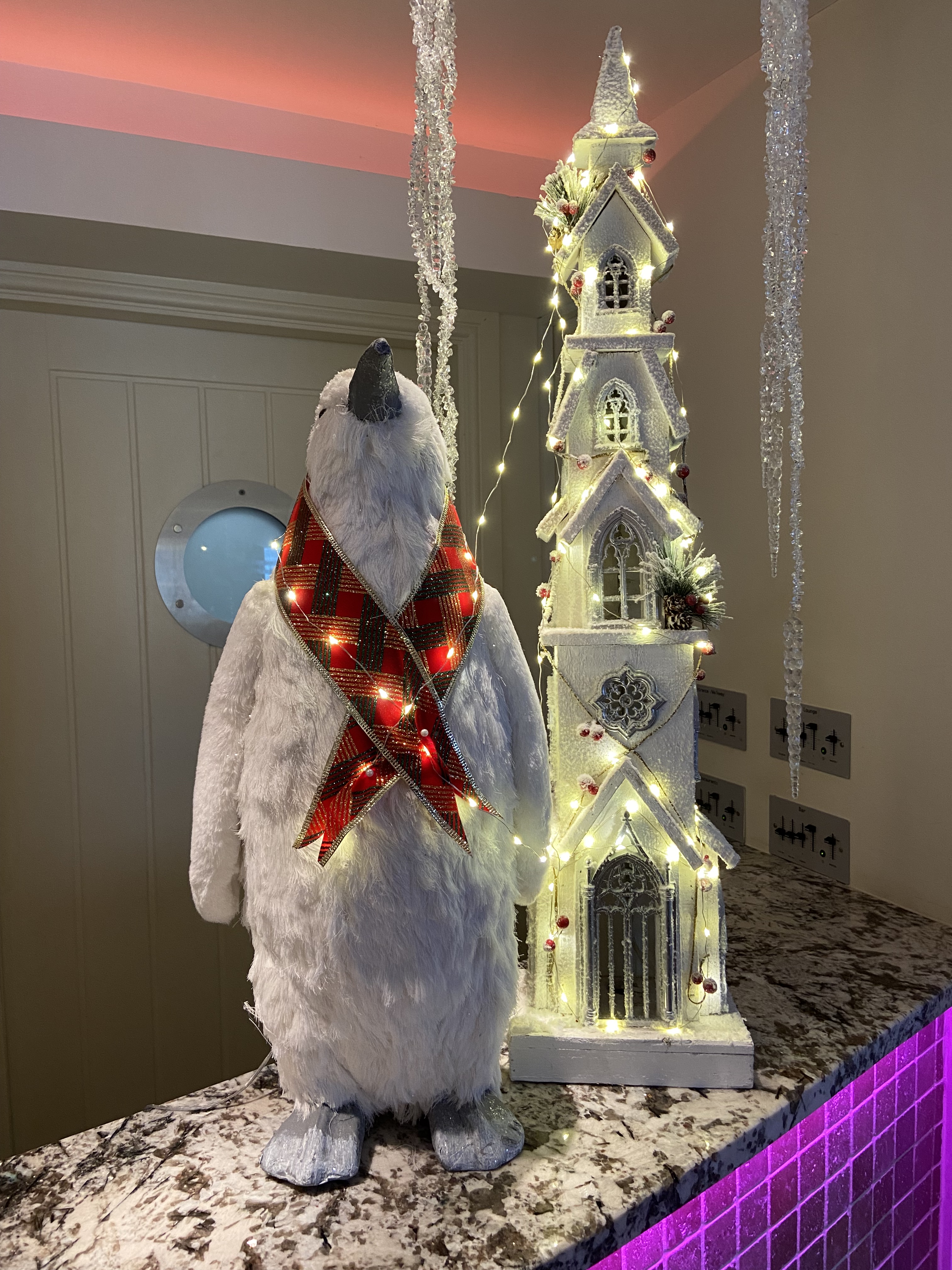
We stopped off at the Courtyard Cafe on Knockraich Farm for lunch. It was beautifully decorated for Christmas and the lights at the top of the page were above us as we dined. I had a ploughman’s lunch, followed by a mince pie with Bailey’s flavoured ice cream. It was delicious.
Having stopped off at Lidl, Valerie and I had another hot tub session m this time with gluhwein. The thought has just crossed my mind that I told mum yesterday that I barely drink alcohol, and now I’m making it sound as if we had a truly boozy weekend, but it was a lovely moment and the gluhwein was very reminiscent of Norwegian gløg. All it needed was some chopped nuts and raisins.
We went to the Christadelphian church service in Stirling on Sunday morning, where I was made to feel very welcome, as I have been on the other occasions I’ve attended. We stayed for a shared lunch and afterwards I rolled up my sleeves and did some of the washing up. I can feel a real sense of community there, which has been lost in many places, following Covid.
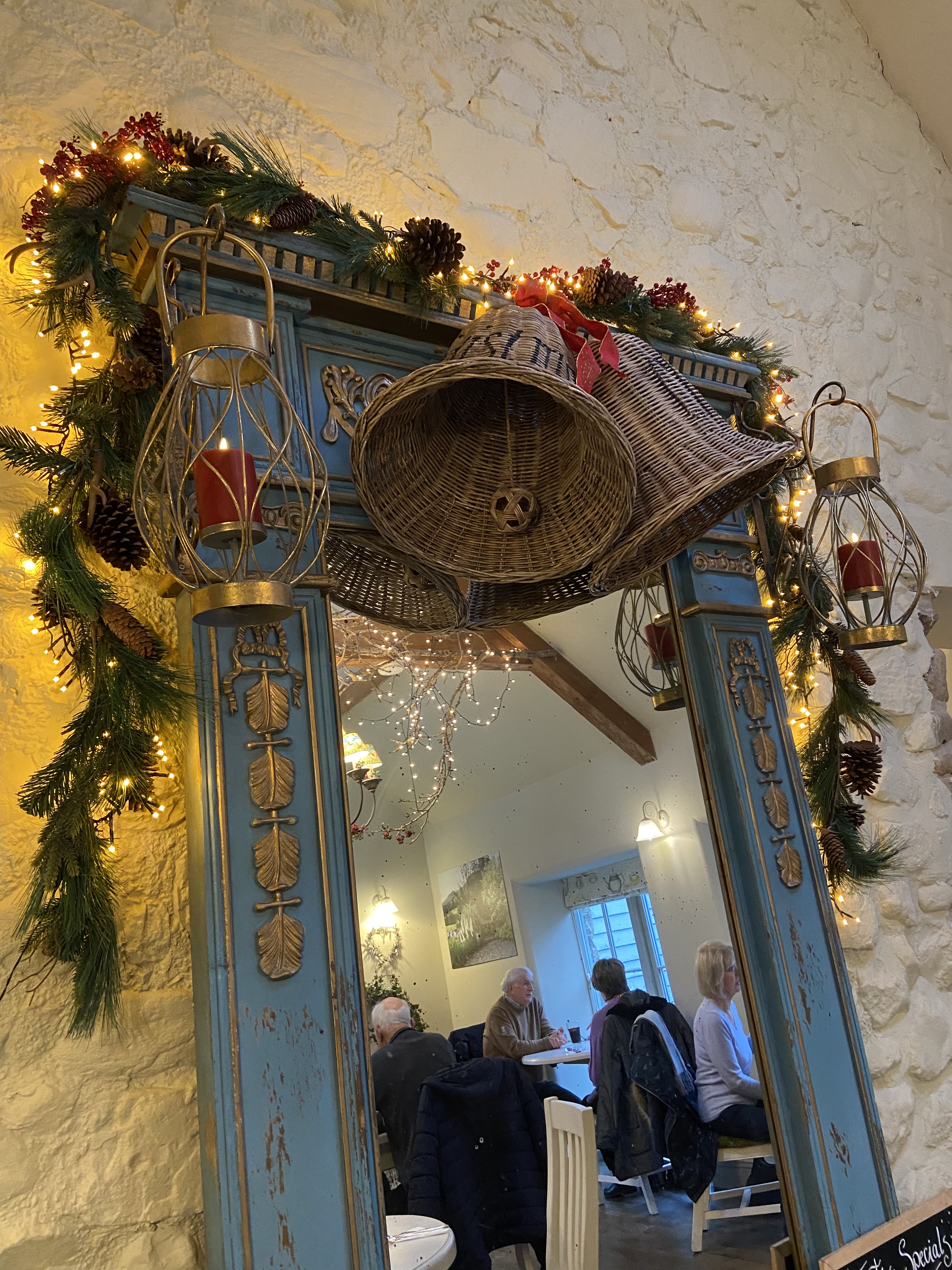
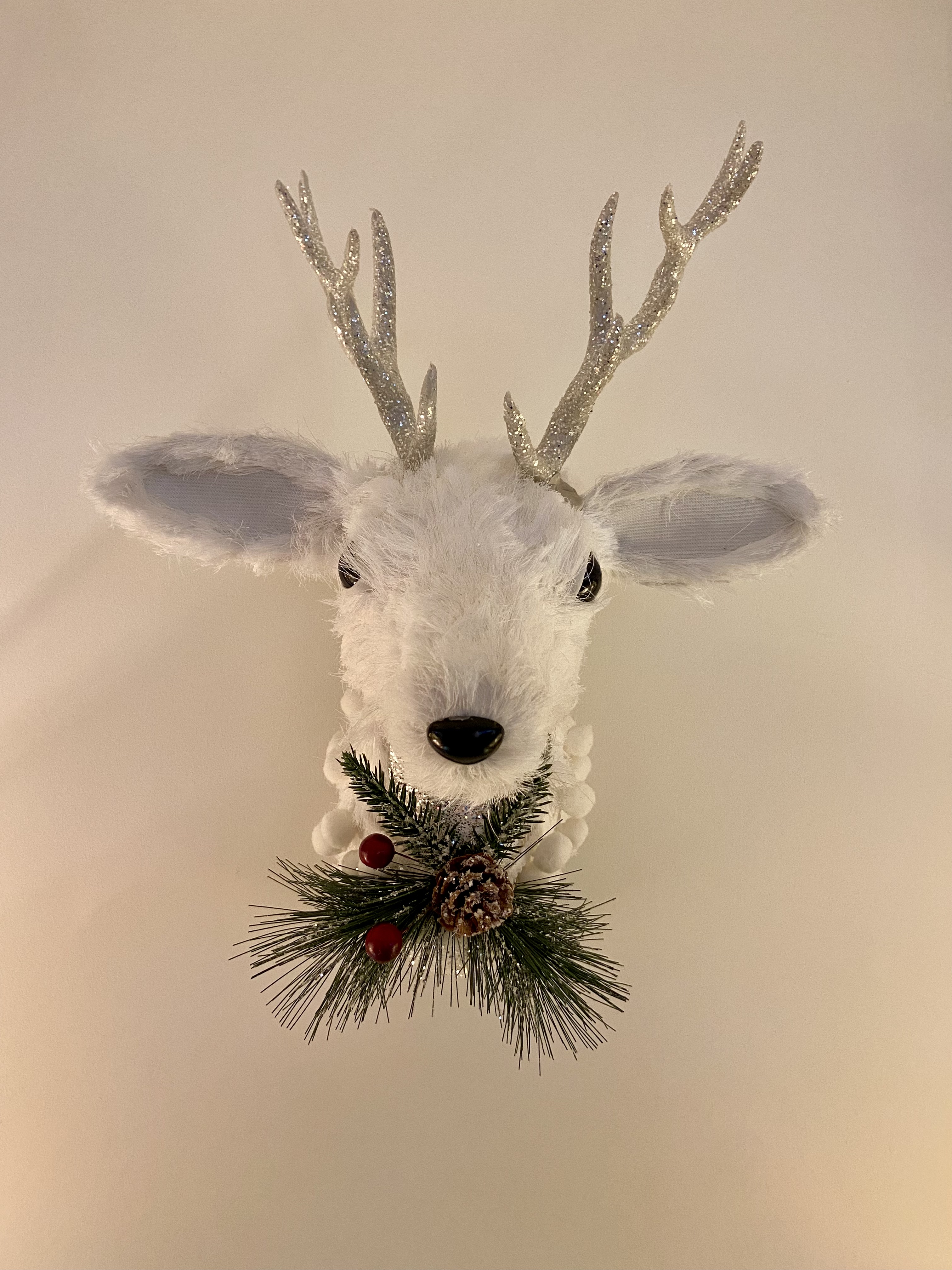
We headed off for a last coffee at the River House in Stirling. Valerie had promised me Christmas decorations and it didn’t disappoint. I love the contrast between the classic beauty of the Courtyard Cafe and the exuberant British, Nordic style decorations here below.
Back to work on Monday and a feeling of nervousness as I went out to blood sample some sheep that had moved from parts of England that are now under restrictions for Bluetongue. It’s too cold now for the mosquitoes that carry it to become infective, but the two sheep both came up a few months back, when the weather was warmer and before the restrictions were in place. Tracing a disease that isn’t spread by direct contact, and which may not show up for some months is a complicated business.
So far, it hasn’t been found up here, but we are staying vigilant. It had been a long time since I had taken blood samples from sheep, but the two visits went okay and I sent all the paperwork in by the next day. I haven’t heard back yet from the debriefing team, even though I spotted an error in one of the forms, so it will doubtless come winging back to me at some point. There are now confirmed cases of avian influenza down in Norfolk, so there could be busy times coming up.
Tuesday was an easier day; I visited a couple of vet practices. Most mixed vet practices in Scotland do some work for the government, checking for notifiable diseases like anthrax, brucellosis and TB. As part of my job, I go out and visit them, partly to check they have suitable equipment, but also for outreach. They are routinely out on many more farms than I am, and if they see anything that we could help with, I hope that they would feel that reaching out was possible. Vets used to work for the ministry for years, but now there’s a constant churning of staff and that continuity has been lost. Changing that will require the political will to improve and invest, so I’m not holding my breath, but in the meantime, I try to present a friendly face.
I also stopped off at ReadingLasses in Wigtown for a lunch of coffee and cake, with a good book to read. The cake was delicious, and this time I bought the book too.
And now, it’s the last weekend before Christmas and I’m going to spend some of it painting. The work on my house is progressing and, having painted the new shower room, the joiner came yesterday to fit the waterproof boards behind the shower. I made a start on one of the bedrooms last night. It still astonishes me how much of the paint sinks into the new plaster. It’s much harder work than normal painting, but also important to do a good job. Hopefully, in the not-too-distant future, I’ll be ready for visitors.
Anyway, I wish you all a peaceful and happy Christmas. Thanks for reading.
This week has felt so long, and has been so full, that it was almost a surprise when I looked back at my photos and realised that it was only last weekend I went to the Northern Canine and Equine Therapy Centre in Rathmell, where they do hydrotherapy for horses and dogs. They had advertised it as a coffee morning and we did indeed purchase a lovely coffee from a van outside the centre, but the real attraction lay inside.
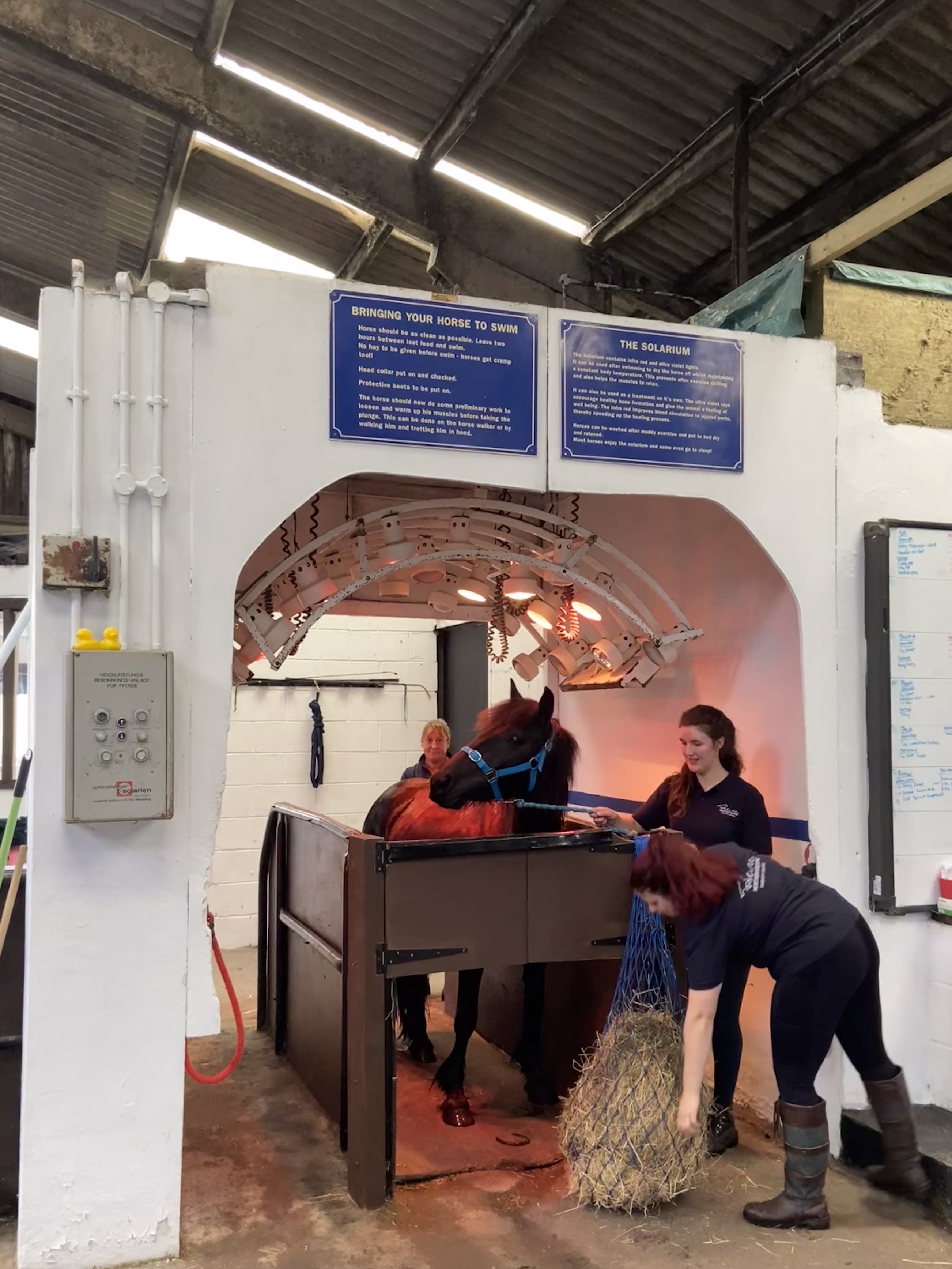
The horse hydrotherapy session was due first, so we walked into the part of the centre where the horses were kept. I wish that I had taken more photos, but it was a lovely place and I instantly felt at home. The centrepiece of the covered yard was obviously the pool (pictured at the top of the page) but around two edges there were stables for the hospitalised horses. Some were there for lameness, some for weight loss and conditioning. Others were there, not so much for treatment, but for pampering. Imagine sending your horse away for a spa weekend!
Having swum round, the pony in the picture was taken out, towelled down, then treated with oils to replace the natural oils that would have been removed from his coat. He then was walked into a solarium to dry out a bit.
After we’d seen the horse swimming, we moved through to the dog pool. There. We watched as a dog physio put her labrador through his paces in the pool.
She told us about the different conditions they helped with. Her own dog doesn’t need any therapy, but he does love swimming. It’s also possible to book a half hour fun session with your dog and I immediately decided I’d like to take Triar to see if he would like indoor swimming. I also found myself wishing I worked there, or perhaps was a vet who could refer animals to them. It felt like a very positive place.
We had rather a bombshell last Friday afternoon, which I couldn’t bring myself to mention last week. My lovely boss, Kirsty, unexpectedly sent out a message to say she was leaving and her last day would be early in August. I will be very sad to see her go, and by the outpouring of shock, so will many of my colleagues. Both Lindsay (my Veterinary advisor – one step up from me) and Sue, who has just taken on a year long post after locumming on and off, called me up, mainly to express their sadness. Though it feels very sudden, it’s good for Kirsty and I hope she gets some much deserved time to relax.
Back at work on Monday, I visited a chicken farm with my colleague, Aleks. I have to do three visits with other vets before I can go solo, and this was my third. Because everyone is so busy, it’s difficult to find dates when two of us can go out together, so I’m glad my third accompanied visit is done. I have three of my own to do, so now I can more easily fit them into my timetable.
I can’t even remember what I did on Tuesday. It all feels so long ago! I was due to revisit a welfare case on Wednesday with David, who works for the local authority with animal health and welfare. We often work together and the revisit was to a farm where we witnessed some serious welfare issues before. But when he arrived, he asked me if we could divert to a more pressing issue. A group of pigs had escaped from their field and had turned up in someone else’s farmyard. It wasn’t the first time they’d escaped, but the farmer, quite correctly, now had them coralled in a barn.
Other authorities, including the police and the SSPCA had been called out when the pigs had escaped before, but nothing had been done. These situations are complicated to deal with. Animals do escape from time to time, and unless they’re on a road or causing risk, it’s really the farmer’s responsibility to get them back and secure them in the field or barn. For David and me, it was essentially a welfare issue. It’s not safe for the pigs to be marauding round the countryside. All farmers have a responsibility to keep their animals safe and keeping them enclosed within a safe area is key to that.
After the big foot and mouth outbreak in 2001, various laws were brought in to try to reduce the risks of another big outbreak. These included standstill laws on animal movements. If cloven hoofed animals (mainly cattle, sheep and pigs) are moved onto a farm, then the farm comes under a standstill order and for thirteen days, no animals can be moved off the farm without special permission.
So pigs landing unexpectedly on someone else’s farm presents quite an issue to that farmer, especially if they were planning on selling some animals, which our farmer was, and imminently. Our first action was to find out if the sale could go ahead. The pigs had not, to anyone’s knowledge, been near the animals that were to be sold, but equally, they had been loose, so where they had been was anyone’s guess. The movement ban applies to all animals on the farm, so the sale had to be stopped. That was done before we left the office.
Our next action was to visit the farm. It was an hour’s drive, but when we got there, I was able to examine the pigs. They were healthy and being well looked after. The main issue that had to be dealt with (or so we thought) was that they were not where they were meant to be.
Having looked at the entrapped pigs, we then went to visit the pig owner. The remainder of the herd were in a separate field from the ones who had escaped. To get to them, we had to walk through the field where the escapee pigs had been. There were some green boxes that looked like the boxes supermarkets use to deliver produce, but I had walked past them, keen to see if the pigs were okay. David had gone to get something from his van and I expected him to follow immediately, but when I turned to see where he was, he was standing at the gate, looking round.
He joined us eventually and we went and looked at the pigs. They looked well and the field they were in was (in my opinion) the perfect environment, with a small shelter, long grass and rushes to hide in and mud in which to wallow when the weather was warm.
It was only when we turned and walked back, that David told me what he had seen at the gate. Across from the supermarket boxes, there was litter, lying about. And in that rubbish, which was mostly food packaging, he had found empty packages for sausage rolls, ham and bacon, along with bags for bread and hot dog rolls.
I mentioned foot and mouth and the rules created after the big 2001 outbreak earlier. In addition to new rules on animal movements, strict rules were brought in about feeding pigs. Feeding them any kind of human food or kitchen waste is banned. We asked the farmer about the packages. It wasn’t impossible they had been left by someone having a picnic, but he didn’t know where they’d come from and said he thought people sometimes came and fed the pigs.
So now we had a situation, where there were empty packages for pork products that the escaped pigs had access to, and worse, that it was possible the produce, including raw bacon, might have been fed to the pigs.
These are the kinds of situations that have immediately to be sent up the food chain. Even if I had dealt with such a situation before, I would still have to call it in, without delay. The upshot of my phone call, and the work I have been doing for the last three days, is that both farms have to be locked down, with no movements of live or dead animals onto or off the premises, except under special licence. All the animals have to be inspected every 72 hours for signs of disease for a week, then probably weekly thereafter, for another two weeks. There was also the matter of the pigs being on the wrong farm, which was resolved yesterday, after lots of negotiation and paperwork.
So a vist which I thought might be a little complicated to resolve has turned into a behemoth case. One thing I will say is that we have an enormous amount to be grateful for with the farmer who took in the marauding pigs. She did everything right from start to finish, including calling us in. Chances are, the pigs don’t have foot and mouth, but now we have everything under supervision, so if the worst happens, we are already on top of it.
Had she chosen not to trap the pigs and call us, but had shoo’d them away and sent her animals to the sale, the potential for us being faced with another 2001 was there. That was started by pigs being fed improperly processed food and the disease wasn’t spotted until it had been sent all over the country. I may now be faced with three weeks of visits and a ton of paperwork, but this is the kind of work that can prevent a world of pain for farmers and a devastating cull that costs the country billions.
So this is what I am here for. I’m only a tiny cog in a very important chain, and kudos to both the wonderful farmer who called it in and for David for his observational skills. Next time, I won’t be so quick to pass by litter to look at animals.
But if I have one final thought, it is that I wish the government could see what we are here to do and how important vets and animal health and welfare officers are to this process. There should be more of us on the ground and the pay for those of us who choose to do this should be much better. Staff come and go, or work quickly to get promotion as there is no pay progression in our part of the civil service any more.
We need experienced people on the front line, but there is zero financial incentive to come and stay. Maybe saying this publically could get me into trouble, but if so, so be it. The people responsible for removing progressive pay bands for these roles have put the health and welfare of the nation’s animals at risk.
I work alongside a few, faithful staff, who have years of experience, a network of connections, a load of invaluable local knowledge, who are asked to train new entrants on the same wage as them. That is both plain wrong and absolute insanity. We should be making sure those people have an incentive to stay, that they know they are valued and that they don’t have to move to a different job to be properly rewarded.
And on that cheery note (sarcasm alert for non Brits) I shall leave you to your weekend! Have a good week all, and see you next week.
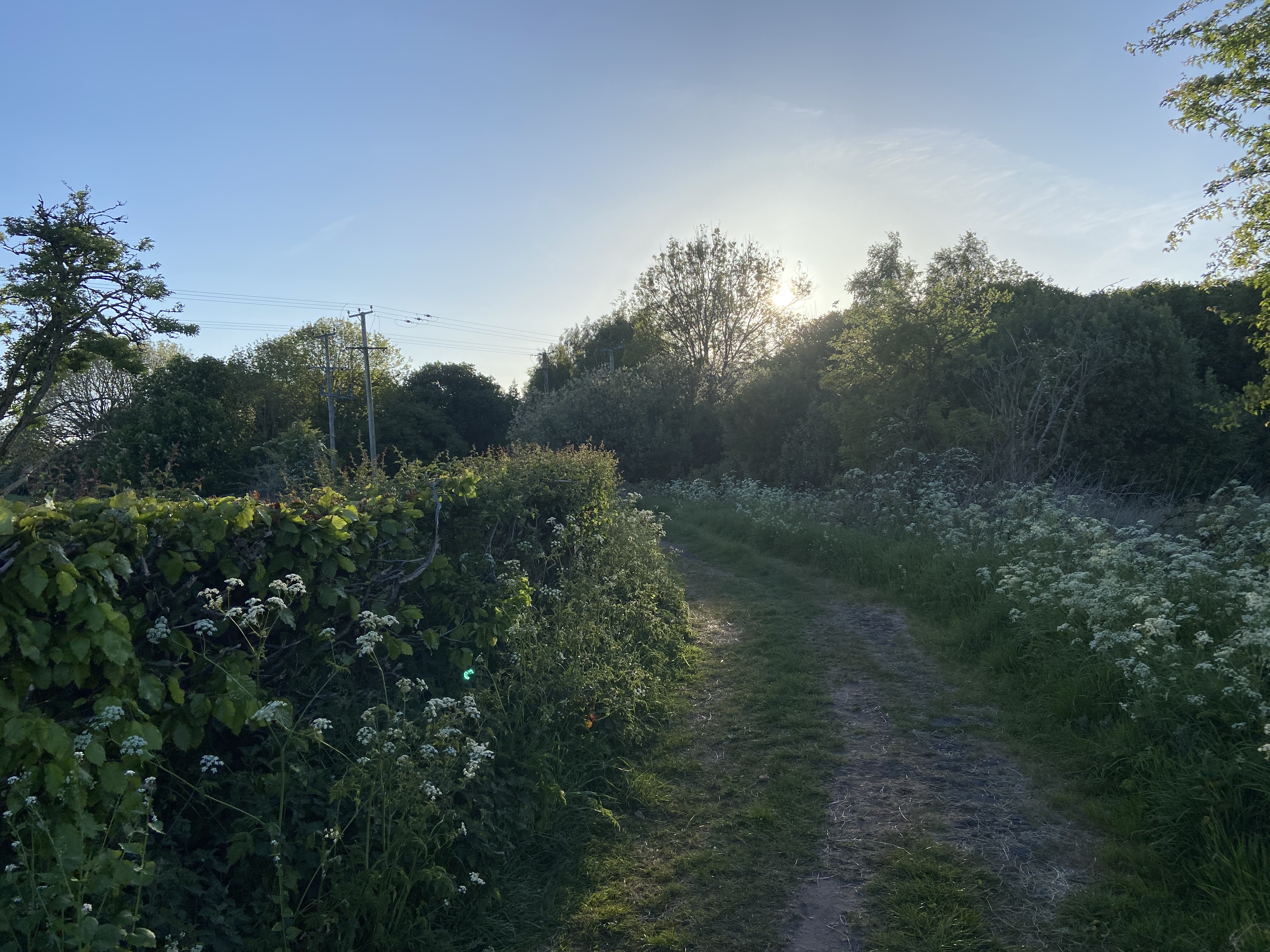
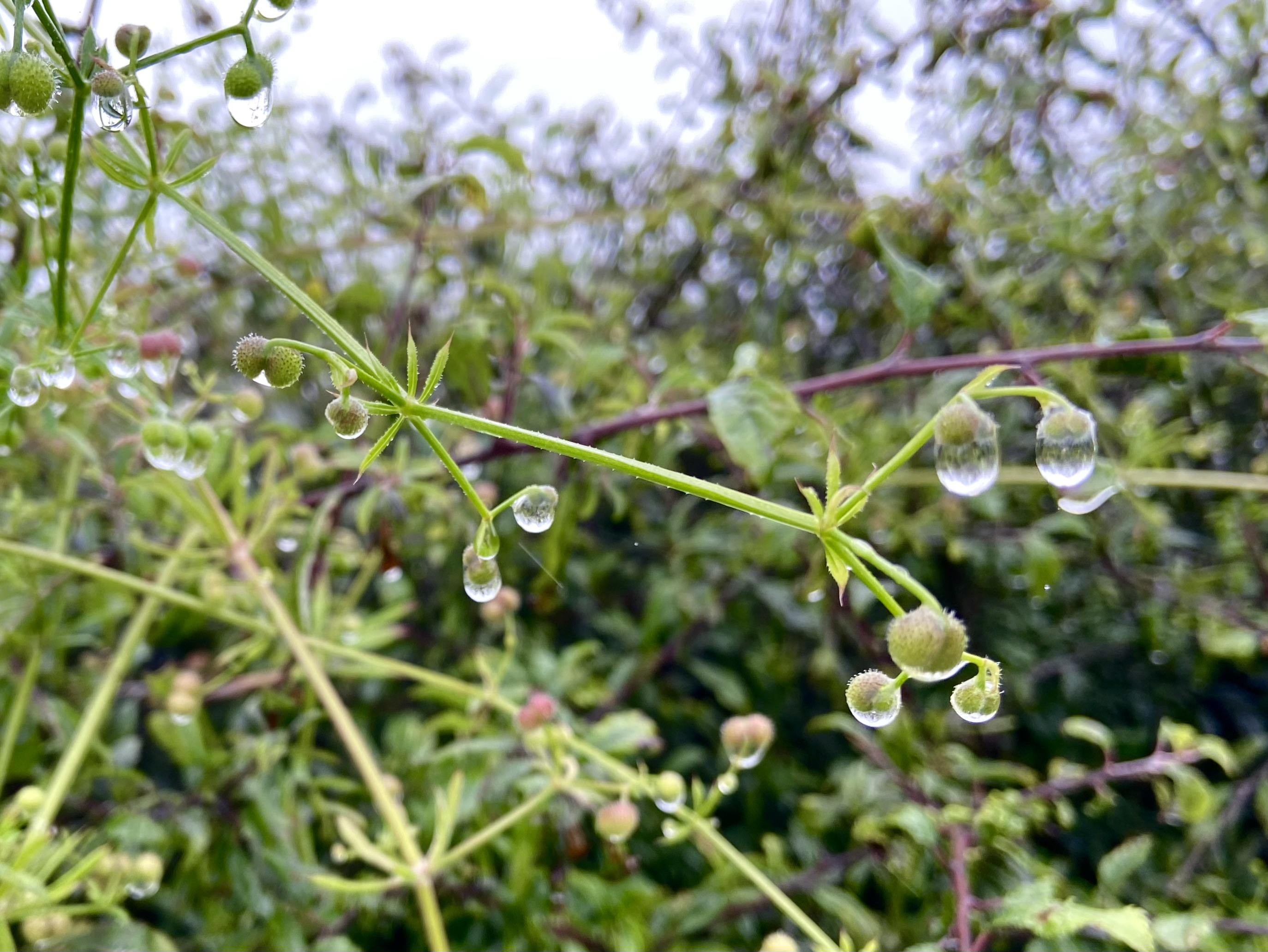
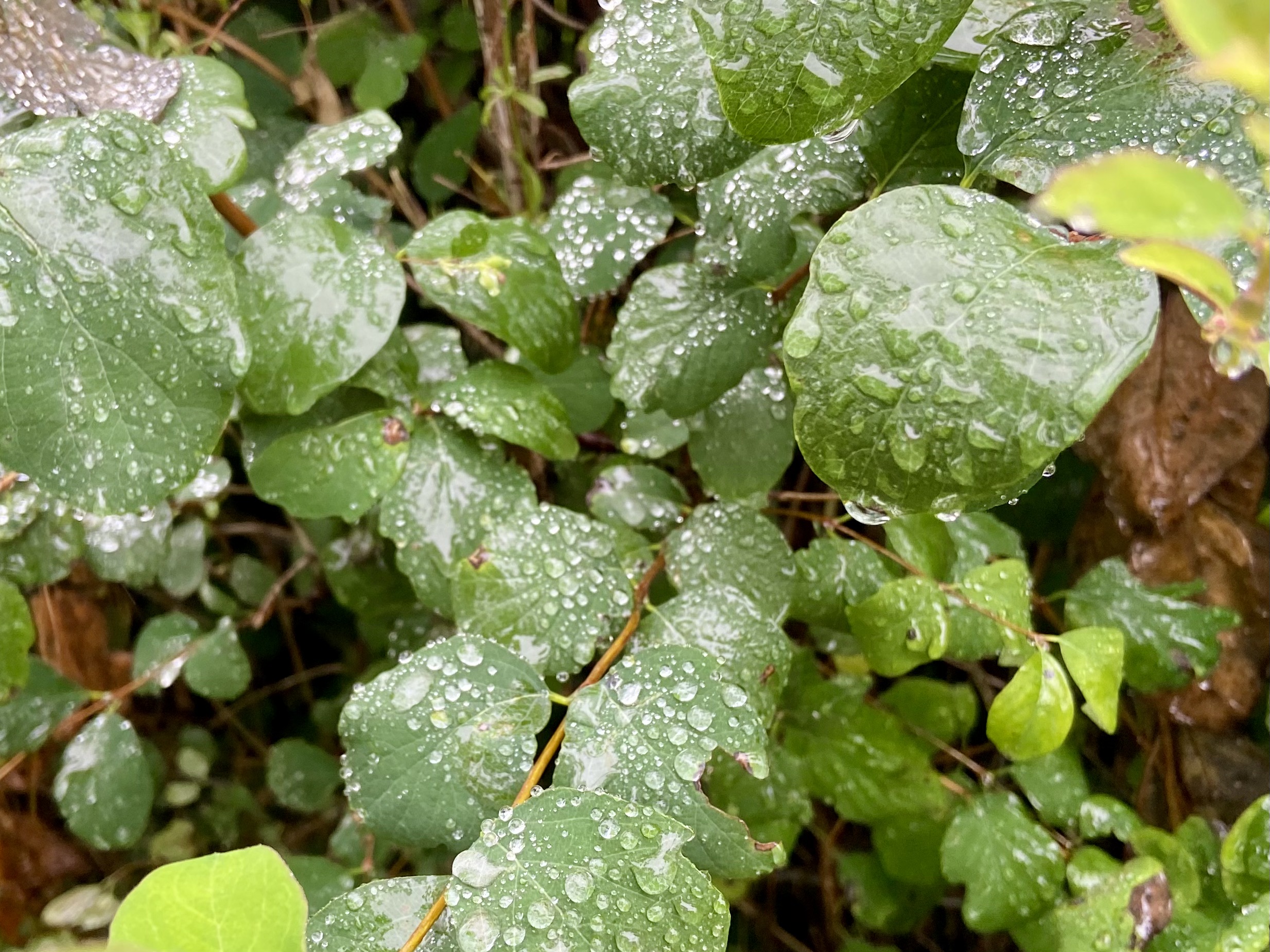
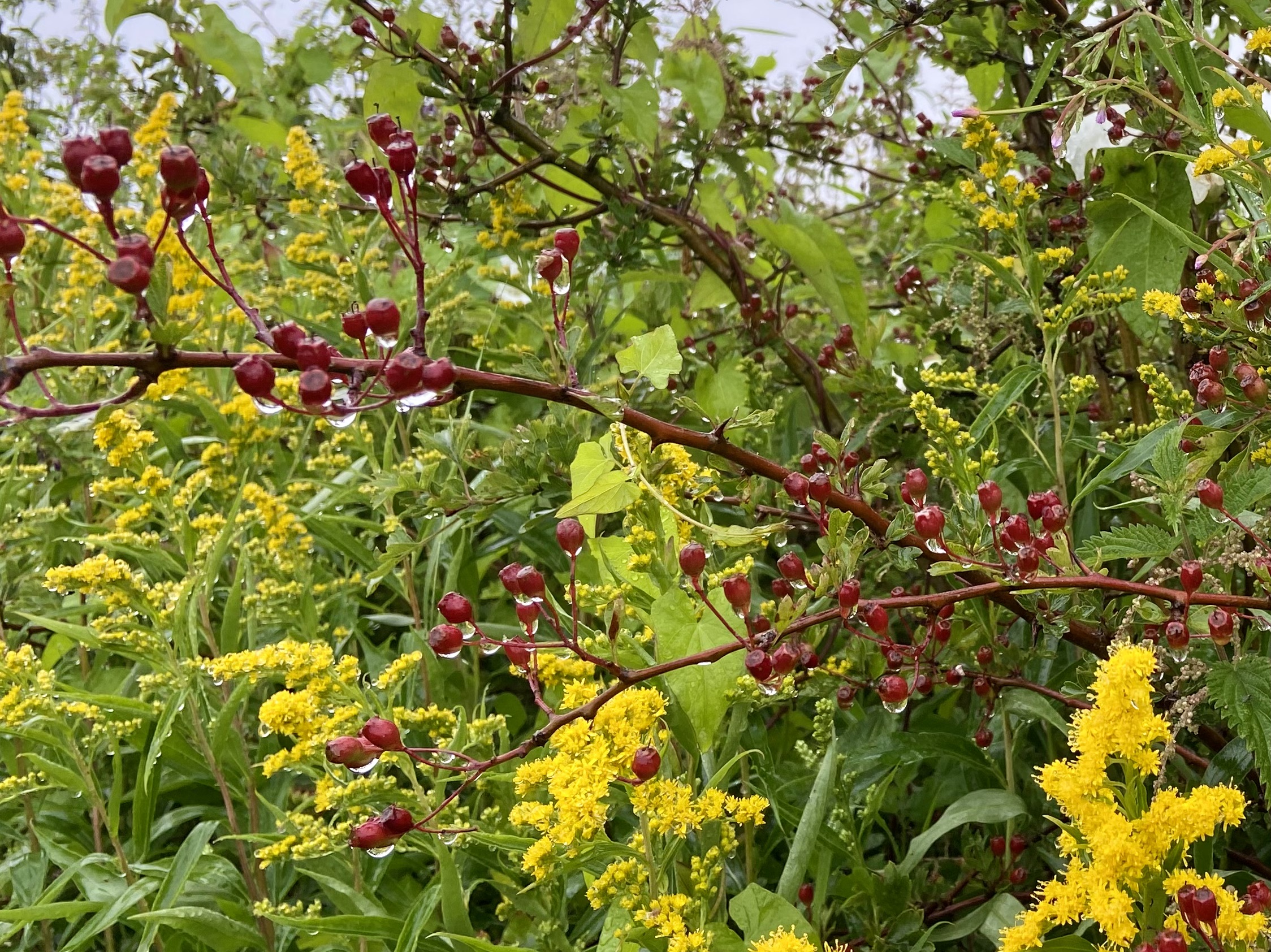
A few “after the rain” photographs for those who love Blackbird Lane.
One of the things I enjoy about working as a government vet is travelling to different places. It hasn’t happened yet, but at some point, I will be sent to do detached duty, where I can be sent anywhere in the UK to deal with any emerging notifiable disease. Even in my region though, I get around a bit. On Monday, I am going to Ayr to accompany a colleague on a welfare inspection. She has only been out to one such inspection so far and I’ve already done my three, so hopefully I can help her to do a good job.
I’m also going to be one of APHA’s vets at the Royal Highland Show next weekend, which is exciting. If nothing happens, it’ll be a lovely day out. It’s a long time since I’ve been, but it was always an enjoyable day out. If something happens that I have to deal with, it will be… interesting. Imagine how the day would change if we discover one of the animals is showing signs of foot and mouth. There are contingency plans, which I should get next week. I will make myself familiar with them and keep my fingers crossed that the most exciting thing to happen will be visiting the freshly cooked doughnut stand.
Not that I will be doing that. As I mentioned last week, I have been signed up to a weight loss program called Second Nature by the NHS. So far, it’s been very good. Its focus is on changing habits and not on counting calories, which is appealing to me. I can’t get on board with weighing out food for the rest of my life. It relies on encouraging exercise, eating more vegetables and cutting down on carbs, without cutting them out altogether.
I was meant to do lots of meal planning this past week, but bought pick and mix salad every day from my local supermarket, which handily is a ten minute walk from my office. In the evenings, Andrew and I have been using a delivery service called Hello Fresh. Both Anna and Donna recommended it, so we decided to give it a go. Each week, we select four meal plans, they deliver ready prepared ingredients, and we cook the food together when I get home from work. It’s been quite easy to modify the Hello Fresh meals to fit the Second Nature recommendations, so it’s all been very easy and I love not having to decide what to eat while standing in the supermarket.
I also signed up to an online service called Borrow My Doggy and this week, for the first time, someone new took Triar out for a walk. It did make me realise that he’s not the easiest dog to handle. He’s never been placid – quite the opposite. Also, I’ve not taught him very good manners on the lead.
It went off fine though. I’m hoping to find someone who would be able to take him at short notice if I have to go away unexpectedly for work, but I’m going to have to engage more to do that. I’ve just booked a holiday in November, so perhaps I need to concentrate my efforts more. Triar has never been in a kennel and I’m not sure I really want him to start now.
These are some photos from the bottom of my garden, which is running absolutely wild. The garden is full of insects and birds, which I love watching from my kitchen window. I made my way down the broken steps this week and was pleased to find that the overgrown roses have the same, wonderful scent that I remember from the roses in the garden when I was a child. So many these days seem not to have any aroma. “Stop and small the roses” is a good principle in life, I think. We’re down in Yorkshire for the weekend, so I’m going to start with a cup of coffee and take it from there. See you next week!
Andrew and I were in Yorkshire last weekend, which feels like a lifetime ago, but it was a lovely warm day on Saturday and we went on an ice cream hunt, which on the face of it wasn’t very successful. The firstly place we went to was styled like an American Diner, but it was so noisy and there were so many children leaping about that we turned and walked back out. The next place we tried, after consulting the Oracle of Google Maps was a small, village shop, but the only parking we found was in a field, which some canny farmer had mown and was charging £10 per day to enter.
We ended up doing a big circle back to Grassington, where fortunately, we bought a cone, but it wasn’t quite the ice-cream parlour experience we’d been searching for! Grassington is very pretty though and the drive back was too.
On Tuesday afternoon, I met up with some women I met on social media. We’d been chatting online and they were part of a women’s group I wanted to join, so we met for a coffee. I’ve been worried about Andrew being here for the summer with nothing to do, and to my delight, it turns out one of the women owns a small media company in the area. She does some work with young people, so later this morning, Andrew has been invited to a scriptwriting workshop in a cafe in town. He’s read the script they’ll be working on and has some ideas, so hopefully he will enjoy it. If Andrew wants to work in film, the most difficult part might well be finding a way in, so any experience and contacts he can form are a good thing.
I was through in Stranraer again this week, on one of my TB farm cases. We’re still waiting to see if TB is confirmed, but it’s looking more likely and so my Veterinary Advisor and I went to the farm to assess the boundaries and history of animal movements on and off the farm. If TB is confirmed, we will need to move quickly to start tracing where it might have come from and where it could have spread to, so now we are prepared to move to that stage without delay.
I was driving back to Dumfries, when I found myself in a queue of traffic. It’s a fairly difficult road for overtaking long queues, and this one was particularly frustrating as it was going slowly round the bends and speeding up for the straight parts. Seeing a sign for “Holy Cairn” I made a snap decision that this might be a good moment to go and explore one of the historic monuments that are scattered along the A75.
This is a hit and miss activity. Sometimes you can follow side roads for miles and find nothing, or you do arrive, only to find you’re looking at two stones on a hillside. This time, however, I found a good parking space and went through a small gate to find what looked initially like a circle of standing stones…
… but which on closer inspection, had been the spectacular entrance to a chambered cairn.
There was an information block in the corner of the enclosure, which told me a little bit about the cairn and its excavation, but the best thing it told me was that there was another cairn, further up the hill. I followed the track up, to find another, rather different cairn. The entrance to this one was a little less spectacular, but it was sited in such a beautiful place that I could only stand and gaze.
I read the information here too. Long-time readers might remember my trip to Stonehenge where I was amazed to discover that animal herders came down from Scotland to celebrate the winter solstice. I found myself wondering whether the people who used these cairns were among those who made that trip.
The plaque told me the cairns dated from 4000 BC. When I looked up Stonehenge later, it is thought to have been started in 3000BC, so these beautiful cairns were in use a thousand years before Stonehenge was begun. As ever, I felt the wonderful calm feeling that I always get when viewing something ancient or ageless. It’s always a wonderful reminder of how short and insignificant my life is in the grand scheme of things.
And finally, I had been gradually gaining weight, ever since I moved to Arctic Norway. Winter hibernation is all very well, but when winter lasts from October to May, it’s a large chunk of the year to take a break from walking, which was something I had done to keep myself healthy for years. I had hoped to break the bad habits when I came back to Scotland, but there is far too much temptation and I haven’t lost anything at all.
I asked at my GP clinic for help and they have signed me up for six months on an app called Second Nature. It tells me it’s going to help me break my bad habits and form some new and healthier ones, so I will be starting that on Monday. My main hope is to lose enough weight so I can start to go up hills again without creaking to a standstill within a few yards. There’s no weighing and measuring foods or calorie counting, which is good as I can never be bothered with all that. I’m also glad they didn’t offer me drugs. I want to improve my lifestyle, so hopefully this will help. I’ll let you know how it goes!
Of course, I am back in Scotland, and true to form, my colleagues in Stranraer, on hearing this, convinced me that it was essential that I should make the most of the last few days before I began, so this was the result. Have a good week all!
I wrote, last week, about my frustrations around the non payment of relocation expenses. They haven’t yet been paid, but K, my line manager, has told me that the big boss I sent my complaint to is now trying to get it paid from the local budget, rather than continuing to fight with DEFRA HR. I will try to keep you updated. Another colleague has suggested I contact the union I joined when I arrived, so that’s another step to consider, though I am hoping it will all be resolved soon and I won’t need to.
For most of this week, including last weekend and the (Scottish) Monday bank holiday, I have been working as duty vet. During the weekend, that meant the APHA national phone line went through to my work phone, or at least any and all calls from the north of Scotland came through to me. In the north, a second vet was taking phone calls for the south. Not many people call the emergency line (thank goodness). I had only a few calls on the Monday, most of which were easily dealt with. The counter to that is that, if something does come in that actually requires me to go out, it is likely to be something serious. Possible reasons would include a suspected outbreak of a notifiable disease (think bird flu or foot and mouth) or a welfare case that’s so bad it can’t wait.
Anyway at least, with mobile phones, being on call no longer requires me to stay in the house, glued to a landline, so Andrew and I decided on Saturday that it was time to go and explore our local ice cream emporium. There are a couple locally. Farmers in the UK have been encouraged to diversify and so we took a short drive out to Drummuir Farm where they make their own ice cream. There were loads of choices of flavour, from biscotti to battenberg, and Andrew and I ended up ordering two glorious fruity sundaes.
We went for a drive afterwards, including through Dalton, where I stopped to take a photo of this lovely pastoral scene.
Andrew’s eye was caught at Drummuir by the full Scottish breakfast on the menu, so we returned on Sunday for an early lunch, which I can also recommend!
I don’t know if I’ve written much about being duty vet through the week before, but it’s not an enjoyable part of my job. Part of it is dealing with any queries that come in, either in emails or by phone. We don’t actually have to answer the phone during the day, but the calls are logged with a summary of the question, so then we have to look at what’s being asked and decide what action to take.
Some of these are quite straightforward. If a cow dies suddenly, the local private vet should go out and check whether it died of anthrax. An APHA vet has to okay that, then give them a reference number. This mostly involves form filling and it happens often enough that I already know the ropes.
But APHA covers a lot of ground on the animal front, so I might find myself with a query about an imported horse whose health certificate wasn’t filled in properly, or a farmer who failed to update his online records properly and has now found his farm is under TB restrictions as his test couldn’t be verified. These can take a lot of sorting out and require solid understanding of all the different computer systems we use. The main problem for me there, is that I don’t have a solid understanding of those systems yet.
Fortunately I have lovely colleagues, so I managed to get through, but ex policeman Tommy, who shares an office with me, saw that I was so stressed on Tuesday , Wednesday and Thursday that he arrived on Friday with a bottle of Malbec for me! Next week should be better, I think, My ongoing cases were mostly put on hold while I was on duty, so there’s a bit of catching up to do, but at least I have a better grasp of where I’m going with those.
In the meantime, I’ll finish with some pictures from my daily walks down Blackbird Lane. We’re into summertime now and my little green lane is full of colour and birdsong: a daily oasis to sooth my soul.
My son John and his girlfriend Yoana visited me last weekend. Though it was raining most of the time (in true, southwest Scotland style) John suggested we could go to New Lanark for a visit, so that’s what we did.
New Lanark holds a special place in my heart. For those who don’t know, it is a former 18th century cotton spinning mill village located on the banks of the Falls of Clyde, where social reform became very important. The lives of those who worked in the mill and their families were improved through schools, education, reasonably priced food and medical support. It’s a living village too – there are still tennants living there, and apparently very long waiting lists to get an apartment.
I think I might have visited with my parents, a very long time ago, but my fondest memories are from when John and Anna were young and we went there every year at Christmas time. There’s a ride you go through, where you sit on moving chairs and are taken on a trip back through the darkness of time. At Christmas, it gets set up like a kind of magical grotto and the filmed clips of a child that grew up in New Lanark, are replaced with an elf-like girl called Holly. At least that’s how it was back then, though that is twenty years ago now.
Millworkers’ apartment block.
The site has been undergoing improvement for a long time and it was lovely to visit again. Some things struck me, now that hadn’t really done so before. One was that the classroom, where the millworkers children were taught was a very large, airy room, with a high ceiling and lots of natural light. The contrast between that and the small, low ceilinged apartments, where large families occupied one or two rooms, must have seemed incredible to the children when they began to attend school.
Robert Owen’s house is on the left.
The other was a comment in the film, where the mill workers’ working day was described. They “only” worked ten hours per day, potentially from ten years old, but there were evening classes so that they could be educated if they wanted. I only work eight hour days and am struggling to motivate myself to write in the evenings. It’s incredible to imagine a world where working ten hour days, six days a week, was considered humane, but there it is.
A beautiful roof-garden has been set up on one of the old mills.
Robert Owen, the social reformer, who brought in the improvements for workers in New Lanark, eventually left to set up a new project in America called New Harmony. This project fell apart within a few years. Reading between the lines, a lot of the people they attracted had lofty ideals, but weren’t necessarily hard working.
View from the rooftops.
It’s easy to see with hindsight, but it’s obviously much easier to improve the lives of those who started out with very little and were used to hard labour than it is to form a new community of truly equal people. If Owen had really wanted a socialist paradise, he could have considered whether it was possible to make all those in New Lanark equal. I think then, he might have realised he couldn’t achieve that without reducing his own circumstances to close to those of his workers, and I imagine that was why he set off on an unrealistic vanity project, rather than really setting out to achieve equality.
Back to work and I am unexpectedly working this weekend as the duty vet for Southern Scotland. This means that if there are any reports of suspected notifiable diseases, such as foot and mouth or bird flu reported, I’m the vet who will be sent out. Equally, if there’s an urgent welfare issue that’s so bad it can’t wait, that will be my job to tackle as well. My car is currently loaded up with boxes full of all the kit that I might need, which is quite eye opening as there’s so much of it. I know that in an outbreak situation, I would have to arrange clean and dirty areas in my car and, as I didn’t have much warning, everything has just been thrown in. I’m keeping my fingers crossed for now. Complicated routines take time to organize and I had less than a day to find everything, without anyone local to help me out. Roll on Monday!
The steam engine that drove the mill when the water in the Clyde was low was housed in the building on the right. The ropes that drove the machinery would have been inside the glass bridge. The mill race goes underneath the building on the right,
I finally made it out of bed on Monday, just in time to go back to work. By Tuesday, I was on the road again as I made my way to Edinburgh for a conference, where APHA staff from all over Scotland came together to meet and learn.
When I drove over to Stranraer, I was craving memories and was rather disappointed at the lack of familiarity. Although I grew up in Penicuik, which is not very far from Edinburgh, and that I went to university in Edinburgh, it hadn’t crossed my mind to hope for something similar. It hadn’t crossed my mind that our route wouldn’t take us on the featureless motorway network, but rather through a load of places that were embedded deeply from my childhood.
We passed through West Linton, then Carlops: familiar names and places from long ago. But it was when we reached Nine Mile Burn, where you can turn off to drive to Penicuik, that I had that sudden feeling of nostalgia.
My adult life has been interesting, but I was fortunate enough to have a very happy childhood. One of my sweetest memories is of climbing onto a low hanging tree bough and sitting in dappled sunlight with my friend, Sharon. We had been watching Robin of Sherwood, Sharon had pictures of Michael Praed on her wall and we were at the age when everything still seemed possible. If there was one moment in my life that I could go back and relive, I am fairly sure that would be the one I would choose as it is so unsullied. A young man fractured my mind at university and by the time I was 25 I’d had skin cancer twice and I think that’s why that memory of unsullied innocence is so precious. I’d love to relive it with Sharon, but she also got cancer and she didn’t make it.
Goodness, I hadn’t expected this to take such a sorrowful turn, but those sweet, sweet memories do come with a hefty dose of melancholy. Anyway, the road carried on past Nine Mile Burn and we passed Silverburn, where my parents once considered buying the farmhouse. It was run down then, but now looks very smart. And then the Pentland Hills were on my left and those really were my old stomping ground. I remember some names: Carnethy, Scald Law, East and West Kip. Scald law was the highest hill, but we more often walked up Carnethy, or took the path over between the hills to a wonderful waterfall, though I don’t remember its name.
Pentland Hills – I think this one is Scald Law, but feel free to correct me!
The hotel in Edinburgh was very pleasant, though very much a typical, identikit modern hotel, with no distinguishing features. I’m still at the stage where there’s lots to learn, so there was plenty of new information to pick up. I enjoyed the evening meal, although the milk chocolate cheesecake, which I expected to be a sweet and fluffy concoction was more like a dark chocolate brick of solidity that even I couldn’t finish.
The conference ran from lunchtime on Tuesday to lunchtime on Wednesday, then on Thursday I had to go to Ayr to have a mask-fitting appointment. This was to check whether I can use the FFP3 masks at work safely. This involved having a mask on, which was attached to a tube which monitored the air I was breathing, while performing various manoeuvres. As this involved marching on the spot, while moving my head around in various ways, and then counting out loud, while trying to breathe normally, it was quite a challenge, given that I am still coughing after being ill, but I survived without falling over, and now I am officially allowed to use a mask if I have to check out any sick chickens.
Much as I love travelling (especially those identikit hotels) and consider it a definite perk of my job, I am rather looking forward to next week, when the most distant visit I have booked in is to Castle Douglas.
I’ve probably gone a bit quiet about my house buying. Compared to an international move, it’s very low key, but I’m now at the stage when all the papers have to be signed, I have to show where the money for my deposit is coming from, and I have to arrange to shift my accounts with all my providers from one house to the other, while leaving an overlap as I don’t want to move everything on one single day. I’m quite excited about buying a house, but it doesn’t quite seem real yet, even though the intended date of exchange is less than two weeks away.
You know, I write these blogs mostly to keep in touch with people, but I sometimes think they will end up being a bit like a diary. Maybe one day in the future, I’ll look back and all the memories will come flooding back. My mind feels odd at the moment. Part of me is chugging onwards, being quite competent, learning lots of stuff, but it’s overlaid with a feeling of there being too much going on. It’s not perturbing me too much, but I do have a sense that there is chaos rushing all around me, while I just wander through it, waiting for everything to settle. I write this weekly and I can’t tell whether any of that feeling is coming across, or whether what I write is as scattergun as it sometimes feels. This week, I volunteered to work as a vet at the Royal Highland Show, and I can’t yet tell if that will turn out to be a marvellous opportunity or a daunting responsibility. Maybe both! Still, you know me. I tend to grab what comes my way and worry about the consequences later.
Anyway, as usual, thanks to anyone who made it this far. I hope you have a good week, and I will leave you with a couple of pictures of Biggar, where we went on school trips to the street museum. I was intrigued by the tiny scarlet door in the first building. I presume the road and pavement have been built up over the years, but anyone using that door would really have to watch their head! See you next week.
The rain is hurling itself against the window as I write this, having returned home after half a week in Stranraer. The wind there was relentless and felt like it was filled with icicles. Not quite the balmy, maritime climate I might have hoped for. Despite the chilly wind and the sleet that fell, the fields were still green and many animals are still outside. So different from the months of snow and ice in the far north. I finally found the time to take a few photos when I was out and about, which I’ll share in between the streams of reminiscence!
It was strange being back. A lot has changed in the last thirty years, although one thing that hasn’t changed much is the little lodge house I lived in back then. It now has oil central heating, where once the only warmth came from a coal fire, and the wheelie bins are out front, rather than tucked away at the back door, but other than that, it still looks much as it did when I lived there. I swore, after those eighteen months that I would never again accept a house without central heating.
The practice I worked in is long gone. The younger of my bosses sold it to the neighbouring practice (now Academy Vets) years ago. I went into Academy Vets as I had to chat to them about a case. I thought I didn’t know any of the staff, but I discovered that one of the senior vets had seen practice with me when he was a student, which illustrates how long ago it all was. My older boss is still around, apparently. Hopefully I can visit him, next time I’m over.
Simpson’s the bakers is still there on the main shopping street. I remember Anne, the kindest receptionist ever, asking if I wanted anything from Simpson’s at lunch time on an almost daily basis. I bought a sandwich: coronation chicken on white bread and they must still be using the same recipe as they used, all those years ago. It was as delicious as I remembered, though it now comes in plastic, where once it was in a white paper bag. The cakes haven’t changed either: very traditionally Scottish, all intensely sweet, no fresh cream and some very garish icing.
I was quite surprised (and rather saddened) by how unfamiliar a lot of it seemed, though I did keep tripping over memories over the course of a few days. I thought the Morrisons supermarket was new, but when I went in, it dawned on me that it was the precious supermarket that was built when I was there. It was Safeway when it arrived in town and was a wonderful addition. Before that, there was only a dim and narrow W.M. Low’s that I would walk around, looking for something for dinner, finding no inspiration. Morrison’s was closer to the centre than I remember and I don’t recall using a roundabout to get into it, but maybe I’ve just forgotten. A colleague who grew up in Stranraer reminded me that the old cattle market was knocked down to build it, and I do recall that as well, but only in the vaguest of ways.
Mostly I drove around, thinking how unfamiliar it all seemed, though when I drove away from Academy Vets (where we used to take dogs for x-rays as my practice didn’t have one) I knew exactly how to get to Lewis Street, where McTaggart and Williamson used to be, and for a few moments, I felt as if time had shifted.
Though my time in Stranraer wasn’t particularly happy, it is where I met Charlie. He took a job in my practice, having spent time as a student doing extramural studies around the corner in Academy Street. We were married twenty three years and have three wonderful children together, so it was a significant time in my life.
Anyway, enough reminiscing and back to the present. This week I have been learning about tuberculosis. It’s important that I do as I will be taking over several TB outbreak cases in just over a month’s time, when my Stranraer colleague goes on maternity leave. Although I’m learning a lot at high speed, I am now reaching the stage when I can see just how much I don’t know.
There’s an online course I need to take, as well as having time for the cases to be handed over. I am finding out where to look up case handling and I’ve an offer of help with the tracing and epidemiology, but I am still going to need a lot of guidance. Each case is different, depending on whether there were signs of TB found when an animal went to slaughter, or whether it was picked up during a skin test, and beyond that how exactly the case progresses, once a positive skin test occurs. There are a multitude of pathways, depending on those factors. I did the skin testing thirty years back, but there were no positive skin tests back then, so the rest is new to me.
Now in addition to skin tests, they can take blood tests and are beginning to understand some of the genetics. Tracing where it came from (and where it might have spread to) is now becoming more clear. You can sometimes tell where a strain might have come from, because it is genetically similar to a separate case. When I was testing, thirty years ago, there was no TB in the area. The aim is to return to that situation, but I think that will take a very long time, if it’s possible at all. Only time will tell.
Yesterday, R and I visited a farm where the investigation is just beginning. One of their cows had a small reaction to the injection during a routine skin test. When tested again, sixty days later, she reacted more. Now she will sadly be taken to slaughter, where they will check her for visible signs of TB and also do a PCR check, where they look for TB DNA. After that, whatever the result, the whole herd will have to be checked again. Until they get the all-clear, with no reactors, they cannot sell any of their animals, or move them off the farm, other than for slaughter. It’s a huge blow to any farmer to find out some of his cows will have to be culled and that there is disease in the herd that can spread to humans. I hope, for their sake, that the tests all come back clear.
I had left my car in a car park in the middle of nowhere while R took me to the farm, and on my return, I was quite surprised to see a van parked beside it. R headed off and to my surprise, the driver of the van came over to chat to me. He was wizened as if he had spent a lot of years battling the weather, but he seemed cheery as he told me he was a mole exterminator! He is seventy five, he said, and still tending to over seventy farms, though in his heyday, he cleared a hundred and twenty. I confess that it had never crossed my mind that the job of mole exterminator existed, but he seemed very upbeat about it and was obviously very efficient. It did cross my mind that perhaps I should consider a new career, but he said he thinks he has someone lined up to take over his patch when he finally gets too old.
Anyway, I’ll leave you with some food pictures. I ate every night in the North West Castle Hotel and would highly recommend it!
Sea bass with creamed potatoes, prawn and chive butter and seasonal vegetables Breast of chicken with mash, haggis and peppercorn sauce
On Friday, I headed out to meet S. S is a locum vet, currently working with the Animal and Plant Health Agency (APHA) and she is being sent out over half of Scotland to cover welfare inspections on farms. Many of these visits are what are called cross compliance visits.
In the UK, farmers and land owners can apply for subsidies from the government. In order to receive these subsidies, they have to follow some rules that are designed to ensure that they are taking good care of the land and any animals that they keep. There are a number of different rules, some of which are for protection of the land from pollution and ensuring boundary markers, such as hedges, are maintained. Others are related to identification of animals via ear tags and so on, but the ones APHA are responsible for are the animal welfare regulations.
You can read a bit more about the cross compliance rules here: Cross compliance
When carrying out a cross compliance welfare visit, many of the aspects of care we look at are similar to any welfare visit. We check whether animals are being looked at regularly and fed and watered, whether they have shelter from the weather and from predators, whether they are protected from injuries, and if they are taken care of when sick or injured. If the farmer is found to be in breech of some of the rules, an assessment is made on how serious the breech is and that can depend on whether he or she knew that they were breaking the rules, how severe the effect is in terms of animal suffering, whether the effect might have spread to other farms and whether it is rectifiable.
For example, a farmer who has been warned before that she needs to treat her sheep as they are infected with the mites that cause sheep scab, but has let the infection continue to the point where the sheep are suffering and some have died, and worse, hasn’t maintained her boundary fences so that it has spread to the neighbour’s sheep, has ticked all the boxes for a very serious breech. She should probably expect to have her subsidy substantially reduced.
The vast majority of visits we do are triggered by other events. These can be reports from neighbours or the market or abattoir. Every year there are routine visits to a certain number of farms. A very small percentage are randomized, but most are risk based, depending on past performance and previous breeches. Most of the farms we inspect still have good standards of welfare though and most farmers are doing their best and do care for their animals. Unfortunately, there are a few rogues, and those are probably the hardest to deal with.
As I discovered in Norway though, it’s rarely as simple as that any farmer who allows animal suffering to occur is an awful person. Very often problems arise when something happens and the animal owner finds themselves in a situation where it’s difficult to cope and then things spiral out of control. There’s a risk that docking someone’s subsidy when they’re already struggling financially might actually have a further negative effect on the animals, so it’s a nuanced situation where some of the decisions can be very difficult.
Next week, I will be spending some time in my old stomping ground of Stranraer. Thirty years ago, I worked in a practice there. The practice is long gone, but the farms I used to visit are still there. A few of the names that come up sound familiar, but so far I haven’t come across the double recognition of a surname and farm.
I will shortly be taking over responsibility for a TB outbreak over there and the farmer’s name is familiar, but he is on (to me) the wrong farm. So I don’t know whether it’s a new farmer, or whether it’s the same family and they’ve moved to a different place, or whether two families have intermarried. That is relatively common of course. Farming families are often connected and back in the day, I also joined Young Farmers when I lived there.
My memory is not that great, but of course the few farms and farmers I do remember were the ones I was friendly with, either at Young Farmers or through visiting their farms. When I started, I had to declare any possible conflicts of interest and I didn’t think I had any to declare as I was working in Dumfries. But over in Stranraer, there might be some minor considerations. Should I be dealing with the farmer who was an asshole on a date back in 1993, do I have to declare it? Probably not. He’s had plenty of time to mature since then, as have I. But I’m looking forward to spending some time there.
Viaduct at Glenluce
And last but not least, my solicitor has now made an official, written offer on the cottage I hope to buy. Keep your fingers crossed for me please. All being well, by Easter I may have a house of my own.
This week, Andrew and I spent our first few days in the house I am renting in Dumfries. We travelled up on Tuesday amid dire warnings that there was a storm on the way. It duly arrived that night. I had bought some new duvets in a sale in Skipton and had worried that 13.5 and 15 tog might be ridiculously warm, but I was glad of mine as I huddled in bed, feeling the chill of the bedroom on my face. Before I left Norway, a few people asked what I would miss and I couldn’t answer. You never really know which things you will feel most intensely, but I can now tell those people that the thing I miss most so far is having a draught-free house!
It did get better. The storm changed direction the next day and the house warmed up a good deal after I’d adjusted the central heating. We don’t have internet yet (which is why this post is late) but Andrew had downloaded some TV programmes onto my laptop, so we had something to watch in the evenings and it was, in the end, quite cosy and comfortable.
Work has been up and down. The whole IT situation seems very sketchy. A new planning system is coming into use and there seem to be daily e-mails about getting ourselves on board. The only problem for me was that, when I followed the link that should have taken me there, I got a message to say that an app was missing and I should ask my administrator for help. I took a screenshot before I started the Christmas break and sent a message to IT support. I came back to a series of messages, the last of which said the case had now been closed as it had been marked as resolved for three days,
Working backwards, I finally found the message that supposedly resolved the issue. Rather than helping me with instructions on how to get the app, or who to ask, there was a message saying everyone had the app, with a series of links about how to use it and all the different applications it covered. At least that was the topic of the first three or so links. I didn’t open the entire list because none of them appeared in any way related to my actual problem, which was that I didn’t have the app.
The most spectacular part of the message though, was the instruction at the end. It said that if you still had a problem, you should refer to the links and that if you wanted to ask them again for help, you must have read all the links. You had to give a full explanation of what you had tried, with reference to which link it related to. If you hadn’t explored every option, you wouldn’t receive a response.
I was close to sending back a snotty message, pointing out that they had just asked a qualified vet to waste several paid hours wading through a long list of articles that (from the evidence of the first three links) were not even targetted for the problem I had reported. My second thought was to send a message appealing to their better nature and asking them to treat me as if I was an elderly relative asking for help with working their newly installed TV.
Instead, I went back to one of the daily e-mails exhorting us to get onto the new planner and check our profiles. Right at the bottom was an address to contact if you were having trouble doing that. Crossing my fingers, I sent a message. The response came back quite quickly. I was, apparently, one of a tiny number people whose laptops had slipped through a crack in the system and hadn’t had the app installed.
I must say that the original e-mail left a bad taste. Presumably the terse message was borne of frustration with their own system somewhere, but it was so impolite that my gut reaction was to abandon any attempt to use the new planner until someone insisted I use it, at which point they would be forced to address the issue that I couldn’t. I’d add that it hasn’t all been bad. I’ve had some very helpful experiences with the IT providers as well, whenever I’ve actually called rather than sending a message, so it definitely isn’t that they’re heartless and horrible. I need to remember not to respond with a knee-jerk reaction when something seems a bit off.
But maybe that’s the second thing that I miss. In Norway, Øivind was often my first port of call when I had an IT problem and he also arranged great parties. I think we need a Party General with IT skills in Dumfries.
Despite my IT teething problems and the weather, it’s been a good week. I’ve been handed my first welfare case, and though my first reaction was that I didn’t know how to tackle it, I’ve had enough help to jump in and make a start.
The report that was sent in used the What3Words system and my first inclination was to follow that trail and see what I found. For anyone who hasn’t come across What3Words, it’s a computer mapping system, where every three square metres of land is allocated a combination of three words. If you are standing somewhere and want to direct someone to find you, the system tells you the words, which then can be used by the finder to trace the location.
So interested was I in seeing whether it worked, and wondering what I would find, I forgot that I hadn’t put my kit in the car. What I actually found was a muddy field and what I now have is a lot more information and a ruined pair of shoes. As G said as he helped me to find out who owned the muddy field the next day, I won’t make that mistake again. Still, tackling my first welfare case was a great reminder that this was what I came here to do.
Andrew and I stopped for lunch on the way from Dumfries to Yorkshire yesterday. Robert Burns’ Selkirk Grace at the top of the page was painted on the wall and I thought it was an apt quotation on a day when Auld Lang Syne – Burns’ most famous song – will be sung in so many places round the world as the year turns. While sitting there, I was struck by another difference between Scotland and Norway. I had Cullen Skink – Scottish fish soup – with crusty bread. In Norway, there would have been two slices of bread and one small pat of butter. In Scotland, there was one slice of bread and two pats of butter. There’s also a lot of haggis on the menu everywhere, which I’m embracing with gusto. Triar and I are going to have to do a lot of walking when the rain finally slows down.
Anyway, I’ll leave you with a photo, taken from Mum and Dad’s conservatory, just after midnight last night. For me 2024 is going to be very different from 2023. I hope (once I have internet in my house) you’ll join me on my journey through it.