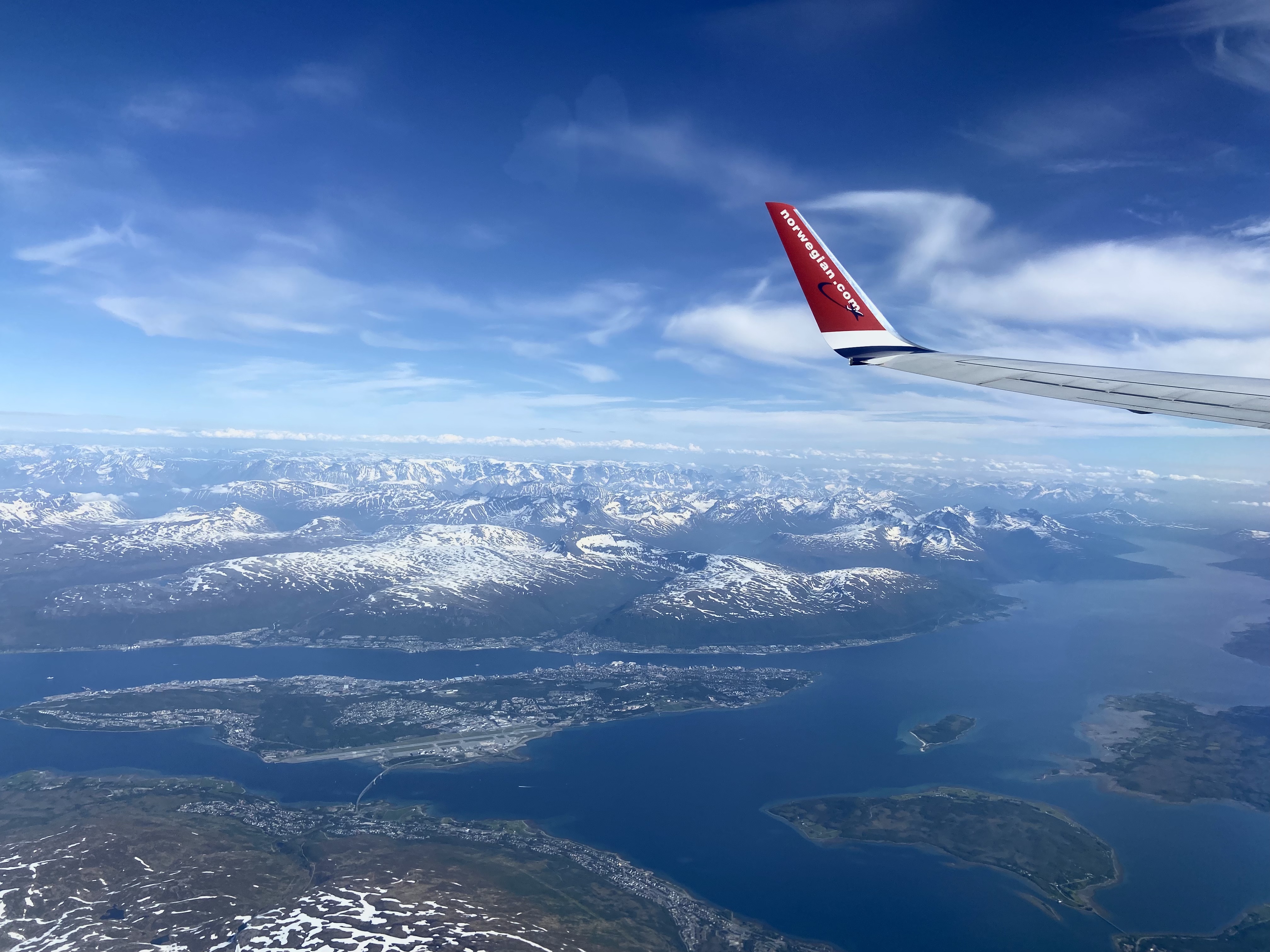
We flew out of Tromsø last Sunday. Despite the threat of strikes and potential airport chaos, for us everything went without a hitch. Flying out of Tromsø is spectacular. The island the city inhabits is still surrounded by snow-capped mountains.
Snow-capped mountain peaks and Tromsø from the air
Andrew and I arrived in Edinburgh in the evening, then the next day we took the train, via Carlisle, to Settle in the Yorkshire Dales. My dad met us as we climbed down onto the platform. It was both wonderful to see him after two and a half years, and jarring at the same time as he stood well back: the first time we’ve met and not hugged immediately in many years.
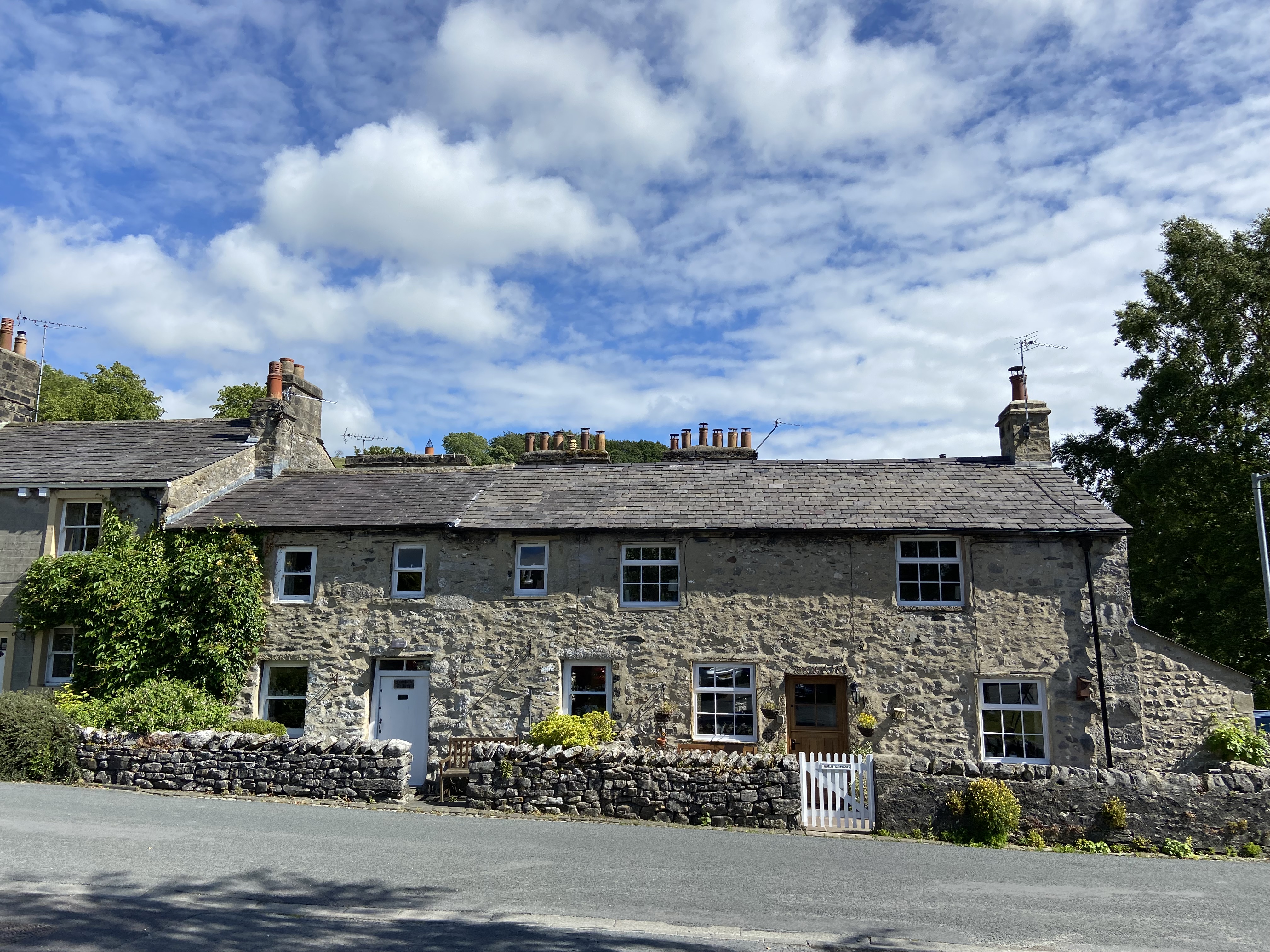
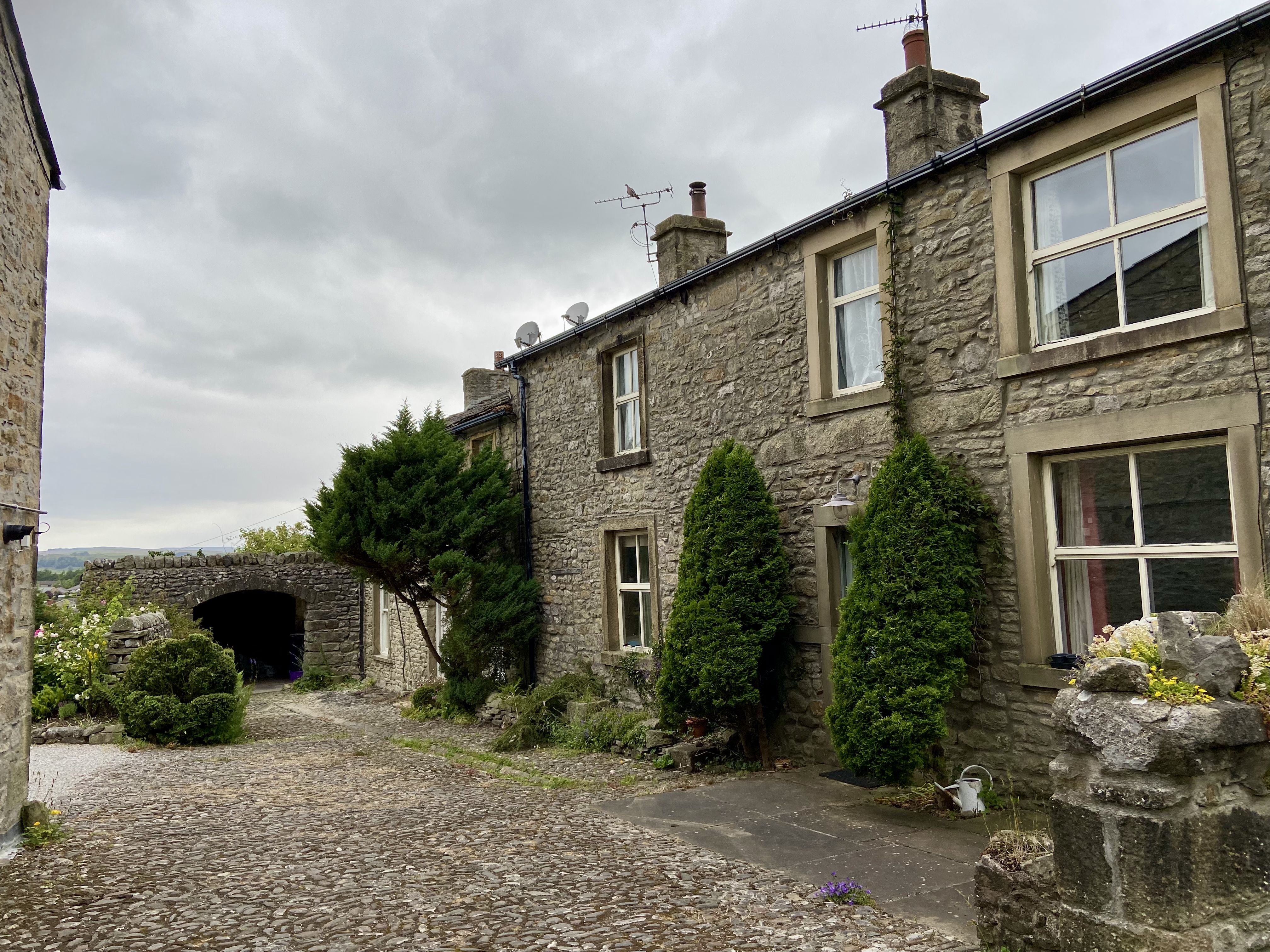
I had booked an AirBnb – an old workers’ cottage in Upper Settle. Our intention was to quarantine for a week before moving into my parents’ house, but our plans changed with the sad death of my mother-in-law. Instead of quarantining, Anna joined Andrew and me and we drove to Glasgow to attend her funeral two days ago.
Driving in the UK again was something of a challenge. When I bought my car two years ago in Norway, I went for a sturdy SUV. it had to be suitable for winter driving and potentially farm roads. I wasn’t looking for an automatic, but as luck had it, that was what I got. Mum and Dad’s manual, diesel Polo couldn’t be much different. Add in the fact that the national speed limit in Norway is 50mph and I hadn’t driven on the left for three years and starting out was something of a challenge. Our practice run into Skipton was … interesting! Sixty mph on the narrow, winding road seemed impossible. I kept slowing down to go through the towns and villages, only to realise I was already only doing forty. I was amused then, when Dad solemnly bade me not to drive too fast as I set off a couple of days later to drive to Glasgow.
John also flew over and joined us for the funeral, which was only very small, but which fortunately went well. He returned with us to Yorkshire, and so yesterday afternoon, for the first time in many years, John, Anna, Andrew and I all sat in my parents’ conservatory together.
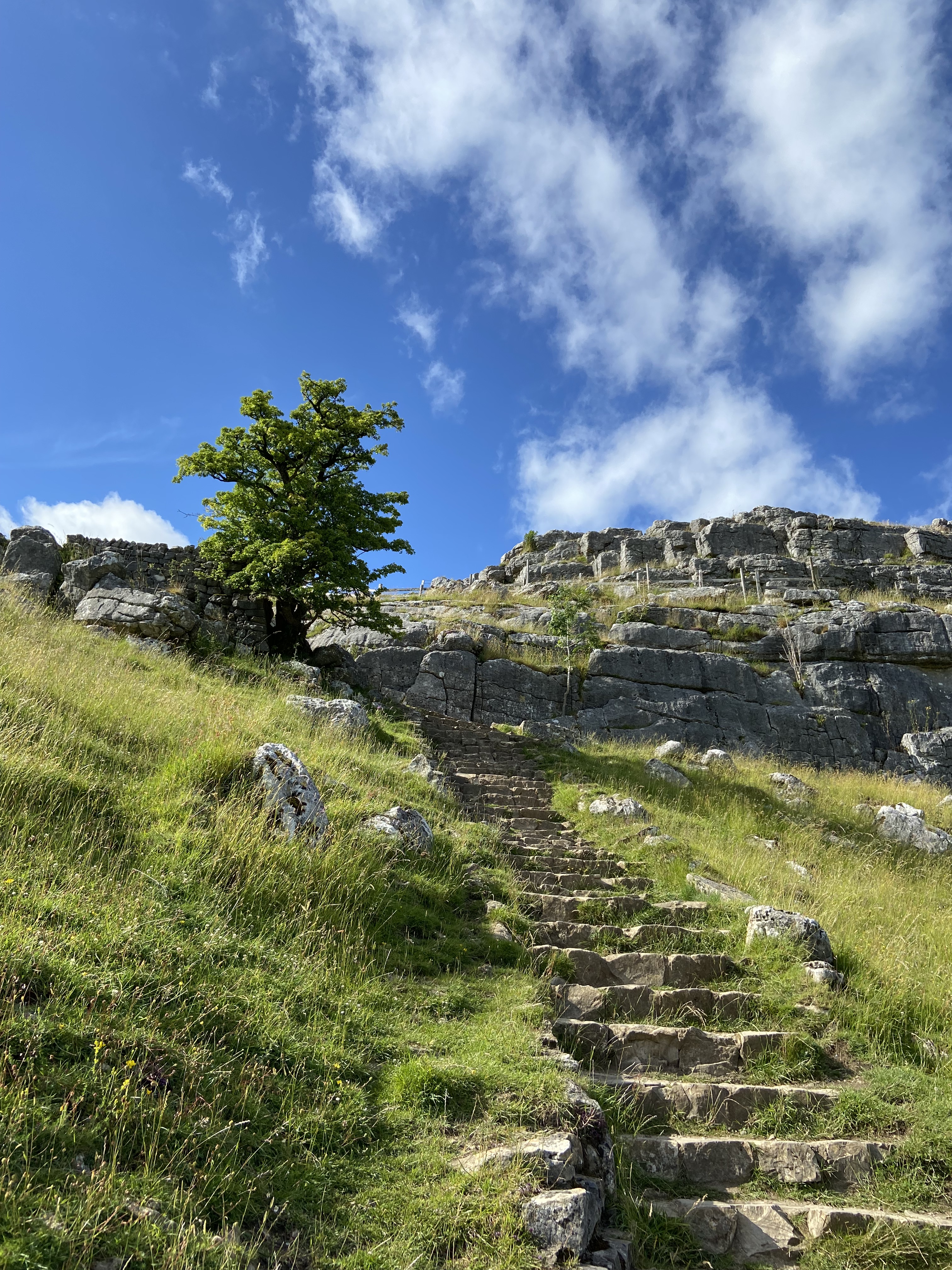
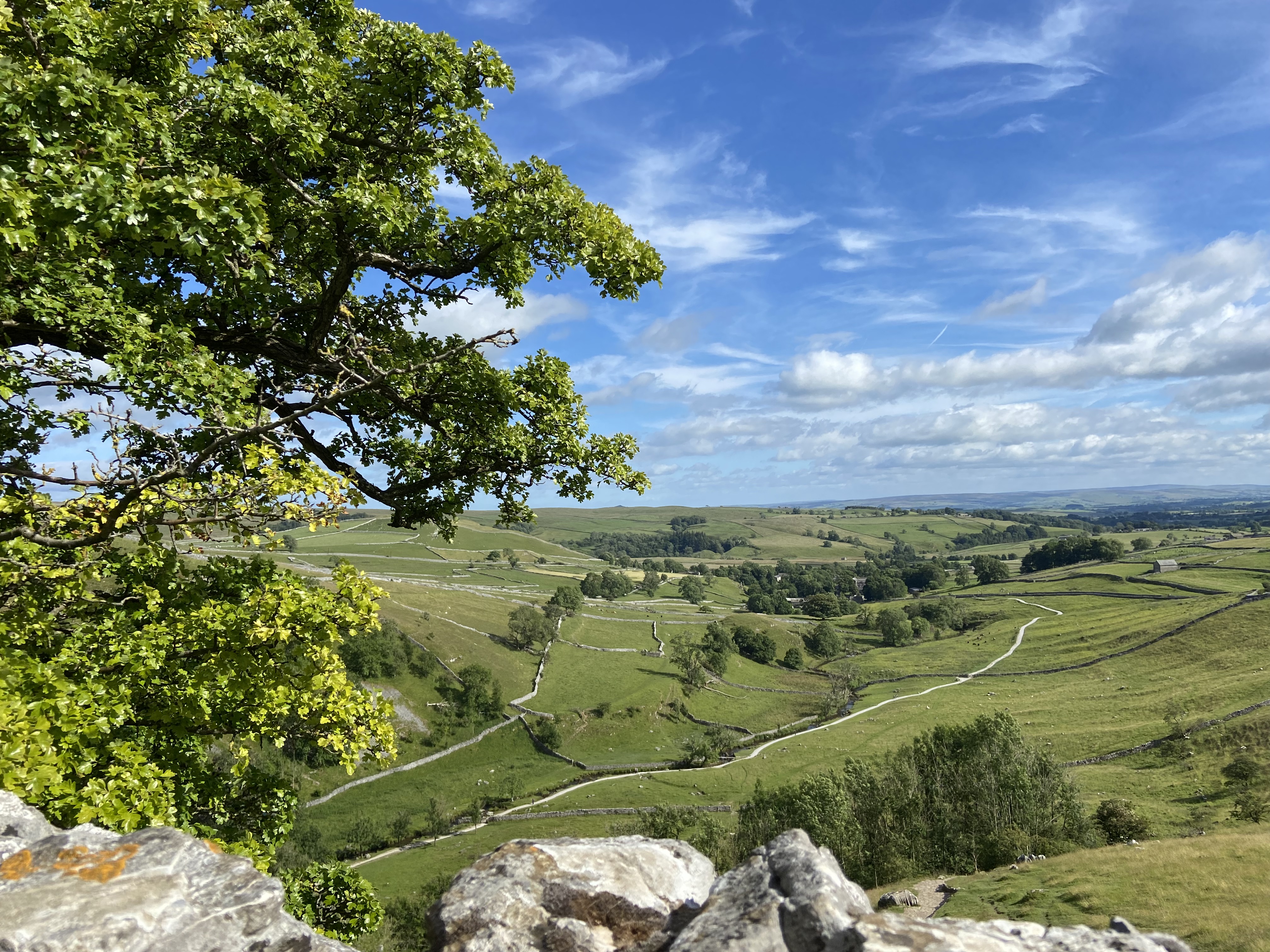
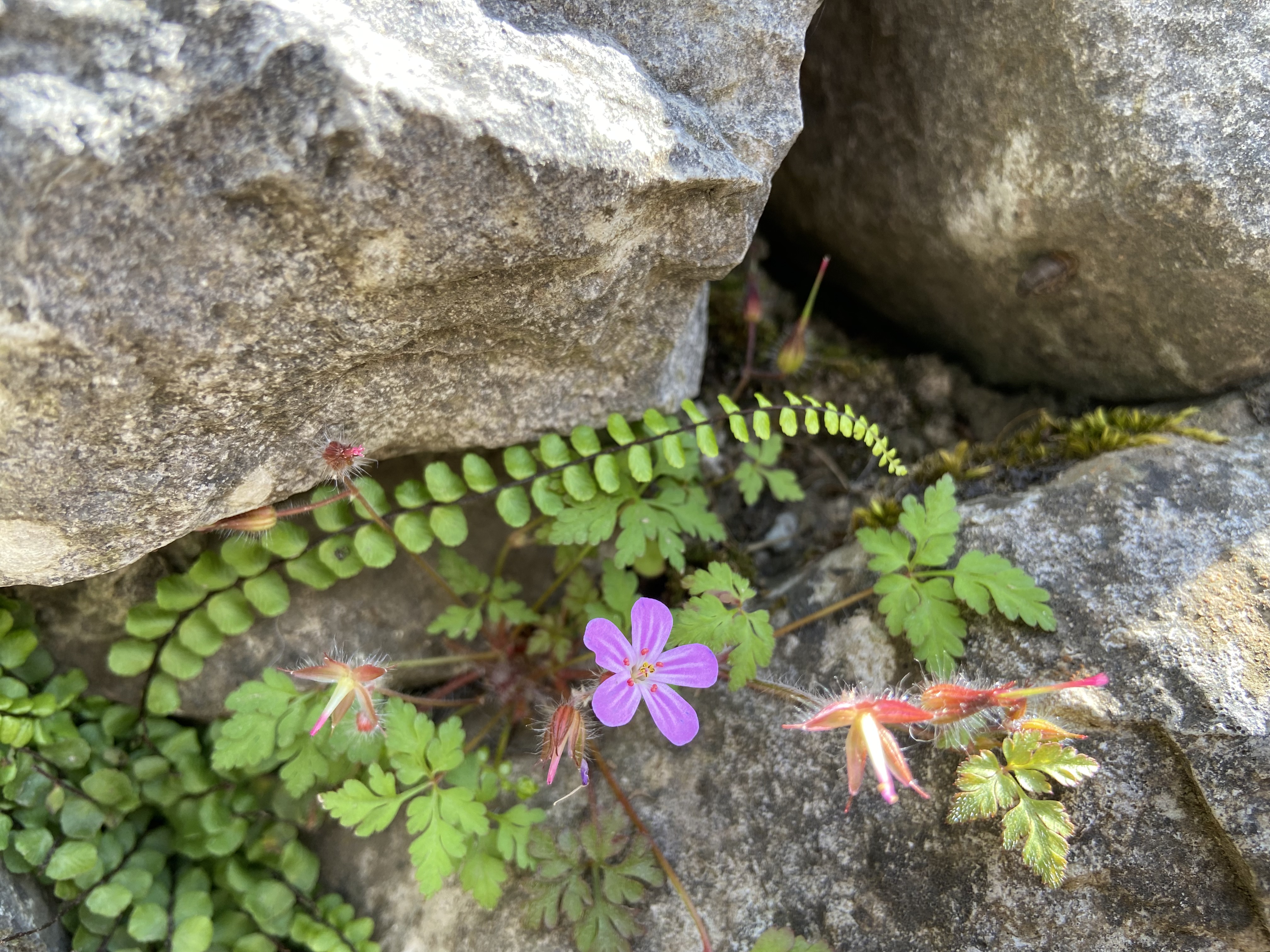
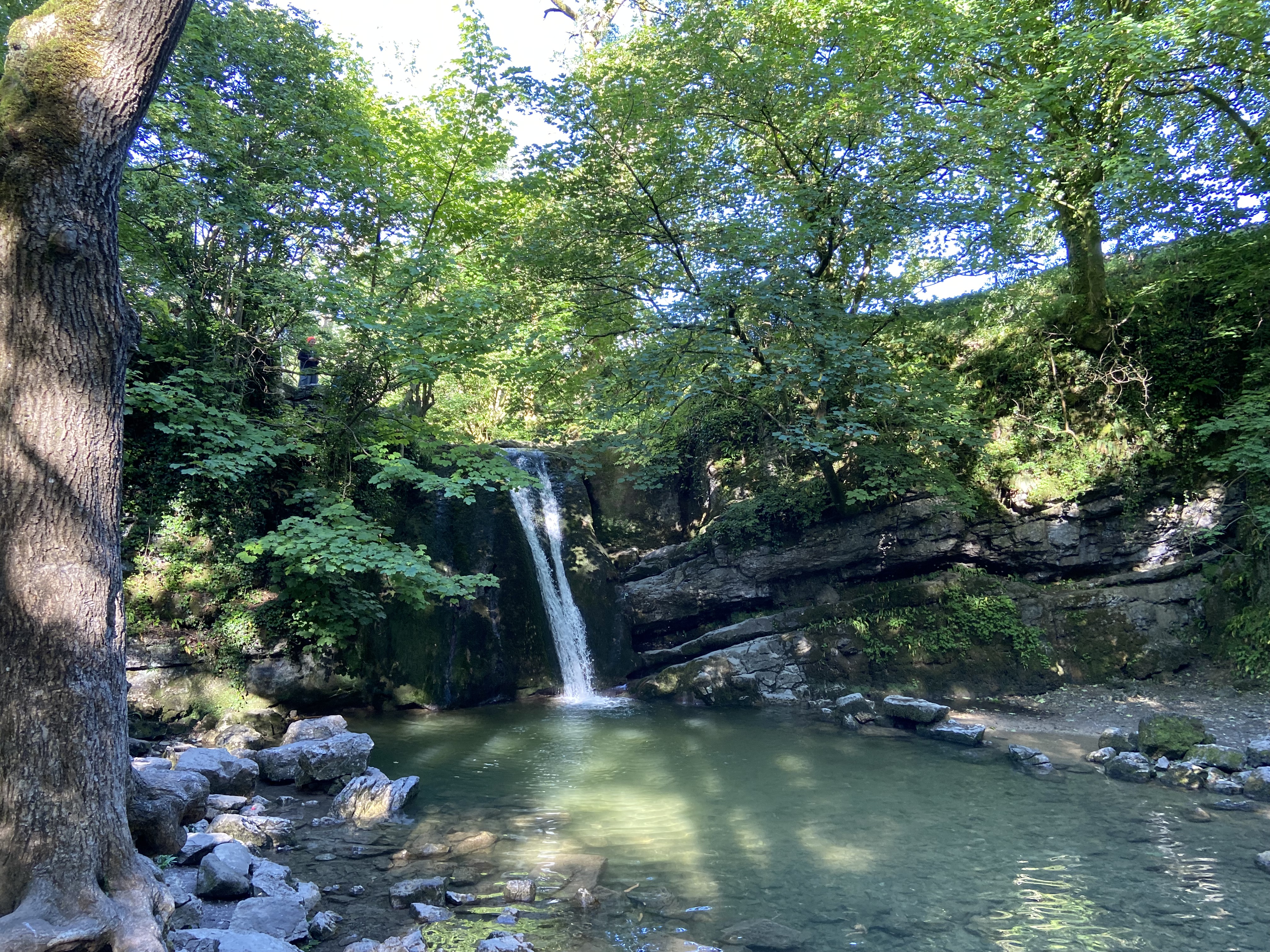
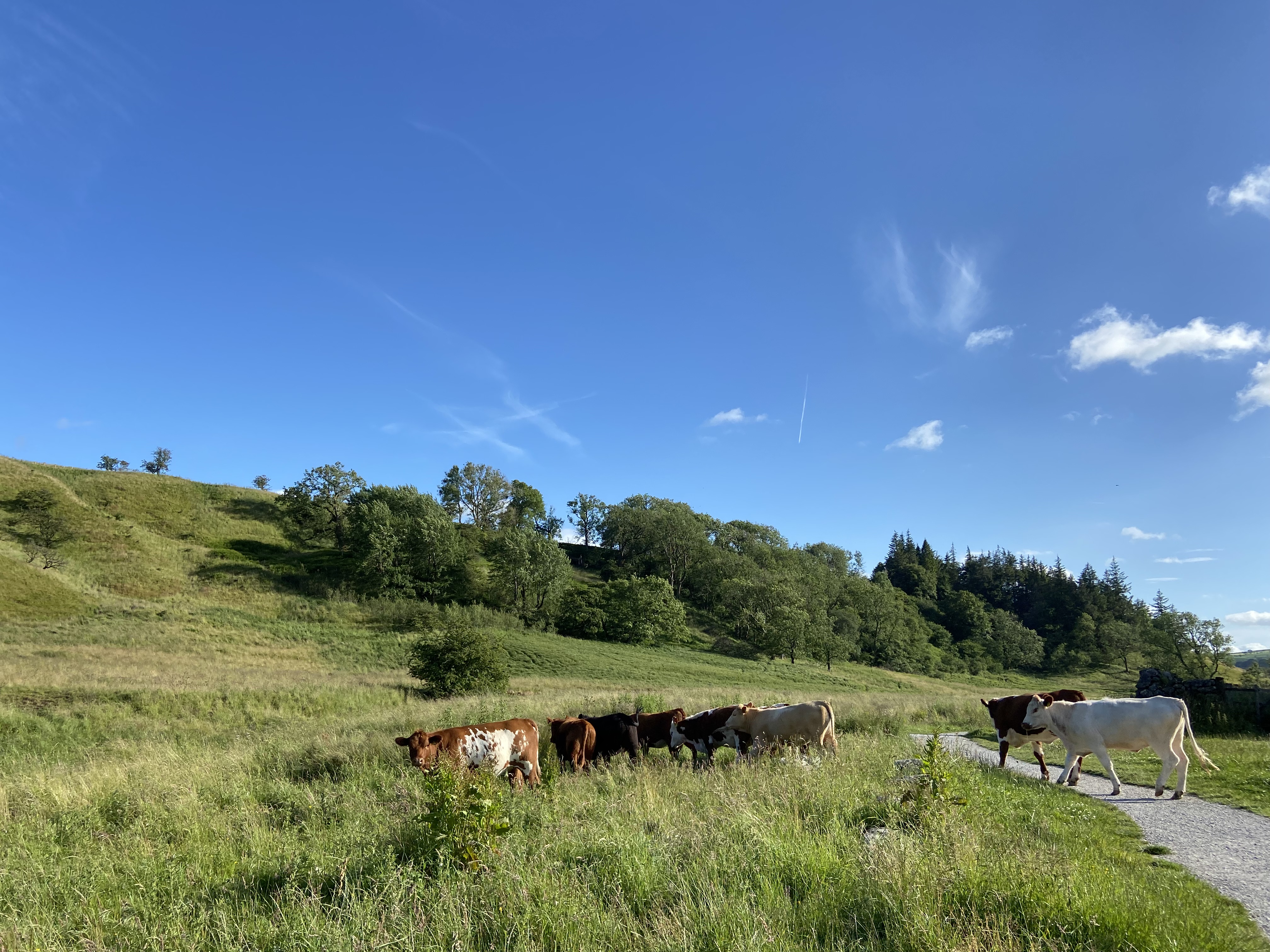
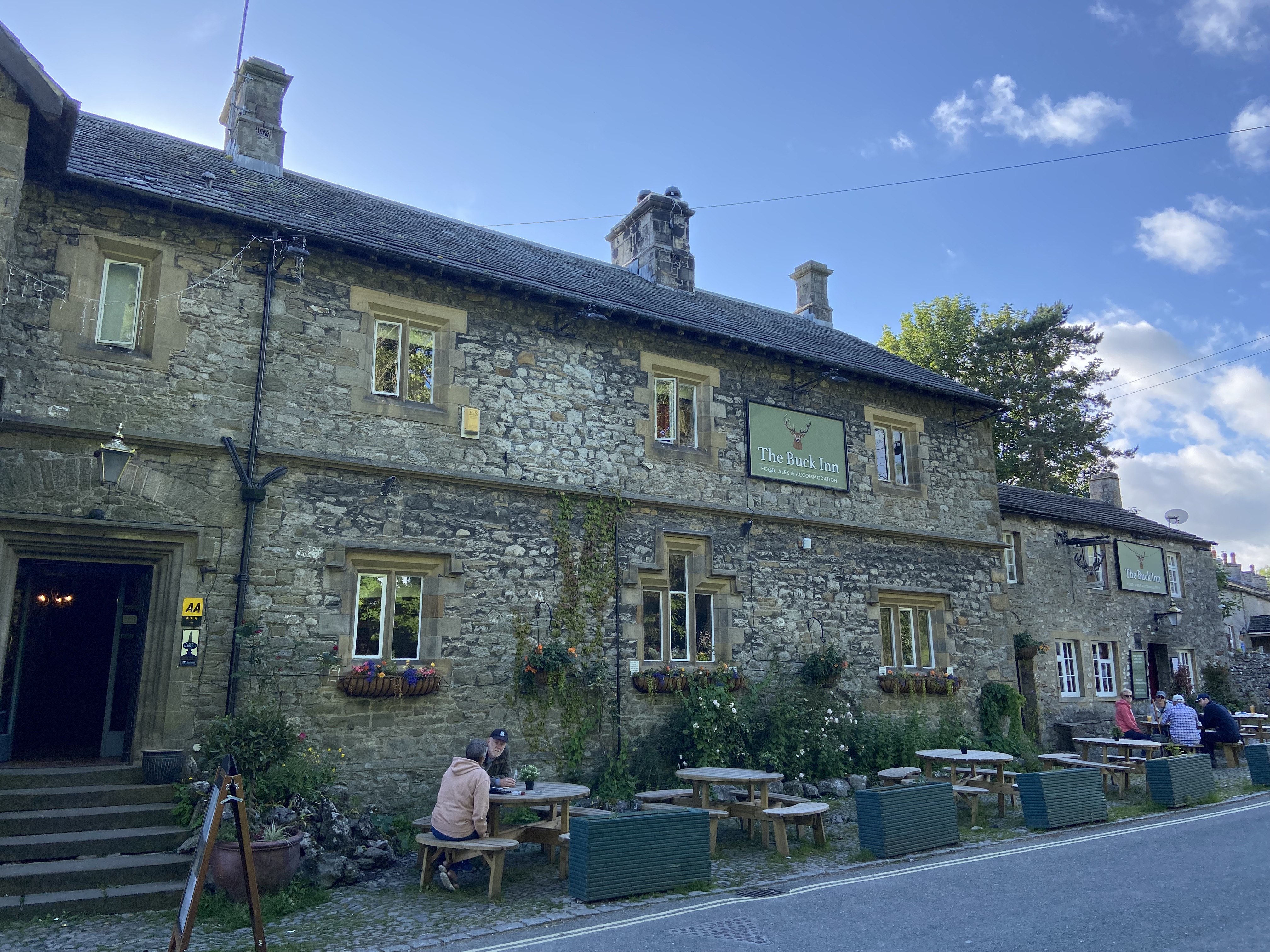
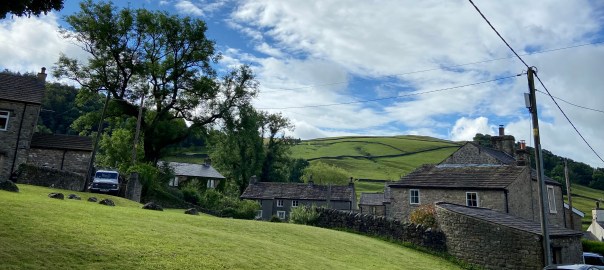
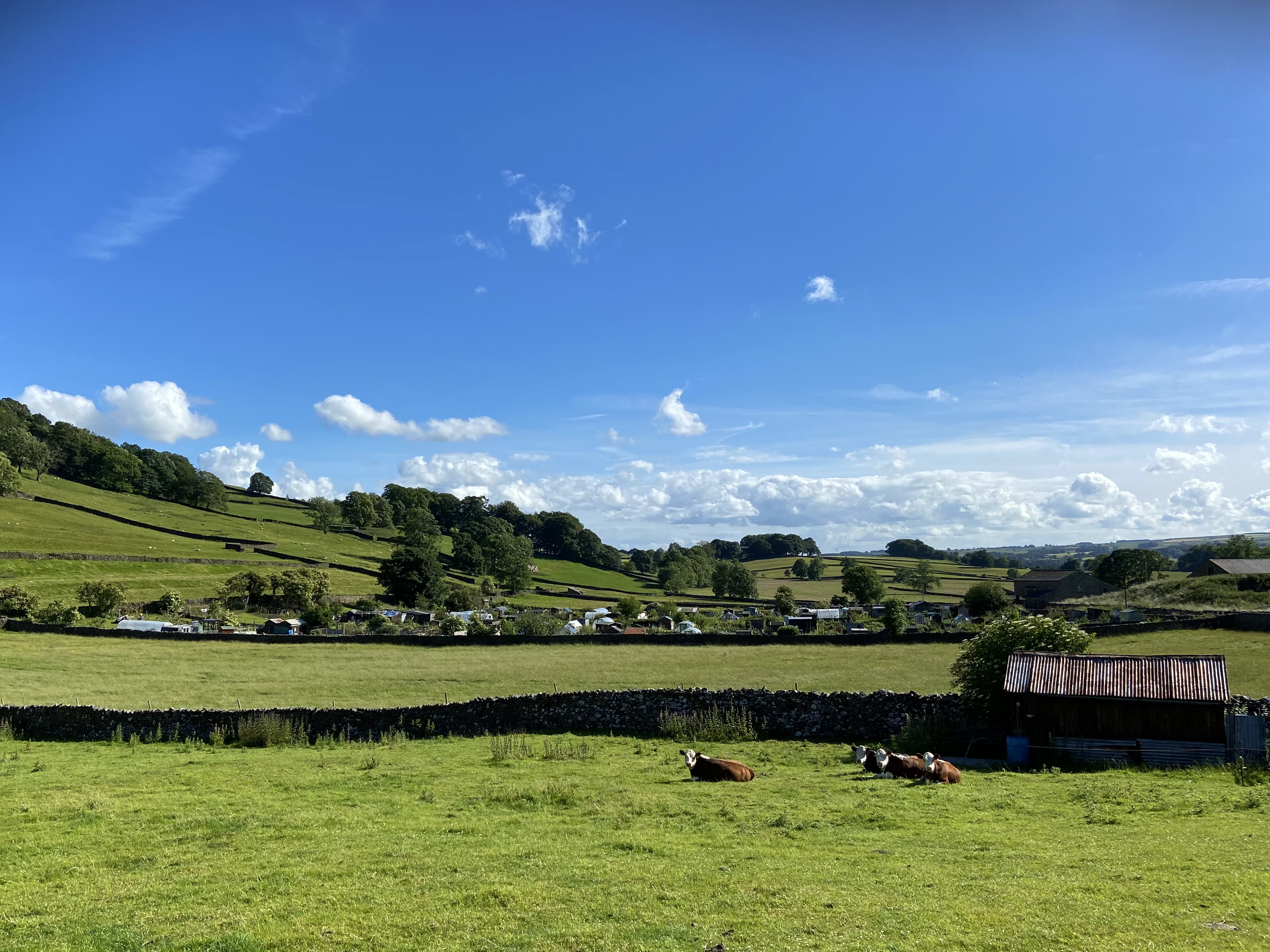
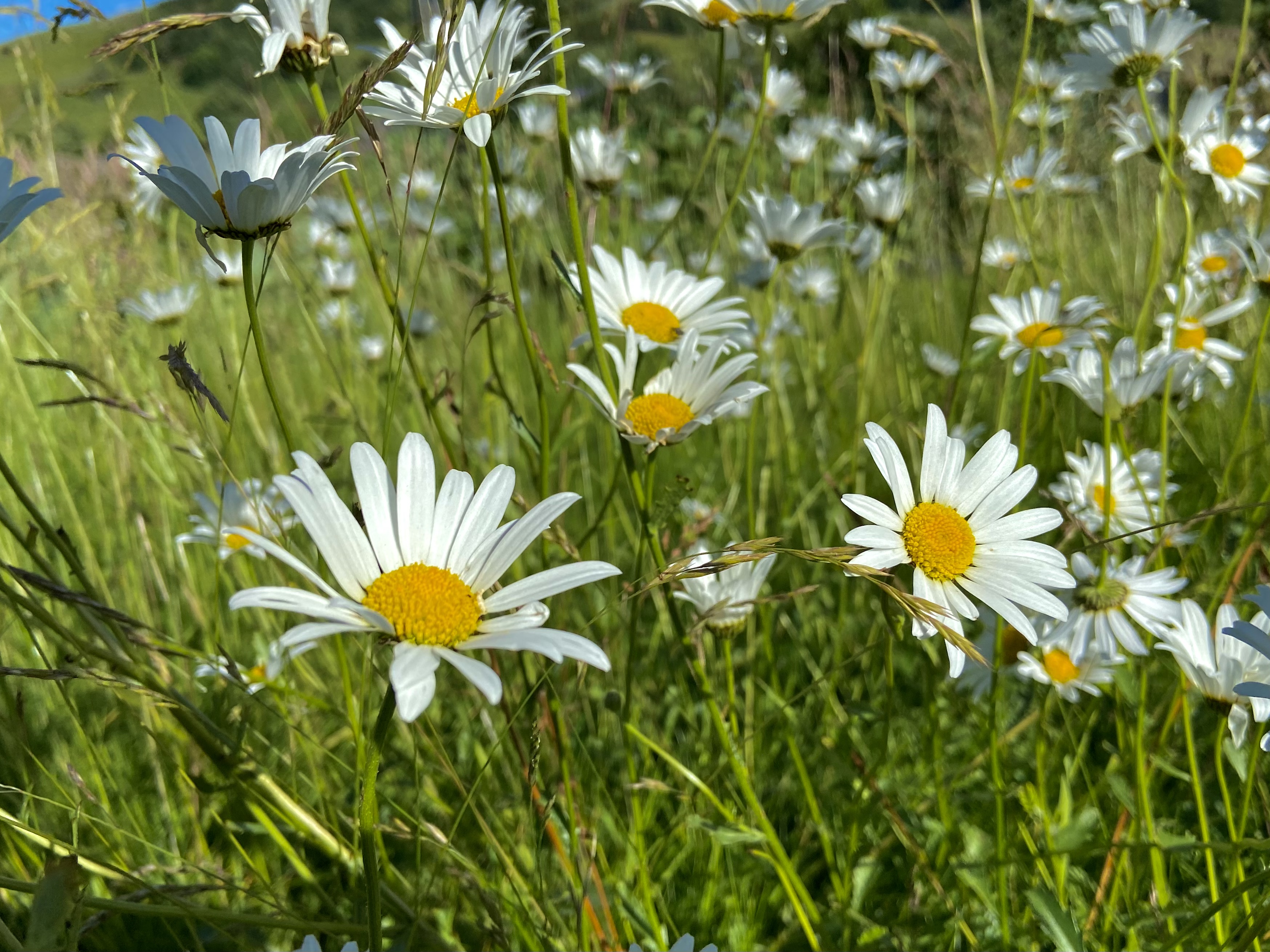
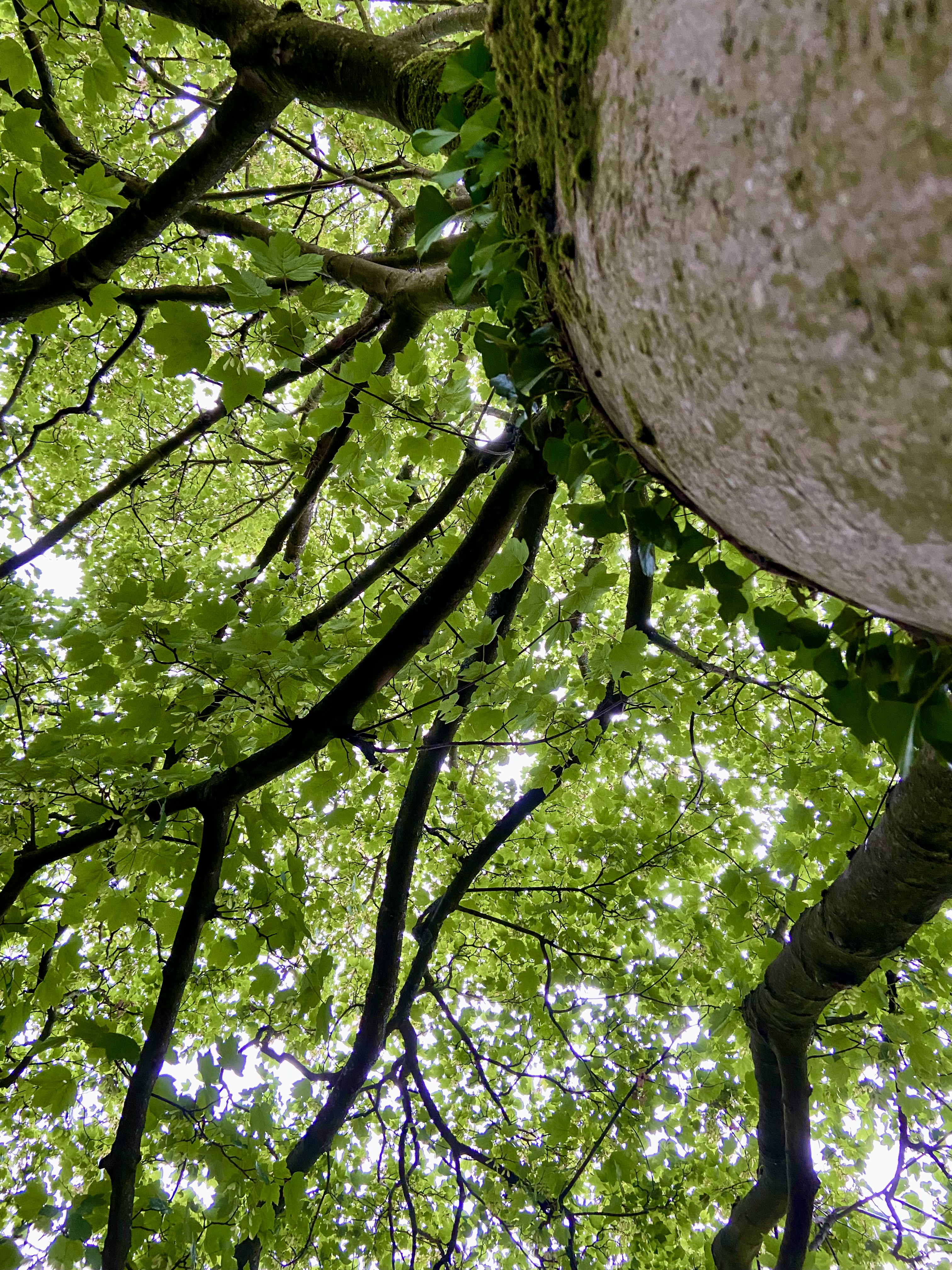
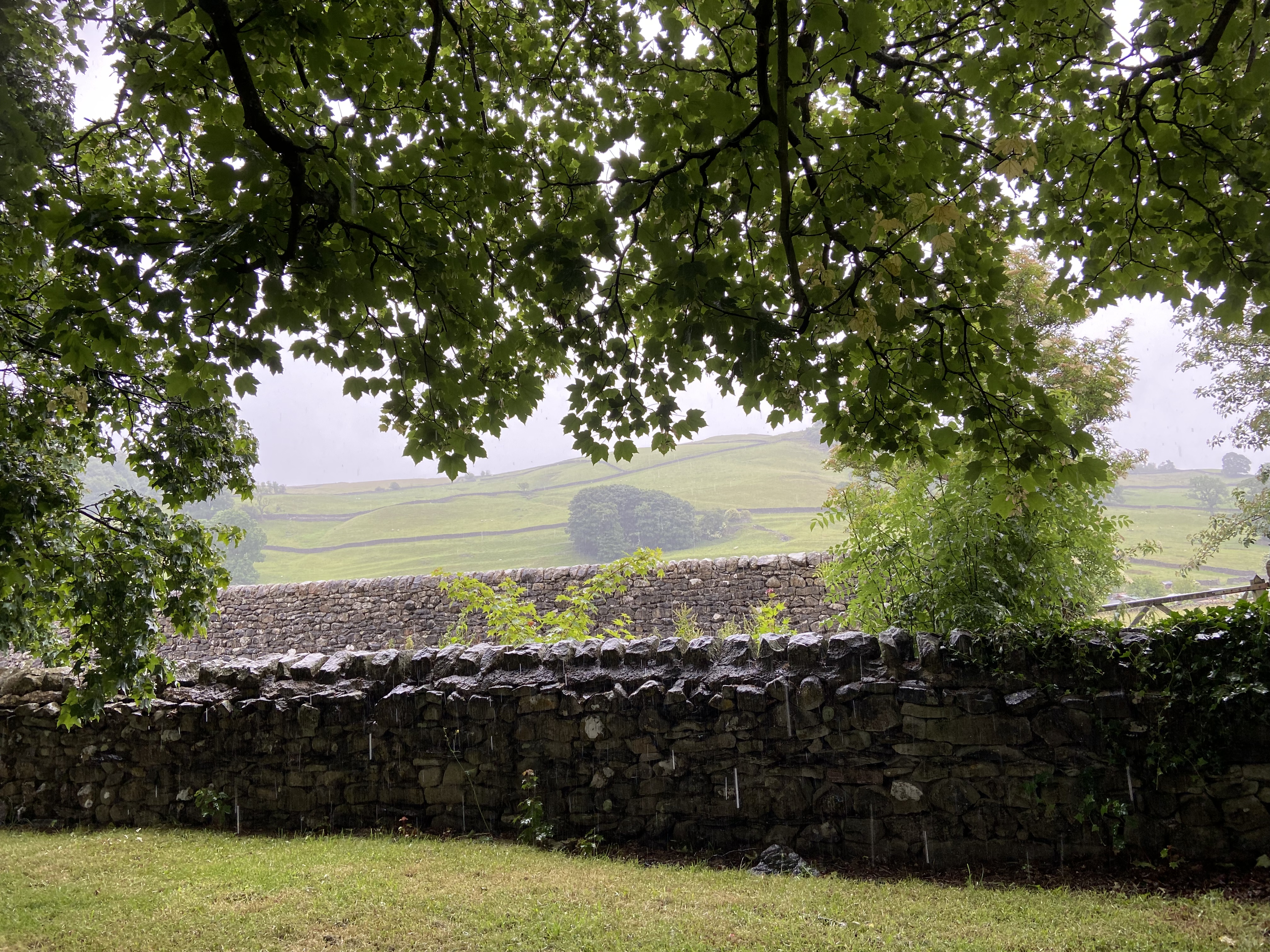
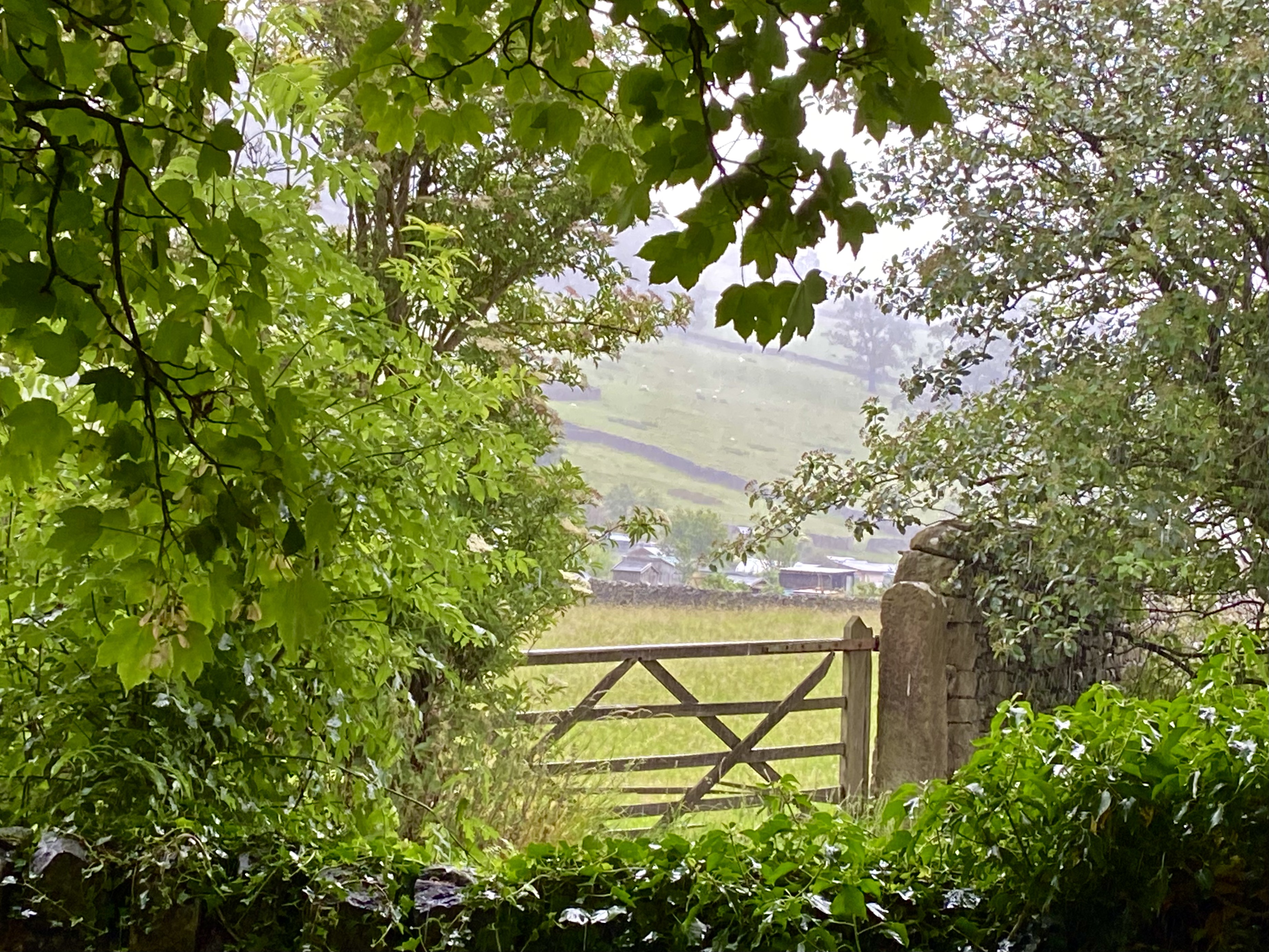
Though I was in the UK in spring, with Anna, it’s different being back in Yorkshire. The contrast with the northern Norway summer is striking. Where the growth around Troms is short-lived, wild and uncontrolled, here the green has a quiet maturity, with its dry stone walls climbing the fellsides and the clustered grey houses on steep lanes. The rest of this entry then, will be a few of the photographs I’ve taken this week, in sunshine and showers, both in my parents’ garden and as I’ve wandered round the town.
Green fields and drystone walls – view from Ingfield LaneDry stone walls and graceful trees
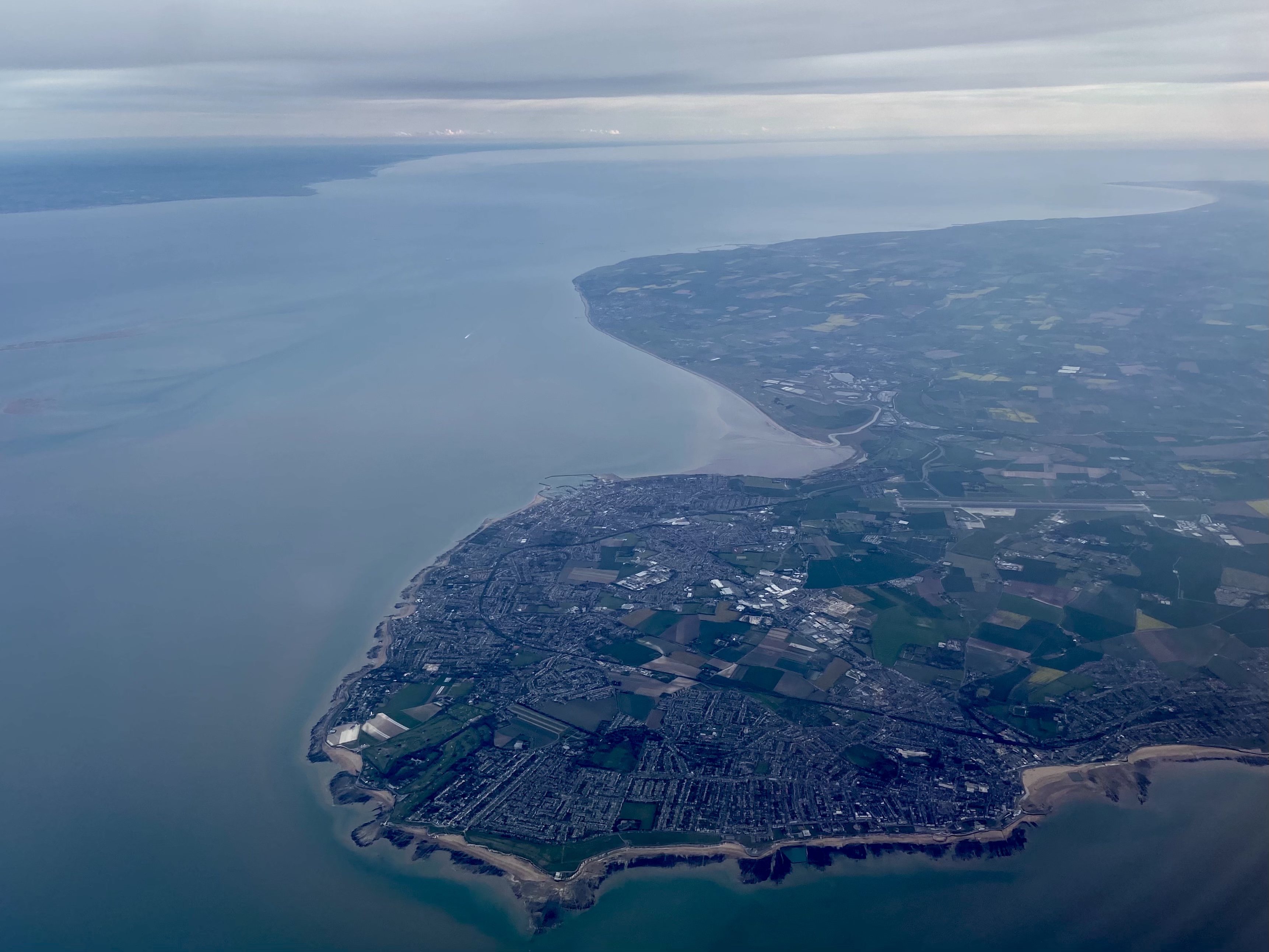
I flew out over the snowy mountains around Tromsø in the early afternoon on Thursday and at twenty past seven, I caught my first glimpse of the UK since December 2019.
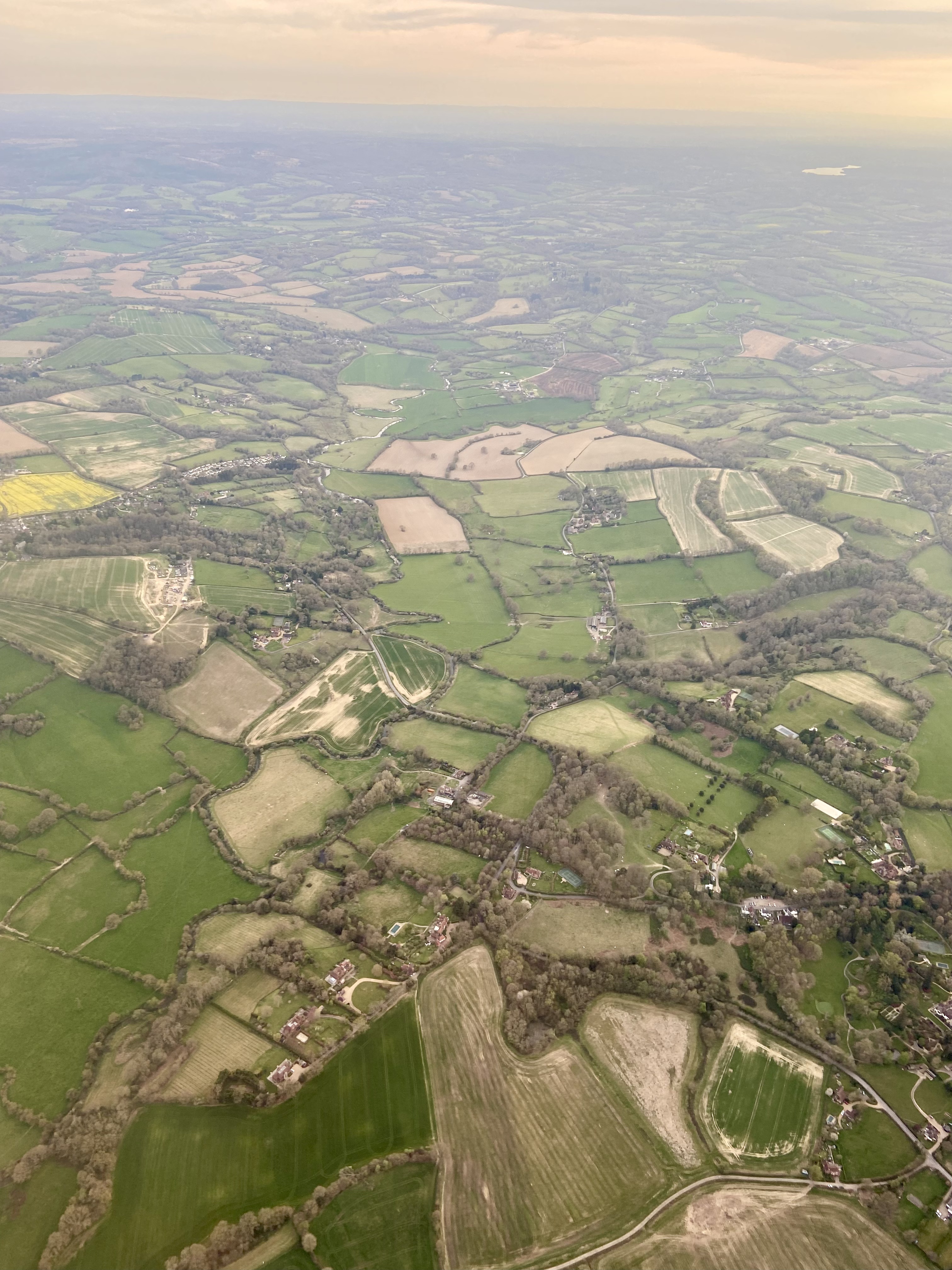
Bottom corner of England from the air
As I flew over, I was struck by how green it all was. There were so many small fields, with hedges as their boundaries. There were also mansion houses scattered among the fields, dotted with swimming pools and tennis courts. It is so different from Norway!
As the wheels touched down, I found myself smiling, then there were tears in my eyes. Being back in the UK after so long was very moving. I love Norway, but there’s something very special about returning to my homeland.
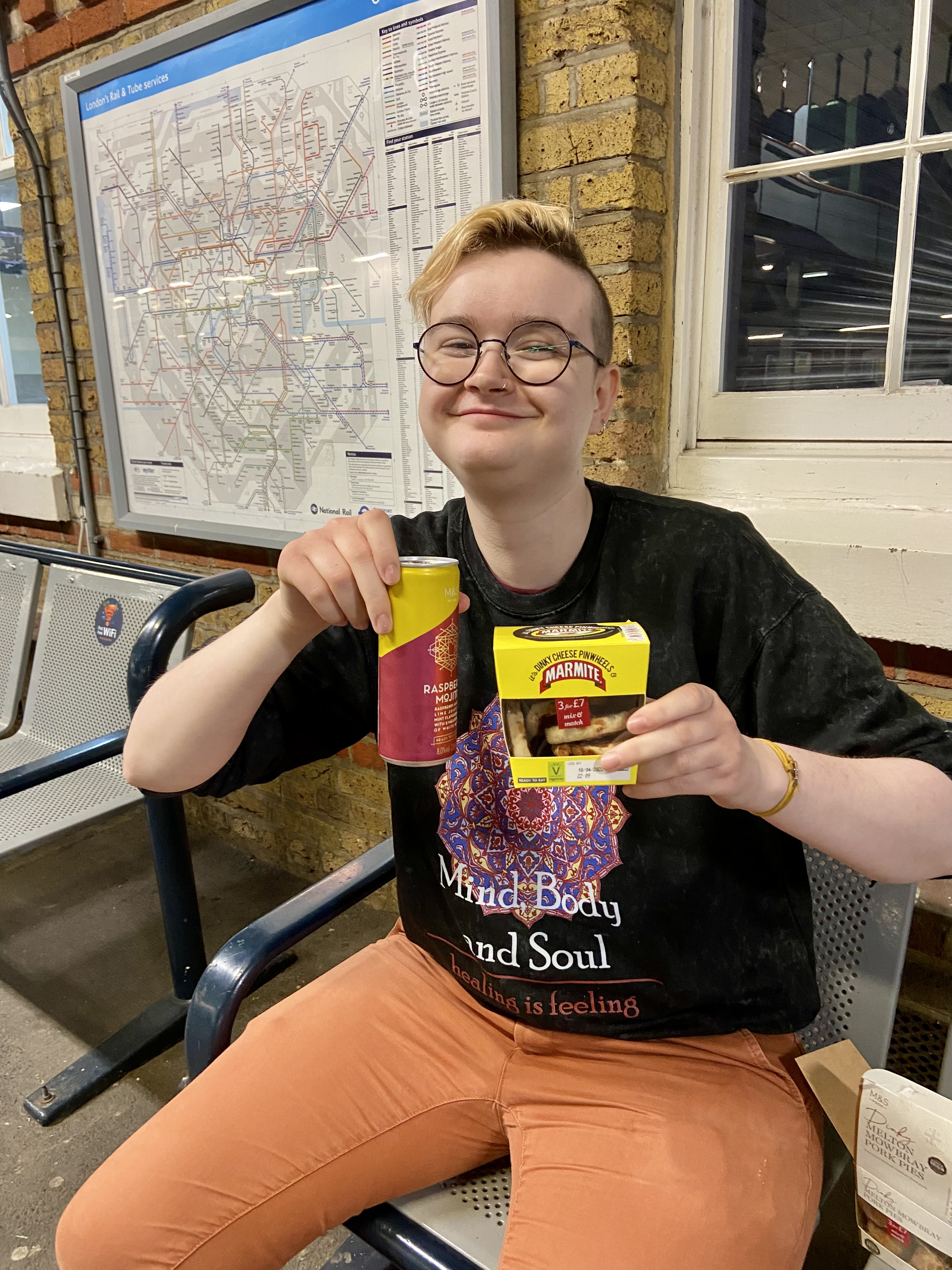
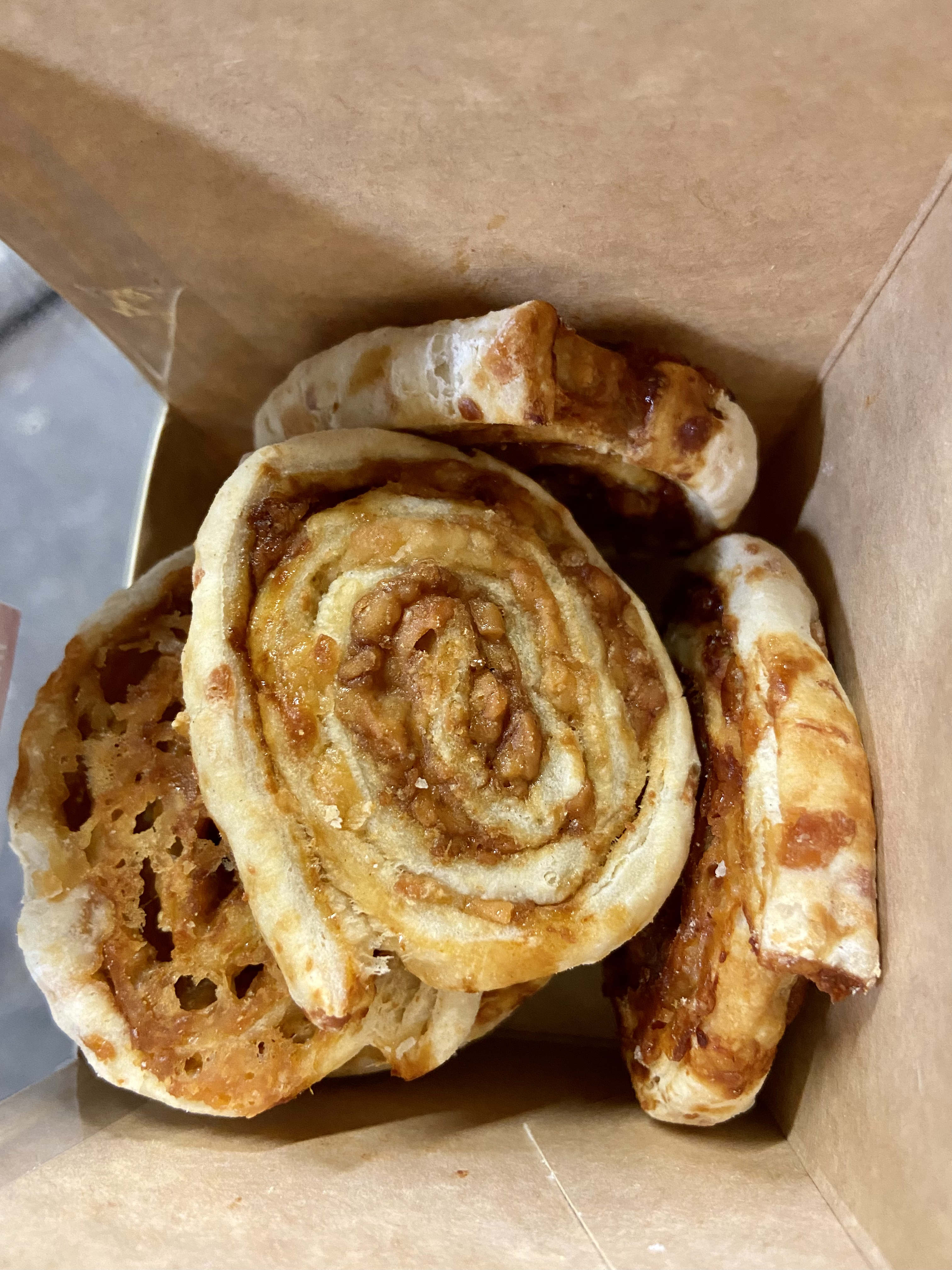
Anna met me at Gatwick. It was wonderful to see her again. We bought marmite pinwheels and chilled raspberry mohitos from Marks and Spencer and had a mini-party on the station at Clapham Junction.
Anna
I’m posting this belatedly, as the available internet for the past couple of days has made posting impossible. There are more photos to follow, but for now, I want to celebrate the memory of coming home.
This week I have been to Lillehammer, to take part in Den norske veterinærforening‘s fagdager. Den norske veterinærforening is the vets’ union in Norway. Fagdager translates as “subject days” and this was a veterinary congress with lectures separated into different streams for vets working with pigs, horses, small animals and (for me the most important) veterinary public health.
It’s a very long time since I have been to such a big meeting, and it was my first time in Norway. There were about five hundred people there, so it was the biggest gathering I’ve been to in a while as well. Having recently had covid was actually a boon. Had I not had it, I would probably have been much more wary of picking it up. I should add that I’m feeling very much better, which is a huge relief.
The trip has led to something of a cascade of emotions. I couldn’t help reflecting on the fact that I knew almost nobody. The veterinary world is a small one, both in the UK and Norway. Back in the UK, I worked for Vets Now, who run emergency clinics in the UK, and for several years I worked at their head office, and had contact with vets and nurses all over the UK. I also worked in a few different places and knew people from university. If I attended a big meeting in the UK, there would probably be loads of people there to catch up with. There was a party night on Thursday, and all around me, other people were doing just that. There were also random outbreaks of singing, including the Norwegian Toasting Song, which I came across for the first time at the Christmas Julebord back when I was working at Tu veterinary clinic back in Rogaland. In fact the only person I did run into was Dagny – Scary Boss Lady from Tu – who gave me a cheerful hug, but was naturally catching up with lots of people herself.
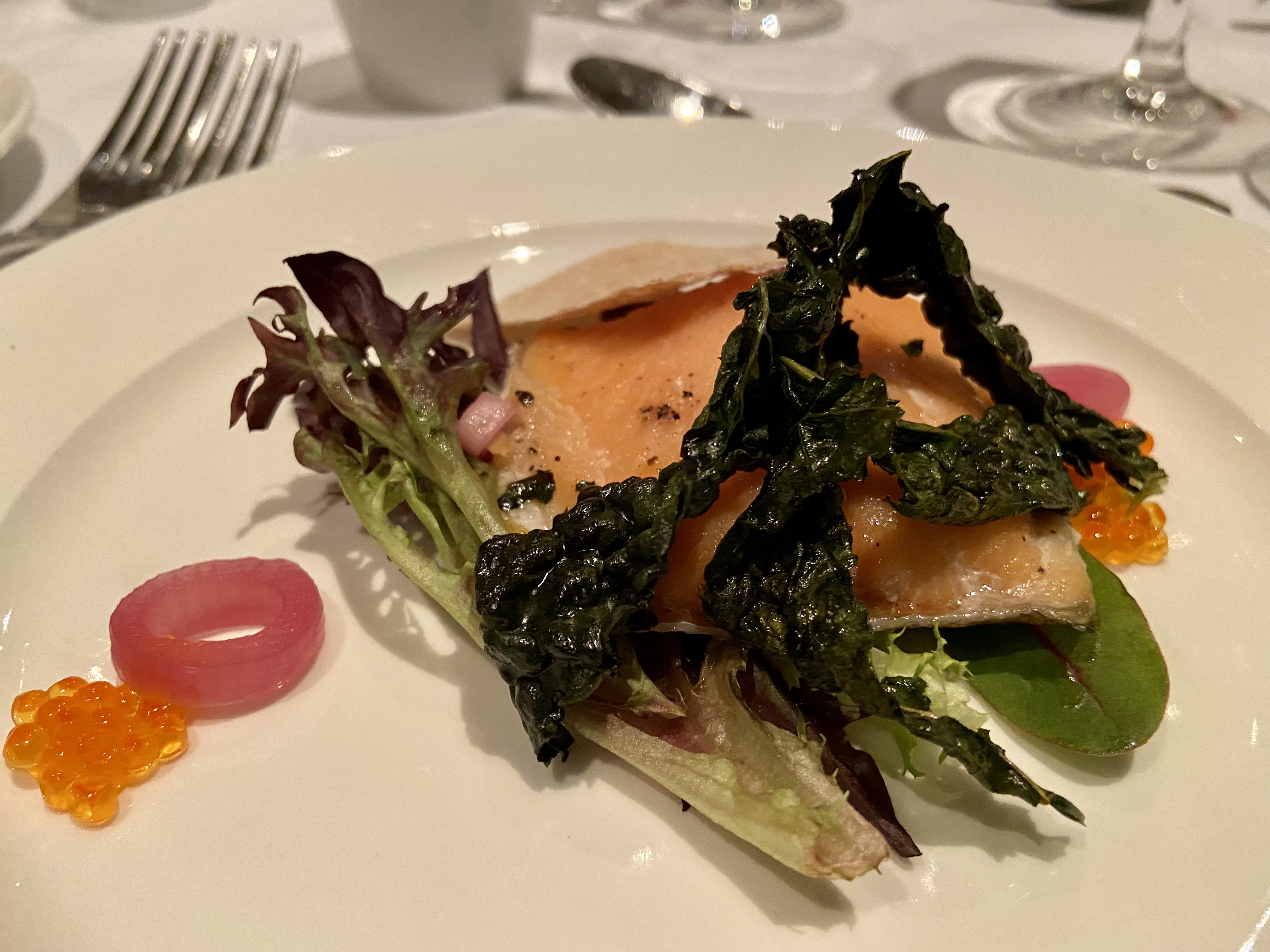
The food was good, though with five hundred people being served it took about three hours from the fish starter to the pannacotta dessert.
I travelled down with Astrid, who works in Storslett. We flew from Tromsø to Oslo and then got the train to Lillehammer. Both those things were something of a novelty, as was leaving northern Norway, which I haven’t done since moving here in August 2020. Coronavirus has turned me into something of a hermit. There was definitely a feeling of opening horizons, both from travelling, and from the lecture streams themselves.
One of the major themes in the veterinary public health stream was sustainability. I guess this might seem somewhat odd, as those two things don’t immediately appear to be strongly linked, but sustainability is something of a theme at the moment in farming, as it probably should be. The European Union is in the process of introducing its Farm to Fork Strategy (“aiming to make food systems fair, healthy and environmentally-friendly”) and because Norway is integrated with the EU (though not a member state) we will be taking on board some, if not all, of the new regulations and initiatives. Norway, as I have mentioned before, has more stringent rules on animal health and welfare than the EU, which it is unwilling to compromise to make food cheaper, or “competitive” as officials in the EU put it.
The most interesting lecture, from my point of view, was one which covered an interesting mix of discussion over the relative amounts spent preventing new variant CJD (BSE related prion disease) and coronavirus and whether insects might be integrated into the food chain in order to minimise the long term impact in the fight against BSE/prion disease.
Regarding the relative costs around the reactions to both diseases, it is difficult to estimate the price of lockdowns, but the argument was that the amount spent on fighting BSE was way over the top. Given the number of samples we take on sheep and cattle, but also on reindeer and even wild animals such as moose, the amount spent in the whole of the EU must be colossal. Given that there are still under 300 diagnosed cases of the new variant of CJD (which spread from BSE in cattle) in the world it does seem odd to still be spending so much. It can, of course, be argued that the campaign to prevent vCJD has been successful in terms of disease prevention. As always, it’s difficult to know, when looking at the cost of something where intervention HAS taken place, what the costs would have been had no actions been taken.
But the other side of this discussion was around the fact that the use of meat and bone meal from ruminants in food fed to other animals is still banned, and how these could possibly be used. The suggestion was made that perhaps what is currently mostly a waste product could potentially be used to feed insects, which would produce protein that could then be fed back into the food chain which is an interesting, if rather bizarre thought. We are living through astonishing times, where the world is changing incredibly fast, compared to what went on for probably thousands of years before the industrial revolution. Sometimes I wonder where it will end.
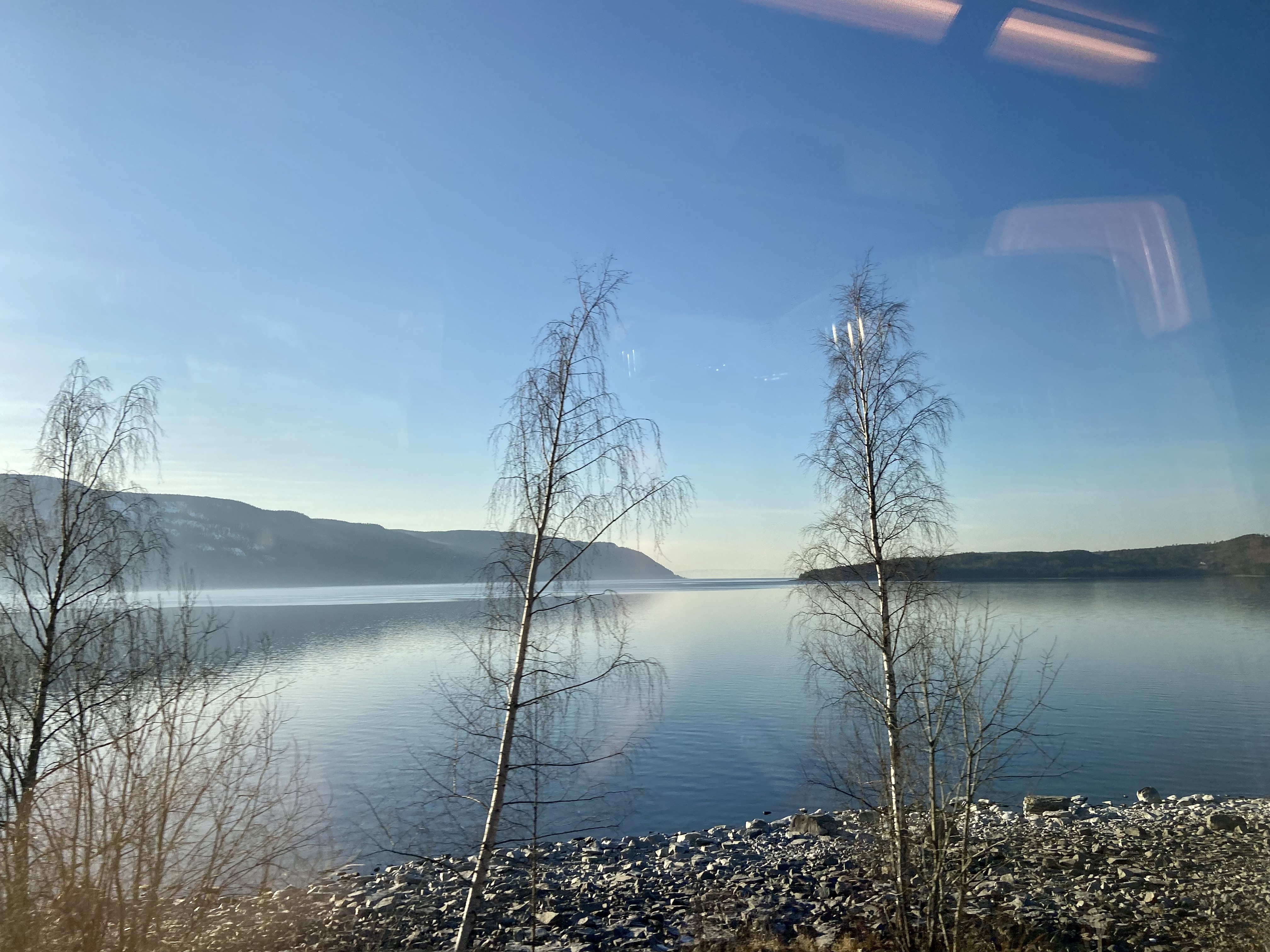
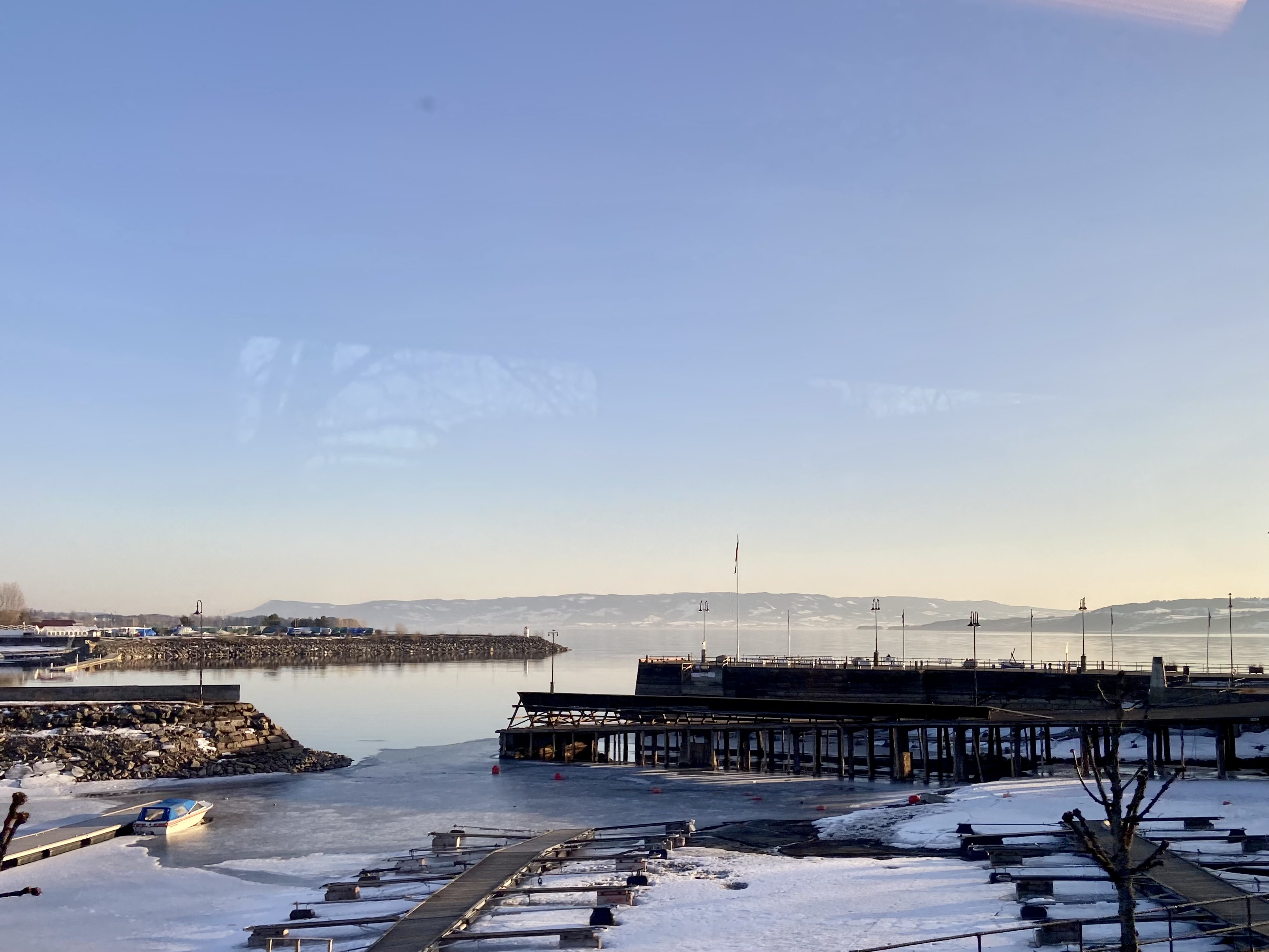
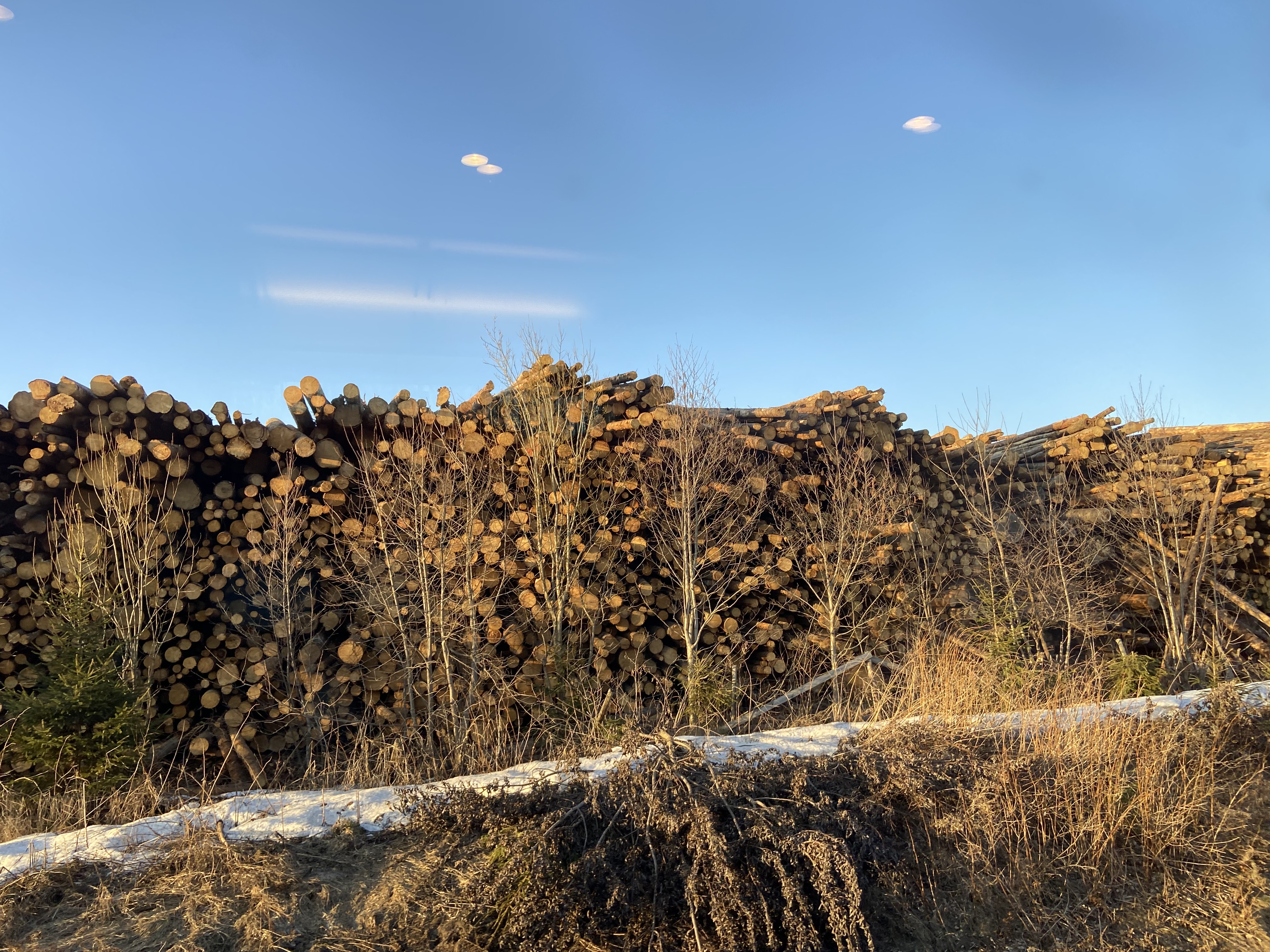
Anyway, back to the more mundane! I enjoyed the train journey from Oslo airport to Lillehammer. I took some photos from the train window. Apologies for the glass reflections. The days when you could open windows on long distance trains are long gone.
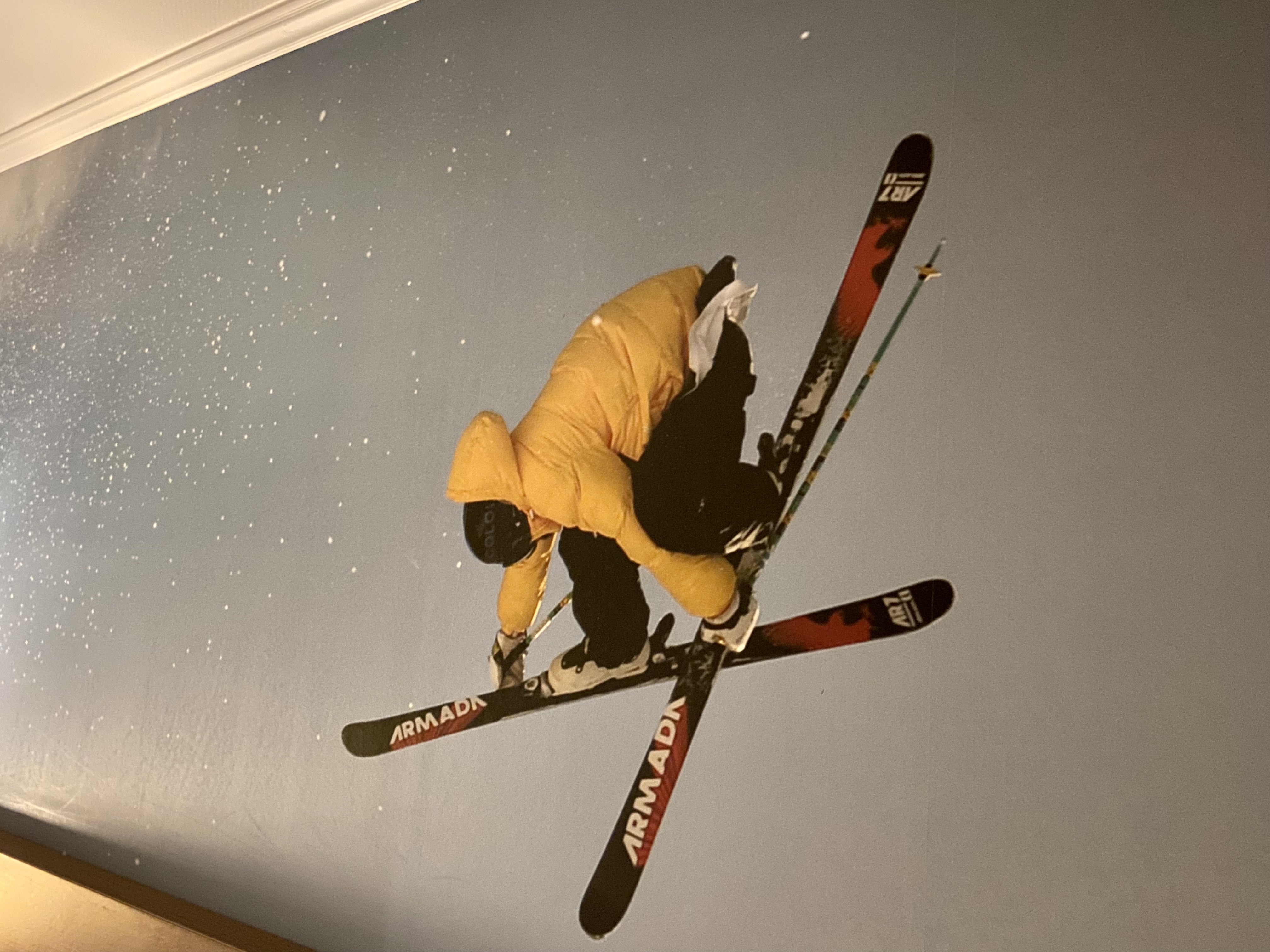
The hotel in Lillehammer was pleasant. I guess that if you’ve heard of Lillehammer, it’s probably because the Olympic Games were held there in 1994. I say the Olympics, because though in the UK and elsewhere, generally people refer to the Olympics and the Winter Olympics, here in Norway it’s the other way round. Here we have the Olympics and the Summer Olympics. Anyway, there was a ski jump just visible from the back of the hotel, and this chap was caught in an eternal gymnastic leap on my bedroom wall.
Picture of a ski gymnast on the hotel wall in Lillehammer
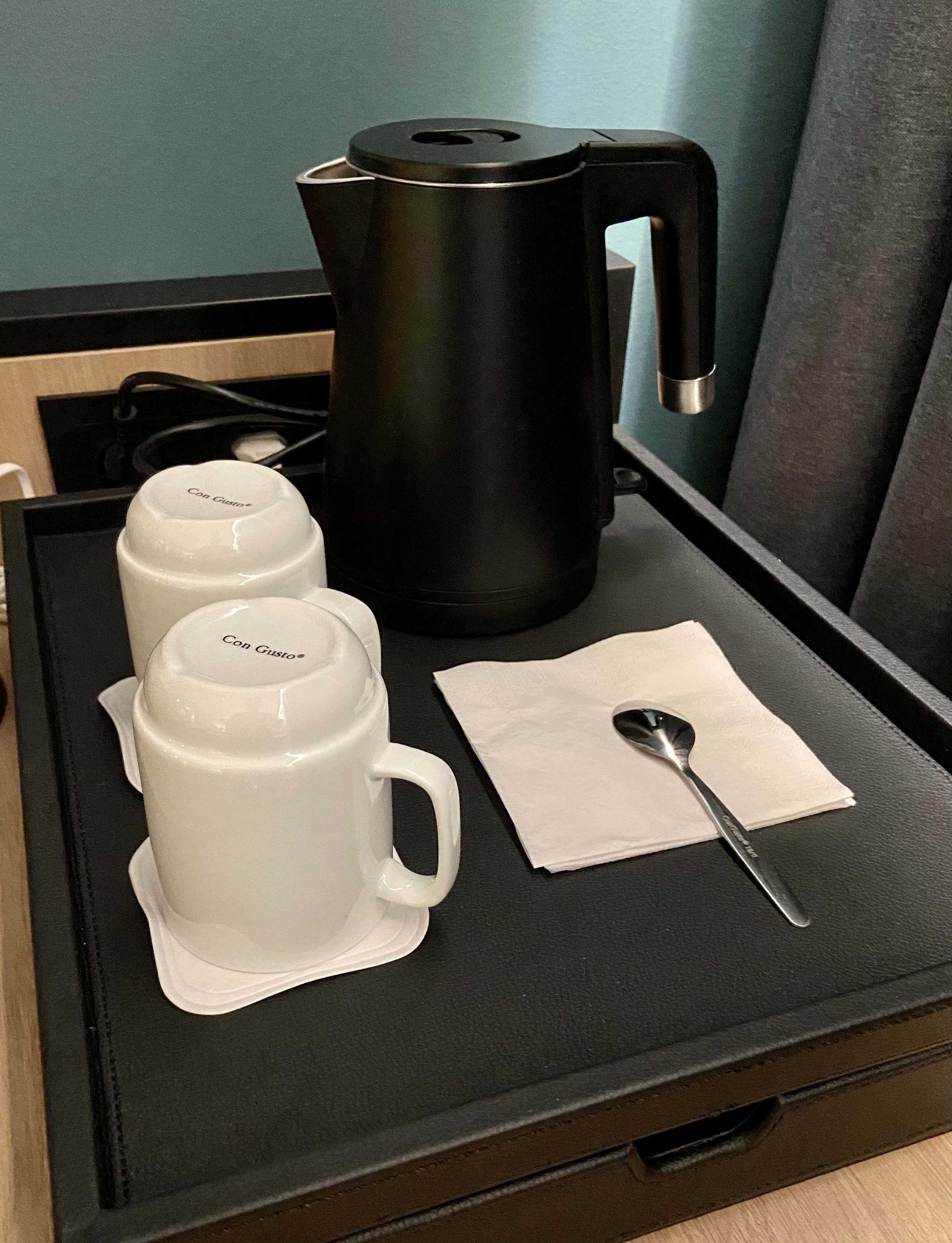
Because there were no flights back to Tromsø or Bardufoss on Friday evening, I spent the night in a hotel at Oslo Airport. I was greeted in the entrance by a red plastic moose in sunglasses, but the most pleasing sight greeted me in the room, and was much more down to earth. Most British hotels have a kettle in the room, but in Norway, it’s so rare that I actually took a photograph!
So now I am home, but going away has been a wonderful boost. Things are beginning to change and the world, which has felt closed in for the past two years, may be opening up again soon. And to that I say, bring it on!
I am writing this from a hotel room in Honningsvåg on the island of Magerøya. Honningsvåg is the «northernmost town on mainland Norway» although technically it’s on an island, so arguably, it isn’t! It’s also one of the smallest cities in Norway, having been given its status in 1996, one year before legislation was brought in stating that Norwegian cities must have at least 5,000 inhabitants.
It’s very much the stereotyped end-of-the-road place. I am reminded of Scottish towns like Campbeltown, Stranraer and Thurso as they were when I was younger. Nowadays, I think most of those remote Scottish towns have caught up with the money to be made from tourism and are now filled with friendly cafes and upmarket shops selling highland-cow aprons and novelty fudge shaped like sheep droppings. But Honningsvåg is still utilitarian. The houses are scattered along the single road, with a few a little higher up the hillside. Though they are painted in different colours, they were built for practicality, with no thought for aesthetics. There’s a toy-shop with faded lettering. The main street is stippled with chipped paint and grey, harled walls. The harbour is charming though.
We drove up over three days, though we only spent three to four hours travelling on each of them.
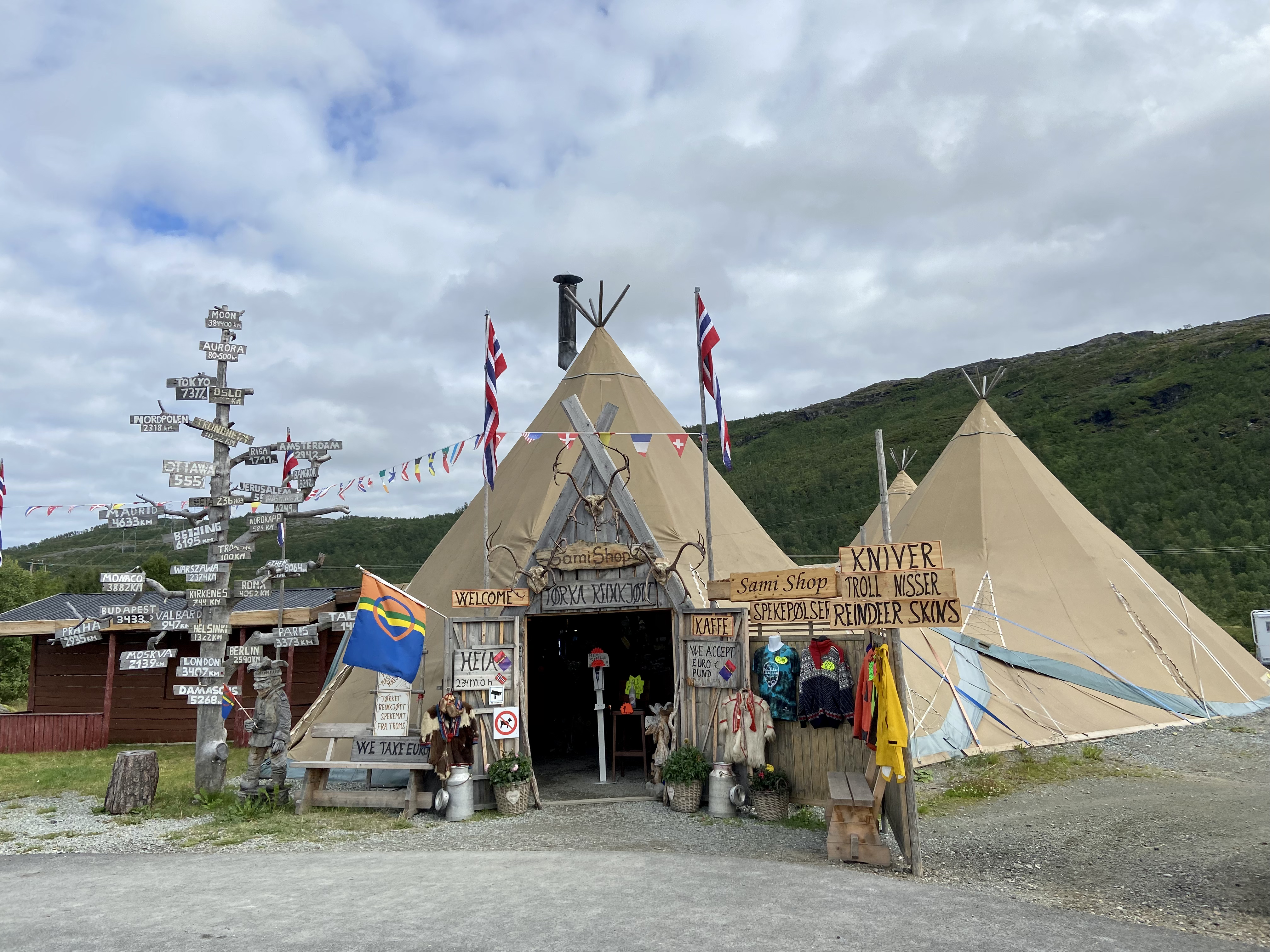
Day one. We stopped off at the Sami shop on the E6 north of Bardufoss. I have driven past a few times, but have never stopped. I was surprised to find a fire in the tent, near the entrance. It was set in a fireplace with a well-designed chimney and was very welcoming. We might stop for coffee on the way back, but we were less than an hour into our journey, so we decided to push on.
It was a beautiful day as we drove along the sides of fjords and through mountain glens. We reached our desination: a cabin near Skibotn, which I had found on AirBnB. The cabin I had booked was very basic: two bunk beds and a stove, but happily it was a campsite where we were able to upgrade to a cabin with a toilet and shower. These campsites are very common in Norway. The cabins are designed to be slept in, by as many people as you can fit in the available space, and not much more. This was a typical example. There were three bedrooms, two with a bunkbed each and the other with a bunkbed and one very squashy single bed. There was a table and chairs, but nowhere else to sit. There were two electric rings for cooking, but pans and plates had to be borrowed from reception. Deciding quickly that we would eat out, we dumped our things and headed out to explore.
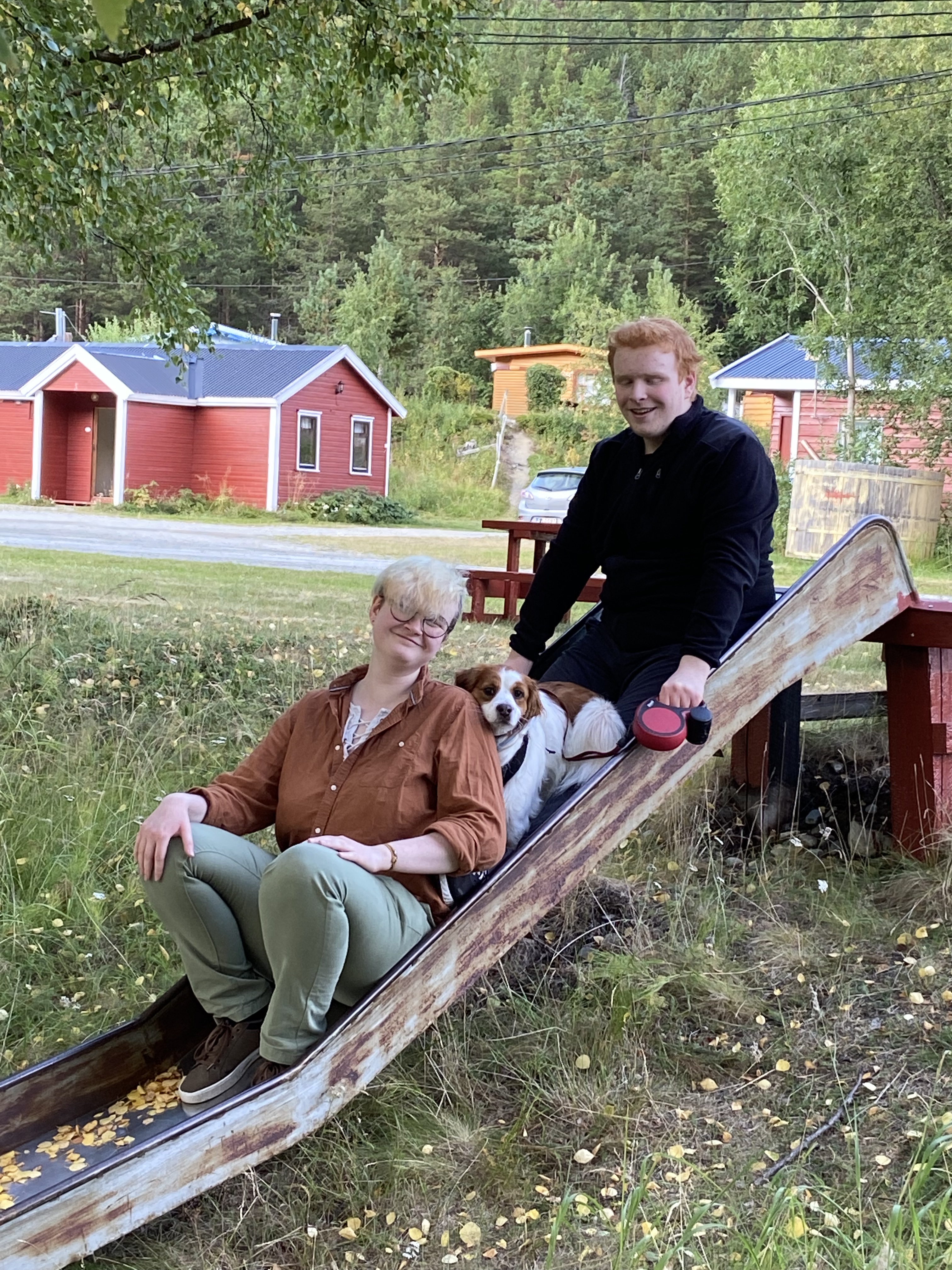
We passed through Skibotn without seeing anywhere to eat, but stopped to air the dog (translation from Norwegian) on a pebbly beach on the edge of the fjord. While Anna and Andrew skimmed stones, and Triar gambolled about, I investigated possible eateries on my phone.
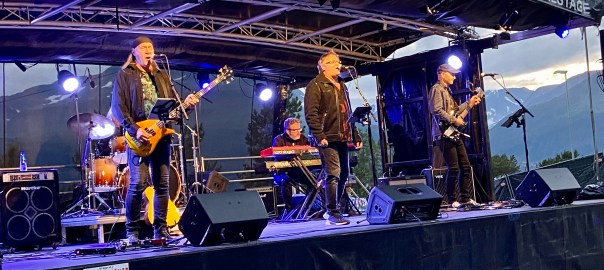
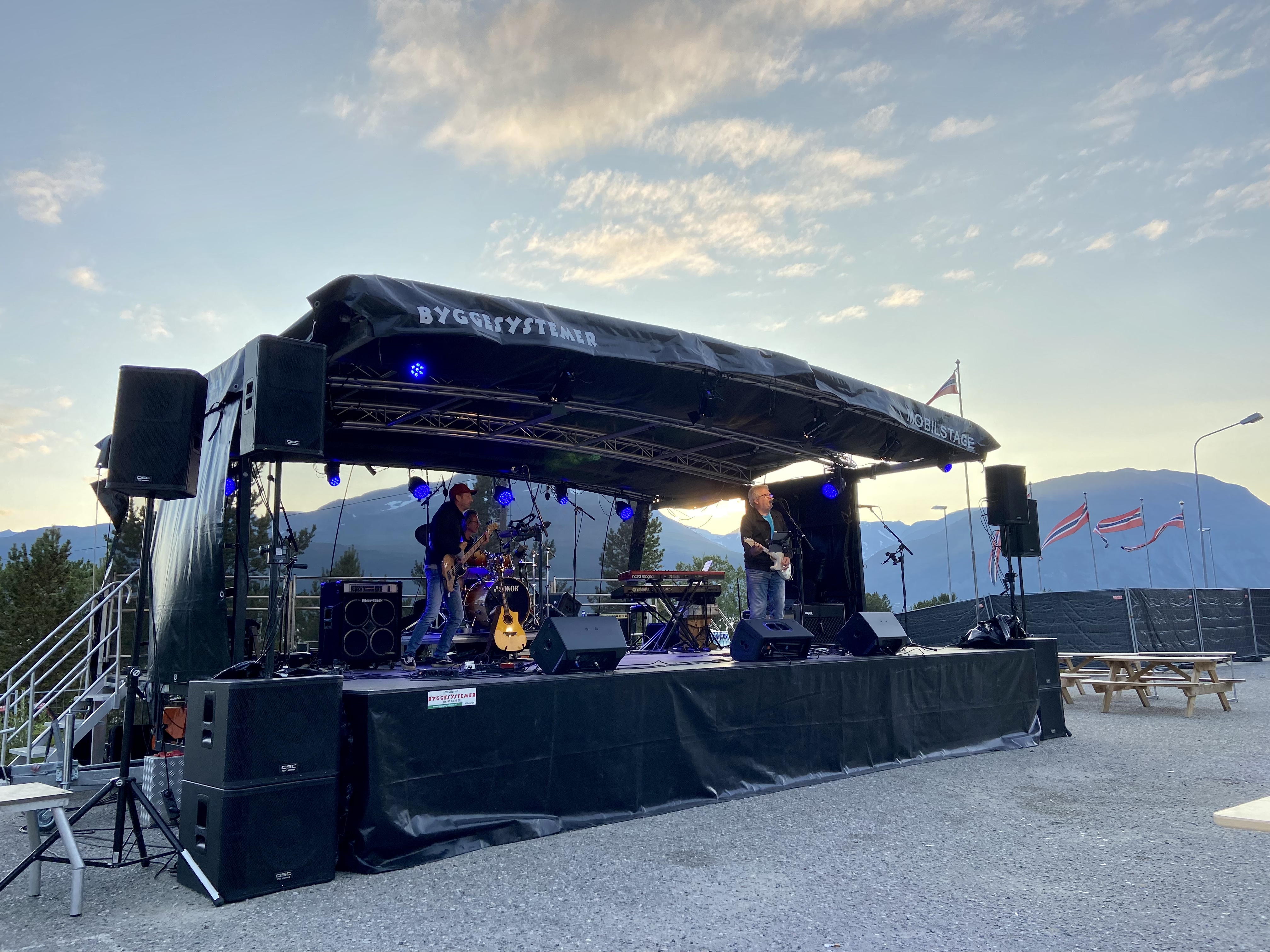
There was a hotel nearby, which seemed like a possibility, so we headed back to the car and drove to it. It seemed deserted and somewhat surprisingly, there was an area temporarily walled off with what appeared to be a stage in the background. Sliding in through the gap, we made our way inside to ask about food. A couple of tantalising cup-cakes lay on what looked like the remains of a conference lunch, but there was nothing available right now. There would be later though. The stage would be in use for Guffstock! Guffstock being a small festival. Who was playing, we asked. Ove Schei was on first at eight, followed by a band called Royal Jam at ten. We’d not heard of either of them, but thinking back to the cabin and its lack of a sofa, we glanced at one another and bought three tickets for the evening.
We found some food at Circle K. Norway doesn’t have many motorways except around Oslo and there arek no service stations by the main roads. Instead, almost all the petrol stations serve hot food and lots of them have a few seats. Two pizzas later, we headed back to the cabin to wait for the evening’s entertainment.
Though the inside of the cabin was rudimentary, the setting was beautiful. We wandered along the valley floor, admiring the flowers and the river, and finding our eyes drawn upwards to the overhanging mountain tops and the tree-lined lower slopes, where the autumn colours were beginning to emerge.
We returned to the cabin and decided to play cards. I had bought a little box of games a couple of years back, when holidaying in Yorkshire. We opened it to find three sets of cards: Donkey, Snap and Old Maid. I had expected them to be basic, but functional. They were worse than expected: roughly cut with a tendency to stick together. We played Old Maid first and had fun, despite the unwieldy, badly drawn cards. Of course, I was left with the Old Maid card. Next, we looked at the rules for Donkey and laughed, because as I had thought, Donkey and Old Maid are the same game. We played it anyway, passing cards round, pairing them up, and teasing one another mysteriously about who had the Donkey card. We were well on through the game, before I noticed as I looked round the hands we were holding that there were only four cards left. I hadn’t been passed the Donkey card at any point, and had rather been wondering about it. I looked round again. Definitely only four cards.
I looked across at Anna, and then at Andrew, who was sitting on my left. «Does anyone actually have the Donkey card?» I asked.
Both of them shoot their heads and we grinned at each other. So not only were the cards badly made, but they hadn’t even managed to insert the essential Donkey card in the pack.
Despite not having heard of the bands, we had a wonderful evening. Rather than their own songs, both Ove Schei and Royal Jam played a lot of classic tracks and before long, we were clapping along. It’s a long time since we’ve seen any live music and here we were, outside as dusk fell and the sun dipped behind the mountains behind the stage. It was a wonderful end to the first day of our journey.