Category Archives: Vet

Modernity and Memories

Though in some ways, the weeks seem to rush past, by the time I write this blog, things that happened Saturday to Tuesday always seem distant. I will be wandering round, on one of those days, thinking “I’ll have to write about this,” then by the end of the week, something else displaces it. Ideally, I should start logging in as things happen, but hey, I’m not that organized! Anyway, this week I have carefully stored away a couple of things I really want to share. The first is about a welfare inspection I did on Tuesday.

I’ve probably said it before, but the sheer size of farms now, compared even to fifteen years ago when I left, is astonishing. When I qualified as a vet, in 1991, larger dairy units might have had 150 cows. Numbers were creeping up though, and by the time I left the UK many of the bigger herds had expanded to having over three hundred cows. Now it seems to be not unusual to have a thousand, sometimes even more.

I have been wondering how welfare is maintained on such a unit. Back when herds were smaller, most farmers knew their animals well. I went out with a dairyman when I was at college and he knew the personalities of the cows he milked and there were some he was very fond of. I remember seeing him cry when he’d been away on holiday and came back to find one of his favourites gone, due to the carelessness of the relief dairy worker that had been covering for him. No wonder some farmers barely take holidays.

I am not under the false impression that bigger is inevitably worse. Those who have expanded are often the most efficient and forward thinking farmers. They are investing in the herd and their own future, but still I had been wondering how. These are living animals and to keep track of when they are in season or in calf, or are sick, takes a lot of time for observation and knowledge.

As we walked along the calf pens, I could see they were being bucket fed. Lots of bigger farms use automatic feeders for their calves, but not here. The farm is run by a couple and (fairly traditionally) it’s the woman who is responsible for feeding the calves. They did have automatic feeders for a while, but found they tended to get dirty. In addition, teaching them to drink from a bucket prepares them for going into bigger groups and being given milk from a trough. You can also check how much milk each calf gets and individualise each one. I guess it takes a long time at peak calving time, but it was interesting to see that a good start in life is so important that industrialization hadn’t occurred (or rather, had been tried and rejected) on this part of the farm.

As we moved from the calves to look at the close-to-calving cows, I was interested to notice that the nearest cow had something attached to her foreleg. I asked what it was, and was told it was a movement monitor. Just as I wear a watch that can tell me how many steps I take each day, the cow’s steps were also being monitored. I wasn’t immediately sure what purpose this would serve, but later, he took me to the computer where these measurements were read.

He showed me a the readings of a cow that was coming in season every month or so. Sure enough, the movements peaked hugely at that time. But it wasn’t only that he could look at the program and see which animals were in season. The system itself recognizes the pattern and, as the cow comes out of the milking parlour, where it goes twice a day, a gate automatically opens to allow it through into a different area, so she can be inseminated. A person walking through the cubicle shed to separate out these cows disturbs all the other animals. Instead, this is another process that is mechanised to minimise both the work required and the disruption to the herd.

Automatic scrapers to clean passageways in cubicle sheds have been around for a long time. Usually they are pulled by chains or ropes and there were some of those here. The chains were in runnels to prevent the cows standing on them and hurting their feet. One of the sheds had one of the newer machines, that functions like a robot vacuum cleaner. These have the advantage that they can go round corners, so there are no missed sections, which there are with the chain scrapers.

What I hadn’t seen before though, was an automatic scraper for moving silage. Usually cows are fed in a passage, where they put their heads between bars and eat the silage and feed that is put there. As they eat, the food gets pushed away, and usually someone will drive along with a tractor now and then and push it back in. Here, there was a machine that ran along a metal track, doing the job automatically for all the big sheds. It runs every two hours, except just after milking time, when it is set to go hourly, as the cows tend to be hungry when they’ve just been milked. Again and again, I saw that, although this system was on a large scale, there were tweaks and tricks that meant that it was really set up, based on what the cows needed.

And finally, back to the matter of the individual animal and the personal relationship. I can’t say I really touched on this with the farmer, although it was apparent as we walked round, that there was still fondness for individual animals. He did tell me though, that where his dad had always been keen to give every sick animal a chance, he tended to be more ruthless is removing animals with bad feet or which had been ill enough to mean they probably wouldn’t thrive. One thing I have observed from life as a vet is that there is a lot of unconscious cruelty by some pet owners, who keep their pets alive long after that life stopped being worth living. Perhaps in a system where animals with bad feet get removed quickly, breeding from those animals that are left will create a better herd, with fewer foot problems in the future. Anyway, I really enjoyed my visit. Cows are still cows and they are still my favourite animals and these visits give me plenty of food for thought.

The other memory was from last weekend. I mentioned I had been told there was a man in his nineties, who’d lived here all his life. I ran into him last weekend. He has a garage at the end of the street where he makes wooden toys for children. He beckoned Triar and me in, and gave Triar a biscuit. Though he was in a wheelchair and his hands were shaky, he was painstakingly painting a toy duck that would go on a stick. There would also be feet attached to a wheel that would spin as it was pushed along the ground.

I asked him if he sold the toys and he said no. He gives them away, and the look on the child’s face is payment enough, he told me. If I ever have any children to stay, I will undoubtedly take them along to see him.

He also started to tell me a bit about the street and I resisted the urge to ask him if I could record what he was saying, as it was lovely. He had lived in the street law his life, he said, and could remember back to the time when it was a village and not part of the town. The doctor came out rarely, he said. If someone was sick, they called for Mrs Black. Mrs Black was also the one you called on if someone was giving birth. We also had a discussion about the healing powers of honey. As antibiotic resistance is growing, even in the vet world there is starting to be more exploration of how old remedies can be better integrated into modern treatment. I bet Mrs Black could have taught us a few things about helping sick people that we have lost in our rush towards modern medicine.

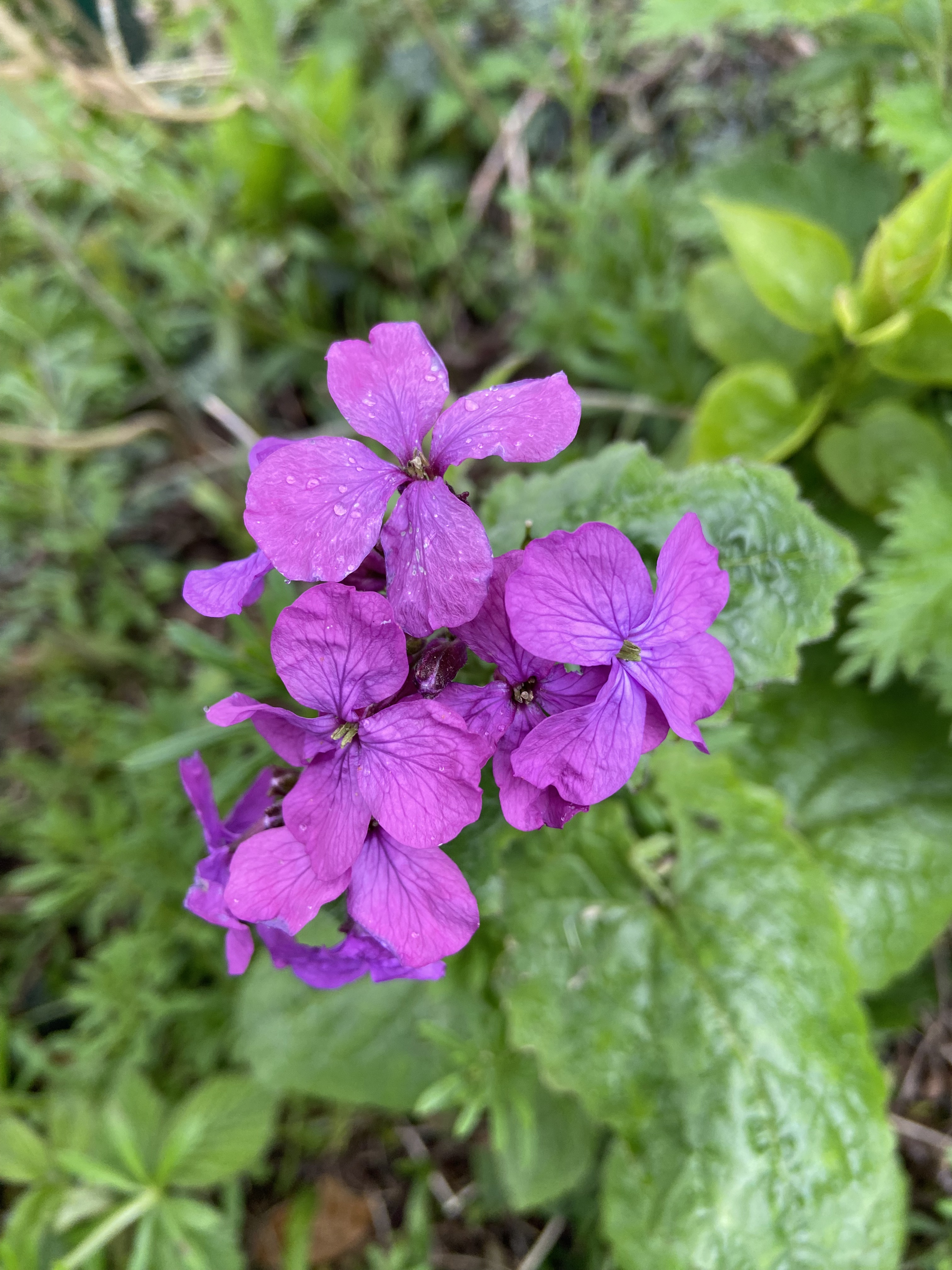
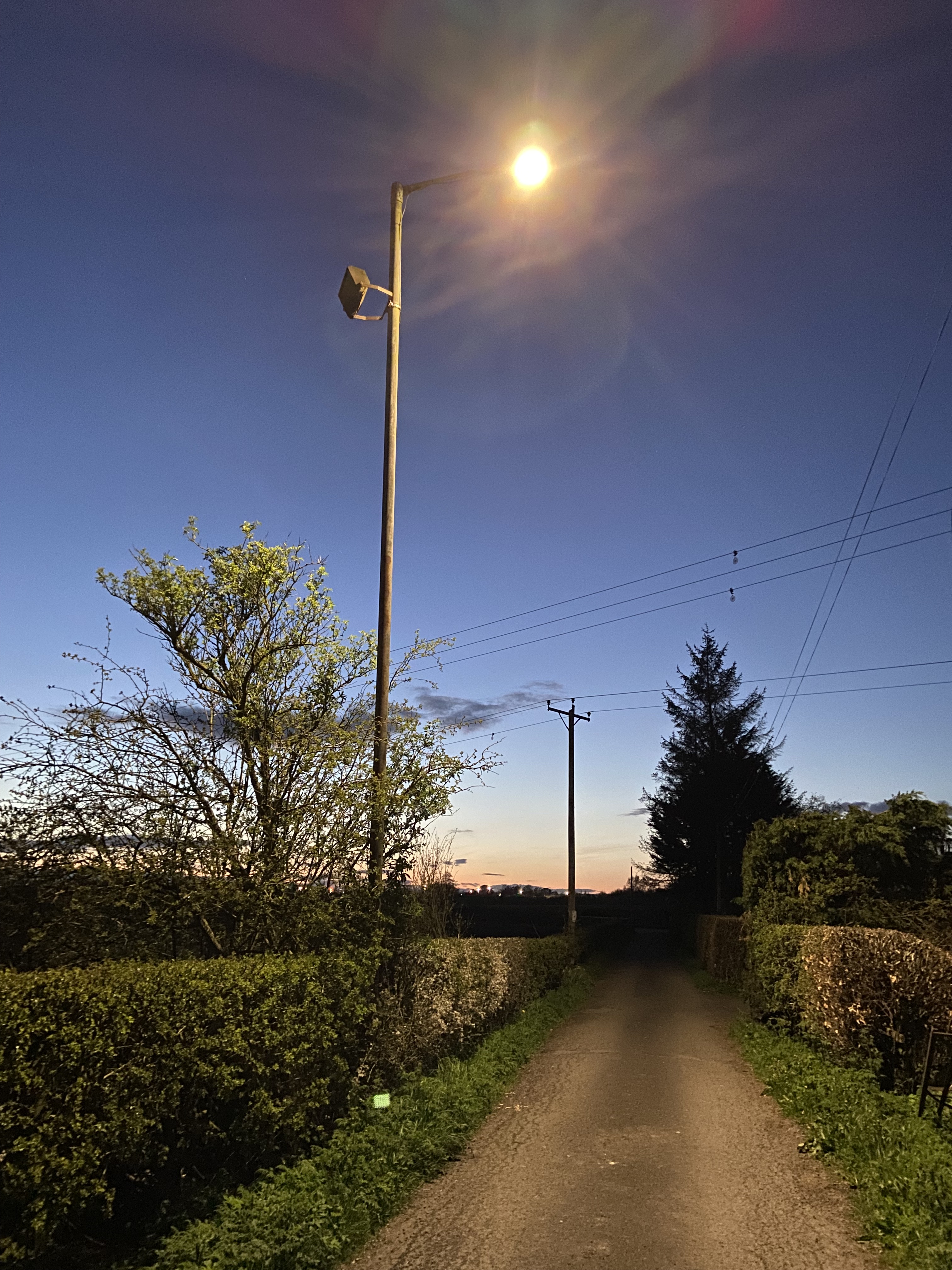
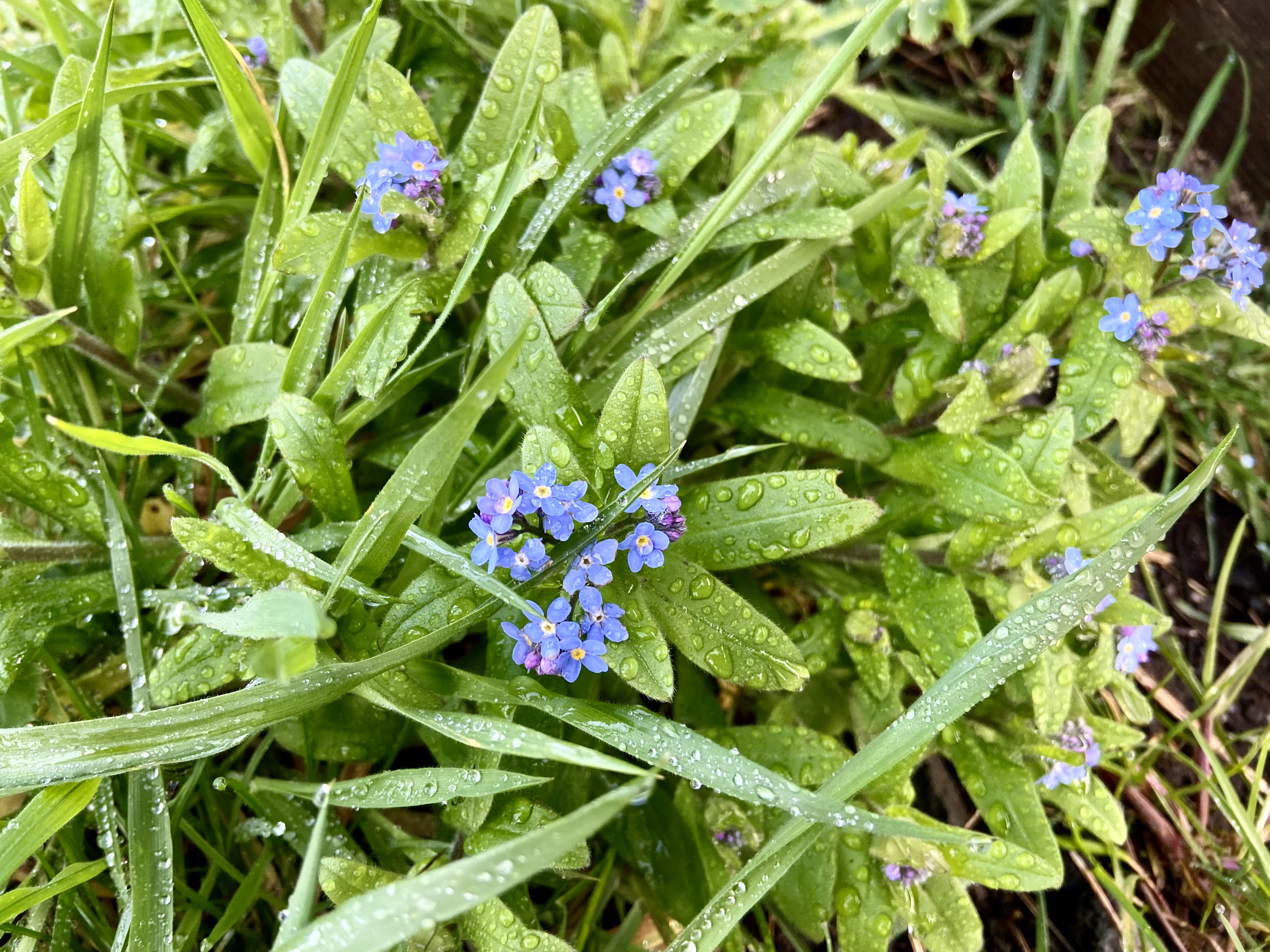
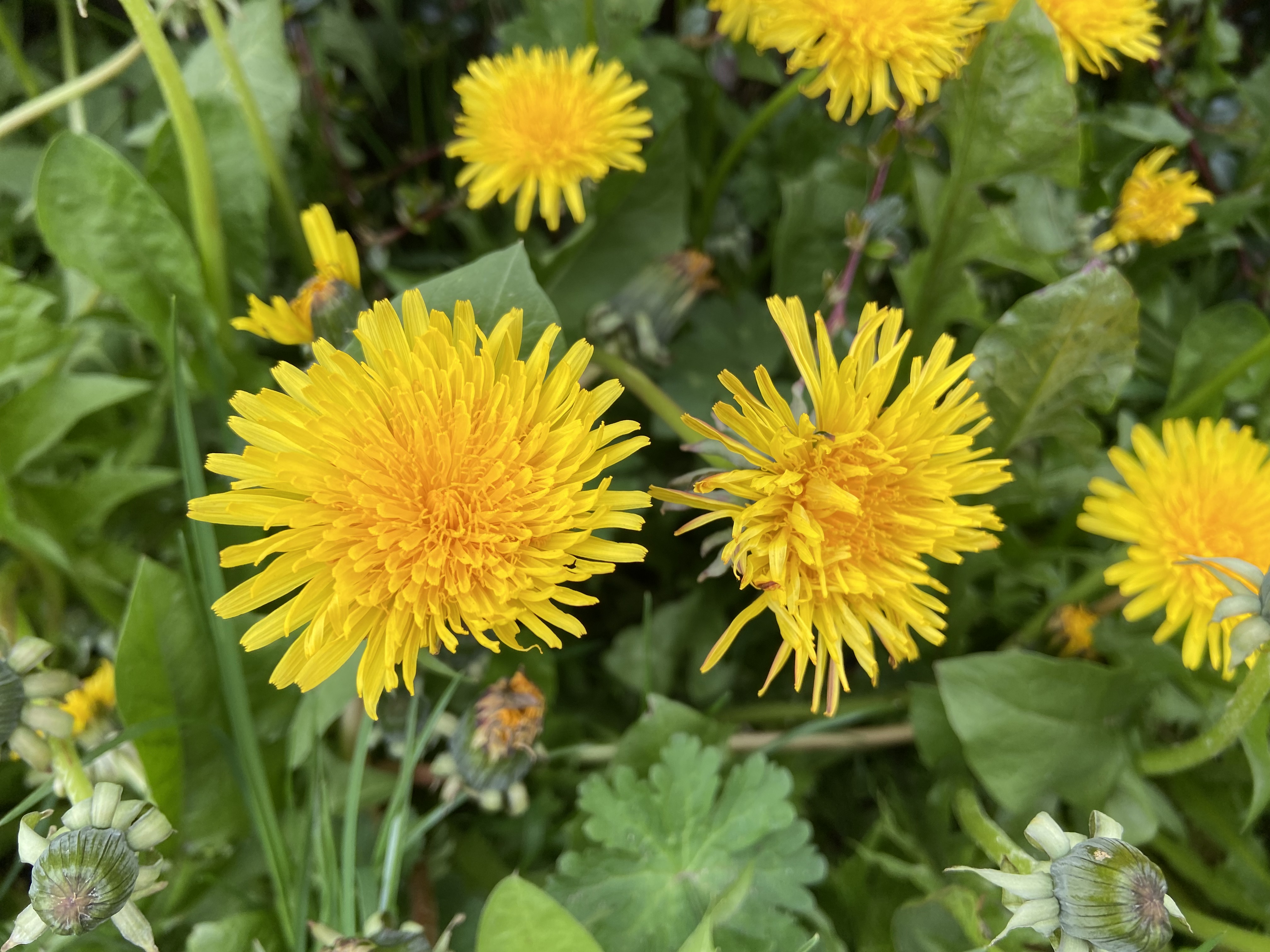
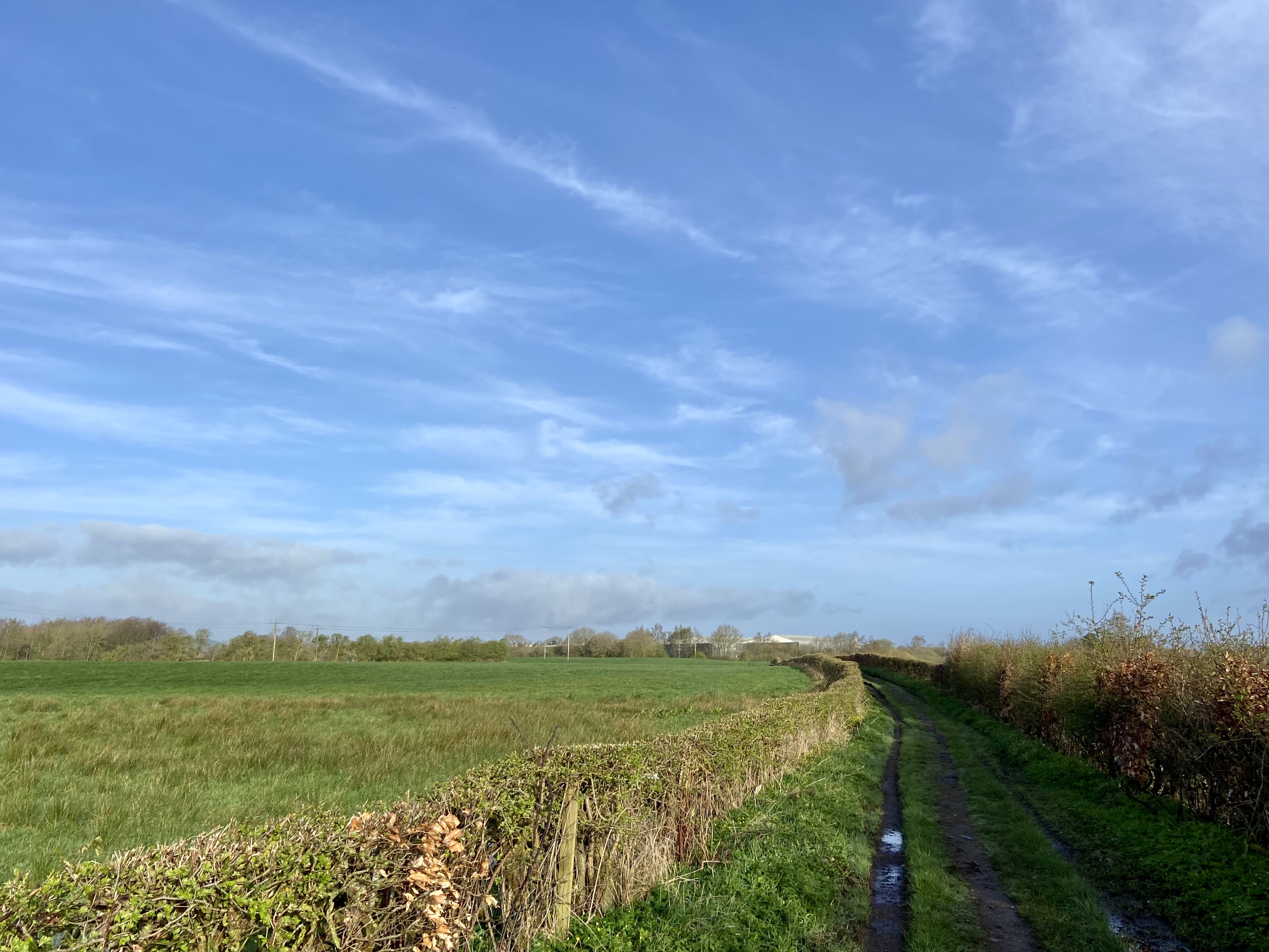
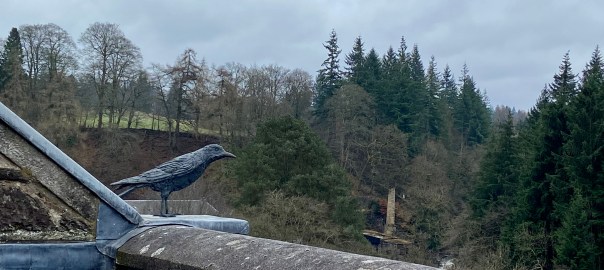
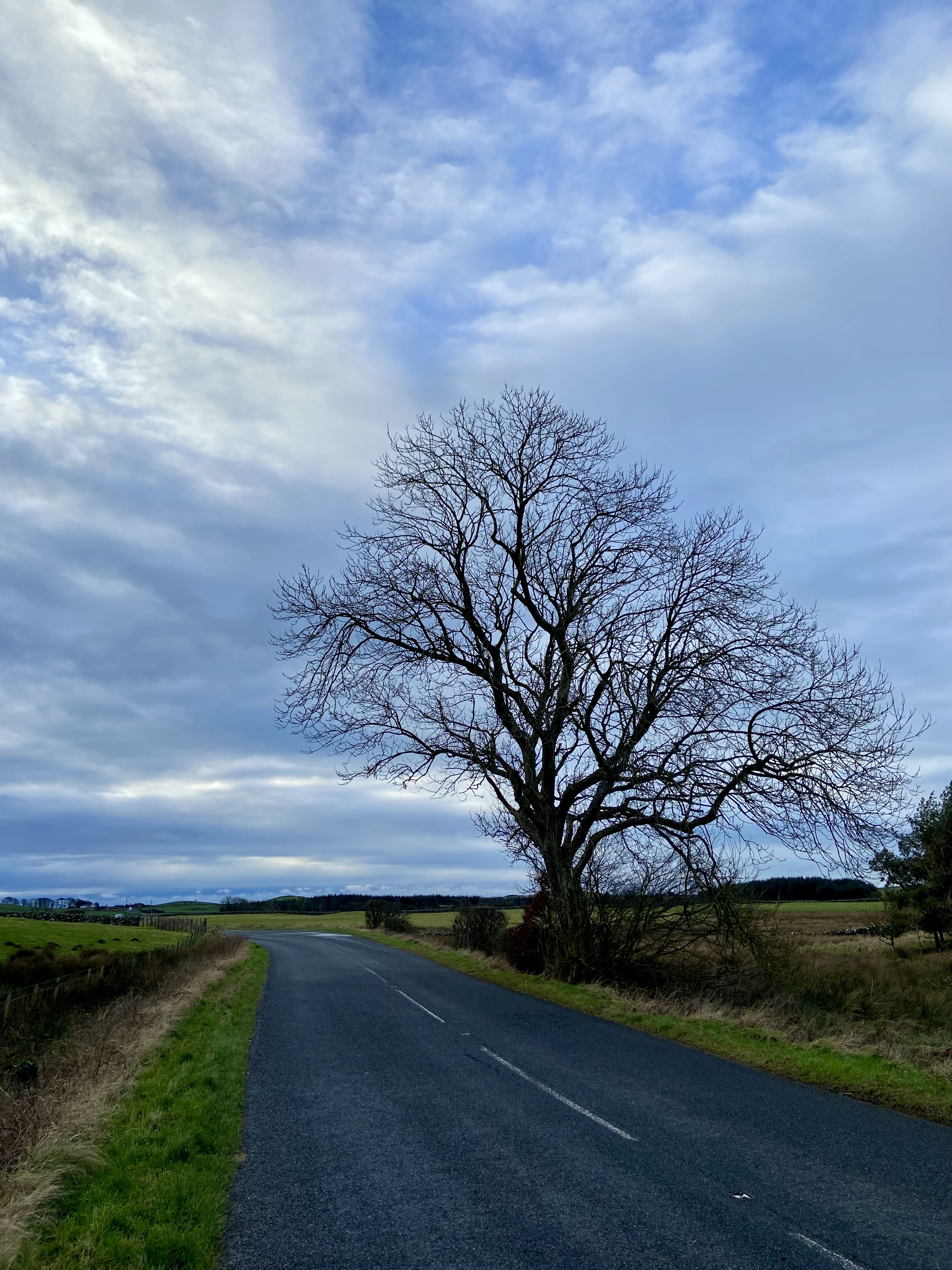
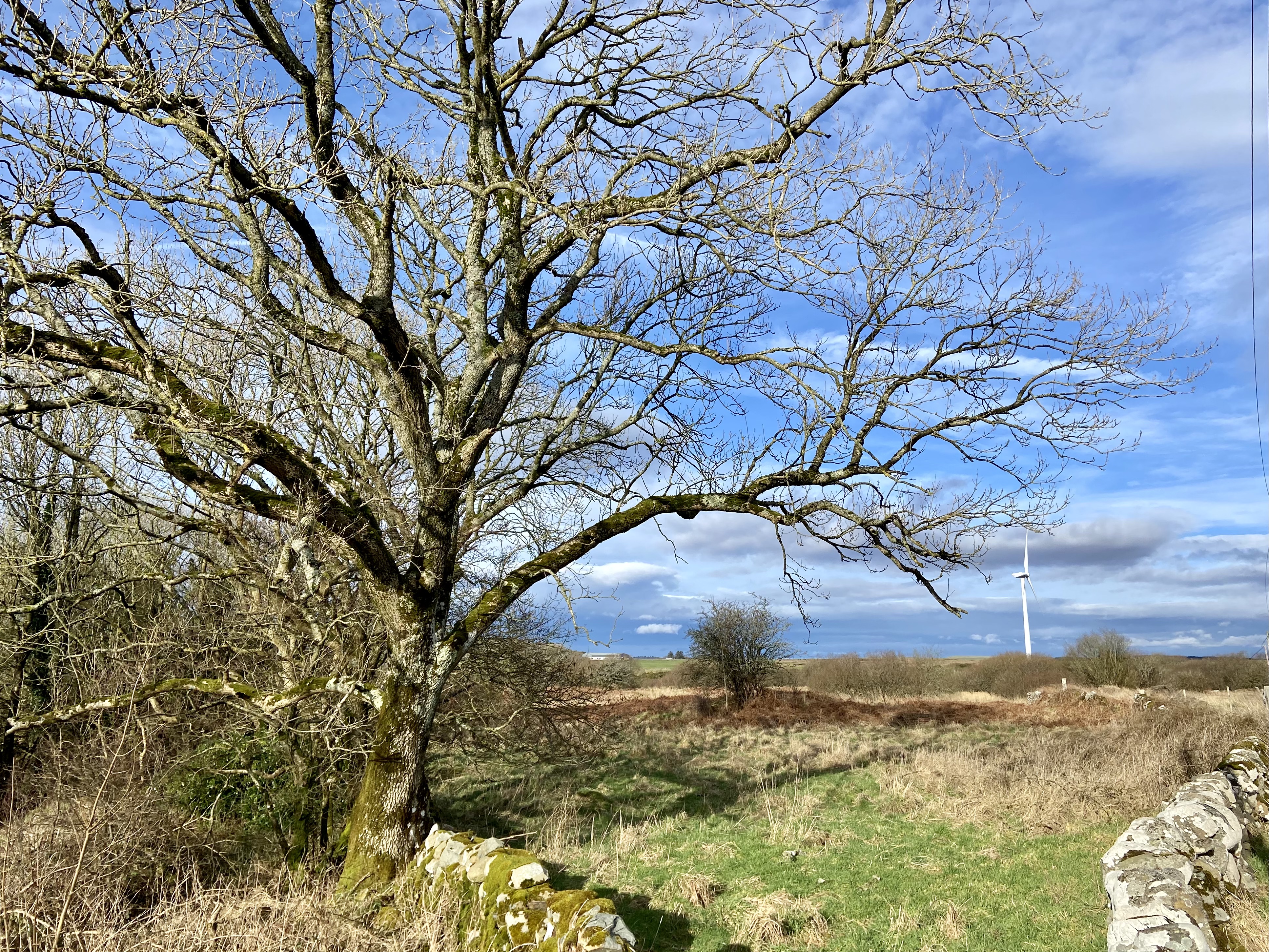
Anyway, I’ll leave you on that note. The pictures are from Blackbird lane, where Triar and I are still walking, morning and evening. This week’s unusual birds were a tree pipet and a mistle thrush, but the blackbirds haven’t deserted. Have a good week and thanks for reading!

Blackbird Lane

It’s been a quiet week at work. As a veterinary inspector, I am on a rota four times a year for detached duty. During that time, I can be deployed anywhere in the UK where there is a disease outbreak. I was on the rota for next week, so I was half waiting for a call to come in, and I had kept my calendar clear of visits. I wasn’t sure when I would be told, but I was out inspecting a rendering plant on Tuesday with G, who told me that if I hadn’t heard by now, I could probably assume I wasn’t being sent anywhere.

I must say it came as a relief. Normally, I’m all for travelling to different places for work. I love a bit of variety and the current outbreak work seems to be bluetongue inspections and blood testing (last year’s bird flu – higher risk – not so pleasant) but I was exhausted after moving and the house is still in chaos. Triar was also unsettled so, much as he loves visiting Mum and Dad, it seemed better all round to be staying in our new home for a while. It also meant that I could plan my workload over two weeks instead of rushing through it.

The rendering plant visit was fascinating. I dare say most would find it grim. They deal with animal waste products, so stuff like fallen stock (animals that died on farms) and slaughterhouse waste. The products they process are high risk, so they have to heat them to a high temperature, then separate what’s left out. What impressed me, is that even these waste products are put to good use.

They remove as much fat (tallow) as they can and send it to make biofuels. Their fat is used to drive buses. The remaining meat and bone meal is sent to a power station and burned to produce energy, then the ashes become fertilizer. The plant itself has also recently invested in machinery that recirculates the heat, so that it’s twenty five percent more efficient than it used to be, and if the price of tallow drops, they can even run the unit using that, rather than selling it. Given how much of our household waste goes into landfill, it was good to find out that this waste is being put to much better use.

I was feeling a bit down when I came back from Yorkshire last Sunday. I had flung everything into my new house and then had to go away, so I knew I wasn’t coming back to an oasis of tranquility. Donna had suggested celebrating my arrival with gin, but she had a friend round and there was no way I could leave Triar to go and join them. Practical as ever she immediately suggested that she and Debs could come round, bringing the gin with them.

They arrived with gin, tonic and extra large ice cubes, which apparently are better as they don’t melt so fast and dilute the gin too much! Having allowed Debs to pour (in the knowledge that Debs pours with a very generous hand) they didn’t even get as far as sitting down. Seeing I was overwhelmed with everything, they offered to do what Donna had done when I last moved, and unpack my kitchen.

There wasn’t really any room for me (it’s a little house) so I went and cleaned out the sticky, hairy bathroom drawers, which I confess was helped along by being gin fueled. There’s quite a lot still to be done and cleaned, but having the basics in place makes life much more liveable.

My new street does seem rather lovely. There are three rows of cottages in what was once a village outside Dumfries, but which has now been assimilated. My street doesn’t go anywhere and I am almost at the end of it, so there’s not a lot of passing footfall. I’ve said before, that it seems like something out of Harry Potter and that feeling hasn’t gone away. I’ve been taking a Triar out morning and night and every time I seem to meet someone new. There’s Gary next door and Kay along the way, who has a little dog called Hamish, and apparently there’s a lovely old man across the street, who’s 93. He was born here, I was told, and wants everyone to feel welcome, so I hope to meet him soon. Everyone has been incredibly welcoming and it does feel like I’m living in a friendly village, rather than in a town.

And so the best part of my daily routine at the moment, is walking Triar. At the end of our street, you can take a left turn down a lane. It’s bordered with hawthorn and it’s filled with wild flowers and birdsong. It’s not (so far as I know) called Blackbird Lane, but that’s what I’ve called it in my head, because they are everywhere.

They sit atop the hawthorn, regarding me with their bright eyes, seemingly fearless. The males, with their sleek black plumage and cheerful yellow beaks, compete with one another for the best perches. I caught sight of one of the quieter brown females last night with a worm in her mouth, so perhaps she already has young somewhere.

I see house sparrows too, in the hedges and flitting around, but what I find particularly wonderful is the birdsong. A Norwegian friend from the Arctic posted on Facebook this week “the sound of spring” with film of a newly unfrozen stream, emerging from the ice. A wonderful sound indeed after the winter silence, but here in south west Scotland, spring is filled with birdsong.

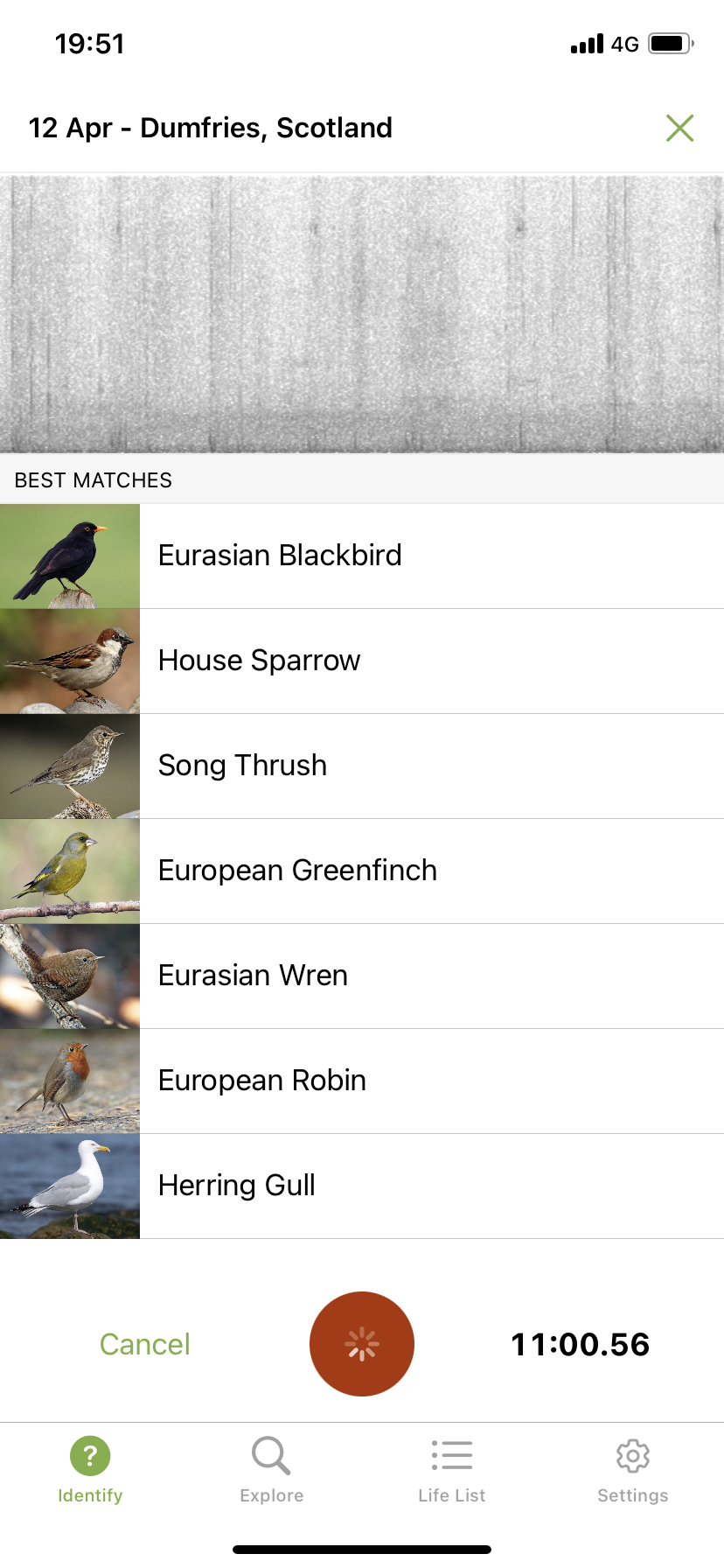
Just listening to it fills me with joy, but a while back, I downloaded an app, which records the song and tells me what I am hearing. I remembered it a couple of nights ago and it came up with sparrow, blackbird, wren, great tit and blue tit. Last night’s rendition was even better, though it did miss the wood pigeon that was calling in the distance. Finding out which birds are there makes the whole thing even more wonderful.

So there is a lot to do, but also a lot to look forward to. Today, I have to go and buy a stepstool so I can reach the ceilings. The previous owner smoked in the kitchen and the smell still lingers, along with the yellow stained paint. I’ll need to wash it all down before I can paint it. A colleague recommended a joiner to me and he came round yesterday to assess how much work it would be to put in insulation in the roof.

He suggested that, as we would have to pull the walls down to put the insulation in, if I was considering putting in a bathroom or toilet upstairs, it would be better to do the whole thing at once, and check the wiring too, if that was a viable option, so he might come back today with an electrician and later with a plumber. If he can really organize everything for me, that would be a miracle.

But priorities are priorities and the most important task of the day, apart from my tours down Blackbird lane, is to go out and buy some gin and tonic in the hope of attracting in a friendly neighbour. Said neighbour may have to bring along some extra large ice cubes as my freezer needs defrosting before I can use it. Currently it is scented with six month old cigarette smoke. Obviously I should have defrosted it before I moved in, but lingering ice odours hadn’t crossed my mind! I’m going on holiday soon, so that will be a good opportunity for defrosting, cleaning and airing.

Anyway, I hope you’ve enjoyed this little trip down Blackbird lane. I am looking forward to seeing what grows there through the summer and also exploring further as the mud dries up. Have a good week all!

From Nostalgia to Duty

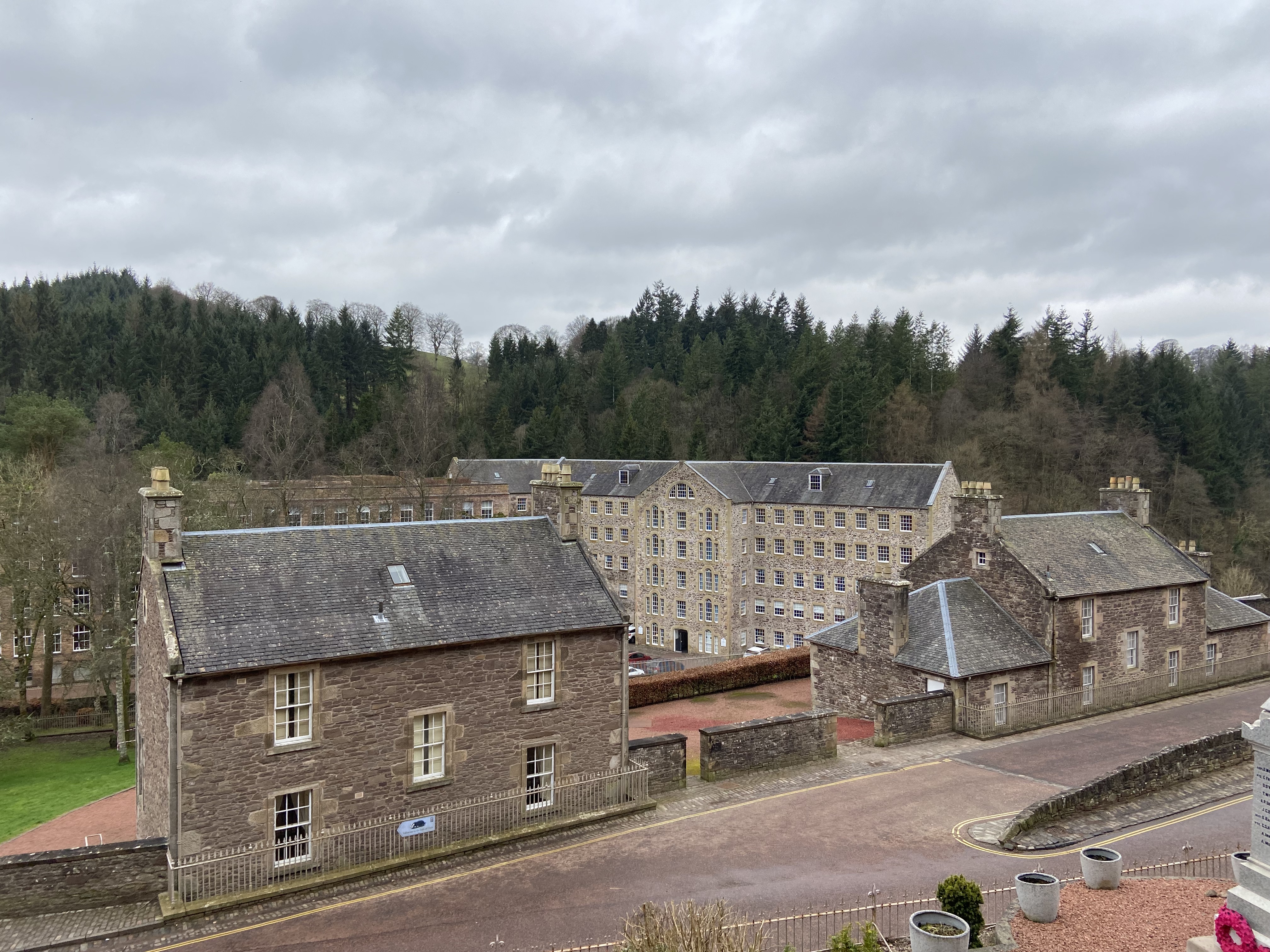
My son John and his girlfriend Yoana visited me last weekend. Though it was raining most of the time (in true, southwest Scotland style) John suggested we could go to New Lanark for a visit, so that’s what we did.

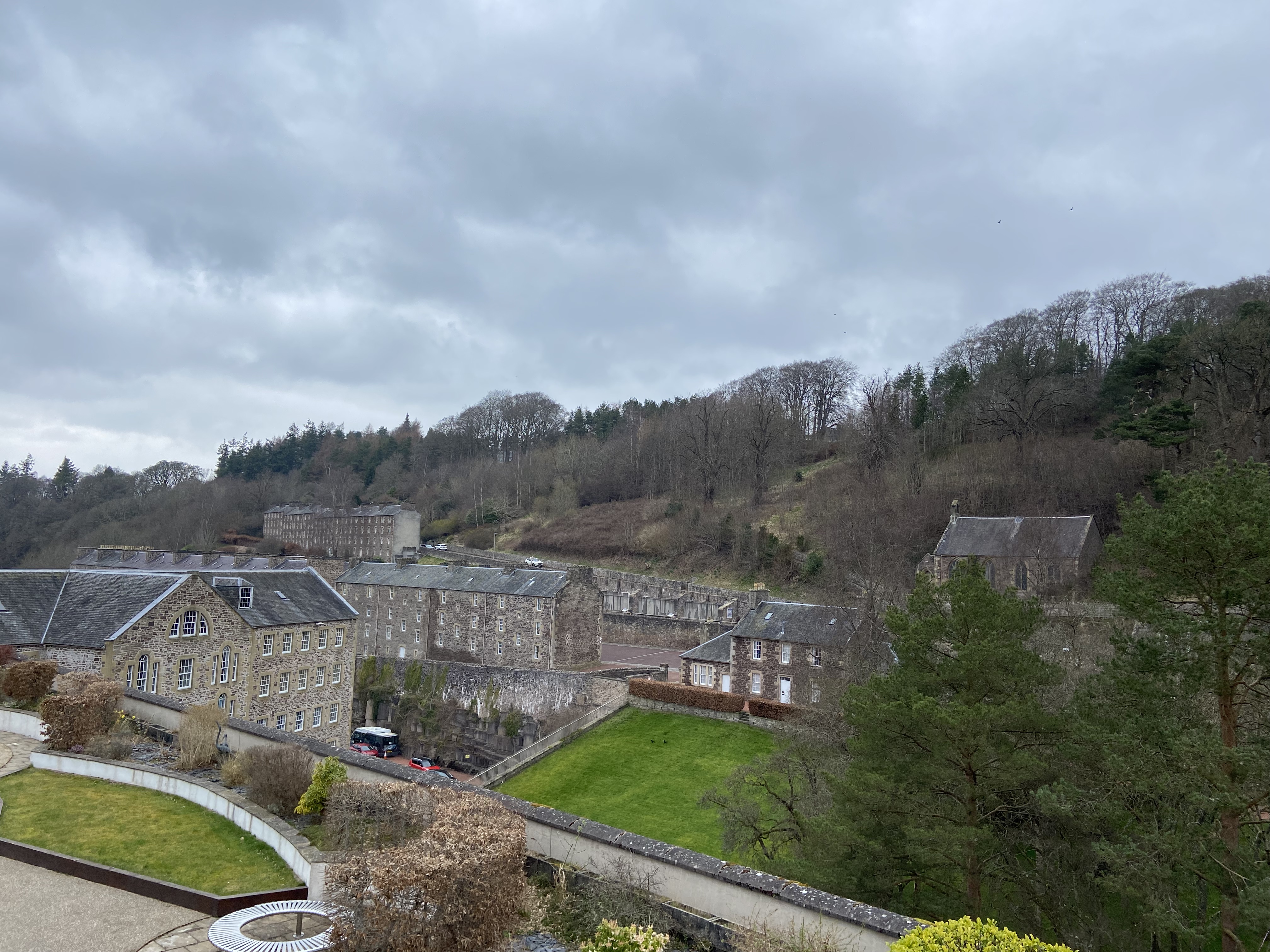
New Lanark holds a special place in my heart. For those who don’t know, it is a former 18th century cotton spinning mill village located on the banks of the Falls of Clyde, where social reform became very important. The lives of those who worked in the mill and their families were improved through schools, education, reasonably priced food and medical support. It’s a living village too – there are still tennants living there, and apparently very long waiting lists to get an apartment.

New Lanark

I think I might have visited with my parents, a very long time ago, but my fondest memories are from when John and Anna were young and we went there every year at Christmas time. There’s a ride you go through, where you sit on moving chairs and are taken on a trip back through the darkness of time. At Christmas, it gets set up like a kind of magical grotto and the filmed clips of a child that grew up in New Lanark, are replaced with an elf-like girl called Holly. At least that’s how it was back then, though that is twenty years ago now.

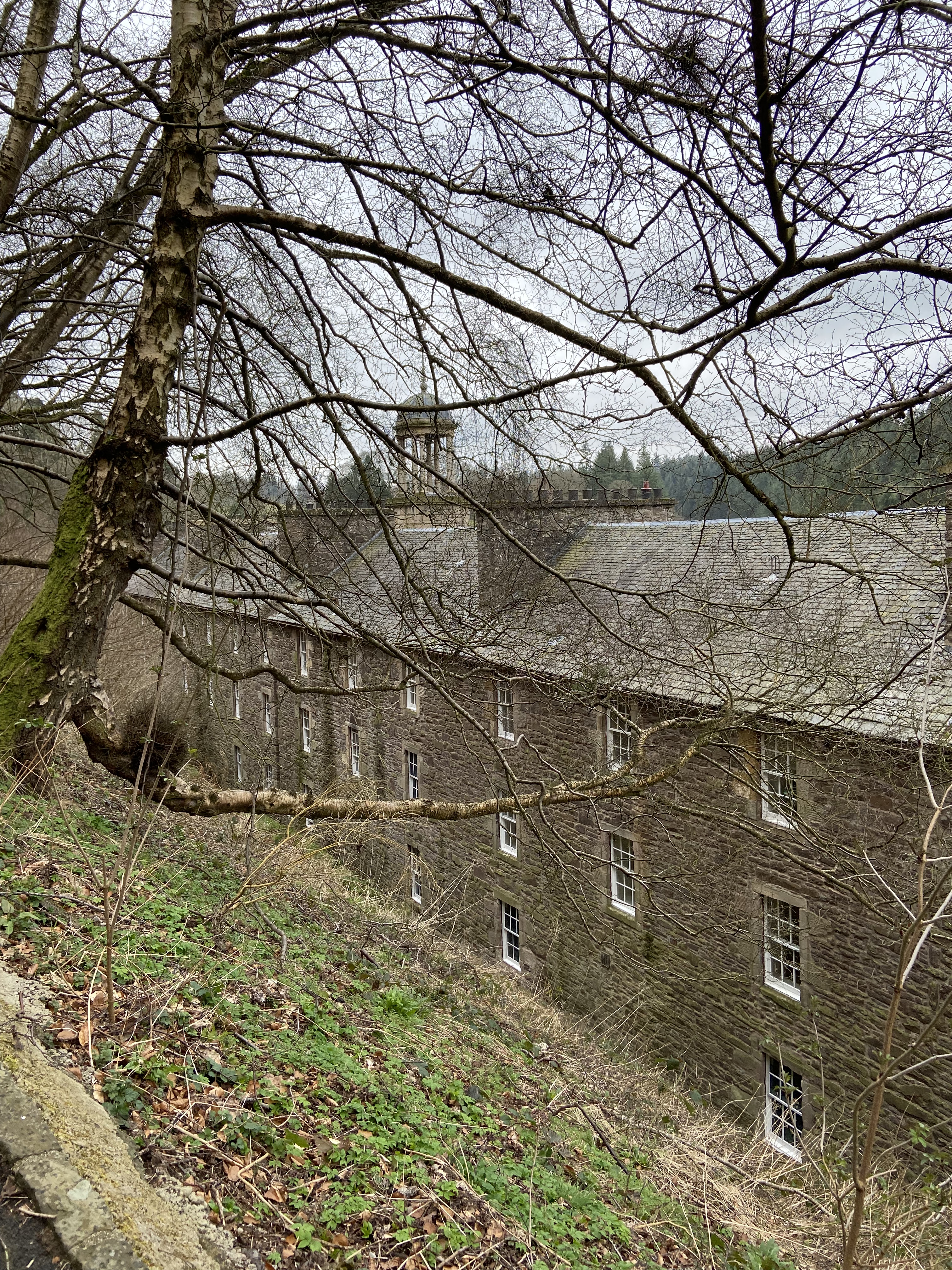
Millworkers’ apartment block.

The site has been undergoing improvement for a long time and it was lovely to visit again. Some things struck me, now that hadn’t really done so before. One was that the classroom, where the millworkers children were taught was a very large, airy room, with a high ceiling and lots of natural light. The contrast between that and the small, low ceilinged apartments, where large families occupied one or two rooms, must have seemed incredible to the children when they began to attend school.

Robert Owen’s house is on the left.

The other was a comment in the film, where the mill workers’ working day was described. They “only” worked ten hours per day, potentially from ten years old, but there were evening classes so that they could be educated if they wanted. I only work eight hour days and am struggling to motivate myself to write in the evenings. It’s incredible to imagine a world where working ten hour days, six days a week, was considered humane, but there it is.

A beautiful roof-garden has been set up on one of the old mills.

Robert Owen, the social reformer, who brought in the improvements for workers in New Lanark, eventually left to set up a new project in America called New Harmony. This project fell apart within a few years. Reading between the lines, a lot of the people they attracted had lofty ideals, but weren’t necessarily hard working.

View from the rooftops.

It’s easy to see with hindsight, but it’s obviously much easier to improve the lives of those who started out with very little and were used to hard labour than it is to form a new community of truly equal people. If Owen had really wanted a socialist paradise, he could have considered whether it was possible to make all those in New Lanark equal. I think then, he might have realised he couldn’t achieve that without reducing his own circumstances to close to those of his workers, and I imagine that was why he set off on an unrealistic vanity project, rather than really setting out to achieve equality.

Back to work and I am unexpectedly working this weekend as the duty vet for Southern Scotland. This means that if there are any reports of suspected notifiable diseases, such as foot and mouth or bird flu reported, I’m the vet who will be sent out. Equally, if there’s an urgent welfare issue that’s so bad it can’t wait, that will be my job to tackle as well. My car is currently loaded up with boxes full of all the kit that I might need, which is quite eye opening as there’s so much of it. I know that in an outbreak situation, I would have to arrange clean and dirty areas in my car and, as I didn’t have much warning, everything has just been thrown in. I’m keeping my fingers crossed for now. Complicated routines take time to organize and I had less than a day to find everything, without anyone local to help me out. Roll on Monday!

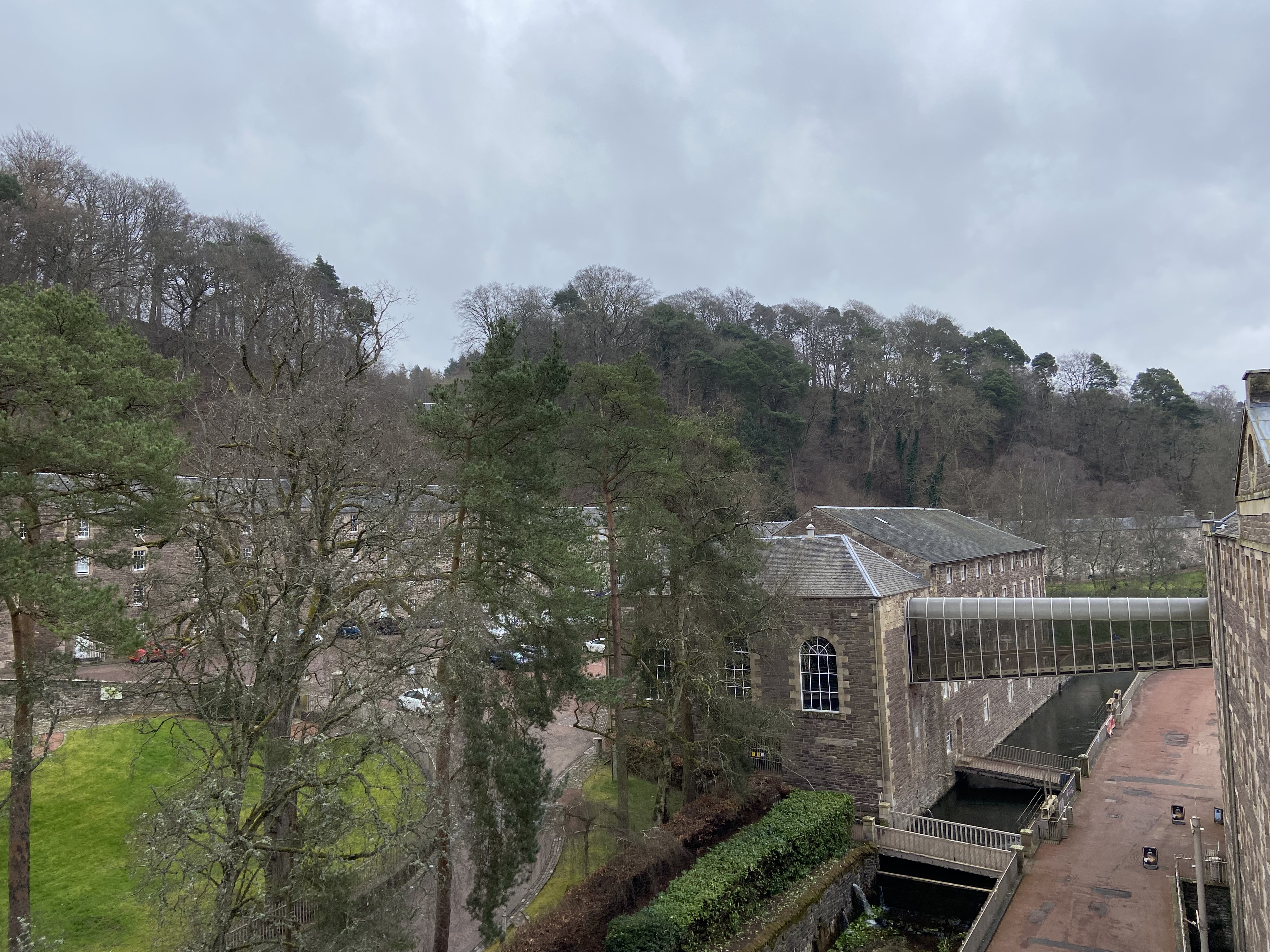
The steam engine that drove the mill when the water in the Clyde was low was housed in the building on the right. The ropes that drove the machinery would have been inside the glass bridge. The mill race goes underneath the building on the right,

Tripping

I finally made it out of bed on Monday, just in time to go back to work. By Tuesday, I was on the road again as I made my way to Edinburgh for a conference, where APHA staff from all over Scotland came together to meet and learn.

When I drove over to Stranraer, I was craving memories and was rather disappointed at the lack of familiarity. Although I grew up in Penicuik, which is not very far from Edinburgh, and that I went to university in Edinburgh, it hadn’t crossed my mind to hope for something similar. It hadn’t crossed my mind that our route wouldn’t take us on the featureless motorway network, but rather through a load of places that were embedded deeply from my childhood.

We passed through West Linton, then Carlops: familiar names and places from long ago. But it was when we reached Nine Mile Burn, where you can turn off to drive to Penicuik, that I had that sudden feeling of nostalgia.

My adult life has been interesting, but I was fortunate enough to have a very happy childhood. One of my sweetest memories is of climbing onto a low hanging tree bough and sitting in dappled sunlight with my friend, Sharon. We had been watching Robin of Sherwood, Sharon had pictures of Michael Praed on her wall and we were at the age when everything still seemed possible. If there was one moment in my life that I could go back and relive, I am fairly sure that would be the one I would choose as it is so unsullied. A young man fractured my mind at university and by the time I was 25 I’d had skin cancer twice and I think that’s why that memory of unsullied innocence is so precious. I’d love to relive it with Sharon, but she also got cancer and she didn’t make it.

Goodness, I hadn’t expected this to take such a sorrowful turn, but those sweet, sweet memories do come with a hefty dose of melancholy. Anyway, the road carried on past Nine Mile Burn and we passed Silverburn, where my parents once considered buying the farmhouse. It was run down then, but now looks very smart. And then the Pentland Hills were on my left and those really were my old stomping ground. I remember some names: Carnethy, Scald Law, East and West Kip. Scald law was the highest hill, but we more often walked up Carnethy, or took the path over between the hills to a wonderful waterfall, though I don’t remember its name.

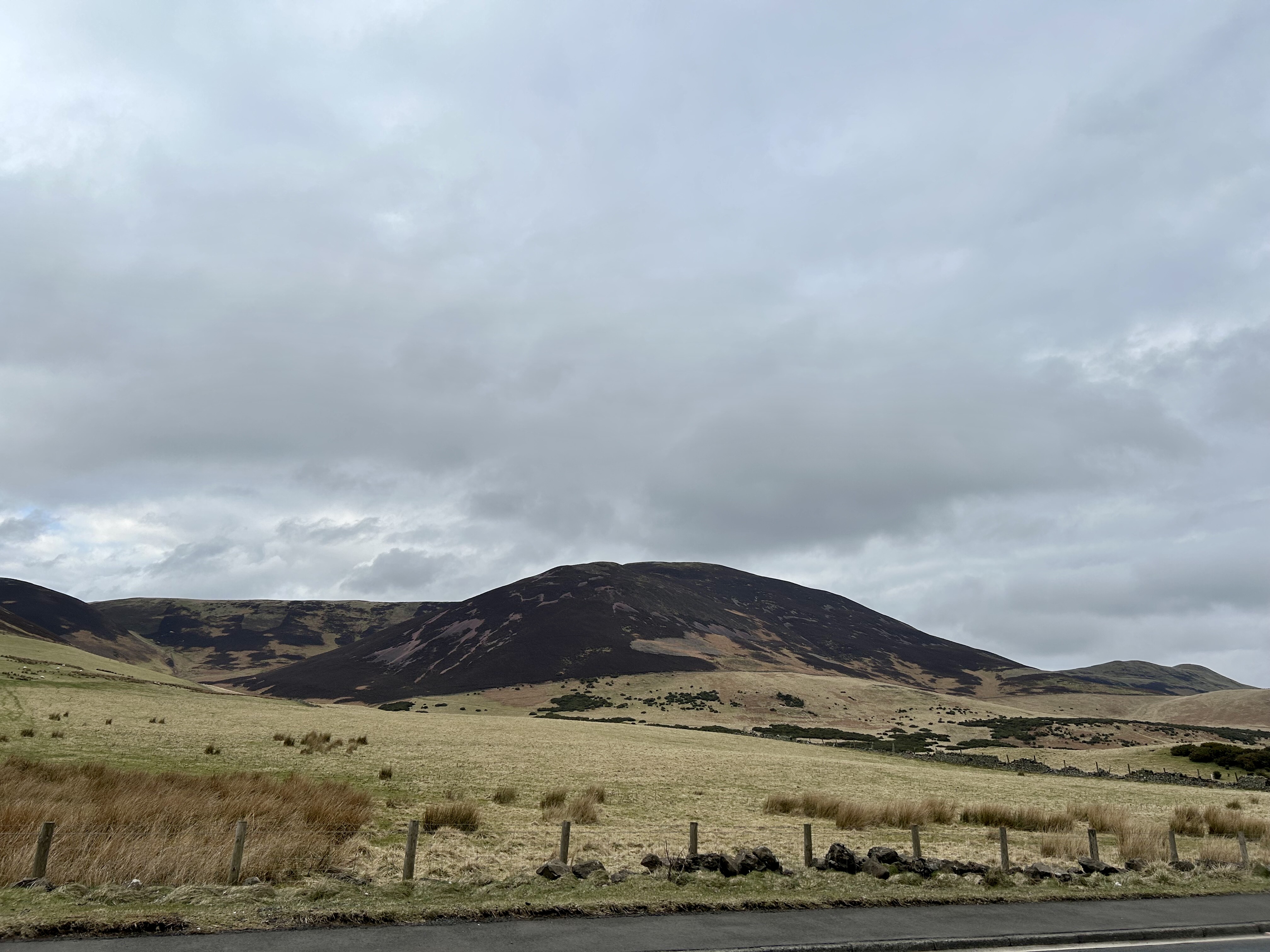
Pentland Hills – I think this one is Scald Law, but feel free to correct me!

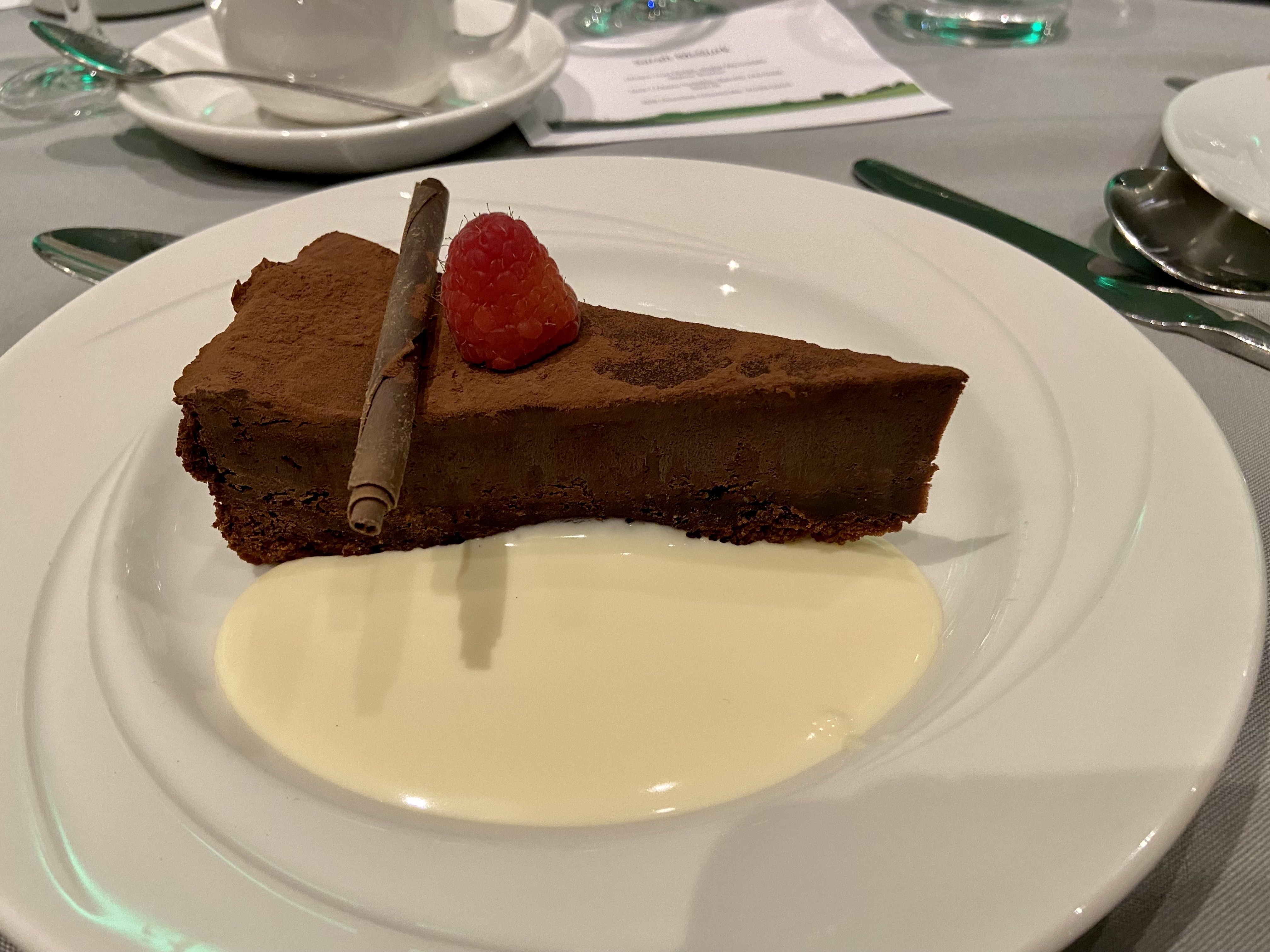
The hotel in Edinburgh was very pleasant, though very much a typical, identikit modern hotel, with no distinguishing features. I’m still at the stage where there’s lots to learn, so there was plenty of new information to pick up. I enjoyed the evening meal, although the milk chocolate cheesecake, which I expected to be a sweet and fluffy concoction was more like a dark chocolate brick of solidity that even I couldn’t finish.


The conference ran from lunchtime on Tuesday to lunchtime on Wednesday, then on Thursday I had to go to Ayr to have a mask-fitting appointment. This was to check whether I can use the FFP3 masks at work safely. This involved having a mask on, which was attached to a tube which monitored the air I was breathing, while performing various manoeuvres. As this involved marching on the spot, while moving my head around in various ways, and then counting out loud, while trying to breathe normally, it was quite a challenge, given that I am still coughing after being ill, but I survived without falling over, and now I am officially allowed to use a mask if I have to check out any sick chickens.

Much as I love travelling (especially those identikit hotels) and consider it a definite perk of my job, I am rather looking forward to next week, when the most distant visit I have booked in is to Castle Douglas.

I’ve probably gone a bit quiet about my house buying. Compared to an international move, it’s very low key, but I’m now at the stage when all the papers have to be signed, I have to show where the money for my deposit is coming from, and I have to arrange to shift my accounts with all my providers from one house to the other, while leaving an overlap as I don’t want to move everything on one single day. I’m quite excited about buying a house, but it doesn’t quite seem real yet, even though the intended date of exchange is less than two weeks away.

You know, I write these blogs mostly to keep in touch with people, but I sometimes think they will end up being a bit like a diary. Maybe one day in the future, I’ll look back and all the memories will come flooding back. My mind feels odd at the moment. Part of me is chugging onwards, being quite competent, learning lots of stuff, but it’s overlaid with a feeling of there being too much going on. It’s not perturbing me too much, but I do have a sense that there is chaos rushing all around me, while I just wander through it, waiting for everything to settle. I write this weekly and I can’t tell whether any of that feeling is coming across, or whether what I write is as scattergun as it sometimes feels. This week, I volunteered to work as a vet at the Royal Highland Show, and I can’t yet tell if that will turn out to be a marvellous opportunity or a daunting responsibility. Maybe both! Still, you know me. I tend to grab what comes my way and worry about the consequences later.

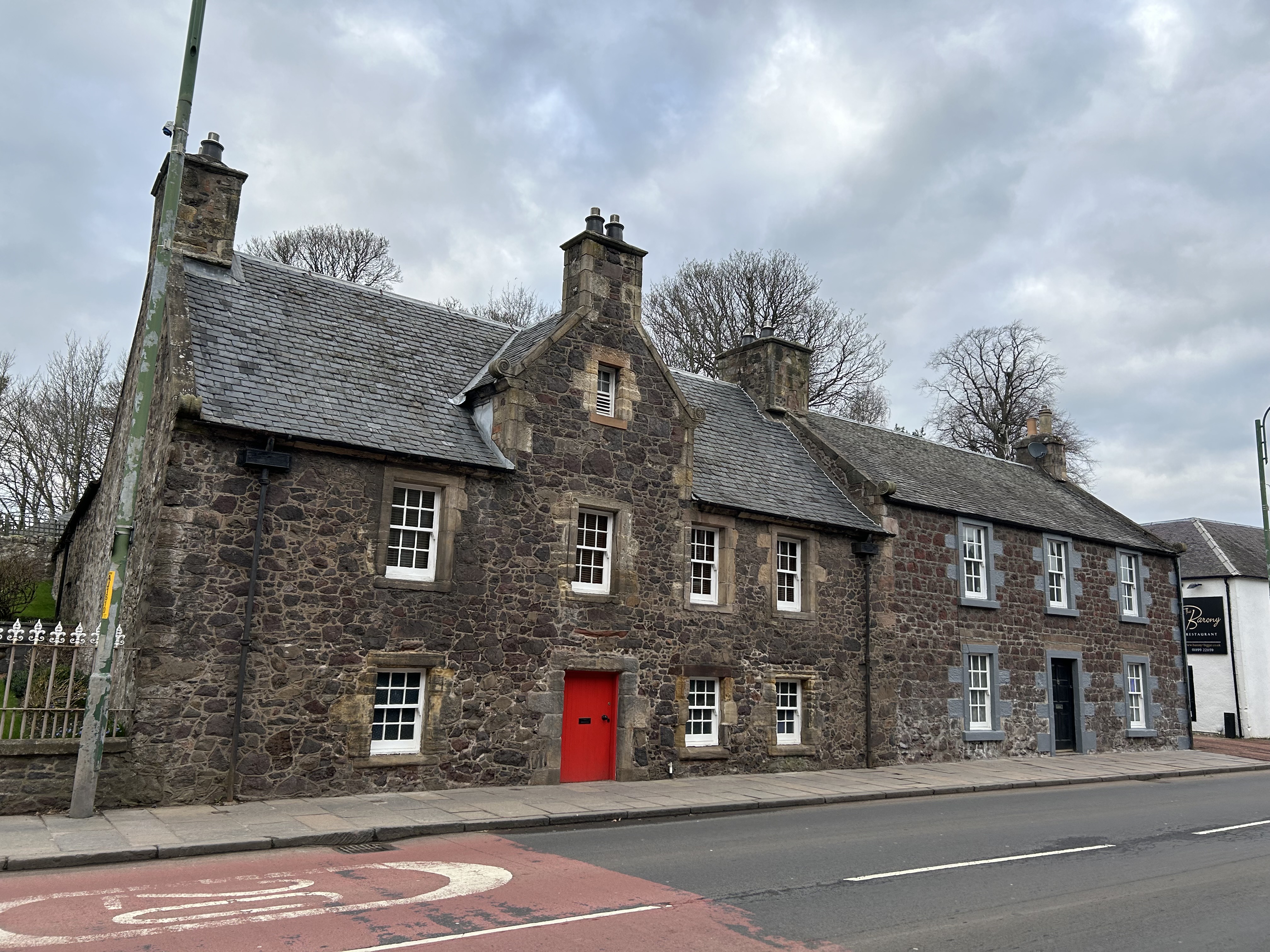
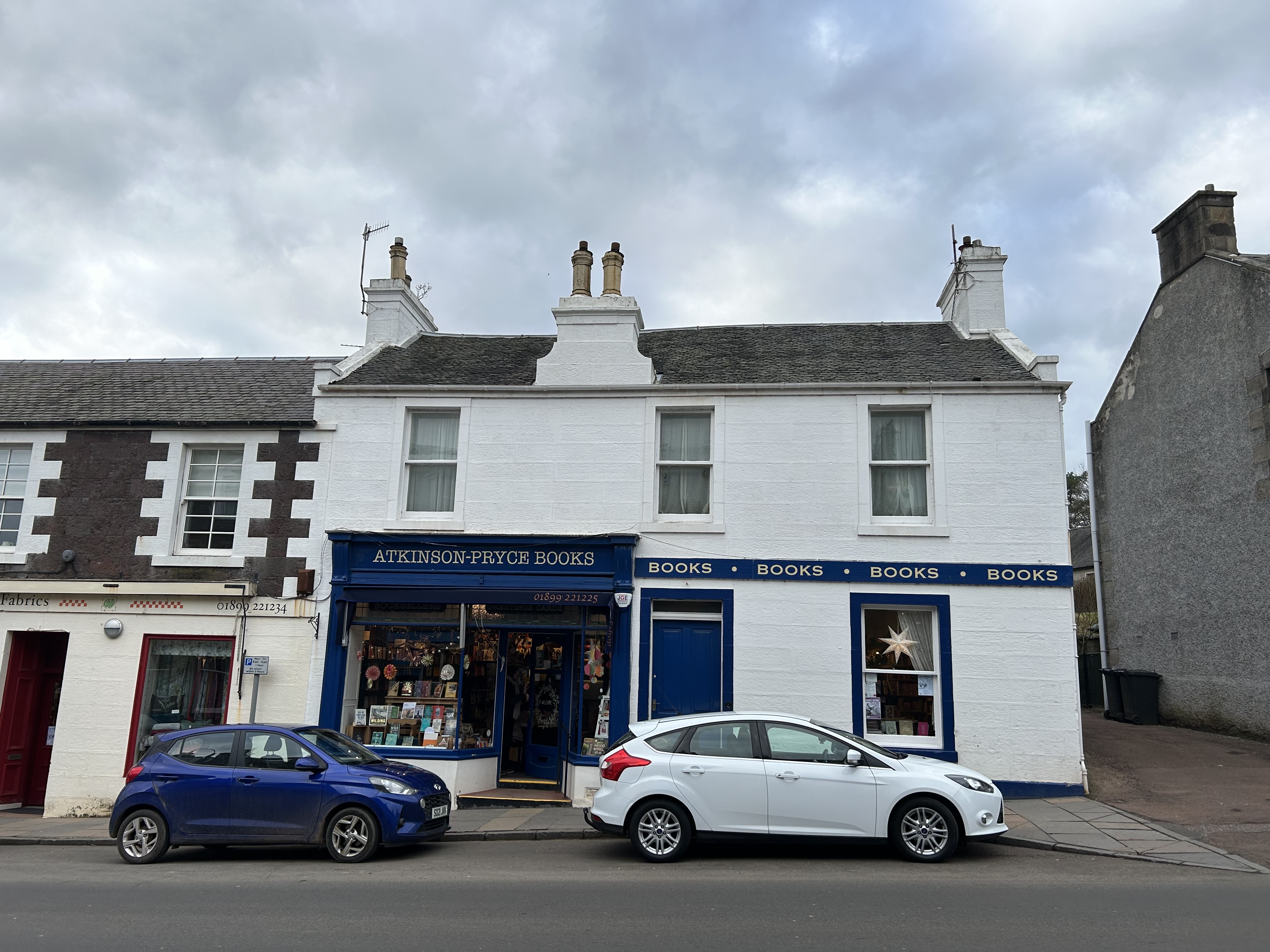
Anyway, as usual, thanks to anyone who made it this far. I hope you have a good week, and I will leave you with a couple of pictures of Biggar, where we went on school trips to the street museum. I was intrigued by the tiny scarlet door in the first building. I presume the road and pavement have been built up over the years, but anyone using that door would really have to watch their head! See you next week.

Testing for Tuberculosis

I was tempted to call this week’s entry TB, or not TB but that feels wrong. Although I have enjoyed this week, the subject is serious and there are sad overtones. I suppose the animals that go to slaughter following our test would have ended up there anyway eventually, but their lives will be cut short and it is a loss for the farmer, though he will receive some financial compensation for the cattle which are culled. It can’t be easy, knowing there is disease in your herd.

Though the aim to wipe out TB is laudable, for each farmer affected it can be a major headache. When we find TB on a farm, all cattle movements on and off that farm are limited. Restrictions are put in place and the only place those animals can go, is direct to the slaughterhouse. This means that if there are more animals on the farm than grass for them to eat, the farmer can’t send the excess stock to market. He either has to buy in food for them, or send them to be killed, even if they are animals that would be more valuable sold live. A young breeding cow has more value than the price of its meat, for example.

So it’s a difficult juggling act for the farmer. Throw in there the fact that our tests aren’t perfect, the disease is unpredictable and eliminating it can be difficult and you have the perfect combination for resentment of the people coming on the farm to do the testing and represent the government who put all these rules in place. We were very lucky this week that the farm owners were philosophical. It’s time consuming for the farmer as well. We tested close to four hundred animals this week. It took the best part of four days and even then, there are some retests that need to be done. Then in a couple of months, the whole thing will need to be repeated. On and on until the tests come back clear.

I met up with the team on Sunday night in the hotel where I would be sleeping for the best part of a week. I had met S the vet before. She took me out on some welfare visits a couple of weeks back, but there were two animal health officers coming too to carry out the blood testing and keep the paperwork in order. There was also another TB team, who would be skin testing at another farm in the area, so we were quite a big group. Though the food and conversation were good, we all retired early, ready for the hard work that was coming the next day.

It was interesting to me to go out testing. Thirty years ago, I used to carry out TB skin tests in the area, though in those days, there was no known TB in the area and all the tests were routine herd tests where we didn’t expect to find anything. The farm where we tested this week has already had TB confirmed. Culled animals had been found to have TB lesions present and culture results – where they attempt to grow bacteria in a lab from a possibly infected source – had shown that bovine TB to be present.

As far as I could see, the skin test hasn’t changed much at all. Two patches of skin on the neck are clipped (so you can see where you injected) and two types of tuberculin are injected: avian and bovine. Tuberculin contains purified proteins from the tuberculosis bacteria and in the UK, two types are used.
Because other harmless bacteria can be present in the environment, avian tuberculin is also injected, to try to rule out animals which have developed an immune reaction to those harmless bacteria, but still capture those that are infected with the harmful cattle strain. What this means, in terms of the test, is that if the animal produces an immune response, a lump develops at the injection site. If the lump at the bottom (bovine tuberculin) is bigger than the lump at the top (avian tuberculin) then the animal is classified as a “reactor”. That animal must then be slaughtered and checked for disease.

What was new to me though, was doing blood testing for TB in addition to the skin test. The blood tests are relatively new, very expensive, and there is a limited capacity for doing them in the UK. The animal health officer – SW – who arranged the test, had to call the lab in advance and book in our samples. The blood in the tubes also has to be kept within a certain temperature range and as it is winter, that meant that as soon as the sample was taken, it had to be placed in an insulated box with a heat pad. At the end of the day, a courier came, who would drive the samples directly to the lab.

Though it was a dull day on Monday, the test started well. SW was taking bloods and was wonderfully efficient at it. The arrangement with the needles was a bit different from what I remember in the old days. We used to use a test tube, a needle and a small, plastic needle holder. In between blood tests, you would unscrew the needle from the holder and replace it with a new one, so the holder was reused. Now, presumably due to the number of needle stick injuries that caused, a new needle holder is used for each animal. In addition, you don’t put the protective cap back on the needle. Instead there’s a green plastic flap that you flip into place to cover the needle. Doubtless it saves a lot of sore thumbs, but there is an immense amount of plastic waste.

This is K, the other animal health officer, taking a sample from the cow’s tail.

I had forgotten how messy blood testing cattle is. It was a beef farm, so the animals are always a lot wilder than dairy cattle. The animals are run up a race (a narrow fenced passage) and into a crush, where their neck is trapped so that they can’t move forward or back. That doesn’t stop them fighting it though, and as they scrabble about, the air fills with flying dungbombs. Of course, when you’re taking a sample from the tail, you’re also directly in the splat zone. I did a few samples and was briefly proud of how clean everything was… and then a cow sent the traditional jet of liquid shit directly at me and I spent the rest of the day with half my jacket and one trouser leg well and truly coated.

SW and K made a wonderful team. I was worried at the start that I would be a complete spare part, but they quickly involved me. Despite all the flying faeces, and the potentially serious nature of our visit, it was wonderful being back out on a farm, in the thick of the action, doing the job that I trained for all those years ago.

We had bought packed lunches in the shop in the morning. As we walked back to the cars, I was reminiscing with S the vet about the old days. When you spent the day on a farm testing, it was normal when you broke for lunch, to find a wonderful three course meal waiting for you in the farmhouse, courtesy of the farmer’s wife. Though it was already starting to be more common for farmer’s wives to work, it was still a regular part of that life back then, but I had been told it was uncommon now.

Of course, with four of us there, it would also be a big ask, but to my delight, we were invited into the farmhouse, where there was delicious, warming farmhouse soup, sausages, cheese and rolls and pancakes with butter and jam. Given what we were there to do, it was fantastically generous and it added to that feeling of deja vu I had all week.

We spent all day on Monday and Tuesday, injecting the skin test and taking blood samples, then on Thursday and Friday, S went out to read the skin test and I accompanied her, partly to do the writing (making sure you record the numbers and make sure the right animals are identified is crucial) and partly to see what the skin reactions are like and how they should be read. Though I’d seen a few avian reactions years ago, I never found any reactors and I was half hoping we wouldn’t find any.

But that hope only got as far as the third cow. Unfortunately, she had a lump where the bovine tuberculin had been injected, but no reaction at the avian injection site, which meant that she was a reactor. It was quite a chilling feeling for me, partly because the cow would have to be slaughtered and partly because I now knew that here was an animal with an infection that could be passed to humans. We’re not allowed out on farms to test without having had a BCG vaccine, but it was an unexpectedly sobering thought.

Things went relatively well from there, though there was one other reactor, and that was last years calf from the infected cow. Interestingly, the blood tests came back on Friday, and though it had picked up TB in the calf, the cow tested as negative. It will be interesting to see what is found when the two of them are culled. Though it’s not nice to see a young, recently weaned beast being sent off, it was some consolation that the cow would have company. Cattle tend to be stressed when they are isolated from the herd, and the farmer is required to isolate reactors as soon as possible.

There were also some more positives from the blood test, so they will be sent off too. Then, as I said back at the start, the herd will need to be tested again, and maybe several more times, but hopefully it will eventually be cleared. Officially Scotland is TB free, but in southwest Scotland, where animals are regularly brought in from Ireland, it’s always going to be a problem until they find a better solution. And as this is part of my patch, it looks as though we will be working on it for some time yet.

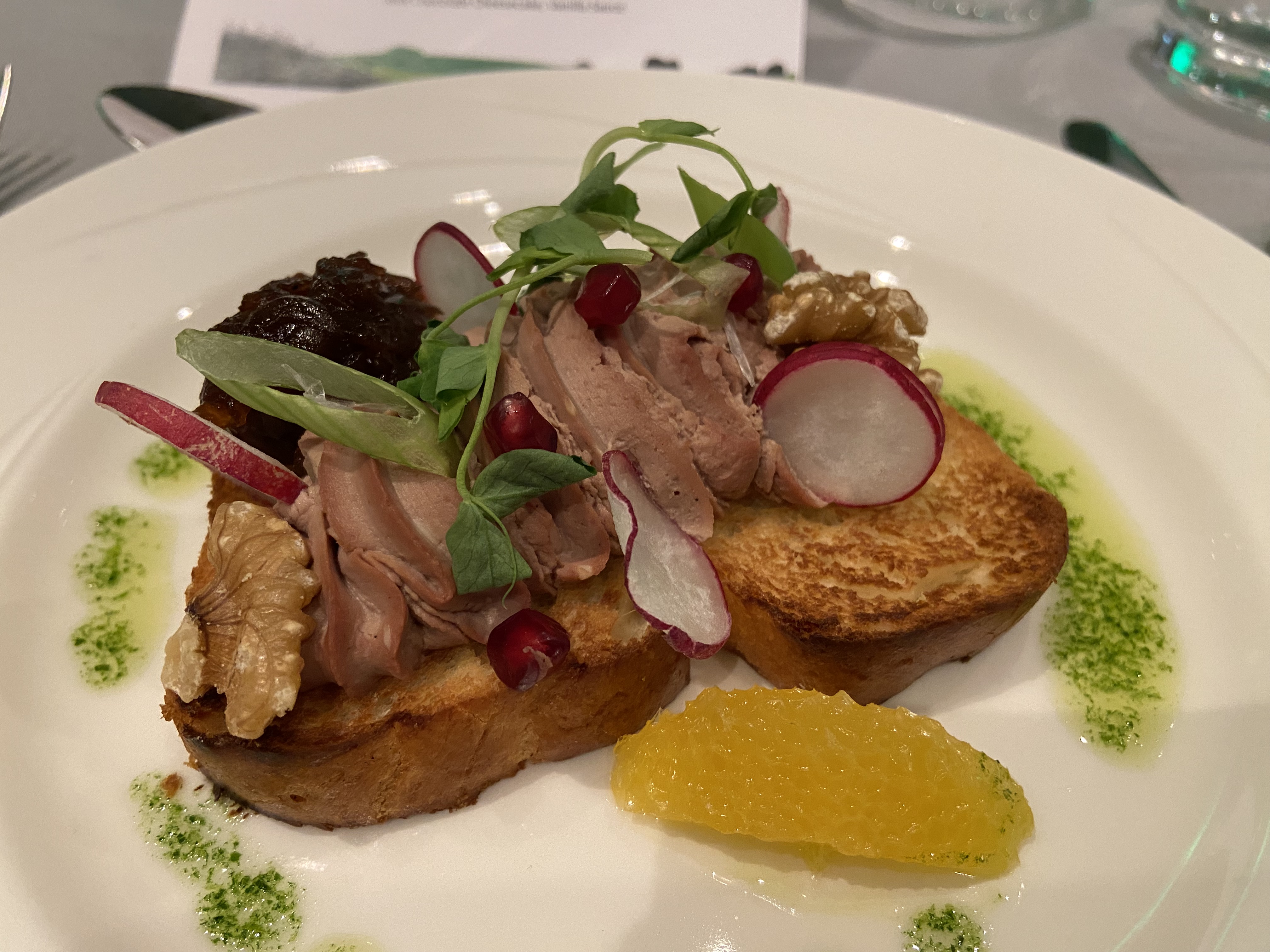
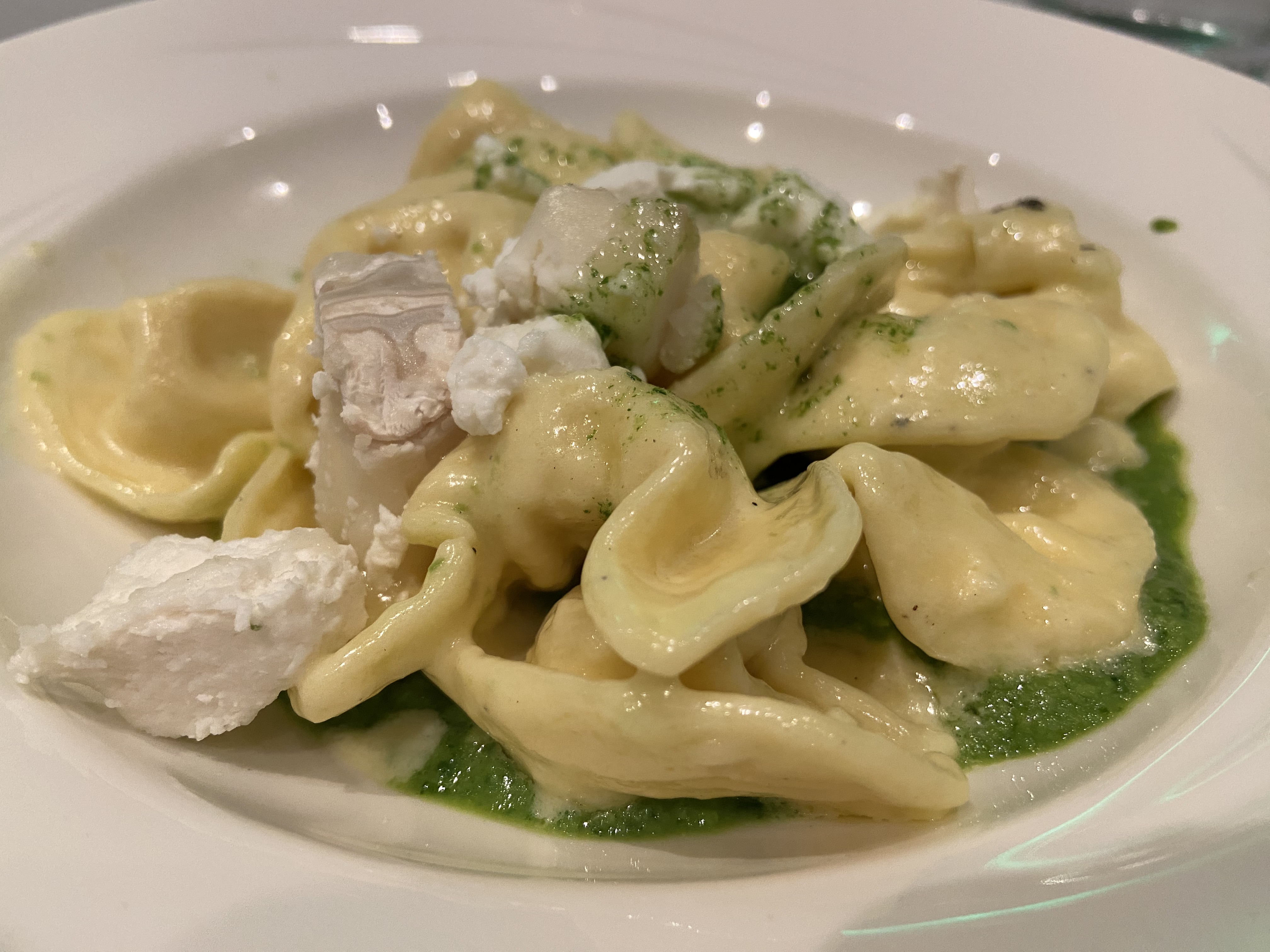
And for those of you that have made it this far, here are some gratuitous food photos from the Craignelder Hotel, where we stayed.

A Sky Full of Kites

I stayed in Scotland last weekend and Triar and I had a couple of good days. He and I went for a walk in a forest on Saturday. He was off lead and though I was a little nervous as he rushed off, splashing through ditches and disappearing into the undergrowth, he kept coming back and was eventually so tired that he returned to walk at my side, at which point I put him back on the lead. There were laws in Norway and going off lead was banned at certain times of year, so this is mostly new to both of us, but hopefully will become normal. He came home with manky paws and a coat full of twigs. I’ve spent the past week picking tiny bits of wood from the carpets, but it was worth it to see his cheery face.

On Sunday, I hired a dog field at Kirkgunzeon and that was also great fun. I invited Donna and her two dogs and thought they didn’t interact too much, they didn’t fight and all of them were tired out after running around for forty five minutes. I also got to practice Triar’s whistle recall, which is still excellent, thank goodness.

Treacle and Rubens
Tabletop Triar

My brain has been a bit frazzled at work this week. One of the most disconcerting things in my new job is having to jump from case to case, sometimes at the drop of a hat. Part of the reason it’s tough at the moment is that so many things are new to me. I can be just starting to be feeling things are under control, when suddenly something unexpected wangs into my e-mail that needs an urgent response and (this is the problem) I don’t know how to handle it.

I know from experience that this will get better. It’s a long time ago now, but I can remember as a brand new vet that every night on call felt this way. Anything could fly at me and I was more or less on my own to deal with it. Yes, I could usually call on someone, but you you can’t do that for every case. After a while, it became normal and I could deal with anything without that panicky feeling that I might mess something up.

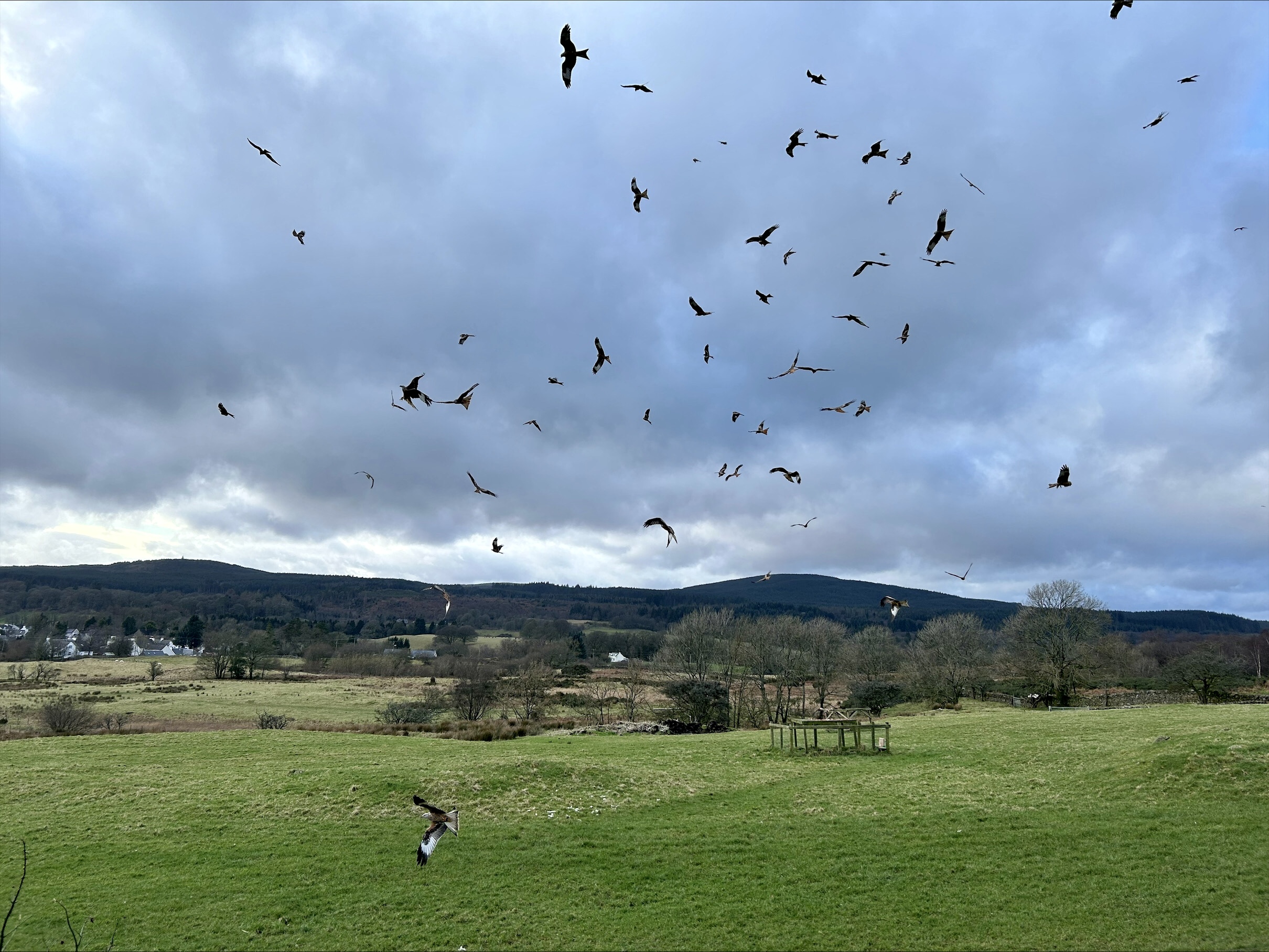
Outside of that, my new life continues to be interesting and rewarding. On Monday, C took me out on a visit to the Red Kite Centre at Ballymack Farm. We weren’t there to see the kites, rather the way their food was prepared and stored, but we stopped to watch the kites anyway. It was probably amongst the best lunchtime breaks I’ve ever had!

The delightful owner is in her eighties, but still goes out every day to feed the birds. There were a few birds circling in the sky overhead but we watched her go out and scatter their food and then suddenly the entire sky was filled with soaring wings. Their cries sounded melancholy on the wind as they waited, then in a flurry, they swooped in, diving to grab the raw meat, rising again into the air and then circling again. It was a stunning display and though I tried to take some photos, my phone camera couldn’t really do it justice. I envied the man who had a huge zoom lens on his camera. His family were waiting impatiently for him, but I fully understood as he stood outside in the blustery wind taking picture after picture, hoping for that perfect shot.

I’ve done a couple of other visits this week and raw pet food has been a feature of all of them. It comes under the classification Animal By Products or ABP and the agency I work for does quite a lot of work trying to ensure it is produced and stored safely. Other features included work on my first potential TB case and a complaint about two dead cows. One thing I can say is that every day is different! Thank goodness I have wonderful colleagues who seem very willing to support me through it all.

I’m in Yorkshire this weekend, dropping Triar off as next week I will be in Stranraer again, learning more about TB case handling out on a farm. Have a good week all!

Lunch at the kite feeding station – they do a mean carrot cake!

Tuberculosis

The rain is hurling itself against the window as I write this, having returned home after half a week in Stranraer. The wind there was relentless and felt like it was filled with icicles. Not quite the balmy, maritime climate I might have hoped for. Despite the chilly wind and the sleet that fell, the fields were still green and many animals are still outside. So different from the months of snow and ice in the far north. I finally found the time to take a few photos when I was out and about, which I’ll share in between the streams of reminiscence!

It was strange being back. A lot has changed in the last thirty years, although one thing that hasn’t changed much is the little lodge house I lived in back then. It now has oil central heating, where once the only warmth came from a coal fire, and the wheelie bins are out front, rather than tucked away at the back door, but other than that, it still looks much as it did when I lived there. I swore, after those eighteen months that I would never again accept a house without central heating.

The practice I worked in is long gone. The younger of my bosses sold it to the neighbouring practice (now Academy Vets) years ago. I went into Academy Vets as I had to chat to them about a case. I thought I didn’t know any of the staff, but I discovered that one of the senior vets had seen practice with me when he was a student, which illustrates how long ago it all was. My older boss is still around, apparently. Hopefully I can visit him, next time I’m over.

Simpson’s the bakers is still there on the main shopping street. I remember Anne, the kindest receptionist ever, asking if I wanted anything from Simpson’s at lunch time on an almost daily basis. I bought a sandwich: coronation chicken on white bread and they must still be using the same recipe as they used, all those years ago. It was as delicious as I remembered, though it now comes in plastic, where once it was in a white paper bag. The cakes haven’t changed either: very traditionally Scottish, all intensely sweet, no fresh cream and some very garish icing.

I was quite surprised (and rather saddened) by how unfamiliar a lot of it seemed, though I did keep tripping over memories over the course of a few days. I thought the Morrisons supermarket was new, but when I went in, it dawned on me that it was the precious supermarket that was built when I was there. It was Safeway when it arrived in town and was a wonderful addition. Before that, there was only a dim and narrow W.M. Low’s that I would walk around, looking for something for dinner, finding no inspiration. Morrison’s was closer to the centre than I remember and I don’t recall using a roundabout to get into it, but maybe I’ve just forgotten. A colleague who grew up in Stranraer reminded me that the old cattle market was knocked down to build it, and I do recall that as well, but only in the vaguest of ways.

Mostly I drove around, thinking how unfamiliar it all seemed, though when I drove away from Academy Vets (where we used to take dogs for x-rays as my practice didn’t have one) I knew exactly how to get to Lewis Street, where McTaggart and Williamson used to be, and for a few moments, I felt as if time had shifted.

Though my time in Stranraer wasn’t particularly happy, it is where I met Charlie. He took a job in my practice, having spent time as a student doing extramural studies around the corner in Academy Street. We were married twenty three years and have three wonderful children together, so it was a significant time in my life.


Anyway, enough reminiscing and back to the present. This week I have been learning about tuberculosis. It’s important that I do as I will be taking over several TB outbreak cases in just over a month’s time, when my Stranraer colleague goes on maternity leave. Although I’m learning a lot at high speed, I am now reaching the stage when I can see just how much I don’t know.

There’s an online course I need to take, as well as having time for the cases to be handed over. I am finding out where to look up case handling and I’ve an offer of help with the tracing and epidemiology, but I am still going to need a lot of guidance. Each case is different, depending on whether there were signs of TB found when an animal went to slaughter, or whether it was picked up during a skin test, and beyond that how exactly the case progresses, once a positive skin test occurs. There are a multitude of pathways, depending on those factors. I did the skin testing thirty years back, but there were no positive skin tests back then, so the rest is new to me.

Now in addition to skin tests, they can take blood tests and are beginning to understand some of the genetics. Tracing where it came from (and where it might have spread to) is now becoming more clear. You can sometimes tell where a strain might have come from, because it is genetically similar to a separate case. When I was testing, thirty years ago, there was no TB in the area. The aim is to return to that situation, but I think that will take a very long time, if it’s possible at all. Only time will tell.

Yesterday, R and I visited a farm where the investigation is just beginning. One of their cows had a small reaction to the injection during a routine skin test. When tested again, sixty days later, she reacted more. Now she will sadly be taken to slaughter, where they will check her for visible signs of TB and also do a PCR check, where they look for TB DNA. After that, whatever the result, the whole herd will have to be checked again. Until they get the all-clear, with no reactors, they cannot sell any of their animals, or move them off the farm, other than for slaughter. It’s a huge blow to any farmer to find out some of his cows will have to be culled and that there is disease in the herd that can spread to humans. I hope, for their sake, that the tests all come back clear.

I had left my car in a car park in the middle of nowhere while R took me to the farm, and on my return, I was quite surprised to see a van parked beside it. R headed off and to my surprise, the driver of the van came over to chat to me. He was wizened as if he had spent a lot of years battling the weather, but he seemed cheery as he told me he was a mole exterminator! He is seventy five, he said, and still tending to over seventy farms, though in his heyday, he cleared a hundred and twenty. I confess that it had never crossed my mind that the job of mole exterminator existed, but he seemed very upbeat about it and was obviously very efficient. It did cross my mind that perhaps I should consider a new career, but he said he thinks he has someone lined up to take over his patch when he finally gets too old.

Anyway, I’ll leave you with some food pictures. I ate every night in the North West Castle Hotel and would highly recommend it!

Sea bass with creamed potatoes, prawn and chive butter and seasonal vegetables
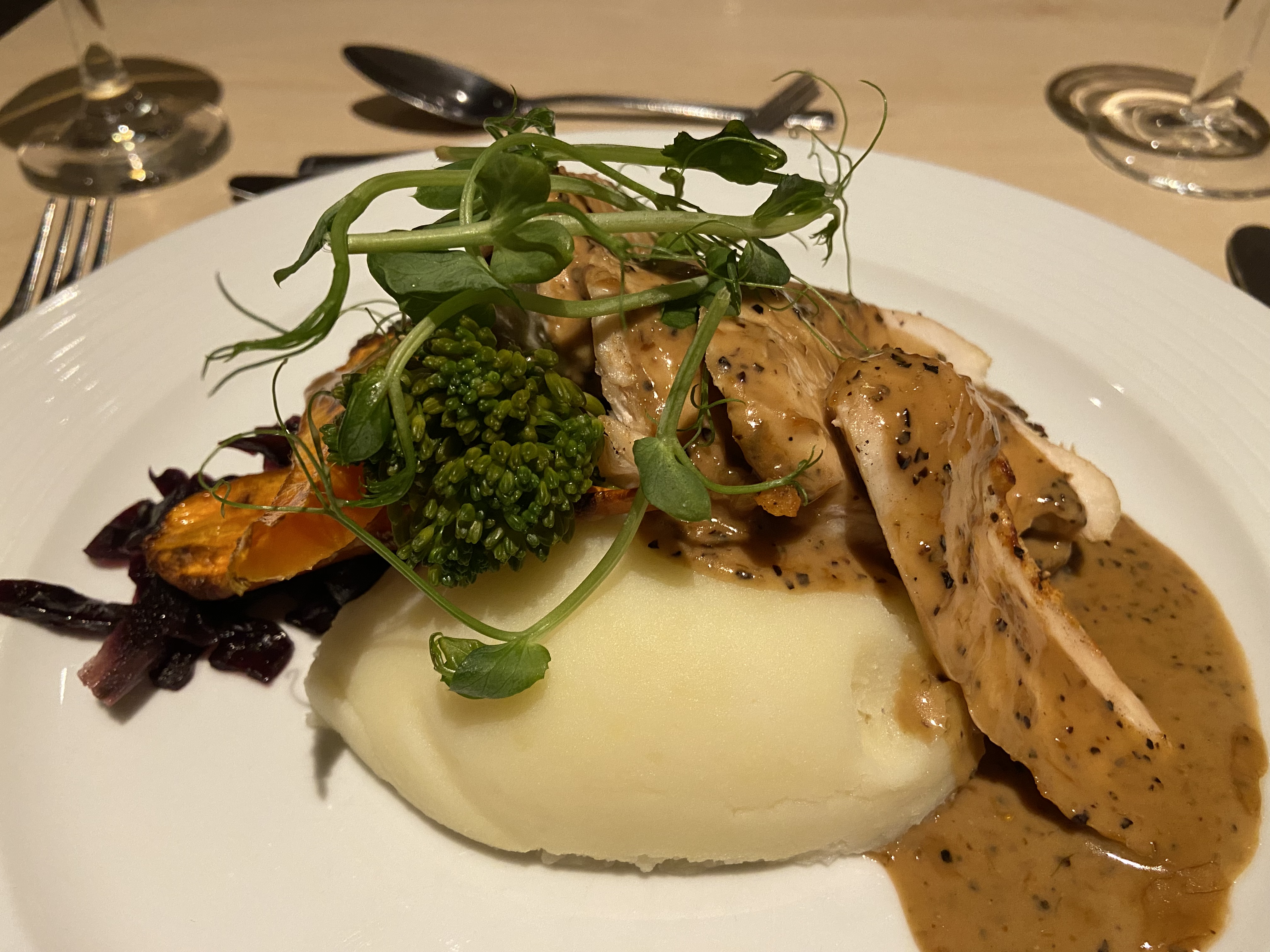
Breast of chicken with mash, haggis and peppercorn sauce

… and the piece de resistance…

Strawberry cheesecake

Delicious! See you next week.

Farewell to Ice and Snow

Current Location: Ganddal, South-West Norway

Another emotional week, this week. If you’ve been following for a while, you will understand why I was nervous of handing over the house, more specifically the cleaning. Shirley, knowing all that history, volunteered to come and help me and was absolutely wonderful.

As a retired nurse, I thought that if there were any problems, she’d be a great witness. She is also an absolute whirlwind with a mop. I think she cleaned three rooms in the time it took me to get the bathroom sorted out. She also brought along a kettle and delicious biscuits and we sat and drank coffee, gazing out of the kitchen window at the snowy bulk of Fagerfjell (Mountain) that rises up behind the house. It was lovely to have some pleasant last memories after the furniture removal debacle!

My last two days at work were lovely. I was on the early shift, checking the live animals both days. I had quite forgotten that Tuesday was Halloween, so I was especially delighted to come back from the lairage to find that Trude had made our office really cosy with Halloween themed decorations, sweets, and a cake.

A few last memories of the lairage: there were wooly pigs there on my last day. Like many of the pigs, they were fast asleep when I arrived to look at them, so I took a photo. Actually, I think the black one facing me in the middle might have clocked me, but it’s a typically peaceful scene from the pig pens, albeit with extra wool!

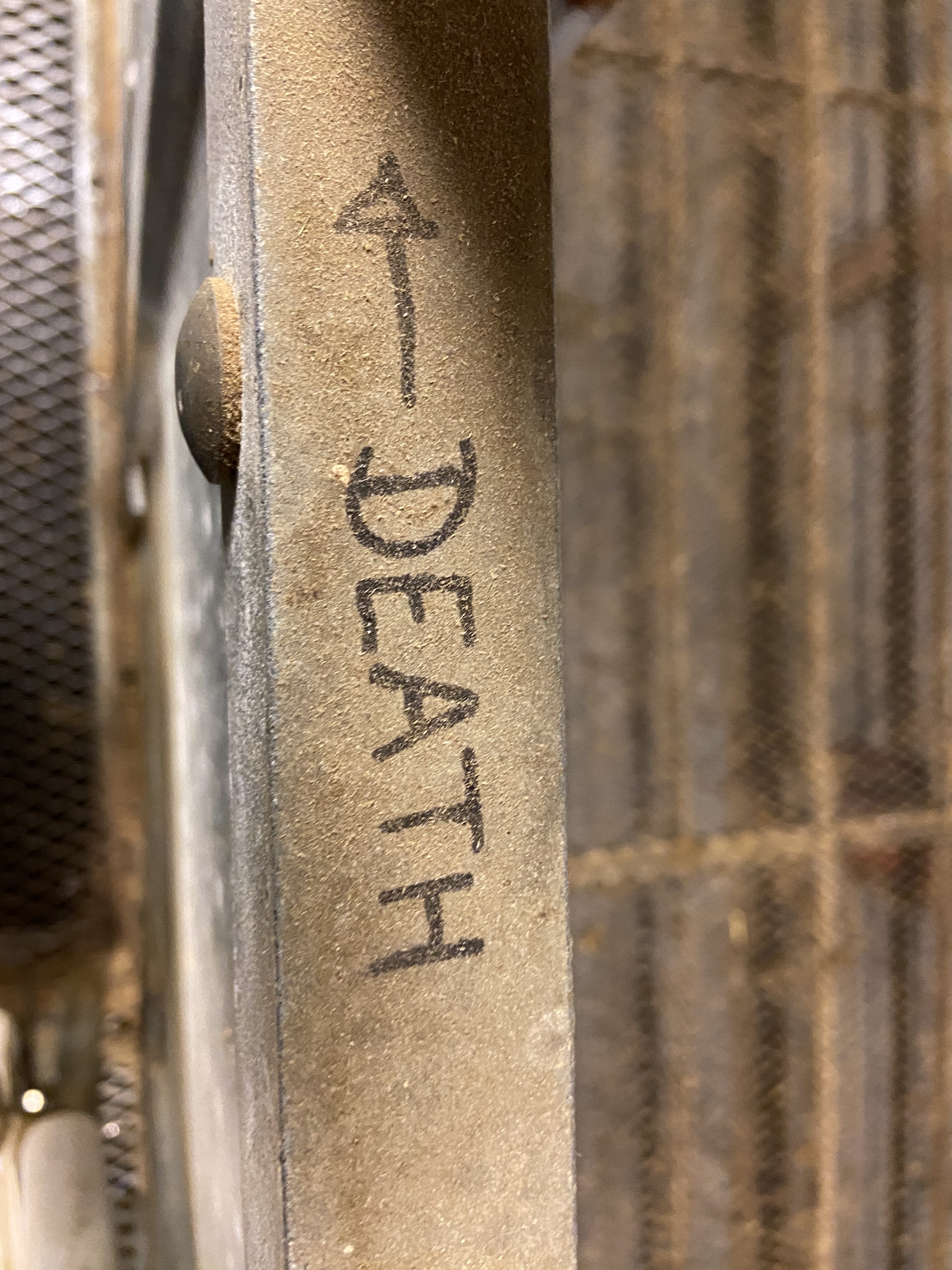
There are a couple of bits of grafitti that have amused me over the years. Someone with a dark sense of humour has added a direction marker for any poor sheep in the «cold lairage». Fortunately, with all the sheep being Norwegian, they won’t have understood it if they saw it.

And there is a cheerier message on the back of one of the gates we stand behind when the animals come in. There’s not too much danger from a flock of sheep, even if they do run straight over you, but there are also big bulls brought in on a regular basis, and then this i very relevant.

Translated, it says, «You are safe here, Amen». A very reassuring message.

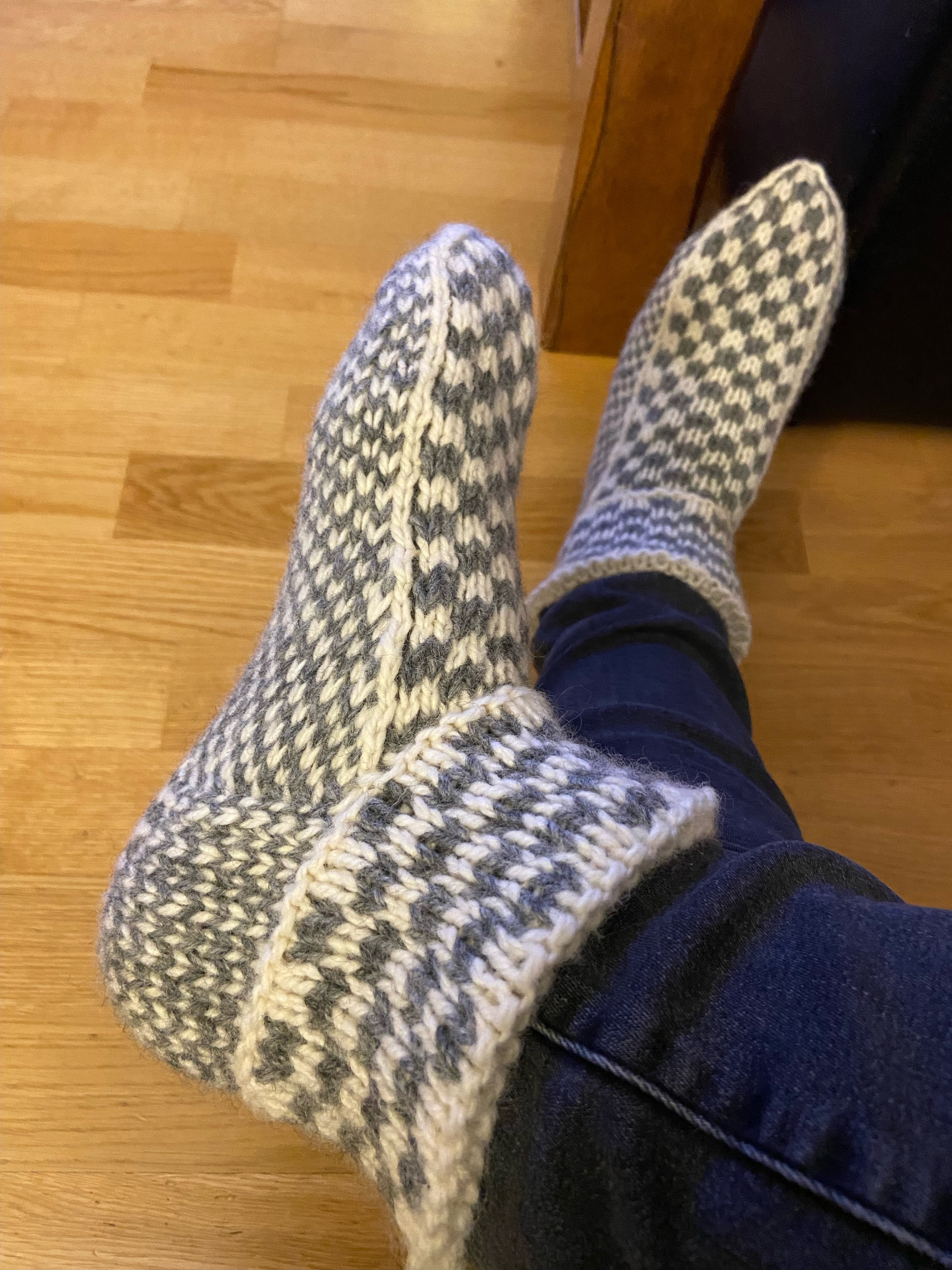
We had pizza together at lunch time and I spent the rest of the day showing Ingrid how to do a few last things. I also hugged almost everyone, which was lovely, given the restraints of Covid that were in place for so much of my first couple of years. I was also given some gifts, including a lovely pair of Målselv socks, which I can confirm are deliciously warm as well as very pleasing to look at.

The sale of the car to Kaj and later of the house, went through without a hitch. Both had originally been planned for 1st November, but as the house was ready before that, I handed over both sets of keys on the 31st and then drove to Tromsø with John. I had two nights in the lovely flat he and Yoana have rented. They’ve made it really cosy. I bought them a Nespresso machine as a housewarming present. Hopefully they’ll get a lot of use from it.

On Thursday morning, I walked through the snow to catch the bus that would take me to the airport. It was a beautiful day and I managed to capture a last photo of Tromsø as the plane took off.

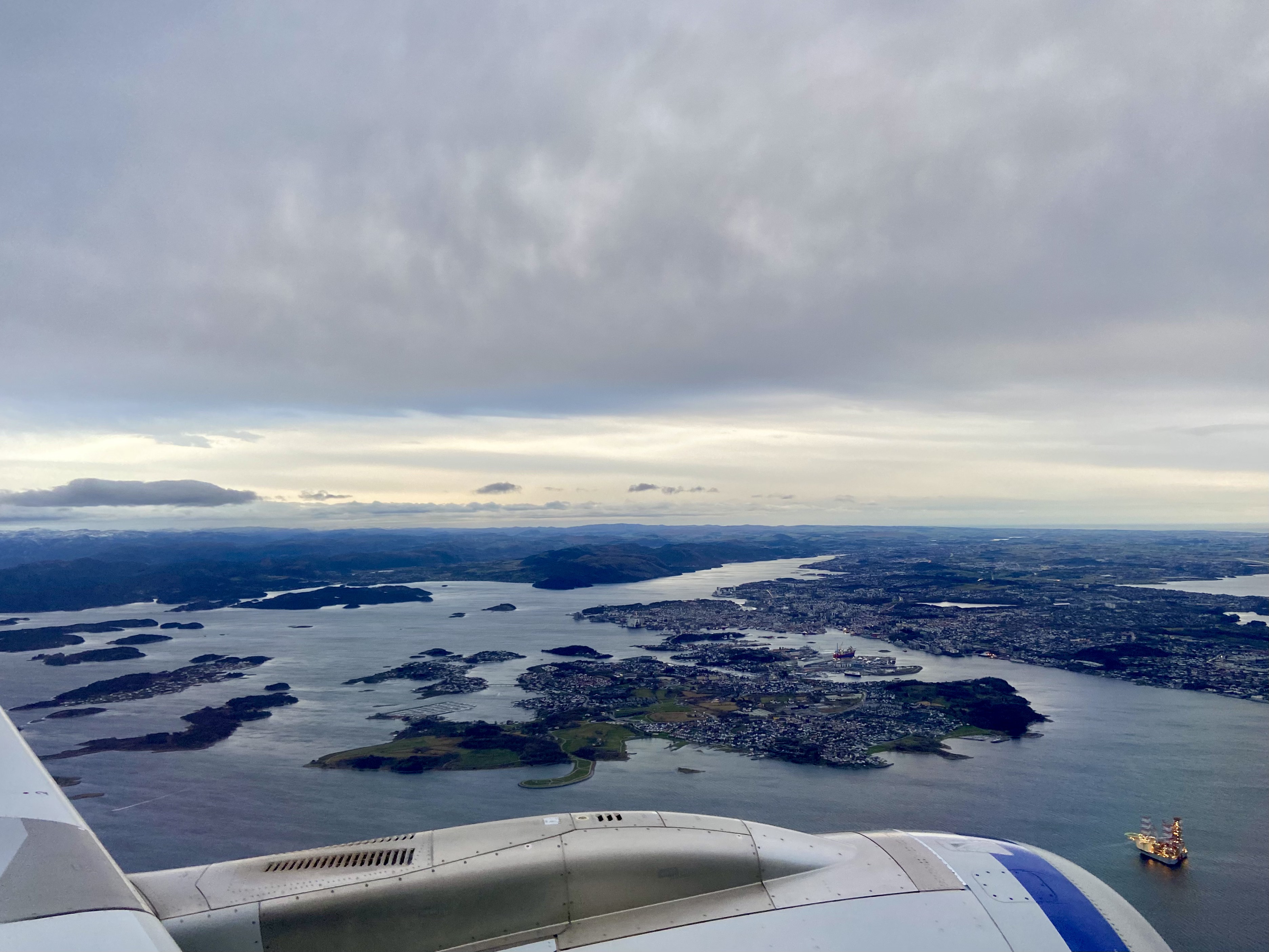
It was a lot greener in Stavanger when I landed.

And of course, this lovely boy was waiting for me at the airport. It was wonderful to be reunited.

So now I am in Stavanger for a few days. Andrew came round on Thursday evening and yesterday and tonight Anna will be joining us. She will be coming with me on the next leg of my journey. We will take a boat from Stavanger to Hirtshals in Denmark on Tuesday evening.

And for regular readers, I have been asked to continue blogging by so many people that I will continue when I get to Scotland, so I hope you will all join me as I begin the next stage of my life as «The Vet Who Came In From The Cold».

Heat!

Sunrise/sunset: Up all day.

We’re reaching the tail end of the twenty four hour sunlight. You might think that, as we live in the Arctic, that it would never get warm, but this week it was approaching thirty degrees Celsius. There’s no point in waiting for the cooler evening either, because there isn’t one. I have been woken at four in the morning most days this week. That seems to be the time when the sun reaches the side of the house where my bedroom window is. fortunately, we have an air conditioning unit, which gives us heat in winter and cool air now. The house has a tin roof, designed to hold some snow in winter as snow acts as insulation, to an extent, but in summer, having a house with a black tin roof obviously can have its disadvantages.

The heat can be very significant when considering the transportation of animals, so that has been an important part of my job this week. Several countries in Europe have actually banned animal transport this week, but sometimes when it’s warm, it’s possible for them to travel during the night, when temperature’s drop, but up here, that’s not really a consideration. We’ve not been at the stage where a ban was needed, but the drivers of the lorries that bring animals into the abattoir have been asked to ensure the animals have enough space in the containers and to make sure their temperature alarm systems are working and switched on. The lorries are fitted with thermometers which measure temperature and if it goes over thirty, the driver should receive an alarm on their mobile phone. I have been monitoring the logs all week. Though it’s actually the abattoir’s responsibility (the company owns the lorries) Mattilsynet can request the information at any time and it’s good to make sure, especially during the holiday period.

In Norway in summer, everyone is entitled to take four weeks of holiday in a single block. Most people choose to take at least three weeks and many take four. There’s often a rule that you have to choose whether to take the first four weeks or the second of a seven or eight week period, but what it means is that everything is running at a much reduced rate. In the abattoir, when the line is running fast, there are people at lots of different stations and each does an individual task, but in the holiday, they often have to double up. And if the person who does one specific job most of the time is away, then often the person doing that task will be less experienced. Of course, that means the vets and technicians at Mattilsynet have to do more monitoring, which would be fine if we didn’t also have the same holiday system! In short, in Norway you shouldn’t expect anything much to be achieved in summer.

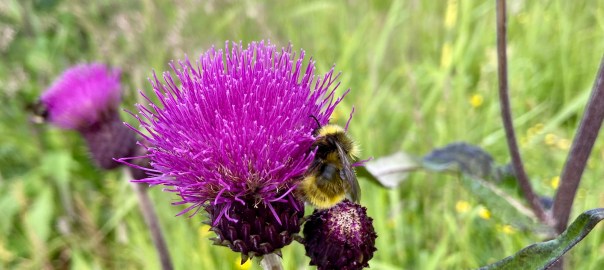
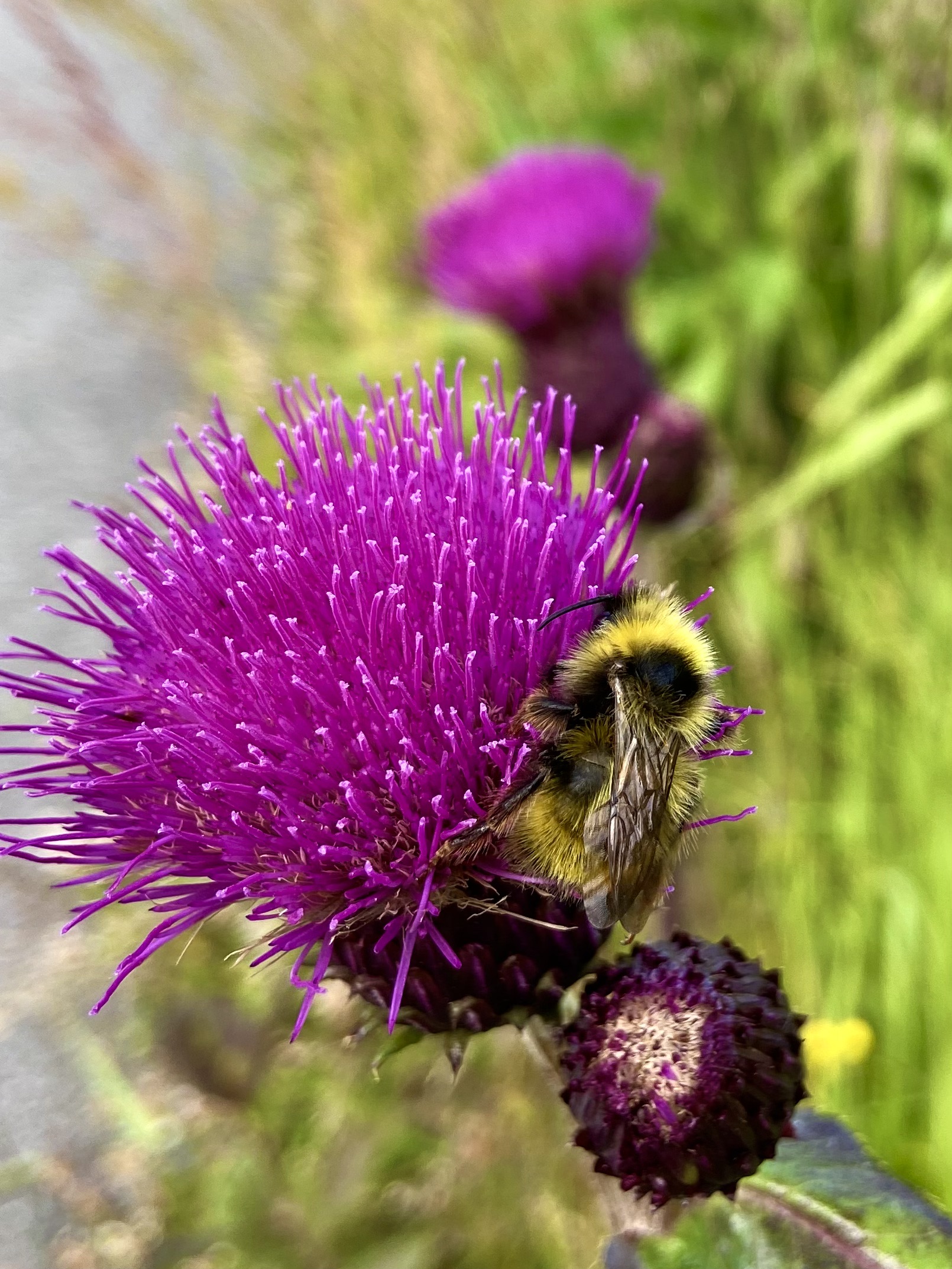
There are compensations though. It is spectacularly beautiful with everything growing. There are lots of insects, including bumble bees, which I love.

There are also less attractive insects. I’m sure I have mentioned mega mosquitoes before, but this year has yielded a spectacular crop of evil, black horse flies. According to locals, this is because we had a cold and rainy May. Supposedly they are short lived, which is good because when they bite you, it’s painful. The locals also call them kleg, which might not be the correct spelling, but is a real blast from the past as in Scotland, horse flies are also known as klegs.

Anyway, despite the clouds of horse flies, John and I managed to enjoy a barbecue last Sunday, to celebrate Konstantin’s birthday. Konstantin had lit a fire by the time we got there and the smoke kept them at bay for a little while. It was a wonderful location by a lake, chosen by Konstantin.

There’s a notice on that board behind Konstantin that says you can hire canoes. There’s also a boat landing place with a ladder for swimming. We will definitely be going back sometime and hopefully, the flies will stay away!

Super Blue

Sunrise/sunset: 09:08/14:56 Daylength: 5hr48min

I’ve seen the sun! I wasn’t even looking for it, but went outside at work on Monday just after ten o’clock and, to my amazement, there it was!

I don’t think the feeling of joy this gives can be understood until you’ve lived somewhere where there is a significant period when the sun doesn’t come over the horizon at all. Long cloudy spells, even in the south of Norway, were not the same. I had a visceral feeling of joy at this moment. When the sun isn’t out, the light here is still super blue. I will add some other photos later, taken on a couple of different days this week, and you will see what I mean.

This winter has been hard. The snow came early and there has been a lot of it and on top of that, the temperature changes have been crazy. One day it’s minus twenty, the next it can be above zero. We badly needed the wood that Ann brought because this year has demonstrated that our house is not really insulated well enough. At super-cold temperatures, even the lovely new, powerful heat exchanger I bought doesn’t really cut it and the electricity bill last month was heinous. On the coldest days, when we come home, it can be thirteen or fourteen degrees in the house, which isn’t super-freezing, but isn’t comfortable to sit in. The wood stove solves the problem, but it takes a couple of hours to really start warming the place up. Before next winter, I will be getting new insulation in the loft and I hope that will make a significant difference.

As regular readers will know, I am in the process of moving jobs at the moment, though still within the Norwegian Food Safety Authority: Mattilsynet. I have spent most of this week working in the abattoir, where I am rapidly learning how to do new tasks, in particular to do with administration. The two main aims are to ensure that the food produced is safe and to ensure that animal welfare is high and though the first is very important, it is the second that interests me more.

For the first time this week, I have come across a situation where I am going to have to issue a fine. In Norway, it is illegal to send cows to the abattoir within the last month before they are due to calve. As their pregnancy progresses, the ligaments around the pelvis begin to loosen, and obviously as the calf gets bigger, it’s more likely that loading and unloading and travelling in general can result in pain or injury. In an odd coincidence, having not come across a case before, this week there were two.

In one of these, in my opinion, the farmer seems not to have been careful enough, though I believe he does still care about his animals. It’s not entirely up to me and Thomas explained that I will need to involve the animal welfare advisor before I make the decision, but it seems likely he will be fined. The other case was even sadder to deal with. I called the farmer and he told me that he’d had a vet out to check the cow for pregnancy and that the vet had got it wrong. It happens, of course. Mistakes do occur, but for the farmer it was a significant blow. He won’t be charged a fine as he sent me evidence, but his cow was pregnant with twins and he sounded very upset as he told me she was a good cow. Farming has to be one of the toughest professions there is.

Andrew is in his last year at school. He has known for a while that he wanted to go to folk high school for a year (before probably going on to university), but this was the week when many of them started accepting applications for next year, and to his enormous delight, he got into his first choice of school to study film. We had previously looked at ones closer to home, but the courses local t ous didn’t seem as well suited to what he wanted, and so he is going to move back to southwest Norway for a year. It will be strange without him, but I am delighted with how excited he seems. Anna spent a year studying computer game coding near Trondheim and I think she would agree it was one of the best years of her life so far – an uncomplicatedly happy time. As well as studying computing, there was an unexpected sideline at Torshus where they sang sea shanties and the culmination of the year was to sail a tall ship from Bergen to Shetland and back. It will be very interesting to see how Andrew’s school compares.

Last but not least, my mum is eighty years old today. I hope you have something lovely planned and I’m looking forward to celebrating with you in March when we come over. Happy birthday Mum!