Category Archives: Blog

Changing Wheels, Changing Weather

Sunrise/sunset: 08:30/ 16:32. Daylength: 8hr01min

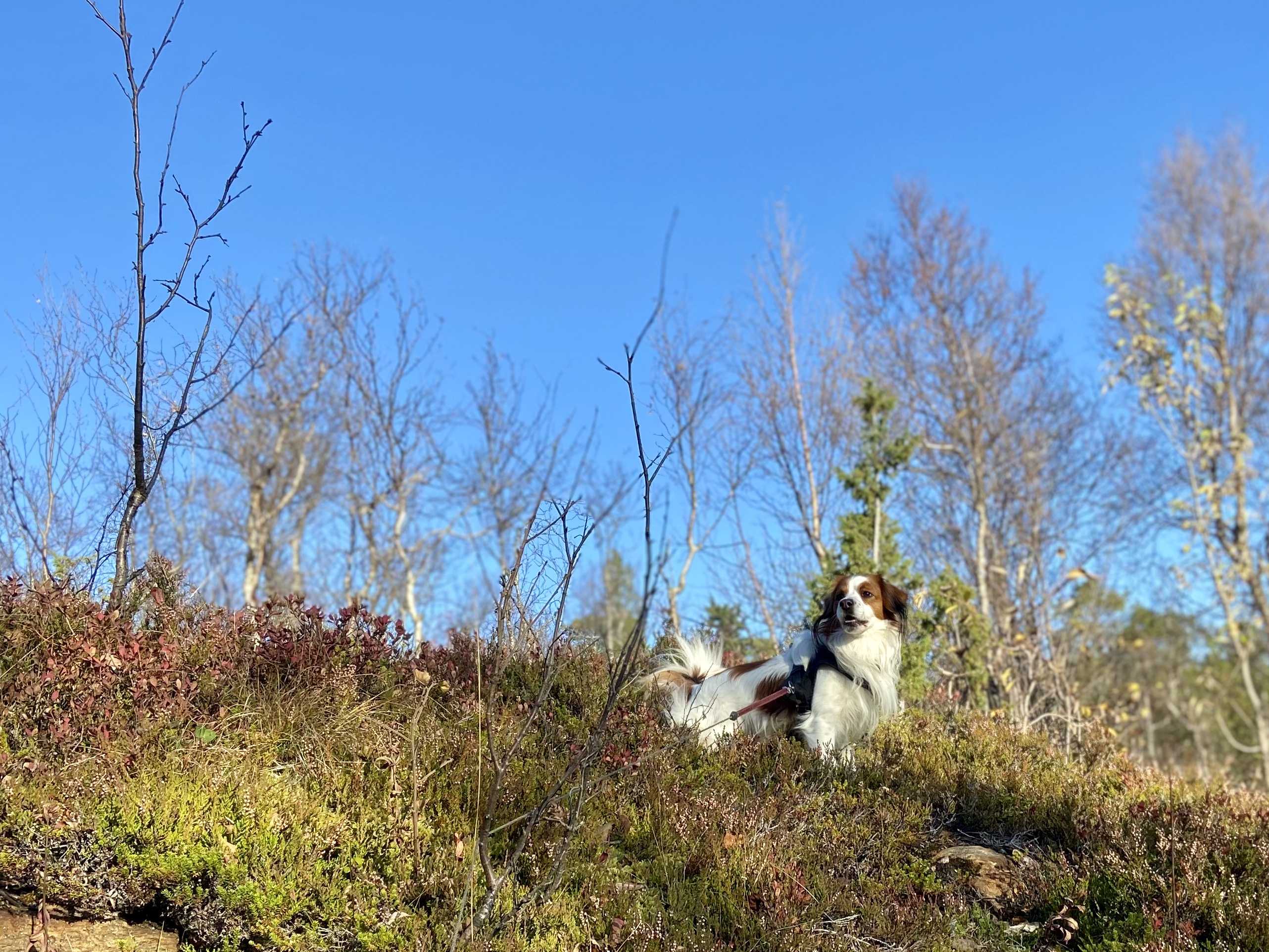
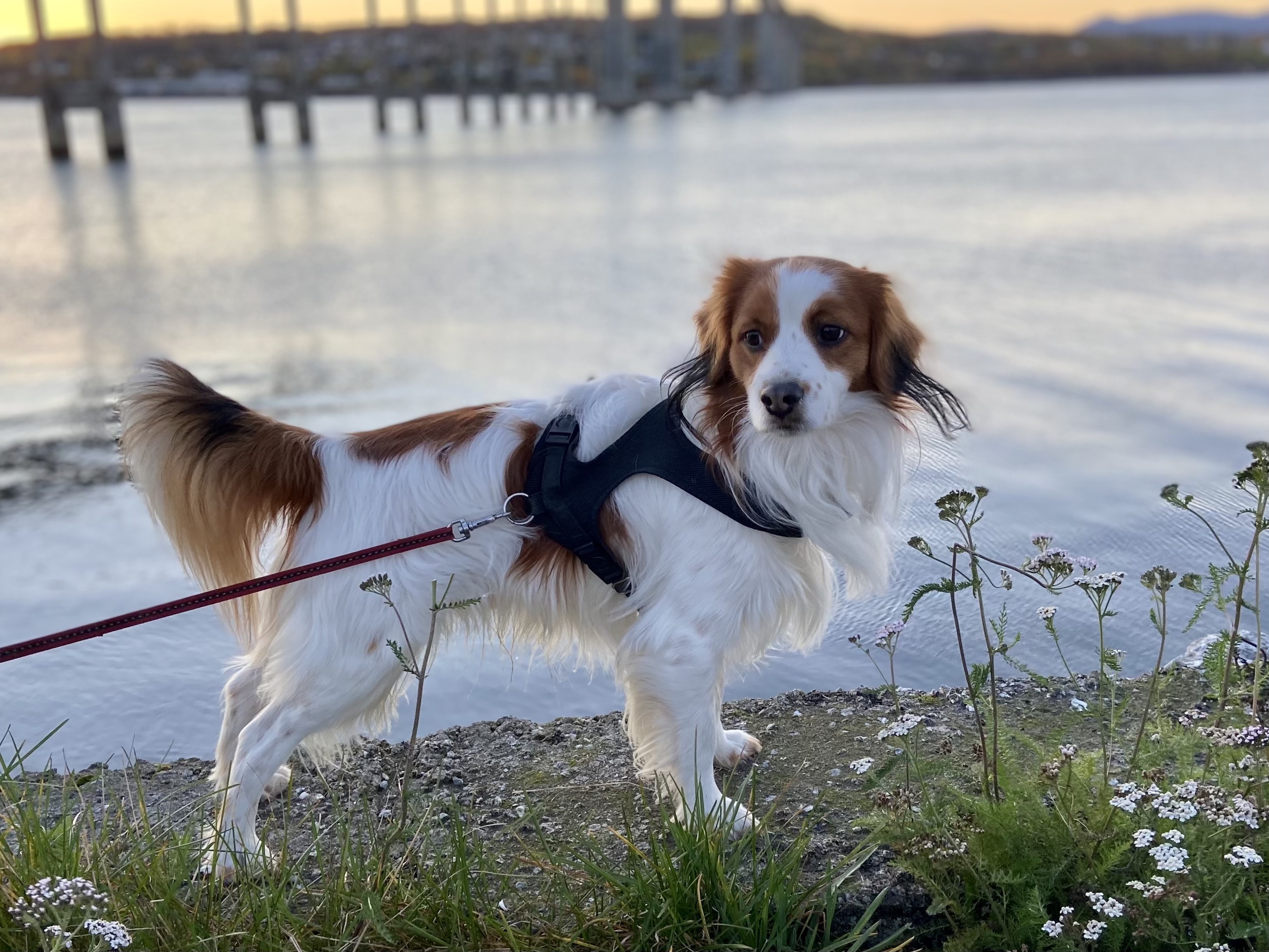
Feeling full of energy last Sunday, I decided I would take Triar for a mountain walk. There has been snow on the higher slopes for a few weeks now, and Triar loves it, so I hoped that if I could get high enough, we would find some. We set off on a pleasant autumn day, and I managed to get a shot of Triar looking noble (or maybe just cute) against the wonderful backdrop of fallen leaves and yellow grass.

Triar against an autumnal backdrop

It was easy to stay warm as we strode up the track. Kistafjellet (the mountain it leads to) is actually over a thousand metres, and the road goes all the way up as there is an antenna mast on the top, but I was not aware of this as I set off.

After walking for about half an hour, we began to see traces of snow, and about forty minutes in, there was a reasonable covering on the roadway, though it was not yet thick enough to cover the grass and undergrowth. As you can probably see from this picture, Triar was delighted.
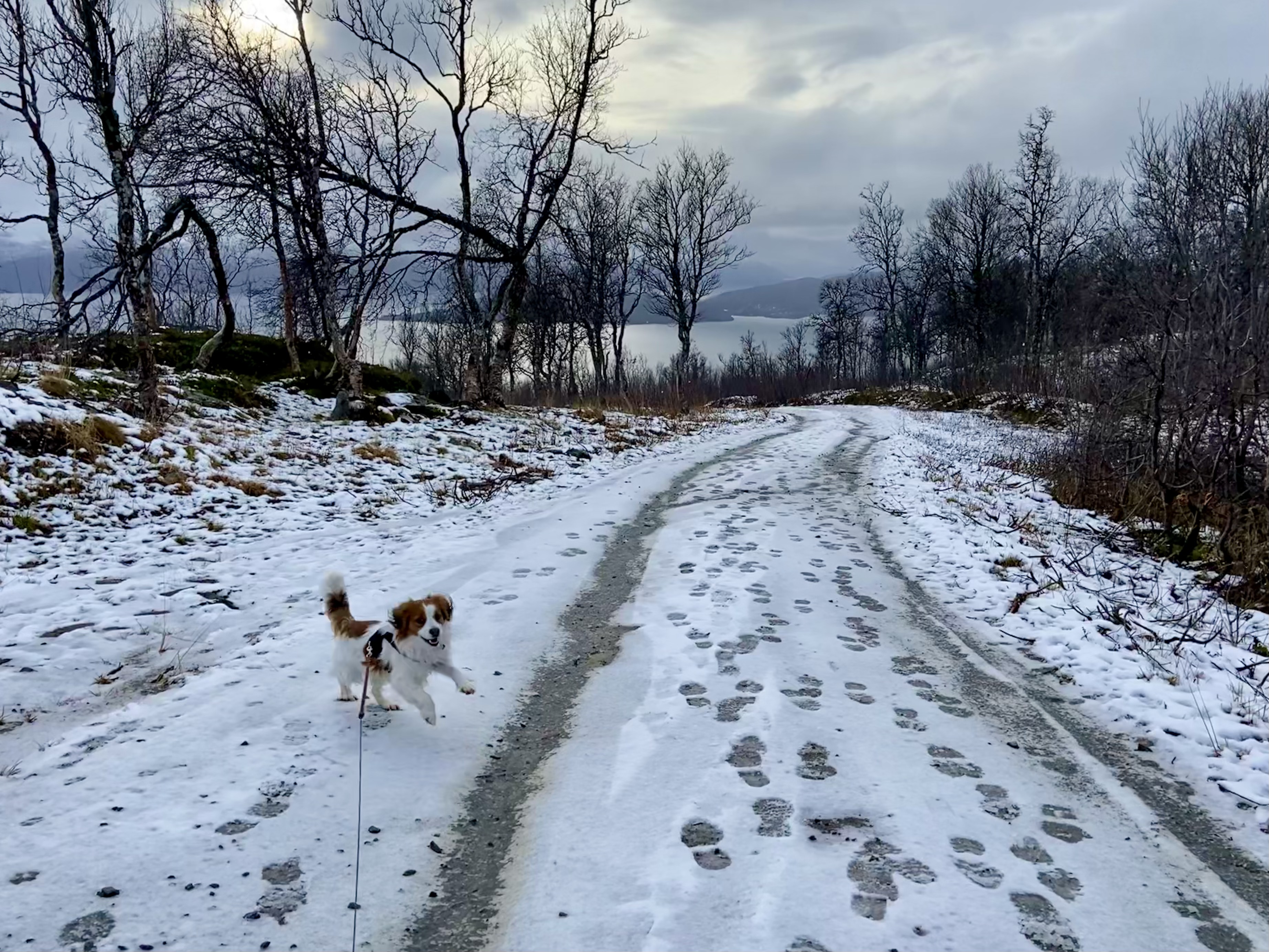
Triar playing in the snow

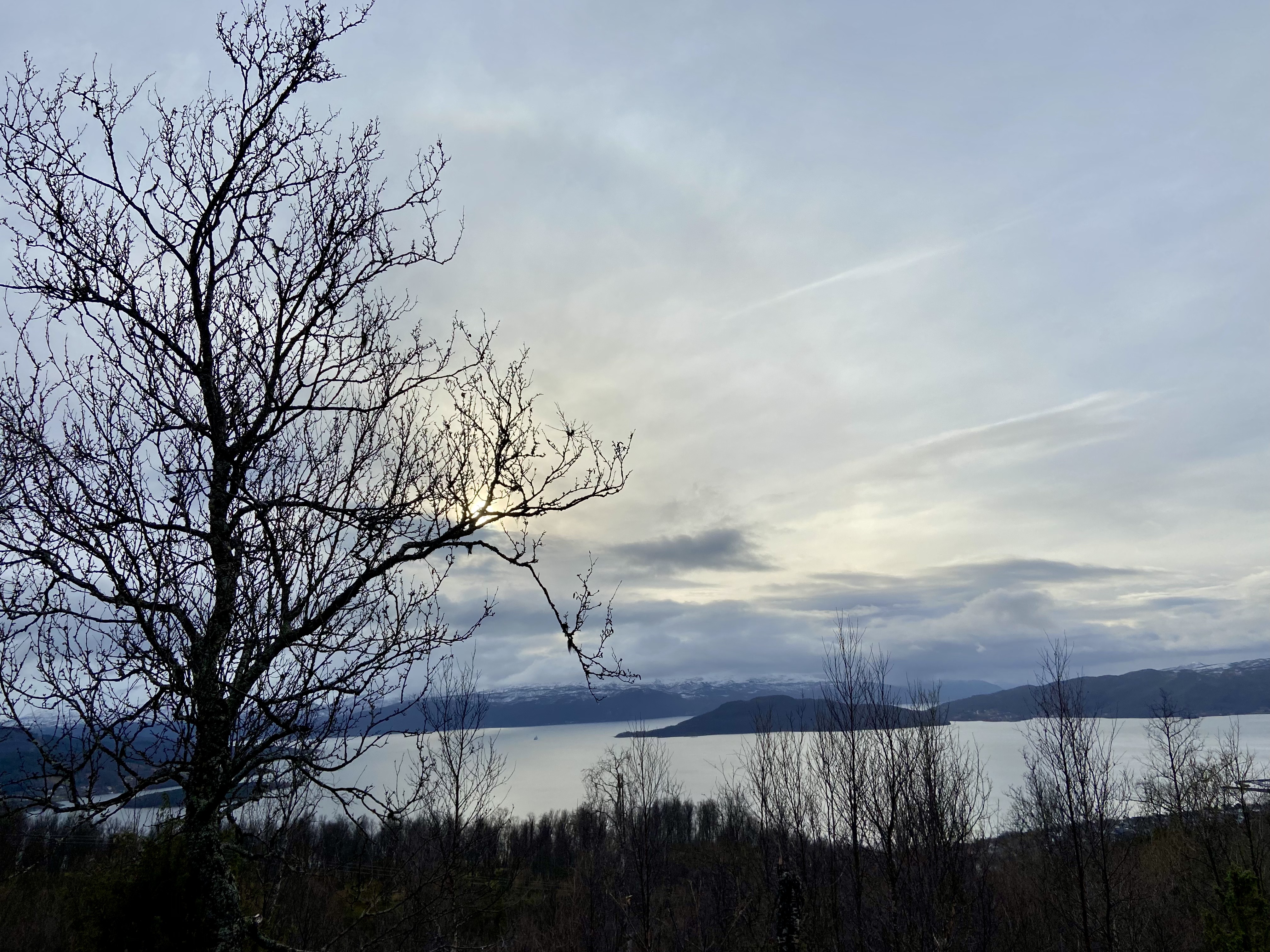
I was still feeling energetic and when I walked to the top of a ridge and turned to look at the view, I was filled with a feeling of exultation. It’s easy to forget how wonderful it feels to stand on top of the world.

View from the track to Kistafjellet

I looked forwards at the road, which continued upwards, wending around a small peak.

Track to Kistefjellet

I felt very tempted to walk onwards, but I was on my own, the wind had picked up, and it was starting to snow. I had brought an extra fleece and waterproofs with me, but no food or warm drinks and I was concerned that if I slipped and hurt myself, I might find myself in difficulties. Reluctantly, I turned around and began to walk back down, but this is definitely a walk for another day.

There’s a certain irony in the fact that, having sought out snow on Sunday, I awoke on Monday morning to discover that the snow had now come to us. It was also rather disconcerting, as I still had the summer tyres on my car, but I managed to drive safely to the “tyre hotel” and got them switched over. These are photographs I took when I came back.

I don’t expect the snow to last yet but I felt, as I set off into the darkness on Tuesday morning, that I was very much back into the winter commute. I thought it might be interesting to share it with you, as I know it’s very different from my commuting experiences in the UK.

I wake at four fifteen on Tuesday morning and look out of my bedroom window. Though it is still full darkness, the world becomes very much brighter when there is snow on the ground. The moon is almost full, and I take a photograph out of my bedroom window.

Night view of Senja over Gisundet Sound

Realising there might be snow on the car, I head outside a few minutes early at twenty to five. I brush the snow from round the edge of the driver’s seat door (if I fail to do this, the seat will be covered in snow as I pull the door open) hop in, start the engine, then climb back out. The car is indeed under a layer of snow, but it’s minus three, and it is powder snow, so it brushes off easily. Ice and frost are much harder. In Norway, it’s illegal to drive with a lot of snow still on your car, so I pull out a long handled scraper/brush to reach over the roof and bonnet. It isn’t deep, so I don’t have to clear the driveway. I jump back in, reverse slowly up the steep slope (always a relief to manage it as I have no spikes on my tyres) and set off over the hill and down into the town centre.

There’s a small lake just off the end of the main shopping street and I drive past it whenever I go out. In winter, they wrap lots of the trees in lights. They will be on all the time until the darkness is past, so the area looks welcoming and rather festive.
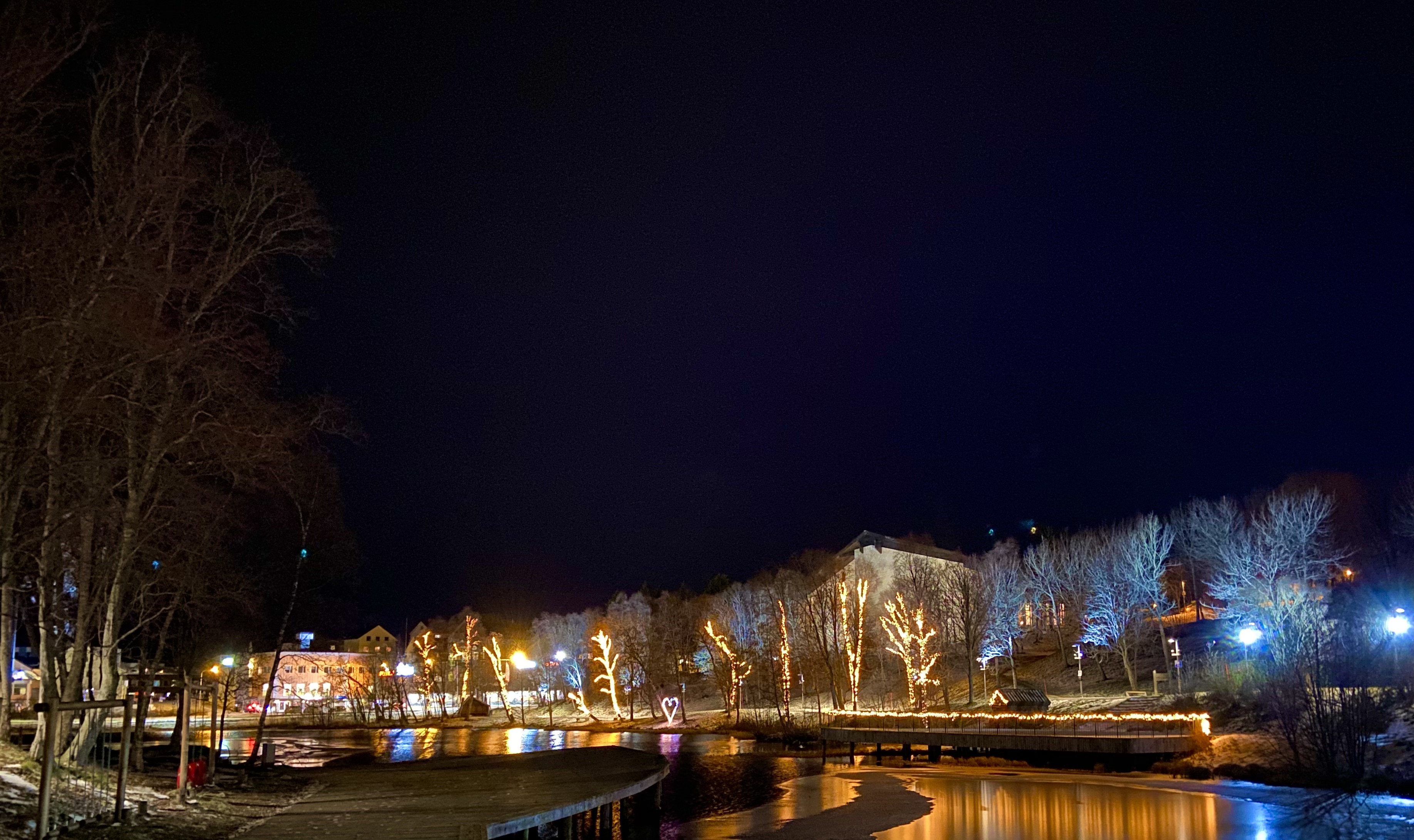
The lake in the park with trees wrapped in lights

It’s only a few minutes drive to the office. I’ve come earlier than I would in summer as I will be changing over to one of the Mattilsynet cars for my onward journey, and I have left time to clear the second car. I pull up in the car park and push open my car door, which is unexpectedly difficult. An easterly wind is howling and I can hear the rapid tap, tap of ropes fluttering against the masts on the boats in the little harbour. The flat where I live was completely sheltered, so it is a shock to climb out and feel the wind biting through my clothes. Shoulders hunched, I lock my car and scurry over to the new car, to find an unexpected bonus. There is so much wind here that there is no snow on the car at all. With relief, I slide into the driver’s seat and start the engine. Though I was only outside for a few moments, my fingers are freezing and so I gratefully switch on the heated steering wheel.

The road is lined with streetlights for quite a long way after I leave the town. There’s no shelter here and sinuous flurries of snow are snaking along the ground. Parts of the road are white, but where the snow has disappeared, I can see the shimmer of ice underneath, and so I drive carefully until the road rises a bit, and here it is dry and I can speed up a little.

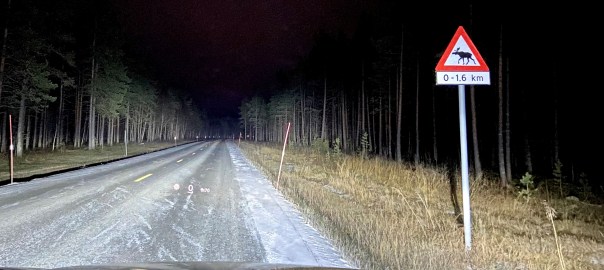
As I reach the end of the streetlights, I pass the first of the moose warning signs. It’s peak migrating season and the sign has a light attached, which flashes when there have been moose sighted in the area. The light is flashing, and so I slow down again and drive on, assessing the woodland on either side of the road, looking out for eyes reflected in the trees. In some areas, blue reflectors line the road. These are supposed to make it easier for the moose to see when cars are coming. As you can see, despite the fact that this is a main road, there are no cats-eyes to guide you. I am used to it now, but they were so ubiquitous in Scotland, marking the centre, margins of the road, and junctions, all in different colours, that it was a shock to find they were so rare here.

Dark road – blue reflectors

Every time I take this route, I drive past a brightly painted shelter with a single milk churn standing in it. I presume this has been preserved from a time, not so long ago, when that was how the milk was collected and transported, before the farms increased in size and milking machines and cooling tanks and tankers became the norm. I’ve never stopped here before, but I was delighted to see there are hanging baskets of unseasonal-looking flowers hanging from it. It’s obviously being maintained with love.
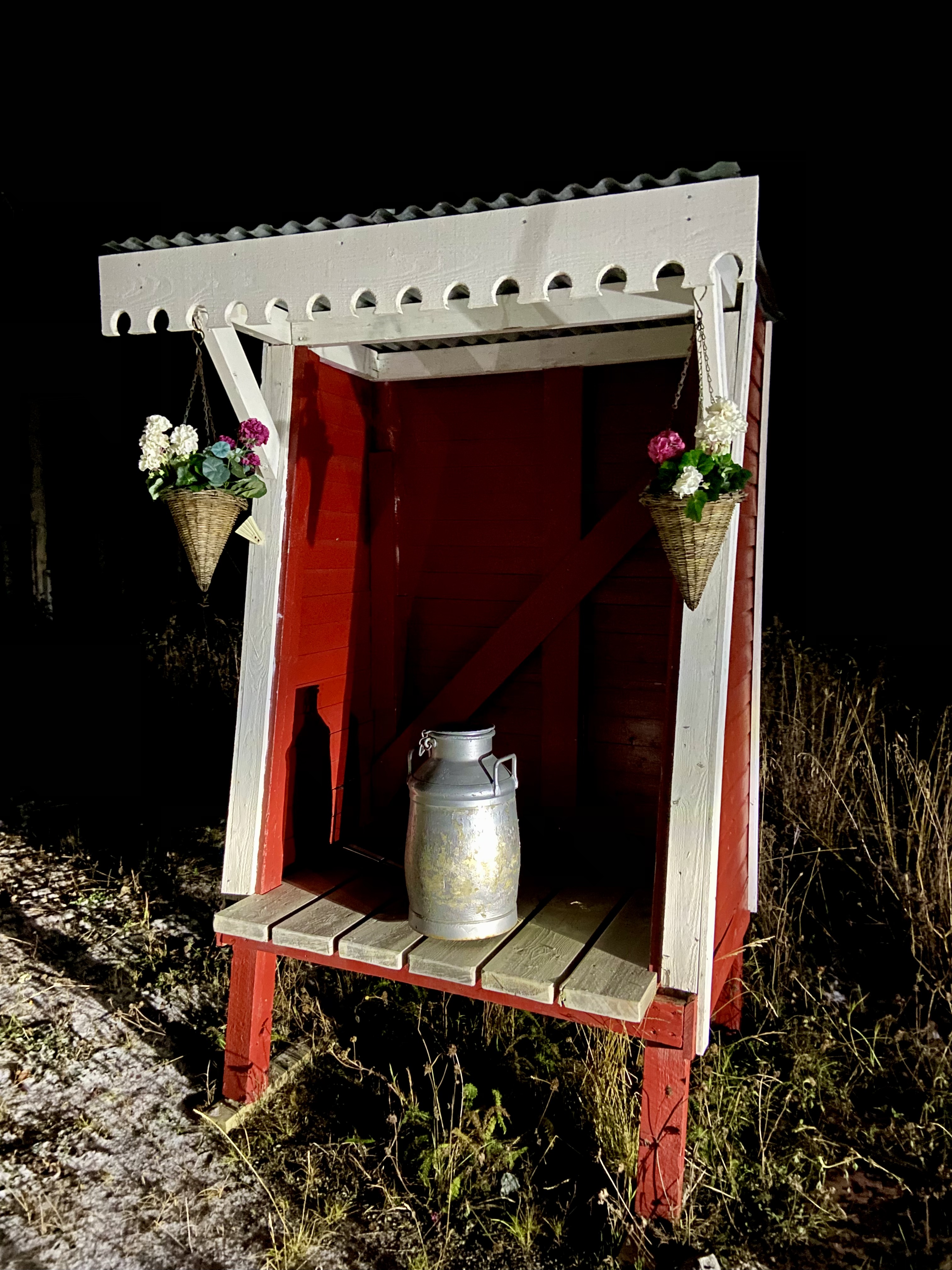
Red and white roadside shelter with milkchurn

I set off again and soon come to a sixty km/hr sign. There’s less snow here and it’s lit again, which I appreciate as I pass slowly through a long section of scattered houses. I should have taken a photograph, but didn’t. I will try to take one and add it later, but Norwegian villages are always filled with light. As well as having porch and outdoor lighting, there’s a tradition of leaving the curtains open year round. The windows downstairs are often lit up all night. Usually the light is a single bulb, either a lamp on the windowsill, or hanging down. Either way, it looks very cosy and welcoming in the winter darkness.

There’s another moose sign at the end of the villages, this time without a light. The forest is set back a little from the sides of the road, so I proceed with reasonable speed, though at fifty miles per hour, it would once have felt very slow to me. It’s amazing how the mind adjusts. Last time I was in the UK, seventy mph on the motorway felt almost impossibly fast.

Road in the headlights with moose warning sign

The last section of my drive is along a section of the E6. Though I can’t see them in the dark, I know that beyond the trees there are high mountains. Even in summer, some of them are decked with permanent ice and snow. In the depths of winter, it will be colder here than near the coast, but for now, it’s actually just above zero. I climb out of the car feeling wide awake and ready for the day ahead.

Triar – snow dog!

Parties and Preparation

Sunrise/sunset: 08:01/ 17:03. Daylength: 9hr02min

I had a pleasant day yesterday, and indeed an enjoyable week altogether. Friday is often the best day of the week anyway, but I had a good start to mine when Vaidotas told me he thought he, Konstantin and I make a great team. Yesterday was my only day at the abattoir this week. I’ve been there a good deal less this year than last, so it was very pleasant to hear I’m appreciated, even though I’m slightly bemused as to which part of my performance he thinks is most useful.

As a quick update, on any day in the season, there is a team of three on the sheep line. We work in a rota of one hour on, thirty minutes off, so when the line is running, there are two of us working at any time. Vaidotas and Konstantin are there daily, and different people make up the number on different days. You’d think it was all about teamwork. Beyond our smaller team, we’re also part of a much bigger team on the line, with perhaps a hundred people, each doing one or two small tasks. However, despite that teamwork, there’s also a feeling of being on your own. The line is noisy, so headphones (attached to a helmet) are the order of the day. There’s not much chance for chat and the work doesn’t require much thought, so there are times when I retreat into my own head, sometimes quite a distance.

Indeed yesterday, with Vaidotas’ happy praise in my head, I started thinking about what I would tell you about it. As I was wondering what he liked about my performance, it crossed my mind that I spend at least some of my time daydreaming, which can’t be all that helpful. I glanced out of the window for a moment as I considered how I would describe that, and thought perhaps I could say I must spend some time staring into the middle distance like some badly written heroine of romance. I was weaving through a mental maze about whether I could compare myself to Jane Eyre, or Eliza Bennet (not that either of those are badly written and neither are particularly prone to the middle distance gaze) when it struck me that even the worst romance writer would not set her (or his) story in an abattoir.

Modern romance novels often take a particular form, so I began to wander through a few possible titles, Canteen Cakes in the Little Slaughter Kitchen maybe or Snowflakes in Nortura Skies, I found myself grinning, and indeed I did smile at everyone around me because I was feeling rather cheery. So perhaps the reason Vaidotas enjoys working with me is because I stand around all day giggling to myself at the silly thoughts in my head. After all, it is unlikely to be my other habit that he finds praiseworthy, as my other habit is peering quizzically at something unusual on a side of lamb that might be nasty (or maybe not) and pointing it out to him to see what he thinks, at which point he invariably reaches for his knife and cuts it off, while I watch and think that next time, I must remember to be decisive and do that myself. Anyway, regardless of the reasons why, I was very pleased.
The rest of the week has been enjoyable too. I didn’t have too much work pending and I had quite a lot of flexitime, so I’ve been working shorter days than usual. Though we don’t have to be back in the office, and can still work from home, it’s no longer the rule that we ought to do so. For most of the year I’ve been here, social events have largely been on hold. However, with the restrictions lifting, and a few people sitting around the table for coffee first thing in the morning, talk somehow turned to the idea of a party. So on November 12th, everyone is going to get together in the office after work. It might seem a little odd, just how exciting that seems to me, but as I said, I’ve mostly been here during lockdown and my contact with other adult human beings has been very minimal. I need to get out perhaps, and expand my network outside of work colleagues, but for now, getting to know them better sounds great.

There was, of course, discussion about food. I believe there may be some budget for socialising, but like everything in the pubic sector, it’s limited. So I piped up and said I would be happy to bring some traditional UK/Scottish food. Though it’s difficult to get some ingredients, I like making sausage rolls, for example, as you can’t buy them here. And pies and savoury pastries aren’t really a thing in the shops. There is frozen puff pastry, but I’ve no idea what they do with it as savoury pies really don’t seem to be a thing. So if I have time, I might make chicken and mushroom pasties. The recipe is here, and rather unexpectedly, that page is the most popular on my website, so I’m guessing it must be relatively reliable! I will probably also bake some shortbread biscuits. Funny that things that are basic in the UK are really quite exotic here, but I’m hoping other people will bring dishes local to them as well. I love trying different things.

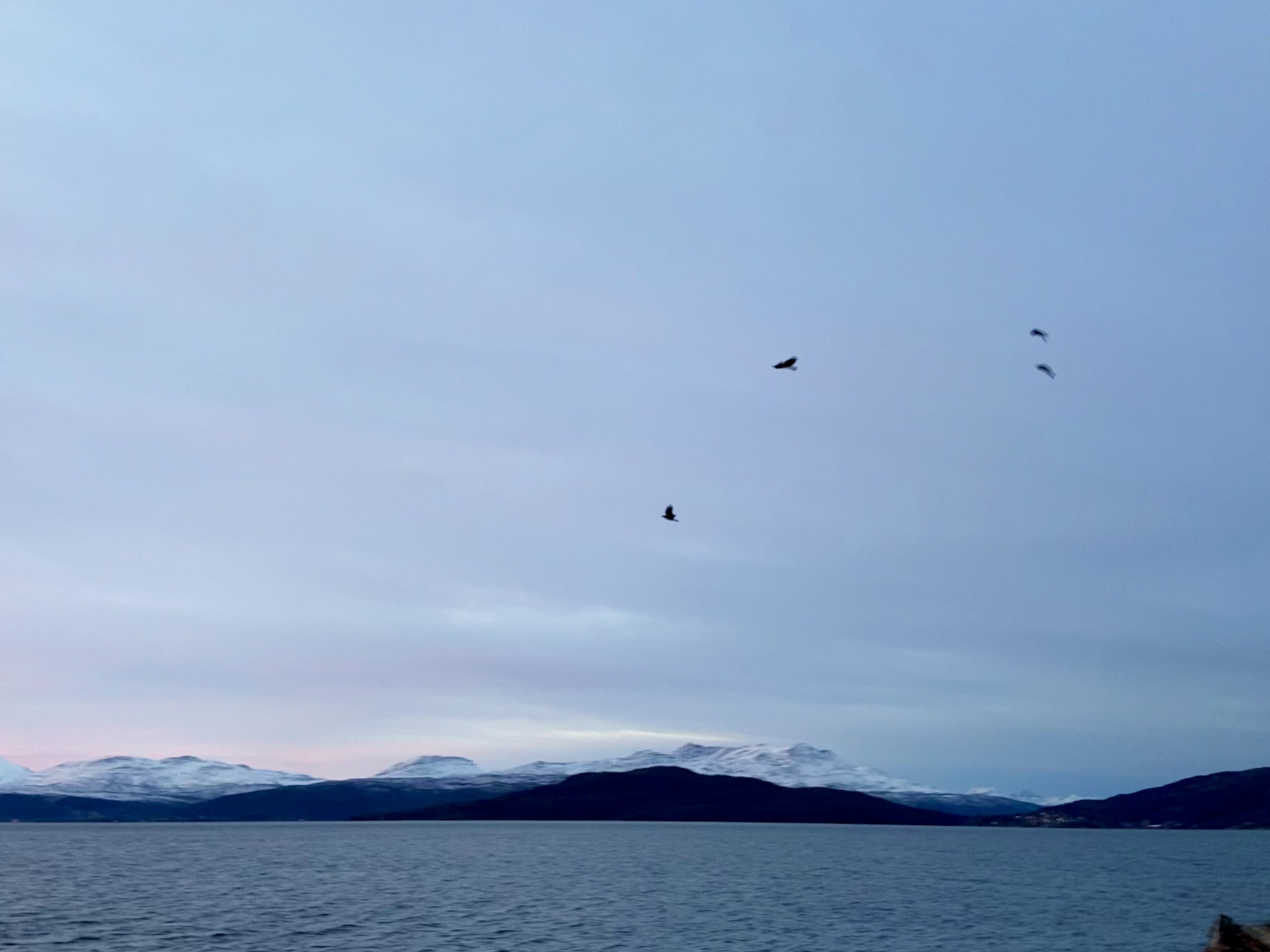
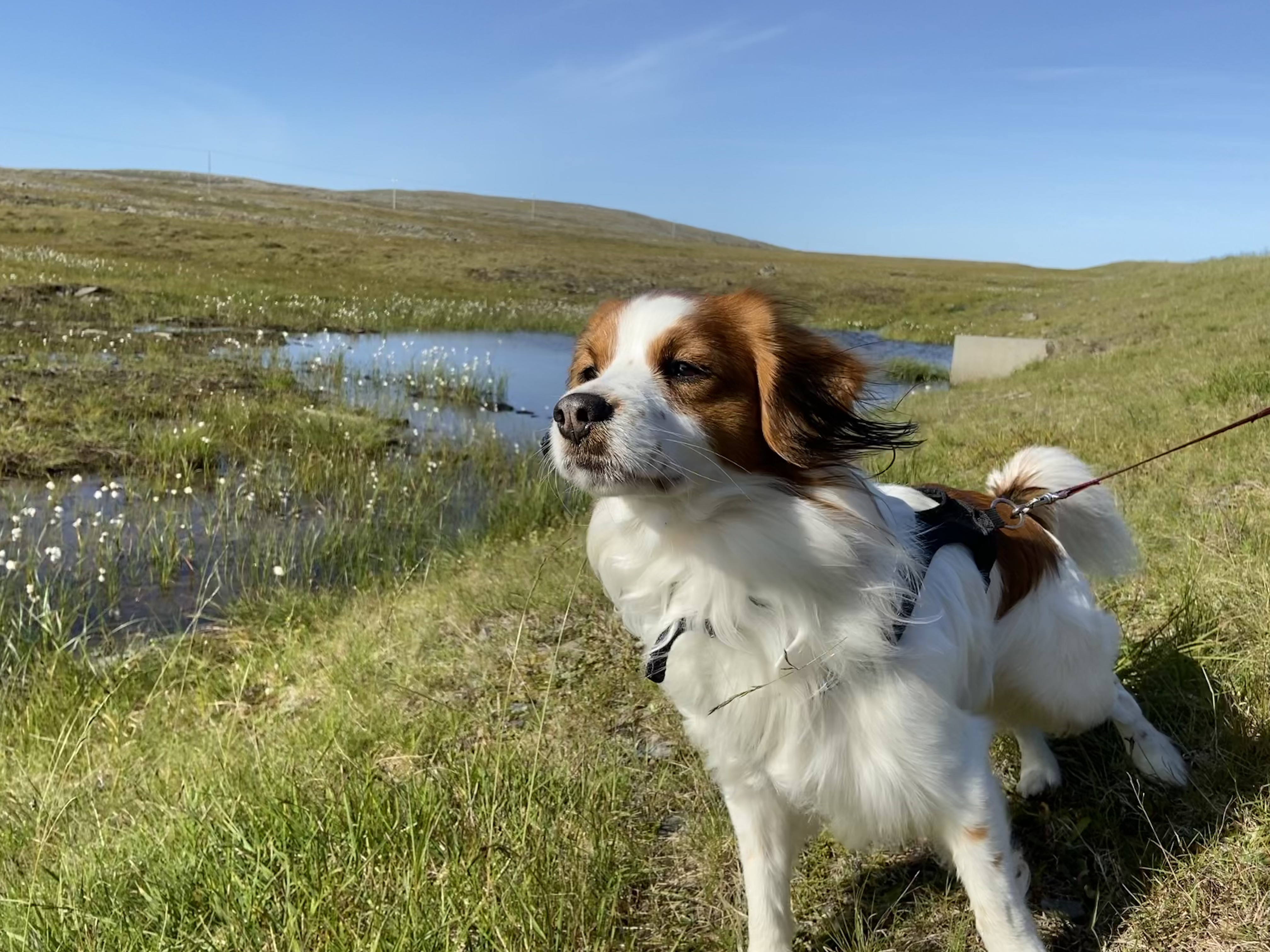
I arrived at the office on Thursday morning to a very beautiful dawn. I had already taken a photo of Senja from the garden before I set out. Looking away from the sun, the blue, polar, pre-dawn light is already kicking in and it’s wonderfully clear. The photo at the top of the page shows a snow cloud over Senja from a few days earlier.

Snow covered mountains on Senja

But as I arrived at the office, the sun was just below the horizon. It was painting the clouds the most wonderful colours and then a group of crows seemed to be enjoying it too, as they performed acrobatics over the fjord. It was too intense to ignore, so I spent a few minutes outside taking photographs before I went in.

And lastly, my preparations for winter are well underway. Until recently, it was quite warm, but the temperatures have suddenly dropped, especially at night. It’s forecast to reach minus ten overnight on Wednesday. So I have thrown the extending shovel back in the car and I’ve bought an extra long implement for clearing snow off the roof of the car, which I didn’t get round to last year. The guinea pigs, after a few nights with a blanket over their outdoor cage, have now moved inside into their winter quarters. They seem very cheery about it all, and indeed have quickly remembered that the sound of the fridge opening sometimes leads to salad if you squeak loudly enough!

Susie and Brownie in their indoor quarters.

The only thing I have failed to do in time, is to change the winter wheels onto the car. They are stored in a local “Tyre hotel” as I don’t have a lot of storage space. When I went in on Monday, they told me I’d missed my slot. It transpired they had sent me an appointment for the change back in September, but as they had the wrong phone number, someone else must have received a random message that their wheel change was due. Anyway, I have a time slot on Monday, and in the meantime, I will just have to drive very carefully, if and when I go out.

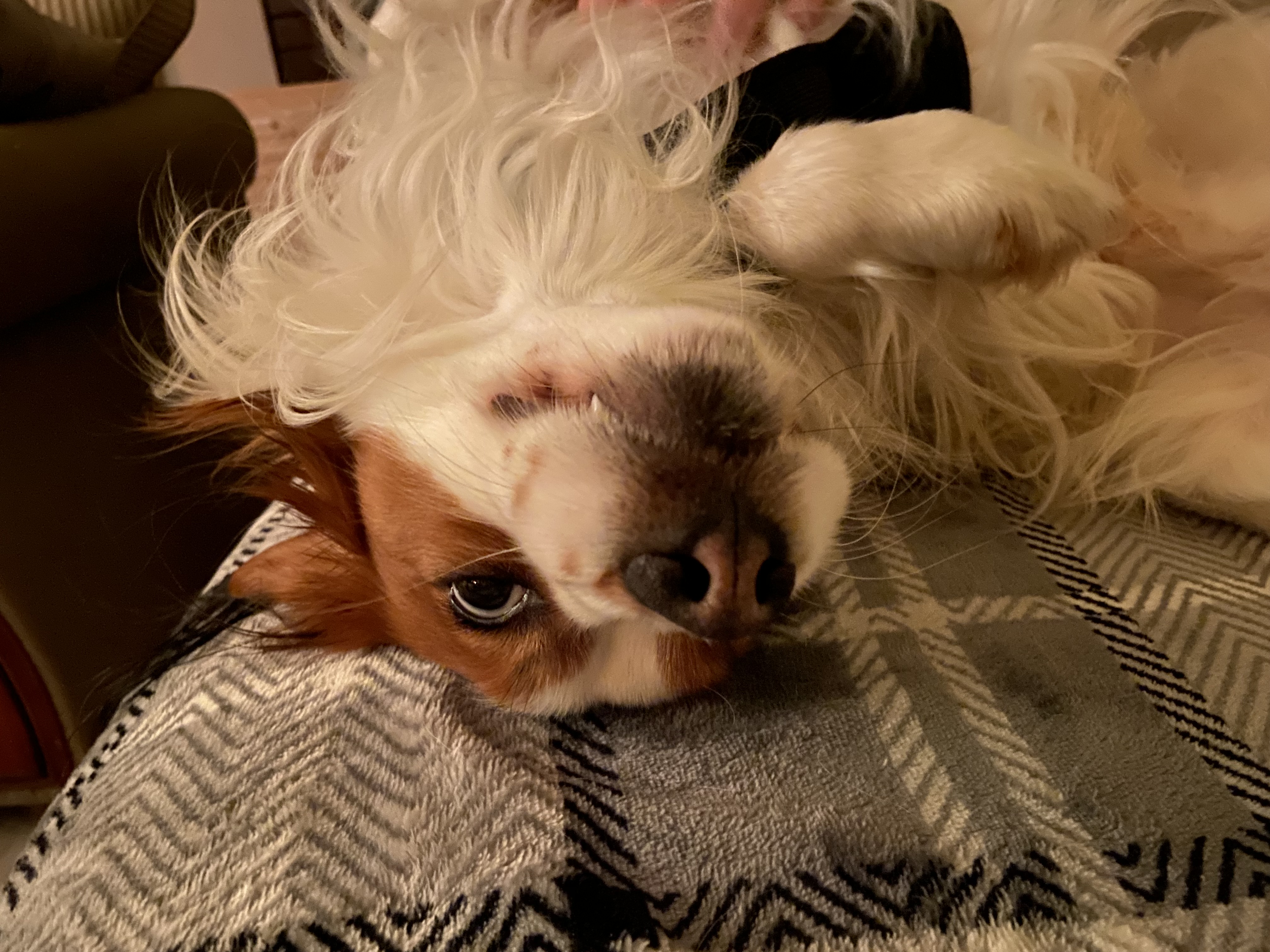
Anyway, I will leave you with a photo of Triar, who seems to be enjoying the cosiness created by new blankets on the sofas, along with the return of the warmth from the heated floor. Thanks for reading and have a good week.

Upside-down Triar

Murder in the Mountains

Sunrise/sunset: 07:33/ 17:35. Daylength: 10hr01min

It crossed my mind this week that perhaps I should try a change of direction in my writing. I don’t really read enough these days (I have six unread books waiting at the moment in my bedroom) but the family Netflix account is filled with dark drama from all parts of Scandinavia. I have all the elements I need. I could set it in the blue Polar Night, when the morning never comes and have a grisly scene in the slaughter house, with a human cadaver hanging among the carcases. There could be people smuggling, with all the season workers coming in, or perhaps the victim(s) could be working in the laundries, washing all those blood stained clothes. Maybe a hand can emerge from one of those huge piles of snow that gather during the winter months, leaving everyone baffled as to when the murder actually occurred.

It’s actually been a quiet week. Andrew has been away, visiting his dad, who lives near Stavanger. Before he went, I asked him to show me how to use the TV. When I was young, the TV was simple to use. Admittedly, you had to stand up to switch it on, and indeed to change the channel, though back then there were only three to choose from anyway. Our first TV was a tiny black and white portable that, rather bizarrely, my parents won in a competition. They also won a small sailing boat on a trailer. I can vaguely remember it appearing in the drive outside our house. Of course, it had to go because they had no car to tow it with. They sold it and bought a little white mini. Anyway I’ve wandered away from the point, which was that I have spent the week alone and quite enjoyed it. I could indulge my taste for true crime and mashed potato. The candles have been lit every evening. It feels comforting to return to having some darkness at a time that my body feels is appropriate.

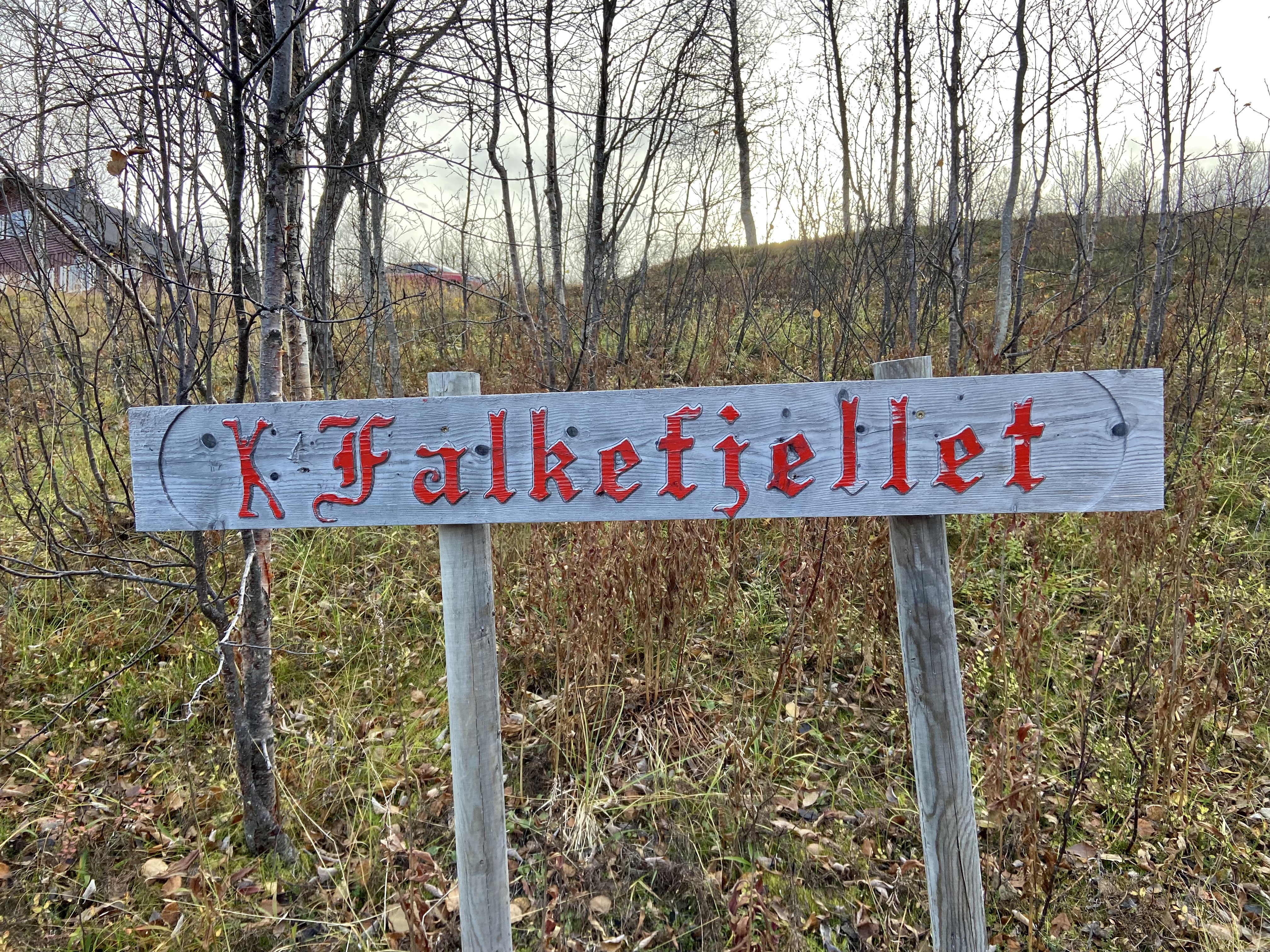
I went out walking again with Ann and Konstantin last weekend. We went up Falkefjellet. The peak we reached, though not the highest point, was above the treeline, which meant there was a good view all round.

The best thing about it was that, for the first time in a while, I felt I could have walked further. My springtime Fit for the Summer campaign seems a very long time ago. The summer was marred by sickness and it has felt like every time I began to work again on getting back into shape, I was hit by something that stopped me. As I reached the summit of Falkefjellet, I remembered how much I love the feeling of arriving on the top of the world. The higher mountains are now swathed in snow, but perhaps there will be time to get a few walks in before the winter really sets in.

The photograph at the top of the page is of one of the red markers on the walk, though the shape of the rock and the bloody brightness of the paint was one of the things that prompted my Scandi Noir thoughts. Here it is again, the full photo, rather than the cropped version.

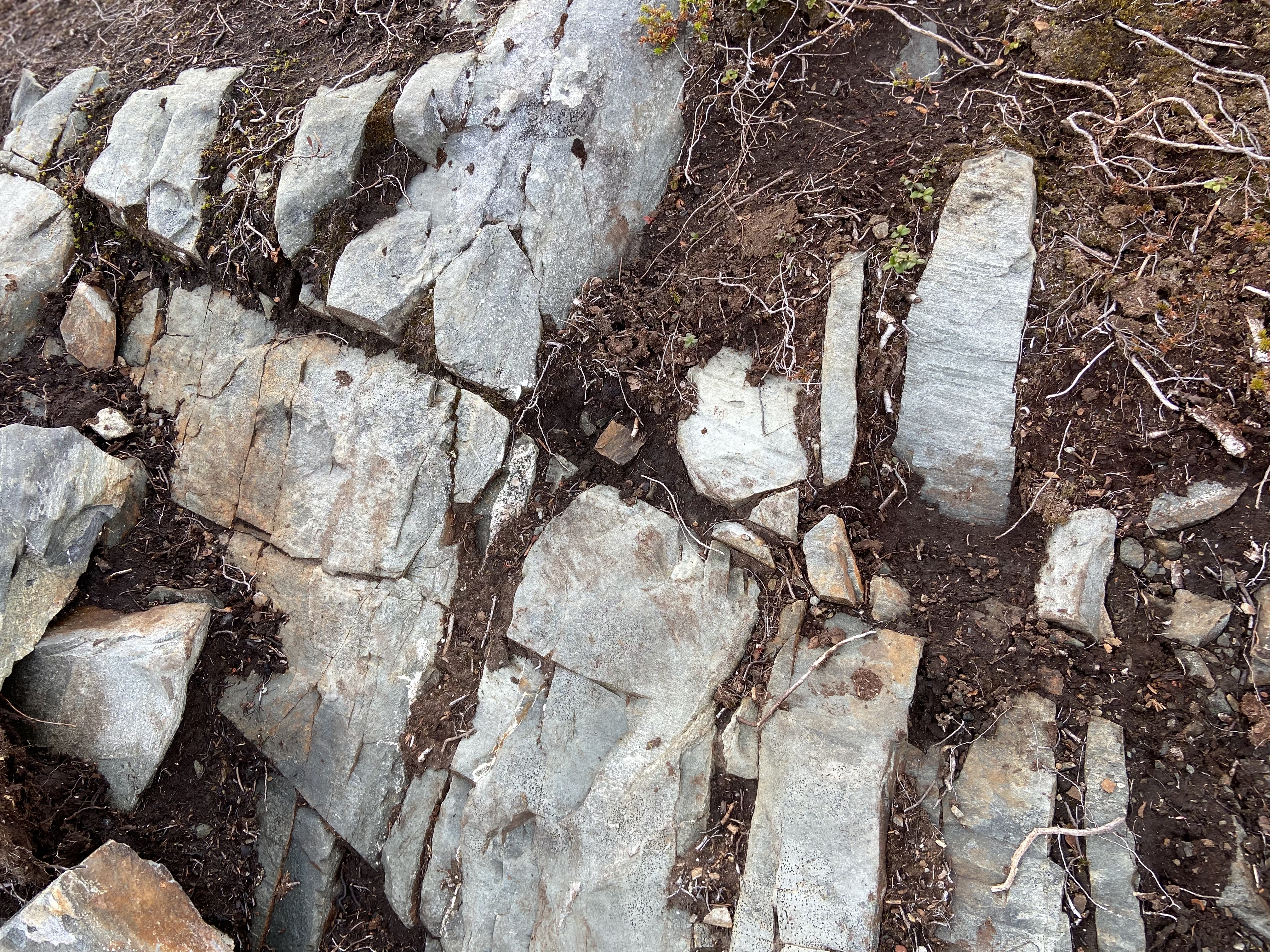
Konstantin was full of facts about the wildlife and the landscape. He is interested in geology and occasionally would point out pieces of marble, or rock formations and tell us how they had been formed. For example, here’s another red marker, this time looking a little like a stone dagger, set into fractured rock.

I asked him how the cracking occurred and he pointed to another section of rock just to the left, where there was more rock in the process of arriving there. This had earth in between the cracks, which of course will hold water. It freezes in winter, driving the stones apart, and then eventually the mud gets washed away, leaving the rather mysterious looking holes in the mountainside.

It was windy on the summit, so here is a picture of Triar, looking windswept and interesting.

Konstantin was in the lead with Triar during the walk. I think they look good together!

And of course, as we descended back to the treeline, there were some wonderful views to enjoy, as well as the smaller details of unexpected plants growing underfoot, in nooks and crannies, and on the trunks of dead but unfallen trees.

Andrew was due to return last night in the evening and the airport is close to the abattoir, so rather than driving over there twice in a day, I decided to take Triar in the car, have dinner with John, and then wait. It was a little hair raising, driving over. Until now, the temperature has been well above zero, but a wind from the north has changed that, and when I left for work at 04.45 there was frost on the car. I still have the summer wheels on as I don’t use the car much and up until now, they have been fine. I will change them over next week, but for now I had to proceed with caution in the darkness. I’d had to stop when driving home on Thursday, as there was a moose that thought about crossing the road, though he looked at all the cars which had stopped to let him, and changed his mind. They’re huge when you see them close up, so I was very wary, but we made it there safely. To fill in the time between work ending and collecting Andrew, I took a quick reprise of the spring fitness project. This is how the landscape looks now, as we head into winter. If you look carefully at the second picture, you can see the white peaks in the distance, though they are rather swathed in clouds.

The plane arrived on time and as we arrived back at the house, Andrew pointed at the sky. There they were, the northern lights, greeting him on his return to the north.

Counting Sheep

Sunrise/sunset: 07:06/ 18:06. Daylength: 10hr59min

Time seems to be rushing by again. Last year, when everything was new, it seemed to move a little more slowly, but I feel I am beginning to feel the rhythm of the place and the seasons, if not yet well, at least with a degree of awareness. We are losing an hour of light each week now. At the end of next month, the Polar Night will be with us again. In the meantime, the progression through autumn continues to be so beautiful that I find myself sighing out loud at just how wonderful it is.

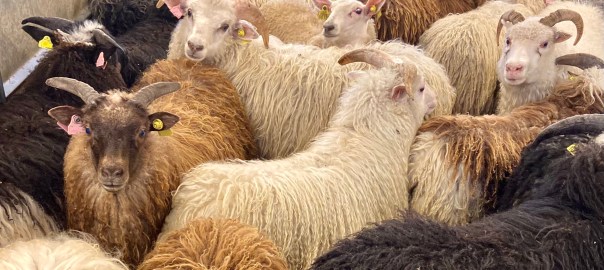
My work is seasonal, as all who work (or have worked) with large animals will understand. This years lambs are being brought in to the abattoir and then their meat is beginning to appear in the shops. That sounds very blunt, I guess, but on some level it feels right that I witness the whole cycle. I have seen a few people on social media express the opinion that all who work in abattoirs (and indeed farming) must be sadistic or macabre, but that isn’t my experience at all. Most of the people I encounter are both down to earth and resilient.

As well as the slaughter season (as it’s called here) I am waiting for the sheep and cattle to be brought in from their summer pastures. Part of our job is to check all aspects of the chain that goes ” frå jord og fjord til bord” (from the land and fjords to the table) and one component of that is traceability. All farm animals must be tagged (or tattoo’d for pigs) shortly after birth, and the tags maintained until they die. All the births and deaths and numbers have to be recorded in the “husdyrregisteret” or livestock register. The vets at Mattilsynet have to go out and check that the farmers are carrying this through, so we will go out and do checks on a number of cattle and sheep farms in the autumn and winter.

As well as looking to see whether all the animals have ear tags, we check the farmers are keeping medical records for all the animals. Medication (and specifically antibiotic/antibacterial use) are much more tightly controlled here than in the UK. We also check that they are entering the details of their herd or flock into the livestock register. Failure to do any of these things results initially in warnings, then fines and (where there is a severe breach of the law) in restrictions on the movement of animals on and off the farm until the traceability requirements are fulfilled. Though we ideally check every farm on our patch over the course of a few years, we also try to integrate these visits with our welfare program. So if we receive a concern message from the general public, or for example one from the electricity suppliers (who give us advance notice if any farmer is at risk of being cut off) and we feel the situation does not sound serious enough to require immediate attendance, then we will try to call them to assess the situation, then add that farm to our list of places where we will carry out “routine checks”.

Life at Mattilsynet can be unpredictable at times, perhaps predictably so! During the season, there are seven members of staff working in the abattoir on any given day. I’m not due there every day, but as well as having the crew of seven, there is always someone listed as back-up. It was me on Monday this week, and so I was not entirely surprised when a colleague called me on Sunday night to explain that one of their children was sick, and therefore they needed me to go in. Because there are so many staff, engaged in different tasks, and we have to cover the whole day (which can often be longer than the standard seven and three quarter hour working day) the start times are staggered. The first vet there, who has to carry out the live animal checks, comes in at 05:45 in the morning. The next wave comes at 06:45, another at 07.45 and the last at 08:15.

I was due to be in with the second wave, starting at 06:45. It takes me about half an hour to get up, and then close to an hour to drive my car to work, grab the keys to one of the work cars from the office (if I haven’t done it the night before) then finish my journey to the abattoir. Rather than starting work at 08:00 locally, I was now going to have to head out at 05:45 and so I had to head to bed almost immediately after receiving the call. I am always worried that I will forget to set the alarm clock on my phone, which of course has a whole range of times to choose from, and so I quickly set it while I remembered, then went to sleep.

It’s always lovely and cool, first thing in the morning, and I enjoy driving in general, and so as I drove in, I was quite happy. As I said earlier, it’s getting dark very quickly, and I found myself musing on the way on just how much darker it was this week. Only a week earlier, on the same shift, I had seen the moose and the detail of its white breath on the air, and I thought that if the same moose was standing there this week, I would barely be able to see it. I even thought that this would be something to tell you in my blog.

It was only when I arrived at the abattoir, that my mind came up against something I thought was odd. When arriving at 06:45, the car park is perhaps half full. But as I drew in on Monday, it was all but empty. It took only a moment to dawn on me that, in my hurry to get to bed the night before, I had selected the 04:15 alarm, rather than 05:15. In fact, I had even arrived before Thomas, who was working that day in Vet 1 position, doing the live animal checks. Thomas was quite surprised when he did arrive, but at least I had already had time to make coffee, which was gratefully received.

Anyway, given that I have raved at the top about how beautiful it is here at the moment, I’d better share some photographs. Seeing the sun out in a perfectly blue sky on Wednesday morning, I decided to use some of my precious flexitime and take Triar out for a walk. We headed up to the ski-slope area and took a walk there. The view was truly dazzling.

Triar seemed to be enjoying himself, rushing through the undergrowth and up and down the rocky outcrops, walking (as ever) four or five times further than me.

As you can see, higher on the mountainside, the trees are already bare, but looking down into the valley, there is still a riot of autumn colour in amongst the huddle of houses.

I awoke to another beautiful day on Thursday, and felt suddenly that I might as well use some more of those hours to take time off while it was still wonderfully light outside. Though I didn’t go on any significant walks, I decided I should make the house look a little better. Triar goes on the sofas in the house, and we do quite often eat while sitting on them, and therefore I try to keep them lined with fleecy blankets. The old ones were rather grubby and still look grey now after washing, so I bought some new ones. I had also accumulated some autumn candles, but was in danger of not getting round to deploying them. So now, as I go into winter, the inside of the house is looking as well as I can make it look. As the evenings are drawing in, and I will shortly be spending a lot of time indoors, it’s important that I have a space that lifts me up when I am there.

Setting out for work on Friday morning, I noted it was five degrees Celsius as I drove through Finnsnes. We live close to the sea, and even this far north, the Gulf Stream stops the temperature from going down as far as it does inland. So as I drove east, I was unsurprised to see the temperature dropping, quickly to three degrees and then further, down below zero and I could see there was frost on the undergrowth on the edges of the forest.

The sun was also rising slowly behind the mountains, giving them the most incredible molten gold edges and so I stopped to try and capture it. Unfortunately, by the time I found somewhere I could pull off the road, where there wasn’t forest in the way, the gold had mellowed into a normal sunrise, but it was still beautiful.

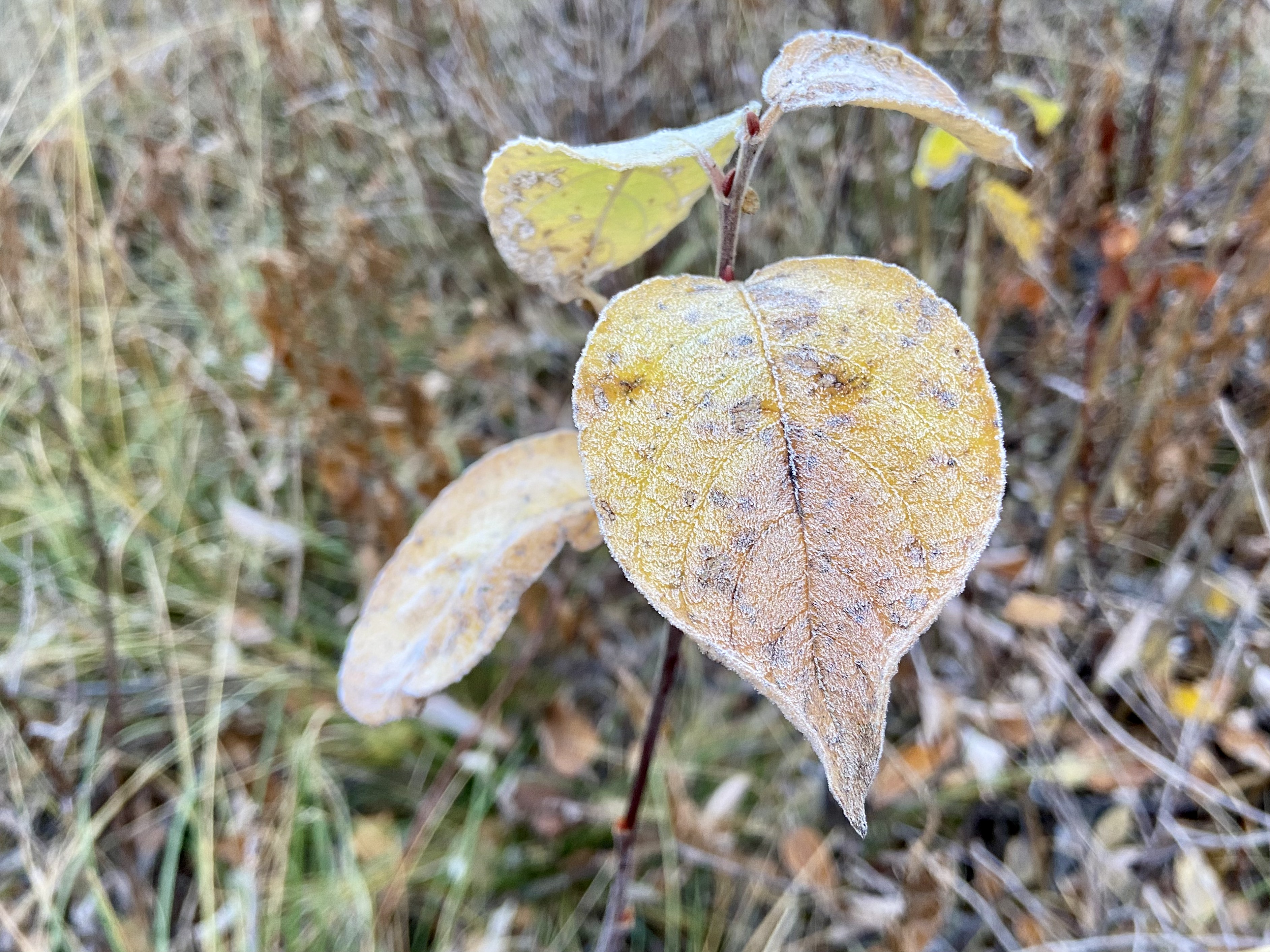
I took a couple of photos of the frost as well, not because it was anything out of the ordinary, but simply because it was the first of the year for me and a reminder that winter will very soon be here.

Please, Not Yet!

Sunrise/sunset: 06:40/ 19:37. Daylength: 11hr56min

I saw a moose on the way to work on Wednesday. There was nowhere to stop, so it was a fleeting glimpse, but it was standing in a clearing in the forest that lines the road for miles and miles. I saw the white plume of its breath on the chilly morning air as I flitted past.

There’s something magical about the dawn twilight. I had the sudden sensation of having caught sight of something that ancient people might have seen thousands of years ago as they walked in the forest. It crossed my mind afterwards, how little I knew about these primeval looking creatures. And so, I began to read a about them.

I was surprised to discover they are classified as a type of deer. They have long legs – good for walking in snow – and cloven hooves that splay out, helping them to walk on top of it, rather than fall through, once an icy crust has formed on top. Even more surprising was finding out that they are good swimmers. Their bodies are designed to withstand the cold, so are not well equipped for the heat of summer. They immerse themselves in water to help cool themselves, but beyond that they are well adapted for eating the aquatic plants they find there.

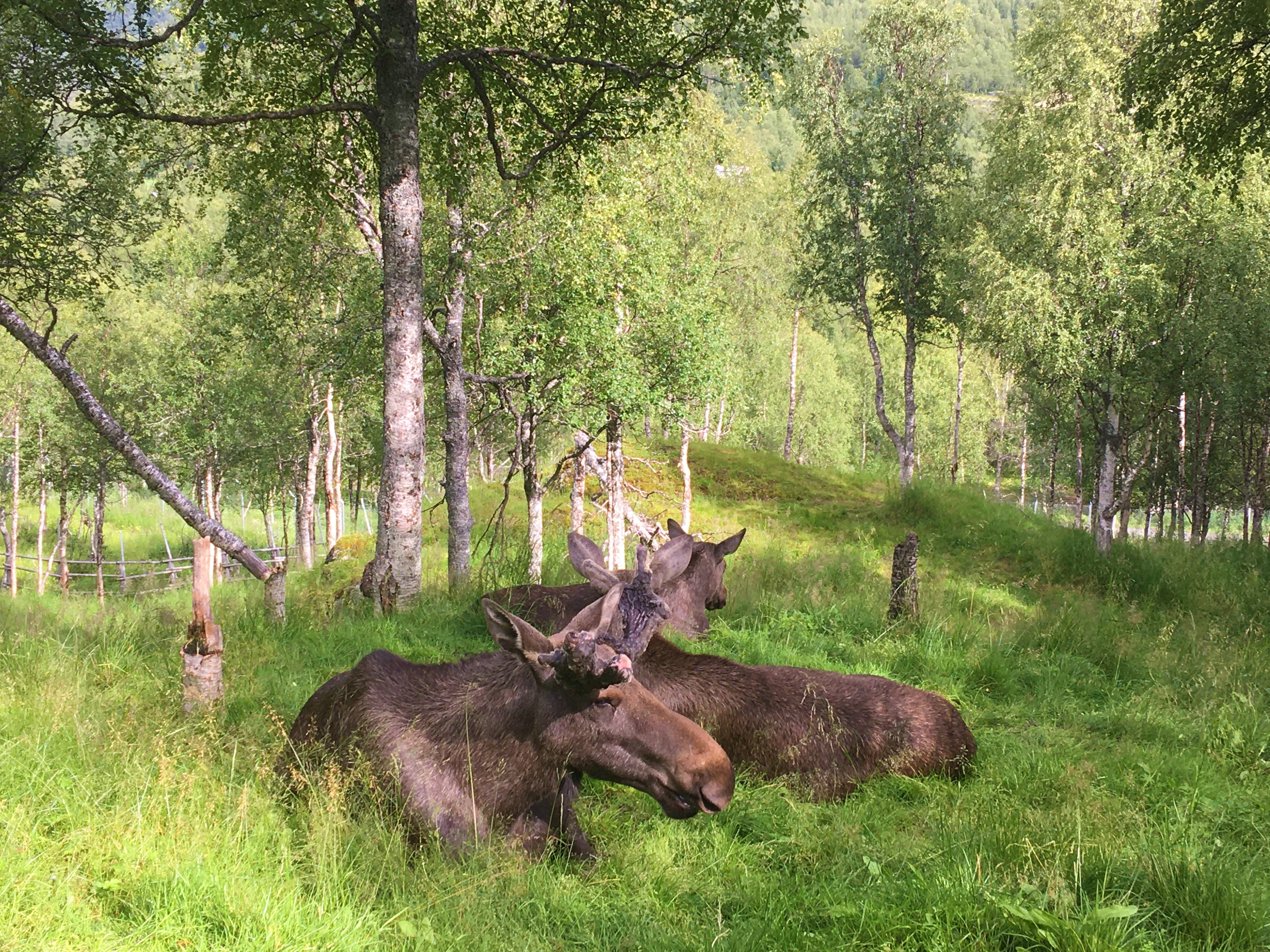
I had always thought their faces were an odd shape. I’ll put in a photo I took, last summer at Polar Parken, for reference below. Now I discover there is a reason for that long droopy proboscis. Apparently they can close their nostrils off when they are feeding underwater. They can actually chew and swallow without coming to the surface. Added to that, they can dive down to a depth of about six metres. Given that they look so ungainly on land, I was fascinated to discover they are so much at home in water.

And now back to last weekend, when Ann, Konstantin and I went for a walk. We set off close to Andrew’s school and trekked round a lake, taking in a stop in a lavvo along the way.

It was a beautiful day. The autumn colours are at their most spectacular at the moment, and the contrast with the blue skies and the darker green of the fir trees surely makes this one of the most beautiful times of the year.

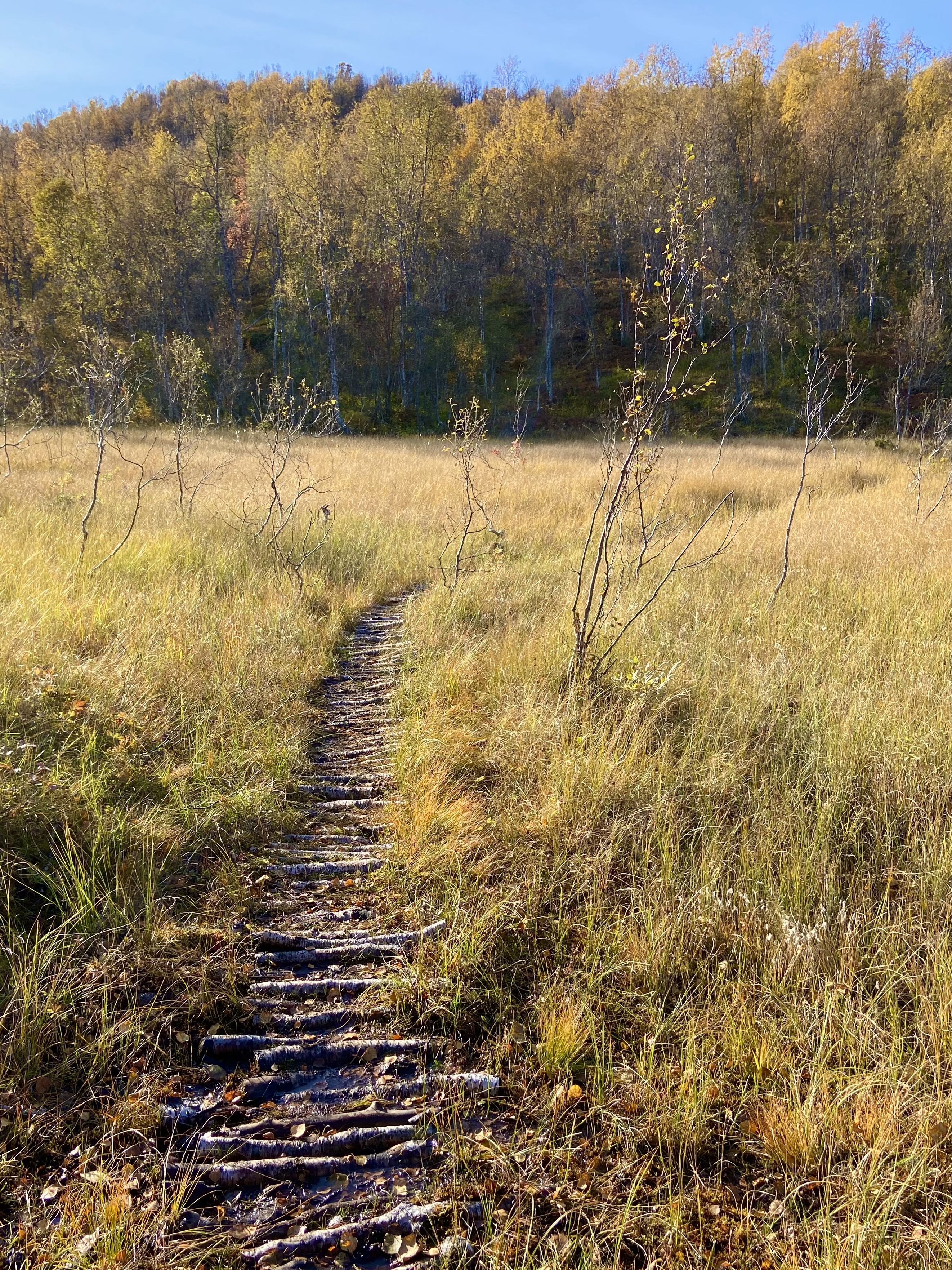
As ever, some of the most interesting things were to be found at ground level as we walked through different kinds of terrain from dry woodland floors with undergrowth and tree roots to boggy wetlands, often with paths created by wooden planks or thick tree branches.

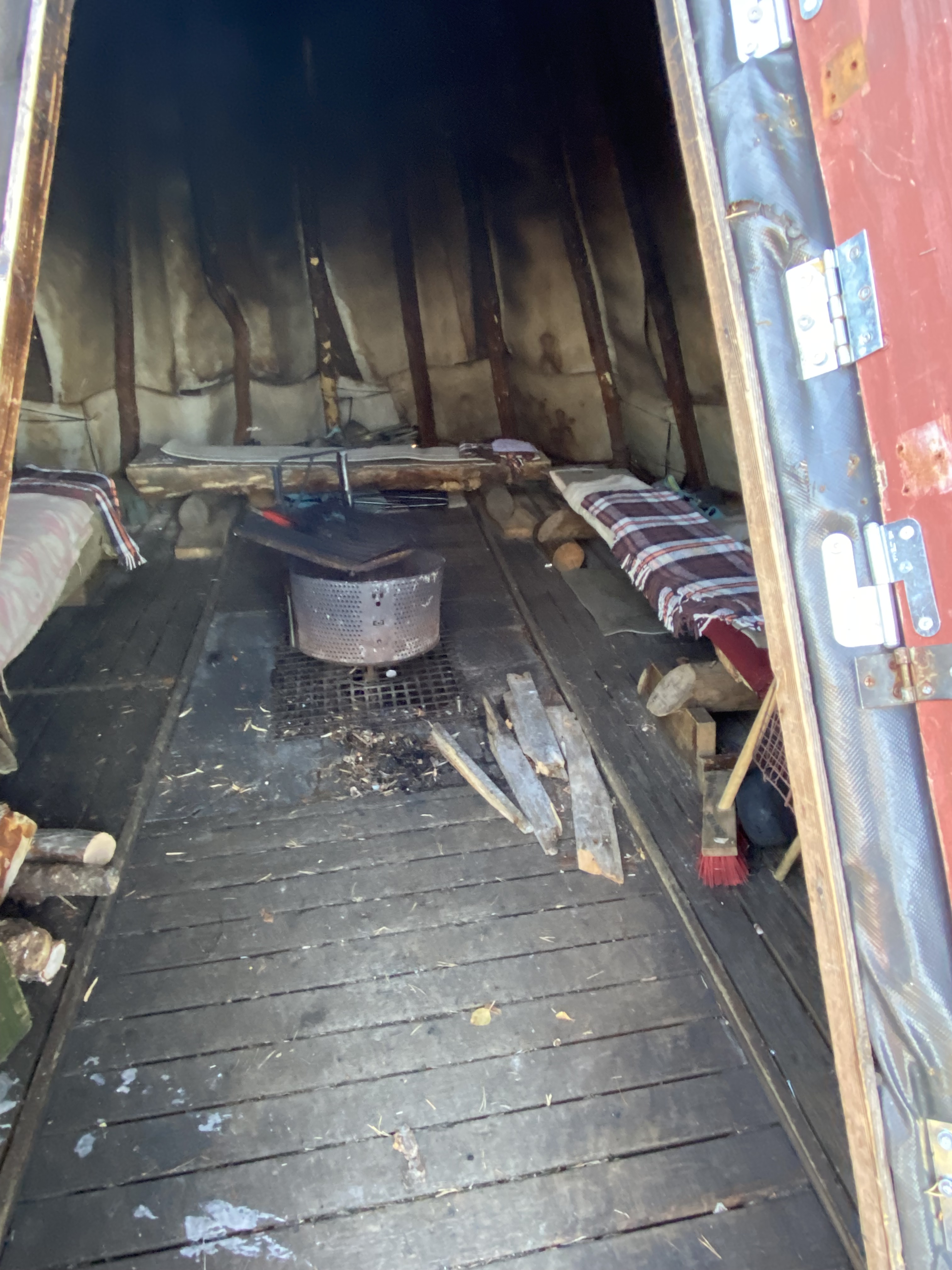
The lavvo was fascinating. You frequently find shelters on well-trodden paths in Norway. Most I have come across are simple newly-built wooden shelters of one sort or another, and they are often stocked with wood and have a fireplace or grill site nearby. The lavvo looked like a much more traditional tee-pee type structure, which is unsurprising as a lavvo is a form of temporary home used by the Sami when herding reindeer.

We stepped inside and found benches lined with blankets and a fireplace. It felt very sturdy and also cosy. It would be amazing to visit in winter and light a fire. There were loads of interesting touches, such as tiny light holes that looked like stars against the dark walls and quite a big gap in the roof to act as a chimney.

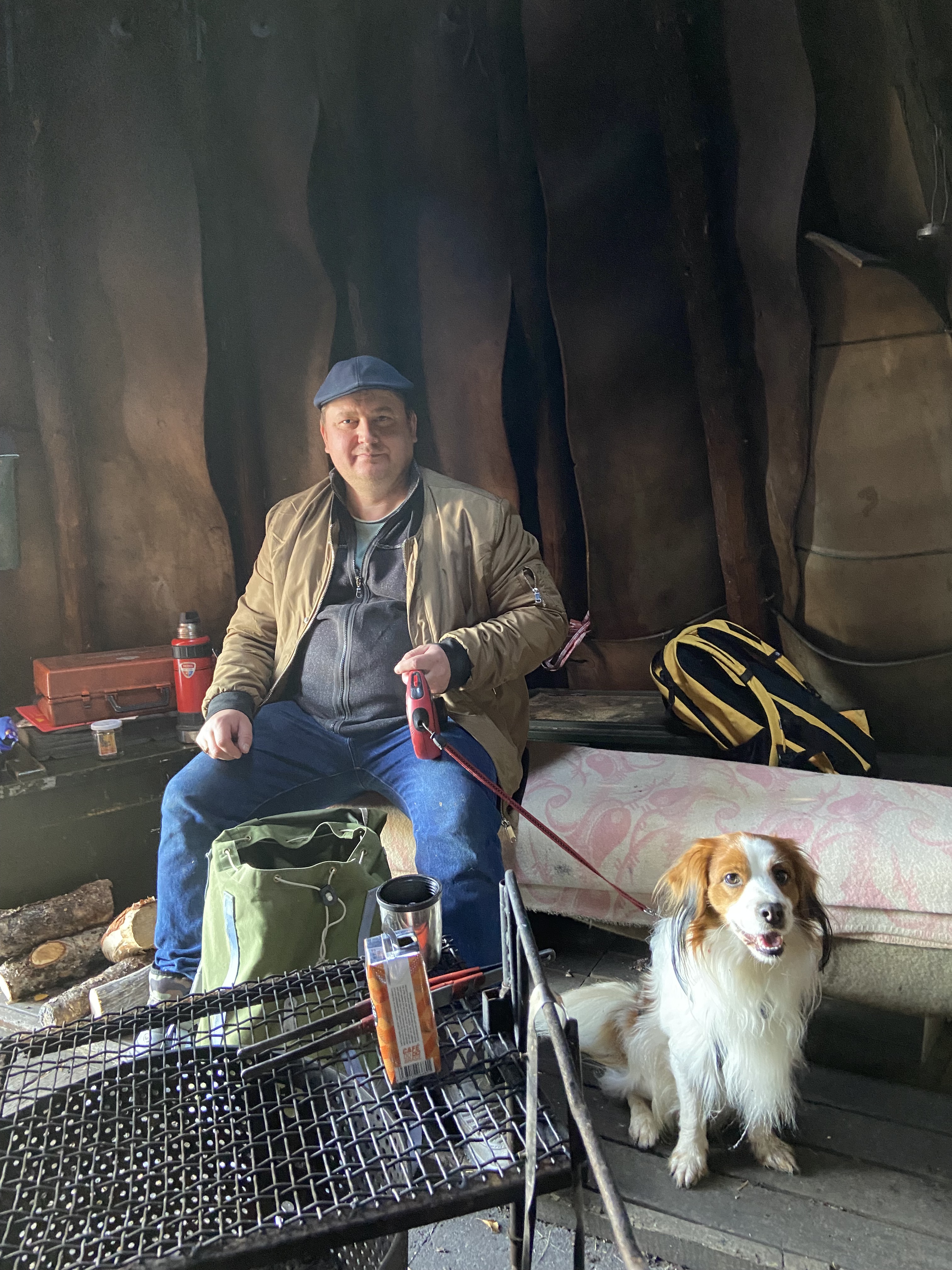
I took a photograph of Konstantin and Triar in the lavvo, that pleased me a lot.

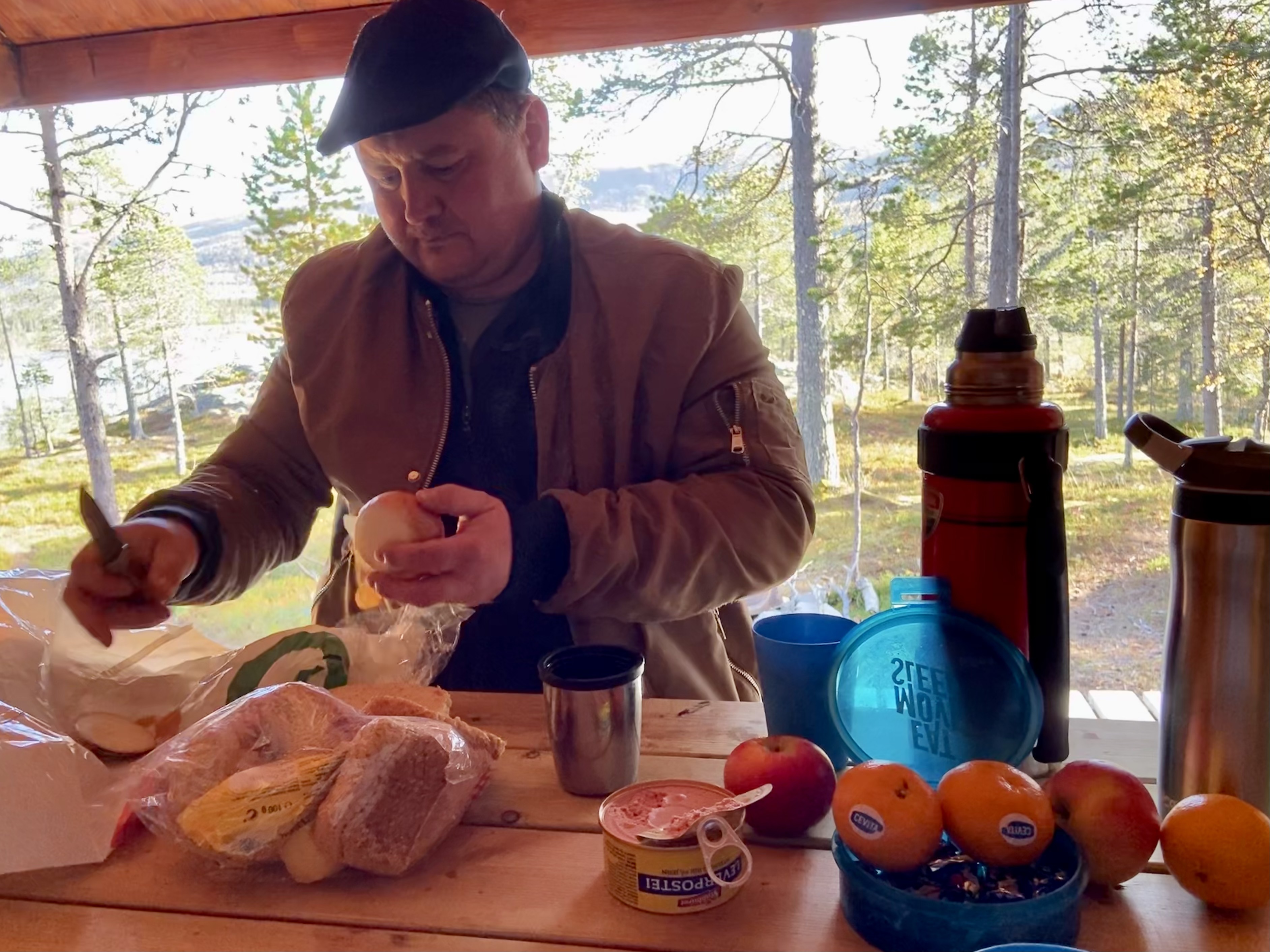
Later in the walk, we stopped in another shelter, this time of the more standard type. I had understood we were doing a relatively short walk and had brought only a banana to eat, but by five kilometers in, I was quite hungry. So I was amazed when we sat down at the wooden table and Konstantin started to pull out a veritable feast from his backpack. He started with a flask of tea, for which he had several cups, one of which I accepted gratefully. As well as the tea, he brought out bread rolls and salty biscuits and liver pate in a tin, as well as various pieces of fruit and a plastic box filled with individually wrapped chocolates. It was when he pulled out his knife and started to slice an onion to go into his rolls that I really started to appreciate his food organisational skills!

We finished the walk and then went for pizza, which was a lovely way to round off the day. Hopefully we’ll get some more good weather before the winter arrives.

I mentioned the arrival of mince pies in the UK in last week’s blog and was thinking smugly that there was no way anyone here would start so early with the lead up to Christmas. Though I love Christmas as much as the next person (not really – I love it way more than average!) starting too soon can take the edge off. October, is too early, and even if you begin half way through November, by the time Christmas arrives, it’s more anti-climatic relief than unadulterated joy.

So I was horrified when I set off to work in the dark hours before five am yesterday, to be greeted by my usual radio station playing “When You Wish Upon a Star”. I had heard an advertisement during the week saying they would be changing to Christmas music on Friday, but they mentioned that this would be additional to normal services, one of which would be on an app. I thought perhaps I had misheard and for now, that I could continue to listen to the music that has become a familiar part of my current life. When I drive a lot for work, I generally get used to the music on certain stations.

Of course, Christmas music on the radio in Norway is very different from Christmas music provided by UK stations. Nobody here has been listening to Noddy Holder yelling “It’s Christmas” at the top of his voice for years. One of the most famous Norwegian Christmas songs begins with the line “Now we have washed the floor and carried the wood in” (the song is by Alf Prøysen who wrote the Mrs Pepperpot stories I read as a child) which I can’t imagine featuring heavily in any British Christmas song. The Norwegian songs are interspersed with Bing Crosby and other US classics, which always seemed rather old fashioned to me, even as a child, and I still like them less than many of the British Christmas top hits, including more modern entries by Coldplay and Glasvegas.

So closer to Christmas, I will gladly start listening again. It’s about time I learned to recognise more of that Norwegian Christmas music. I have become rather fond of Alf Prøysen’s Julekveldsvisa (though I draw the line at having to clean the entire house before I relax into Christmas Eve) and I should continue to embrace more Norwegian things. But not just yet. December will be quite soon enough.

The Gathering Darkness

Sunrise/sunset: 06:13/ 19:08. Daylength: 12hr54min

I mentioned a couple of weeks back that it was not yet entirely dark, but from Thursday this week there has been full darkness for a short time each night. It’s hard to believe we’re already well into September. The sun is low in the sky for much of the day and the autumn equinox will soon be here.

I took that photo when I was out with Triar, and he very kindly posed for me on an upturned boat, that lies beside the narrow path we walked down.

I’m not sure what the boat is doing here, halfway up a rather steep hill, but I suspect it might be a remnant left over from a children’s play park. They quite often use old boats in playgrounds, when they are no longer any use for fishing.

Though it’s coming up for two years since I’ve been in the UK, I do like to follow what’s happening on social media. So I was interested to see, in the past couple of weeks, that the first mince pies have started to appear in shops over there. Mince pies are one of the Christmas foods I miss most. Of course I could make my own, but it’s nearly impossible to recreate the wonderful cool pastry and spiced mincemeat that you get in the shop bought version.

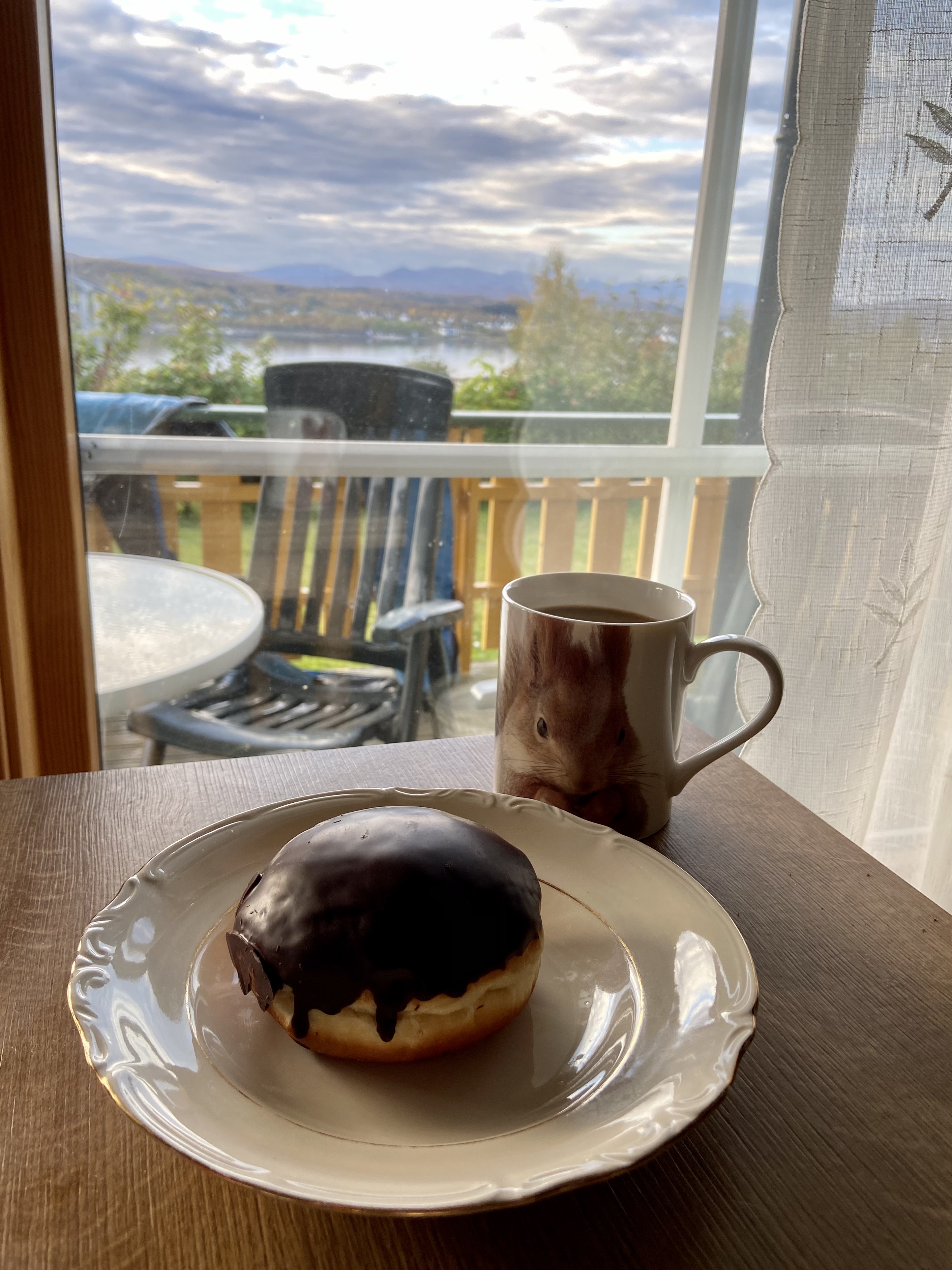
That said, I was pleased to see the return of mørketids boller to the shop I was in yesterday. Mørketid is Norwegian for polar night, which will not arrive until 30th November, so like the mince pies, they are a little early. But I love the seasonality of the foods in the shops here, and this one is specific to the north of Norway. They aren’t as good as mince pies. It’s really a doughnut with dark chocolate and vanilla filling (I have seen pictures with chocolate fillings, but have never located one). Very pleasant with a cup of coffee.

The shorter days at work also ended this week. For a few months in the summer, we work seven hour days, whereas in winter, we work seven and three quarter hours. The difference doesn’t sound much, but I was pleasantly surprised when it began, how much faster the working day passed. It’s a great perk to have shorter working days when the summer is so brief.

There are also some odd quirks in the working hours over Christmas and New Year and there was some discussion about this over morning coffee this week, when there was only me and two Norwegian colleagues present. For example, on New Year’s Eve, our official working day is only two hours. So if you have built up some time off in lieu (TOIL) then that is a good day to use it. If you take the day as holiday, it counts as a whole day off, regardless of how long or short the day is. So if you do that, you took off two hours when you could have taken almost eight if you’d chosen a different day.

I had been thinking about trying to take my one remaining holiday week between Christmas and New Year, but as most of the days then are only five hours, it is worth looking into taking them as TOIL instead. The only downside being that agreed holiday can’t be removed at the last minute, whereas agreed TOIL can.

There are a lot of differences from the UK in the Norwegian way of working, and it can be difficult to find all of them out. I should imagine it’s the same for anyone who lives in a culture they weren’t brought up in, but there are times when I have the feeling I am living in some kind of twilight zone, where all kinds of things are obscure. Nobody tells you about them as they assume everyone knows and of course, as you don’t know they exist, you don’t ask about them.

One thing that I do know about, that is definitely worse in Norway than the UK for permanent employees (and is illegal in EU countries) is that in your first year in any new job, you are not entitled to holiday pay. Last year I worked for Mattilsynet from August and so I was not entitled to any paid holiday at all from them. Technically, I received holiday pay from my last job when I left, but that was eaten up in the expenses of moving up here. This year, I only have ten days paid holiday. I can take unpaid holiday, but three weeks without pay would be quite a hit and I don’t really want to do it unless it’s unavoidable.

I’m not really sure why this rule persists. I believe it has been challenged in Denmark, which is in the EU, while Norway is technically not. But Norway does adhere to most of the other EU rules, as expected under the EEA agreement, so I am unsure why they have not implemented this one. For my part, it’s a bad rule. Given that the only “holiday” I had last year was taken up with driving up here, it feels like a long time since I’ve had a proper rest. It’s not as easy to bounce back at fifty two as it was when I was younger either. Roll on next year, when I will be back up to five weeks plus bank holidays again. I guess anyone from the US reading this might think I’m a wuss, but there it is!

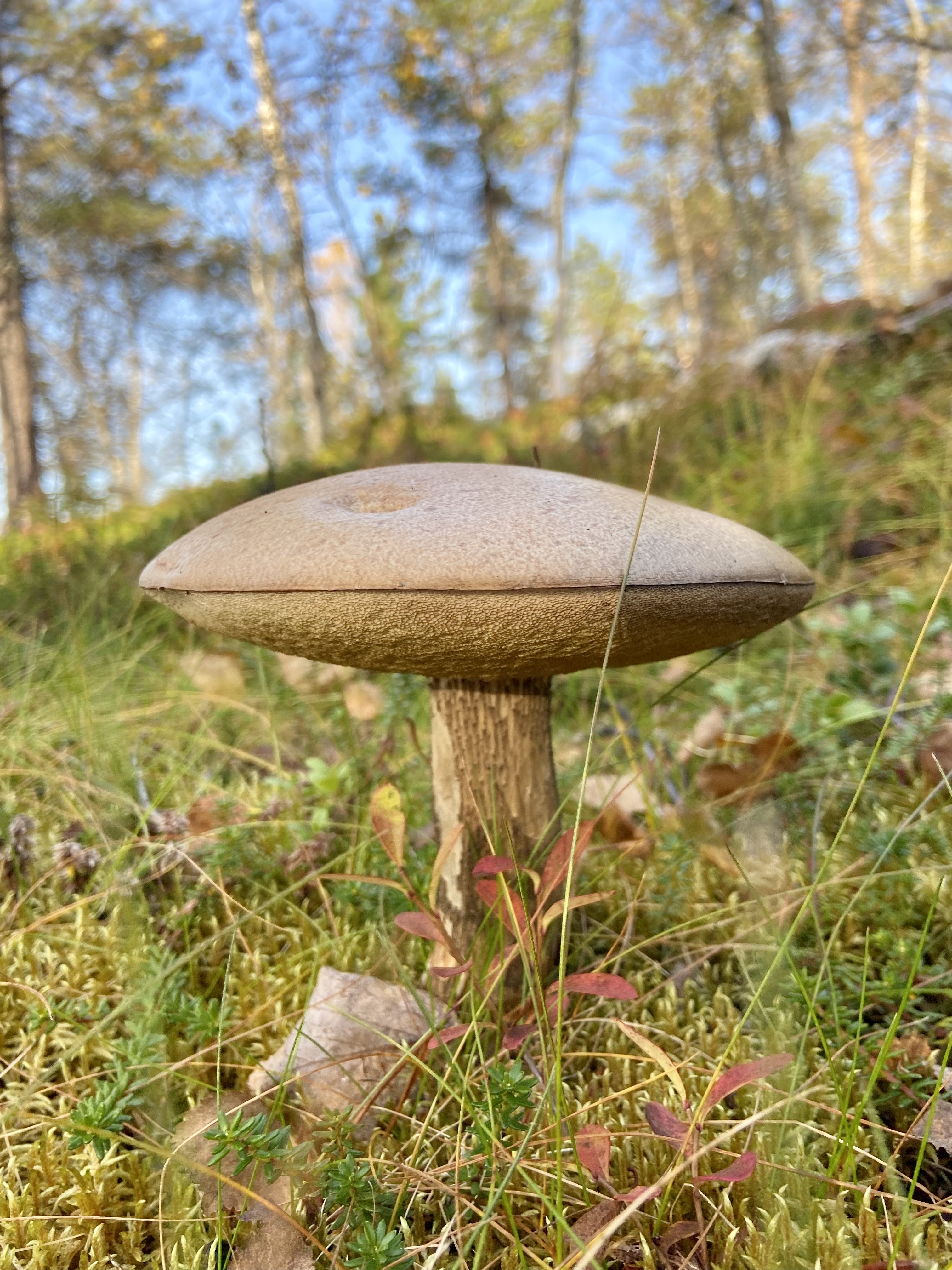
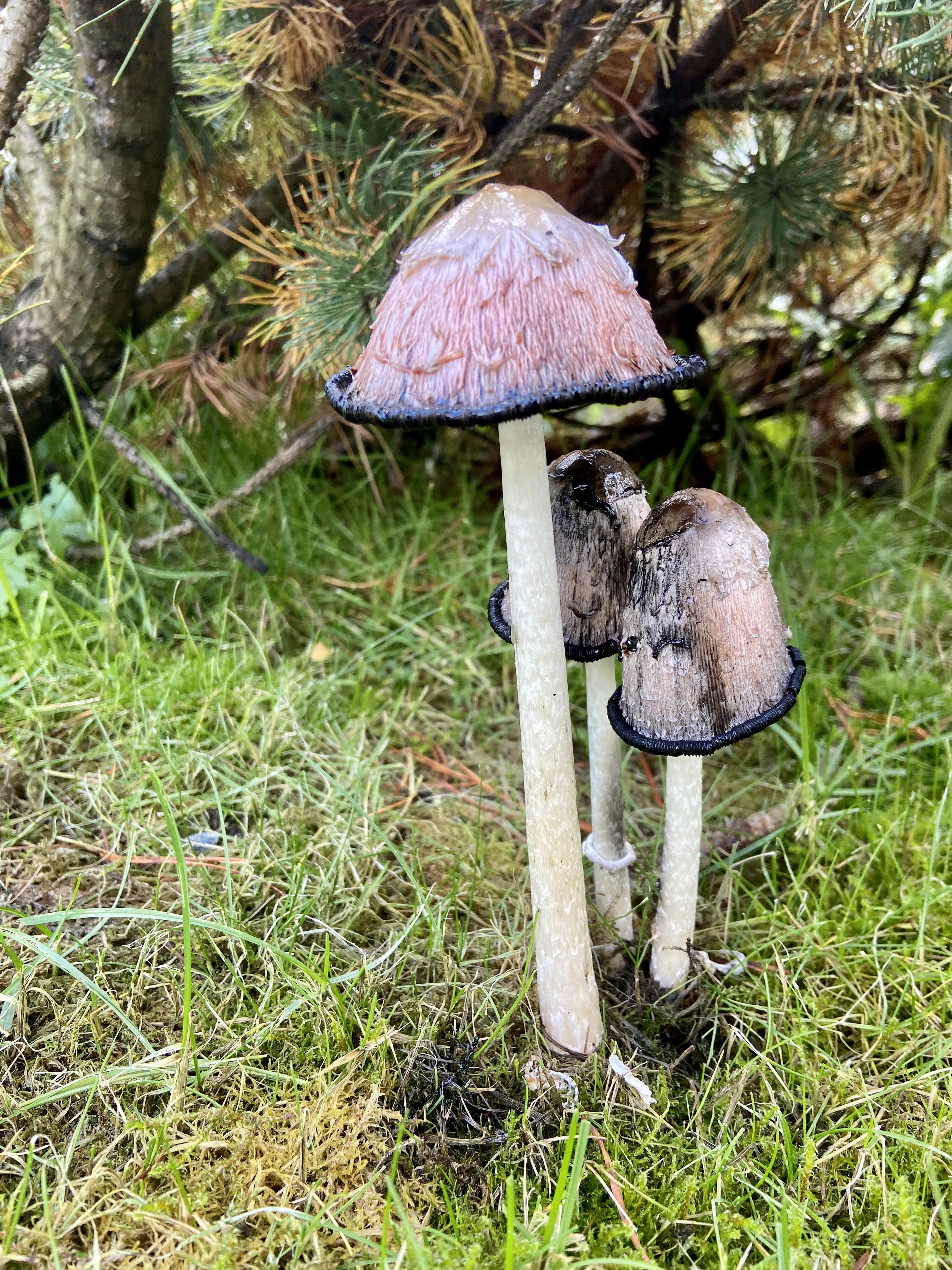
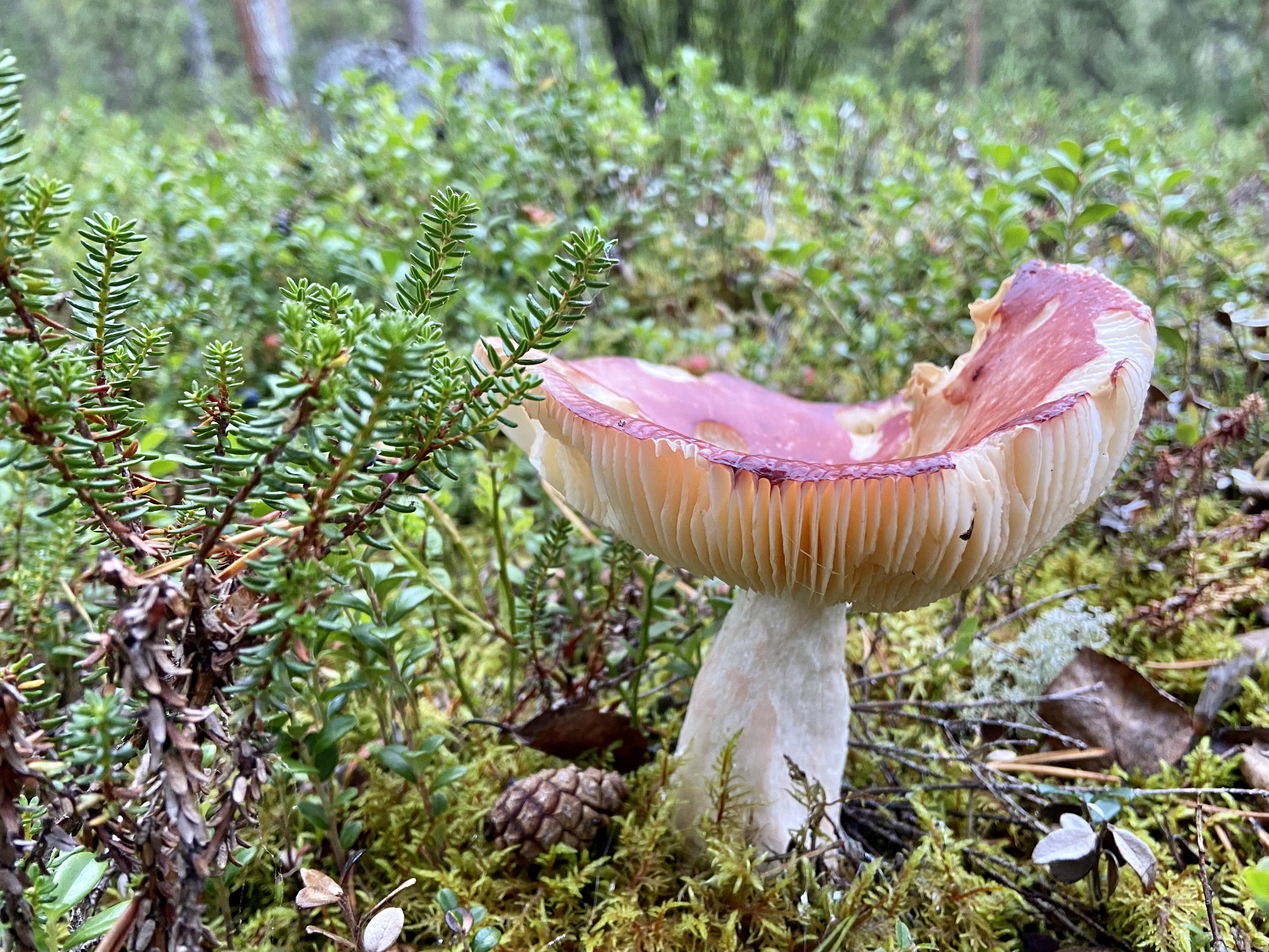
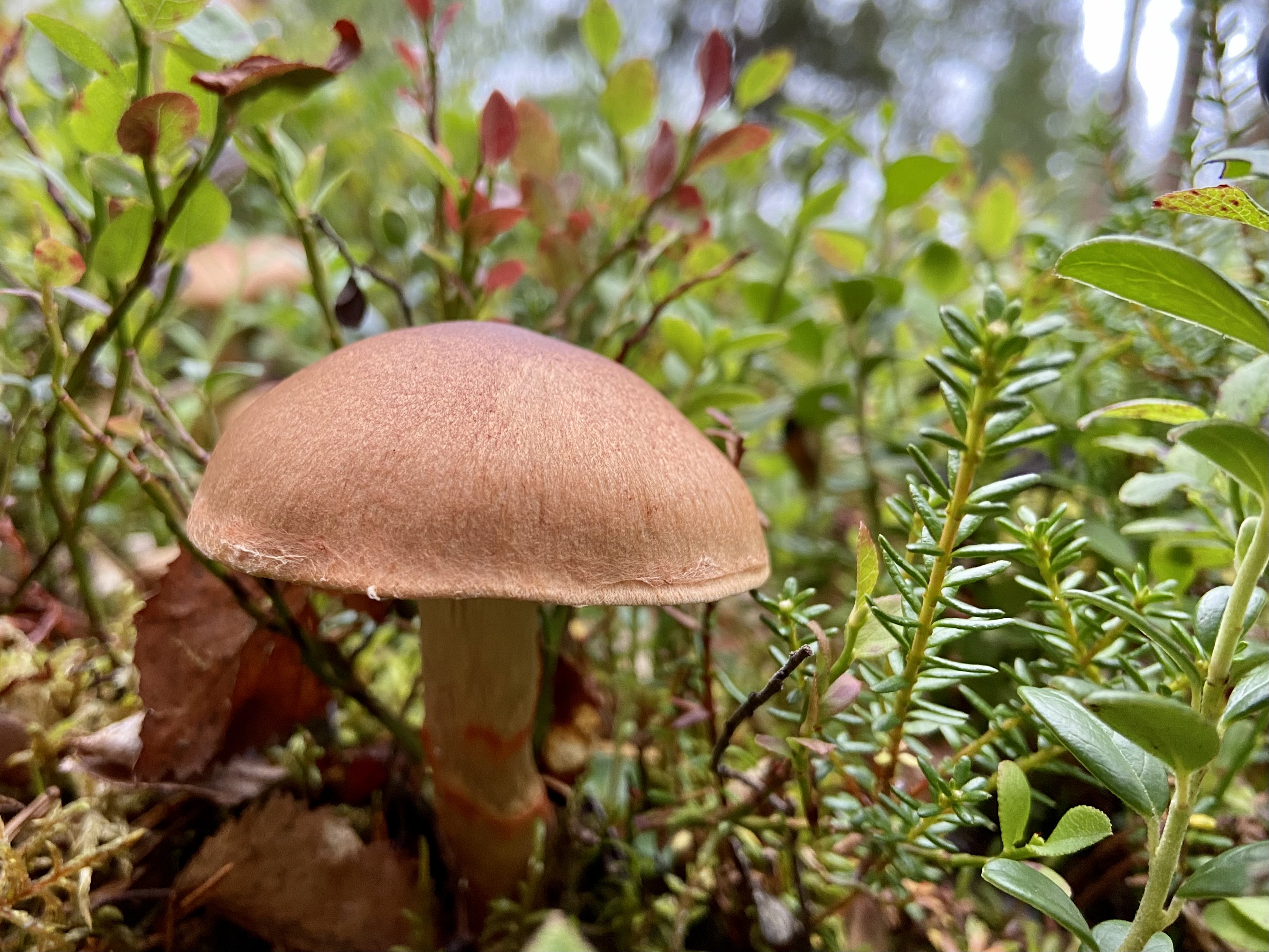
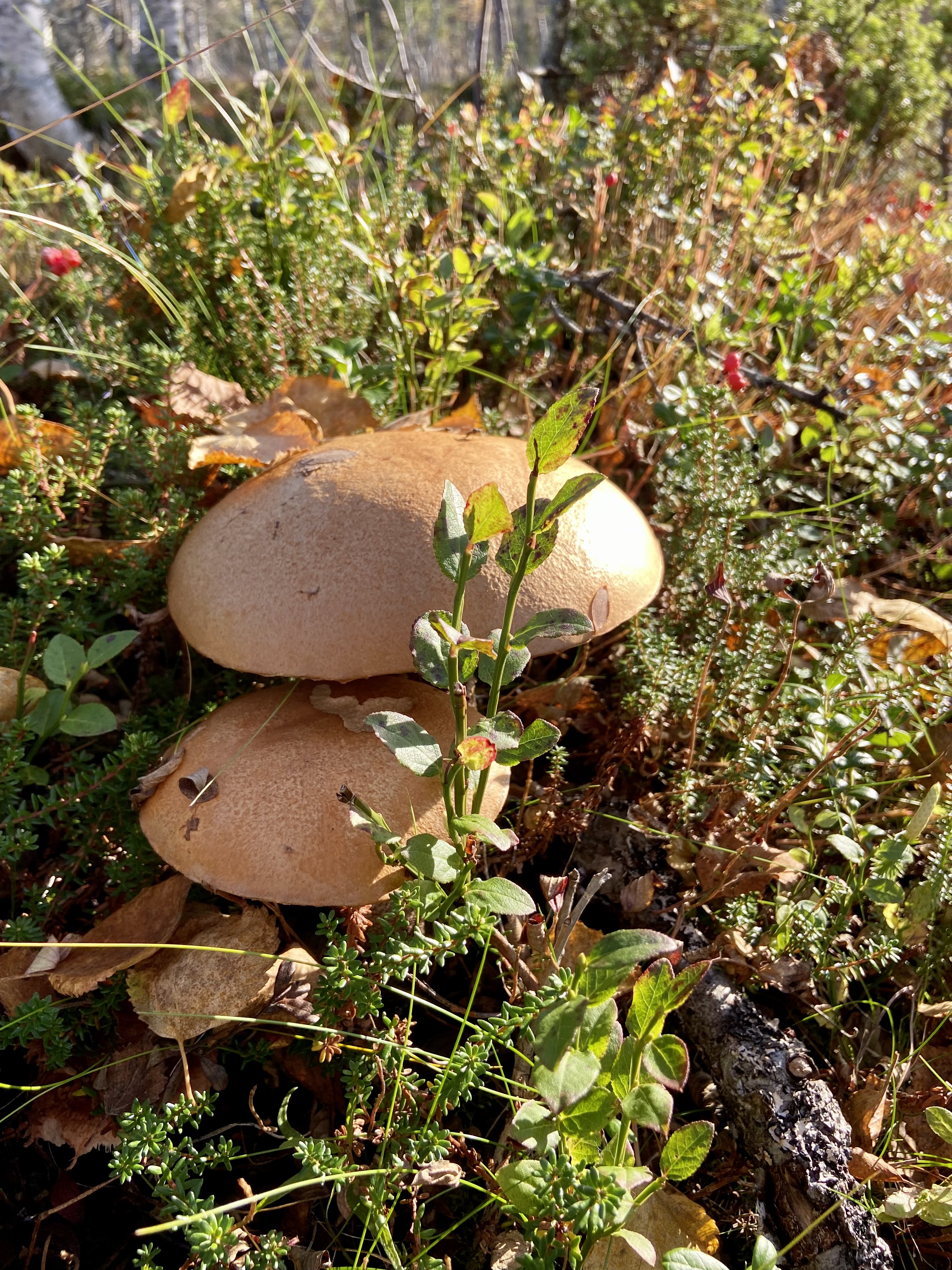
Fungi are odd things. A rather cute looking mushroom appeared one day under the hedge beside my driveaway. I took a few photos over several days. It looked tasty, and at the same time rather demure, with its closed head, all neat and dry. This was taken on the tenth of September and I think it had been there a few days. I assumed this was its final form. I rather liked it.

So I was bemused to come home on Wednesday to find it had seemingly doubled in height. The cup was now opened and its edge had a grim wet look to it! I guess it had to open as its spores must be inside, but any feelings I had that it might taste good disappeared instantly!

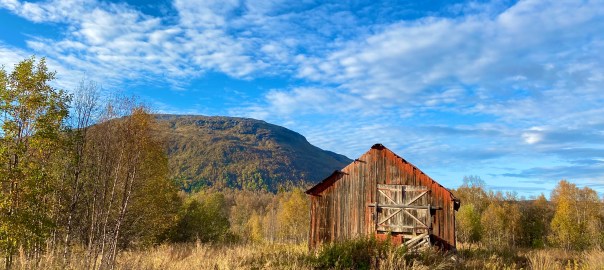
I will leave you with a couple of pictures from my drive home yesterday. There’s a falling down barn that I have been passing every time I drive to the abattoir. I decided I wanted to photograph it in the autumn of last year, but it was difficult to find anywhere to park, and then winter came and the parking possibilities reduced even further. It’s impossible to pull off the road when there’s a wall of scraped snow on either side. I drove past yesterday morning, when I didn’t have time, and thought that by the time I drove home again, the sun would have moved. But I had forgotten that the sun is now permanently in the south and doesn’t move so much from east to west as from south-east to south-west. So here it is in the autumn sun, in all its dilapidated glory. And I’ll throw in one of trees and snow topped mountains for good measure. Hope you enjoy them!

Season

Sunrise/sunset: 05:47/ 19:39. Daylength: 13hr52min

Autumn is in full swing now and there is a chill in the air. Every year in Norway, there comes a time when winter is approaching and bright red snow poles suddenly appear along the sides of the roads. I have often wondered how they are put up and as I was driving John home from his evening class this week, we saw a brightly lit lorry in front of us. It was stopping and starting, and it was on our side and we ended up stuck behind it for a couple of minutes.

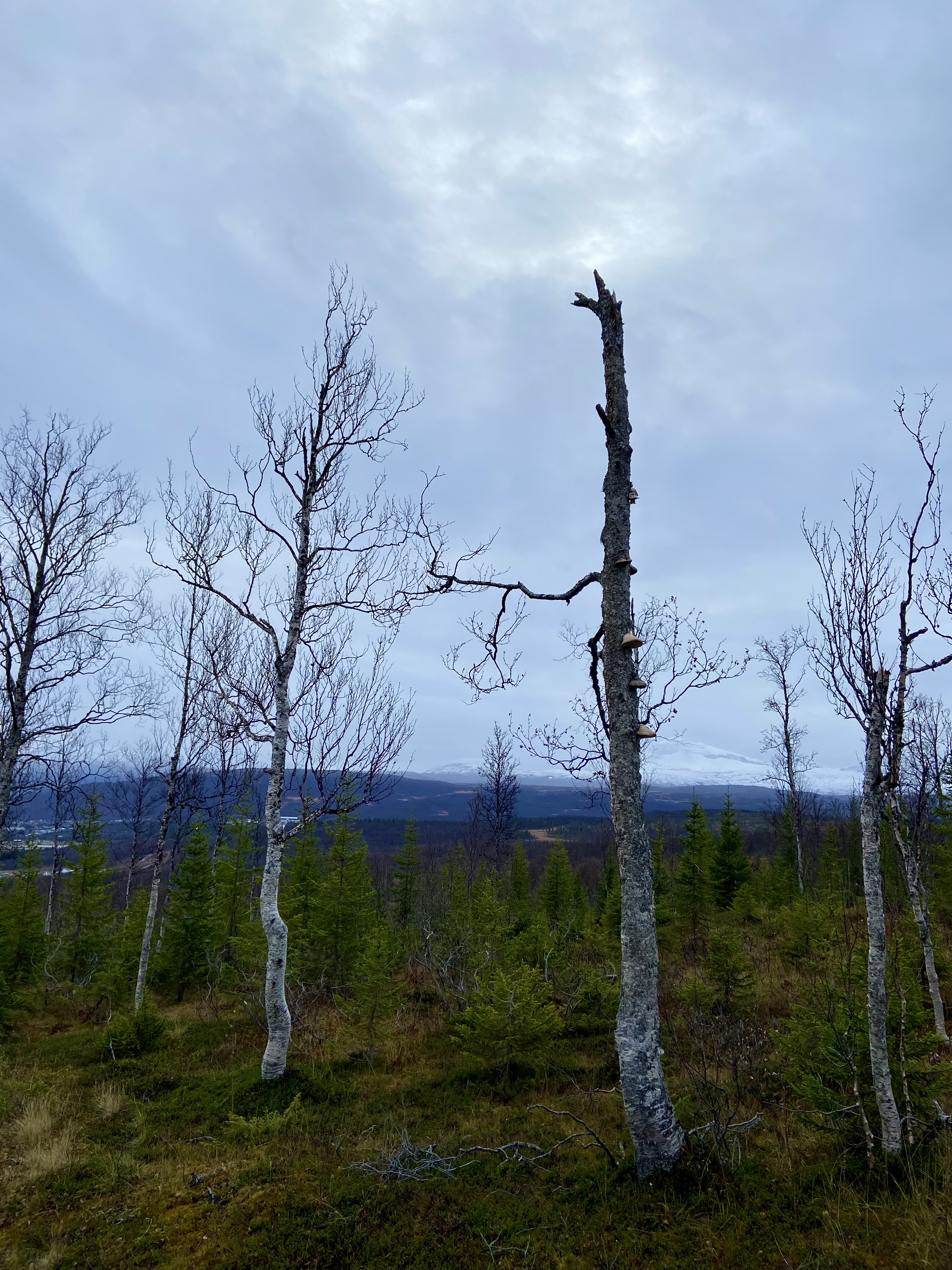
It had an arm on the side, overhanging the edge of the road. There was the sound of a jack hammer as it created holes and then it moved on and the poles were dropped into them. I would happily have watched for a bit longer, but the cars coming the opposite way had passed and there was no excuse to linger. If you look in the photo at the top of the page, you can see one of the poles. I also wanted to photograph that section of the road as I love the two tone effect of the taller pine trees, which are still green, and the smaller silver birch and undergrowth, which are autumn yellow.
I mentioned the Covid roller-coaster last week, but hadn’t expected the drop to be so steep. There’s an outbreak at Andrew’s school, which seems to have spread through the students who board. The school runs an international baccalaureate program which attracts pupils from overseas. Additionally the school covers a huge area, some of which has no public transport that would allow daily access, so those students board too. Information seems difficult to come by, but last weekend there were nine confirmed cases out of one hundred and fifty students, all in different classes and streams.
I half expected to hear the school would close, but discovered instead that even close contacts of the infected students would be in school, and would be tested three times over six days instead of quarantining. Within class groups there is no social distancing or mask wearing and vaccination of sixteen and seventeen year olds had only really started a week earlier, which seemed rather rash. Why not take stronger precautions, at least until the first vaccine dose starts to have an effect? After more than a year of disruption, would two more weeks be a big deal?

Half way through the week I was still assuming there might be a change of course, and I spoke about it to a friend who lives in Rogaland, where I used to live before we moved here. She has a daughter in the same school year as Andrew. I told her about the nine confirmed cases and the lack of precautions, hoping to hear what she thought would happen. She told me instead that in her daughter’s class there are four students off with Covid and even there, they are taking no precautions other than frequent testing.

There’s a definite irony to all this. The government website is firm in that they feel that Norway’s young people have been particularly hard hit by the pandemic and that from now on, they want things to be as normal as possible for them. But having sold the idea that vaccines are the answer to protect people, then having given the first dose of vaccine to those between 12 and 17, why would you then not wait until that dose at least had a chance to give some protection? My friend tells me her daughter’s year feel instead, after more than a year of lockdowns and quarantine, that the government are abandoning them to their fate because the older people are now protected, and who can blame them? Of course logically that age-group are at low risk from Covid, but it’s the ultimate in mixed messages to a group the government claims they want to protect.

Anna will return to the UK tomorrow for university. She had to brave the local Covid test station, with its potential queue for sick people, but fortunately it was very quiet (which I hope is a good sign for the more general situation). I’ve printed out her vaccine certificate, and now hope that everything goes smoothly for her.

As well as the changes in the weather, it is now also “season” in the abattoir, or in other words, the time when the spring lambs come in for slaughter before the adult sheep are taken inside for the long, hard winter. It’s a busy time, with all kinds of people coming in from different countries to work on the line. For the rest of the year, Mattilsynet provides two or three staff on days when the line is running, but from next week, when the season is in full swing, there will be seven.

So I’m likely to be a little more at the abattoir in the coming weeks. Konstantin and Vaidotas, who were here last year during the season, have returned. Already the office has a busier feeling and better still, there might be a bit more social life on offer. Having spent a year social distancing and having a general rule that the office should be avoided unless going there is essential, that is definitely something to look forward to.

Recovery

Sunrise/sunset: 05:20/ 20:11. Daylength: 14hr51min

And so it’s September and already autumnal here in the far north. Though I enjoyed the summer, it had a frenetic feel to it. I had heard, before I moved here, that many people found twenty four hour daylight more troublesome than the darkness of winter and I can understand why. Even with blackout blinds and curtains, it’s disconcerting to wake at four in the morning to see bright sunlight around the edges. Too easy to lose track of time and unexpectedly difficult to go back to sleep when your brain is telling you it’s morning and time to get up.

It’s also interesting to note, as I check timeanddate.com, that it still isn’t fully dark. At the moment, during the darkest part of the night, we are still in something called “astronomical twilight”. It’s a bit of a technicality, related to where the sun is in relation to the horizon, but we won’t experience full darkness for another week and a half. Either way, it’s reassuring to see it getting dark outside the window in the evening, though odd to have to get used to putting lights on again. The rapidity of the change is taking some getting used to.

Not much has happened this week and I don’t have so many photographs. I worked for about an hour on Monday (at home) and attended a meeting on Teams about half an hour in. Though I was there in spirit, my woolly brain was having trouble following what people were saying. Hilde was there too and asked how I was. I explained I was still tired (at that stage, I was still waking at least once through the night to cough for an hour) and proposed working limited hours each day and taking time off using some of the hours I’ve accrued. But she told me if I was still sick, I should use my last day of self-reported sick leave and perhaps get a doctor’s note.

Obviously being ill hasn’t been pleasant, but it has been instructive. The standard legal requirement in Norway is that employers must allow you three days of self-reported sick leave before you have to get signed off by a doctor. You can take up to three days, four times a year. I had assumed that was my entitlement, but Hilde told me that Mattilsynet have signed up to a better agreement (recommended by the state, but not enforced) that we can take eight days sick leave before we have to see the doctor and have up to twenty four days in a year. I was glad to hear it, having already taken two of the four lots of three days. I hope I won’t have to take any more this year, but with Covid on the rise, nothing is guaranteed.

I am signed up to get updates on the Covid situation from Folke Helse Instituttet, the Norwegian Institute of Public Health. Covid is rising rapidly in Norway at the moment and the children are now back at school, so it is likely to escalate. Yesterday I received two messages from them regarding the figures. It seems that, like the UK before them, Norway have decided that, as the most vulnerable people have now been fully vaccinated, they are going to let Covid run its course. I knew this was going to happen at some point. There has to be an end to lockdowns. And of course, more general measures to slow down the spread, like working from home and keeping your distance from others are still in place. But I do still have an edgy feeling when I think about how the next few months might be. A bit like teetering on the brink of a properly scary roller-coaster. I wonder what the world is going to look like on the other side of all this.

Speaking of vaccinations, I had my second on Wednesday. Having researched the reasons for not getting it when unwell, I reckoned that I was recovered enough to get it done. It would also mean that if I had any side effects, I would be at home already. I was sitting in the queue when my phone went twice. Ann was trying to call. I didn’t answer, but a few minutes later I got a message from John to say that he’d been in an accident at the abattoir and had hurt his hand. He was coming over to get an x-ray at the emergency doctors’ clinic here in Finnsnes. It’s very well equipped because of the distance to the nearest hospital.

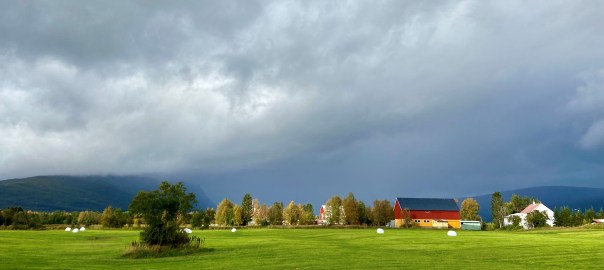
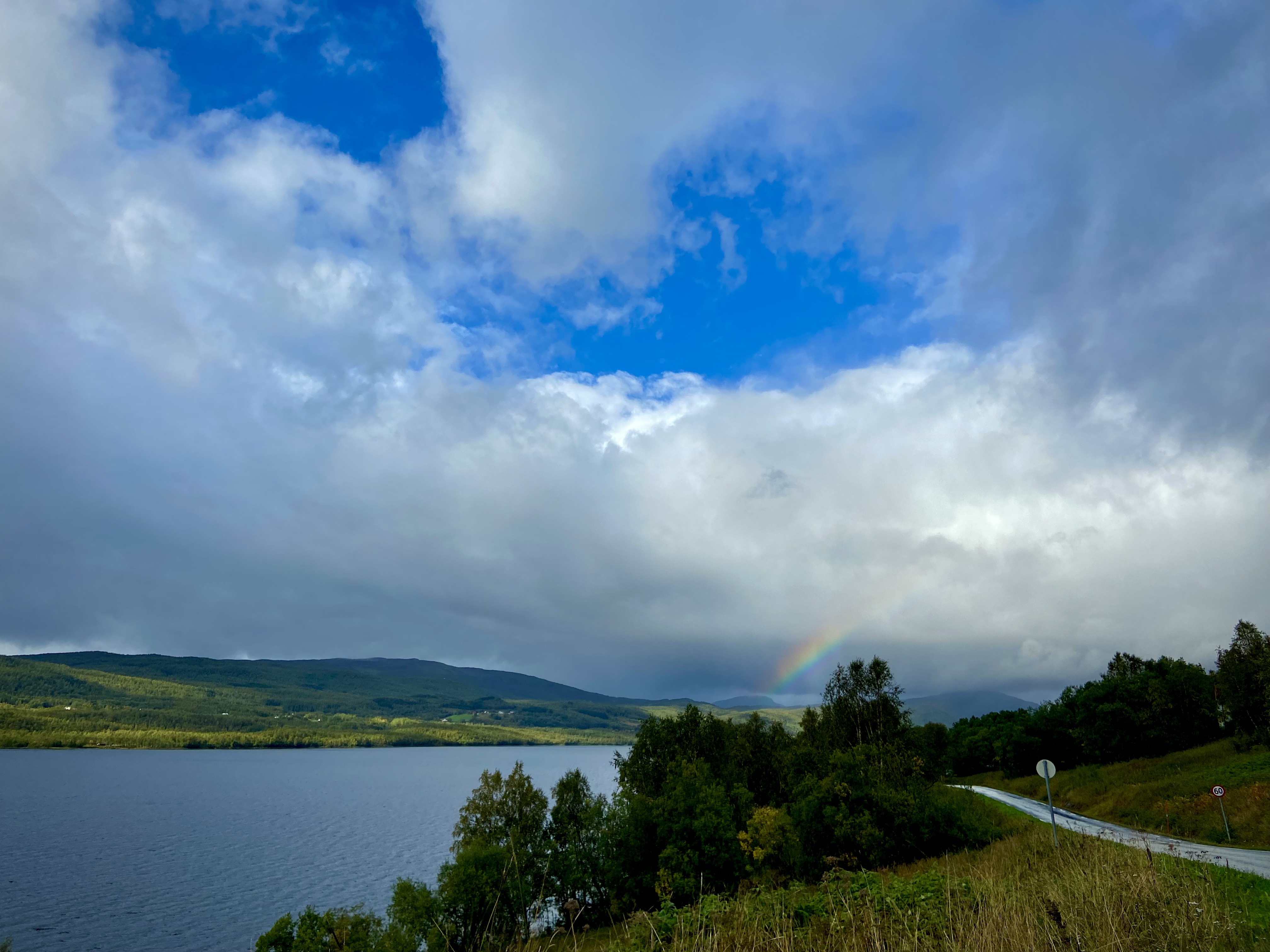
And so after my vaccination, I went to collect him. Fortunately, his wrist was not broken, but he too was signed off for the rest of the week. As Anna was now unwell, it didn’t seem a good idea for him to stay with us, and so I took him shopping, we ate lunch in the car, and then I drove him home. I am used to driving when tired and sick (in the small, rural practices I worked at in Scotland, unless you were bed-ridden or actively vomiting, you were expected to be at work) but I did have to stop for a rest break on the way home. There has been a lot of weather this week: sun and rain and dramatic skies. The photo at the top of the page was where I stopped and below is a rainbow that appeared while we were eating lunch.

Other than that, I’ve not been out and about much. I’ve been hanging around at home, cuddling the dog, eating jelly and looking out of the window which, fortunately for me, is a view well worth looking at. And so I will leave you with a pictorial summary of the last few days and hope for more variation next week, when I will be fully back at work.

Honningsvåg and Departure

Anna and I visited the small Nordkapp Museum on the afternoon of our last day in Honningsvåg. It concentrated mostly on relatively recent history, though it was fascinating to see that being close to the ocean meant that trade routes here allowed this distant arctic region to be colonised early as the ice from the last ice age retreated, long before other regions which nowadays would be considered as hubs for movement and trade.

There were one or two snippets about women, which interested me on a personal level. I am always fascinated by pioneering women. For example this small plaque celebrates the first local paper on Magerøya, which the notice tells us, was written by two ladies.

Witchcraft in the village of Kjelvik seems to have been more strongly ranged against men than women though. Interesting as in other parts of the world, it seems to have been women (and particularly older women) who were targeted.

There was a large exhibition about the war and its after effects. I was aware that the far northern regions of Norway were devastated at the end of the war when the Nazis retreated, and I had wondered whether Honningsvåg was so far away and so remote that it might have escaped being burned to the ground. It seems that it was not. Of course that makes sense. In these days, where road and air travel tend to dominate (at least in my mind) it requires a complete adjustment to understand that in both near and more distant history, boat travel was one of the most significant ways of transporting people and goods. This was especially true around Norway, but also as it connects more distant parts of the world. Of course many goods continue to be transported by boat, but it doesn’t predominate in the news unless something goes wrong. But any harbour town must have been particularly useful to any invading forces, and therefore at risk.

It seems all of Honningsvåg was burned with the exception of the church, which I regret not visiting. The rebuilding effort was rapid. Some had fled to caves in the hills, others returned from evacuation to start again, and those who did so apparently slept in the church.

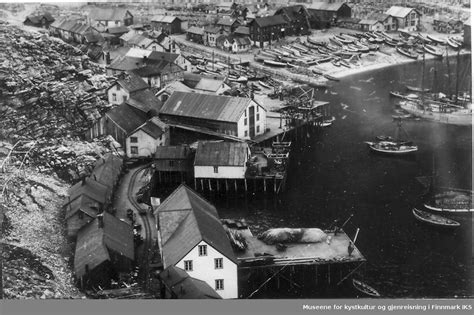
There was also a filmed interview with a man who had been born in Finnkongkeila, which was a busy Sami fishing village to the east of Magerøya. It too was razed in 1944, but due to the lack of road access, and because of the steep slopes that lay behind it with the high landslide risk, the Norwegian authorities decided it would not be rebuilt. The idea of having the place, where you had lived your whole life just disappear, burned and then gradually overtaken by nature, is so alien that I can scarcely imagine it. Here’s a photograph of Finnkongkeila before it disappeared.

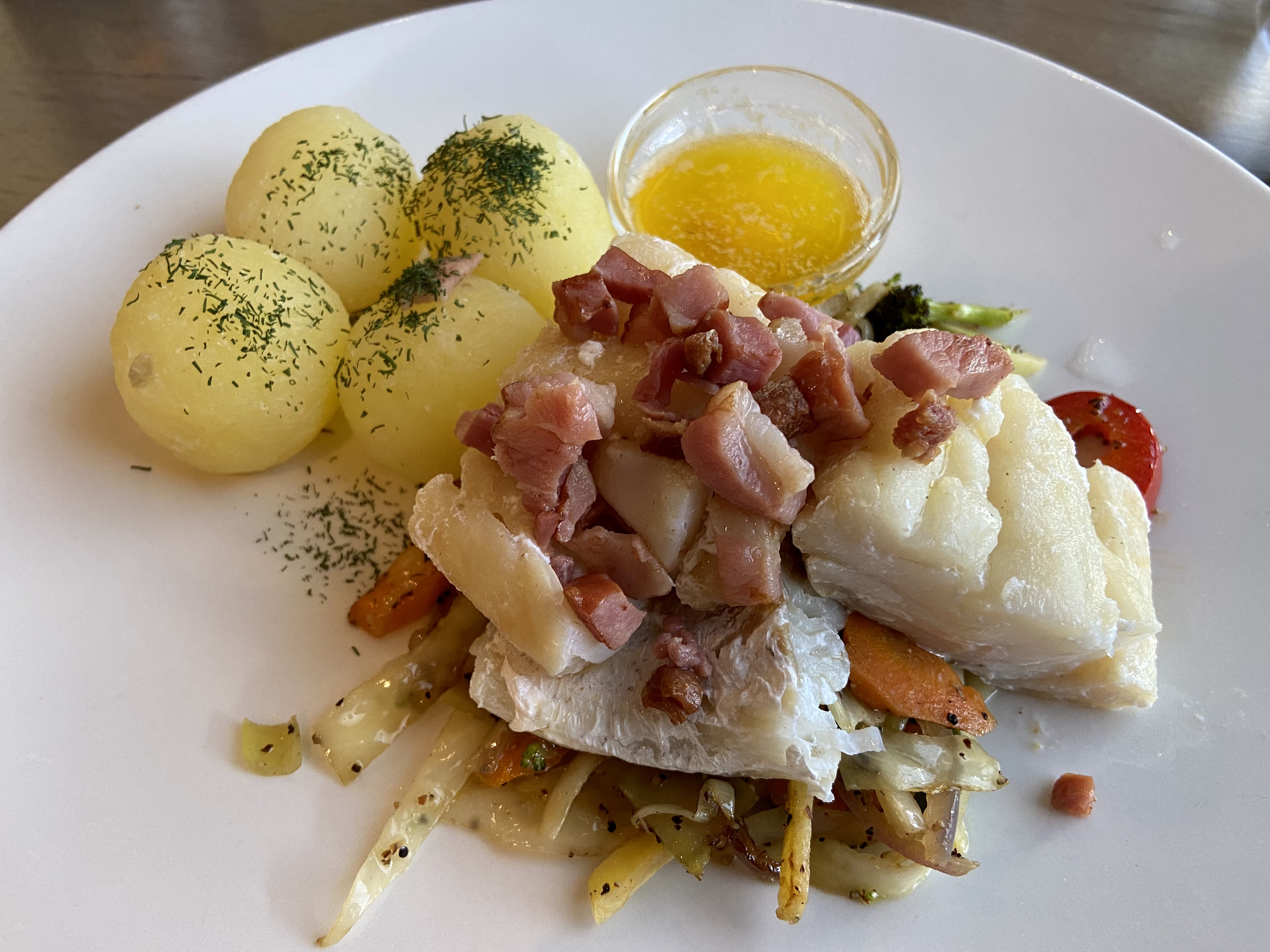
We also read a lot about the local fishing industry and the related trade in dried fish. I was interested to find out that though stockfish is dried and exported in huge quantities, the local dish is actually boknafisk, which is only semi-dried. I had noticed it on the menu in the restaurant we had eaten in the night before, and so of course I had to go back and try it. It was really very good.

I was going to write that our holiday disaster struck the next morning, but given what I’ve written about so far, I shall temper it to say that a mild bump in the road reared its head the next day. I had heard coughing from more than one other guest during breakfast the previous two mornings at the hotel. So it should perhaps not have come as a surprise when Andrew came to us first thing and told us he had a sore throat and perhaps the beginnings of a cough. I confess I wasn’t too much worried about his health (he’s been a school throughout the pandemic and we’ve been through several rounds of colds) but I was concerned about the logistics. Hotels in Norway are not cheap, and the idea of stopping and getting a test locally, then waiting for the results was not appealing. We were due to check out anyway, and so Anna and I went down to breakfast (and took Andrew up some very tasty chocolate croissants). We discussed the situation afterwards. Andrew was already feeling a bit better, and there was still a chance he was suffering only from a flare-up of his allergies and so we decided to head down to Alta to the cabin we had booked there, and then reassess the situation.

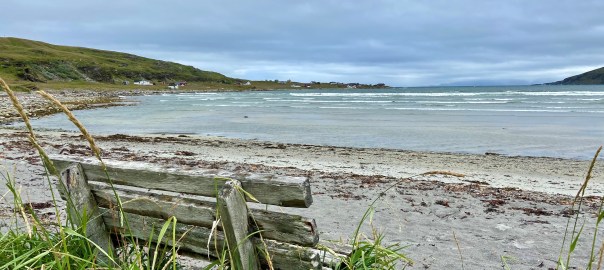
It was only three hours or so, but I was rather sad to be leaving Magerøya so soon. Andrew seemed to be feeling better and we stopped once or twice on the way to get some fresh air and enjoy the scenery. Triar went for a run on a little beach at Repvåg, where I found these two very weathered benches under the sullen sky.

And then we were back into the amazing slate-dominated landscape with its weathered stones, its disconcertingly angles layers jutting towards the sky .

The cabin in Alta was tolerably comfortable. It had a small TV tuned to the National Geographic channel with a sign that sternly informed us that we mustn’t touch the settings. By nightfall, it was obvious Andrew’s cough was not a resurgence of allergies, but definitely something more, and so we decided that we should try and get a test the next day, then find out whether we would be permitted to drive home, or should wait in the cabin until we got the results.

Friday then, was rather sad. We had arranged to have two nights in Alta as there were things we wanted to do there. Our neighbours had recommended the bathing park and I very much wanted to go and see the famous rock paintings and carvings. Instead, Andrew slept for much of the day, while Anna and I sat on poorly padded wooden benches and watched a series of documentaries about aeroplane crash investigations, airport drug smuggling and some rather Top Gearesque programmes about a man who refurbishes classic cars. The wifi was awful, so other pastimes were not really possible. I had hoped to write a blog update, but that wasn’t really possible. Anna and I did take Triar out for a walk in the (fungi-filled) woods, alongside a sortie to the shops and to a local takeaway but that was the extent of our day in Alta.

I was impressed with Alta’s coronavirus test station. Our local version involves going into an old school building, where masks are not compulsory, and standing in a queue of blue dots set two metres apart. I’ve long thought it must be a wonderful hub of infection as everyone who has a cold is meant to get tested. In Alta there’s a drive through tent outside the health centre and drive through we did, shouting replies to the man in protective clothing as Triar barked in Andrew’s ear from the back of the car. We asked about travel and he told us that so long as Andrew stayed isolated in the car and wasn’t too unwell, there was no reason not to head home the next day.
And so abandoning our possible plans for a last night in Vollan or possibly Tromsø (fortunately I had nothing booked as I was sure we would find something and wanted to keep things flexible) we made a run for home last Saturday. It was a six hour drive, and though we stopped to buy food and drinks from garages, we were not really able to take much of a break on the way. We stopped a few times to look at the scenery, which was dominated in part by the sheer numbers of berries growing on the ground and on the trees, and in part by the weather, which was mostly good overhead, but with glimpses of cloud capped mountain tops and distant rain-filled valleys.

I arrived home feeling tired with a rather dry throat. I was still hopeful that this might have been due to a long drive and the car’s air-conditioning, but I woke up on Sunday with a raging cold that has seen me spending most of this week in bed. Andrew’s Covid test was negative, as was mine, but I was definitely not able to go back to work. I’m still coughing away as I write this and feeling fragile, but I will try to work (from home) tomorrow and hopefully things will gradually return to normal. Anyway, I hope you have enjoyed the journey to the north with me. Next time we venture north I’d like to take more time to explore Alta and Magerøya, and perhaps go on a detour to Hammerfest and Karashok. There’s still so much of northern Norway left to explore!

Magerøya and the North Cape

Slightly belatedly, I’m going to take you though the last days of our adventure in two instalments.

There’s something of a controversy over the North Cape (Nordkapp), which in truly Norwegian style, is unfolding gradually. Scandic, who owns many hotels in Norway, invested heavily in a visitor centre right up on the cape where they have sub-leased the land from the municipality. It boasts a wide-screen video system, an underground tunnel with exhibitions about Nordkapp’s history, a coffee shop, conference facilities and a restaurant that seats two hundred and fifty people.

However, rather than charging people to go into the centre itself, for many years Scandic had set fees for the car park outside that were widely considered to be unreasonably high. Presumably this was more lucrative than taking payment only from those who wanted to go in and see the exhibition. Had it been a 50-100kr charge for a car ( a little under £5-10 or a little over 5-10 US$) with an additional fee for going into the centre, I should imagine it would have gone unremarked, but it seems that for a long time, the so-called parking charge also covered entry to the visitor centre and started at a much more painful 260kr (back in 2017) for the car and driver, plus a 40kr charge for each additional passenger.

This caused a divide in the local community. On the one hand, the centre created a great many jobs for local people. On the other, charging excessively to stay outside and look at the scenery comes into conflict with the Norwegian “friluftsloven,” which is the state law that guarantees public access to public lands, which Norwegians justifiably value very highly.

It was only in July this year that a complicated court case ruled that Scandic could for now, no longer charge parking fees for those visiting the cape. The downside for us is that they are now charging 260kr per adult to go in the centre. I discussed this with Anna and Andrew on the day we arrived in Honningsvåg. The centre sounded good to me and I half felt that having come all this way, it would be exciting to have the full experience, so though the price was steep, had they both wanted to go, we would have done. But somewhat to my surprise, they both felt quite strongly that Scandic had behaved in a way that was against what Norway stand for. Both of them said that they would be happy to visit the cape without going into the centre.

I proposed an evening visit, once the centre was closed. I wasn’t sure whether there would still be pressure to buy tickets on arrival, so though the sun would be below the horizon, we decided to go around ten in the evening.

It was a beautiful drive, though the road is precipitous in places. I was glad it was dry and though the temperature on the tops was a chilly 3°C there was no chance of ice. We stopped to admire the sunset as we approached the cape itself.

I was amazed, as we arrived at Nordkapp, to see how many camper vans were parked there. Other travel sites had warned that there might be crowds, but the days of the midnight sun were past for this year and I had wondered whether it might be quiet, but the vans were lined up along the edges of the car park, taking advantage of the wonderful views of the sea and coastline to the east.

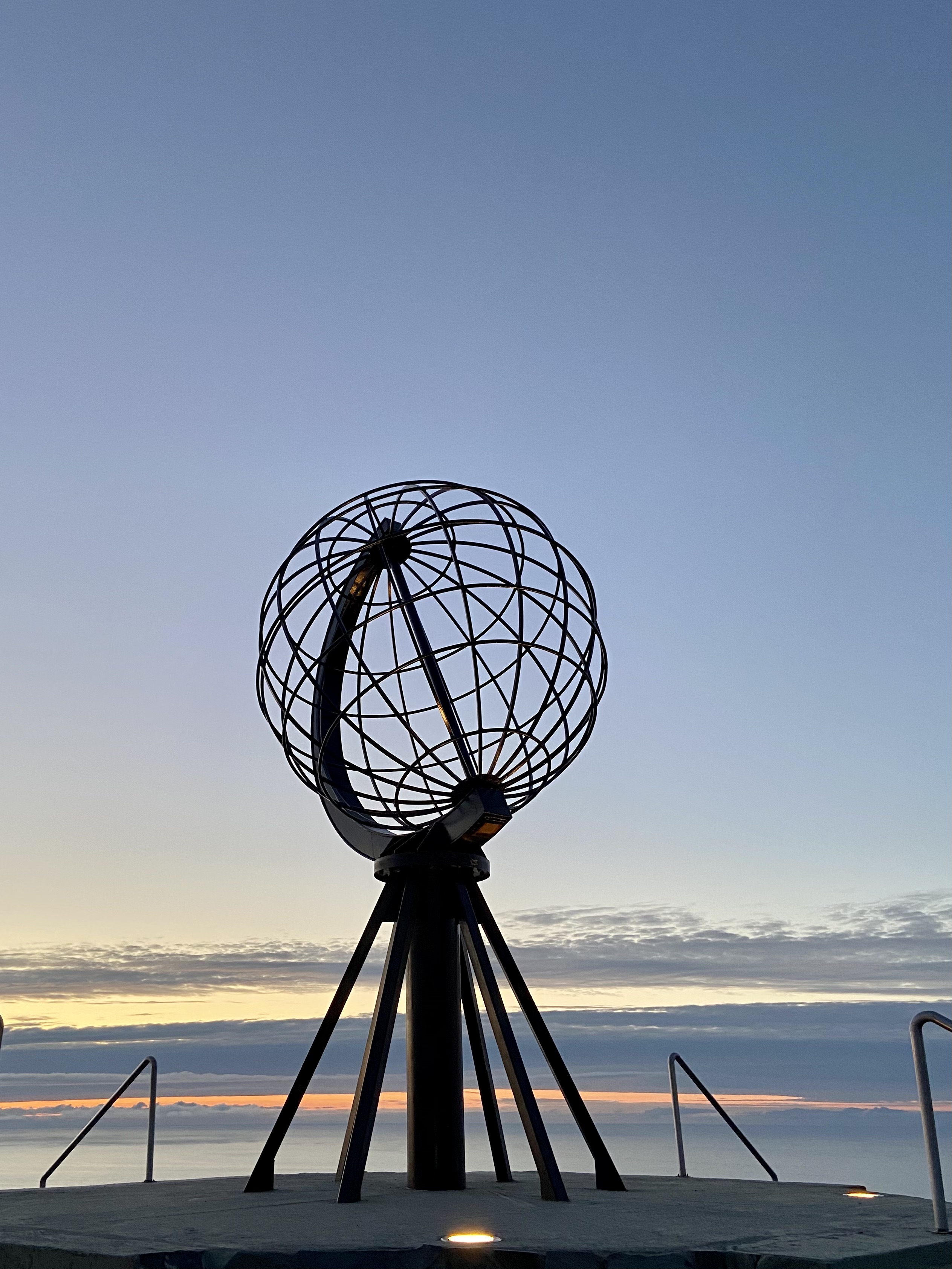
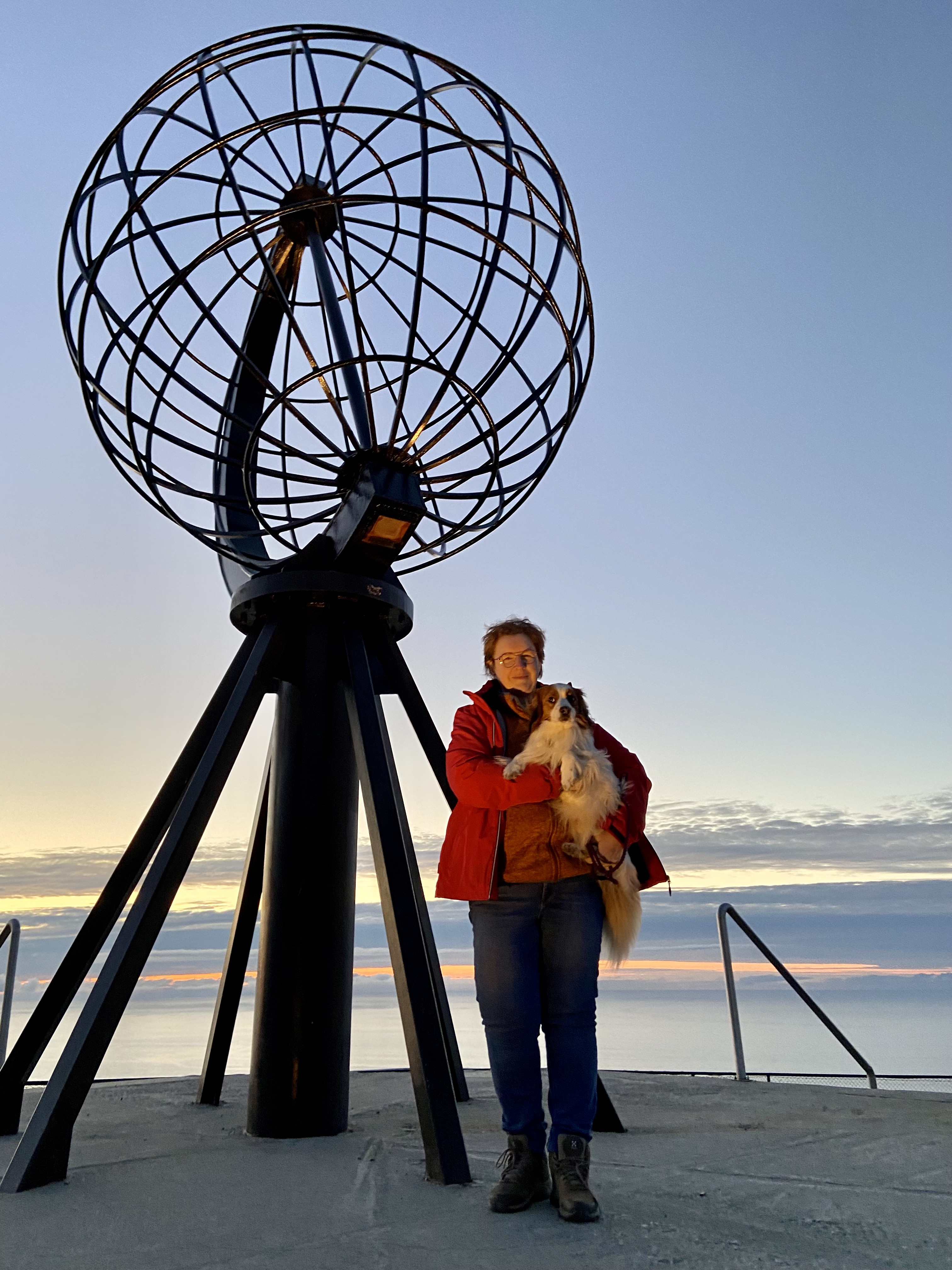
There’s something of an irony over the battles for Nordkapp. The view above shows the Knivskjellodden peninsular. If you look carefully at the map, it stretches a little further north than Nordkapp itself. Nordkapp is where the road ends, whereas to get to Knivskjellodden you have to hike 5km. We had considered it, but as I was the only one who’d brought my walking boots, we had decided against it. Still, the globe monument at Nordkapp was a great photo opportunity and it really did feel very much like the end of a journey to look out over the Barents Sea to the northern horizon.

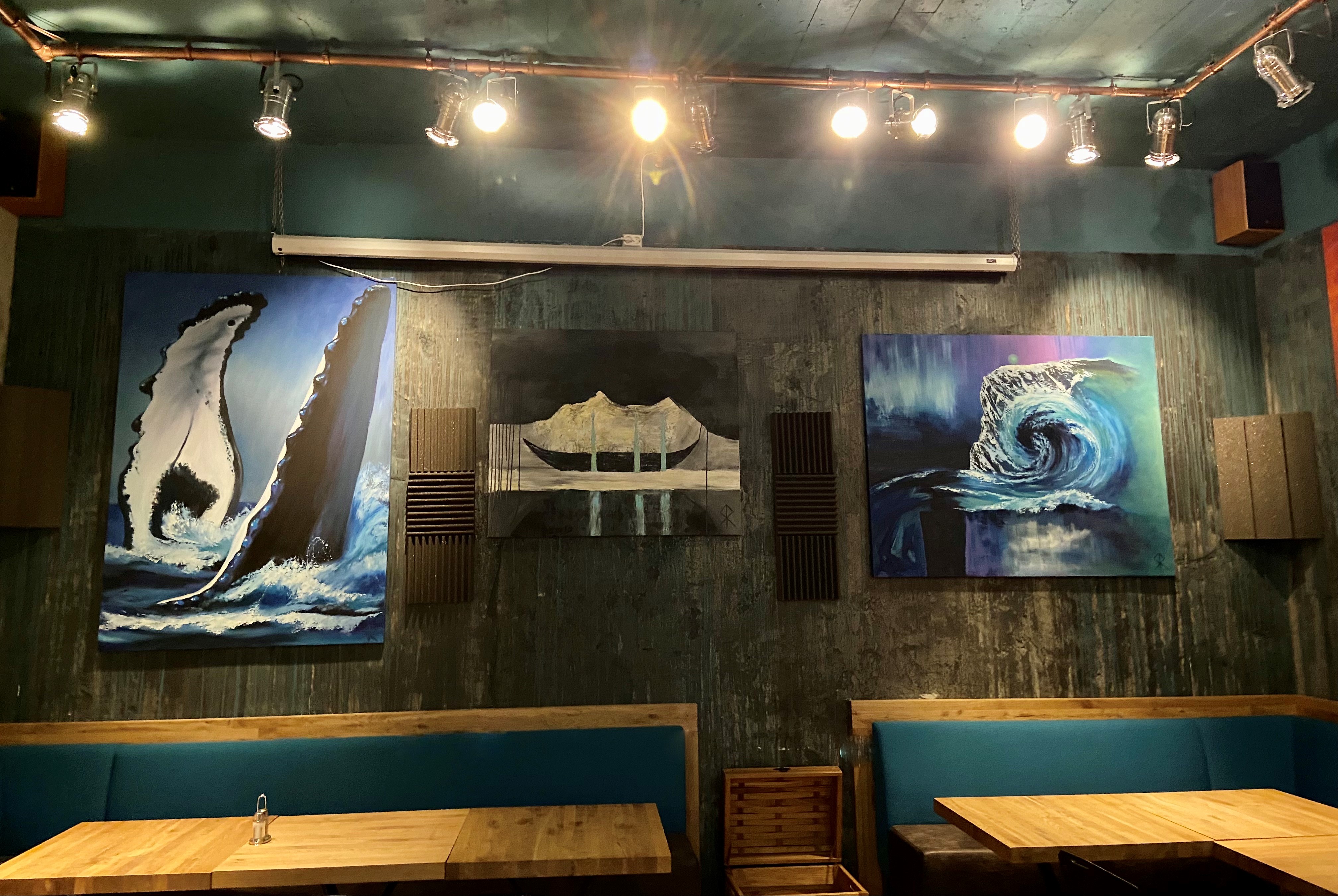
On the drive to and from Honningvåg to the cape, we had noticed a few side roads and we decided that the next day, we would explore them. And so after a pleasant meal under the striking artwork in the Arctic Hotel breakfast room, we set out to explore.

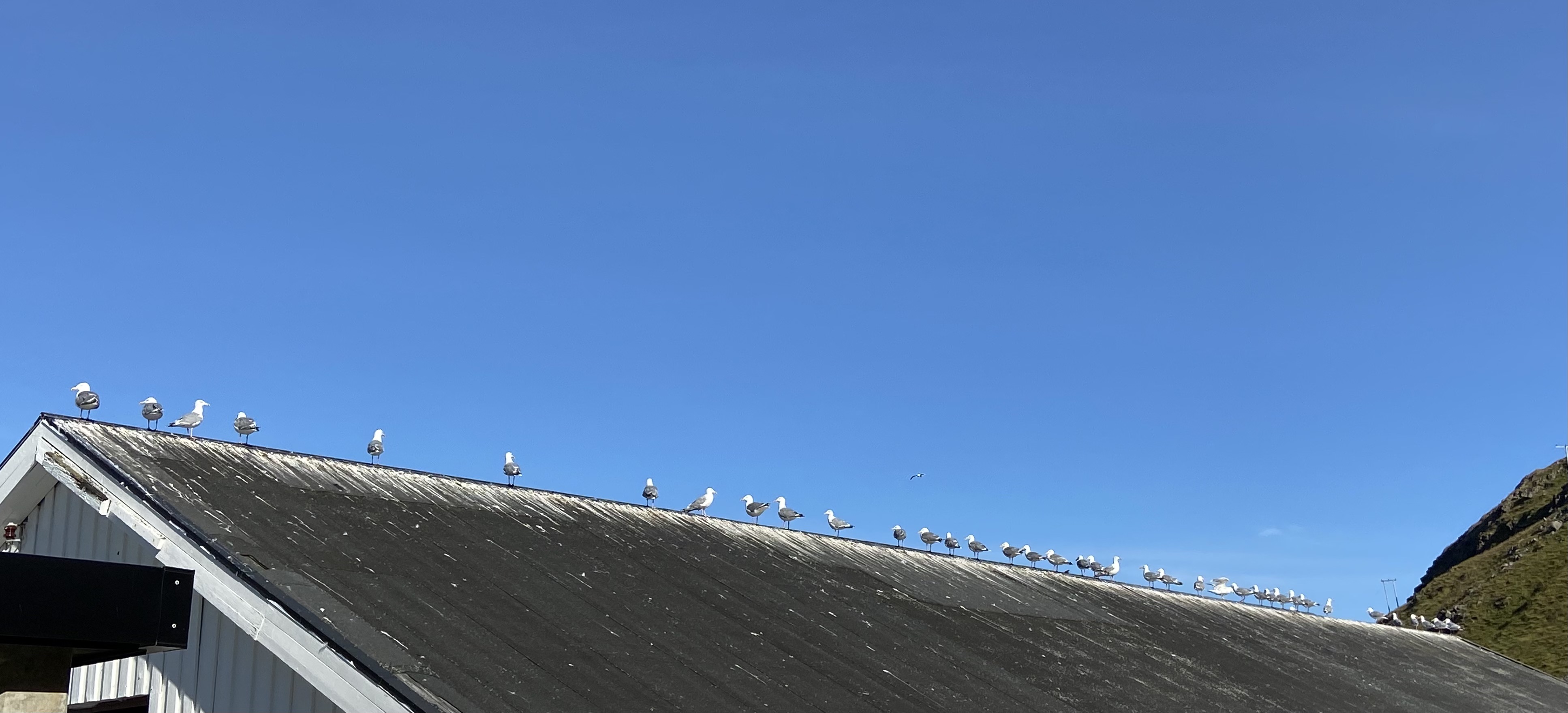
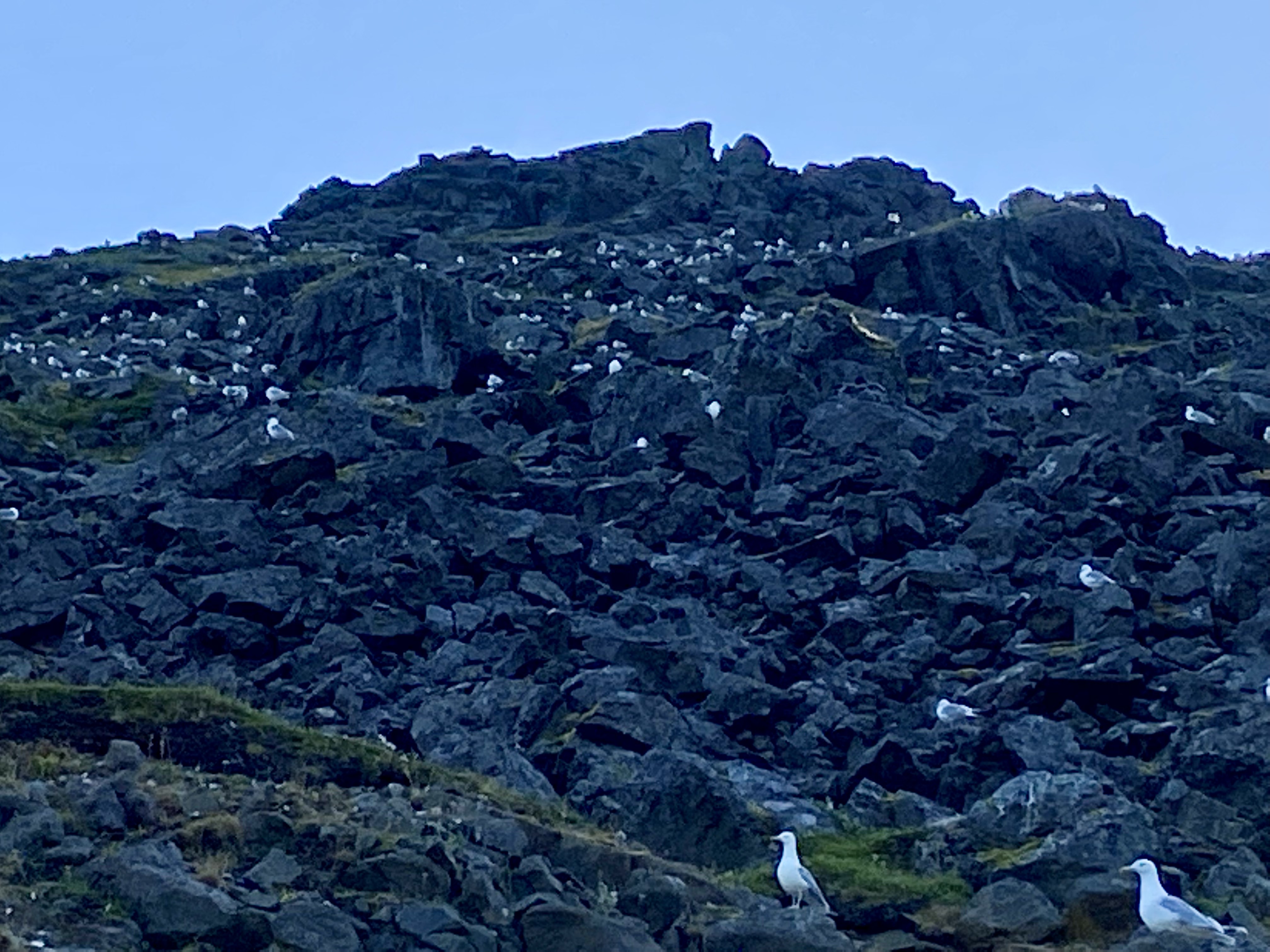
We drove north west out of Honningsvåg until we came to a junction just after a huge bend in the road. The first thing we noticed as we descended the steep road down to Kamøyvær was the massed seagulls on the cliffside and along the roof of a building above an inlet where there was a fish farm.

The village itself was like something out of a fairy tale. A row of brightly painted boats lay in the quiet waters of the harbour and colourful wooden houses were scattered around the bay.

As I stood taking photos, Anna quietly nudged me. From behind the building in the photo, a herd of reindeer were emerging. They carried on getting closer and closer and I thought they would peel off up the hill, but to my amazement, they carried on coming towards us, right into the centre of the village and, to my delight, cantered right past. One or two of them stopped to graze in the space between the houses.

We watched them wander off and then feeling cheerful, climbed back in the car to drive on to the next side road. This time, we turned left off the main E69, heading towards the more distant Gjesvær on the western side of Magerøya. It was a longer road and took us over rather barren moorland, where we stopped to let Triar out for a bit of a wander. I’m not sure whether it was the freshness of the air he was enjoying, or if it was the scent of distant reindeer on the wind, but he seemed to be very cheerful.

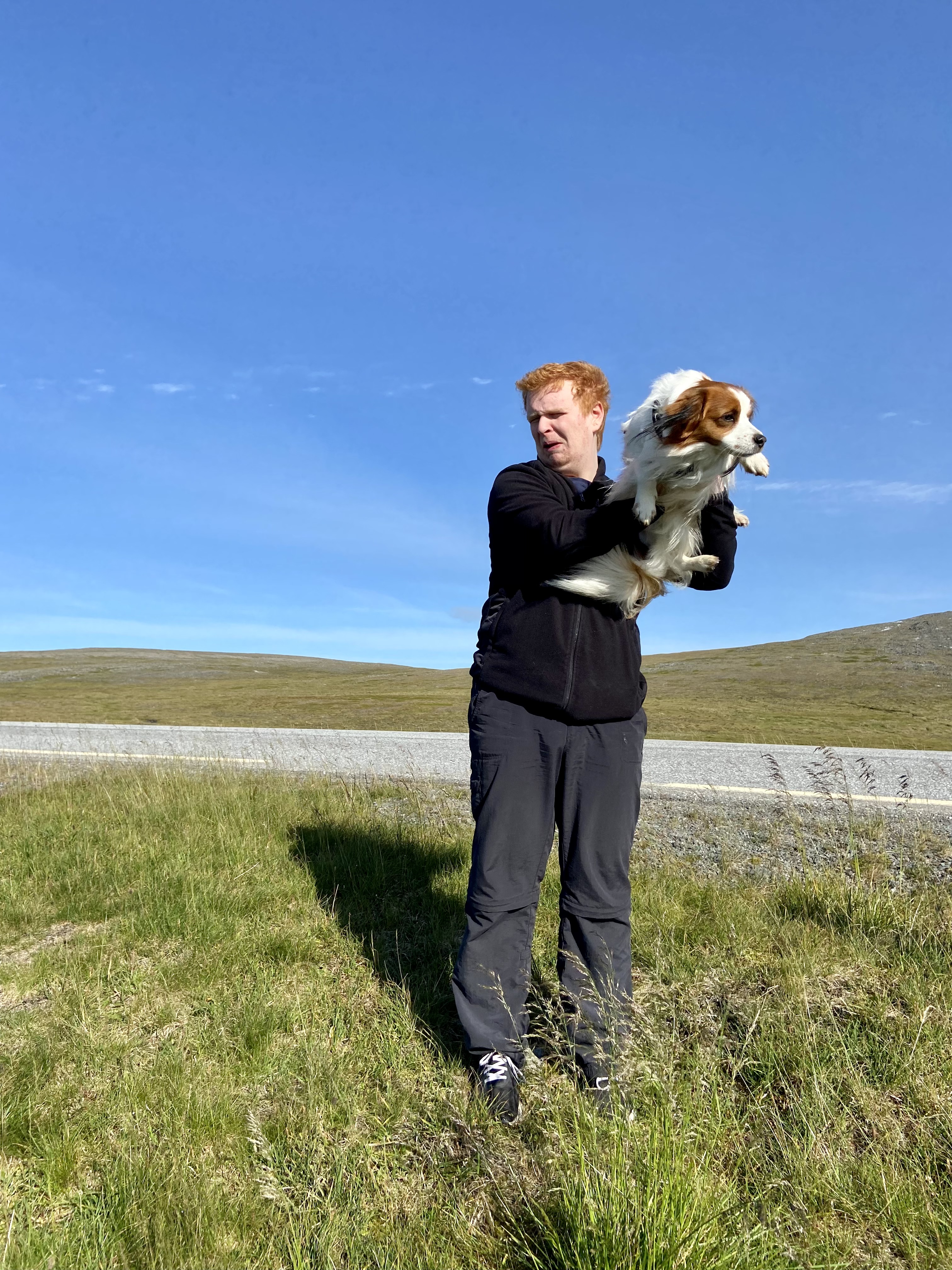
Anna lifted him up, and I took a photo of them together against the wonderful blue and green backdrop.

Feeling happy to have taken such a pleasing shot, I thought it would be nice to get a picture of Andrew, so I asked him to take Anna’s place and this is what I got.

Fortunately, as Triar has been taught from his earliest days that being held up in odd positions usually means food, he was unfazed.

We carried on, down past rocky outcrops and ruffled lakes and came out on a plateau that looked out over Gjesvær and the islands beyond. Sadly we had no food. Who wouldn’t want to have a picnic here?

One thing we noticed as we headed down each of the side roads was that there was a barrier at each end which can be closed in winter when the snows come. Though it looks benign in the August sunshine, the island must be a very different place in winter.

We had coffee and ice creams at the little bird sanctuary building in Gjesvær, and then drove on to our third and final destination, Skarsvåg. There we found another picturesque harbour and, somewhat to our surprise, a small factory, behind which was piled huge bags of sea salt, presumably all ready to be shipped off to wherever they are processed and sold.

And so, our whistle-stop tour of the island complete, we set off back to Honningsvåg and the hotel, where Andrew stayed in and Anna and I went off on a visit to the little museum that stood on the dockside. But that will have to wait until tomorrow.