It feels like a long time since last weekend. Monday was a typically busy day with queries flying at my head from farmers who aren’t allowed to move their cattle as they are under movement restrictions. I was also chasing up information for a report about welfare in transport issues and (probably predictably) my oversight over bird-flu cleansing and disinfection needed rapid attention in the afternoon. It would have been easier if I hadn’t taken holiday on Tuesday and Wednesday, but I wanted to get my desk clear before leaving and I did.
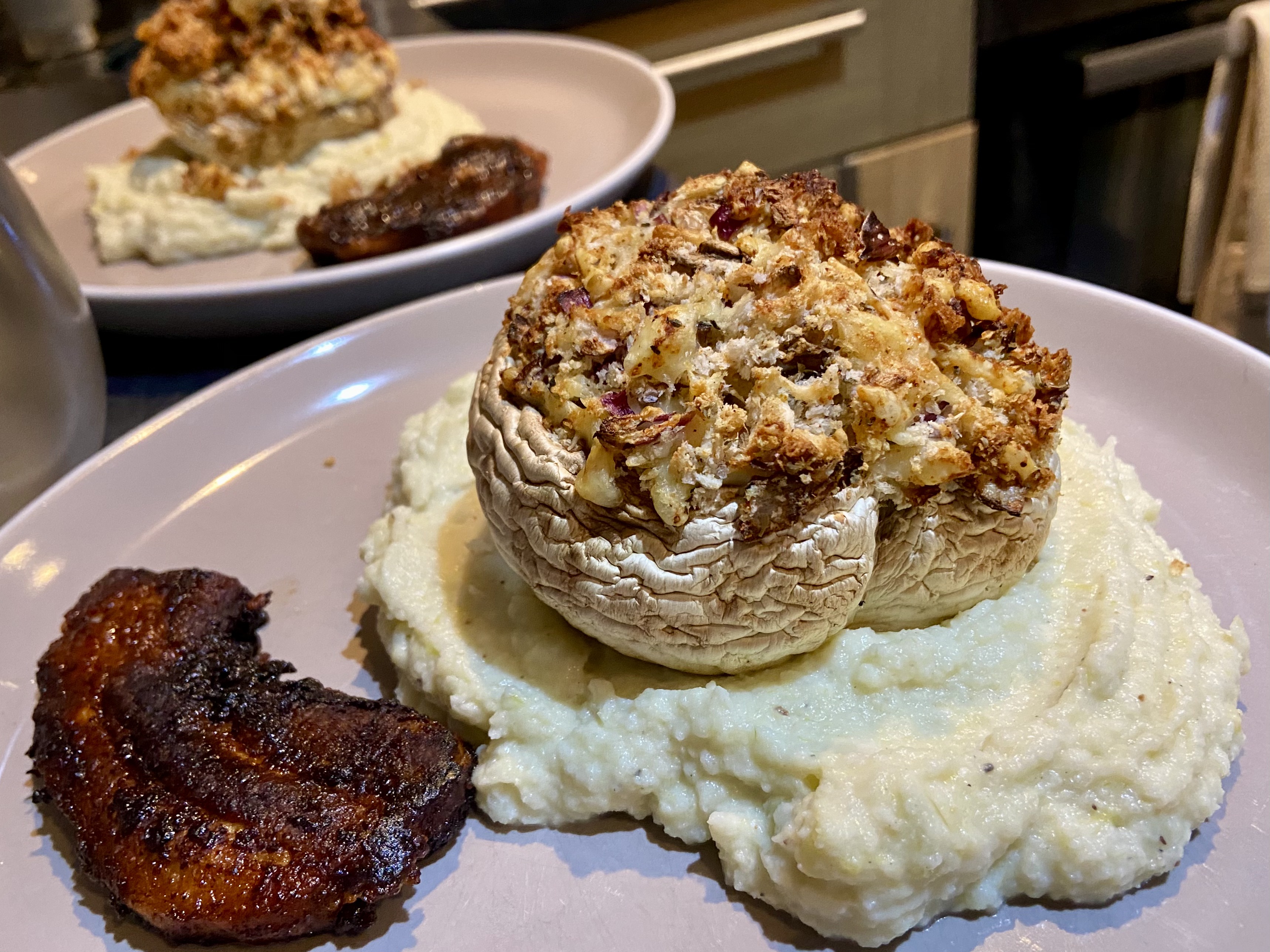
I spent Tuesday and Wednesday in Dunfermline. More about that next week, but I was lucky enough to stay with Valerie in Airth, from where it was only a half hour drive. We had planned to cook stuffed mushrooms when I was there at the weekend and we did that, using garlic and herb cream cheese with a crumb, cheese and onion topping. Cauliflower and leek purée made a wonderful accompaniment, with a slice of fried belly pork on the side. Delicious!
Thursday, I played catch-up and prepared for Friday’s Bluetongue tracing visit. They have found the virus in animals in Northern Ireland, so now we are testing cattle that might have been in contact several months ago. It was a gorgeous sunny day and, for the first time, I was out with my colleague Lisa as she trained a recently joined up Animal Health Officer to blood sample cattle. I had to do a clinical examination of them, while another vet from a local practice did a TB test. Happily they all looked fit and well. The farmer was lambing, so had to leave before I could present him with all the questions I need answers to to complete the predictable ream of paperwork, but I shall go back there on Monday and finish up.
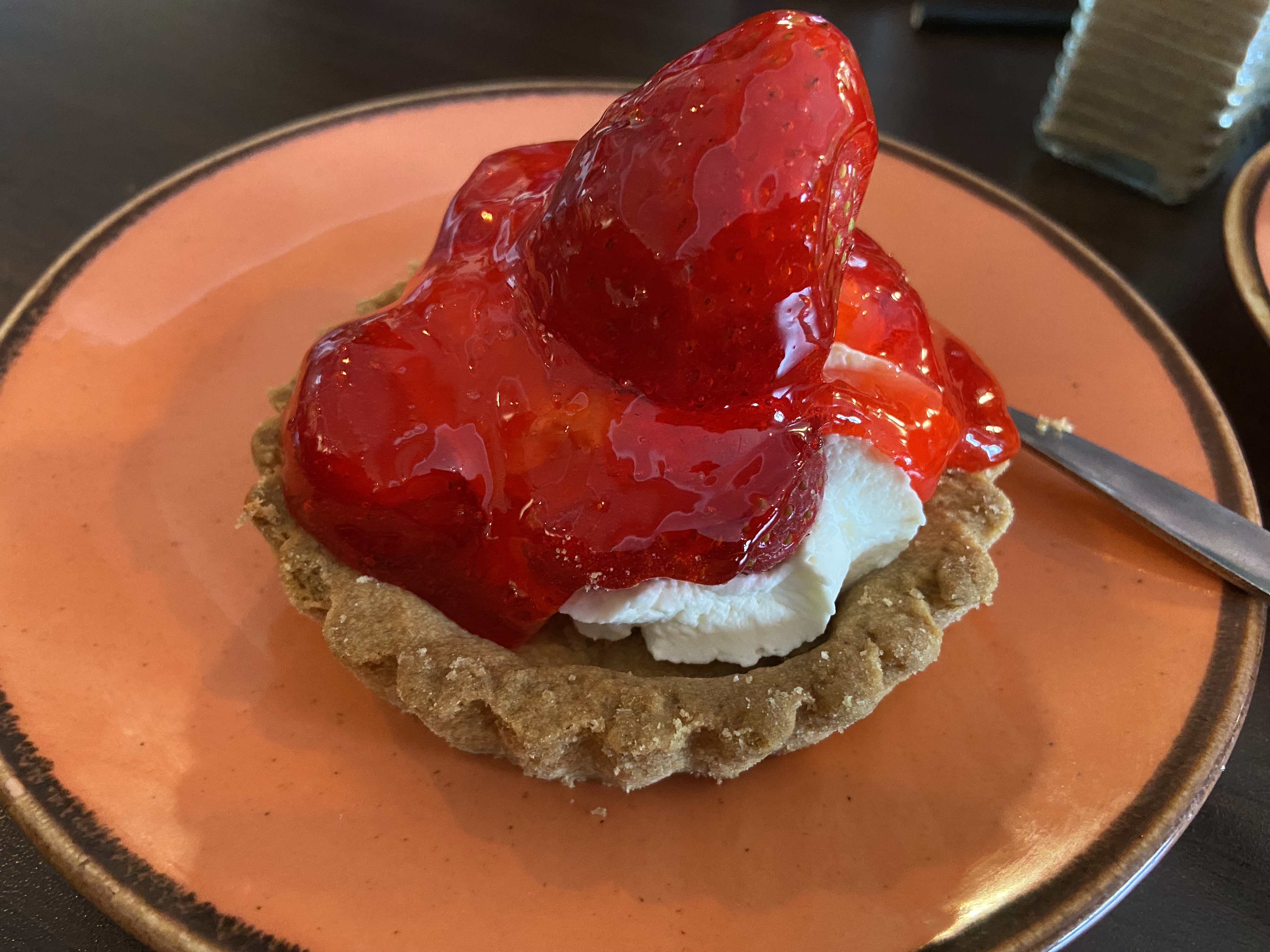
By the time we were done, I was very thirsty, so I decided to stop on the way back for a coffee from the garden centre where my card gets me free drinks. They have a selection of delicious looking cakes there and I hadn’t had any lunch. This time, my eye was caught by the cake at the top of the page. Described as an apple and carrot cake, with lemon icing and pistachio, I really thought I couldn’t go wrong. Moist carrot and apple cake, I thought, which would be tempered by delicious tart lemon to cut through any heaviness. Maybe the pistachio was a step too far, but such a delicious combination could surely not be spoiled, I thought.
I could not have been more wrong. My first advice would be never to buy the last slice of any cake. I’ve never experienced dry carrot cake, but somehow this one was dry enough to stick in the throat. The lemon icing and lemon curd, rather than being tangy, was cloyingly sweet. I genuinely took my first mouthful and thought I should leave the remainder, but if course, my finish-what’s-on-your-plate training kicked in. Reader, I ate the lot.
The last mouthful had something chewy in it, that I initially assumed was a thin slice of candied lemon. It took several minutes of chewing and a lot of hard swallowing, before I realized it was a slice of pretty much dried out apple, which still had the peel on. Driving on afterwards, I suffered some regrets at having wasted part of my precious calorie intake on something so grim, but the deed was done and … well I got over it. What else was there to do?
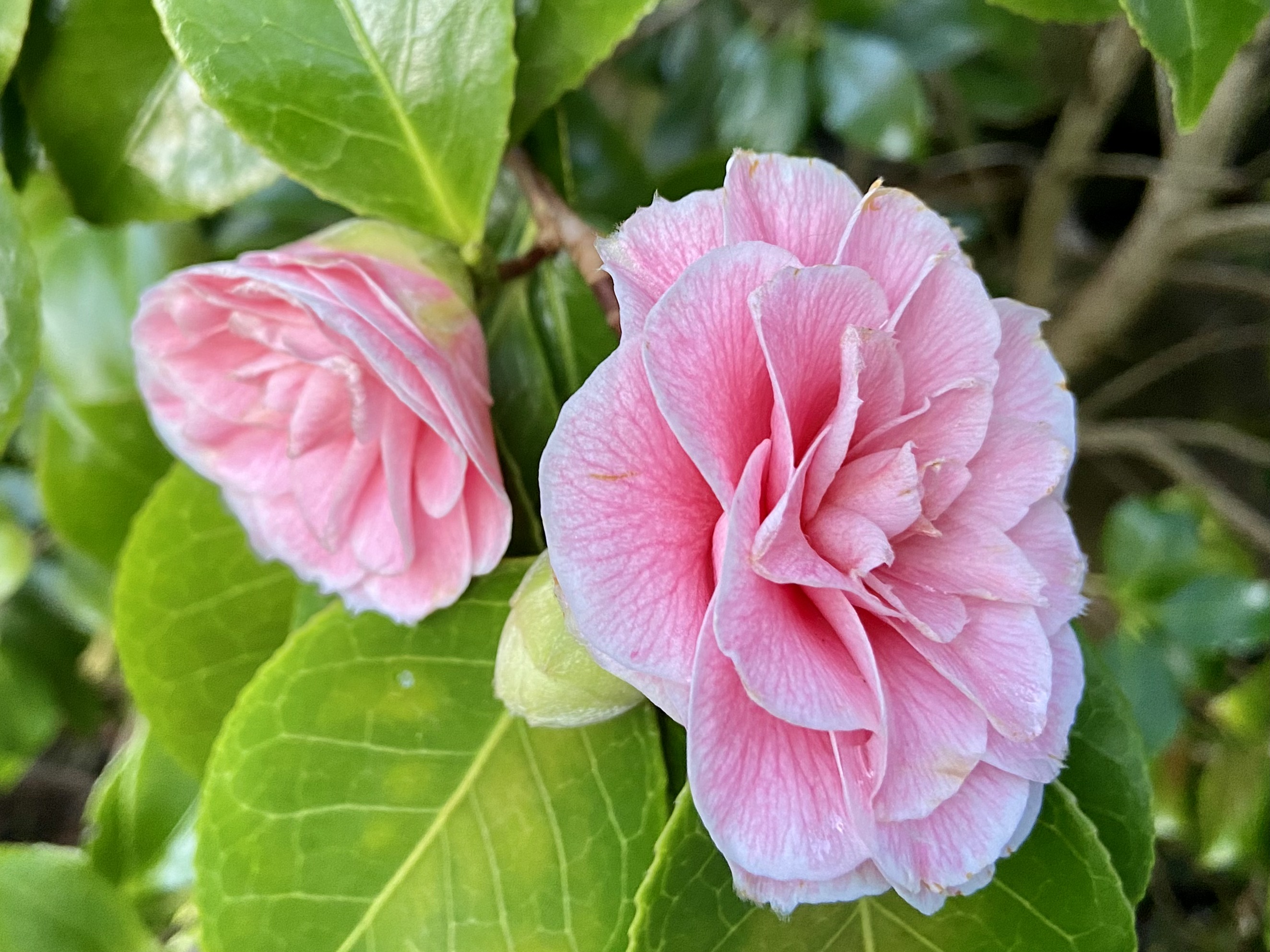
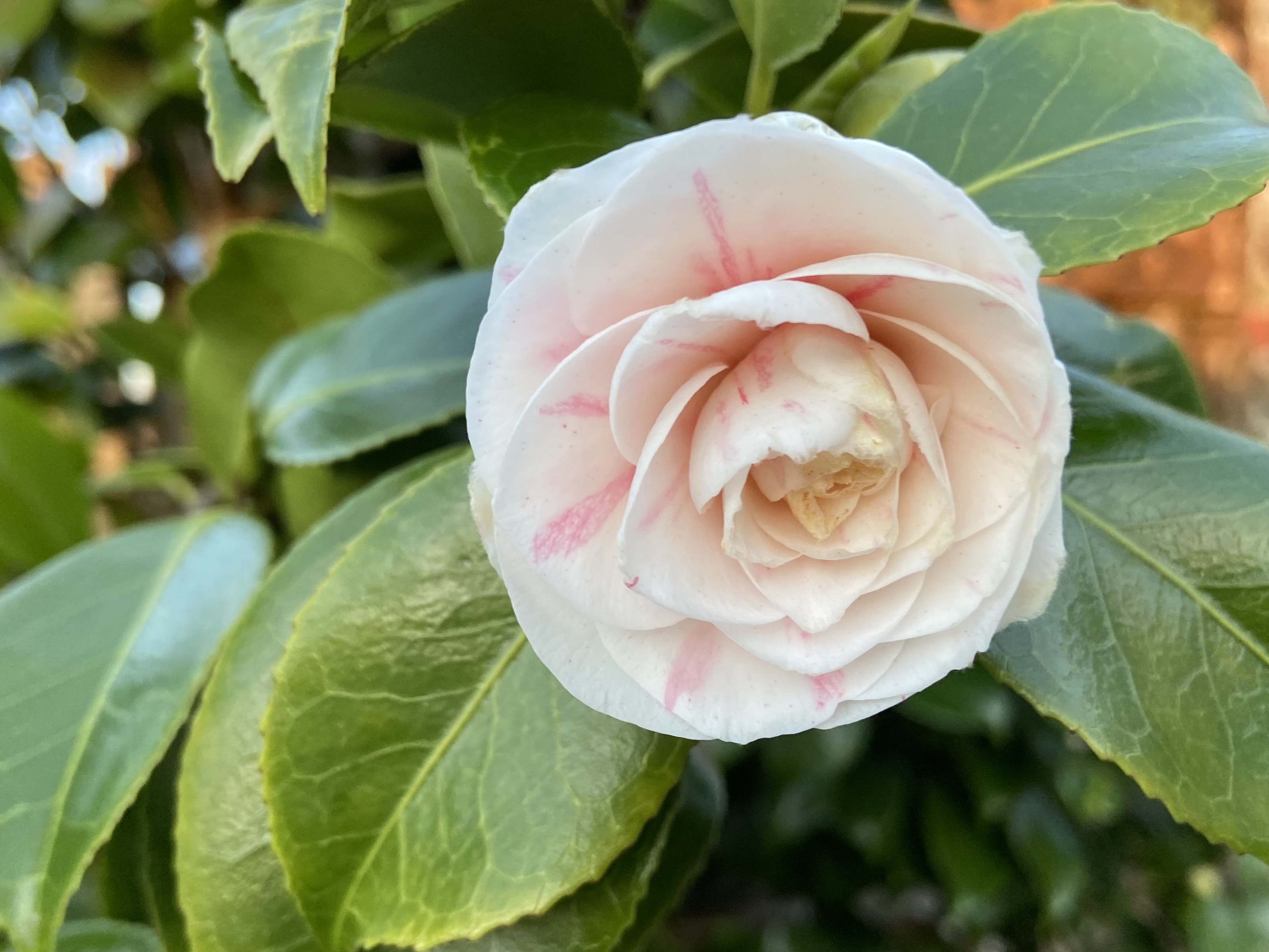
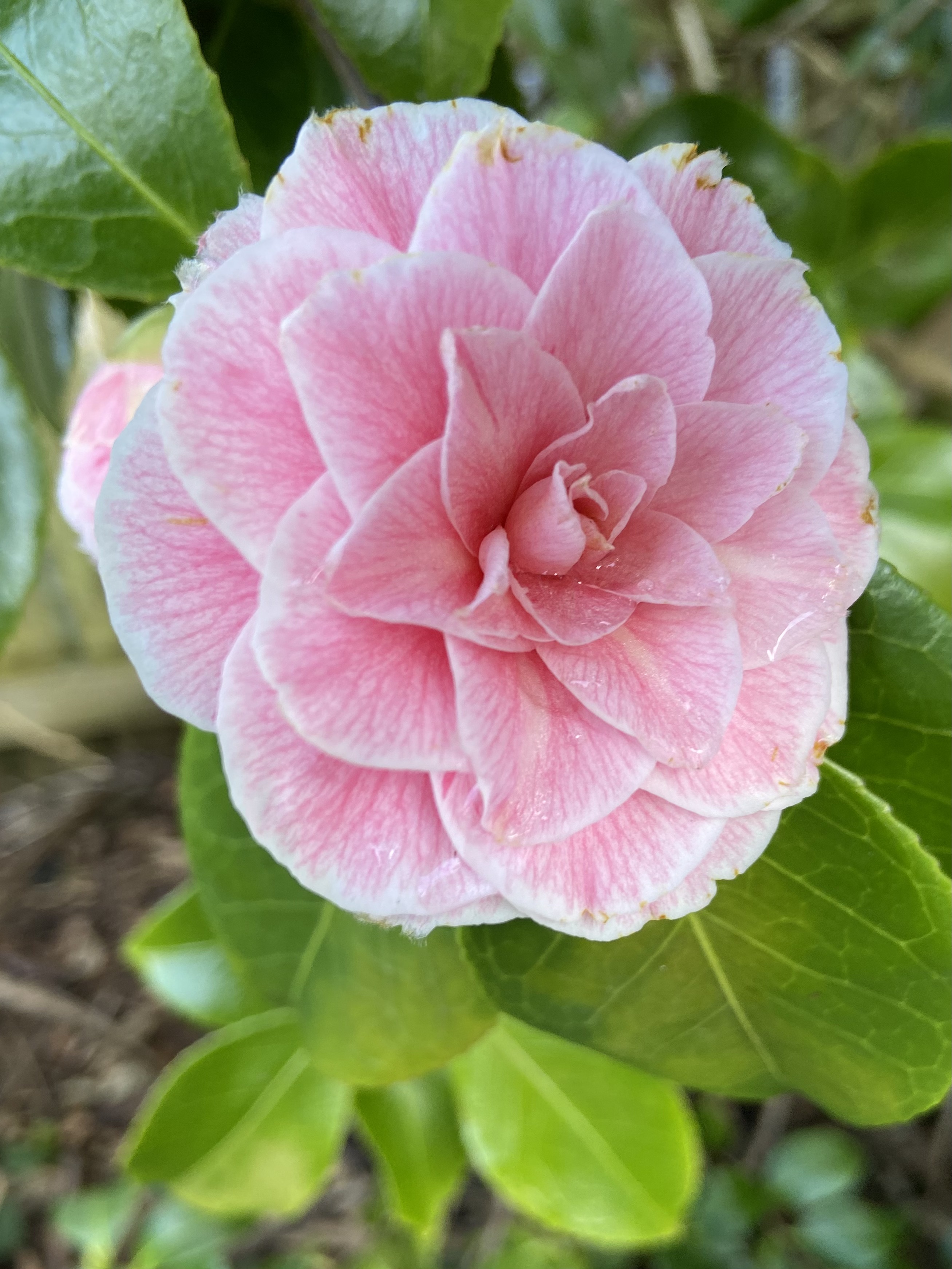
Spring is arriving properly in my garden. My camellia has so many buds on it that they are almost as prevalent as the leaves. The daffodils and crocuses are still glorious and I feel a warm glow when I look at them as I planted them in the autumn and this is my first real act of gardening. Today I have been out to try to buy some hardy geraniums which I hope will manage to compete with the overwhelming ground elder invasion in one of the flowerbeds.
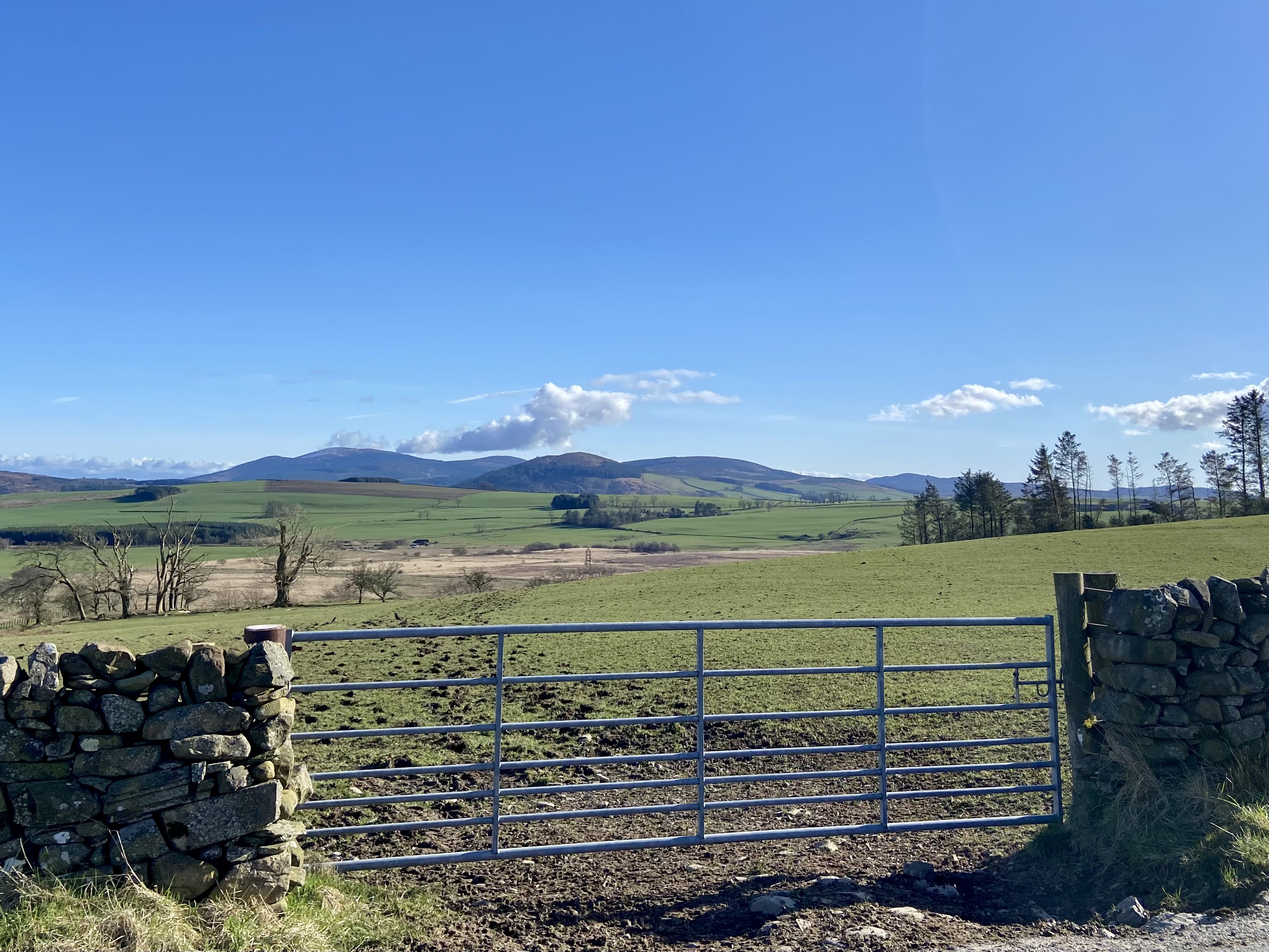
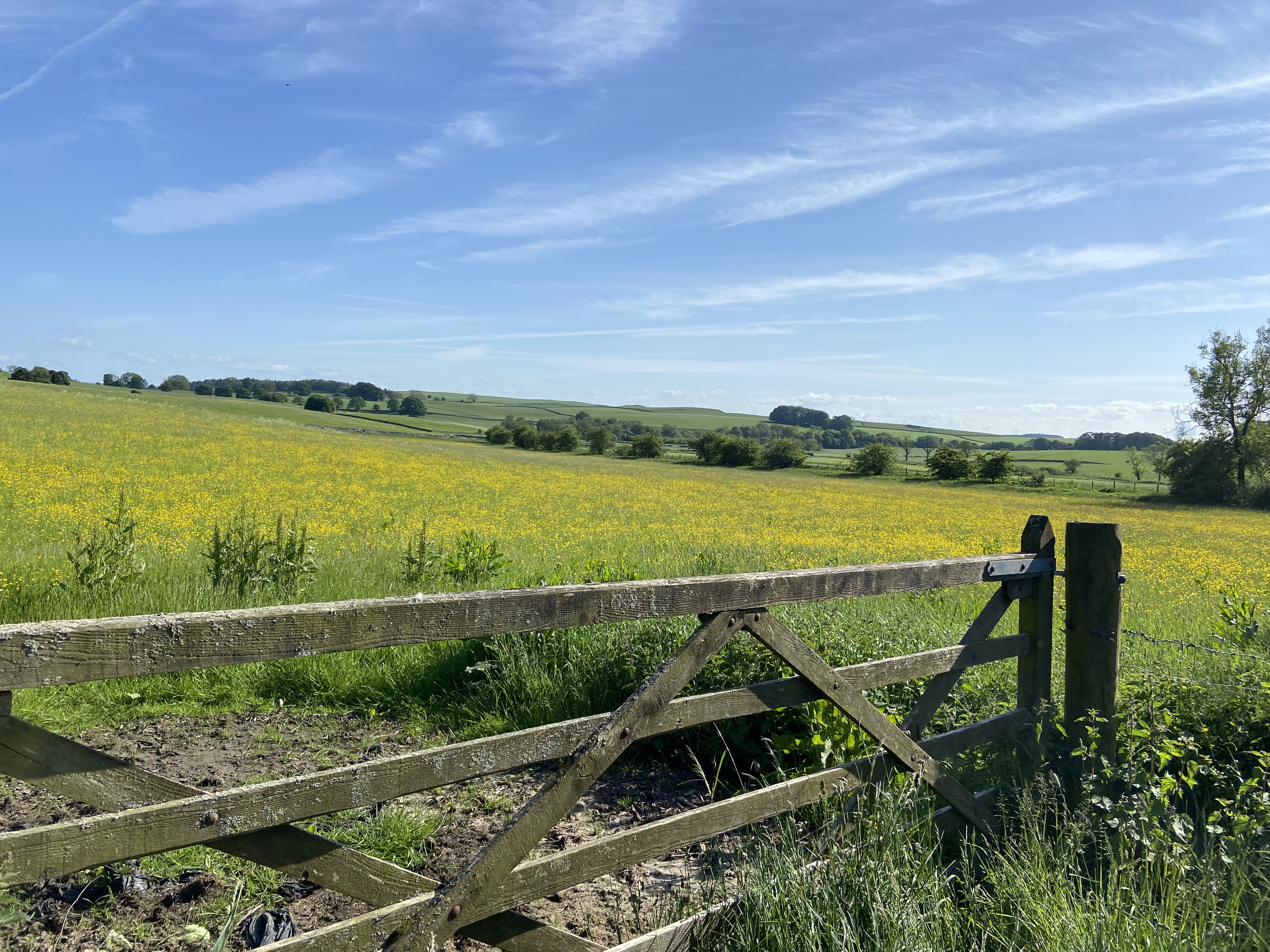
And now I’m back in Yorkshire for more house-move shuffling. One day we will get there, but for now, I will leave you with a typical scene from the gently rolling part of Dumfries and Galloway where I live. Have a lovely week all and thank you for reading.
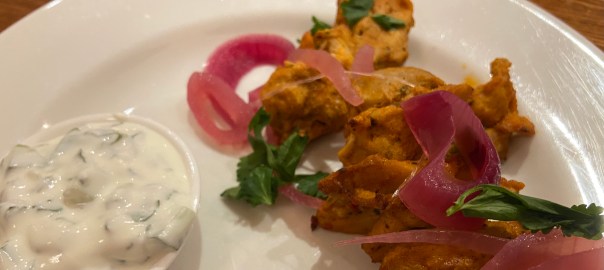
Another weekend is here, and looking back through my photos, most of them are of food! It would be fair to say that, when I’m out walking round a chilly farmyard all day, it is lovely to get back to a hotel, where someone else will cook for me. The picture at the top of the page was a starter – chicken skewers. I followed it up with sweet and sour prawns.
We were staying in the Premier Inn in Ayr, which was very pleasant. I know there are other staff who prefer to go out and find different restaurants to eat in, but for me the benefits of simply walking downstairs and being fed are too tempting to resist. Although the food is obviously mass prepared (it’s fairly consistent from hotel to hotel) I can usually find something I want to eat. I discovered the sweet and sour in Brighton and I would order it again.
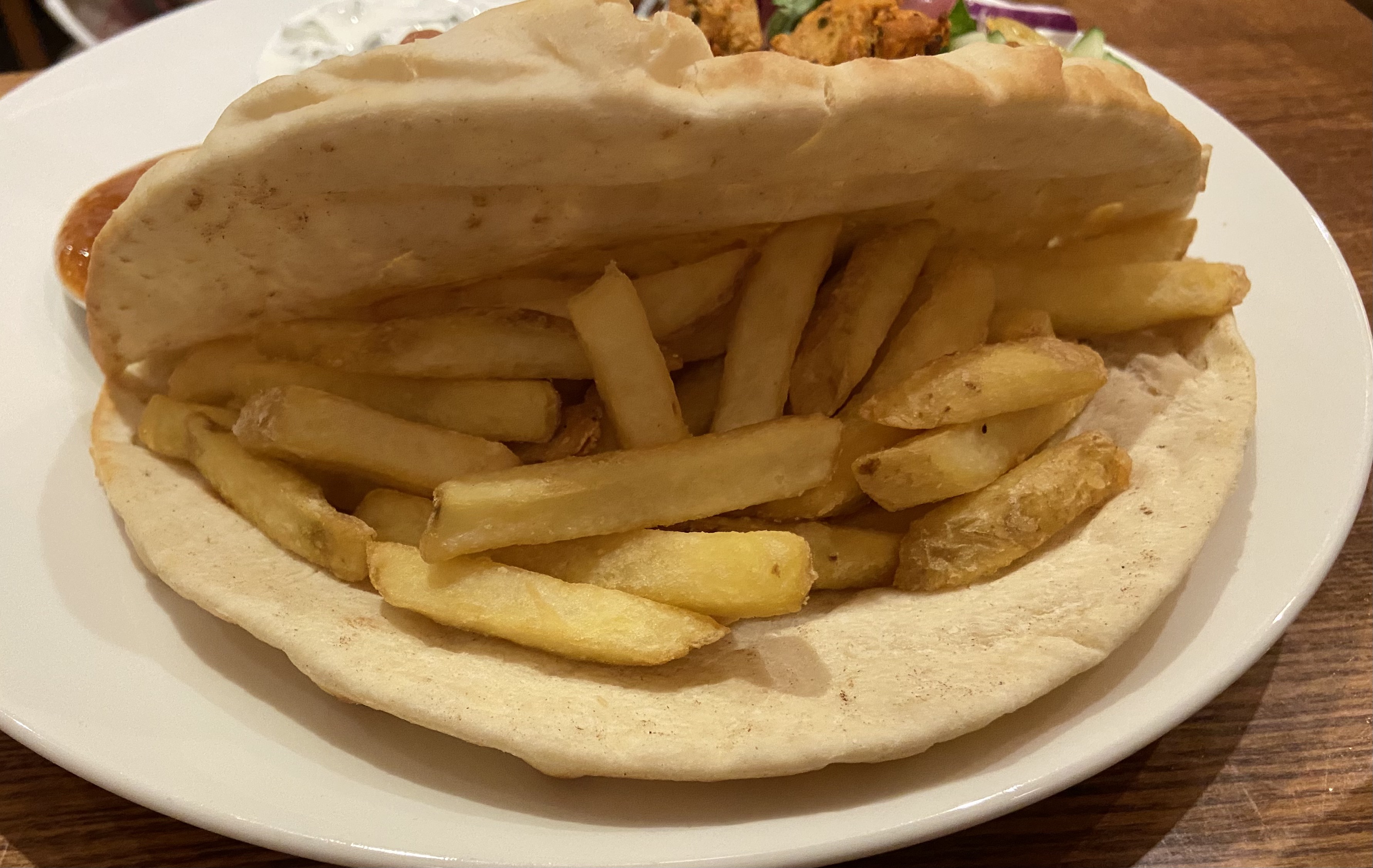
I had to laugh at Lesley’s (the animal health officer who had arranged the trip) main course. She had ordered the chicken skewers as a main. I saw it came with flatbread, but hadn’t twigged that there were chips too. What turned up was a plate of chicken skewers (pretty succulent and with that tangy yogurt dip) with a mega flatbread chip butty! Guess it was probably not much more carb overload than mine, with its white rice and sweet sauce, but it looked way less appetizing!
Lesley had booked the rooms and, for the first time ever, I had a Premier room in the Premier Inn. I was impressed to find both a fridge and a coffee machine in the room, though in the end, having tried to coffee machine with the small sachets of cold milk, I reverted to instant decaffeinated with lattes from the restaurant at breakfast. The little bars of chocolate were nice though.
The farm visits went well. We were blood testing the cattle for a TB Gamma test. The traditional test for TB has always been a skin test, where tuberculin (non infectious liquid, derived from the bacteria that cause tuberculosis) is injected into the neck, to see if it causes an immune response . While a positive skin reaction means it’s very likely the cow has tuberculosis, a non-reaction isn’t a good guarantee that she doesn’t have it. With the gamma test, some cows without TB might have a positive result, but it can pick up earlier infections and is more likely to identify animals with TB that the skin test would miss. We use these tests in combination where there is an outbreak, to try to ensure we get as many of the infected animals as possible.
Fortunately for me, we had a great team and I didn’t have to do too much of the testing. It’s a very physical job, either lifting the cow’s tail and taking blood from a vein that runs down the centre, or getting down on your knees and taking it from the neck. I did a lot of blood testing in the early years of my career because brucellosis testing was still routinely done in cattle, every three years. It seems it’s like riding a bike, because I can still do it, which is just as well because I was asked to step in a couple of times on animals where it was difficult to get blood. The relief when I managed was significant. As my main role was in supervising a new animal health officer who was learning, it wouldn’t look good if I couldn’t do it myself.
The bird flu outbreak is going on and on, though really February is possibly the worst month for it, so it’s not unexpected. I was duty vet yesterday and another two investigations came in. One of them sounded like a certainty, so it looks like our little team will continue to be busy in the coming weeks. I have learned a lot from my involvement last week, not least because I made some errors in case handling and didn’t collect anything like enough evidence for the tracings team. I had to go back and get additional information about exactly where manure had been spread from the farm, when feed had been delivered to each shed, where they got their bedding materials and when and to where had any carcasses been taken away, before the outbreak set in. On a big farm, there are a lot of comings and goings over twenty one days. I did gather the information, but I should have returned the day after I walked round the shed to look at the birds to ask a whole load more questions and to get copies of the paperwork showing all those interactions. Next time, I will have much better oversight. This is how I learn best. As well as being a huge farm, it was only my fourth ever investigation and my first to go positive, and so the steep learning curve goes on.
I had a lovely weekend with Valerie. As well as the hot tub, she introduced me to the addictive TV experience that is Traitors. We binge watched it and it was fascinating to see the damage done in a society when some are enabled and willing to lie and deceive and others (acting innocently) cause havoc and failure through their over-confidence in their skills and beliefs. Others yet, with unseen wisdom and less self-confidence, are ignored. I realise what we see is heavily edited to give a certain slant to things, but seeing the interplay when we know more of the truth than the contestants is very interesting indeed.
Anyway, I shall leave you with my one, single, scenic photo from Ayrshire. Scotland is very beautiful, even in the middle of a sullen, damp winter. Thank you for reading. I hope you have a good week.
I’m short of photos for this week’s entry. In addition to a photo drought, I’ve also been struggling for steps. To my amazement, following the unexpected plumber completion after months of waiting, I’ve hit the jackpot because James the plasterer arrived on Tuesday morning, all ready to go. He was here yesterday and said he’d be back this morning.
So with all that in mind, I had hatched a cunning plan to get more photos and steps before I started to write. James told me he’d be here at eight (even checking if it was okay with me to come so early). So, I thought I could go out when he arrived, take Triar for a sunrise walk (steps!) somewhere pretty (photos!) then as a bonus, I could go for coffee and cake at the garden centre and maybe write this there.
I was rather looking forward to all of that, but my plans fell through when eight a.m. came and went, with no sign of James. This isn’t unexpected. James is a lovely man, singing cheerily as he does a fabulous plastering job, but as I discovered last year, he’s also a bit unreliable. I don’t honestly mind. The job he does is great and he seems to prioritize getting my work done (all his kit is in my house, I don’t think he’s off doing work elsewhere) but planning ahead based on when he’s said he’ll come is a pointless exercise.
Still, I’m incredibly happy that the work in my house is finally moving forward again. Once the plaster has dried, I need some decorating done and a couple of electrical installations completing before I can thinking about frivolities like carpets and curtains. It’s probably not going to quite be finished for Christmas, but I had been starting to wonder whether I was going to have to find a whole new team and priming them to take over the project, so for it to suddenly be moving forward again is fantastic.
In equally good news, my car went in for its MOT and service on Wednesday and passed with no problems. Last year, it cost me £2,000 for things that should really have been fixed before I bought it, so I was nervous about finding myself in similarly expensive hot water, but I heaved a sigh of relief when I was told it was all okay. A month before Christmas isn’t the best time for big bills.
Work has been frenetic. When is it ever anything else? If you’re in the UK, you might know already that the bird flu season has started in earnest in England. Well this week, there has also been a case in southern Scotland. It’s not in my area, but it’s had a knock on effect on everything. All the vets in that area are now going flat out. I had to take over as duty vet on Thursday, and all the higher up staff, who usually act as advisors when anything complicated comes up, are embroiled in managing the situation. All the birds will be culled and, in the meantime, animals and birds within a ten km radius are under lockdown, so any movements on or off their farms have to be assessed and licenced.
In the meantime, with that as background, two of my long-term welfare cases are being wound up. By the end of next week, one more farmer will have gone out of business and the marauding pigs will (hopefully) have been removed. From an animal welfare and future work point of view, this is a good thing, but even as I have been putting the work in that will allow these things to happen, it’s been a sad experience. As I looked into various health implications of moving animals off the farm, I could see that in times past (and not so long ago) this has been a good farm, with high standards. How did we end up here, I wondered? Still, for both of the animal owners involved, I hope that as we help to wind up their dreams-turned-nightmares, that we can work as gently as possible and that it will bring relief and not further sorrow.
Only two more weeks at work and I will be on holiday. I need a break. Yesterday, for the first time in months, my FND twitches came back. Not that surprising. Duty vet on Thursday was exhausting with two calls about possible bird flu cases (fortunately negated during the calls, without having to trigger a full report case investigation) and various other tasks, all hitting at the same time. I’m intending to take it easy this weekend, but as a minimum I want to trim the hedge at the bottom of the garden, at least enough to fill the brown bin for its last emptying of the year. But that’s a task for later. James has arrived, so it’s time to head out for that walk and coffee.
Firstly, a disclaimer. The sheep in the photo at the top of the page are random Norwegian sheep and are in no way related to any invest
Last week’s blog was a week late because I received a phone call as I was writing it. Two weeks ago, I was on call for the weekend and hoping to rest. Most on-call weekends are a matter of keeping your phone near you, maybe dealing with a request by a private vet for a case number so they can go out to test a cow that’s dropped dead to check it wasn’t anthrax or a similar request for itchy sheep that might have scab.
This time, to my surprise, I found my line-manager on the phone. “How would you feel about another report case?” he asked. Well how I felt was broadly irrelevant. I was the ready-to-go vet, so unless I was seriously unwell, it was my task to be handled, whatever it was. “Another AI?” I ventured.
”Um… no.” He paused. “We’ve been sent photos of lesions from some sheep’s tongues. They’re trying to decide whether to treat it as a bluetongue enquiry, or foot and mouth. This isn’t your official call, just a prewarning so you can start to prepare.”
Once the official call comes in, you are expected to be on the road within 30 minutes. In theory, everything should be in your car and you should be able to get in and go. In reality, there are things you might need for sampling that have to stay in the fridge in the lab at work. The buffer solution used for foot and mouth sampling is one of these, so I was glad for the heads up.
I admit, I did feel slightly breathless. Those living in the UK who are old enough to remember 2001 will recall the horrors unleashed on the country as whole farms and regions were forced to cull their livestock and burn them in the fields on horrific pyres of death. The recent, sporadic outbreaks in Europe mean we are on high alert. That the photographs sent in had the high heidyins in a nine am meeting discussing whether they dared risking treating it as “only” blue tongue felt quite significant.
I dressed and went into the office and started to gather paperwork. In theory, I should have paperwork for every eventually in my car, but having the appropriate papers to hand for setting up restrictions is useful. To my mild consternation, I found the main printer wasn’t working. Thanking my lucky stars that I wasn’t a newbie and knew how to work the secondary printer in the lab, I printed out what I thought I’d need.
I also threw a load of blood sampling equipment into my car. Better to have too many tubes than to create the necessity for someone else to come out and onto a farm with possible foot and mouth because you weren’t well enough prepared.
It was quite a long drive out to the farm. As I neared the farm, I slowed down to cast an eye over animals in the nearby fields. None were drooling or looking sick. A good start.
It had been confirmed that I was to treat it, for now, as bluetongue, but that foot and mouth was still there as a possibility. To explain the difference in requirements, because bluetongue is spread by midges, tramping on and off the farm with dirty boots and tyres isn’t so much of a worry. Not that I do that, but if I did, it’s not a disaster.
The restrictions served on the farmer are different too. Bluetongue restrictions only stop animals coming and going. Foot and mouth suspicions, like avian influenza suspicions, mean that every person and vehicle going on and off the farm has to have an individual license and any and all incursions are strictly limited to absolute necessities.
I arrived at the farm , put on paper suit and gloves and served the restrictions. It’s always the first thing to be done and having signed the form, I read out all the clauses that explained in full what was required. Next was history taking.
This is not like taking a history for a normal vet case, where you mostly want to know what has happened to the animal. For a notifiable disease investigation, by the time you are finished, you should have details of every movement on and off the farm within the last twenty one days. You have to assess whether there are any high risk factors. Are there rights of way and picnic sites where people might have fed the animals? Has anyone from the farm recently been on holiday to a different country? Are there stagnant ponds in the vicinity that might encourage midges? The factors, like everything else, vary with the disease suspected.
Having taken a careful history of the animals and the risk factors, I donned more layers of PPE and prepared to look at the animals. I knew, both by being told and by observation, that there were fields nearby that held another farmer’s cattle. I decided to walk up to look at them first. If it was something highly infectious, they might be showing signs too. Again the picture was reassuring. They were young stock from a dairy farm and could not have looked more healthy. They were eating as we approached, then lifted their heads to look at us. Not a nose lesion among them. Nolameness, no drooling. Bright eyes and shiny coats.
I was already, mentally, beginning to think foot and mouth was less likely. Obviously there were still the sheep to look at, but clinical signs in sheep can be subtle, cattle less so. These animals had been in relatively close contact, so by the time the mature mouth lesions were spotted in the sheep (with the caveat that it might have been caught early) I would expect to have seen some spread.
There were two groups of sheep – adults and lambs. The lesions in the photographs, nasty red eroded areas on the tongues, had both been from lambs. We therefore looked at the adult sheep first, partly to prevent any possible cross-infection, but also because a complete absence of problems there would go further towards ruling out foot and mouth. No reason why young sheep would be more severely affected than the old in a disease where neither group would have immunity.
What struck me again was that I was looking at a broadly healthy group of animals. There were 43 ewes and as I scanned their mouths, feet and udders (where possible) I saw nothing. Only bright, uncrusted eyes and alert ears. There were two that the farmer had noted had been getting thin for a while. We selected them out and I examined them more closely. Not a lesion in sight. Normal breathing, normal temperature. One was a bit dirty on her backside, but nothing to suggest foot and mouth or bluetongue.
We moved onto the lambs. This time, I decided we should examine all of them. There were thirty two in the group and the farmer caught each one and held them while their mouths and feet were inspected. In the end, there were four with tongue lesions, four with lesions around their lips and one with a sore area above its foot. None of the lambs with lesions was running a fever. I was strongly beginning to think that what we were dealing with was a severe case of orf – a pox virus that affects sheep and can infect humans who come in contact. It would be unusual to have tongue lesions, but not impossible.
Having taken history and examined the animals, it was time to decide where we were going to go with this. At one extreme, if I thought foot and mouth was still in the picture as a possibility, we would have to issue new restrictions as well as taking samples. I might well have to stay on the farm until it was ruled in or out. I’m still a bit sketchy on the details, though I had arranged for Triar to be looked after, just in case.
If I thought everything was ruled out, I would leave the farm with no tests done and hope I’d got it right. To do that, I’d need to be very certain. My gut feeling was that this was orf, based on the fact that it was only affecting the lambs. Orf is common and spreads in flocks to the new crop of animals born each year. Older animals can carry it, but usually have enough immunity that there are no clinical signs.
So on the grounds that only the lambs were affected and the adult ewes and neighbouring cattle were perfectly healthy, along with the fact that all the lesions were quite mature and I would have expected to see more early stage lesions (we have lectures about aging foot and mouth lesions) I felt confident enough to rule out foot and mouth (phew!). But could I rule out bluetongue too? I decided I couldn’t . After all, midges might well have selectively bitten the lambs with their thinner wool pelt. And orf might exist alongside bluetongue. The lip lesions could be orf and the tongue lesions something else.
And so, armed with my evidence, I called VENDU (the veterinary exotic notifiable disease unit) to tell them what samples I wanted to take. I have never been asked so many times and in so many different ways if I was sure, 100% certain, absolutely confident that I could rule out vesicular diseases like foot and mouth. At the start of the conversation I was using words like probably, but by the end, I was telling the, firmly that no, it was not foot and mouth.
So we tested the nine lambs for bluetongue: the four with mouth lesions, the four with lip lesions and the one with the foot. To cut a long story short, the test was negative, but most of Sunday was still spent on paperwork. I strongly suspect all the lesions were caused by orf: an unusual and interesting case all round and a good learning experience for me.
Lots of text so far and not many pictures, so I shall rectify that. Last weekend, I went to Drumlanrig Castle and met Sue (who used to locum with APHA) for a walk and for lunch. The gardens were beautiful.
Isn’t it warm? It’s not yet seven thirty as I write this, but Triar and I have been out for our walk early. We stopped to have a chat with some heifers in a field (we stayed outside the gate) which is the high point of our day so far! Aren’t they gorgeous?
I came down yesterday as I had a dentist’s appointment to get a filling. I intended to come down on Thursday evening, but was unexpectedly offered a cancellation appointment to see a neurologist, so of course I jumped at the chance. As the occupational therapist at work wanted, he has given me a diagnosis – FND, which I’m guessing most people haven’t heard of. It’s described everywhere as being “like a software problem and not a hardware problem”. Basically they can’t see anything wrong on a battery of tests, but it fits certain criteria.
I’m still trying to process the ramifications. The tests I had were years ago and he hasn’t sent me for any new ones. With hindsight, I’m not sure we talked enough about what’s happening now and how it will be fixed. Back in Norway, I maintained fairly good health for three years, by resting properly when I needed to. He’s going to write me a letter to take to occupational health, so I will see what it says.
But overall, I think it’s good. On examination, he didn’t find anything new or particularly significant. He seemed certain there wasn’t a degenerative disorder. Having spent years looking up my own symptoms (don’t do this!) I had myself thought FND was the closest fit. Back in 2017 when this all began for me, I found almost nothing online about it. Now the internet is awash with information. It is, I feel the neurological disorder du jour! Hopefully I can find a way to manage it better than I am at the moment. I’m still working full time and doing a good job. I’d just like to have more energy to do things when work is over.
In other news, I’m getting through the paperwork mountain, though the dreaded Framework Agreement still needs some work. I’m giving training sessions next week, on Foot and Mouth disease, to some local authority inspectors on Tuesday and on the Disease Risk Form (investigation) during TB outbreaks to my fellow Senior Veterinary Inspectors. My boss, Dean, has a case lined up for me when those are done and there is some chicken work starting from July, so plenty to keep me going. I may be easily tired, but I also don’t like twiddling my thumbs, so it’s all going right at the moment.
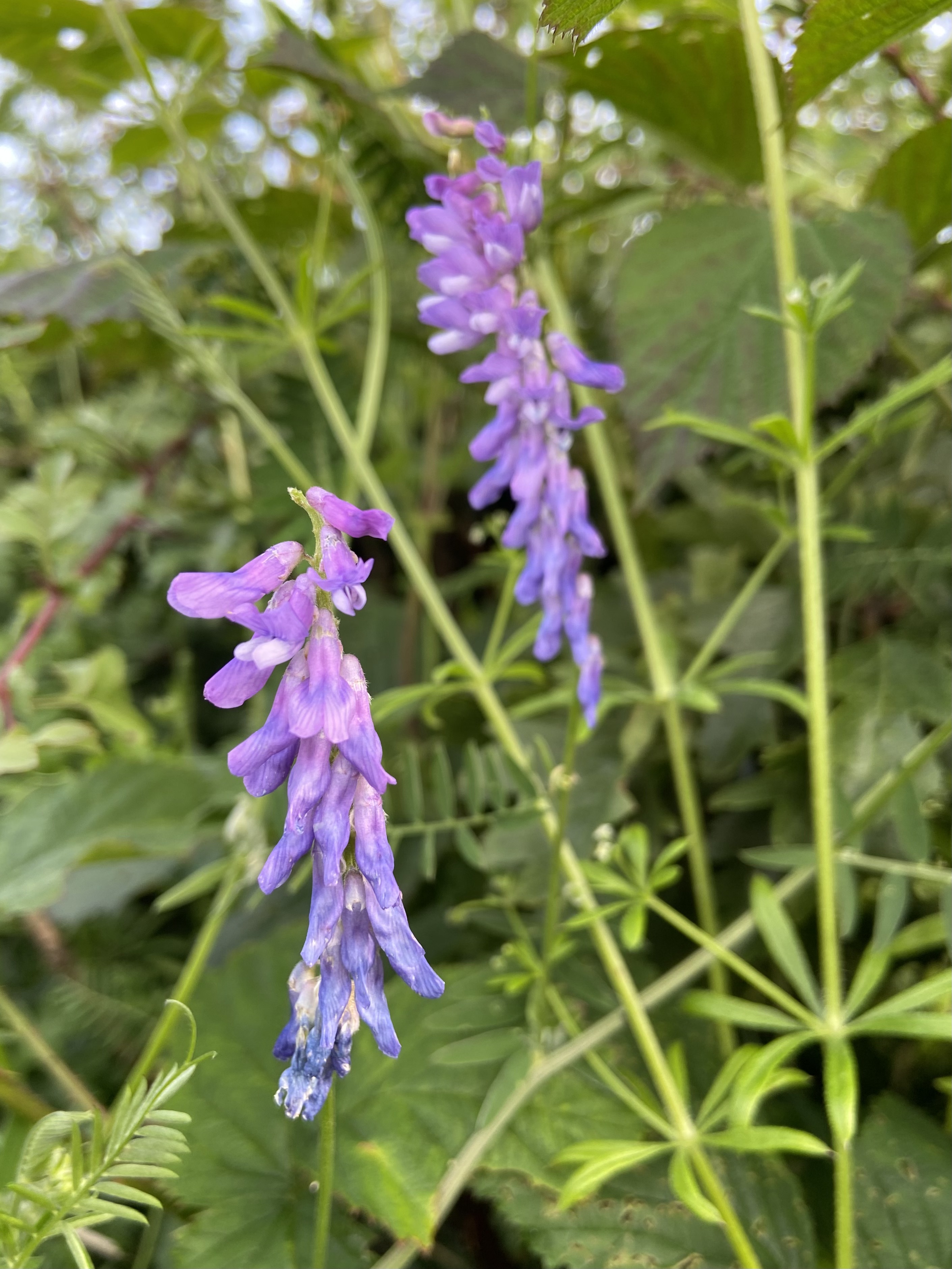
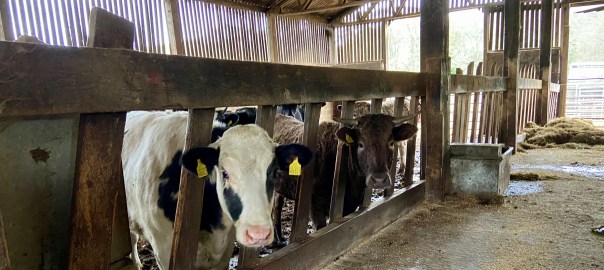
I shall leave you with some more cow pictures and maybe some flowers too. Blackbird Lane is wonderfully overgrown and tangled at the moment, with wildflowers peeking out all over the place. And now it’s time to go make breakfast, so have a good week all, and thanks for reading.
I went back, both to work and to the doctors’ on Monday. The GP I saw was helpful. He was young and I think may have been in his foundation years as a GP, but he took the time to do a fairly thorough neurological examination. I was laughing to myself afterwards as I’ve had so many of them that I could have told him a couple of bits he’d missed, but he found a few things, at least one of them new.
He told me he will contact the neurological department at the hospital, both to ask them to reassess my triage as urgent and also, to ask if there’s anything that can be done for me while I’m waiting. It will be interesting to see if I am now seen earlier than July. I don’t know when he’ll get an answer to the other question.
So I’m not as fatigued as I was. I am managing to do some things again that had more or less come to a halt, like cooking and tidying the kitchen afterwards. I even took myself upstairs yesterday and did a bit of painting in the bedroom, but the energy I had quickly drained, as it did when I tried to do a veterinary risk assessment yesterday morning.
The veterinary risk assessment (VRA) I have to do is an assessment of the possible consequences of moving cattle from a farm where there is no TB present, to one where it has been confirmed.
This particular VRA is a bit of a wildcard because TB hasn’t been confirmed yet. We are waiting for the results at the moment (they are trying to grow bacteria in a Petrie dish from lesions found in the lungs of a cow that was slaughtered) and they won’t be back until mid-March. The cattle that need to be moved onto the farm are young stock (heifers) which are being wintered on a different farm. They are due to calve in mid-April. If the culture is negative, restrictions will be lifted and heifers can move to the dairy unit with no problems. If it’s positive, the restrictions will remain and we will need to move quickly.
In order to complete the assessment, I will look into all kinds of factors, including how high the risk of spread is. For example, are there cattle on neighbouring farms and how likely is it those cattle have had nose to nose contact with cattle from the infected farm? What are the potential costs to the government? For example, moving a lot of cattle onto the farm might mean the government has to pay compensation later, if those animal become infected.
And there is an absolute requirement to carry out a short interval skin test (SIT) before any cattle can be moved onto the farm. TB is a slow moving disease sometimes. A cow can be infected for years before it is spotted. When we confirm there are TB bacteria on the farm, we have to check, via the SIT whether we have one infected animal, or many. Until we’ve done that, it’s impossible to weigh the risk.
So if we get a positive culture, I will need to be ready with the SIT and the VRA so we can move quickly. There’s nowhere to calve those heifers and nowhere to milk them, where they are, so they need to go somewhere, on welfare grounds. I find this part of my work very interesting, but with so much cross-referencing of data, I need to be on the ball. Hopefully I can get more of it done in the early part of next week. Big welfare case is also due a revisit though, so we will see!
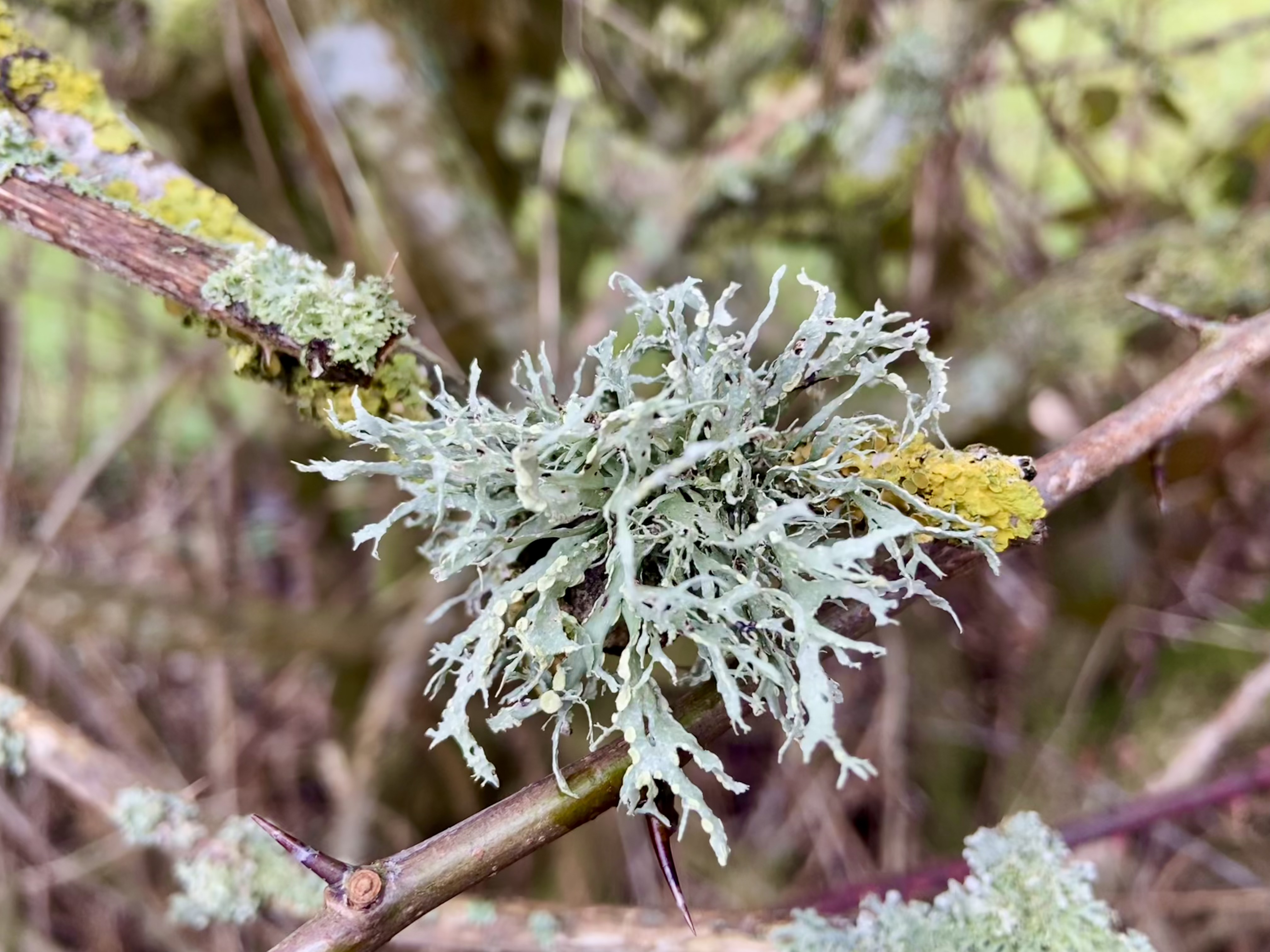
I don’t have so many photos at the moment. I’ve not been out walking or exploring much, though I took a couple of pictures of colourful lichen in Blackbird Lane, which I will share with you.
Taking time to look closely at the nature around me keeps me sane! A few minutes ago, Triar was whining, so I took him outside and stood in the semi darkness, listening to the most wonderful dawn chorus. There were robins and blackbirds and a song thrush, all greeting the new day. Triar stood and listened too, as he sniffed the morning air. I wonder what he could smell.
I saw on Facebook that Norwegian ships from WW2 are coming to Shetland the week I am there. I was oddly emotional when I saw that, hoping I can speak to the sailors who bring them over. I found a rock beside the Nith (which runs through the middle of Dumfries) commemorating the connections between Dumfries and Norway in the war. Funny how things come together sometimes.
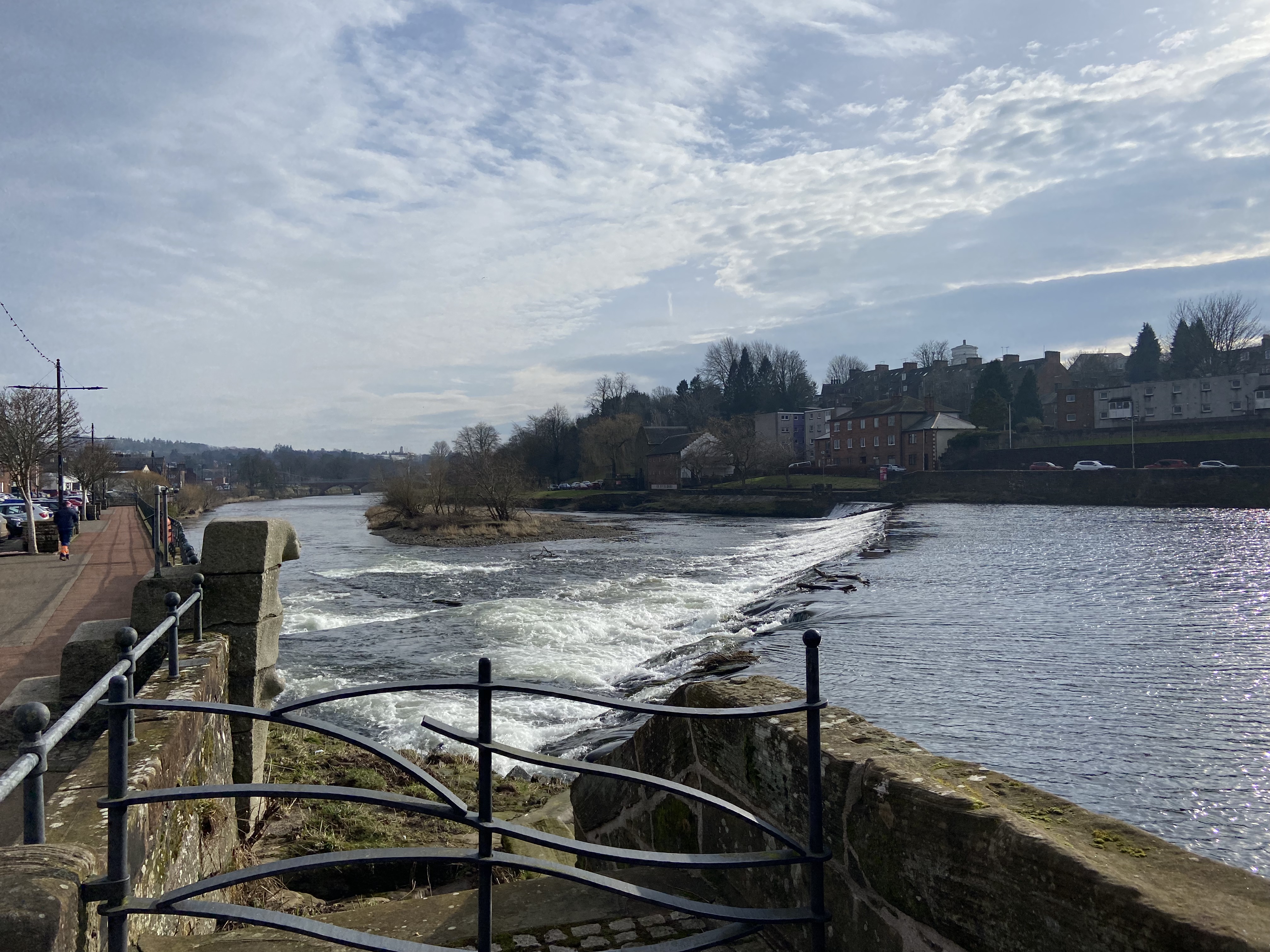
Anyway, I will leave you with photos of the stone and the Nith itself. There were flood warnings in place last night, but midweek, when Triar and I took a walk there, it looked benign enough. Triar photobombed the rock shot, but I’ll not crop it! Have a good week all!
A Sunday afternoon entry this week. Yesterday Mum, Dad, Triar and I travelled to Teeside to a farm stay cottage. It’s a lovely place with cosy stone houses and stables, a cobbled yard and plenty of animals. I took Triar for a tramp on the moors at seven thirty this morning and we came home hungry for breakfast. Morning coffee came later. The cheesecake looked delicious, but having been mostly off sugar for a few months, it was a bit too much. Next time, it’ll have to be a cheese scone instead!
The farm is gorgeous! It’s also a lovely novelty to be able to take pictures without worrying that I’m giving away classified information. The owners are very friendly and, with permission, we explored the farm this afternoon.
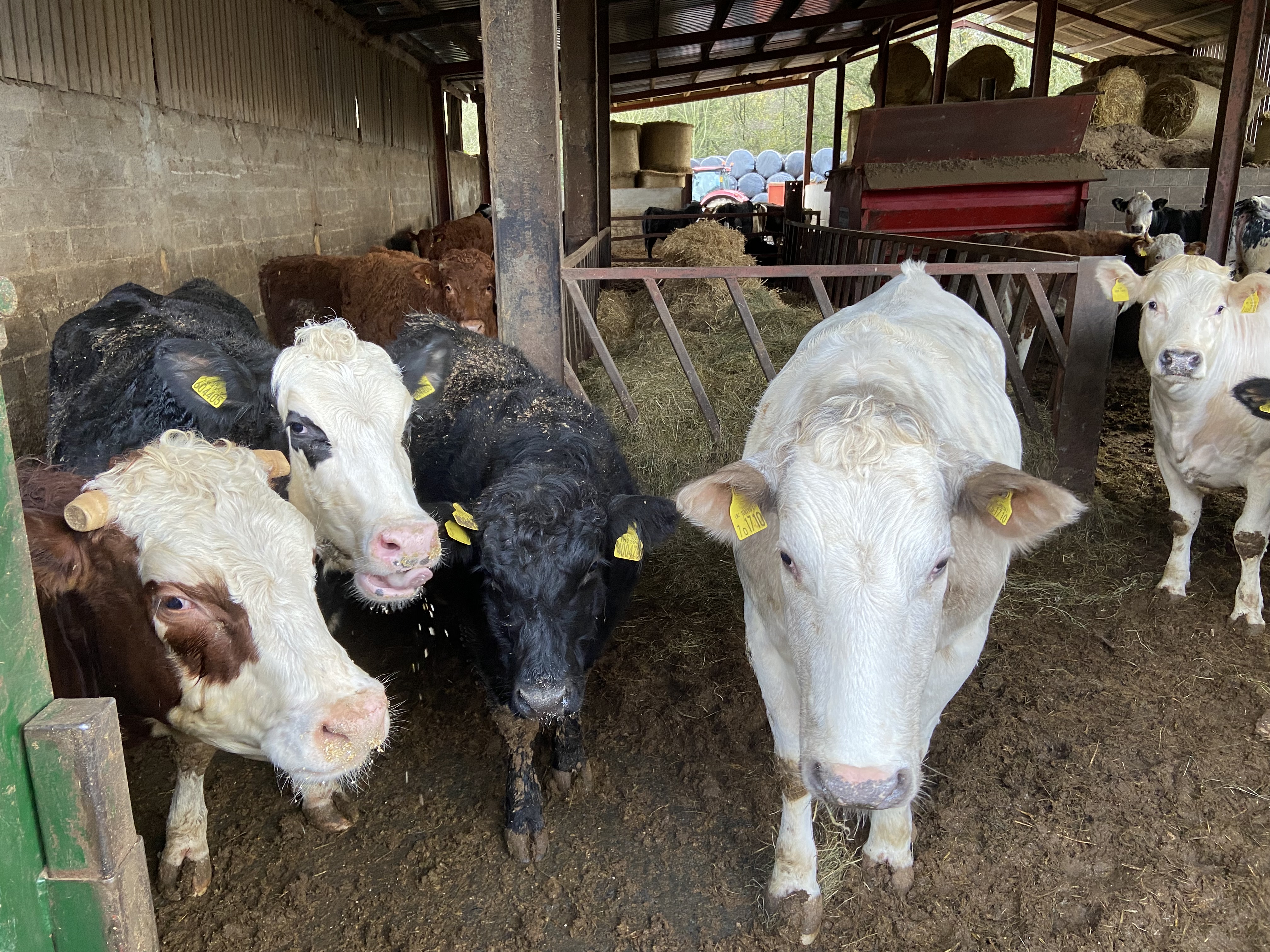
As well as finishing cattle…
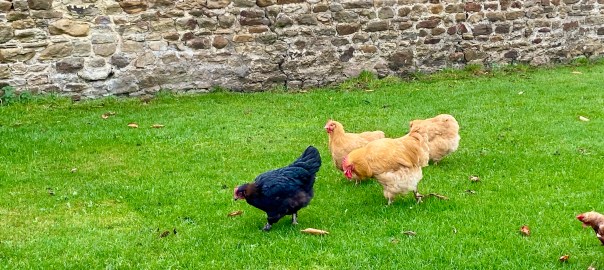
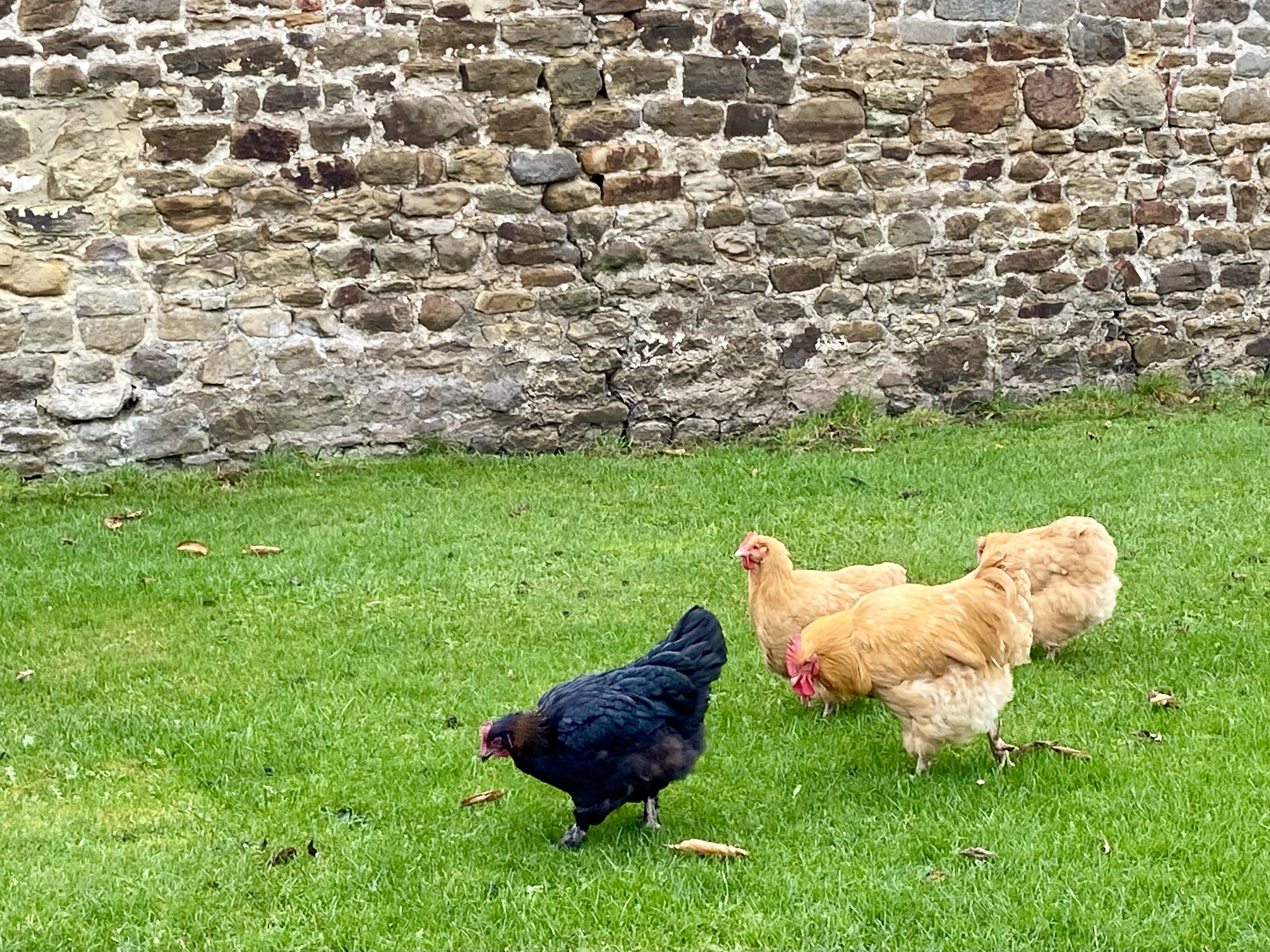
…there are chickens…
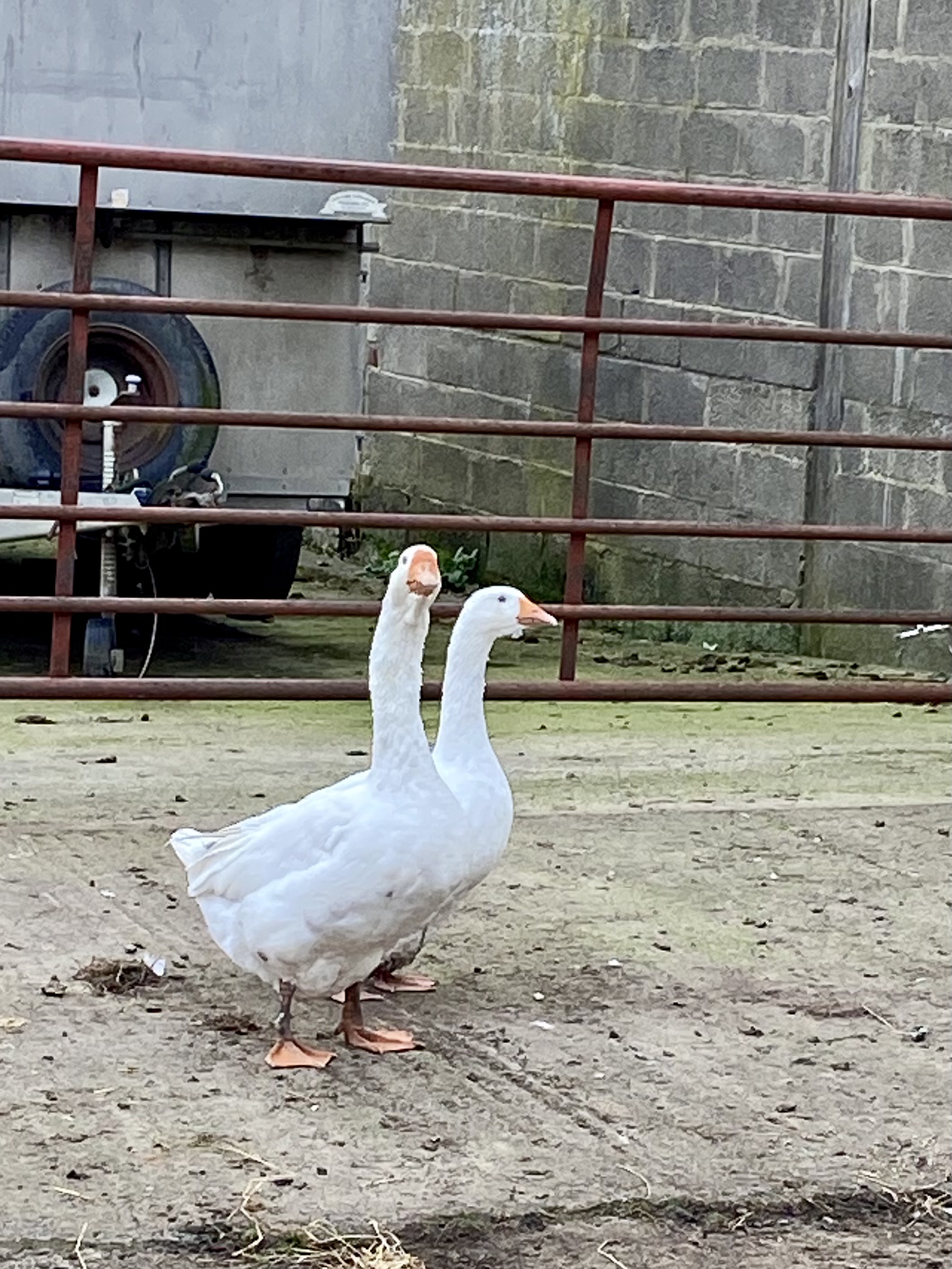
…a traditional brace of guard geese…
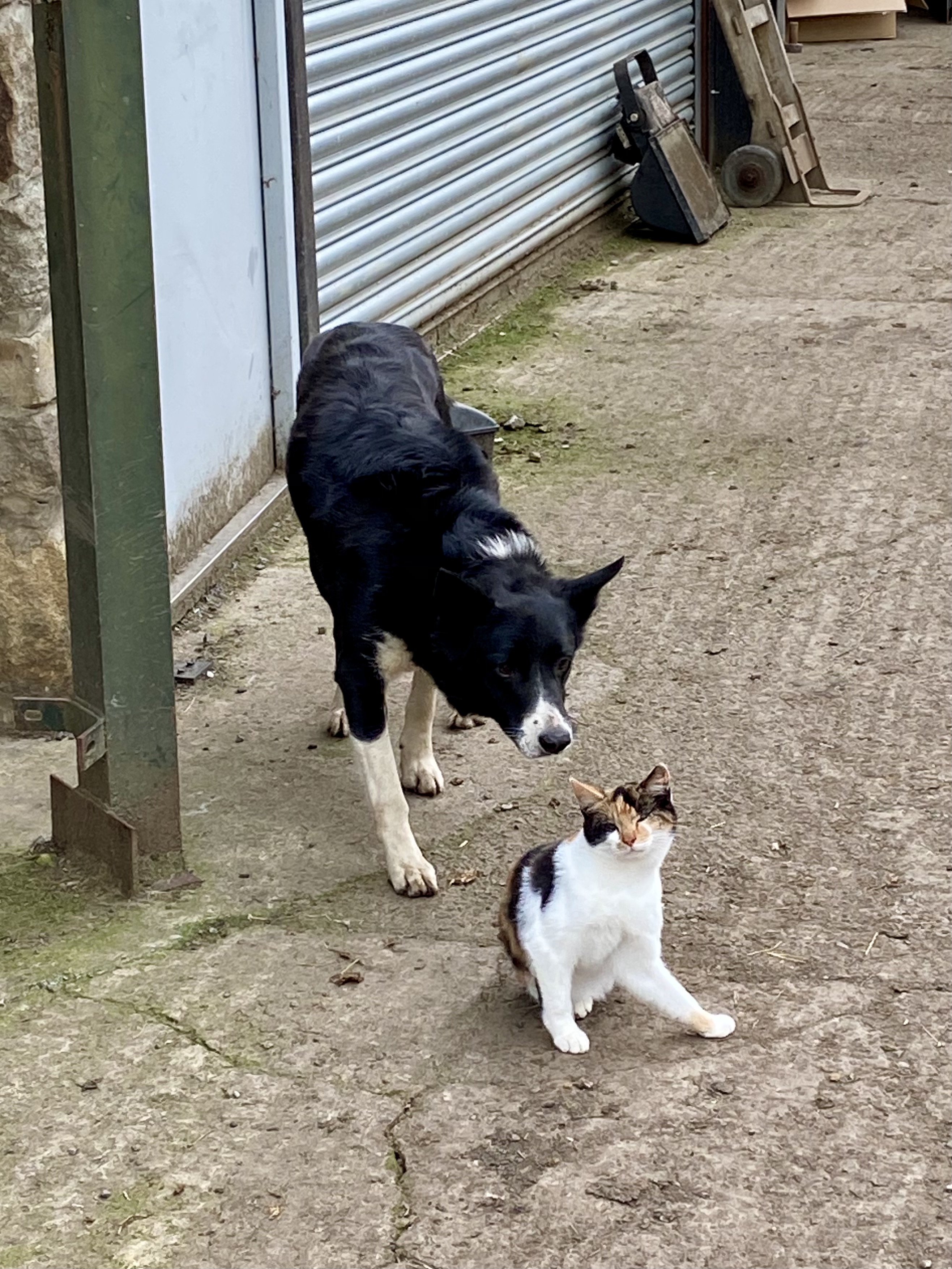
…and a collie that never got the memo about herding cats.
To be fair, I’m not entirely sure this cat is taking this game seriously.
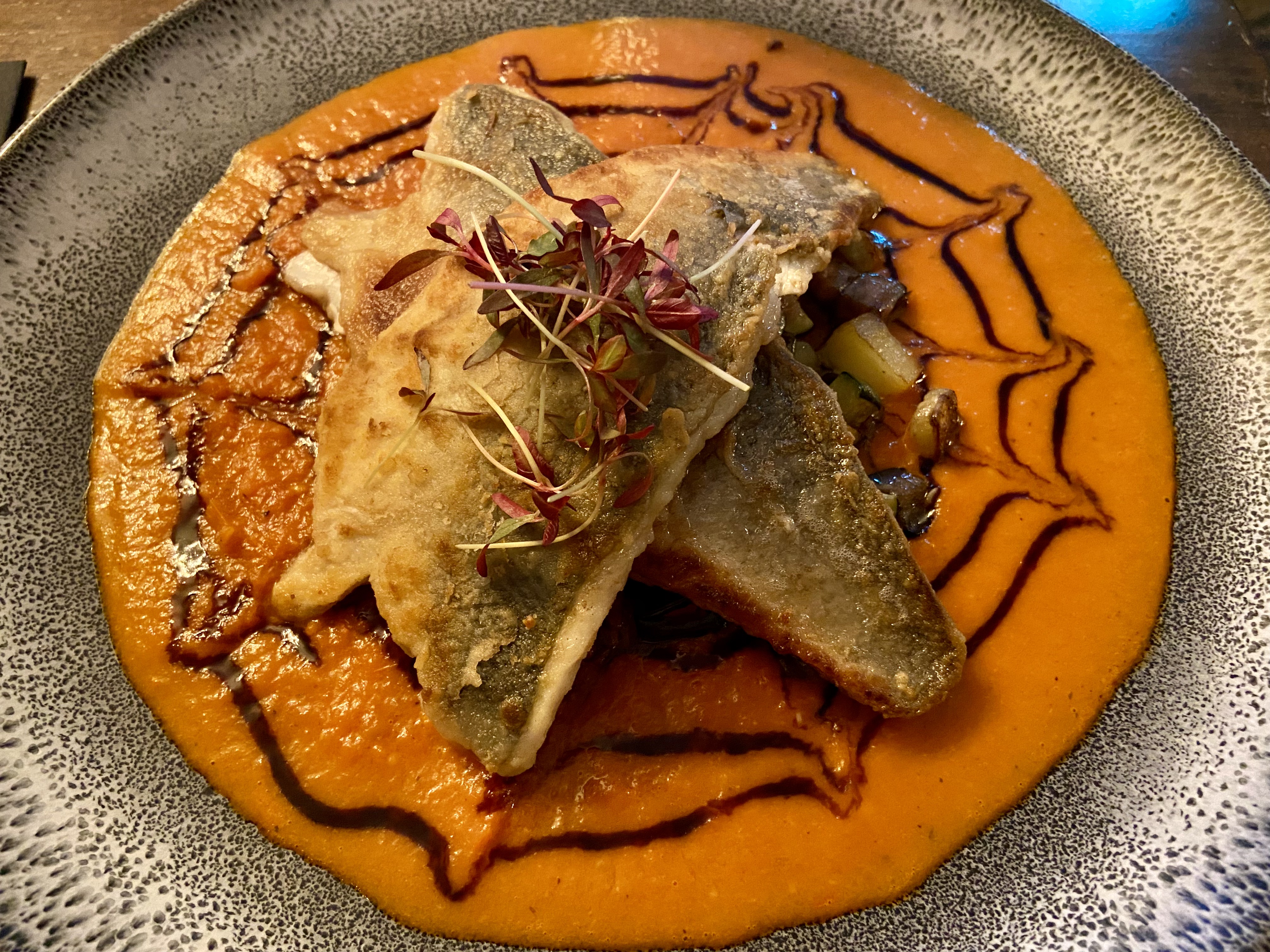
As you can probably tell, I’m enjoying my holiday so far. We stopped at The George for lunch yesterday. It’s a 16th C coaching inn, though I suspect the food styling has changed a bit in the intervening centuries. Who knew that Halloween themed fish would be a thing?
I selected the delicious sea bass with roasted vegetables. Mum chose Yorkshire pudding steak pie on a bed of buttery mash. Mine was definitely the right choice as I enjoyed every last bit, while the (probably equally yummy) pie was a bit too big. The George is within easy driving distance of the farm, so I’m hoping to go back.
Hope you enjoyed the pictures. Have a good week all.
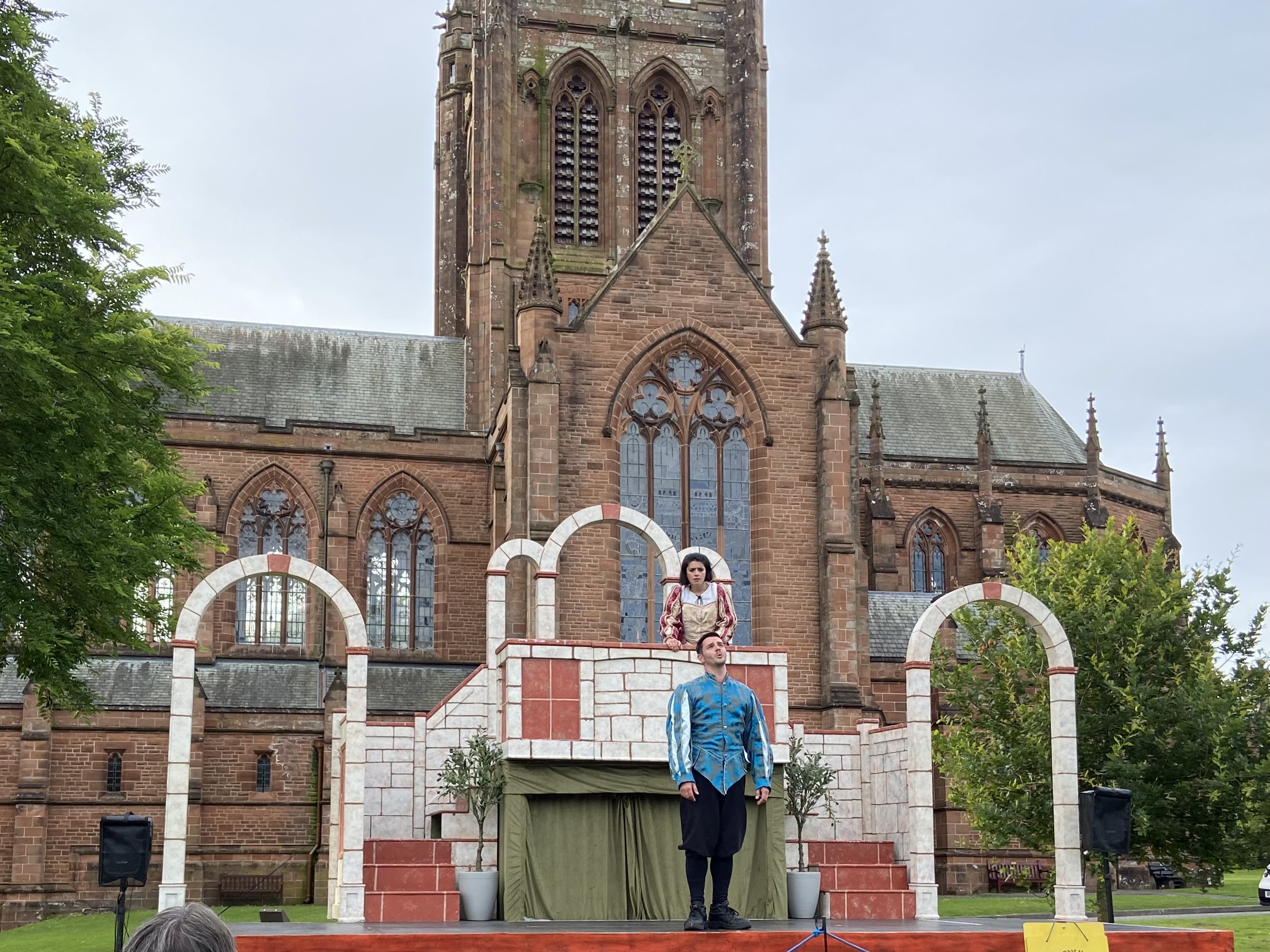
Last Sunday, in the evening, I met Donna and some of her friends for a picnic in the park. Everyone brought food and it was a great spread, with old favourites, like delicious egg sandwiches, to more modern twists, such as salty caramel shortbread. This was in preparation for a spot of outdoor culture – in the shape of a performance of Shakespeare’s Romeo and Juliet.
It was a great evening. The makeshift stage stood in front of the Chrichton Memorial Church and the entertainment was occasionally enhanced by dive-bombing seagulls. Romeo and Juliet isn’t my favourite Shakespeare; I prefer comedy to tradgedy. Juliet’s mother’s big red beard and broad shoulders were an interesting diversion, as was Romeo’s habit of turning his back on Juliet when she was on the balcony (though I understand this was probably related to the combination of a limited stage and the difficulty of being heard outdoors) but it was a great evening and lovely to get out for some entertainment on a sunny evening.
Monday morning started with a visit to my new physiotherapist. I asked my GP to refer me recently when I heard there was a year long weight to see a neurologist for non-urgent problems. I can’t remember whether I mentioned that GP visit, but occupational health at work advised me to go in order to re-examine the neurological problems I had in 2017-19, which resolved to the point where I can work full time, but have never completely gone away. I had physio three times a week, back in 2018-19 and it made a massive difference in getting me back on my feet.
I could see my new physio was somewhat bemused by me. I suspect most patients she sees are significantly impaired, whereas what I want is to build muscle and get as close to full fitness as I can. I suspect there are differences in attitude from Norway. I was much worse, back in 2018, but I can recall being told to warm up for every session, then do three sets of eight, deep squats, three times a week, very early on. Here I’ve been asked to do five to ten, a couple of times a week.
Realistically, I’m more likely to stick with a gentler routine that I can build into my day, which hopefully should be my aim. She did ask me if there was something I wanted to achieve – a goal I could set. I couldn’t think of anything concrete on the day, but after chatting to a colleague, it crossed my mind that I would like to be able to go (downhill) skiing again.
For that, I would want to lose a lot more weight, as well as regain a higher level of strength and fitness, so it’s quite a lot to aim at, but hopefully a worthwhile goal. To give my UK readers bit more context regarding the differing attitudes in Norway and the UK my lovely line-manager, Kirsty, who retired yesterday asked me whether I wasn’t worried about breaking bones. I am, to an extent, but in Norway, most ski slopes have a policy that skiing is free for people who are 70 or over, and it’s not just set up that way as they know nobody will take them up on the offer.
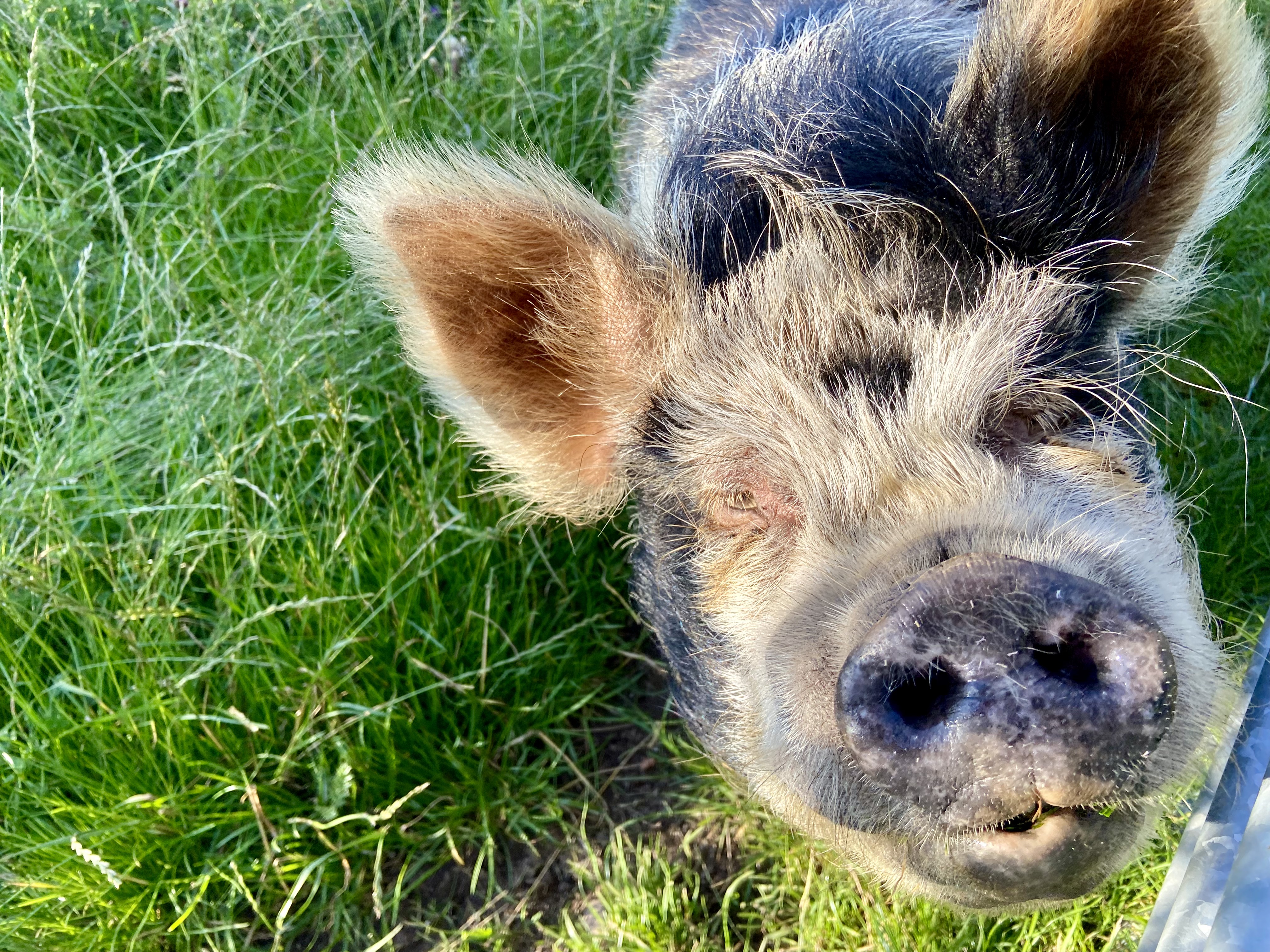
Midweek, Donna and I drove over to visit a friend of hers, who is selling some cottages and (hopefully) some furniture. Assuming none of the people buying the cottages have prebooked sales, hopefully I will be buying three wooden bedside tables from her, along with a matching mirror. I’ve been struggling to find any I liked that weren’t too expensive, so hopefully that will solve that issue. The image at the top of the page is the view from the garden of one of the cottages she has sold, and while we were there, we also met her lovely pig, Dotty. It was a lovely evening.
Yesterday was a lovely day as I went over to Stranraer, where Kirsty was working her last day. Several of us made the trip and we had lunch together and then lots of hugs. She and I discussed Stranraer, where I used to work, many years ago. The office there is very small and much more cosy somehow, than the office in Dumfries. I do sometimes wish I worked there, though due to Donna, and various connections, I have a better social life in Dumfries than I would have over there. There’s also the not inconsiderable matter of Dumfries being a two hour drive from Mum and Dad. Stranraer would nearly double that journey.
Tonight, I have booked to go on an evening wildlife walk with my colleague, Cris. Hopefully the rain will hold off, but whether it does or not, I am looking forward to it.
I will finish off with some photos of the the fields around Blackbird Lane, with some cattle basking in the lovely sunshine we’ve had over the past few days. I wish you all an enjoyable weekend and good week.
Andrew and I were in Yorkshire last weekend, which feels like a lifetime ago, but it was a lovely warm day on Saturday and we went on an ice cream hunt, which on the face of it wasn’t very successful. The firstly place we went to was styled like an American Diner, but it was so noisy and there were so many children leaping about that we turned and walked back out. The next place we tried, after consulting the Oracle of Google Maps was a small, village shop, but the only parking we found was in a field, which some canny farmer had mown and was charging £10 per day to enter.
We ended up doing a big circle back to Grassington, where fortunately, we bought a cone, but it wasn’t quite the ice-cream parlour experience we’d been searching for! Grassington is very pretty though and the drive back was too.
On Tuesday afternoon, I met up with some women I met on social media. We’d been chatting online and they were part of a women’s group I wanted to join, so we met for a coffee. I’ve been worried about Andrew being here for the summer with nothing to do, and to my delight, it turns out one of the women owns a small media company in the area. She does some work with young people, so later this morning, Andrew has been invited to a scriptwriting workshop in a cafe in town. He’s read the script they’ll be working on and has some ideas, so hopefully he will enjoy it. If Andrew wants to work in film, the most difficult part might well be finding a way in, so any experience and contacts he can form are a good thing.
I was through in Stranraer again this week, on one of my TB farm cases. We’re still waiting to see if TB is confirmed, but it’s looking more likely and so my Veterinary Advisor and I went to the farm to assess the boundaries and history of animal movements on and off the farm. If TB is confirmed, we will need to move quickly to start tracing where it might have come from and where it could have spread to, so now we are prepared to move to that stage without delay.
I was driving back to Dumfries, when I found myself in a queue of traffic. It’s a fairly difficult road for overtaking long queues, and this one was particularly frustrating as it was going slowly round the bends and speeding up for the straight parts. Seeing a sign for “Holy Cairn” I made a snap decision that this might be a good moment to go and explore one of the historic monuments that are scattered along the A75.
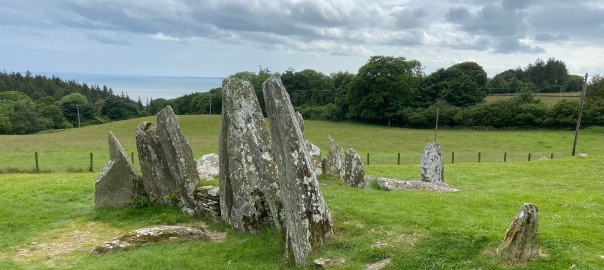
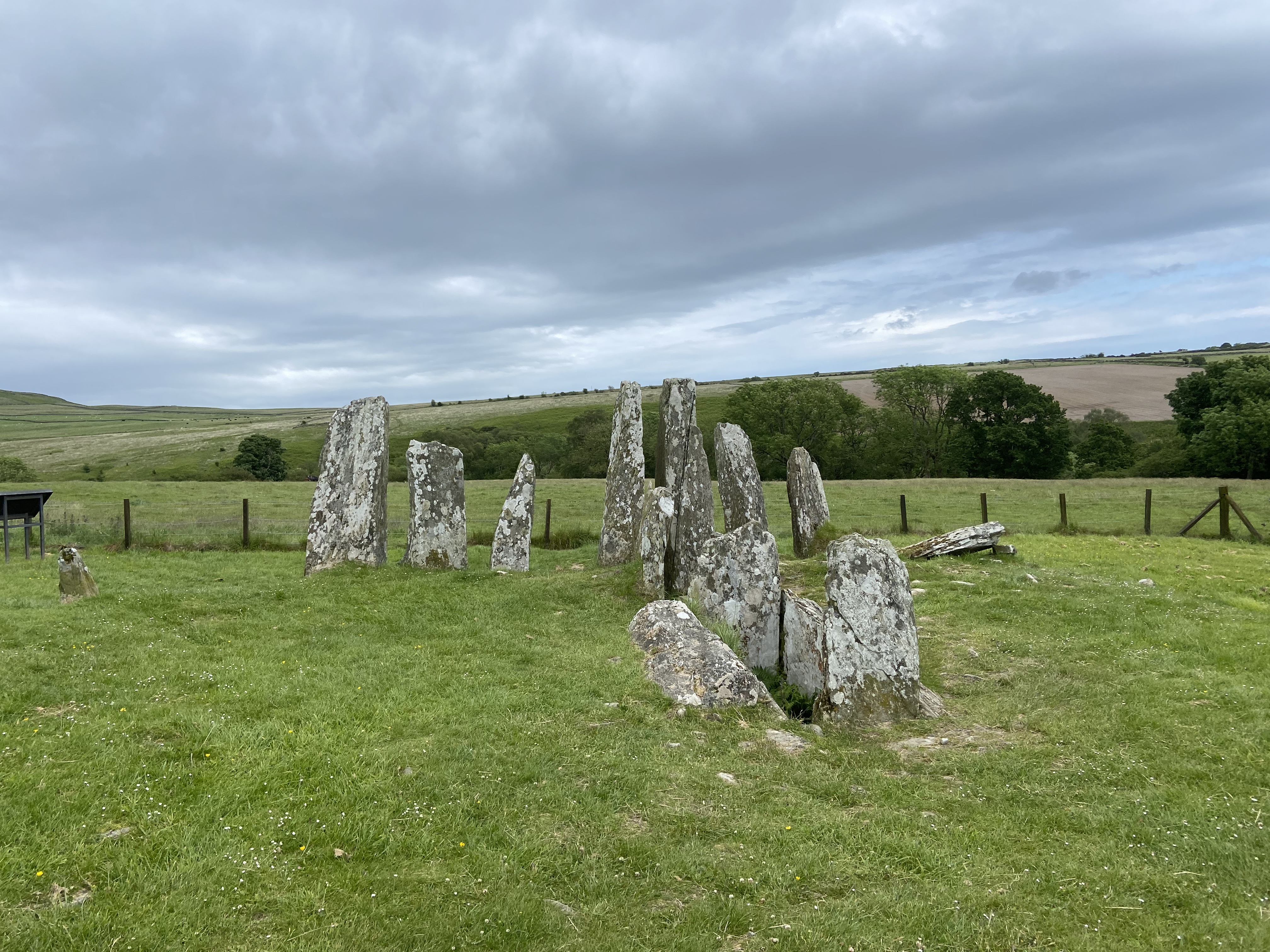
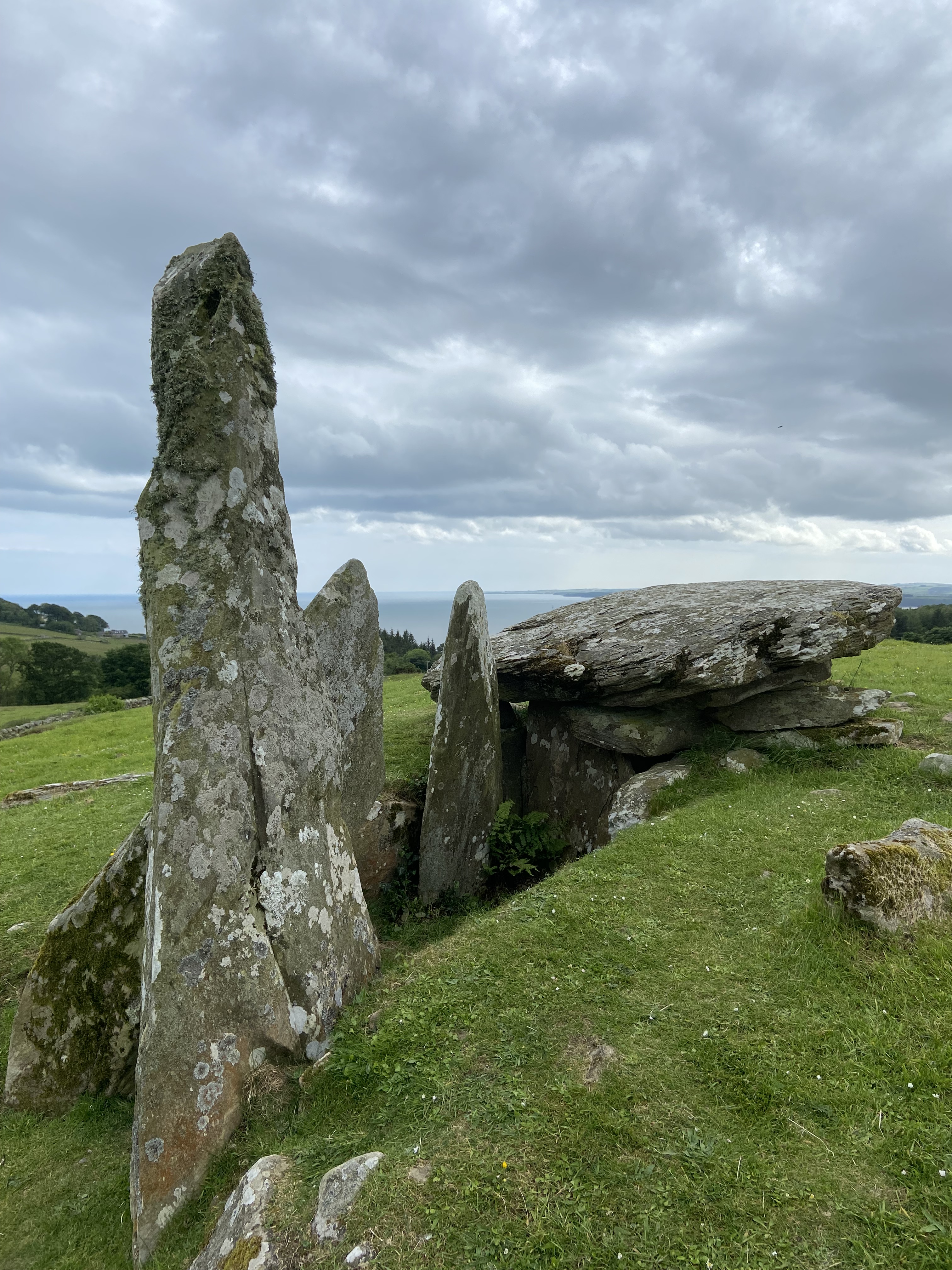
This is a hit and miss activity. Sometimes you can follow side roads for miles and find nothing, or you do arrive, only to find you’re looking at two stones on a hillside. This time, however, I found a good parking space and went through a small gate to find what looked initially like a circle of standing stones…
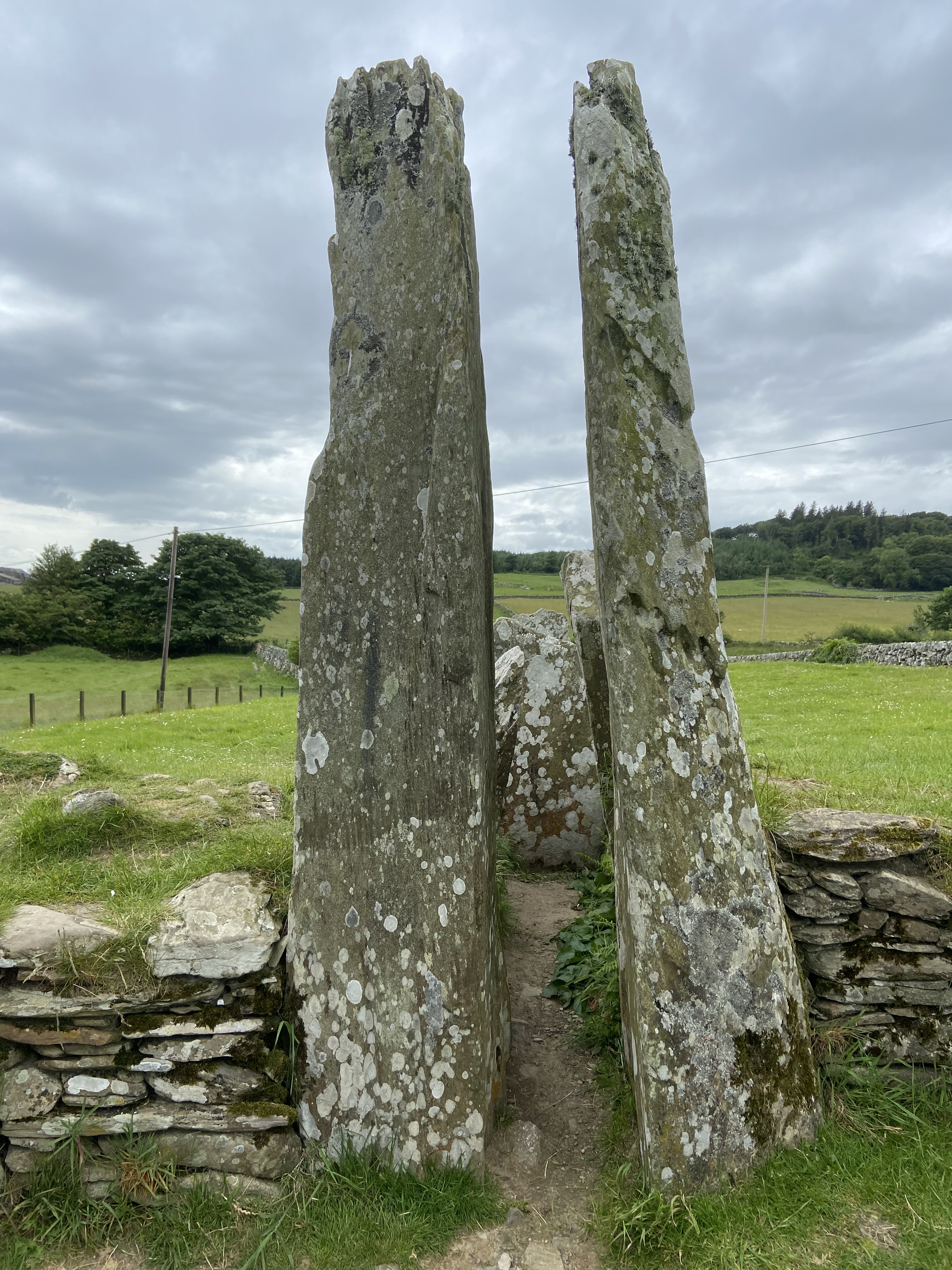
… but which on closer inspection, had been the spectacular entrance to a chambered cairn.
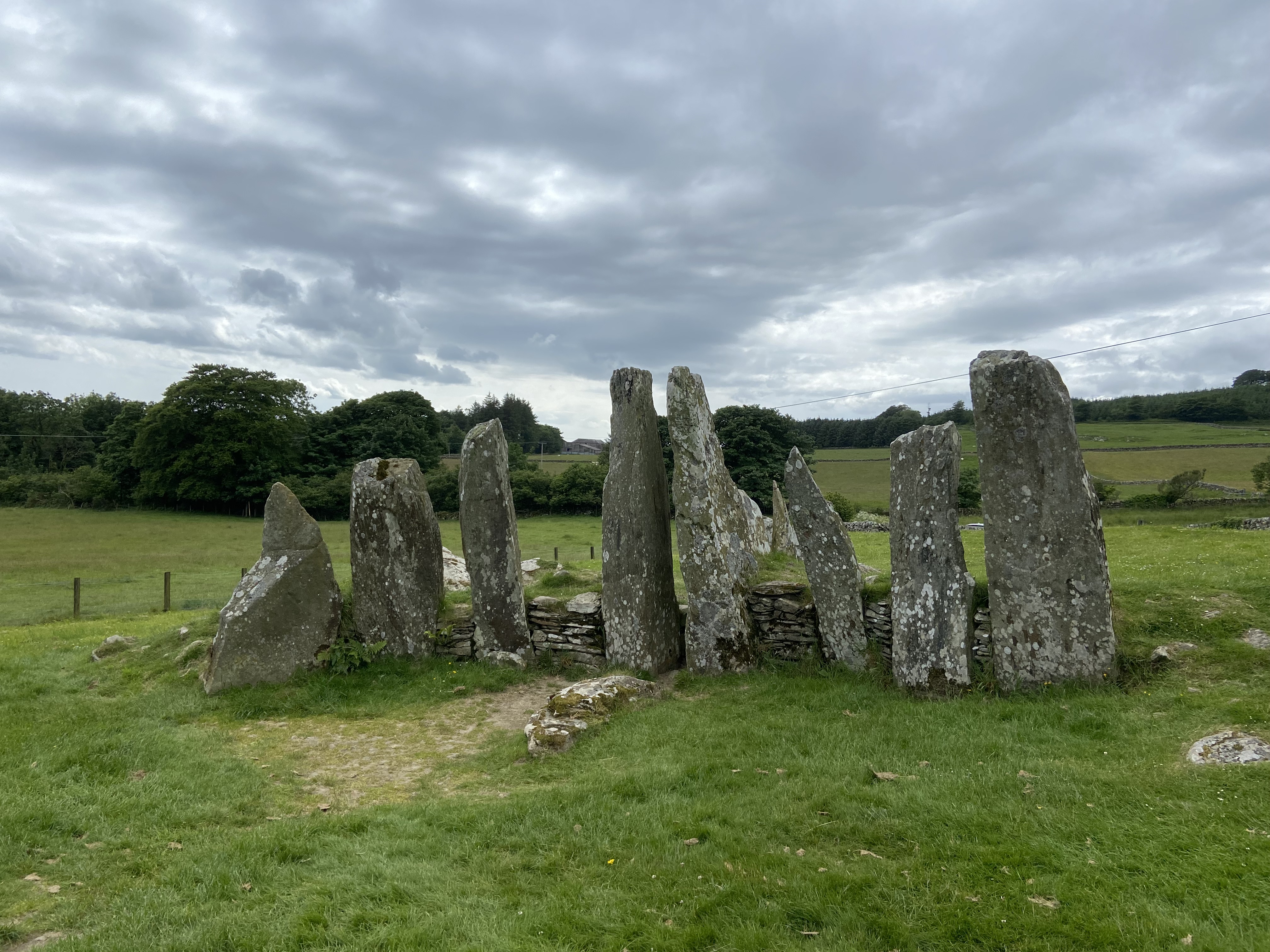
There was an information block in the corner of the enclosure, which told me a little bit about the cairn and its excavation, but the best thing it told me was that there was another cairn, further up the hill. I followed the track up, to find another, rather different cairn. The entrance to this one was a little less spectacular, but it was sited in such a beautiful place that I could only stand and gaze.
I read the information here too. Long-time readers might remember my trip to Stonehenge where I was amazed to discover that animal herders came down from Scotland to celebrate the winter solstice. I found myself wondering whether the people who used these cairns were among those who made that trip.
The plaque told me the cairns dated from 4000 BC. When I looked up Stonehenge later, it is thought to have been started in 3000BC, so these beautiful cairns were in use a thousand years before Stonehenge was begun. As ever, I felt the wonderful calm feeling that I always get when viewing something ancient or ageless. It’s always a wonderful reminder of how short and insignificant my life is in the grand scheme of things.
And finally, I had been gradually gaining weight, ever since I moved to Arctic Norway. Winter hibernation is all very well, but when winter lasts from October to May, it’s a large chunk of the year to take a break from walking, which was something I had done to keep myself healthy for years. I had hoped to break the bad habits when I came back to Scotland, but there is far too much temptation and I haven’t lost anything at all.
I asked at my GP clinic for help and they have signed me up for six months on an app called Second Nature. It tells me it’s going to help me break my bad habits and form some new and healthier ones, so I will be starting that on Monday. My main hope is to lose enough weight so I can start to go up hills again without creaking to a standstill within a few yards. There’s no weighing and measuring foods or calorie counting, which is good as I can never be bothered with all that. I’m also glad they didn’t offer me drugs. I want to improve my lifestyle, so hopefully this will help. I’ll let you know how it goes!
Of course, I am back in Scotland, and true to form, my colleagues in Stranraer, on hearing this, convinced me that it was essential that I should make the most of the last few days before I began, so this was the result. Have a good week all!
Though in some ways, the weeks seem to rush past, by the time I write this blog, things that happened Saturday to Tuesday always seem distant. I will be wandering round, on one of those days, thinking “I’ll have to write about this,” then by the end of the week, something else displaces it. Ideally, I should start logging in as things happen, but hey, I’m not that organized! Anyway, this week I have carefully stored away a couple of things I really want to share. The first is about a welfare inspection I did on Tuesday.
I’ve probably said it before, but the sheer size of farms now, compared even to fifteen years ago when I left, is astonishing. When I qualified as a vet, in 1991, larger dairy units might have had 150 cows. Numbers were creeping up though, and by the time I left the UK many of the bigger herds had expanded to having over three hundred cows. Now it seems to be not unusual to have a thousand, sometimes even more.
I have been wondering how welfare is maintained on such a unit. Back when herds were smaller, most farmers knew their animals well. I went out with a dairyman when I was at college and he knew the personalities of the cows he milked and there were some he was very fond of. I remember seeing him cry when he’d been away on holiday and came back to find one of his favourites gone, due to the carelessness of the relief dairy worker that had been covering for him. No wonder some farmers barely take holidays.
I am not under the false impression that bigger is inevitably worse. Those who have expanded are often the most efficient and forward thinking farmers. They are investing in the herd and their own future, but still I had been wondering how. These are living animals and to keep track of when they are in season or in calf, or are sick, takes a lot of time for observation and knowledge.
As we walked along the calf pens, I could see they were being bucket fed. Lots of bigger farms use automatic feeders for their calves, but not here. The farm is run by a couple and (fairly traditionally) it’s the woman who is responsible for feeding the calves. They did have automatic feeders for a while, but found they tended to get dirty. In addition, teaching them to drink from a bucket prepares them for going into bigger groups and being given milk from a trough. You can also check how much milk each calf gets and individualise each one. I guess it takes a long time at peak calving time, but it was interesting to see that a good start in life is so important that industrialization hadn’t occurred (or rather, had been tried and rejected) on this part of the farm.
As we moved from the calves to look at the close-to-calving cows, I was interested to notice that the nearest cow had something attached to her foreleg. I asked what it was, and was told it was a movement monitor. Just as I wear a watch that can tell me how many steps I take each day, the cow’s steps were also being monitored. I wasn’t immediately sure what purpose this would serve, but later, he took me to the computer where these measurements were read.
He showed me a the readings of a cow that was coming in season every month or so. Sure enough, the movements peaked hugely at that time. But it wasn’t only that he could look at the program and see which animals were in season. The system itself recognizes the pattern and, as the cow comes out of the milking parlour, where it goes twice a day, a gate automatically opens to allow it through into a different area, so she can be inseminated. A person walking through the cubicle shed to separate out these cows disturbs all the other animals. Instead, this is another process that is mechanised to minimise both the work required and the disruption to the herd.
Automatic scrapers to clean passageways in cubicle sheds have been around for a long time. Usually they are pulled by chains or ropes and there were some of those here. The chains were in runnels to prevent the cows standing on them and hurting their feet. One of the sheds had one of the newer machines, that functions like a robot vacuum cleaner. These have the advantage that they can go round corners, so there are no missed sections, which there are with the chain scrapers.
What I hadn’t seen before though, was an automatic scraper for moving silage. Usually cows are fed in a passage, where they put their heads between bars and eat the silage and feed that is put there. As they eat, the food gets pushed away, and usually someone will drive along with a tractor now and then and push it back in. Here, there was a machine that ran along a metal track, doing the job automatically for all the big sheds. It runs every two hours, except just after milking time, when it is set to go hourly, as the cows tend to be hungry when they’ve just been milked. Again and again, I saw that, although this system was on a large scale, there were tweaks and tricks that meant that it was really set up, based on what the cows needed.
And finally, back to the matter of the individual animal and the personal relationship. I can’t say I really touched on this with the farmer, although it was apparent as we walked round, that there was still fondness for individual animals. He did tell me though, that where his dad had always been keen to give every sick animal a chance, he tended to be more ruthless is removing animals with bad feet or which had been ill enough to mean they probably wouldn’t thrive. One thing I have observed from life as a vet is that there is a lot of unconscious cruelty by some pet owners, who keep their pets alive long after that life stopped being worth living. Perhaps in a system where animals with bad feet get removed quickly, breeding from those animals that are left will create a better herd, with fewer foot problems in the future. Anyway, I really enjoyed my visit. Cows are still cows and they are still my favourite animals and these visits give me plenty of food for thought.
The other memory was from last weekend. I mentioned I had been told there was a man in his nineties, who’d lived here all his life. I ran into him last weekend. He has a garage at the end of the street where he makes wooden toys for children. He beckoned Triar and me in, and gave Triar a biscuit. Though he was in a wheelchair and his hands were shaky, he was painstakingly painting a toy duck that would go on a stick. There would also be feet attached to a wheel that would spin as it was pushed along the ground.
I asked him if he sold the toys and he said no. He gives them away, and the look on the child’s face is payment enough, he told me. If I ever have any children to stay, I will undoubtedly take them along to see him.
He also started to tell me a bit about the street and I resisted the urge to ask him if I could record what he was saying, as it was lovely. He had lived in the street law his life, he said, and could remember back to the time when it was a village and not part of the town. The doctor came out rarely, he said. If someone was sick, they called for Mrs Black. Mrs Black was also the one you called on if someone was giving birth. We also had a discussion about the healing powers of honey. As antibiotic resistance is growing, even in the vet world there is starting to be more exploration of how old remedies can be better integrated into modern treatment. I bet Mrs Black could have taught us a few things about helping sick people that we have lost in our rush towards modern medicine.
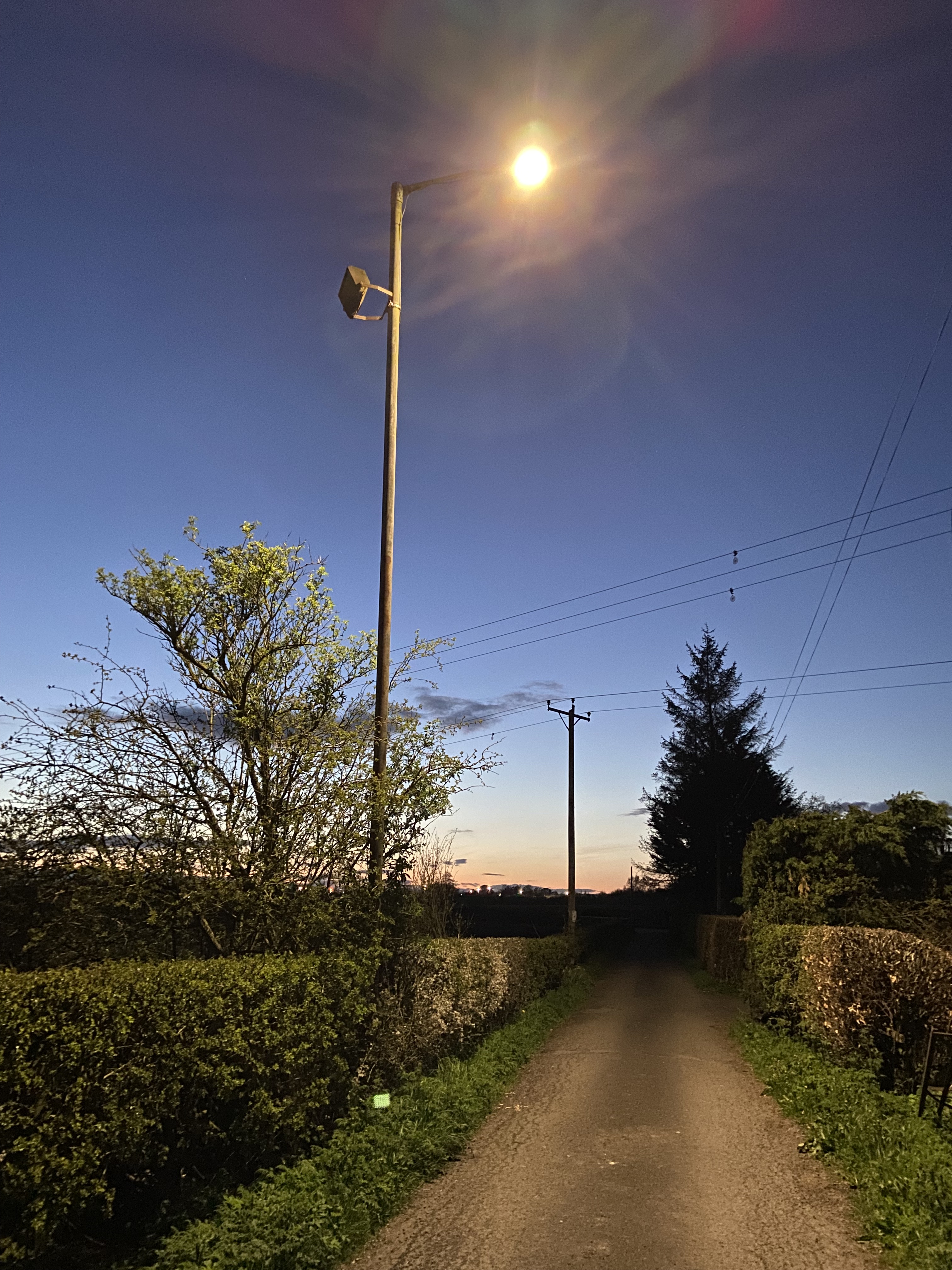
Anyway, I’ll leave you on that note. The pictures are from Blackbird lane, where Triar and I are still walking, morning and evening. This week’s unusual birds were a tree pipet and a mistle thrush, but the blackbirds haven’t deserted. Have a good week and thanks for reading!


























 A Vet’s Life