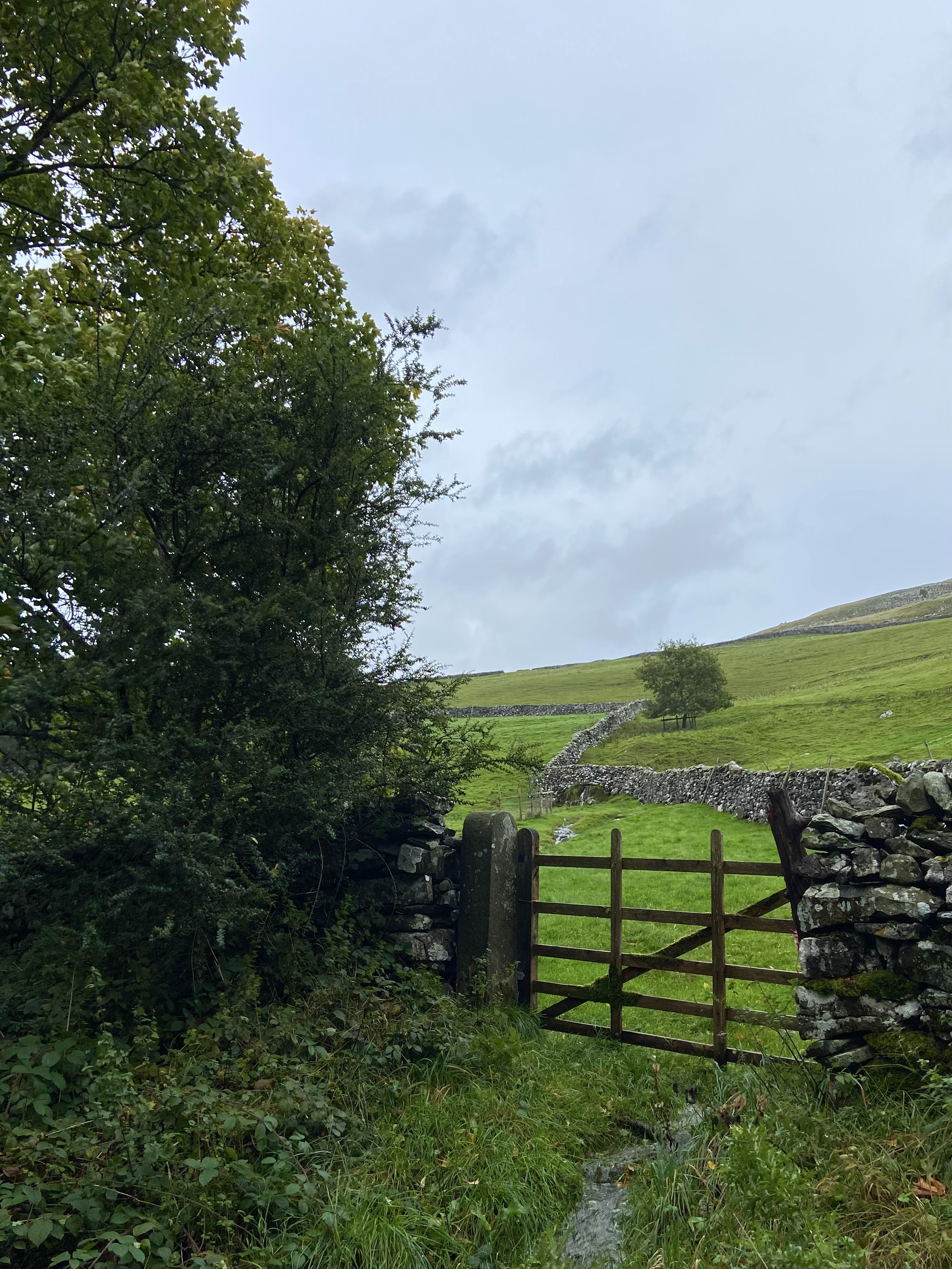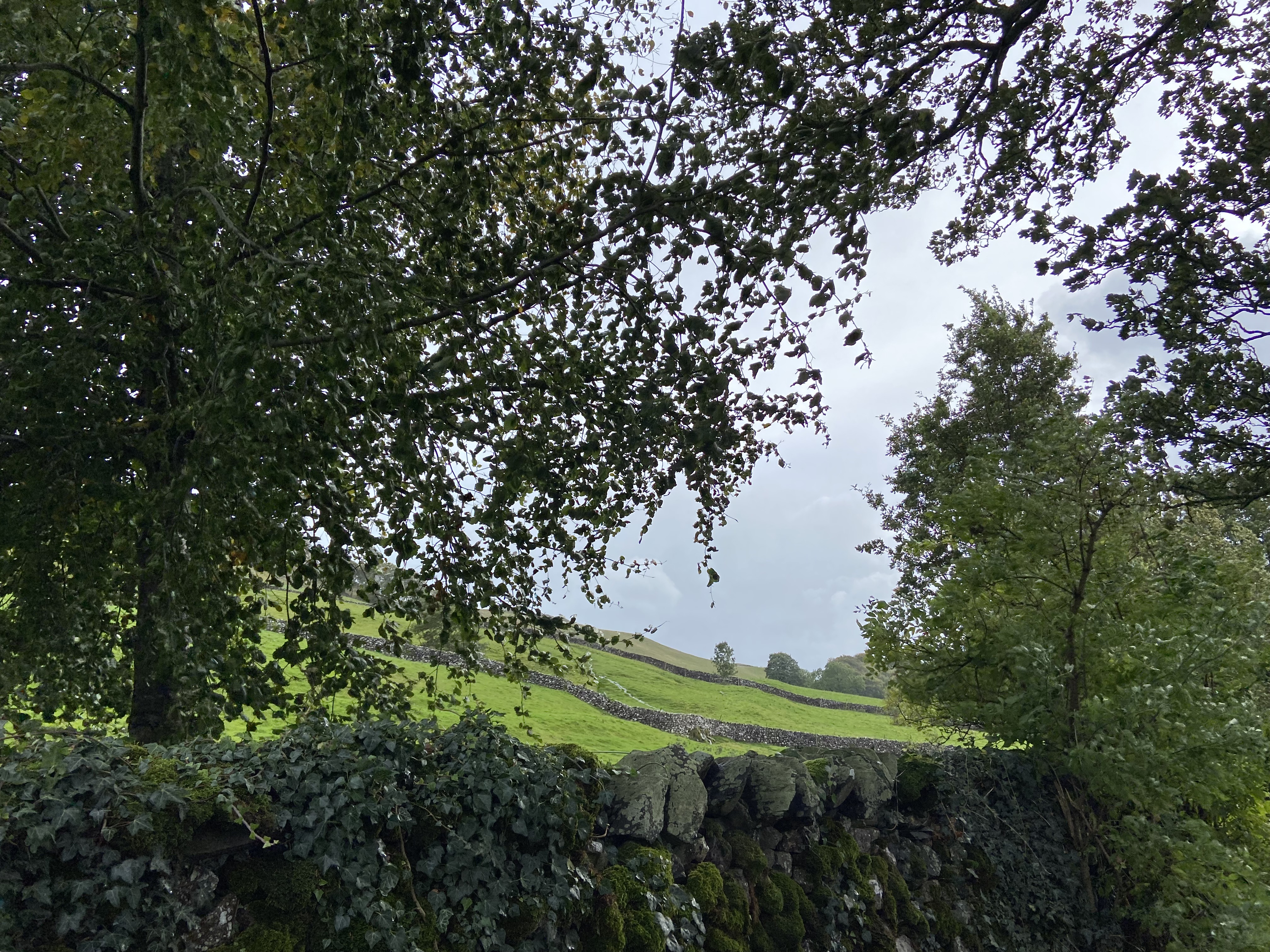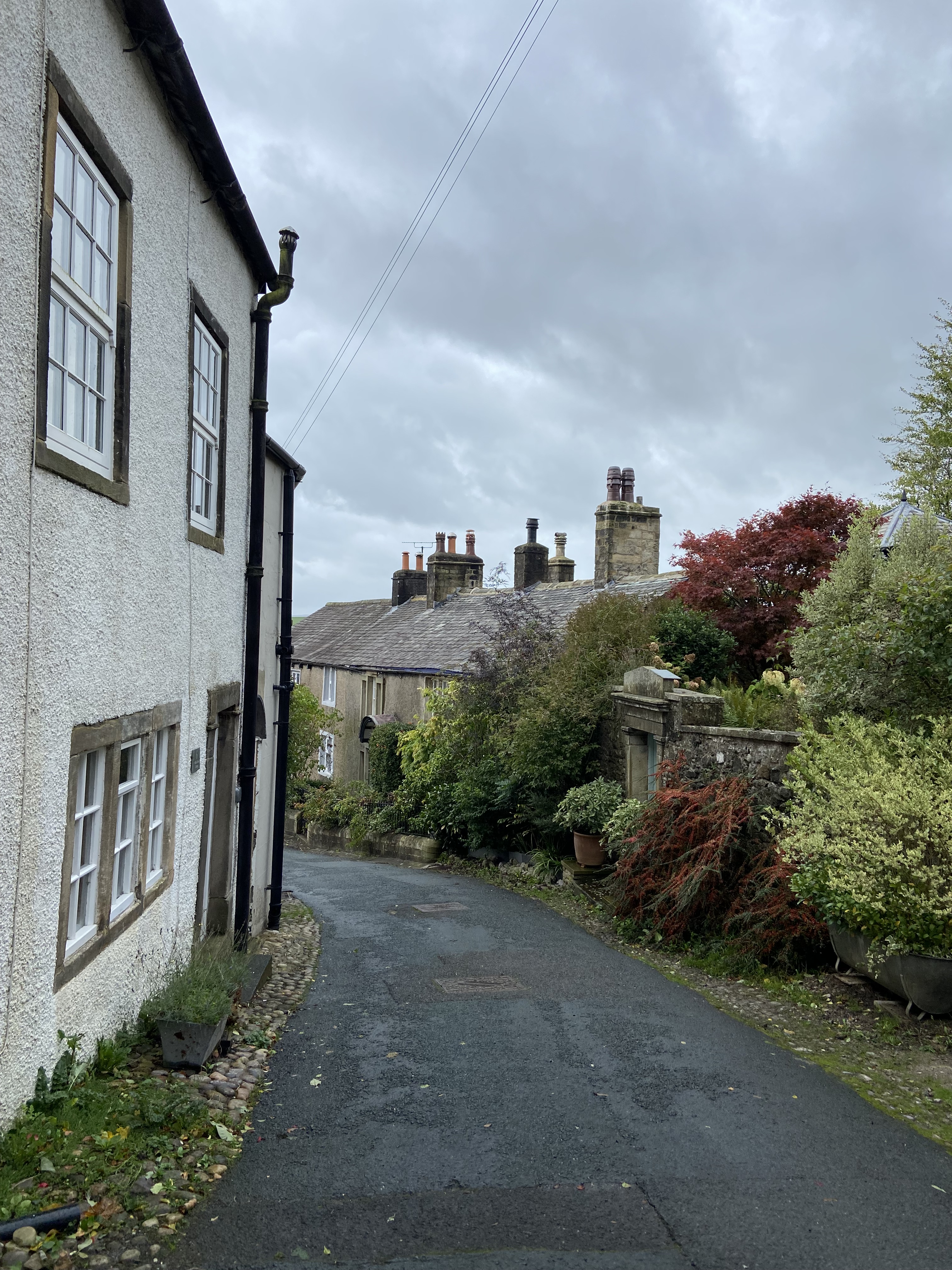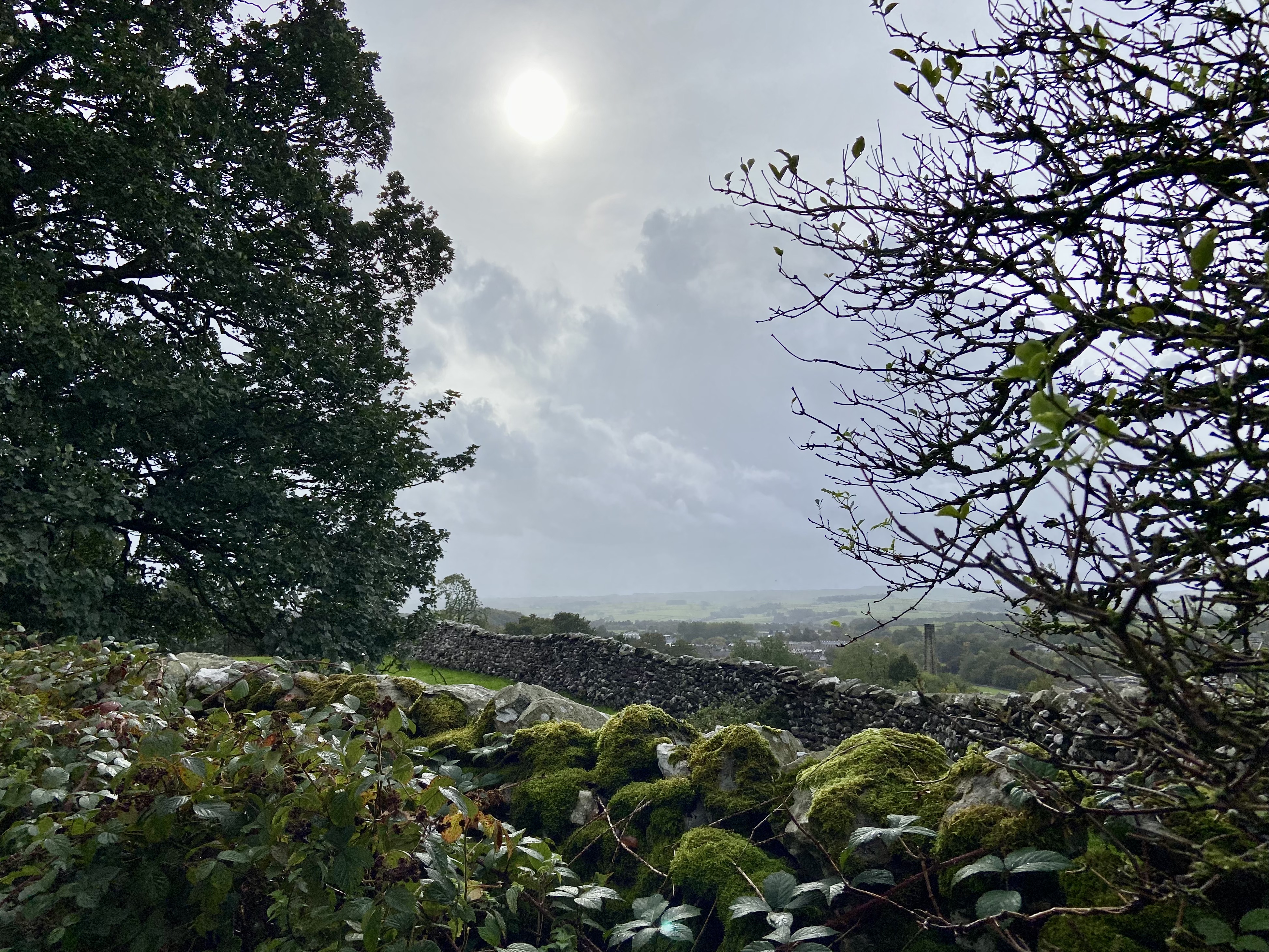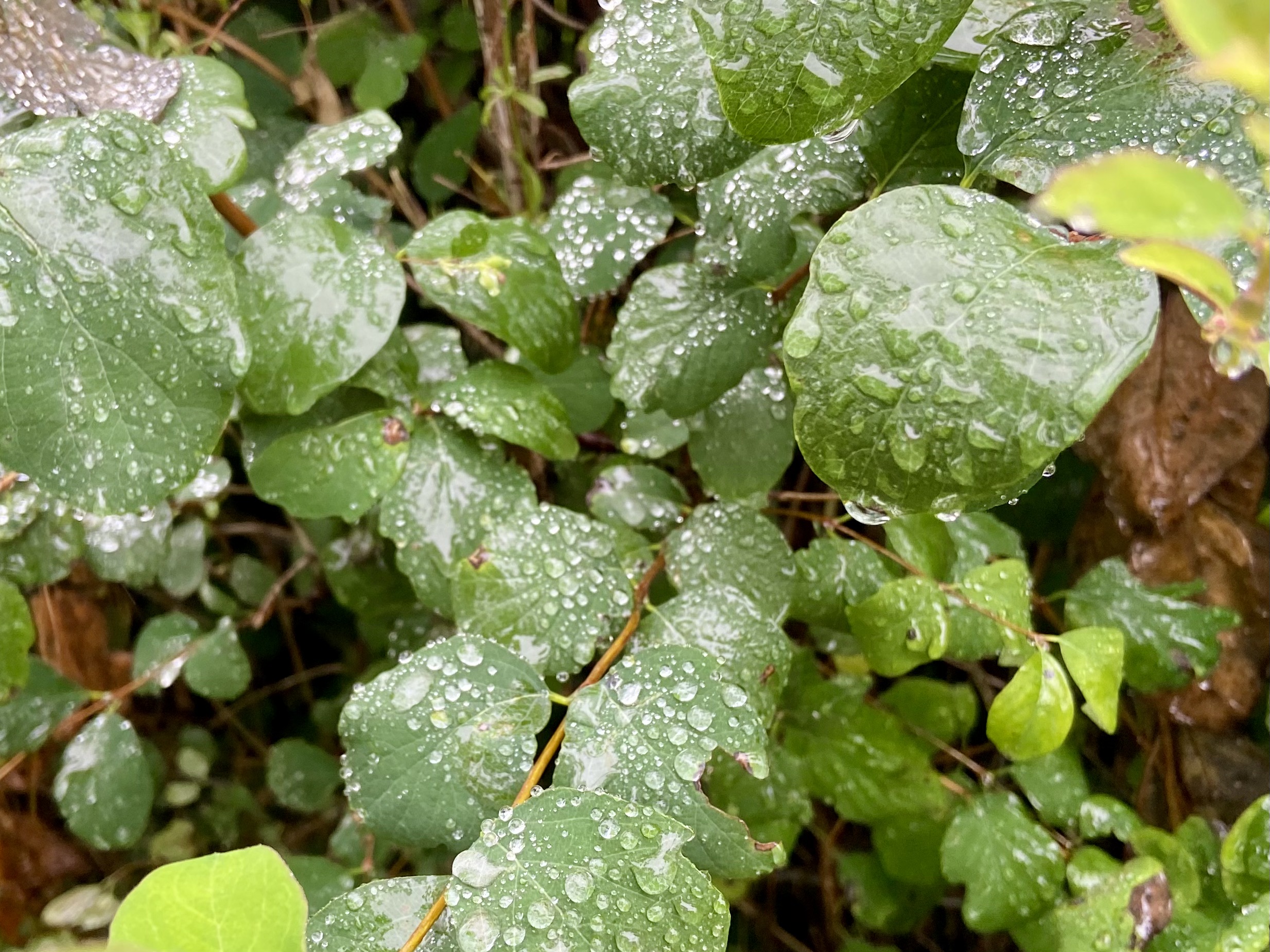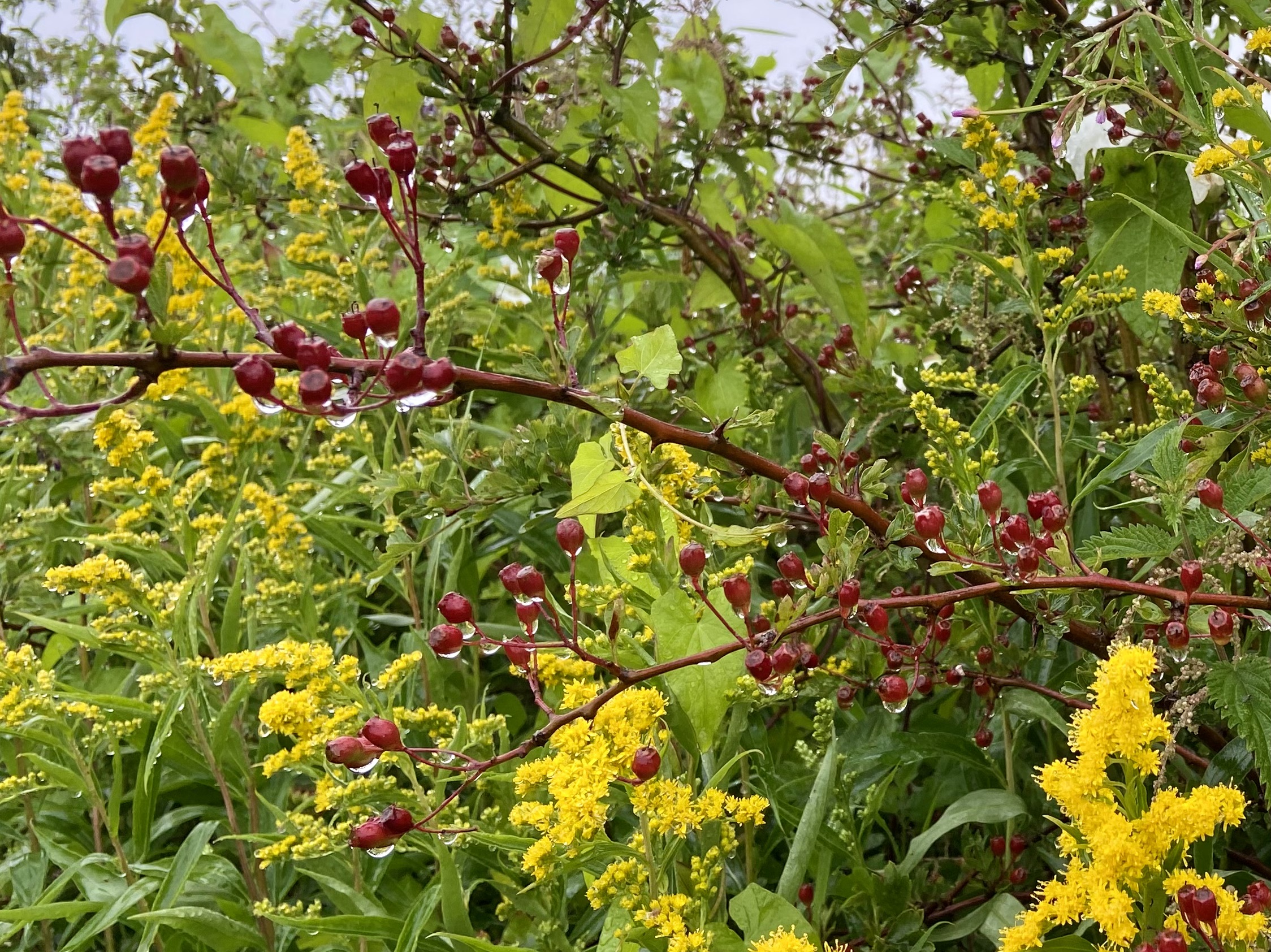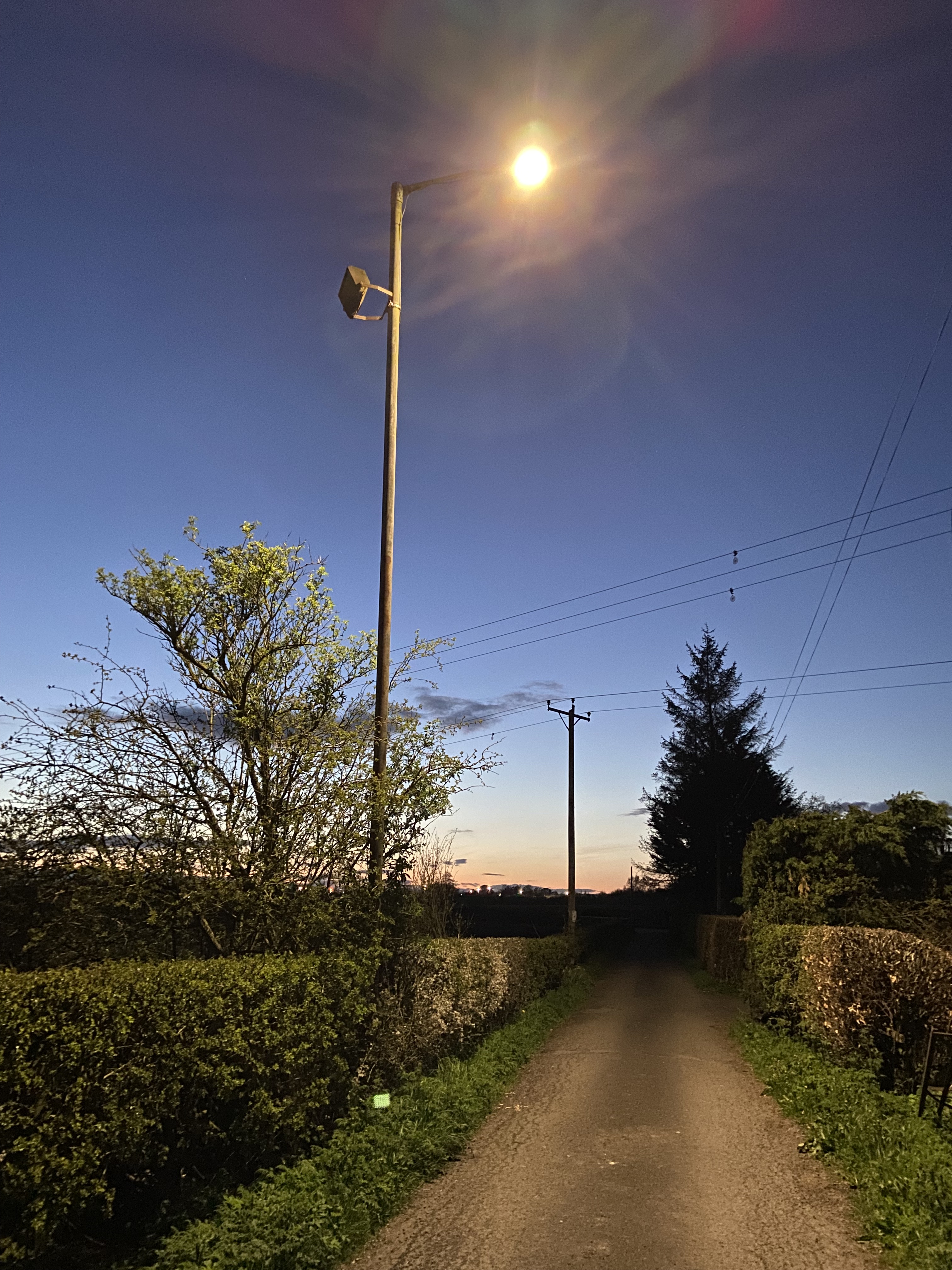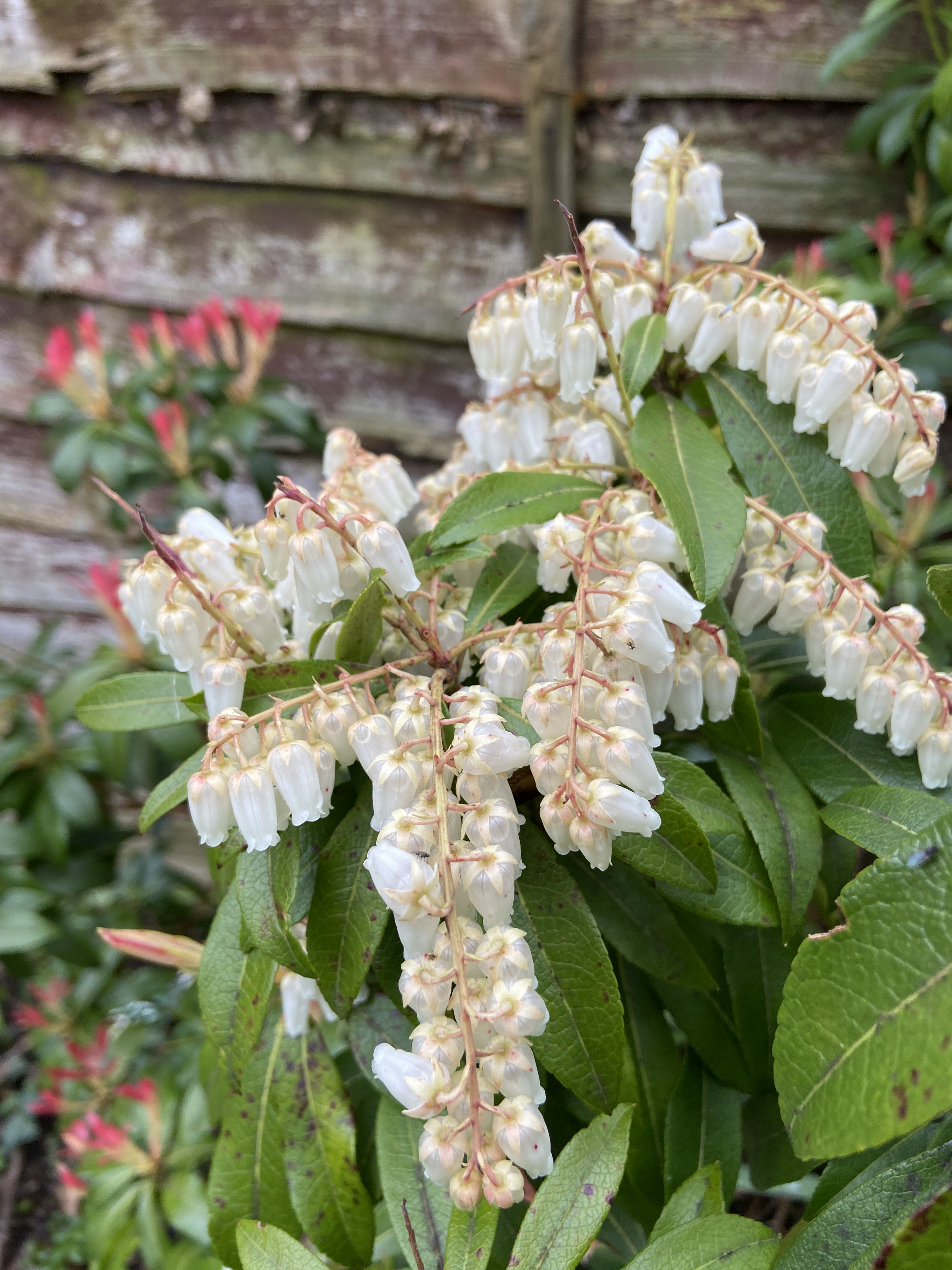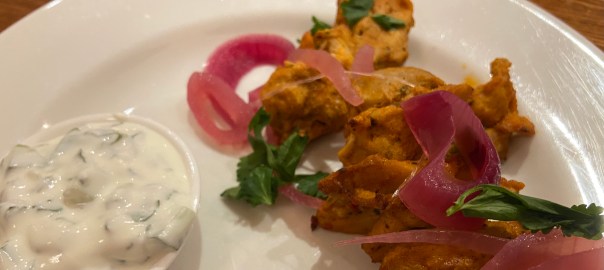
I’m short of photos for this week’s entry. In addition to a photo drought, I’ve also been struggling for steps. To my amazement, following the unexpected plumber completion after months of waiting, I’ve hit the jackpot because James the plasterer arrived on Tuesday morning, all ready to go. He was here yesterday and said he’d be back this morning.
So with all that in mind, I had hatched a cunning plan to get more photos and steps before I started to write. James told me he’d be here at eight (even checking if it was okay with me to come so early). So, I thought I could go out when he arrived, take Triar for a sunrise walk (steps!) somewhere pretty (photos!) then as a bonus, I could go for coffee and cake at the garden centre and maybe write this there.
I was rather looking forward to all of that, but my plans fell through when eight a.m. came and went, with no sign of James. This isn’t unexpected. James is a lovely man, singing cheerily as he does a fabulous plastering job, but as I discovered last year, he’s also a bit unreliable. I don’t honestly mind. The job he does is great and he seems to prioritize getting my work done (all his kit is in my house, I don’t think he’s off doing work elsewhere) but planning ahead based on when he’s said he’ll come is a pointless exercise.
Still, I’m incredibly happy that the work in my house is finally moving forward again. Once the plaster has dried, I need some decorating done and a couple of electrical installations completing before I can thinking about frivolities like carpets and curtains. It’s probably not going to quite be finished for Christmas, but I had been starting to wonder whether I was going to have to find a whole new team and priming them to take over the project, so for it to suddenly be moving forward again is fantastic.
In equally good news, my car went in for its MOT and service on Wednesday and passed with no problems. Last year, it cost me £2,000 for things that should really have been fixed before I bought it, so I was nervous about finding myself in similarly expensive hot water, but I heaved a sigh of relief when I was told it was all okay. A month before Christmas isn’t the best time for big bills.
Work has been frenetic. When is it ever anything else? If you’re in the UK, you might know already that the bird flu season has started in earnest in England. Well this week, there has also been a case in southern Scotland. It’s not in my area, but it’s had a knock on effect on everything. All the vets in that area are now going flat out. I had to take over as duty vet on Thursday, and all the higher up staff, who usually act as advisors when anything complicated comes up, are embroiled in managing the situation. All the birds will be culled and, in the meantime, animals and birds within a ten km radius are under lockdown, so any movements on or off their farms have to be assessed and licenced.
In the meantime, with that as background, two of my long-term welfare cases are being wound up. By the end of next week, one more farmer will have gone out of business and the marauding pigs will (hopefully) have been removed. From an animal welfare and future work point of view, this is a good thing, but even as I have been putting the work in that will allow these things to happen, it’s been a sad experience. As I looked into various health implications of moving animals off the farm, I could see that in times past (and not so long ago) this has been a good farm, with high standards. How did we end up here, I wondered? Still, for both of the animal owners involved, I hope that as we help to wind up their dreams-turned-nightmares, that we can work as gently as possible and that it will bring relief and not further sorrow.
Only two more weeks at work and I will be on holiday. I need a break. Yesterday, for the first time in months, my FND twitches came back. Not that surprising. Duty vet on Thursday was exhausting with two calls about possible bird flu cases (fortunately negated during the calls, without having to trigger a full report case investigation) and various other tasks, all hitting at the same time. I’m intending to take it easy this weekend, but as a minimum I want to trim the hedge at the bottom of the garden, at least enough to fill the brown bin for its last emptying of the year. But that’s a task for later. James has arrived, so it’s time to head out for that walk and coffee.
I was in Brighton last weekend to attend “the largest annual grassroots feminist conference in Europe”, according to FiLiA who ran it. If you’re in the UK, you might have seen in the news that the Brighton Centre venue was vandalised the night before it started. The whole of the front of the building was sprayed with pink paint and several windows were broken. In addition, inside there was also disagreement, with a woman announcing in the opening ceremony that she “wouldn’t be lectured on Hamas” before attempting to rouse the room with chants of, “free, free Palestine”. A few women stood up and joined in, some Jewish women stood up and walked out, some jeered and the rest of us sat there in stunned silence. For an uplifting weekend, where FiLiA say you can “Build your Feminist Network. Leave inspired,” it wasn’t a great start.
Regular readers will know I love strong women and there were plenty of them there, but I don’t think I will be going to the next one. Brighton was also curiously depressing, though perhaps it isn’t curious really. Like many UK cities, the drugged homeless lined the pavements and the whole place seemed dirty and down at heel. Like many seaside towns, you could see it had once been gorgeous and rather grand, a haven for holiday makers. Now they go for beaches abroad, with reliable sunshine at lower prices. I did get a photograph on the first evening that I love though. The sea is still beautiful, under the evening sky.
There were cafés along the beachfront, where the lovely Welsh woman I made friends with on the first day bought me an ice cream! It was probably the high point of the weeekend!
On Monday, I headed back to Scotland. Somewhat rashly, I had agreed to work in Stranraer on Tuesday and had booked to stay there Monday night. The logistics of collecting Triar from my parents in Yorkshire and dropping him off with a friend in Dumfries were complicated. Several delays on the railways meant I ended up getting a taxi for the last leg of my Yorkshire journey. A jackknifed lorry on the A75, with blue flashing lights lighting up the night (nobody was hurt) was the final hold-up, but at least the hotel was comfortable when I finally got there at 10:30 in the evening.
My lovely friend also seems to have enjoyed having Triar and sent reassuring photos of him looking happy. I’d been a bit worried about picking him up, driving him two hours, then dropping him off again, but he seems to have been so well looked after, that it was all good!
As usual, after a few days back at work, it feels as if I never left. Two days out on farm, blood testing cattle with three (female) animal health officers was uplifting. We have some wonderful women in our APHA team. I was duty vet on Thursday, where the high point of the day was dealing with a query about fish-sludge being fed to maggots (no, me neither). And all the while, as I was out on farm and juggling bizarre questions, there were emails landing in my inbox about cows which had been transported to slaughterhouses with shackles on.
For my non-farm readership, occasionally (and particularly around calving time when the ligaments are softened) cows do the splits on their hind legs and then can’t easily get up. With shackles buckled onto their hind legs, that stop their legs sliding outwards, they can often manage okay, until they heal. A new decision has been made that travelling in shackles isn’t allowed, on the grounds that an animal with them on, isn’t fit to travel. This isn’t a law, it’s a directive that has come from someone high up in APHA. Like all such decisions, it’s somewhat controversial. If a farmer wants to send such a cow to the slaughterhouse and can’t send her in shackles, he may decide to take them off and risk sending her anyway, which is more risky than sending her with them on.
As my investigative case is all about unfit animals being transported, all the emails about this new rule being broken (in Scotland) are now being directed to me. What it really highlights is not that animals in shackles shouldn’t be travelling, so much as that there is a huge gap in care, now that having lame animals culled on farm and being sent to the abattoir afterwards is so incredibly limited. If a cow has an accident, farmers only have 24 hours to decide if it’s so serious that she should be culled, so there’s no time to wait and see how she fares. This is all a hangover from the EU, so since we’ve left, perhaps we could start to look at systems that might work better for our animal welfare here. If I can find the time, and put together some coherent arguments, maybe a visit to my MP is in order. There are times when trying to sort things out locally, just isn’t enough.
I shall leave you with some stormy pictures of Yorkshire. Thanks for reading and have a lovely week!
I went back, both to work and to the doctors’ on Monday. The GP I saw was helpful. He was young and I think may have been in his foundation years as a GP, but he took the time to do a fairly thorough neurological examination. I was laughing to myself afterwards as I’ve had so many of them that I could have told him a couple of bits he’d missed, but he found a few things, at least one of them new.
He told me he will contact the neurological department at the hospital, both to ask them to reassess my triage as urgent and also, to ask if there’s anything that can be done for me while I’m waiting. It will be interesting to see if I am now seen earlier than July. I don’t know when he’ll get an answer to the other question.
So I’m not as fatigued as I was. I am managing to do some things again that had more or less come to a halt, like cooking and tidying the kitchen afterwards. I even took myself upstairs yesterday and did a bit of painting in the bedroom, but the energy I had quickly drained, as it did when I tried to do a veterinary risk assessment yesterday morning.
The veterinary risk assessment (VRA) I have to do is an assessment of the possible consequences of moving cattle from a farm where there is no TB present, to one where it has been confirmed.
This particular VRA is a bit of a wildcard because TB hasn’t been confirmed yet. We are waiting for the results at the moment (they are trying to grow bacteria in a Petrie dish from lesions found in the lungs of a cow that was slaughtered) and they won’t be back until mid-March. The cattle that need to be moved onto the farm are young stock (heifers) which are being wintered on a different farm. They are due to calve in mid-April. If the culture is negative, restrictions will be lifted and heifers can move to the dairy unit with no problems. If it’s positive, the restrictions will remain and we will need to move quickly.
In order to complete the assessment, I will look into all kinds of factors, including how high the risk of spread is. For example, are there cattle on neighbouring farms and how likely is it those cattle have had nose to nose contact with cattle from the infected farm? What are the potential costs to the government? For example, moving a lot of cattle onto the farm might mean the government has to pay compensation later, if those animal become infected.
And there is an absolute requirement to carry out a short interval skin test (SIT) before any cattle can be moved onto the farm. TB is a slow moving disease sometimes. A cow can be infected for years before it is spotted. When we confirm there are TB bacteria on the farm, we have to check, via the SIT whether we have one infected animal, or many. Until we’ve done that, it’s impossible to weigh the risk.
So if we get a positive culture, I will need to be ready with the SIT and the VRA so we can move quickly. There’s nowhere to calve those heifers and nowhere to milk them, where they are, so they need to go somewhere, on welfare grounds. I find this part of my work very interesting, but with so much cross-referencing of data, I need to be on the ball. Hopefully I can get more of it done in the early part of next week. Big welfare case is also due a revisit though, so we will see!
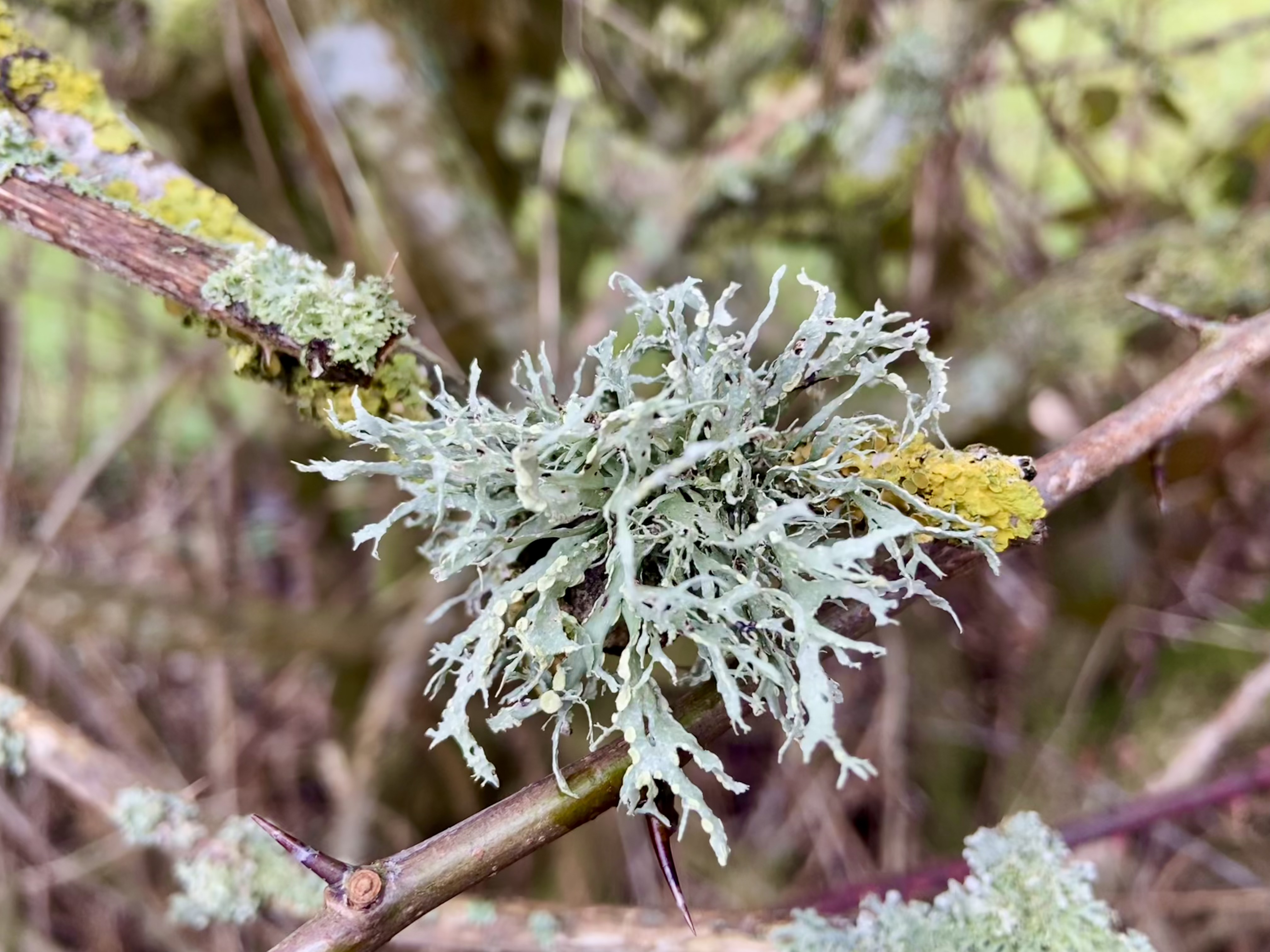
I don’t have so many photos at the moment. I’ve not been out walking or exploring much, though I took a couple of pictures of colourful lichen in Blackbird Lane, which I will share with you.
Taking time to look closely at the nature around me keeps me sane! A few minutes ago, Triar was whining, so I took him outside and stood in the semi darkness, listening to the most wonderful dawn chorus. There were robins and blackbirds and a song thrush, all greeting the new day. Triar stood and listened too, as he sniffed the morning air. I wonder what he could smell.
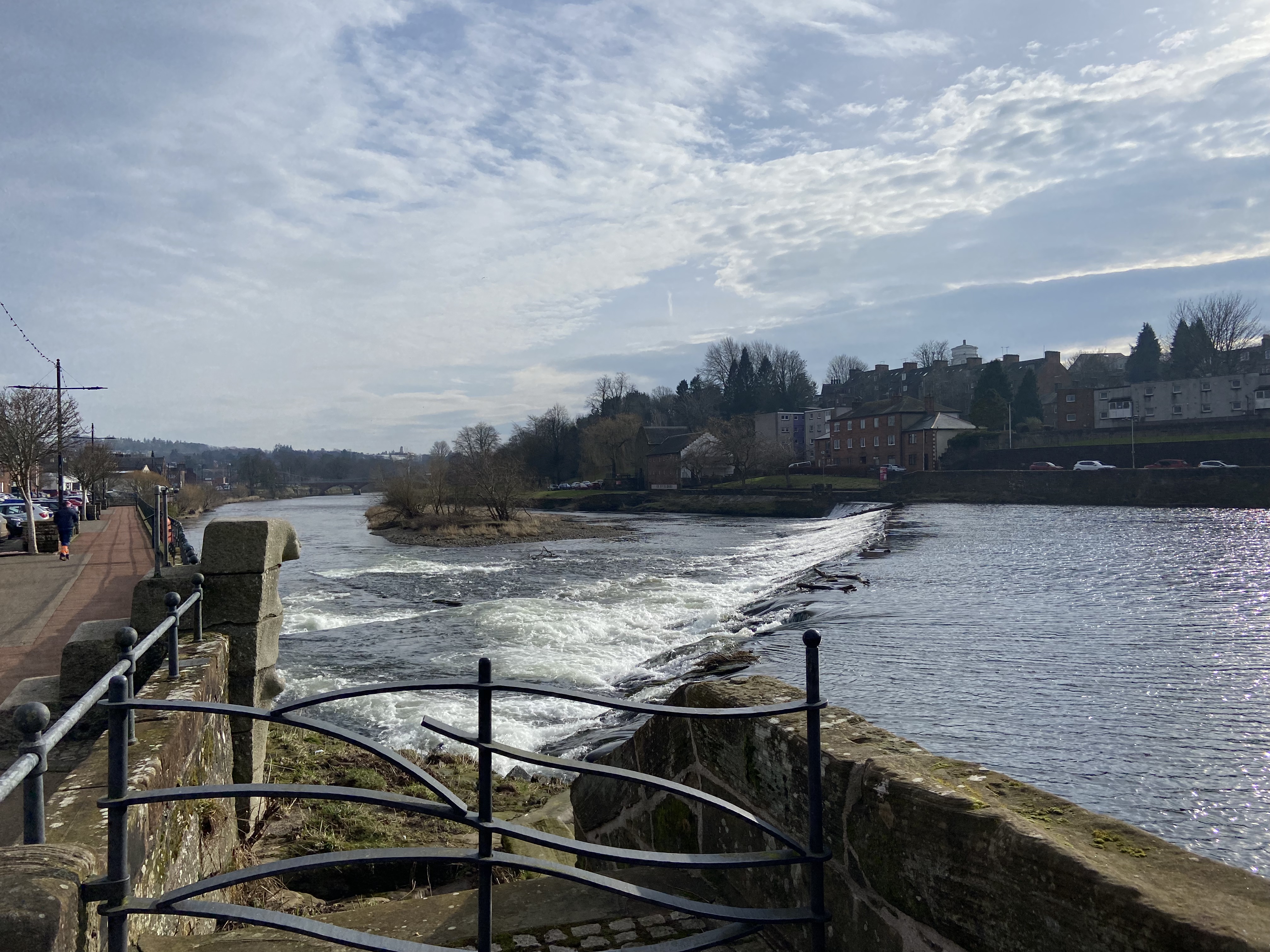
I saw on Facebook that Norwegian ships from WW2 are coming to Shetland the week I am there. I was oddly emotional when I saw that, hoping I can speak to the sailors who bring them over. I found a rock beside the Nith (which runs through the middle of Dumfries) commemorating the connections between Dumfries and Norway in the war. Funny how things come together sometimes.
Anyway, I will leave you with photos of the stone and the Nith itself. There were flood warnings in place last night, but midweek, when Triar and I took a walk there, it looked benign enough. Triar photobombed the rock shot, but I’ll not crop it! Have a good week all!
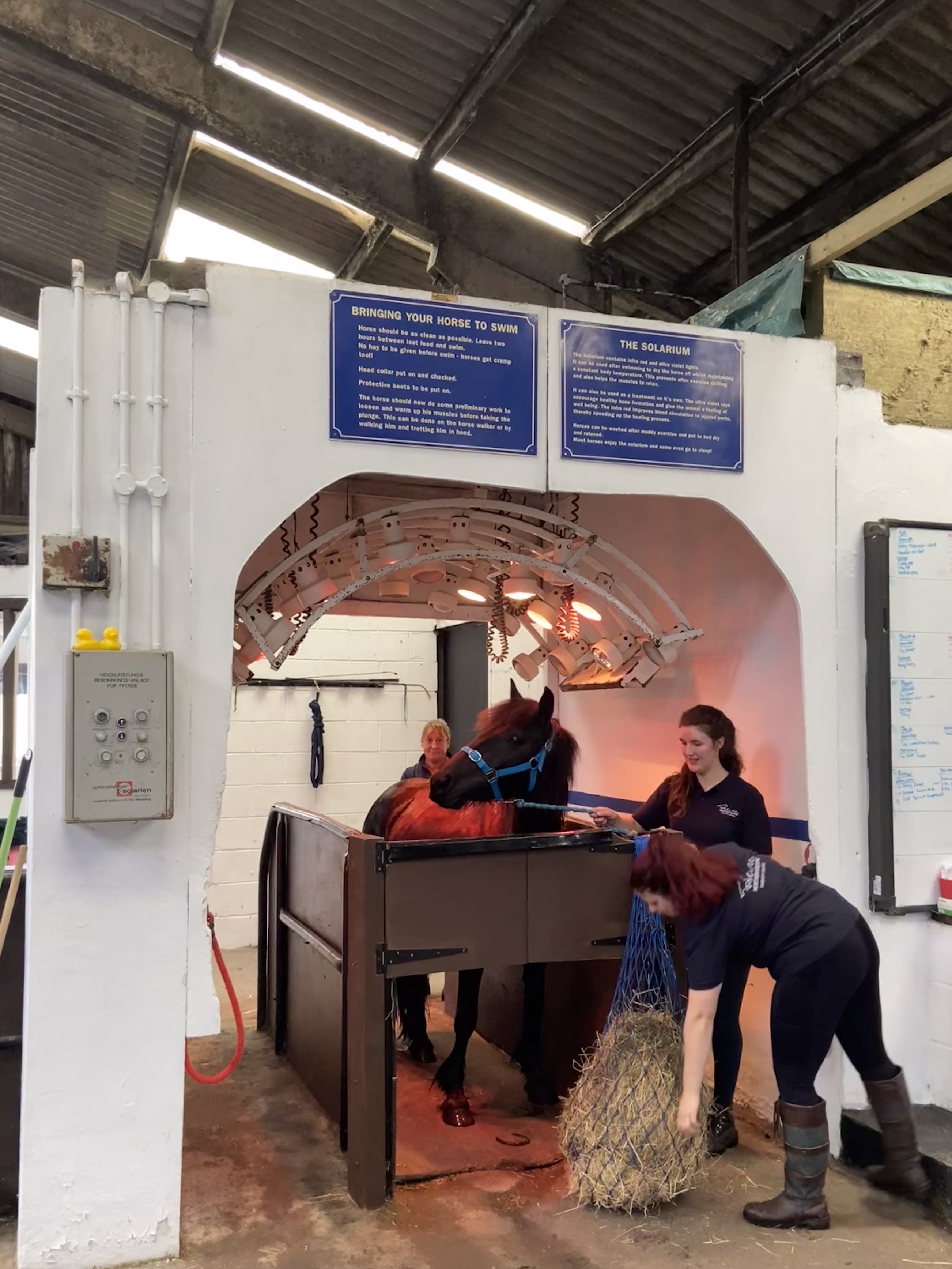
This week has felt so long, and has been so full, that it was almost a surprise when I looked back at my photos and realised that it was only last weekend I went to the Northern Canine and Equine Therapy Centre in Rathmell, where they do hydrotherapy for horses and dogs. They had advertised it as a coffee morning and we did indeed purchase a lovely coffee from a van outside the centre, but the real attraction lay inside.
The horse hydrotherapy session was due first, so we walked into the part of the centre where the horses were kept. I wish that I had taken more photos, but it was a lovely place and I instantly felt at home. The centrepiece of the covered yard was obviously the pool (pictured at the top of the page) but around two edges there were stables for the hospitalised horses. Some were there for lameness, some for weight loss and conditioning. Others were there, not so much for treatment, but for pampering. Imagine sending your horse away for a spa weekend!
Having swum round, the pony in the picture was taken out, towelled down, then treated with oils to replace the natural oils that would have been removed from his coat. He then was walked into a solarium to dry out a bit.
After we’d seen the horse swimming, we moved through to the dog pool. There. We watched as a dog physio put her labrador through his paces in the pool.
She told us about the different conditions they helped with. Her own dog doesn’t need any therapy, but he does love swimming. It’s also possible to book a half hour fun session with your dog and I immediately decided I’d like to take Triar to see if he would like indoor swimming. I also found myself wishing I worked there, or perhaps was a vet who could refer animals to them. It felt like a very positive place.
We had rather a bombshell last Friday afternoon, which I couldn’t bring myself to mention last week. My lovely boss, Kirsty, unexpectedly sent out a message to say she was leaving and her last day would be early in August. I will be very sad to see her go, and by the outpouring of shock, so will many of my colleagues. Both Lindsay (my Veterinary advisor – one step up from me) and Sue, who has just taken on a year long post after locumming on and off, called me up, mainly to express their sadness. Though it feels very sudden, it’s good for Kirsty and I hope she gets some much deserved time to relax.
Back at work on Monday, I visited a chicken farm with my colleague, Aleks. I have to do three visits with other vets before I can go solo, and this was my third. Because everyone is so busy, it’s difficult to find dates when two of us can go out together, so I’m glad my third accompanied visit is done. I have three of my own to do, so now I can more easily fit them into my timetable.
I can’t even remember what I did on Tuesday. It all feels so long ago! I was due to revisit a welfare case on Wednesday with David, who works for the local authority with animal health and welfare. We often work together and the revisit was to a farm where we witnessed some serious welfare issues before. But when he arrived, he asked me if we could divert to a more pressing issue. A group of pigs had escaped from their field and had turned up in someone else’s farmyard. It wasn’t the first time they’d escaped, but the farmer, quite correctly, now had them coralled in a barn.
Other authorities, including the police and the SSPCA had been called out when the pigs had escaped before, but nothing had been done. These situations are complicated to deal with. Animals do escape from time to time, and unless they’re on a road or causing risk, it’s really the farmer’s responsibility to get them back and secure them in the field or barn. For David and me, it was essentially a welfare issue. It’s not safe for the pigs to be marauding round the countryside. All farmers have a responsibility to keep their animals safe and keeping them enclosed within a safe area is key to that.
After the big foot and mouth outbreak in 2001, various laws were brought in to try to reduce the risks of another big outbreak. These included standstill laws on animal movements. If cloven hoofed animals (mainly cattle, sheep and pigs) are moved onto a farm, then the farm comes under a standstill order and for thirteen days, no animals can be moved off the farm without special permission.
So pigs landing unexpectedly on someone else’s farm presents quite an issue to that farmer, especially if they were planning on selling some animals, which our farmer was, and imminently. Our first action was to find out if the sale could go ahead. The pigs had not, to anyone’s knowledge, been near the animals that were to be sold, but equally, they had been loose, so where they had been was anyone’s guess. The movement ban applies to all animals on the farm, so the sale had to be stopped. That was done before we left the office.
Our next action was to visit the farm. It was an hour’s drive, but when we got there, I was able to examine the pigs. They were healthy and being well looked after. The main issue that had to be dealt with (or so we thought) was that they were not where they were meant to be.
Having looked at the entrapped pigs, we then went to visit the pig owner. The remainder of the herd were in a separate field from the ones who had escaped. To get to them, we had to walk through the field where the escapee pigs had been. There were some green boxes that looked like the boxes supermarkets use to deliver produce, but I had walked past them, keen to see if the pigs were okay. David had gone to get something from his van and I expected him to follow immediately, but when I turned to see where he was, he was standing at the gate, looking round.
He joined us eventually and we went and looked at the pigs. They looked well and the field they were in was (in my opinion) the perfect environment, with a small shelter, long grass and rushes to hide in and mud in which to wallow when the weather was warm.
It was only when we turned and walked back, that David told me what he had seen at the gate. Across from the supermarket boxes, there was litter, lying about. And in that rubbish, which was mostly food packaging, he had found empty packages for sausage rolls, ham and bacon, along with bags for bread and hot dog rolls.
I mentioned foot and mouth and the rules created after the big 2001 outbreak earlier. In addition to new rules on animal movements, strict rules were brought in about feeding pigs. Feeding them any kind of human food or kitchen waste is banned. We asked the farmer about the packages. It wasn’t impossible they had been left by someone having a picnic, but he didn’t know where they’d come from and said he thought people sometimes came and fed the pigs.
So now we had a situation, where there were empty packages for pork products that the escaped pigs had access to, and worse, that it was possible the produce, including raw bacon, might have been fed to the pigs.
These are the kinds of situations that have immediately to be sent up the food chain. Even if I had dealt with such a situation before, I would still have to call it in, without delay. The upshot of my phone call, and the work I have been doing for the last three days, is that both farms have to be locked down, with no movements of live or dead animals onto or off the premises, except under special licence. All the animals have to be inspected every 72 hours for signs of disease for a week, then probably weekly thereafter, for another two weeks. There was also the matter of the pigs being on the wrong farm, which was resolved yesterday, after lots of negotiation and paperwork.
So a vist which I thought might be a little complicated to resolve has turned into a behemoth case. One thing I will say is that we have an enormous amount to be grateful for with the farmer who took in the marauding pigs. She did everything right from start to finish, including calling us in. Chances are, the pigs don’t have foot and mouth, but now we have everything under supervision, so if the worst happens, we are already on top of it.
Had she chosen not to trap the pigs and call us, but had shoo’d them away and sent her animals to the sale, the potential for us being faced with another 2001 was there. That was started by pigs being fed improperly processed food and the disease wasn’t spotted until it had been sent all over the country. I may now be faced with three weeks of visits and a ton of paperwork, but this is the kind of work that can prevent a world of pain for farmers and a devastating cull that costs the country billions.
So this is what I am here for. I’m only a tiny cog in a very important chain, and kudos to both the wonderful farmer who called it in and for David for his observational skills. Next time, I won’t be so quick to pass by litter to look at animals.
But if I have one final thought, it is that I wish the government could see what we are here to do and how important vets and animal health and welfare officers are to this process. There should be more of us on the ground and the pay for those of us who choose to do this should be much better. Staff come and go, or work quickly to get promotion as there is no pay progression in our part of the civil service any more.
We need experienced people on the front line, but there is zero financial incentive to come and stay. Maybe saying this publically could get me into trouble, but if so, so be it. The people responsible for removing progressive pay bands for these roles have put the health and welfare of the nation’s animals at risk.
I work alongside a few, faithful staff, who have years of experience, a network of connections, a load of invaluable local knowledge, who are asked to train new entrants on the same wage as them. That is both plain wrong and absolute insanity. We should be making sure those people have an incentive to stay, that they know they are valued and that they don’t have to move to a different job to be properly rewarded.
And on that cheery note (sarcasm alert for non Brits) I shall leave you to your weekend! Have a good week all, and see you next week.
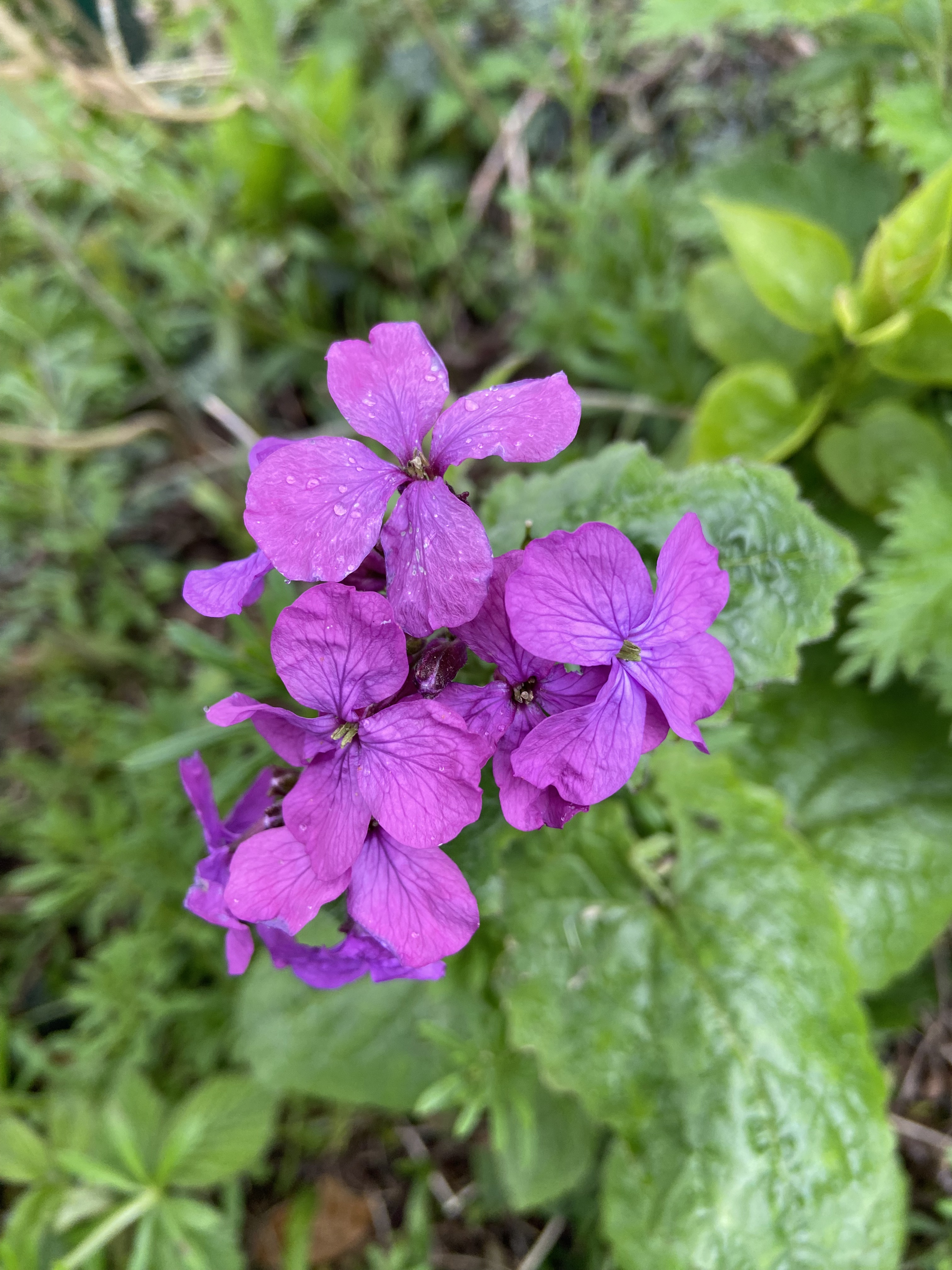
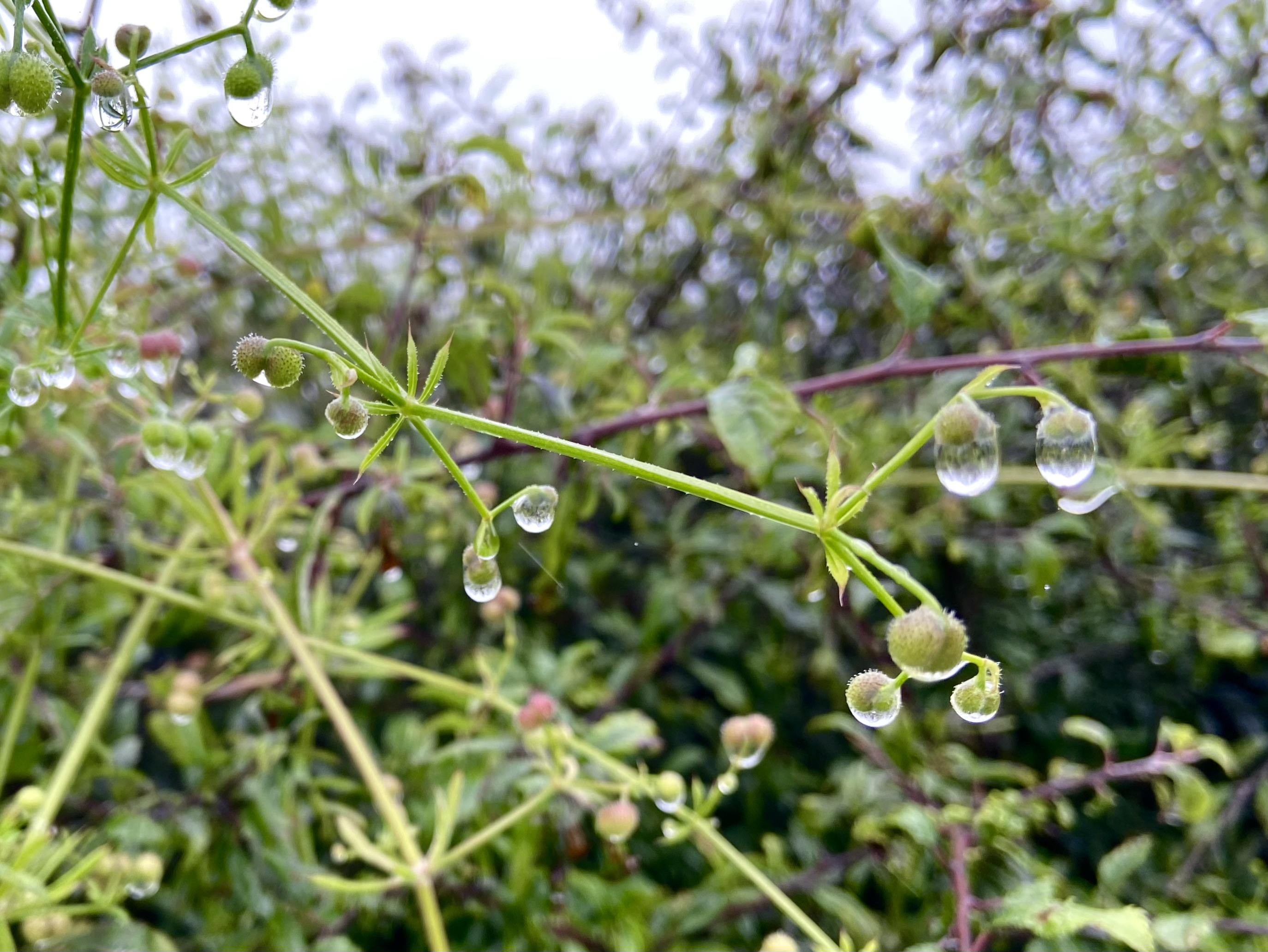
A few “after the rain” photographs for those who love Blackbird Lane.
This has felt like the longest week yet. I was duty vet on Monday, Tuesday and Wednesday. At any given time, there are three vets covering direct enquiries in Scotland and these can vary hugely from issues that are directly relevant to other tasks we do (TB, welfare, notifiable or reportable disease, animal by-products) to enquiries that have effectively been sent to the wrong agency or department. For example at one point, I had a question about sheep scab (a reportable mite infestation) alongside another about some brown banded cockroaches that had been seen in a consignment of books brought in from India.
The first of those – the sheep scab – is absolutely our territory. That one I knew I would have to deal with from start to finish. The cockroaches? Really I am clueless. So the first part of my task was to working out which of the tasks was mine to complete and which should be forwarded on. As a complete novice, even making that decision isn’t straightforward. The two other vets on duty with me were busy with their own tasks. There’s a more senior vet on call, but that’s mostly for consultation on serious cases at nights or weekends.
I had thought, before I started, that it was only three days. How bad could it be? But by Monday lunchtime, I was overwhelmed. I was told to follow various checklists, but without prior understanding, they didn’t have enough detail. The instruction, “obtain owner or keeper’s e-mail so restrictions can be served and lifted with fewer delays” sounds straightforward enough, but there are multiple different systems where that e-mail might be recorded. Moreover, those are so complex that looking things up could take an hour and even then, I might still not have found it.
Finally, in desperation, I called my veterinary advisor, Pilar. I probably should have done it earlier, but I knew she was busy and she had already spent hours with me, trying to prepare me. Fortunately she was empathetic and understood how out of depth I was feeling. I had actually reached the stage where I was contemplating switching off computer and phone and walking away, but she talked me through everything in simple steps, told me I could gather most information by calling the vet who diagnosed the scab and the farmer whose sheep were infected and gave me a list of what to ask each. The cockroaches, she directed me to another APHA specialist, who would be able to advise.
It took me a very long time to work through that sheep scab case. Next time, it will be much quicker, but the good news is, that by the time I phoned cockroach guy back afterwards to find out more about his query, he’d already had the Forestry Commission in, who had dealt with the problem. As someone else pointed out, almost none of the enquiries are urgent, but it still feels overwhelming. It will get better over time, but those three days left me feeling wrung out.
Having survived the three days (and nights – no calls, but not relaxing knowing the possibility is there) of duty vet, I was hoping for a good end to the week, but it wasn’t to be. On Friday, I had booked in a welfare investigation with David, the local authority inspector. As regular readers will know, mostly those investigations reveal good welfare, but occasionally the reports are accurate, and this was one of them.
There are two main sets of rules we follow. There’s both the law of the land (Animal Health and Wefare Act, Scotland, 2006) and a more stringent set of welfare guidelines that farmers sign up to in order to receive government subsidies. Up until now, I have mostly visited farms where the farmers were broadly compliant with the guidelines, which represent a higher standard than the law. There have been a couple who met the law but not the guidelines, but until now, I haven’t seen any proper breaches of both.
There are various protocols in place for dealing with breaches, depending on severity. Minor breaches can be corrected with simple guidance. There’s a sliding scale from there, including serving notices for improvement within a specific timeframe, calling for direct action while on the farm (such as calling the private vet or requiring that animals are culled) right up to prosecution, for the most serious cases. The latter is usually (though not always) a last resort after improvements haven’t been made.
Anyway, yesterday I had my first Scottish breach. I’ve dealt with some in Norway before, so the welfare signs and how to record them are similar. However the protocols differ and it’s easy to put your foot in it. One thing I have learned is that, when I come across welfare problems, it’s intense. There’s a lot of pressure to make sure you get stuff right. If you say the wrong thing, the farmer can get prematurely angry or defensive, which makes everything more difficult. On every case I’ve reflected on afterwards, I have looked back and realised there were ways I should have done better and some things I learned. This is my initial list after yesterday. I know more will crop up as the case is processed and followed up.
Firstly, don’t forget to take supplies. There’s a minimum kit I should have had with me and didn’t. In Norway, we used disposable overalls and boot covers on every farm and I would go round the stockroom and pick up measuring implements, microchip readers and other equipment each time. It had become routine. Here there are certain items I am meant to have with me at all times, but I went out with someone from the local authority and (incorrectly) assumed that the LA inspector would have everything I needed. I don’t think it caused any catastrophic problems, but that was only by good fortune. I can easily rectify that for next time.
In addition, I will never again go out without food and drink. Generally such inspections take a few hours at most and we can go and buy lunch, but this time, there was a lot to get through and I was uncomfortably thirsty before we managed to take a break. In Norway there were often no cafes or shops within a two hour drive. Thomas never ever went anywhere without a can of cola and something to eat and I had started to do similar. Again, an easy lesson.
Second, don’t do welfare on a Friday. Graham mentioned this and it’s great advice. Sometimes it’s unavoidable, but in fact, it can cause no end of problems. Vets go onto out-of-hours rates and limited staffing at weekends, so if a call-out is fairly urgently required, it’s more complicated. Worse, abattoirs close for the weekends. They did in Norway too, but we had an emergency slaughter service 24/7. Labs close. If you want to send them anything, and it’s late, you can’t leave it till the next day. Even from the point of view of our own follow-up, it would have been better to go through the case the next day and not have two days in between.
Third (and unexpected). Don’t use the word evidence. It’s a funny thing to reflect on, but I never accidentally used that word in Norway. I didn’t even know the Norwegian word when I started working in Finnsnes! I rapidly learned how important language was when I started out in practice years ago though and now I need to learn what works in this role. The way you phrase things makes a massive difference to how the person on the other side of the exchange reacts.
To me, it felt like a technicality. Evidence is stuff I see and write down. It can be positive or negative, but it was obvious when I used it a couple of times that it instantly conjured the threat of a court case. Next time, I will find alternatives. If I ask to take photos, it’s not for evidence, it’s to get or record a full and accurate snapshot of what I’m seeing. Doing that is easily described as being in everyone’s interest. There are so many police shows now that the rights they read out (that include the word evidence) are probably at the forefront of people’s minds. I’ve always thought it would be easier to do this job in English and there’s no doubt it is, but there are new pitfalls and I need to adjust.
Anyway, as well as the things I got wrong, there were others that I did get right. The habit of using descriptive, observational, factual language, not opinion became second nature in Norway. A cow is not “thin”. Thin is an opinion. Instead I might write that “I can see her ribs and the bony prominences of her pelvis and spine and I rate her body condition score at 2” (with an explanation of what the condition score means). Those are facts. Realistically, “thin” is shorthand for “I observed those things” but it can open up the problem that different people might assess “thin” in different ways.
On my suggestion, David drew a map. I learned that from police in Norway after working on a case with them. It makes it easier to keep track if you have all the farm buildings mapped out and the sheds numbered. You can then describe more accurately where you found various animals and what your photos show.
This is a Scottish/British one; I should record important words verbatim. I learned that on a statement writing course. It’s not easy to do that as conversations go faster than I can write, but writing down someone’s actual words removes any confusion created by a summary of what you thought they said.
And finally, I’m going to end with something David told me. It can feel overwhelming during a welfare case, especially if there are many issues that need to be addressed. Again, harking back to Norway, even if I managed to improve things, I could still get bogged down in what I didn’t achieve, because it could have been done better. But as David pointed out, in the end of the day, if the actions I took relieved the suffering of a single animal, that was still an important achievement.
Though in some ways, the weeks seem to rush past, by the time I write this blog, things that happened Saturday to Tuesday always seem distant. I will be wandering round, on one of those days, thinking “I’ll have to write about this,” then by the end of the week, something else displaces it. Ideally, I should start logging in as things happen, but hey, I’m not that organized! Anyway, this week I have carefully stored away a couple of things I really want to share. The first is about a welfare inspection I did on Tuesday.
I’ve probably said it before, but the sheer size of farms now, compared even to fifteen years ago when I left, is astonishing. When I qualified as a vet, in 1991, larger dairy units might have had 150 cows. Numbers were creeping up though, and by the time I left the UK many of the bigger herds had expanded to having over three hundred cows. Now it seems to be not unusual to have a thousand, sometimes even more.
I have been wondering how welfare is maintained on such a unit. Back when herds were smaller, most farmers knew their animals well. I went out with a dairyman when I was at college and he knew the personalities of the cows he milked and there were some he was very fond of. I remember seeing him cry when he’d been away on holiday and came back to find one of his favourites gone, due to the carelessness of the relief dairy worker that had been covering for him. No wonder some farmers barely take holidays.
I am not under the false impression that bigger is inevitably worse. Those who have expanded are often the most efficient and forward thinking farmers. They are investing in the herd and their own future, but still I had been wondering how. These are living animals and to keep track of when they are in season or in calf, or are sick, takes a lot of time for observation and knowledge.
As we walked along the calf pens, I could see they were being bucket fed. Lots of bigger farms use automatic feeders for their calves, but not here. The farm is run by a couple and (fairly traditionally) it’s the woman who is responsible for feeding the calves. They did have automatic feeders for a while, but found they tended to get dirty. In addition, teaching them to drink from a bucket prepares them for going into bigger groups and being given milk from a trough. You can also check how much milk each calf gets and individualise each one. I guess it takes a long time at peak calving time, but it was interesting to see that a good start in life is so important that industrialization hadn’t occurred (or rather, had been tried and rejected) on this part of the farm.
As we moved from the calves to look at the close-to-calving cows, I was interested to notice that the nearest cow had something attached to her foreleg. I asked what it was, and was told it was a movement monitor. Just as I wear a watch that can tell me how many steps I take each day, the cow’s steps were also being monitored. I wasn’t immediately sure what purpose this would serve, but later, he took me to the computer where these measurements were read.
He showed me a the readings of a cow that was coming in season every month or so. Sure enough, the movements peaked hugely at that time. But it wasn’t only that he could look at the program and see which animals were in season. The system itself recognizes the pattern and, as the cow comes out of the milking parlour, where it goes twice a day, a gate automatically opens to allow it through into a different area, so she can be inseminated. A person walking through the cubicle shed to separate out these cows disturbs all the other animals. Instead, this is another process that is mechanised to minimise both the work required and the disruption to the herd.
Automatic scrapers to clean passageways in cubicle sheds have been around for a long time. Usually they are pulled by chains or ropes and there were some of those here. The chains were in runnels to prevent the cows standing on them and hurting their feet. One of the sheds had one of the newer machines, that functions like a robot vacuum cleaner. These have the advantage that they can go round corners, so there are no missed sections, which there are with the chain scrapers.
What I hadn’t seen before though, was an automatic scraper for moving silage. Usually cows are fed in a passage, where they put their heads between bars and eat the silage and feed that is put there. As they eat, the food gets pushed away, and usually someone will drive along with a tractor now and then and push it back in. Here, there was a machine that ran along a metal track, doing the job automatically for all the big sheds. It runs every two hours, except just after milking time, when it is set to go hourly, as the cows tend to be hungry when they’ve just been milked. Again and again, I saw that, although this system was on a large scale, there were tweaks and tricks that meant that it was really set up, based on what the cows needed.
And finally, back to the matter of the individual animal and the personal relationship. I can’t say I really touched on this with the farmer, although it was apparent as we walked round, that there was still fondness for individual animals. He did tell me though, that where his dad had always been keen to give every sick animal a chance, he tended to be more ruthless is removing animals with bad feet or which had been ill enough to mean they probably wouldn’t thrive. One thing I have observed from life as a vet is that there is a lot of unconscious cruelty by some pet owners, who keep their pets alive long after that life stopped being worth living. Perhaps in a system where animals with bad feet get removed quickly, breeding from those animals that are left will create a better herd, with fewer foot problems in the future. Anyway, I really enjoyed my visit. Cows are still cows and they are still my favourite animals and these visits give me plenty of food for thought.
The other memory was from last weekend. I mentioned I had been told there was a man in his nineties, who’d lived here all his life. I ran into him last weekend. He has a garage at the end of the street where he makes wooden toys for children. He beckoned Triar and me in, and gave Triar a biscuit. Though he was in a wheelchair and his hands were shaky, he was painstakingly painting a toy duck that would go on a stick. There would also be feet attached to a wheel that would spin as it was pushed along the ground.
I asked him if he sold the toys and he said no. He gives them away, and the look on the child’s face is payment enough, he told me. If I ever have any children to stay, I will undoubtedly take them along to see him.
He also started to tell me a bit about the street and I resisted the urge to ask him if I could record what he was saying, as it was lovely. He had lived in the street law his life, he said, and could remember back to the time when it was a village and not part of the town. The doctor came out rarely, he said. If someone was sick, they called for Mrs Black. Mrs Black was also the one you called on if someone was giving birth. We also had a discussion about the healing powers of honey. As antibiotic resistance is growing, even in the vet world there is starting to be more exploration of how old remedies can be better integrated into modern treatment. I bet Mrs Black could have taught us a few things about helping sick people that we have lost in our rush towards modern medicine.
Anyway, I’ll leave you on that note. The pictures are from Blackbird lane, where Triar and I are still walking, morning and evening. This week’s unusual birds were a tree pipet and a mistle thrush, but the blackbirds haven’t deserted. Have a good week and thanks for reading!
I have been down to Weybridge agent this week, this time for a cattle handling course. Before going, I was rather cynical. After all, I’ve been a vet and have worked with cattle for a long time, I’d done a course in Norway about the design of facilities in abattoirs, where I learned about behaviours, so I rather thought it might be a lot of repetition. The two colleagues who attended with me were actually farmers, so I think they had the same concern, but it warm in fact, very interesting.
The essence of the course was to teach us about health and safety when it comes to cattle. I haven’t read it yet, but there is a health and safety document (HS32) regarding handling facilities and minimum safety standards when we go to a farm, what we should look for and when to walk away.
There’s a drive in UK farming at the moment and grants available for building safer facilities, we were told. Farmers who provide inadequate, unsafe facilities are paid the same for their products as farmers who don’t, so if we walk away, for valid reasons (backed up by HS32) then there is legal pressure for them to comply. If they don’t, they will find themselves under a movement ban. As someone who probably would have tended to push on through, this in itself was a good message. Take it further and it’s also good for the animals. Escape attempts that go wrong don’t only result in risk to the human beings present, but to the animals as well.
Most of the course was led by Miriam Parker, and if you are interested in what she does, there are videos online. In essence, she designs livestock handling facilities with the animals in mind. If you want an animal to go somewhere, the best way to do that is to design the facility so the animal wants to walk through it. Ideally, you want the handlers to be able to guide them from outside as well, as that is much safer.
I had learned about flight zones before: the area an animal maintains around itself – enter it and the animal tries to move away. I also knew about the balance point – if you stand behind its shoulder, it tends to move forwards, in front, it moves back or turns. But we also looked at the behaviour and signs of discomfort when you are in the flight zone (a potentially risky place to be) and the limitations of cattle sight.
I had always thought that, with their eyes in the sides of the head, that cattle were mostly looking out to the sides. Not so! They have very wide peripheral vision and can perceive movement there, but most of their attention is still focused in front of them. I should have known that really. When they stand looking at you in a field, they do look straight at you, after all. What they do have though, is a great big blind spot in front of them, which means it’s much harder to judge distance when close up, for example. If you wondered what the picture at the top of the page was, it’s my colleague, Lesley, wearing a pair of spectacles that allow you to get an idea of what a cow sees. No wonder, when cows are walking into somewhere that looks strange, they take a lot of time, putting their heads down and to different angles, trying to eye up not only whether it’s safe, but whether they can get through at all.
We also went out to a field, where there were some fairly flighty calves. Our group of about twenty was split into smaller groups, then we were sent out in turn to try various exercises, such as getting them to walk to different places in the field. This proved to be quite difficult as getting them moving slowly in the first place was one thing. Slowing them down if they took off was much more difficult. Miriam explained the importance of moving back to give them space, rather than pushing them on, or standing close to keep them where you want, to the point where they’re stressed and milling. Step back and they are more likely to relax and stand.
I had been disappointed with my performance with various teams for much of the exercise. However the last task of the day was to try to split off two calves, leaving the others in a group. Many years ago, I used to stay up late into the night, watching One Man and his Dog on TV. For those who don’t know, this was a shepherding competition for a shepherd and his sheepdog, where they had to guide the sheep round the field, through various gates and into certain areas, before guiding them into a pen and closing the gate.
One of the exercises they did was to separate out two sheep from the rest of the flock. How many times did I watch as those calm dogs edged towards the group, moving in an out until they saw their chance? A gap would form, where two of the animals started to edge away and the rest weren’t quite ready to follow, and then the dog went in between them, cutting the group cleanly into two. To my enormous pleasure, I found I could do this instinctively, and for the first time that day, our group performed this task smoothly and without a hitch. It was a great end to the session.
Good as the cattle course was, it was also great to spend some extra time getting to know my colleagues better. As well as Lesley, we had Lauren there. Both of them are from farming backgrounds and, like many people from farming stock, they are very down to earth, as well as funny and practical. I’ve always felt that the people I work with are what make the most difference between enjoying work or not and I’m looking forward to working with them more!
I’ll finish with a few photos from my new garden. Though it’s running a bit wild at the moment m there’s plenty of colour and lots to look at. Have a good week, all!
The rain is hurling itself against the window as I write this, having returned home after half a week in Stranraer. The wind there was relentless and felt like it was filled with icicles. Not quite the balmy, maritime climate I might have hoped for. Despite the chilly wind and the sleet that fell, the fields were still green and many animals are still outside. So different from the months of snow and ice in the far north. I finally found the time to take a few photos when I was out and about, which I’ll share in between the streams of reminiscence!
It was strange being back. A lot has changed in the last thirty years, although one thing that hasn’t changed much is the little lodge house I lived in back then. It now has oil central heating, where once the only warmth came from a coal fire, and the wheelie bins are out front, rather than tucked away at the back door, but other than that, it still looks much as it did when I lived there. I swore, after those eighteen months that I would never again accept a house without central heating.
The practice I worked in is long gone. The younger of my bosses sold it to the neighbouring practice (now Academy Vets) years ago. I went into Academy Vets as I had to chat to them about a case. I thought I didn’t know any of the staff, but I discovered that one of the senior vets had seen practice with me when he was a student, which illustrates how long ago it all was. My older boss is still around, apparently. Hopefully I can visit him, next time I’m over.
Simpson’s the bakers is still there on the main shopping street. I remember Anne, the kindest receptionist ever, asking if I wanted anything from Simpson’s at lunch time on an almost daily basis. I bought a sandwich: coronation chicken on white bread and they must still be using the same recipe as they used, all those years ago. It was as delicious as I remembered, though it now comes in plastic, where once it was in a white paper bag. The cakes haven’t changed either: very traditionally Scottish, all intensely sweet, no fresh cream and some very garish icing.
I was quite surprised (and rather saddened) by how unfamiliar a lot of it seemed, though I did keep tripping over memories over the course of a few days. I thought the Morrisons supermarket was new, but when I went in, it dawned on me that it was the precious supermarket that was built when I was there. It was Safeway when it arrived in town and was a wonderful addition. Before that, there was only a dim and narrow W.M. Low’s that I would walk around, looking for something for dinner, finding no inspiration. Morrison’s was closer to the centre than I remember and I don’t recall using a roundabout to get into it, but maybe I’ve just forgotten. A colleague who grew up in Stranraer reminded me that the old cattle market was knocked down to build it, and I do recall that as well, but only in the vaguest of ways.
Mostly I drove around, thinking how unfamiliar it all seemed, though when I drove away from Academy Vets (where we used to take dogs for x-rays as my practice didn’t have one) I knew exactly how to get to Lewis Street, where McTaggart and Williamson used to be, and for a few moments, I felt as if time had shifted.
Though my time in Stranraer wasn’t particularly happy, it is where I met Charlie. He took a job in my practice, having spent time as a student doing extramural studies around the corner in Academy Street. We were married twenty three years and have three wonderful children together, so it was a significant time in my life.
Anyway, enough reminiscing and back to the present. This week I have been learning about tuberculosis. It’s important that I do as I will be taking over several TB outbreak cases in just over a month’s time, when my Stranraer colleague goes on maternity leave. Although I’m learning a lot at high speed, I am now reaching the stage when I can see just how much I don’t know.
There’s an online course I need to take, as well as having time for the cases to be handed over. I am finding out where to look up case handling and I’ve an offer of help with the tracing and epidemiology, but I am still going to need a lot of guidance. Each case is different, depending on whether there were signs of TB found when an animal went to slaughter, or whether it was picked up during a skin test, and beyond that how exactly the case progresses, once a positive skin test occurs. There are a multitude of pathways, depending on those factors. I did the skin testing thirty years back, but there were no positive skin tests back then, so the rest is new to me.
Now in addition to skin tests, they can take blood tests and are beginning to understand some of the genetics. Tracing where it came from (and where it might have spread to) is now becoming more clear. You can sometimes tell where a strain might have come from, because it is genetically similar to a separate case. When I was testing, thirty years ago, there was no TB in the area. The aim is to return to that situation, but I think that will take a very long time, if it’s possible at all. Only time will tell.
Yesterday, R and I visited a farm where the investigation is just beginning. One of their cows had a small reaction to the injection during a routine skin test. When tested again, sixty days later, she reacted more. Now she will sadly be taken to slaughter, where they will check her for visible signs of TB and also do a PCR check, where they look for TB DNA. After that, whatever the result, the whole herd will have to be checked again. Until they get the all-clear, with no reactors, they cannot sell any of their animals, or move them off the farm, other than for slaughter. It’s a huge blow to any farmer to find out some of his cows will have to be culled and that there is disease in the herd that can spread to humans. I hope, for their sake, that the tests all come back clear.
I had left my car in a car park in the middle of nowhere while R took me to the farm, and on my return, I was quite surprised to see a van parked beside it. R headed off and to my surprise, the driver of the van came over to chat to me. He was wizened as if he had spent a lot of years battling the weather, but he seemed cheery as he told me he was a mole exterminator! He is seventy five, he said, and still tending to over seventy farms, though in his heyday, he cleared a hundred and twenty. I confess that it had never crossed my mind that the job of mole exterminator existed, but he seemed very upbeat about it and was obviously very efficient. It did cross my mind that perhaps I should consider a new career, but he said he thinks he has someone lined up to take over his patch when he finally gets too old.
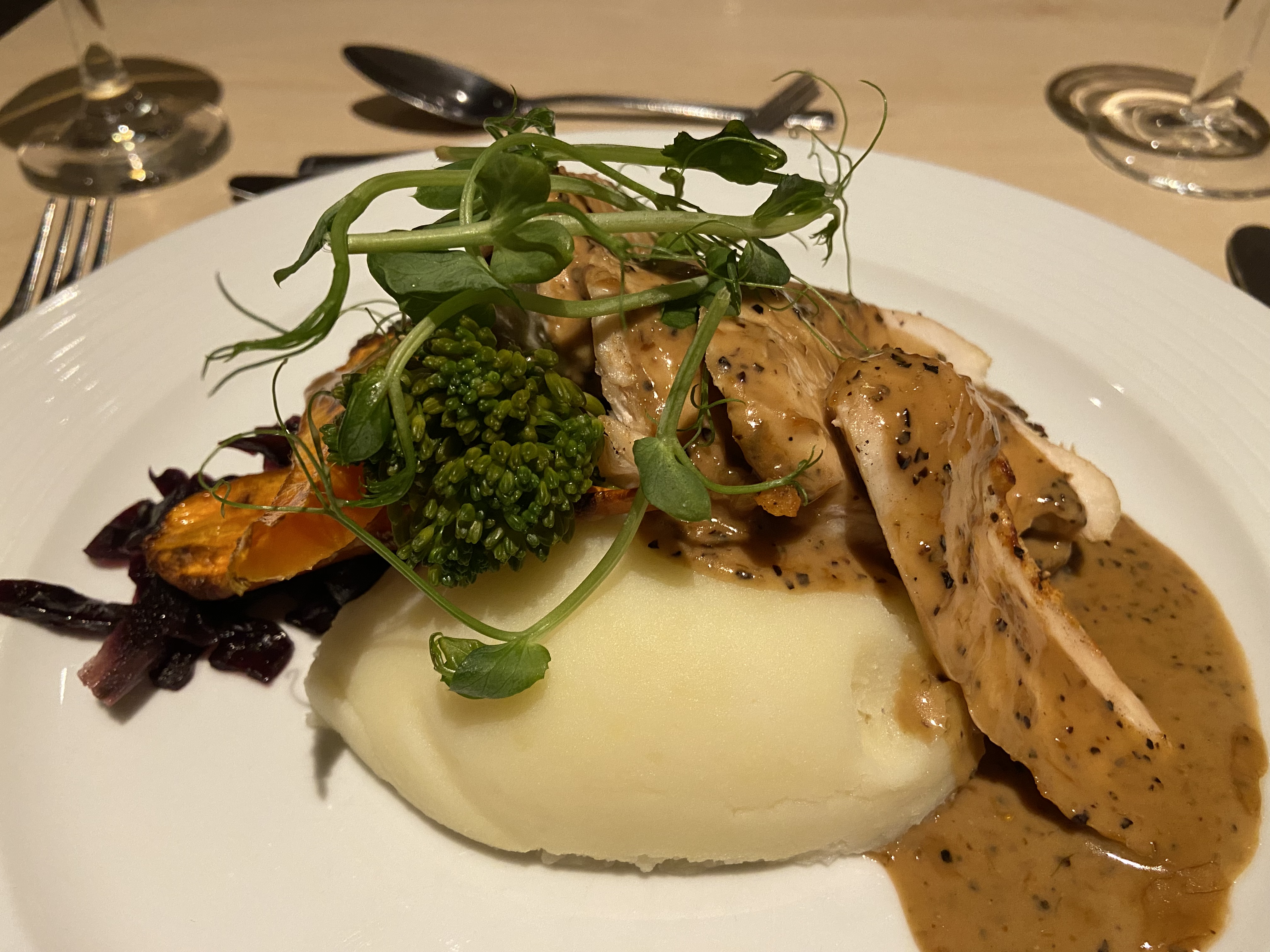
Anyway, I’ll leave you with some food pictures. I ate every night in the North West Castle Hotel and would highly recommend it!
Sea bass with creamed potatoes, prawn and chive butter and seasonal vegetables Breast of chicken with mash, haggis and peppercorn sauce
I’d like to tell you about a wonderful woman I sometimes work with called Gry. She works as a nurse in the community, as well as running a sheep farm with her husband. She also works with me now and then on animal welfare cases as a member of dyrevernnemnda – people from the area with experience with animals and an understanding of their welfare needs.
Red rocking chair with white sheepskin
We were out together on a visit on Monday. I love having her there as she is very knowledgable and can talk to anybody. She also knows a whole lot more about sheep farming in the Arctic than I do!
The visit had gone well – always a relief, so as we drove away, I asked her if she’d like to go somewhere for coffee. Our options were limited. We wandered into the local hotel, but the bar was empty. We resisted running off with the Peach Schnapps and climbed back into the car.
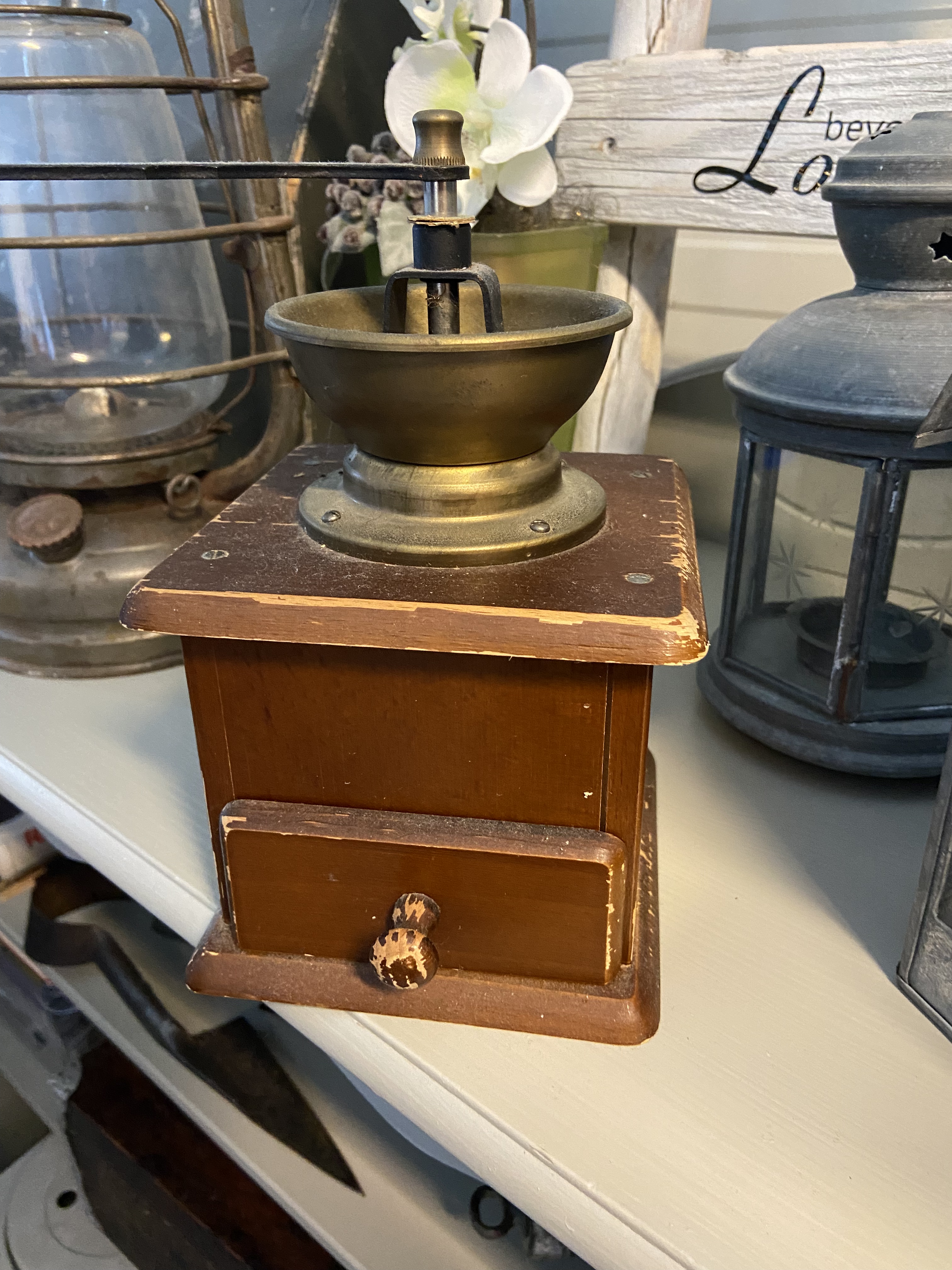
An old coffee grinder in brass and wood
Gry suggested we could buy a sandwich at the garage and go back to her barn and she would make coffee. Her barn is wonderful. They built it in 2016 and it has a living area that’s almost as big as my flat. They sleep there during lambing time so they can keep an eye out at night.
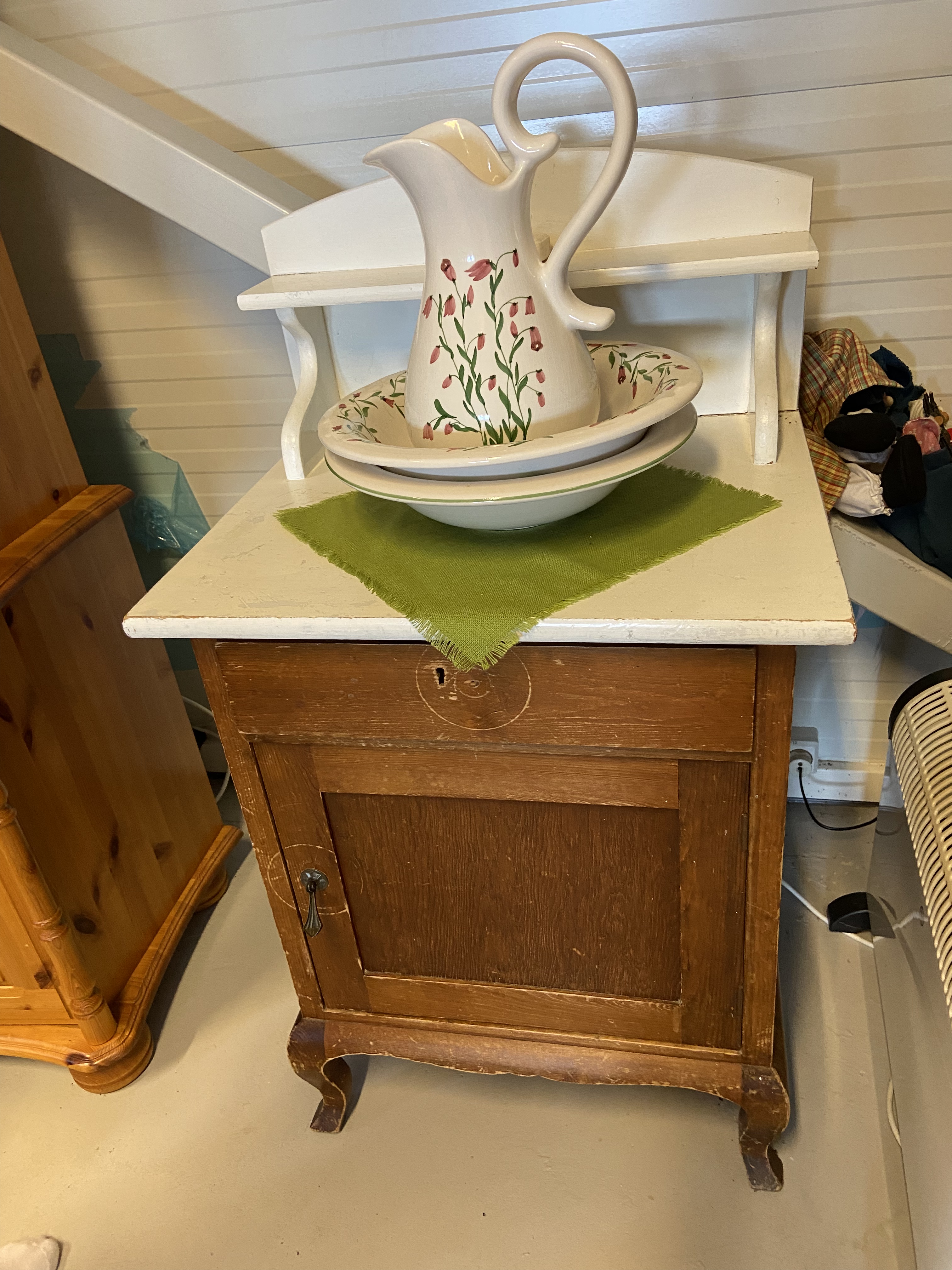
Ewer and basin, standing on an old-fashioned wash stand
She took me in and I sat down at a big wooden table with a cosy red table cloth. As she made the coffee, I sat looking around at all the wonderful objects she has collected. This is an old waffle iron.
Waffle iron – one of three
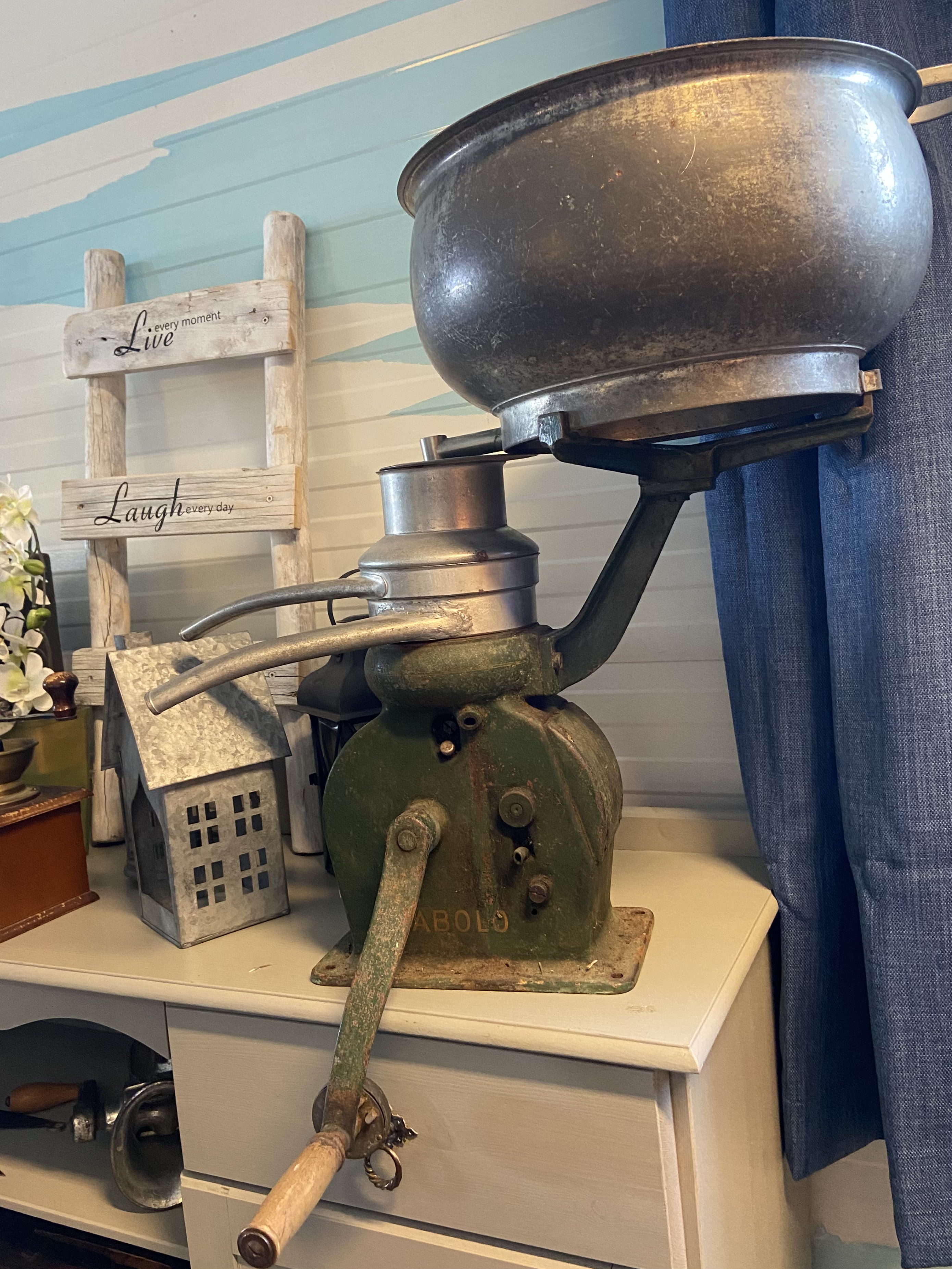
But there was one object that I didn’t recognise, and so I asked her about it. This, she told me, is an old gadget for separating out the milk from the cream. Those of us who are old enough to remember milk in a bottle on the doorstep will also remember that the cream is lighter than the milk, and so it rises to the top.
Milk separator
Gry told me that she works with dementia patients, and sometimes she brings them back to the barn. They see the old things and respond with pleasure.
She was at a museum with an old man. They had a milk separator there too, which they had taken apart.
It has seventeen separate components inside and they have to be fitted together correctly for it to function. Despite being often confused, the old man’s face lit up. He set to and in minutes had reassembled the separator, with everything in place.
Some days my job can be tough. Few things are more distressing than animal cruelty.
But then there are other days when everything goes right. And just now and then, I discover that alongside the animals, I am also working with some of the most warm-hearted people in the world.
I said earlier in the week that if I didn’t post, I’d be swimming in photos by the weekend. Despite doing so, I still have so many things I want to share with you that this will be a whistle stop tour of Tuesday and Wednesday evenings.
There are lots of tunnels in Norway. Many roads which used to go through mountain passes, or clung to cliff edges around insane bends, have been rerouted to go through or under. Sometimes, the old road stays open, either because there is a village or walking area, or otherwise to provide an alternative route in the event that the tunnel is closed.
There is a tunnel on the E6 just south of Sørkjosen and Birgit recommended, on Tuesday evening, that I explore the road it replaced. The first section was flat and of the clinging to the cliff face variety. There were road signs reminding drivers not to forget to go round the bends and I wondered how many unwary tourists, distracted by the scenery, had gone over the edge before they decided they really ought to put up notices. The view really was worth looking at. One of the first things I saw was this classic red barn, built into the mountainside above the fjord.
Red barn with fjord and mountains on Jubelen.
The road itself is called Jubelen and Birgit told me that like “Rest and Be Thankful” in Scotland, it was probably named by people who were heartily glad to reach the top of a stiff climb. Shortly after the barn, the road began twisting its way up the fellside. There was a car park at the top, where a frozen lake was surrounded by warnings that it was drinking water and shouldn’t be polluted. The way onwards was blocked for cars and impassable without skis, so I climbed out of the car and decided to take a walk back down the road to take some pictures.
The road onwards was closed to traffic.
I walked quite a way down the road. It was a bright day and the sunshine warmed my back as I tramped down the hill. I have been noticing, for the past week or so, that there are patches of green appearing through the snow, particularly on banks that face the sunlight. Often when snow disappears, there can be weeks where everything looks brown and dead, but some of the ground cover here is so hardy that in places it is pushing its way through the snow. After months of white, these intense patches of colour are very cheering, as is the wonderful chatter of newly flowing streams that fills the air.
Further down the road, there were beautiful views across Reisafjord to the mountains beyond.
Reisafjord from JubelemReisafjord from Jubelem
There was also this wonderful frozen waterfall. I guess it doesn’t get much sunlight, being on the north side of the mountain. A mixed blessing for me as it was hard to photograph with the bright sky above and behind, but I hope you can get some idea of the blue, icy beauty.
It was slower, walking back up the hill. I noticed a few things I thought I’d like to share with those of you who live in warmer places. The roads in Norway are kept remarkably clear, even when there is heavy snow. Gradually the snow builds up on the verges until there are piles so high that in places, you can’t see over them. A friend commented on Facebook that if she was driving here, she’d never get anywhere as she would stop so often, but once the snow arrives, there are very few places you can pull off the road. The laybys and passing places all have to be cleared and side-roads and entrances become narrow and hemmed in.
As the snow has begun to melt, I have noticed that it happens unevenly. Quite often the piled up snow has begun to resemble castle ramparts with regularly spaced clumps of ice perched along the top of the wall.
Winter is obviously hard on asphalt. Lots of the newly-revealed roads have deep holes. During winter, they were filled and masked by the hard packed snow and are only becoming apparent as it melts. Long cracks also appear, many of which look like they were patched up last summer, only to have widened again.
For now, the roads are dry, but when it rains, or the snow melts, there is nowhere for the water to escape. And so as we begin to approach spring, those clearing the roads have begun to create gaps in the ramparts so that some of the water can escape into the ground.
One last picture. As I drove back down and reached the bottom of the hill, I stopped to take another photo, looking back towards Sørkjosen. If you zoom in to the bottom right (thank you Lara!) corner of this picture, you can see the hotel where I was staying!
Zoomed in shot – hotel on the left and the surviving pre-war building opposite
Wednesday night was quite the contrast. As Birgit had warned me on Tuesday, the weather closed in and by Wednesday evening the skies were heavy and there was snow in the air. Birgit had invited me to eat with her at home and so after work, I followed her on the road that led north from Storslett and out to her house.
I have posted about the wonderful red barns here before, and to my delight, Birgit has one of her own.
Birgit’s fjos.
Birgit has a small herd of Lyngshest that she and her partner use for breeding and riding. She tells me that once a week, a group of local pensioners come and ride out with her partner, Geirmund. I have often thought Norway is a good place to grow old (often the ski slopes are free for over 70s) and this sounds like one more wonderful discovery of active retirement. She led me into the barn where we found the farrier working.
This is Rein, who is 22 years old
We went in the house and were greeted by the lovely aroma of food in the oven, and by Birgit’s seven year old Bouvier de Flandres , I Mo. He was as warm and friendly as Birgit herself and very soon, as we stood in the kitchen, he lay down on my feet to keep them warm.
Birgit’s house was wonderfully cosy and filled with photographs of horses and Birgit and Geirmund’s family. Her children, like mine, are mostly grown up, but as we walked into the living room, we were greeted by one of her two cats.
Tigra is three years old.
Once the farrier was finished, Geirmund came in and we ate together. After that, Birgit took me on a proper tour of the barn, or fjos, as it is called here.
It felt like a slice of heaven to me. As well as the older of the Lyngehest tied up in stalls there were chicken and sheep. Lead ropes and sheep-bells hung on the walls and there was the sweet smell of horses and hay.
The younger horses are outside. Despite the patches of snow and the dampness of the ground as it melts, they too seemed to be thriving. Birgit tells me they are very even tempered and cheerful, even when faced with injury or difficulties.
This beauty is Reisa Virko. Virko is Sami and means lively.
Despite the mud and the snow, we went for a short walk afterwards down towards the fjord. I stopped to take the photograph of the tractor and floats. I saw them on top of a bank as we walked past and I couldn’t resist. Farming and fishing, thrown together, old, but probably still working. Note also the boat with the green deck in the background. The far side is filled with holes, but perhaps there are parts that can be used. And you can also see the ubiquitous wires that spread over so much of the landscape in Norway. Often I try to photograph round them, but here I felt they were very fitting.
As we passed the tractor again on the way back, Birgit told me that in winter, there was an otter slide on the bank beside it. Presumably the otters will head into the fjord shortly for the summer, if they haven’t already gone. As for me, I hope that I will be back here very soon. Thank you Birgit for a lovely evening.