I said last weekend that it wouldn’t be long until John and I returned to Senja Roasters. We decided to explore the three course menu and so we booked a table for this evening. There’s always anticipation before going to a new restaurant. It’s not always possible to predict how the food will taste from reading a menu and though there were good signs (local and international ingredients, paper menu, limited choice) those things don’t always translate into food heaven. This time there was no disappointment. John and I decided to share the meat and fish options, though next time, if there’s a vegan risotto, I will definitely go that way. But for now, I want to share this evening’s fabulous meal with you.
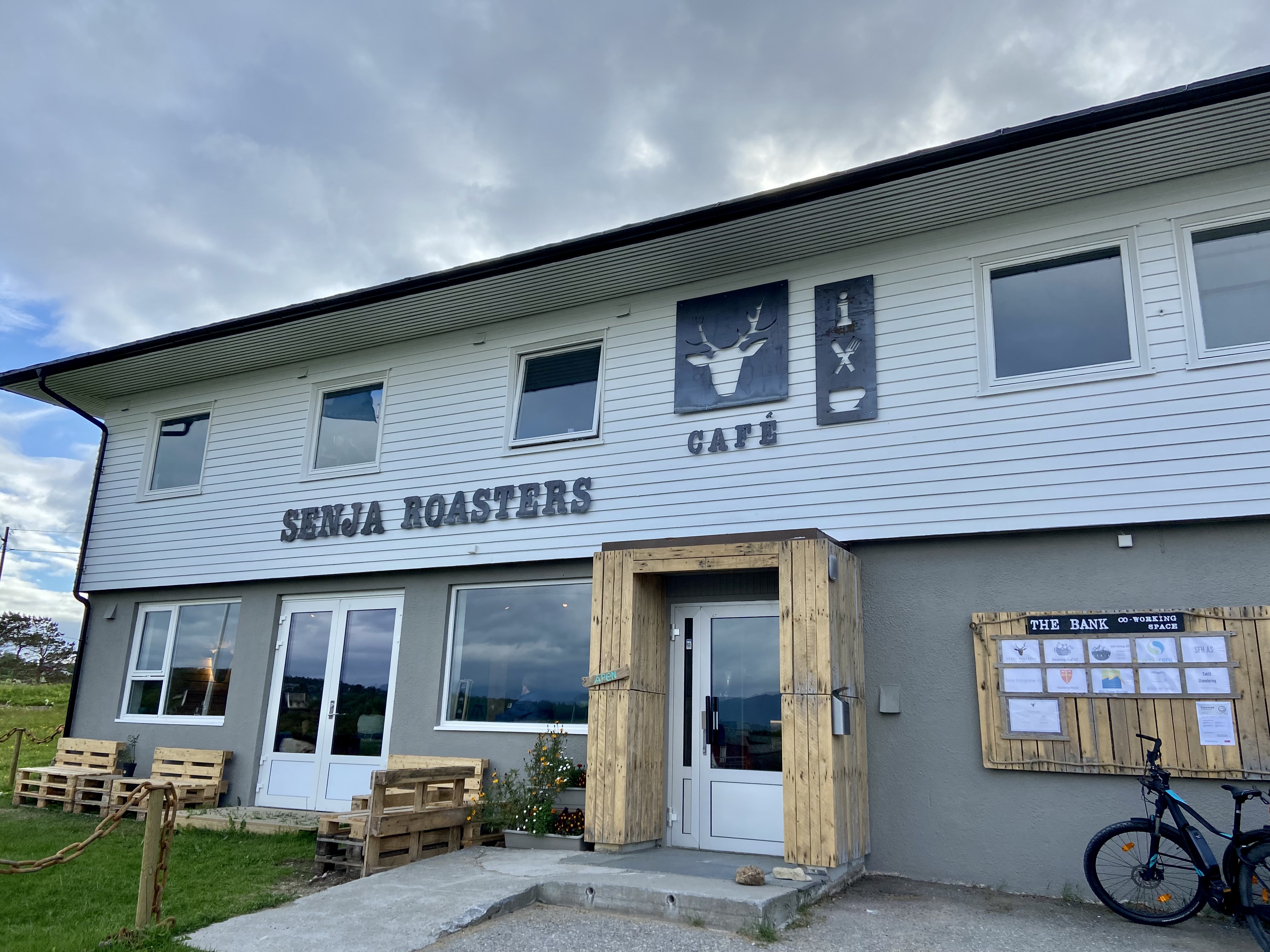
Senja Roasters Café.
The starters sounded interesting: Cod tongues and coffee-crusted tataki reindeer. The cod was wonderful, light and crispy. For me, this was extra special. Fish in batter isn’t common here. It was like a tiny taste of home.
Cod tongues with tangy-mayonnaise and wakame salad.
The tataki reindeer was exquisite. Almost black on the outside, rare in the centre. It was meltingly tender and packed with flavour.
Coffee-crusted tataki reindeer with beetroot ketchup.
We must have looked hungry because in the fairly brief interval between the starters and the main courses, we were brought some more of those delicious crusty bread rolls we had last Sunday.
Onto the mains, again we shared the meat and fish dishes. The waitress was very attentive and happily brought us separate eating plates and bowls for all three courses. We started with a tasty halibut dish on an unusual sweetcorn and red onion salsa. The flavours were lifted by a light-touch citrus sauce:
Halibut with maize salsa and orange chimichurri.
Next up, slow roasted lamb shank with a rich red wine sauce. Traditional flavours, but extremely well done.
Lamb shank with fried butternut squash in red wine sauce with a hint of chocolate.
We spent a few minutes chatting in between the main course and the dessert. The view outside the window kept drawing my gaze as the light changed over the fjord. Here we were in a modern restaurant, not in the centre of a city, but out in the wilds of Norway. Imagine popping over in your boat and tying up outside… maybe one day!
And finally, onto the dessert. Two very different choices here: a rhubarb crumble, sweet and piquant, and a tiramisu, bittersweet coffee taste with a sweet, creamy finish.
Rhubarb crumble.Tiramisu
We rounded off the meal, me with a cafe latte and John with the hot chocolate at the top of the page. It was a perfect end to a fantastic meal. I think our enthusiasm must have been noted because the chef came out at the end to talk to us. As John pointed out afterwards, you know when you’ve had a great meal when you run out of ways to tell the waitress how much you loved it all.
And a final touch, when we were in Roasters last Sunday, they told us they were expecting a visit from Mattilsynet and hoping to earn the smiley face that means the inspectors found the hygiene was good. It seems they must have passed as I saw this on the way out.
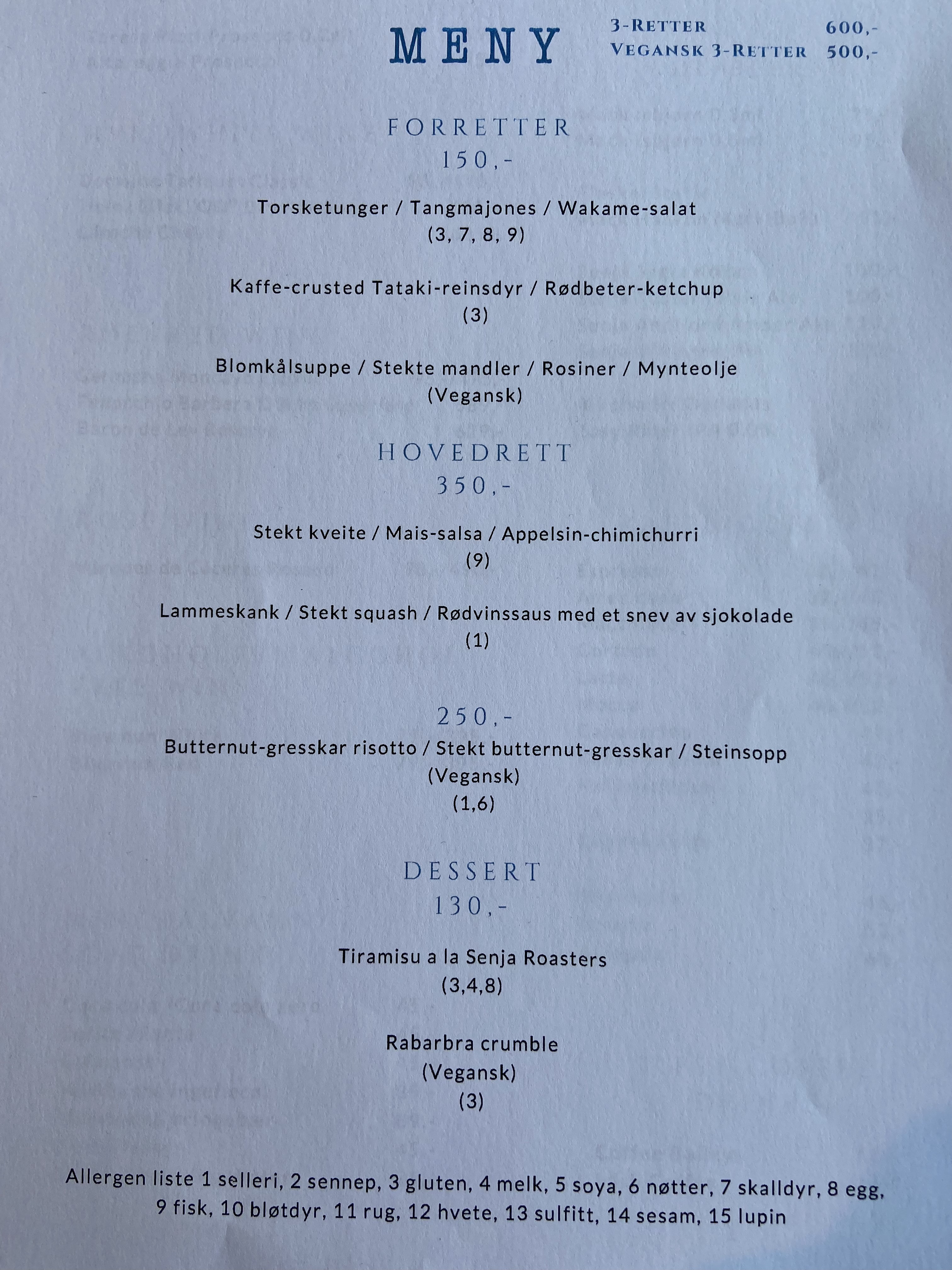
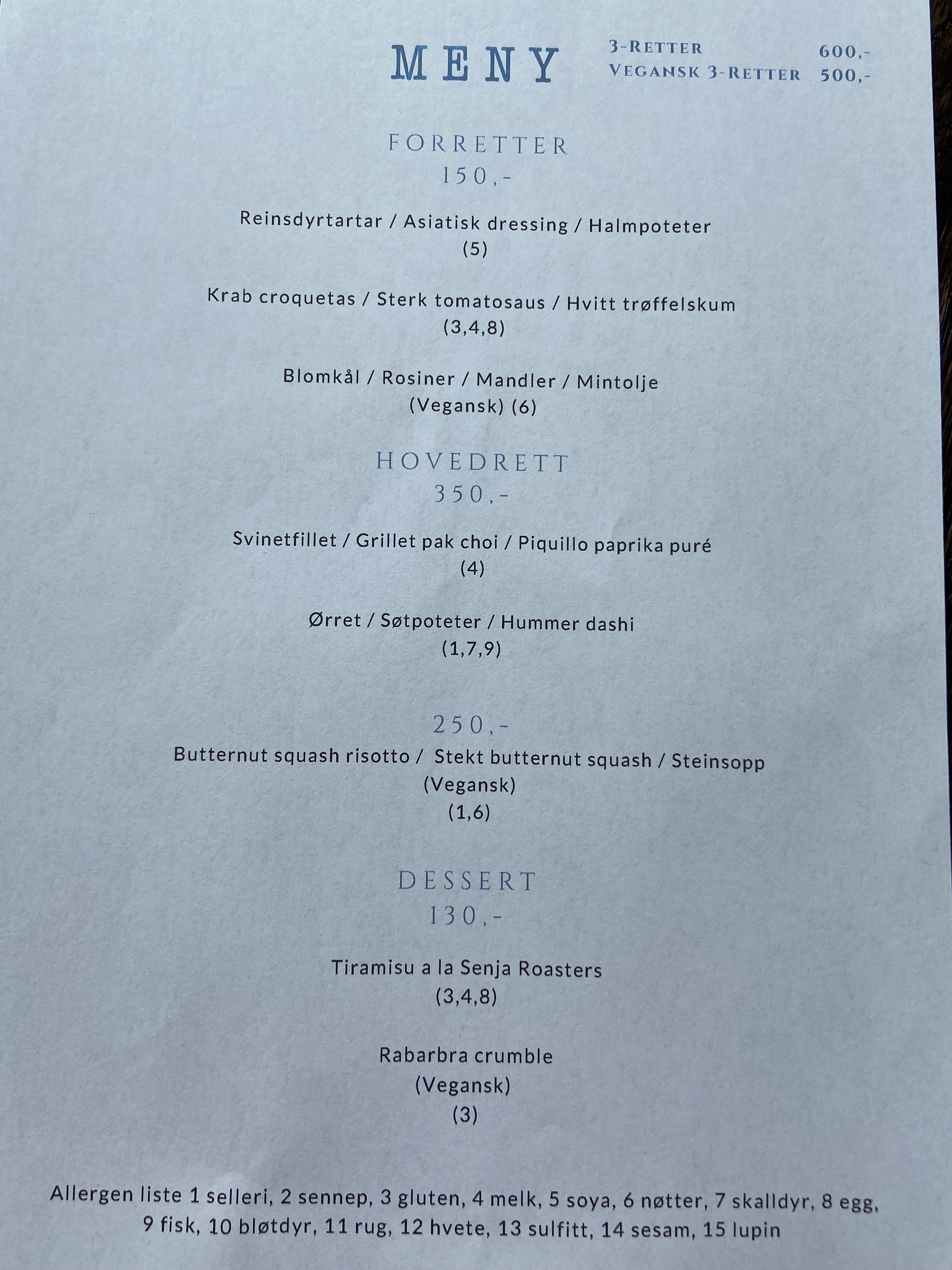
Here is this evening’s menu, for Norwegian speakers. For any non-Norwegian vegans reading, the starter was cauliflower soup with fried almonds, raisins and mint oil, and the main course, butternut squash risotto with porcini mushrooms.
Edit to add a photo of the risotto from a week later. Also delicious!
Something caught my eye as Thomas drove into Stonglandseidet on Friday. On the front of an unassuming building, a sign: Senja Roasters. It seemed an unusual name for somewhere so far out into the countryside. Cafe culture hasn’t reached rural Norway to the same extent it has reached the UK. I have driven round the northern end of Senja before and thought that a coffee shop would have turned a pleasant drive into a proper day out. And so I tucked away the information in my head to check out later. It was more a stir of curiosity than a white hot hope.
I checked it out when I got home and my interest grew. Senja Roasters, I discovered was indeed a café with, as I had hoped, a special interest in coffee. Not only that, it had a real foodie vibe. Local Arctic ingredients – tick! Complementary use of imported food – tick! Vegetarian? Vegan? Yes to both. There it was, a truly international eating experience, tucked away on an island in a remote part of Norway.
The menu sounded great. The brunches or Frunches (the Norwegian word for breakfast being frokost) included the delicious sounding Challah Toast – “French toast made out of challah bread or brioche, brunost and mascarpone whipped cream, honey, roasted pears, pumpkin seeds and almonds.” and Banger Fritters – “Beetroot and ginger, smoked carrots, and crispy tofu.“
The dinner menu sounded good too. Butternut soup with fried butternut and crispy cabbage, poached halibut with cherry tomatoes, sugar buttons and saffron sauce, homemade rhubarb crumble.
And so this morning, I asked John if he would like to come out on an exploratory mission with me. Good as thecafé sounded, there was a chance it wouldn’t live up to expectations. I also wondered about price. The website didn’t say and it seemed liked the kind of upmarket place that would charge upmarket prices in a city in the UK. How expensive would the same experience be out on Senja?
It was a fair drive from home, so by the time we arrived, it was definitely approaching lunchtime. First impressions were good. Though it was empty, the surroundings were very pleasant: a mixture of clean blue walls and rustic wood that fitted well with the menu.
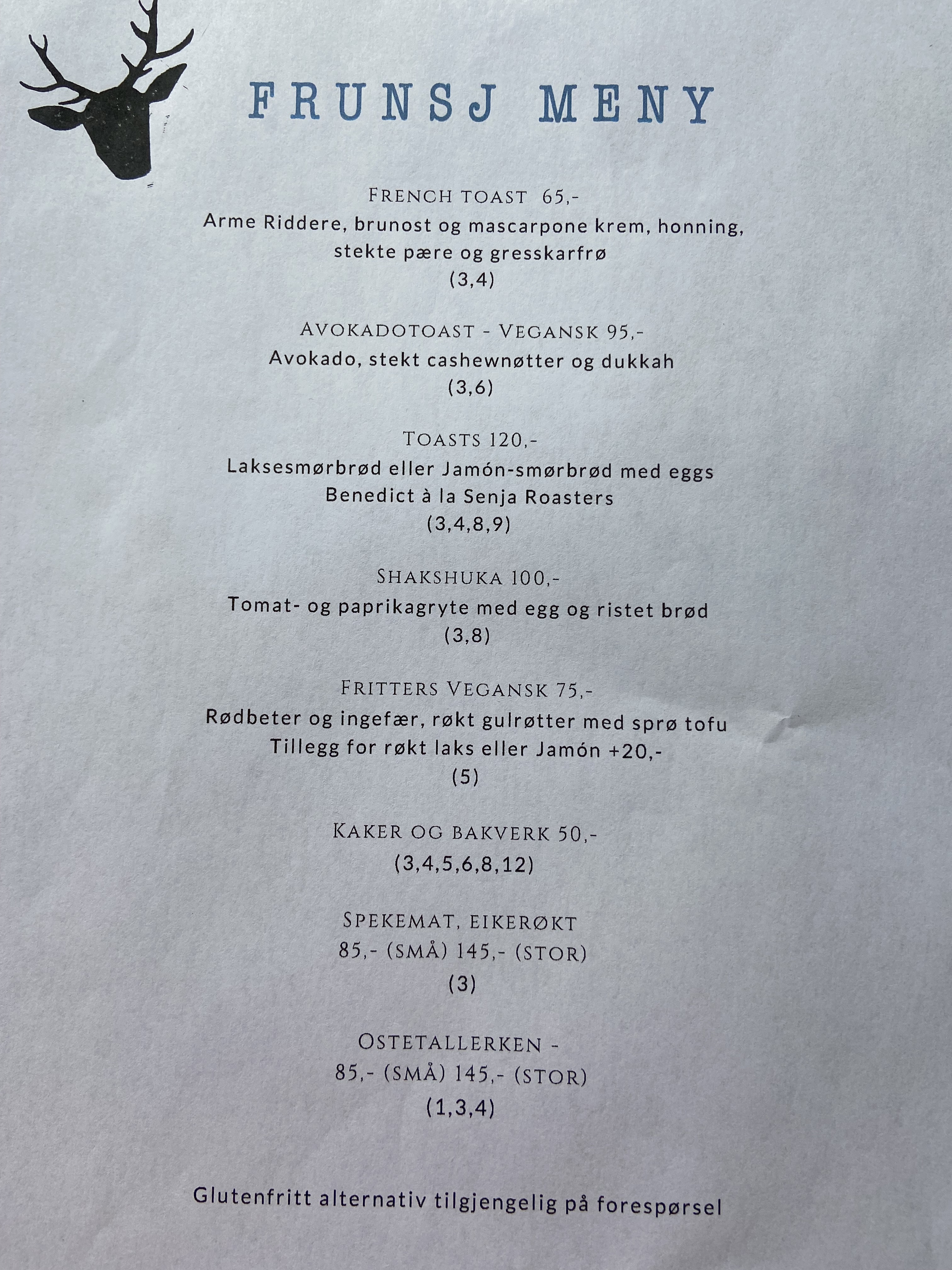
We had intended to drink coffee, check out the prices, and come back another day. We ordered coffees – a cappuccino for John and a latte for me. The waitress (I think she was Daniela, though I forgot to ask) brought our coffees very promptly. I explained we probably wouldn’t be eating today, but would like to see the menu. She brought them – printed on ordinary A4 paper – another good sign. A pre-printed menu doesn’t always indicate poor food, but if the chef is using local ingredients, which can vary from day to day, it’s much more likely the menu will vary as well.
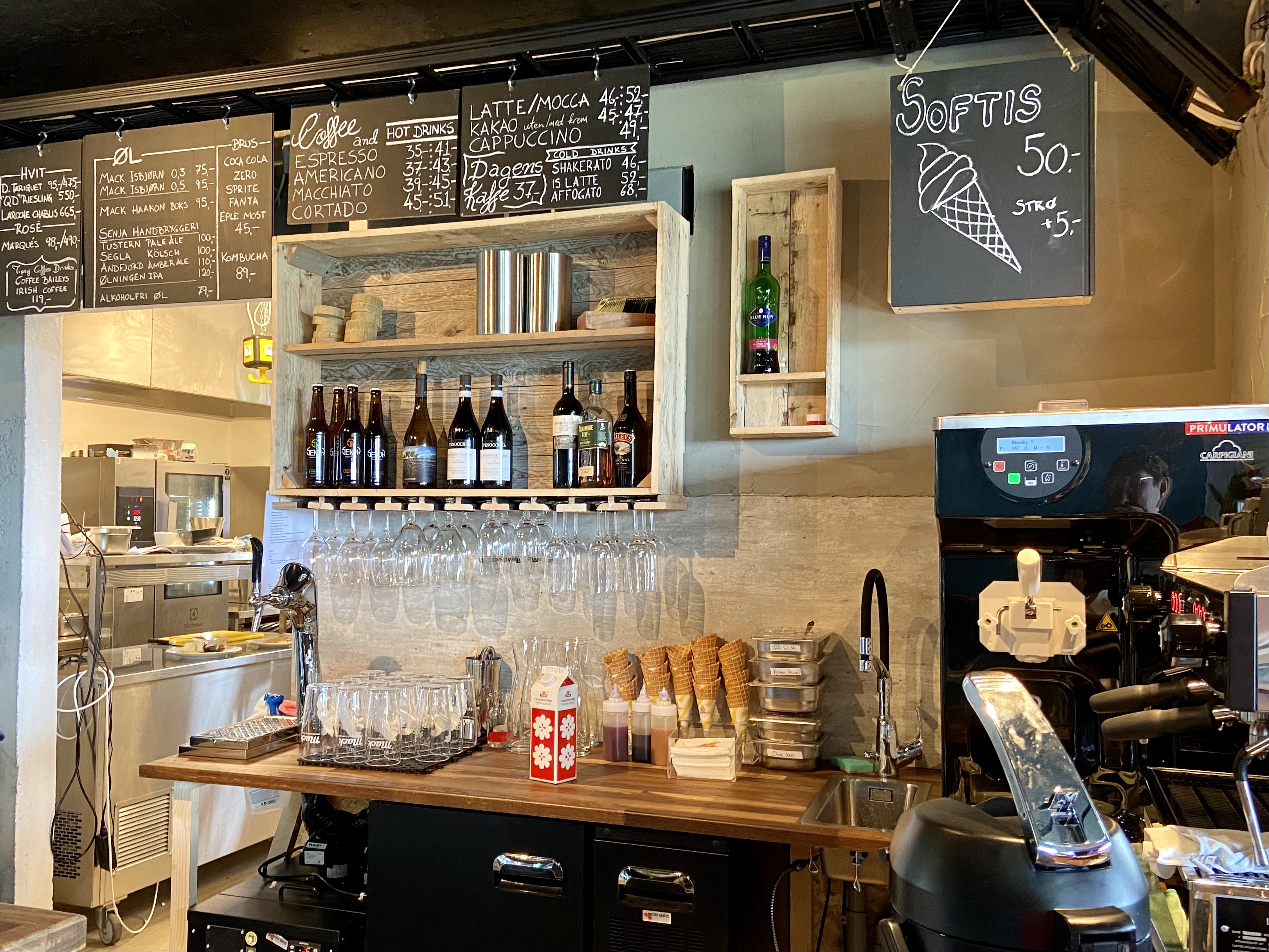
To my pleasure, the prices didn’t seem any higher than they would have been in London. For Norway, they were normal. The coffee was wonderful too: well rounded and smooth, with no trace of bitterness. Within a couple of seconds, all my careful plans were abandoned. I asked John whether he would like to share the cheese platter, and he agreed he would.
The website had listed the team behind Senja Roasters as being from Spain, Finland, Germany, Russia, Australia and France, so I was hoping for a truly international selection and I was not disappointed. There was Manchego Ezequiel, imported directly from Spain, Chevre goats cheese, Norwegian Brie from Dovre Ysteri and Gorgonzola pikante defendi.
It was accompanied by homemade blueberry and onion jam and quince marmalade. There were warm, crusty bread rolls, salt biscuits and Norwegian flatbreads. It was a wonderful combination.
I asked Daniela a little about how long Roasters had been open. To my amazement, she told me that it had only opened last week. Like us, the team had felt that Senja was rather short on coffee shops, and rather than regretting, as I had done, they had decided to do something about it. Amazing to think that if Thomas and I had passed by only a few weeks ago, I wouldn’t have made such a wonderful discovery.
As it is, we will definitely be going back. Today’s menu sounded delicious, and Daniela said it would continue until the end of this week. After that, there will be summer menus. I hope that the tourists, who flock to Senja in the summer, will discover Roasters. It is definitely worth a visit.
When I applied for this job last summer, one of the things that attracted me was the very varied workload. Working in remote places where relatively few people live has some (often unconsidered) side-effects, and that is one of them. If you are a (human) GP who lives in a city, you are likely to have many specialist centres available. If you have a complex case, then referring them is the obvious thing to do. But if you are a GP on a remote island, where referral is complex, where a hospital stay might mean that family cannot visit and where sometimes the weather means that nobody can get on or off the island, your workload, and the scope of things you might attempt to deal with locally is likely to be quite different. One isn’t necessarily better than the other, but they might appeal to different people, and the latter is more like the work I do here. In other areas, those who work in animal welfare in the field are a separate team from those who work in the slaughterhouse. Their teams might be big enough so that their members can specialise. But here, it’s mostly me and Thomas locally, and we cover a very large area and a whole range of different animals.
For large chunks of the summer, I will be working in the abattoir. The staff who work there full time will be on holidays and for now, I am the default stand-in. This is slightly complicated by the fact that the other part of my job seems to be speeding up, rather than slowing down, but most vets will recognise that there is a seasonal pattern to our work. I have accrued several days of flexitime, most it over the past few weeks, but it isn’t looking like I’ll be taking them any time soon.
This week couldn’t have been much more varied. I have been working on a list of places that need follow-up checks. These are farms where there were problems in the past, where Mattilsynet has recorded that the law has been broken. I’ve been creating files showing the timelines of events and the specific areas that needed improvement. The next stage is to follow up with visits, but in order to work on the histories, I’ve had to polish up my Excel skills, which have been sadly neglected in recent years.
Thomas and I also carried out an emergency readiness exercise, which is done twice a year. This is aimed at making sure that if there was a major outbreak that was a serious threat, either to other animals or to people, that we would be prepared. Here’s a picture of me, decked out in protective gear that we might use if there was an outbreak of avian flu.
I hope it never arises. It is incredibly hot inside the double layer of protective clothing. Those who work for the likes of Doctors Without Borders fill me with admiration. And of course, at the present time, there are staff working with COVID who have been spending weeks and months working in protective clothing that perhaps they had never seriously anticipated using. To anyone reading who has been faced with it, you are amazing.
On Friday, I had my day planned out. It was going to be a relatively pleasant day in the office. I had a few things that needed to be updated and I needed to check the lists of animals coming in to the abattoir next week. It’s someone’s job to check through the farmers who are sending in their livestock in case there’s anything in particular that we need to follow up. There was also a departmental meeting to attend, which I have only remembered now as I’m writing this!
But instead of a quiet day with an early finish, it turned into one of those wild-card days that end up being the high points of the year. I knew Thomas was going out for the day. I assumed he was blood testing some animals in our area that have recently been diagnosed with a disease that’s being tracked, so I asked him if that was what he was doing, and whether he needed a hand.
It turned out he wasn’t blood testing. Instead, he had been called out to assess the possible welfare implications of moving a group of reindeer from one area of Senja to another, using a helicopter. Reindeer herding is a traditional Sami occupation. There are families who have been using traditional summer and winter pastures for hundreds, perhaps thousands of years. Back then, the land was presumably not owned by anyone in the way it is now.
But since more modern styles of agriculture have become normal, the rights of each group can come into conflict. If you are feeding your cattle on one pasture and are growing hay in another, the last thing you want is a group of reindeer trekking through. Arguably, this should have been discussed when the land was bought, but that too will be largely historical as farms are often handed down in families and the sale might have occurred generations back. What was done in the past can’t be undone. Fortunately there are some landowners who are happy to have the reindeer on their land. If I was building a holiday home in the wilds, or had land I wasn’t using for farming, I’d love to be in an area where I was likely to wake up to reindeer in the garden.
When conflict arises, sometimes it’s best for everybody if the reindeer are moved, but that isn’t easy. There are times of year when the herd comes together for migration, and that is when they are generally taken to new places. The herders work with the natural behaviour patterns of the animals. Moving them in the middle of summer when there is plenty of good grazing, and perhaps young calves at foot, is not so straightforward. And that is where the potential helicopter comes in.
Anyway, Thomas suggested that if I had time, I would be welcome to come along. It would be useful to have an extra pair of eyes and also helpful if I can start to learn more about the political landscape here in the north of Norway.
Assessing the welfare implications of such a move requires an examination of two separate factors. One is looking at the landscape. We drove round the likely route, looking in particular at fences they might have to bypass or leap. The other factor is the reindeer themselves. Moving a group of adult male reindeer is very different from moving heavily pregnant females, or mothers with calves at foot. Ideally, Thomas wanted to inspect the animals. He wanted to assess whether there were any pre-existing injuries that might make running at speed and jumping over obstacles a high risk.
But of course, it’s not always easy to find groups of animals that have freedom to roam. We hit lucky on our first location. A group of nine reindeer were standing at the top of a sloping pasture. One of the herders had dogs, but as the reindeer flew off at full pelt as soon as they caught sight of the dogs, it was obvious that herding them that way could be almost impossible.
We only saw them from a distance. I assumed what I saw was a buck with a group of females. There was one magnificent male, dark in colour, bigger than the others and with impressive antlers. But I was told that in fact it was a group of nine males. How they could tell, I’m not sure, but I hope in time I will learn a little more about them and it will seem a little less foreign.
I had assumed, from the first stop, that finding the rest would be straightforward. What actually happened was that we spent the rest of the day playing the most spectacularly unsuccessful game of hide and seek I have ever been involved in.
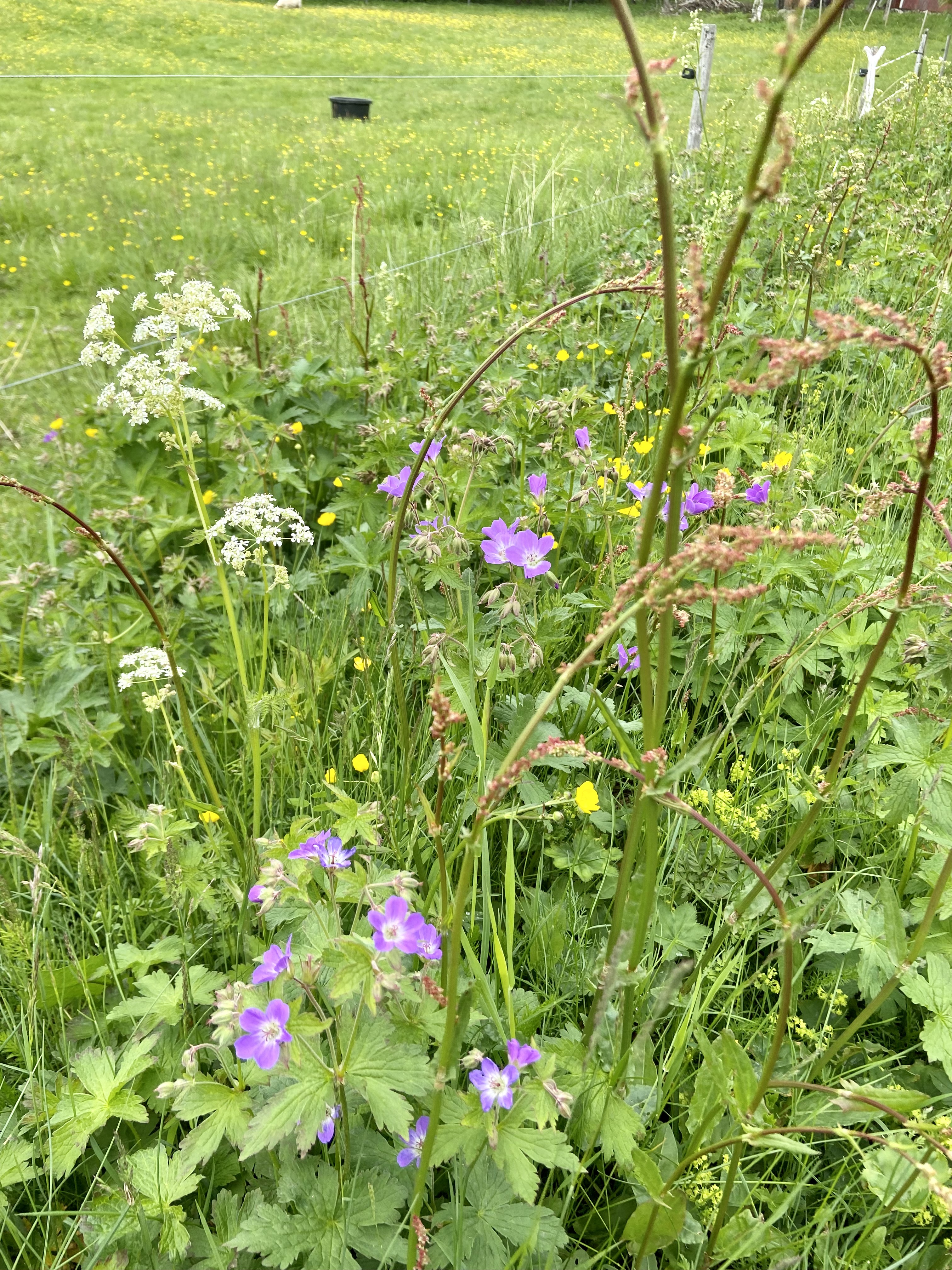
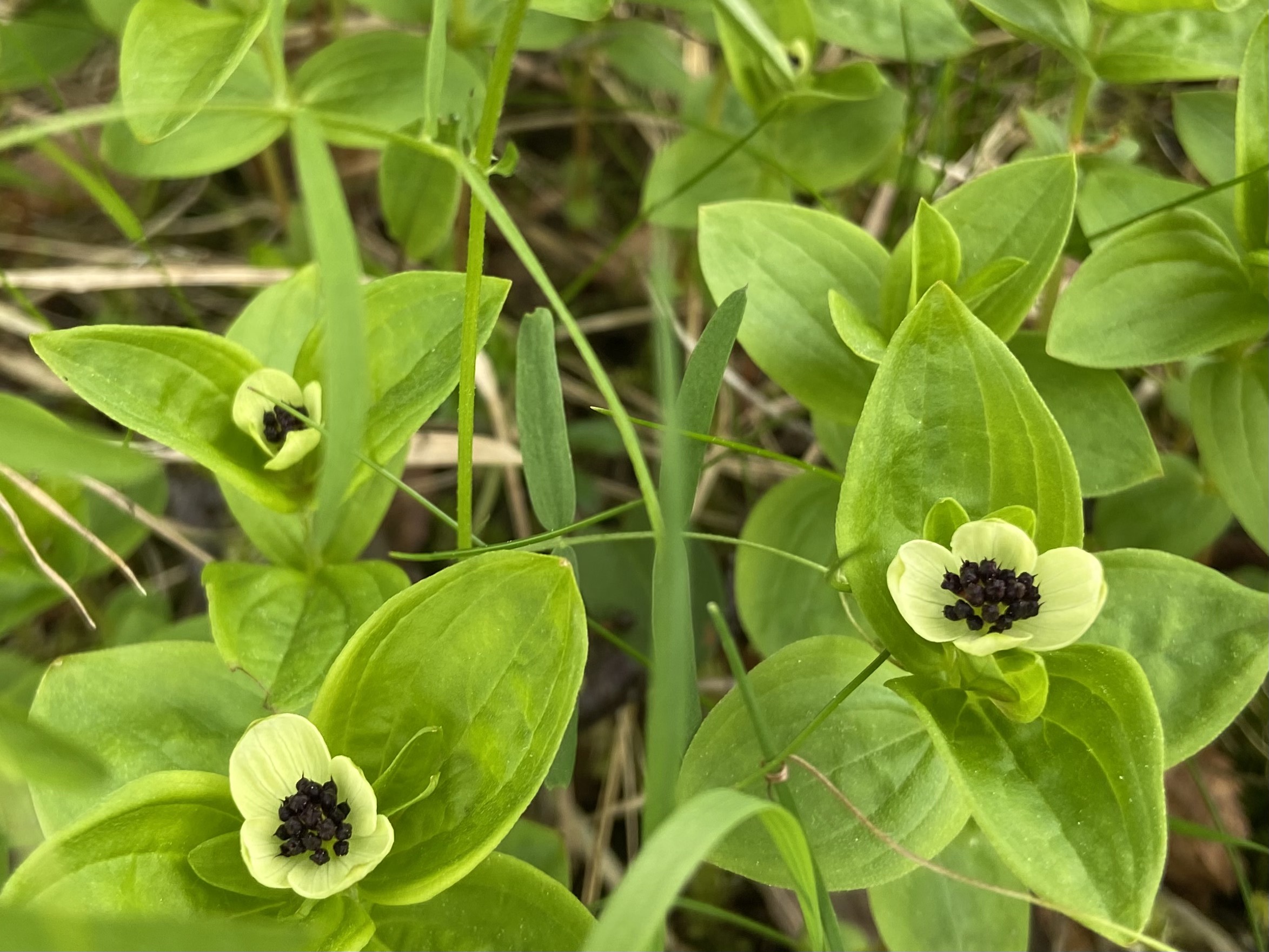
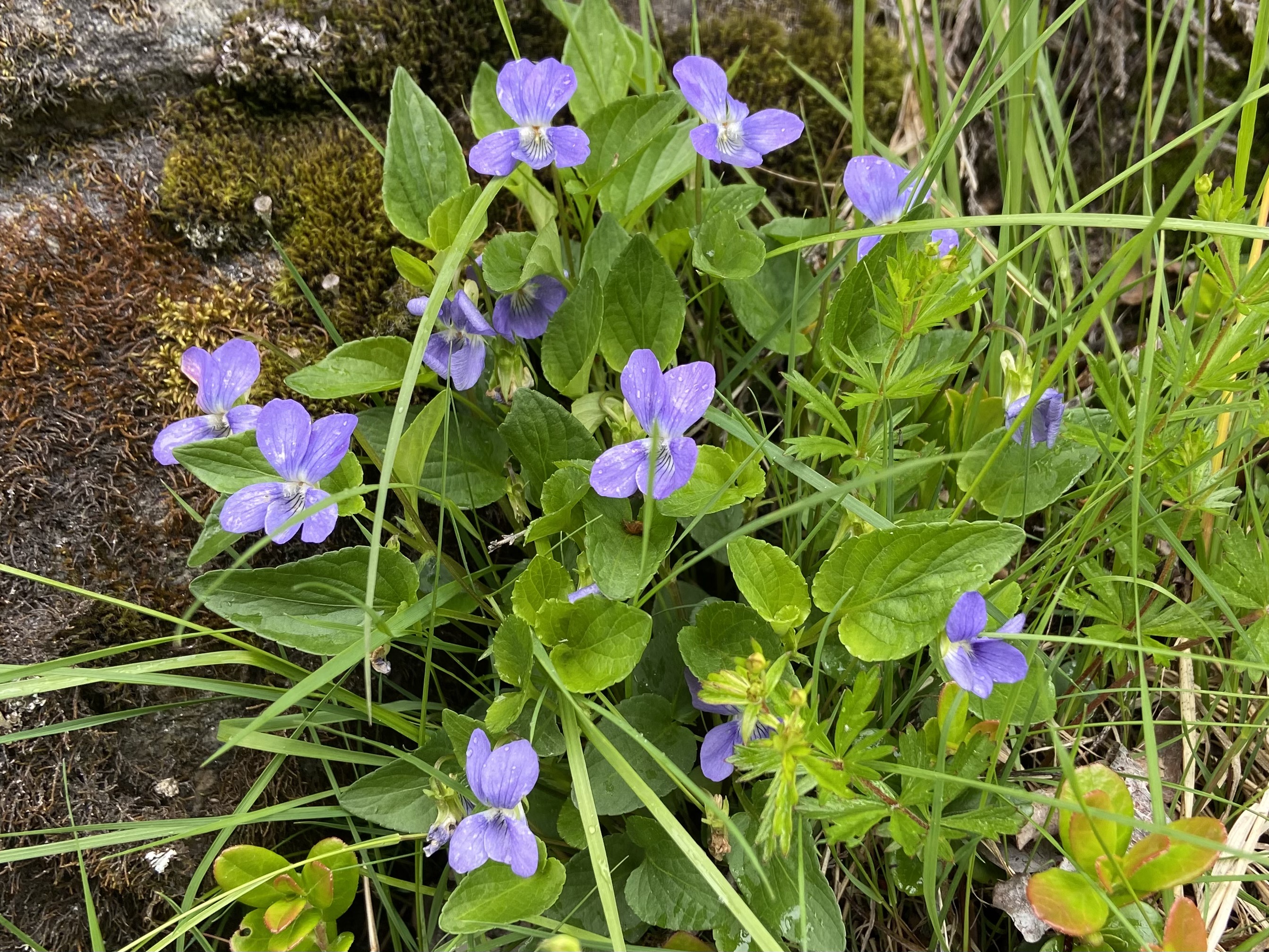
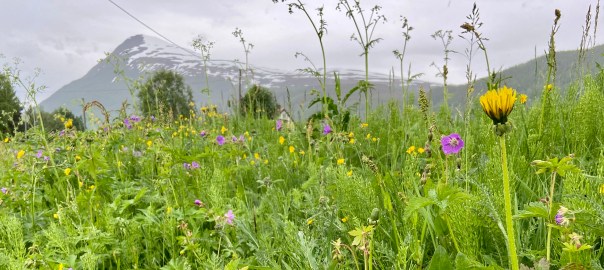
But for an unsuccessful day, it was very satisfying. If you’re going to waste a day in the wilderness looking for elusive creatures, it might as well be done in one of the most beautiful places on earth in the early part of the summer. I was told before I came here, that the summer was intense. That the contrast between the white of winter and the green of summer was extraordinary. But what I hadn’t reckoned with was the flowers. They are everywhere, from roadsides and pastures to the forest floor. Different sizes, different hues, stretching out as far as the eye can see.
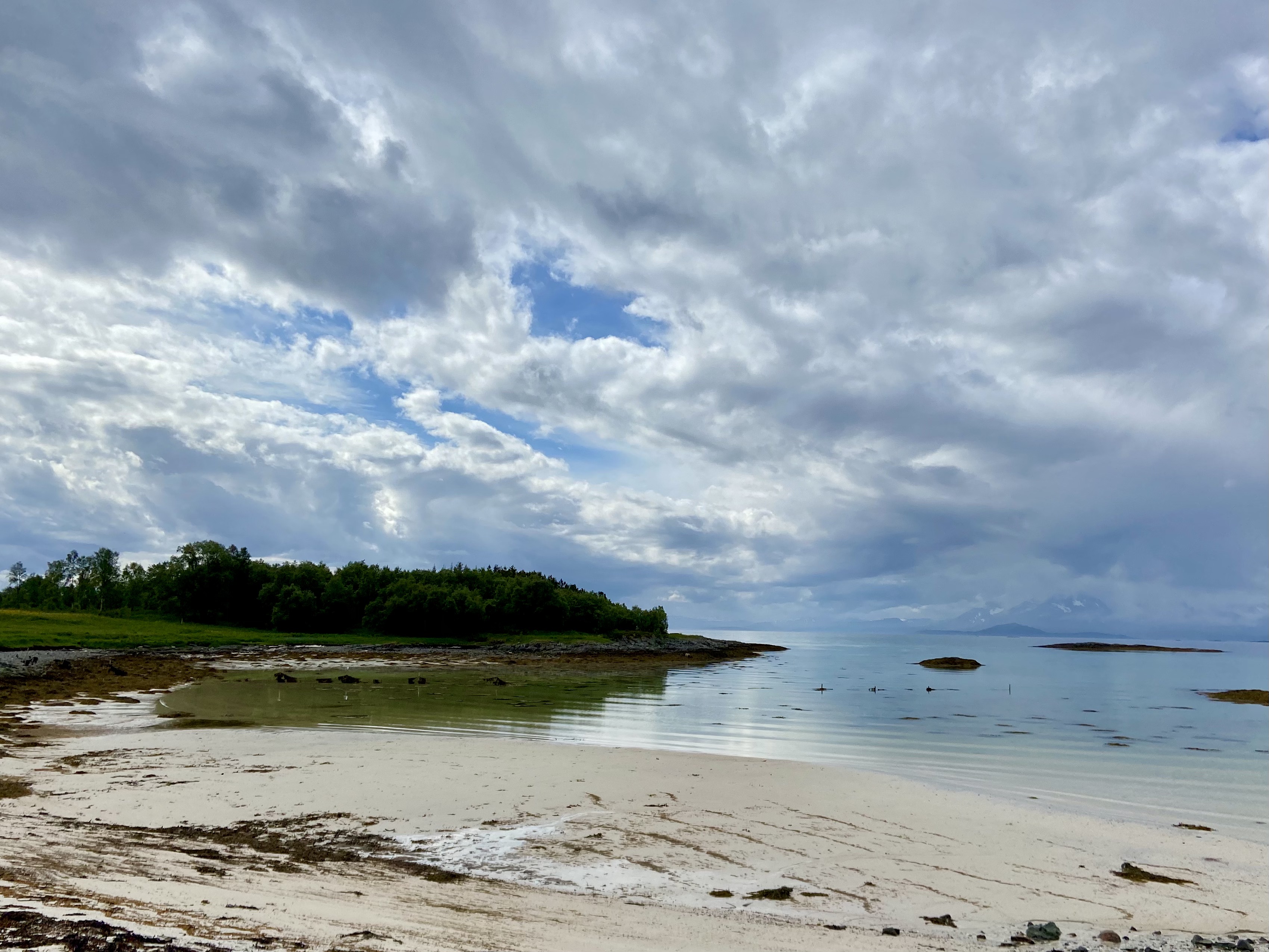
We were at the southern end of the island – a part I haven’t really explored before. And as well as trees and pastures, there were beaches and bays with white sand and turquoise water that looked more tropical than arctic to my eyes.
I was very glad I had started my fitness project a few weeks back. Though the general pace of life in Norway is slower than that of the UK, Norwegians walk much faster. When the group were walking, I could mostly keep in touch with them, though at one point everyone set off and scrambled up a steep slope. It was heavily strewn with fallen branches and knee high undergrowth that caught on my bootlaces and clothes. I found it so tough that I had to give up halfway to the top. Had I not, I have the feeling I might have ended up flying headfirst down the hill into one of the alarming looking nests of fire ants.
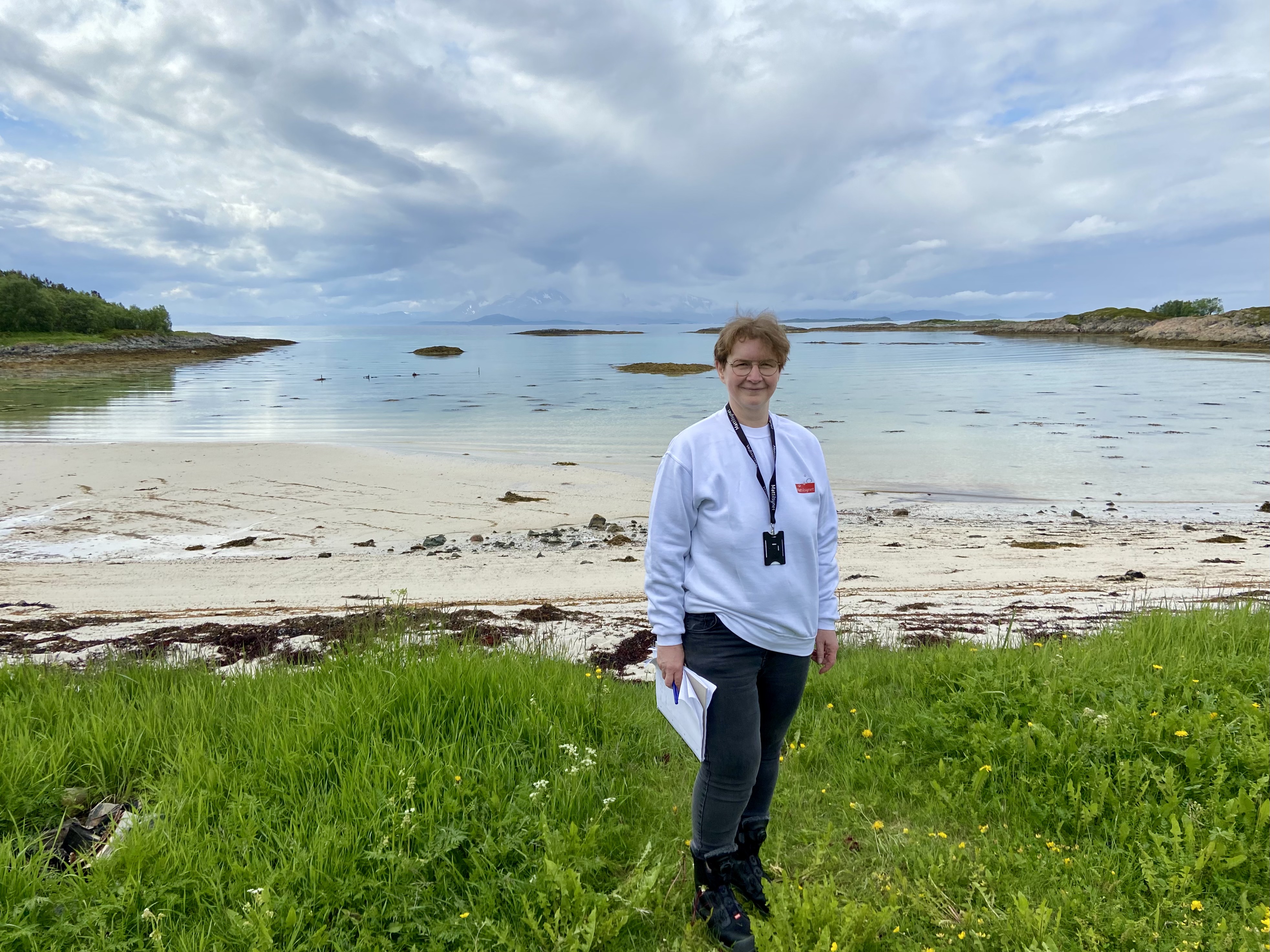
Still, Thomas offered to take a photo of me at the beach, so here it is. This is me: a typical day at the office!
In the end, we didn’t see any more reindeer in the wilds of Senja. We had to return home having inspected only half the group we had wanted to see. But we were assured the remainder were also all male and that there were no calves. Most of the fences were well constructed as well. It is now illegal to build new barbed wire fences in Norway, so hopefully they will gradually disappear. Thomas gave a cautious go ahead to the move. The owners of the reindeer will be given time to make the attempt themselves, but if that doesn’t work, the helicopter may be needed. Thomas told me that the ownership of the reindeer is also complicated. The herding is very much a family business, so children in the family are likely to own a couple of reindeer alongside their parents’ larger share. All in all, it was a very interesting day and by the end of it, I felt I had learned a few basic facts about how herding works. It’s a very different way of life.
We returned to the office, where I had to speedily download a link for a website to my phone. There’s work to be done next week that I probably should have prepared for yesterday. With a bit of luck, I might be able to fit most of it in on Monday, assuming nothing else comes up. But I wouldn’t have missed yesterday for anything. Sometimes you have to seize the moment. And if Thomas is reading, he might be pleased and surprised to hear that I actually found two reindeer on my way home. For some unexplained reason, this mother and her calf were lurking in the Co-op. Appropriately, they were standing right beside the Polar Bread. Now that really isn’t something you see every day!
This isn’t going to be an easy post to write. I tend to keep these entries upbeat, but sometimes there are issues that go so deep that they shouldn’t be ignored. There has been a great deal of discussion over animal welfare in Norway in recent weeks, especially concerning the welfare of pigs. Back in 2019 NRK (the Norwegian national broadcaster) aired an exposé of problematic practices on pig farms in Norway. Using undercover footage taken over five years, it was revealed that despite Norway’s strong legal rules around animal welfare, there were farmers in the pig industry who were flouting them. Some of them seemed to be taking pleasure in the fact that they were doing so.
Mattilsynet responded by increasing welfare visits in Rogaland, the area highlighted in the program, and this year the Pig Welfare Campaign has been rolled out across Norway. I spent a great deal of time at the beginning of the year learning about the program and about signs to watch out for that might indicate that an investigation should be carried out. It is part of my job to monitor the welfare of pigs coming in through the abattoir. There are certain signs that indicate possible welfare breaches which should trigger further investigation. So far, in my time working there, the general condition of the pigs coming through has been high, but it is an important tool in the chain, particularly for pig farms, which produce meat, reared over a relatively short period, and must therefore send animals through the abattoir with much higher frequency than, for example, dairy farmers.
But of course, monitoring procedures at the abattoir are not sufficient to ensure that good welfare is being practiced. It stands to reason that farmers might not send in animals that show clear signs of abusive practices. And despite the increased inspections carried out by Mattilsynet in Rogaland, there was another report aired recently on NRK regarding animal activists who had broken into pig farms and had taken photographs of animal welfare violations.
I confess I have very mixed feelings regarding animal activists. On the one hand, if there are welfare problems within farming, it is important that those are highlighted. But on the other side of the equation, their practices in breaking in place animals at risk. There is a strong commitment to biosecurity in Norwegian farming, which obviously is ignored by those breaking and entering.
According to a virtual Mattilsynet meeting on Friday, those same activists had held pictures showing evidence of animal welfare breaches from as far back as 2016. They had not reported those breaches to the authorities, which would suggest they are more interested in creating a scandal than in addressing those issues. It is important to remember that the aim of these groups is not to improve welfare by working with the farming industry and the authorities, but to close down the animal farming industry altogether.
Accordingly, these groups always highlight the worst. How many farms did they break into? How many of those were farms with very high welfare standards? It would be much more useful to have a balanced view of the whole picture. Without that, it is impossible to tell whether they have revealed that problems are occurring in a very high percentage of farms, or whether there is huge negativity being created around “a few bad apples”.
Mattilsynet have also come under fire. It is said that we are working too slowly in closing down those farms where animal welfare is chronically poor. Perhaps that is true, in some cases, but in many circumstances there has to be a period of assessment, of attempted education and/or enforcement, before taking the huge step of removing someone’s source of income.
These kinds of scandals are always both depressing and demoralising, not least because they are a reminder that there are some very unpleasant people in the world, and that some of them actually seem to revel in creating animal suffering. It frightens me that as well as those who are careless, lazy and ignorant (which I would say are the main drivers of animal welfare issues) there are also a few who are actively malevolent. I try not to dwell on it, but there has been a case in our region which might have fallen into that category. Those people make me feel sick to my stomach and because they will lie and work hard to conceal what they are doing, I think we will never gain full control over what they do.
However, it is important not to dwell too much on the things we can’t fix. I visited a farm on Friday where there were pigs running around in the open air, digging their snouts in the earth and obviously having a great life. Birgit and I carried out the first of our Pig Welfare Campaign visits on the same farm and it was a wonderful salve to the negativity. Reports like the one above can easily make it seem that we have an uphill and sometimes impossible task in trying to police all matters within the animal welfare sphere. But it’s essential to remember there are a lot of good people in the farming industry in Norway, who are doing their very best to uphold the excellent welfare standards that are required in law.
I drove a long way on Friday to complete the visit with Birgit. Despite the distance, it’s important that we work as a team. When I see the links between the scattered offices and the abattoir and all the knowledge held by veterinarians such as Birgit, Thomas, Ammar and Hilde, all of whom have worked in this area for a long time, I am reminded of how important that web of knowledge can be. I’ve been here almost a year now and I am beginning to build up my own map. I will continue to fight for better conditions for all animals in my own capacity. And though my contribution is small, I am not fighting alone.
I am going to finish with a few photographs from Friday. As well as all the wonderful flowers that are brightening the verges, I drove along the side of a steep fjord, where the melting snow is creating myriad waterfalls as the twenty four hour sunlight warms the landscape.
It’s been a busy week, but the days have been warm and sunny. The snow has retreated once again to the mountains and with barely a pause for spring, summer has arrived. I have taken so many photos that this will be an image-filled, whistle-stop tour of my week.
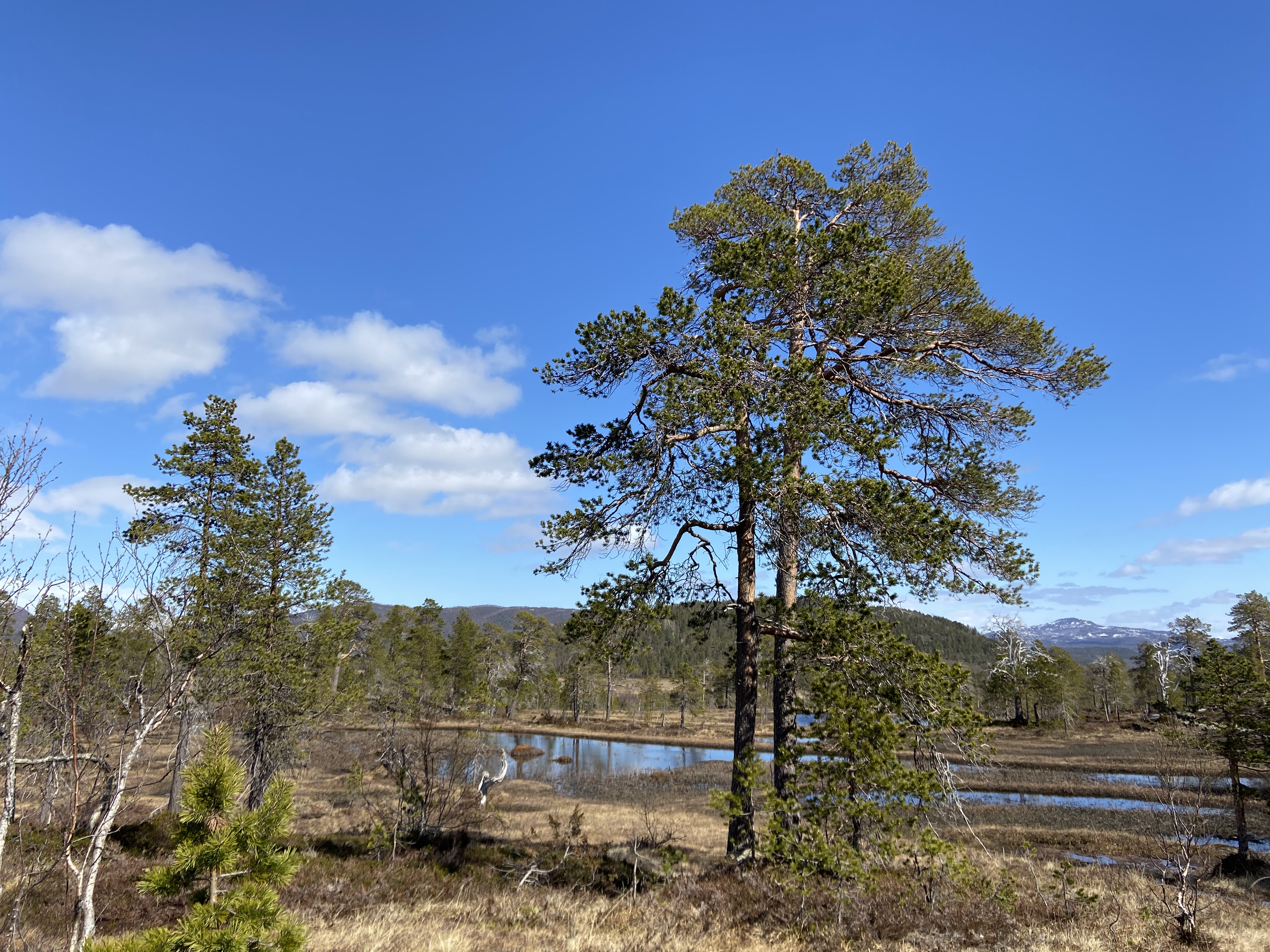
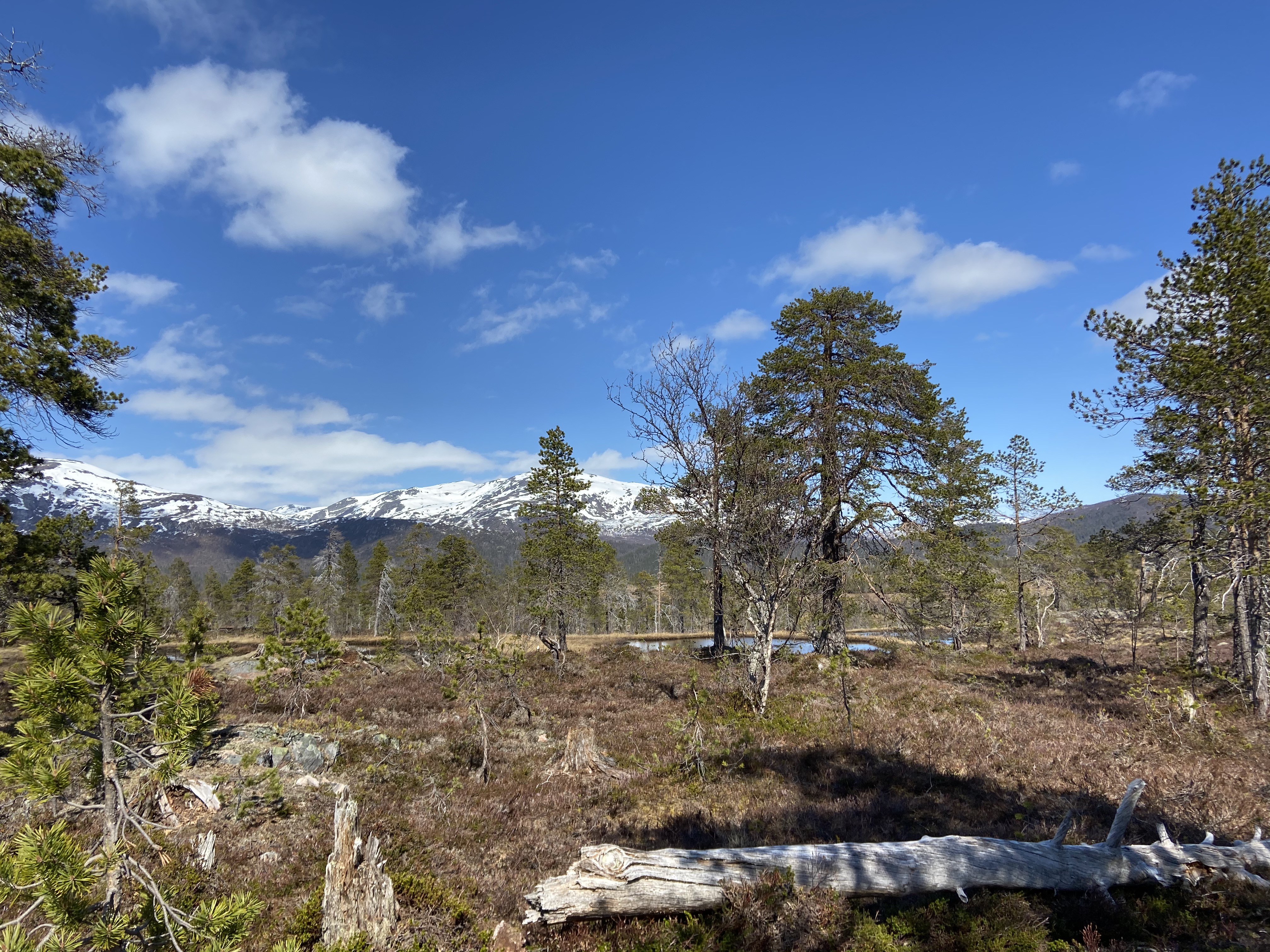
Last weekend, Anna, Triar and I went walking in Ånderdalen National Park. Regular readers will know it’s one of my favourite places. The ground was still brown, but the sturdy fir trees that cling to the shallow soil were bathing in the twenty four hour sunlight. For three or four kilometers, the path is maintained for wheelchair users, but at the end it is possible to go further, up into the hills or down towards a lake. We decided to go down and discovered that the path descended into a peat bog, carefully woven with plank bridges to walk on. As you can see, Triar decided that staying on the planks wasn’t nearly as much fun as taking a peat-pool plunge.
Because of the long winter, and because we were doing limited visits due to coronavirus, there is a lot of catching up to do. I have been blood testing goats with Ammar. We check them for two notifiable diseases: brucellosis and caprine arthritic encephalitis virus (CAEV). Brucella can cause goats to miscarry and can spread to humans and CAEV mostly causes arthritic changes in joints, but can also occasionally cause inflammation of the brain in kids. Ammar works in Tromsø and between us, by next week, we hopefully will have finished this year’s testing in both our areas. We tested two herds on Monday.
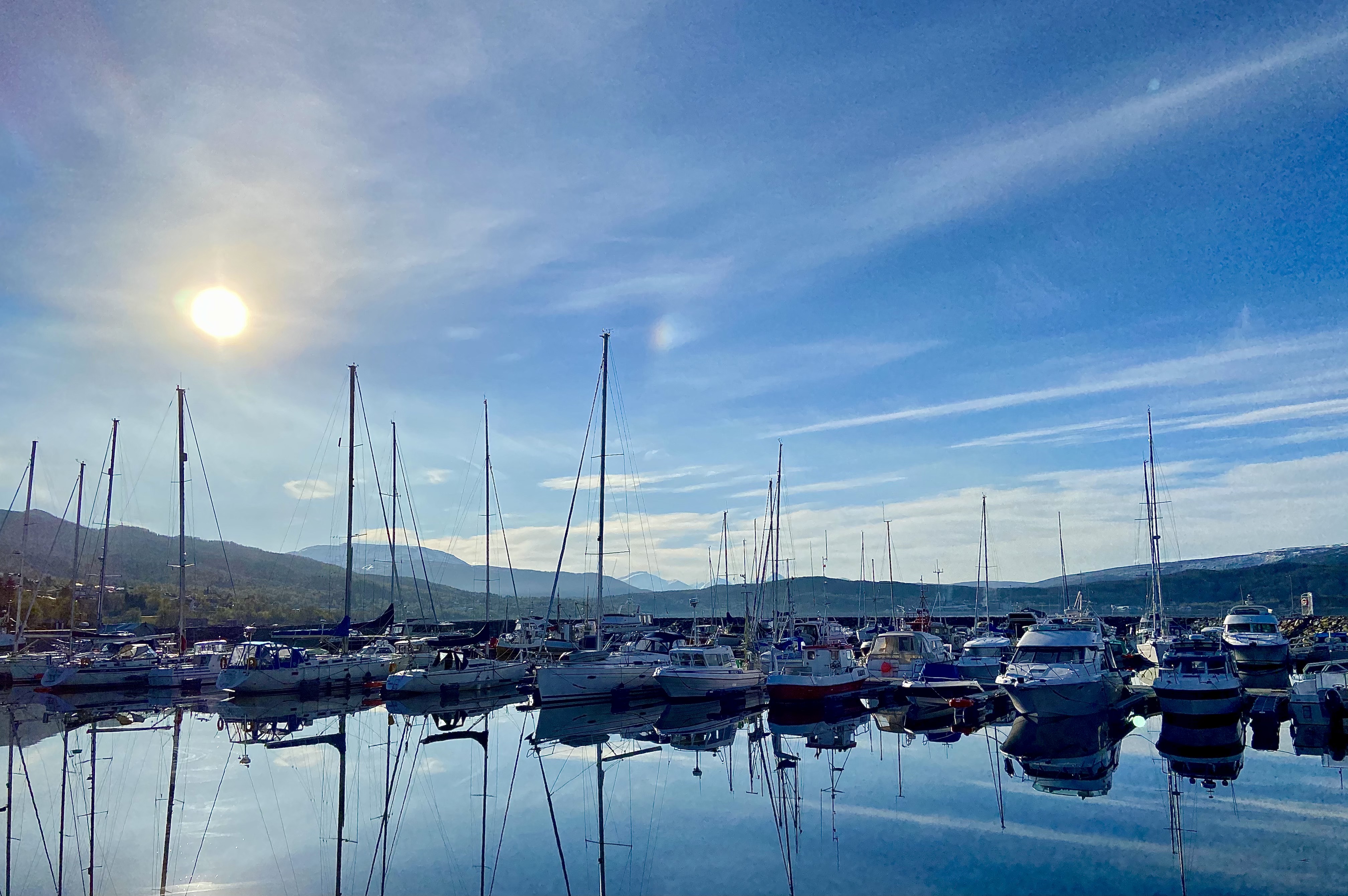
Tuesday began early with a trip to the abattoir. As I left the house at about five thirty in the morning, I couldn’t resist taking a picture and I took another of the harbour beside work as I changed cars. As you can see on the top picture, the leaves were beginning to appear, but hadn’t quite opened.
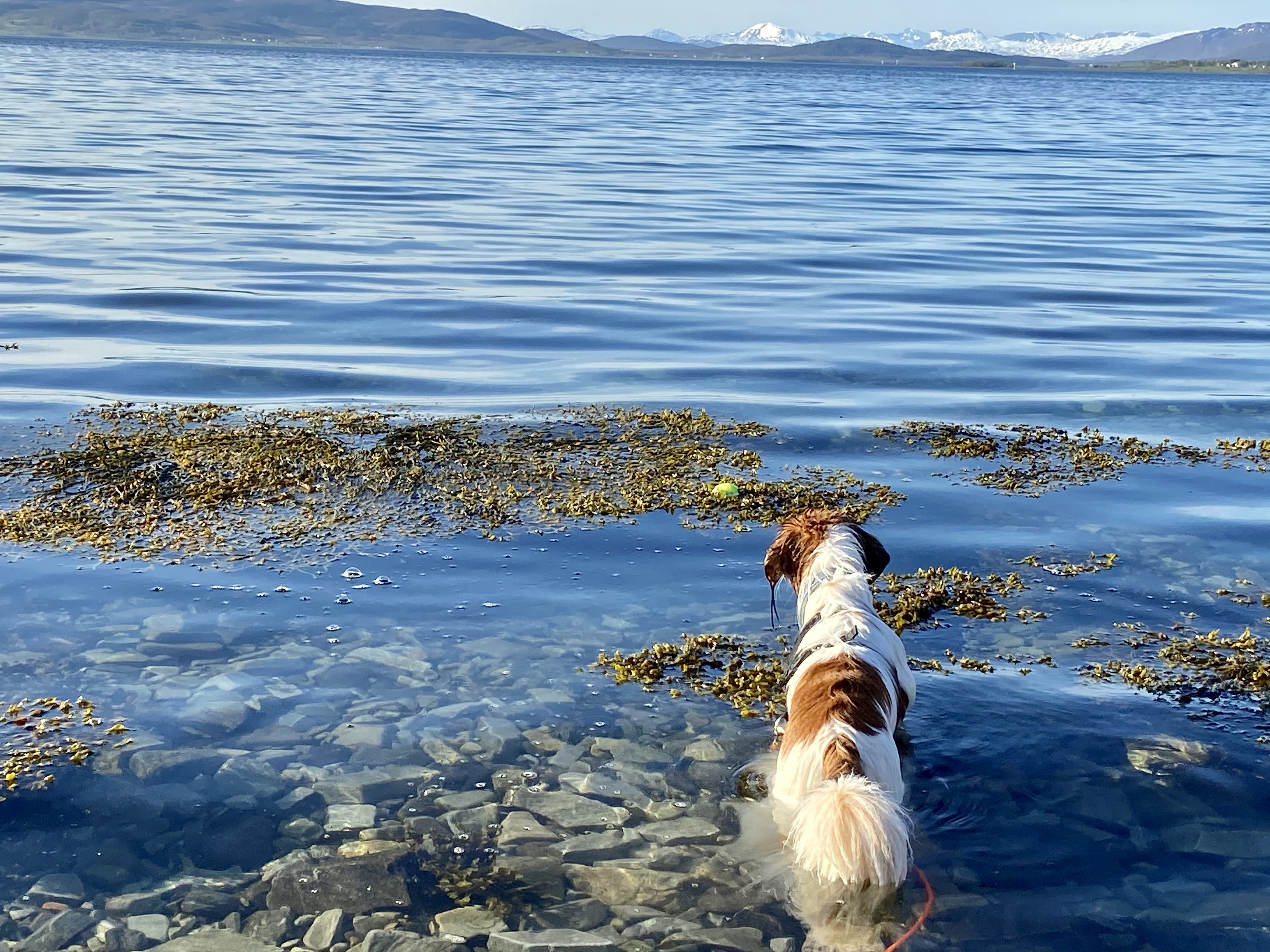
In the afternoon, there were more goats, but when Anna suggested a walk in the evening, I couldn’t resist. We crossed the bridge to Senja and walked down to a little harbour we discovered in winter. How different the little stony beach looked now. The water was so clear and it was so warm that we couldn’t resist going in for a paddle.
On Wednesday, I was back on Senja with Thomas and Håkon, who works with Dyrevernsnemnda. We were following up a welfare report from the public, but when we arrived, everything was fine. It seems to happen that way quite often, but we have to follow everything up. It’s better than missing something bad. There was wildlife on the roadsides, both reindeer and elk, and we stopped at a viewpoint for another photo opportunity.
Thursday was spent in an all day meeting on Teams. I worked from home, learning about the difficult job of dealing with farms and farm-parks who break the law over years. We have many tools at our disposal, ranging from advice at one end, to total bans on animal keeping at the other. Unlike in the UK, where animal welfare cases have to be taken to court, in extreme cases, where animals are suffering, we can remove the right to keep animals. It wasn’t a very cheery day, but important nonetheless. I spent Friday following up on some of the information and on some admin, that was badly in need of sorting out. And then in the evening, Anna, Andrew and I packed the car to go on a camping trip. John was meant to be coming, but in a frustrating twist, having stated at the beginning of last week’s blog that it was easy to get complacent about coronavirus, someone who works in the same office as me has tested positive. Though the risks are tiny (the over-riding rule is still for working from home wherever possible, so there was no contact between me and the affected person) John thought it better not to come this time. I hope my colleague is not too unwell and that nobody else gets it.
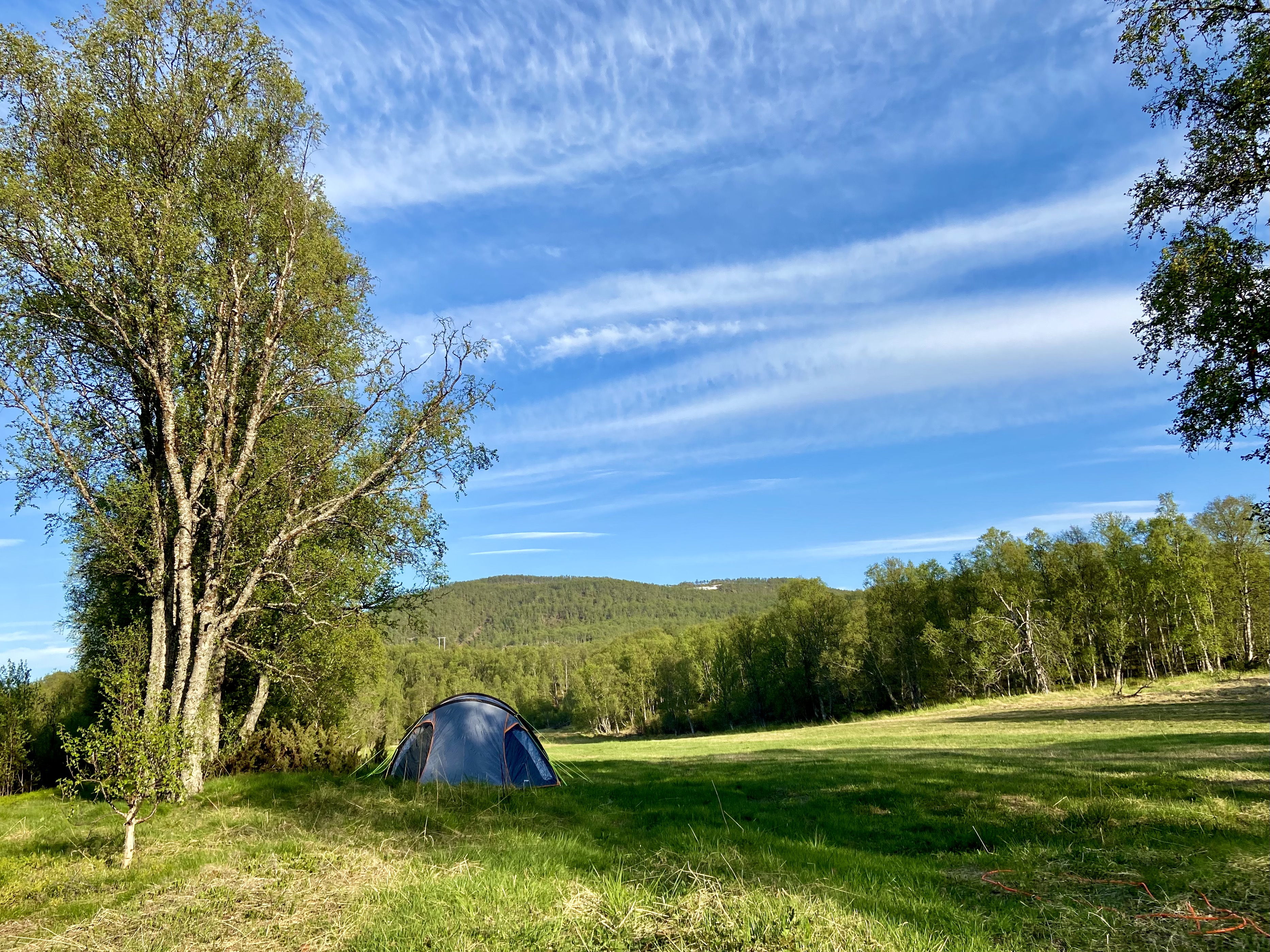
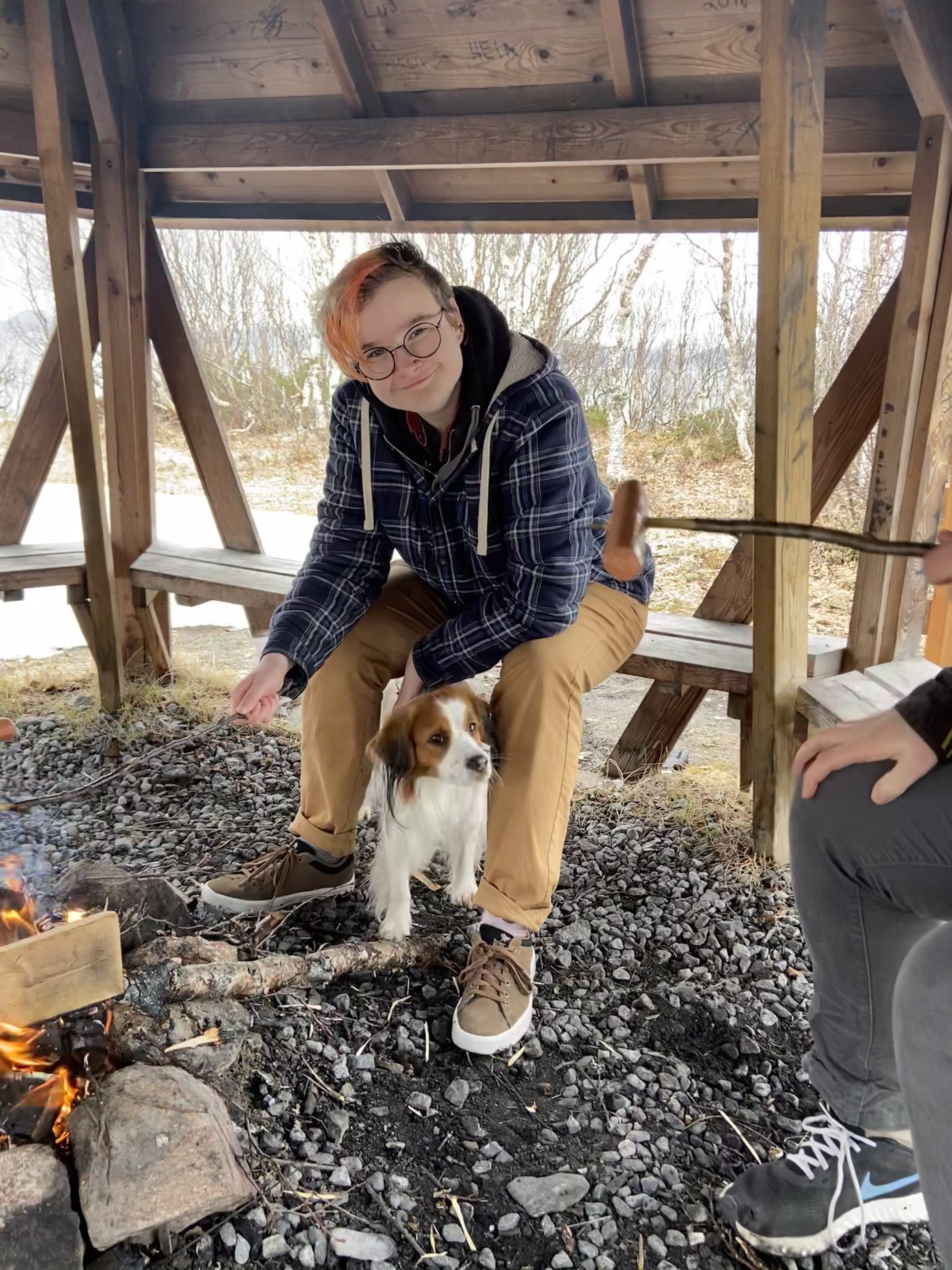
We had been planning to camp at Sørvika near the beach, but when we arrived there, several caravans had already taken up residence. We wanted somewhere more private, and so we drove on and found a little track that led up into the hills further around the peninsula. Wild camping is allowed in Norway. So long as you aren’t near houses or on agricultural land, you can pitch your tent anywhere. We found a field, which might be used for hay, and camped on the edge of it, under some trees. It was wonderfully green. We had hoped for a fire, but had to settle for the trusty little gas ring that John and I bought for driving up here last year. Triar particularly enjoyed the hot dogs.
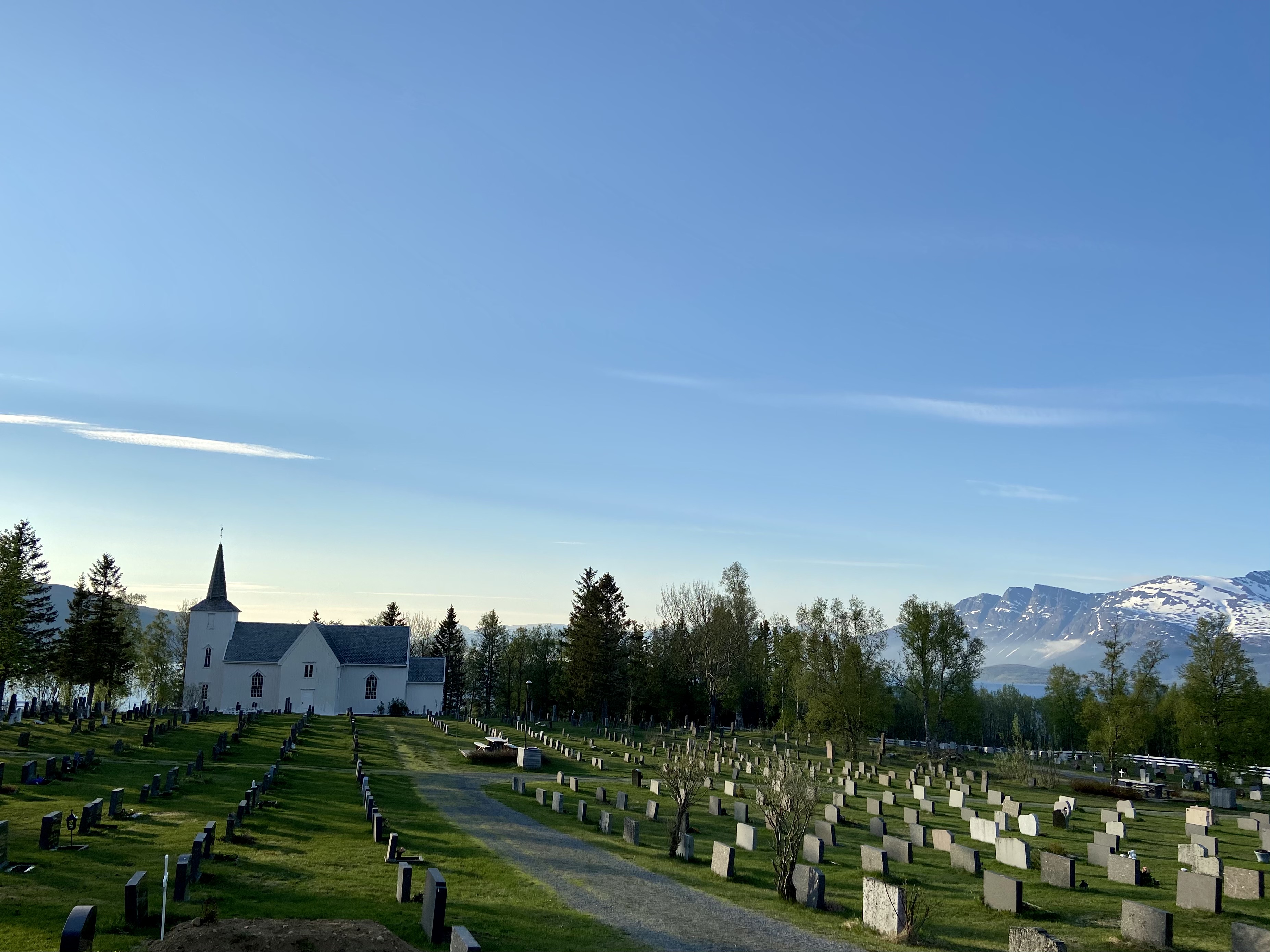
We drove on round to Rossfjord after we’d eaten. Beautiful as it was, the mosquitoes were out in force and being eaten ourselves was not part of the plan. There, we found one of the most beautiful graveyards I have ever seen. On the hillside stretching up from the white wooden church, the gravestones were well tended and new, but in the little corner furthest away from us, there was a much older section, with only a few iron crosses and low grassy mounds marking the graves. It was wonderfully tangled and overgrown, slumbering in the evening sunshine. When I am gone, I hope my resting place is equally peaceful.
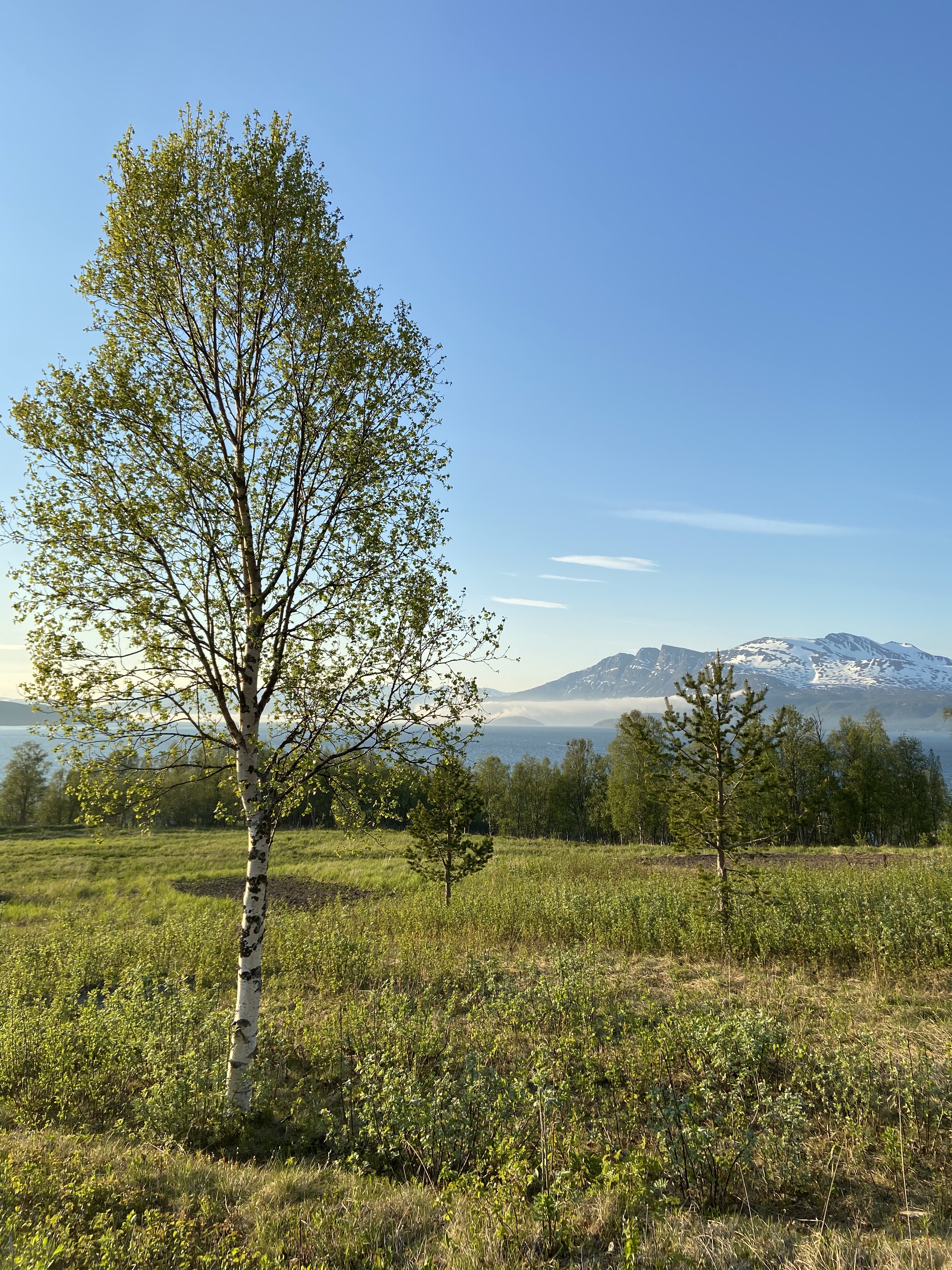
As we drove back, the air grew colder and mist began to form over the sound, gathering on the mountains opposite.
It wasn’t very dark in the tent, but somehow I managed to sleep well. I woke a few times and marvelled at the birds singing. Do they sleep in summer at all?
We came home this morning. Someone has to feed the guinea pigs! And as it’s late, I thought I would pop outside to get you a picture of the midnight sun over Senja.
When I’ve clicked on the “Publish” button, I shall go to my bedroom, close the blackout blinds and the curtains and go to sleep. Good night all.
In many ways, living here in the north of Norway, it’s easy to get complacent about coronavirus. The Norwegian government has stipulated that nobody should go to work or school with a cold, or any symptoms of a respiratory illness. Some people take this seriously. Quite a few ignore it. A colleague of John’s announced last week at work that he had a cold. John came over on Saturday to stay for the weekend, but by the evening, he had developed a sore throat. I took him for a test on Sunday, then very sadly took him home. Andrew is entering exam time and the last thing he needs is to have to stay at home because of the coronavirus rules.
It is frustrating when there are rules and people ignore them. And here in Norway, there isn’t anything like the pressure for presenteeism that exists in the UK. I was amazed years ago, when working at Tu Clinic, to find that if one of the vets had a cold, they would stay home and the receptionist would ring round the clients and rearrange the appointments for another day. Back in the UK, it was an unwritten rule in all the practices I worked in that unless you were actively vomiting or unable to get out of bed, you should drag yourself into work. If you did take a sick day, nobody would ring any clients. The other vets were expected to manage.
It wasn’t coronavirus, happily. It is easy to get complacent, living up here in isolation. I no longer feel the fear I did when I was further south and living in an area where many people travelled because of the oil industry. But there is currently a significant outbreak of British variant COVID in Hammerfest, which is about as out-of-the-way as it gets. It’s a reminder that nowhere is completely safe.
Having said all that, it was a pleasure to attend a real-life meeting in Tromsø on Tuesday this week. It was a training session for Dyrevernsnemnda, who are a group of lay people with an interest in and knowledge of animal husbandry. They work alongside the veterinary surgeons on welfare cases, providing a different perspective and improving balance in decision making. For me, it was a very useful meeting. Those working for Dyrevernsnemda come out on inspections with us and so the information was a whizz through of the laws and practices that govern us. It was very well presented.
It was also lovely to travel to Tromsø. Though it’s only two hours away, I have only been once before on an emergency mission to find a companion guinea pig. Another reminder that we are not living in normal times. I drove up with Thomas. Tromsø is on an island and we entered the city over this bridge.
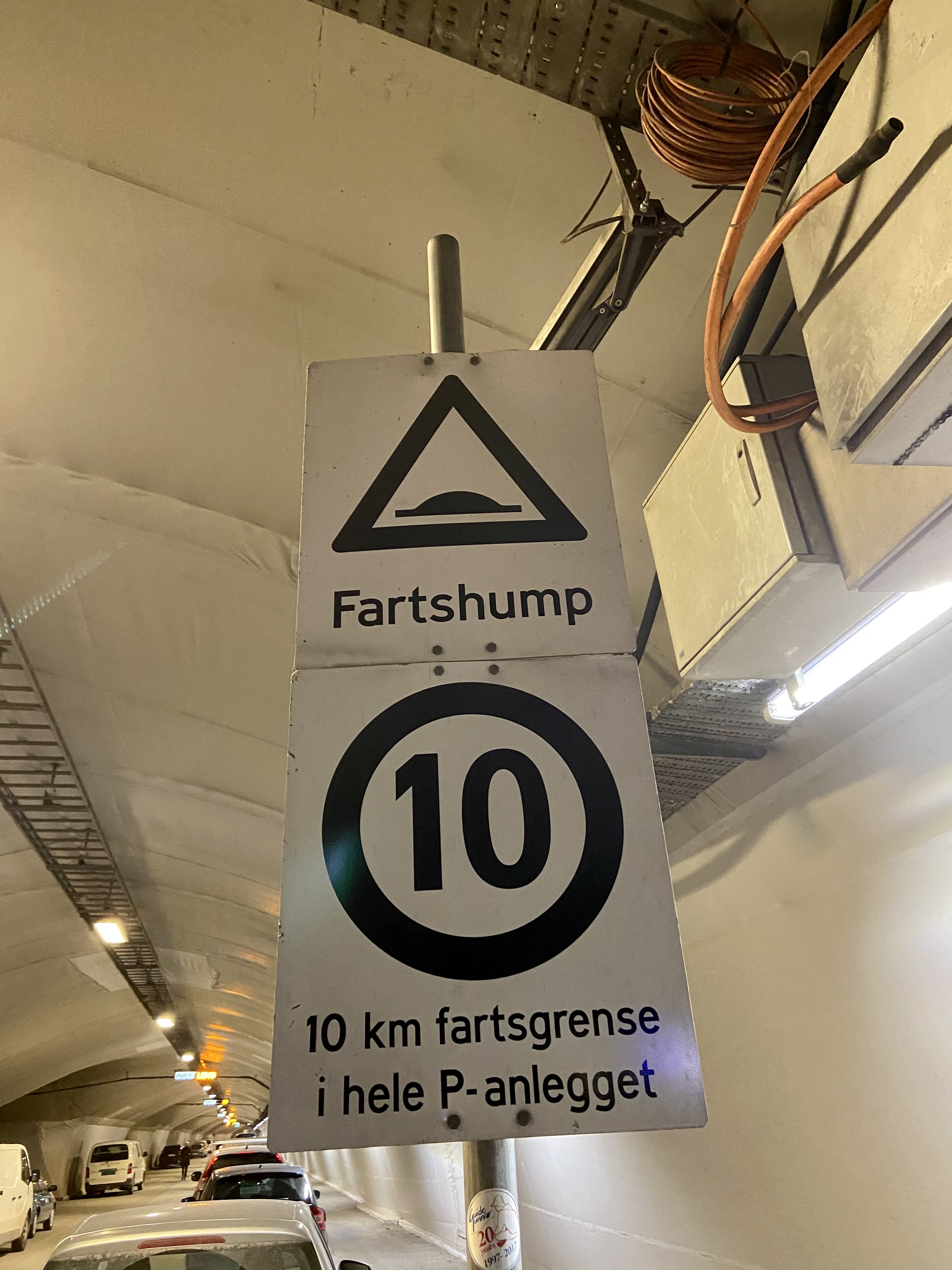
I was glad that Thomas knew his way around. The city is on a hill and he pulled into a car park built into it. I was surprised to find a row of arches cut into the rock and lined with some kind of material. After the meeting, when we returned, I was even more amazed when I discovered the car-park was connected to the tunnel system that runs under the city. Norwegians are very skilled at building tunnels, but it still fascinates me when there are miles of roads underground, with junctions and roundabouts. I was also pleased to find a speed-bump sign in Norwegian. Obviously my sense of humour is very basic!
Wednesday was lovely. I travelled up to Laksvatn with Ammar to blood test some goats and we have arranged to do some more next week. I love going out to farms and doing practical work. There is none of the pressure that exists with the welfare side of the job and it is a lovely reminder of the time when I was working as a farm vet, which was what I always wanted to do. I gave it up after having children because the lifestyle doesn’t fit easily with family life when both parents are vets. I thought about returning to it last year, but didn’t feel certain I could manage calvings and some of the other more physical work now. Odd how life turns out.
Speaking of goats, we received an interesting e-mail this week. A couple from Germany, or perhaps the Netherlands have been travelling in Sweden. They have been hillwalking, which would be all very well, except for the fact that they have taken their pet goat with them. They’ve been seen out and about with the goat on a lead and it is rumoured they might be heading to Norway. I’m not sure what the rules are in Sweden, but in Norway there are very strict rules attached to importing animals. It’s one thing taking your dog with its passport, but the idea of roaming around Europe with a tame goat is something I found amusing.
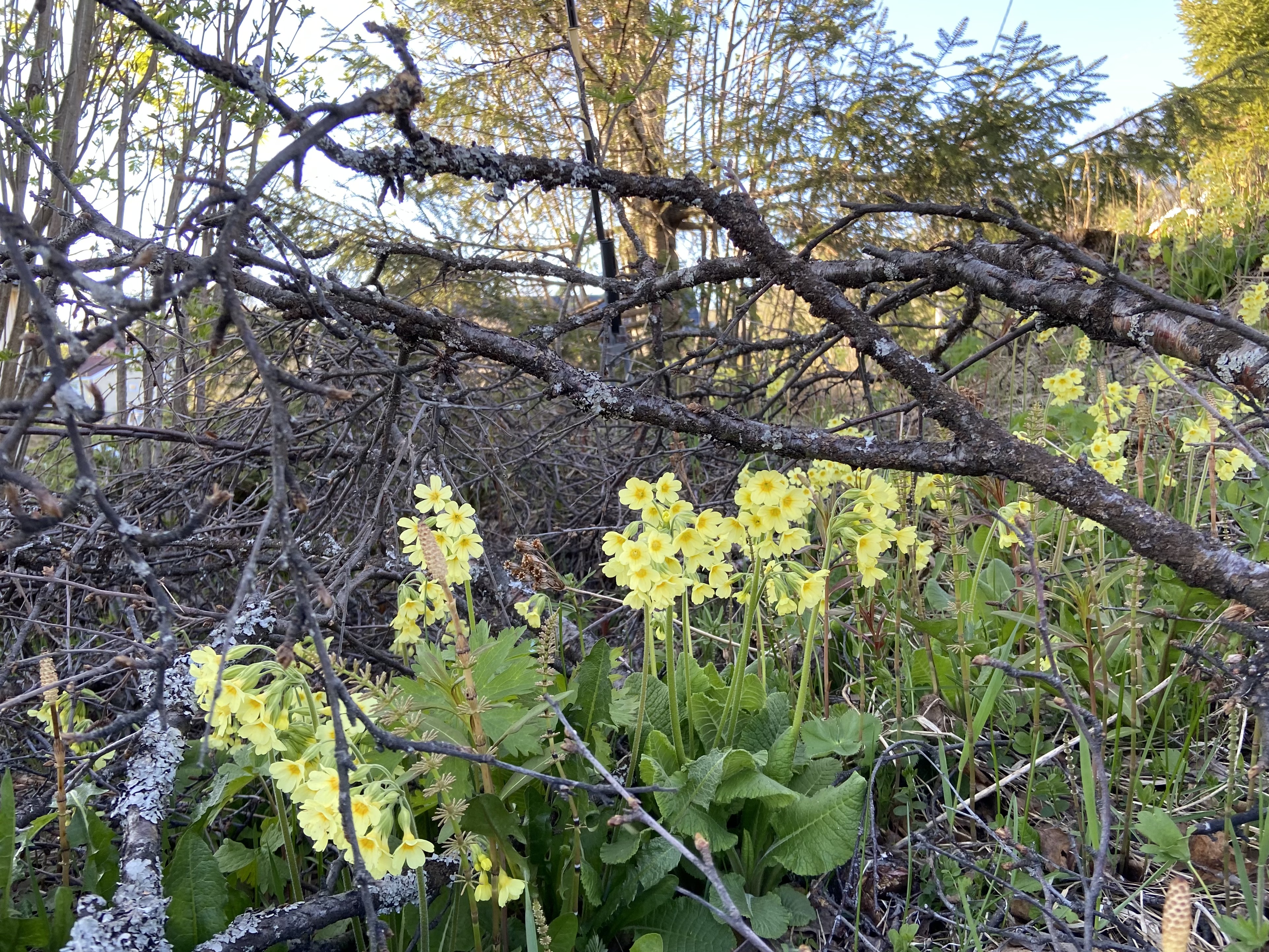
I’ll finish off with a few photographs I took while continuing my walking program this week. More spring flowers are pushing through the ground and this week, cowslips seem to have taken over from the coltsfoot. Now it’s summer, more people are flying flags. It’s quite common for Norwegians to have a flag pole of some sort. There are strict rules around flying the Norwegian flag. If you put it up, you are supposed to take it down again at nightfall. Perhaps the Norwegian flag doesn’t like to be darked on. Presumably up here, in summer, you could leave the flag up all day because it doesn’t actually get dark, but it still seems to be common to fly a wimple, which has the Norwegian colours, but isn’t technically a flag that needs to be taken up and down. And although it’s very spring like, as you can see in the picture at the top of the page, and the one below, there are still lots of places where the trees have no leaves. Have a lovely weekend everybody.
Ann was on holiday this week and so I worked every day from Tuesday to Friday at the abattoir in Bardufoss. I was on animal welfare duty all week (which involves an early start) and as John is living over there in an apartment with a spare bedroom, I spent the better part of the week at his place.
As we set off to drive over on Monday evening, we began discussing health and fitness. Through the long winter, walking in the countryside was largely impossible. Trails were blocked with snow and even if you wanted to park and walk along the road, you often couldn’t as the car parks hadn’t been cleared and there was nowhere to stop. Looking back, I realise how unprepared I was. Next winter, I will have to find a solution other than sitting on the couch for three months, but for now, the challenge is to get my untrained muscles outside and get some fresh air into my lungs.
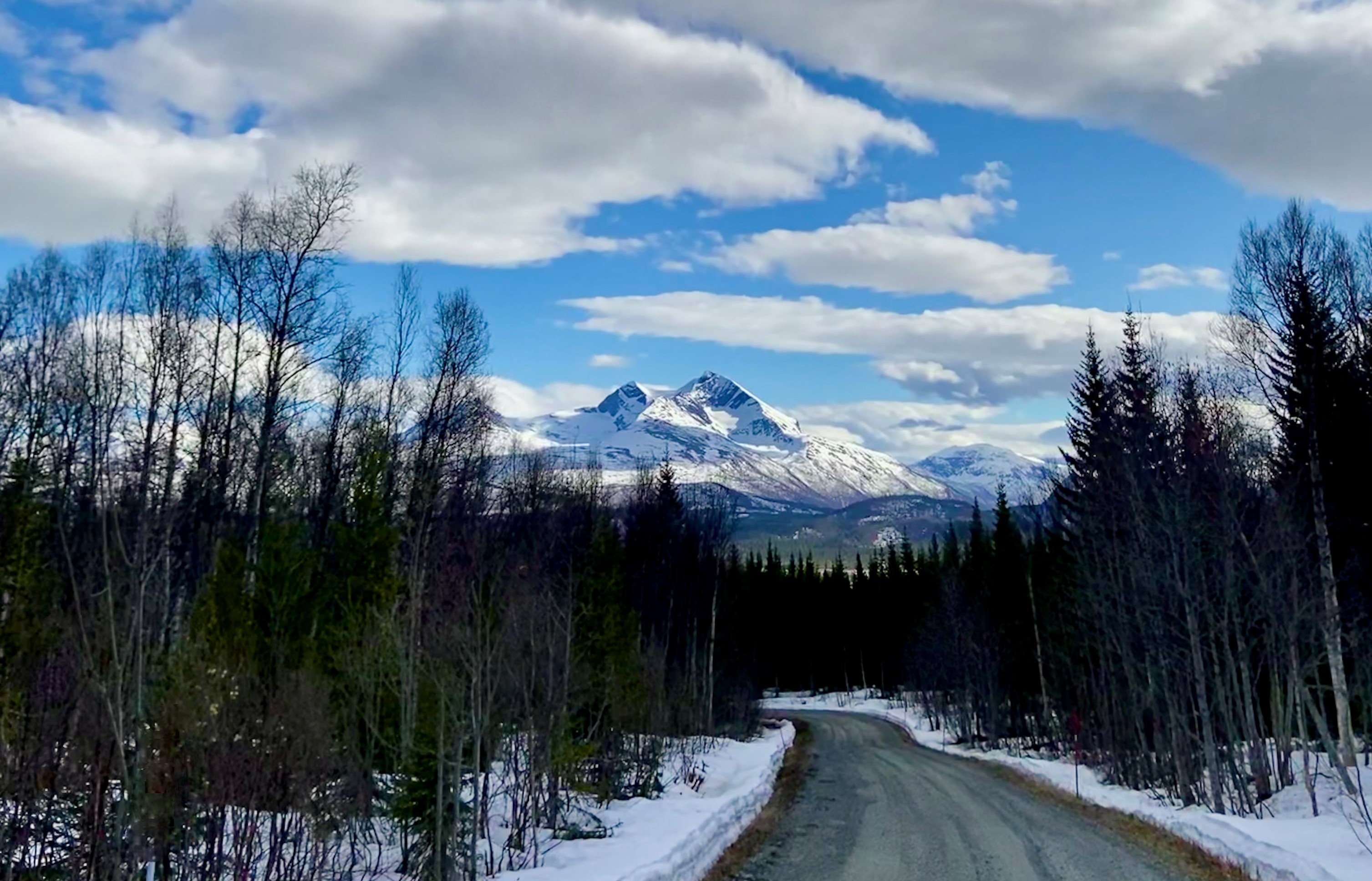
John suggested we walk up an unmade road close to his house that weaves up the side of one of the fells. Because it’s technically a road, it was cleared through the winter. A few weeks ago, there would have been an icy crust and walls of snow, but those have melted. There are large laybys all the way up. In winter, these were crucial passing places when the road was hemmed in, but now they are big enough to park in.
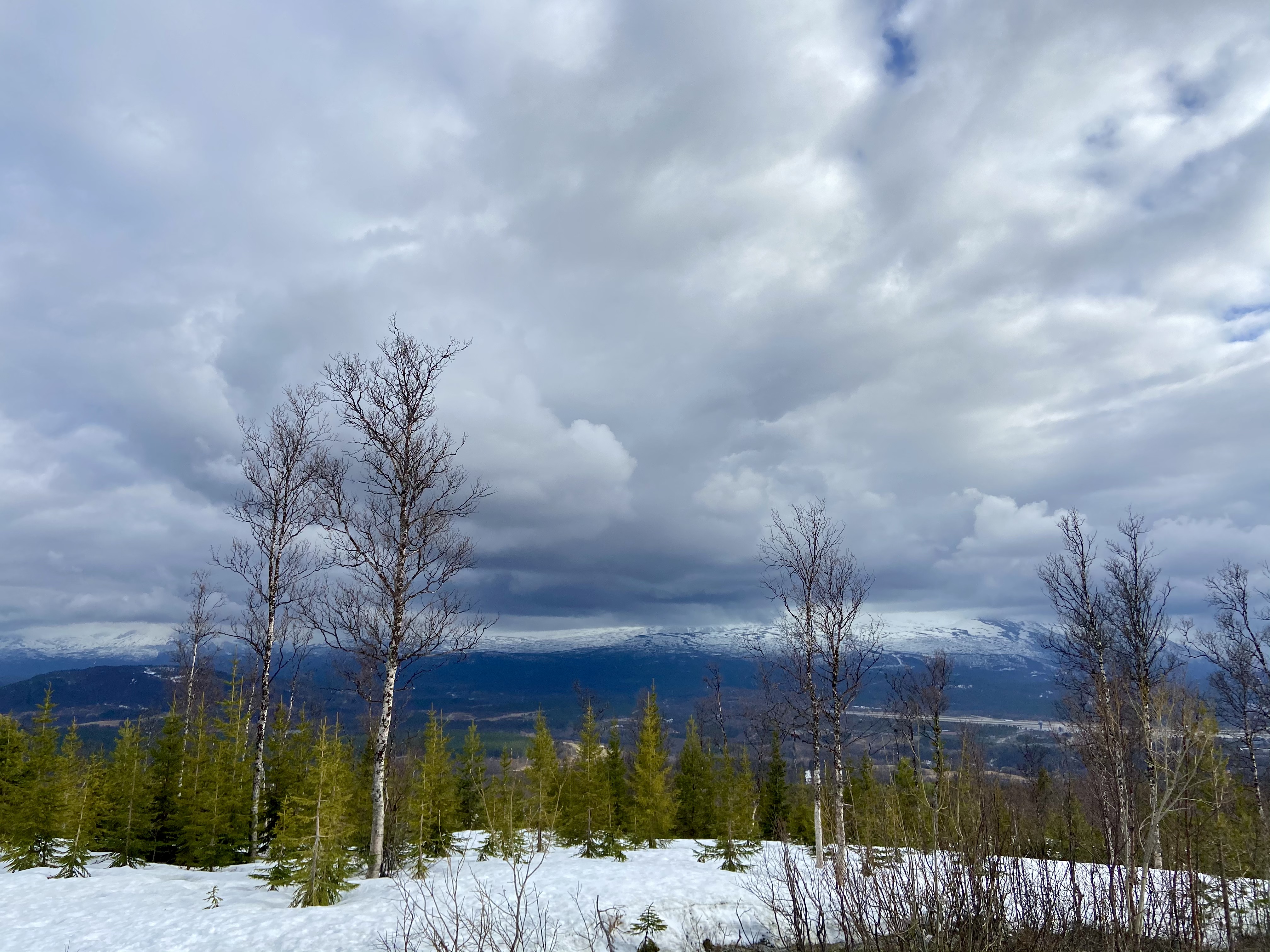
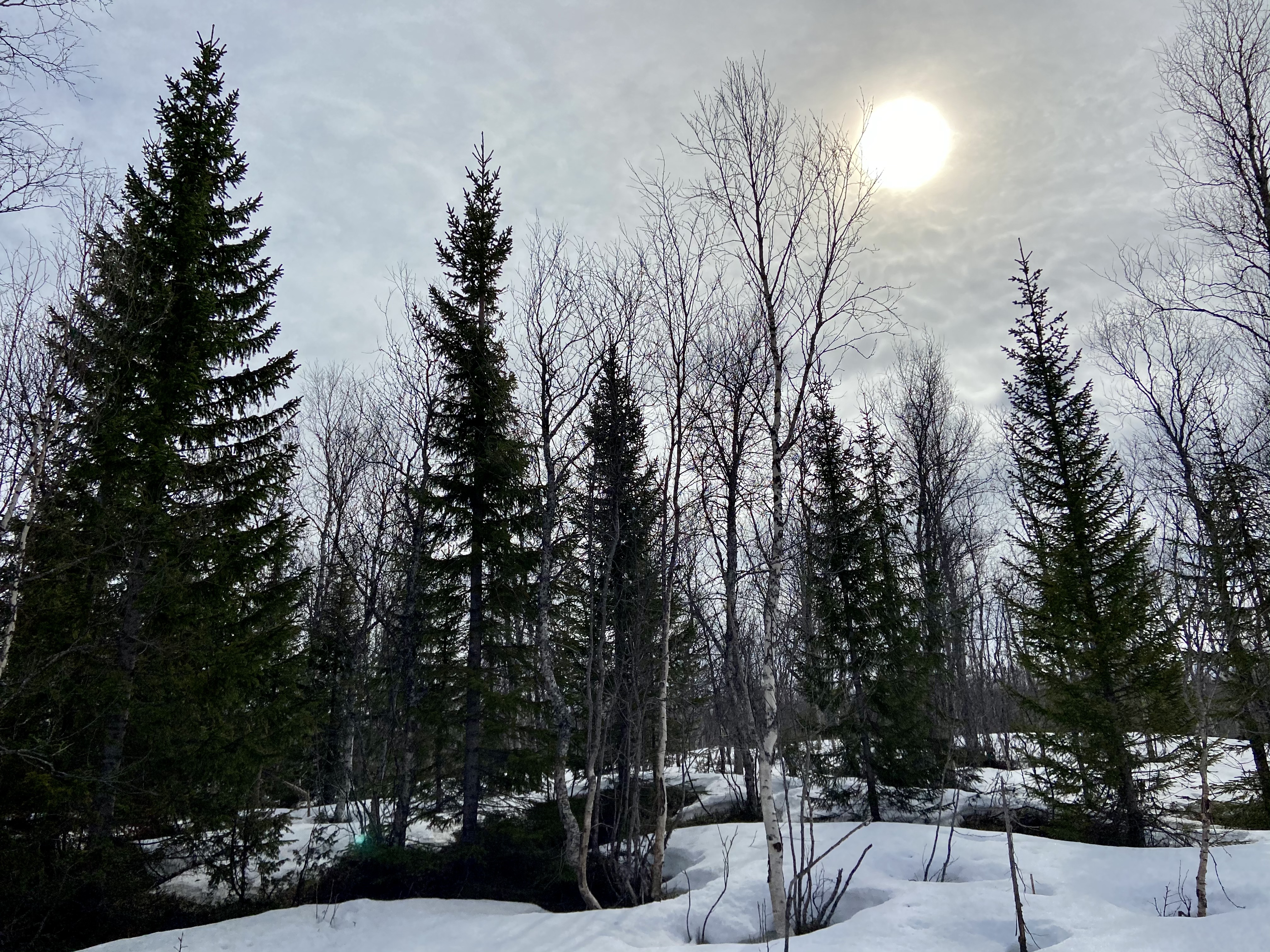
John’s proposal was that we should start from the bottom and walk up in stages, so that’s what we did. The first day’s walk was a steep twenty minute trek through woodland. It was pretty enough, even as I gasped my way uphill. A large stream, recently frozen, ran alongside sections of the track. The forest floor was still lined with snow. But it was only when we reached the end of the first day’s segment and turned round that I could see just how beautiful the scenery was.
Day one from the highest point of our walk.
Only a couple of weeks ago, the mountains were swathed in pure white. Now their rocky faces are emerging and the trees that line their lower slopes are beginning to be tinged with purple as new branches and leaf buds begin to grow.
Icy mountain stream.
We stopped to photograph the stream on the way back down. The peaty water flowing over the ice gives it a very different look from the streams in Scotland in springtime.
Highest point on day two.
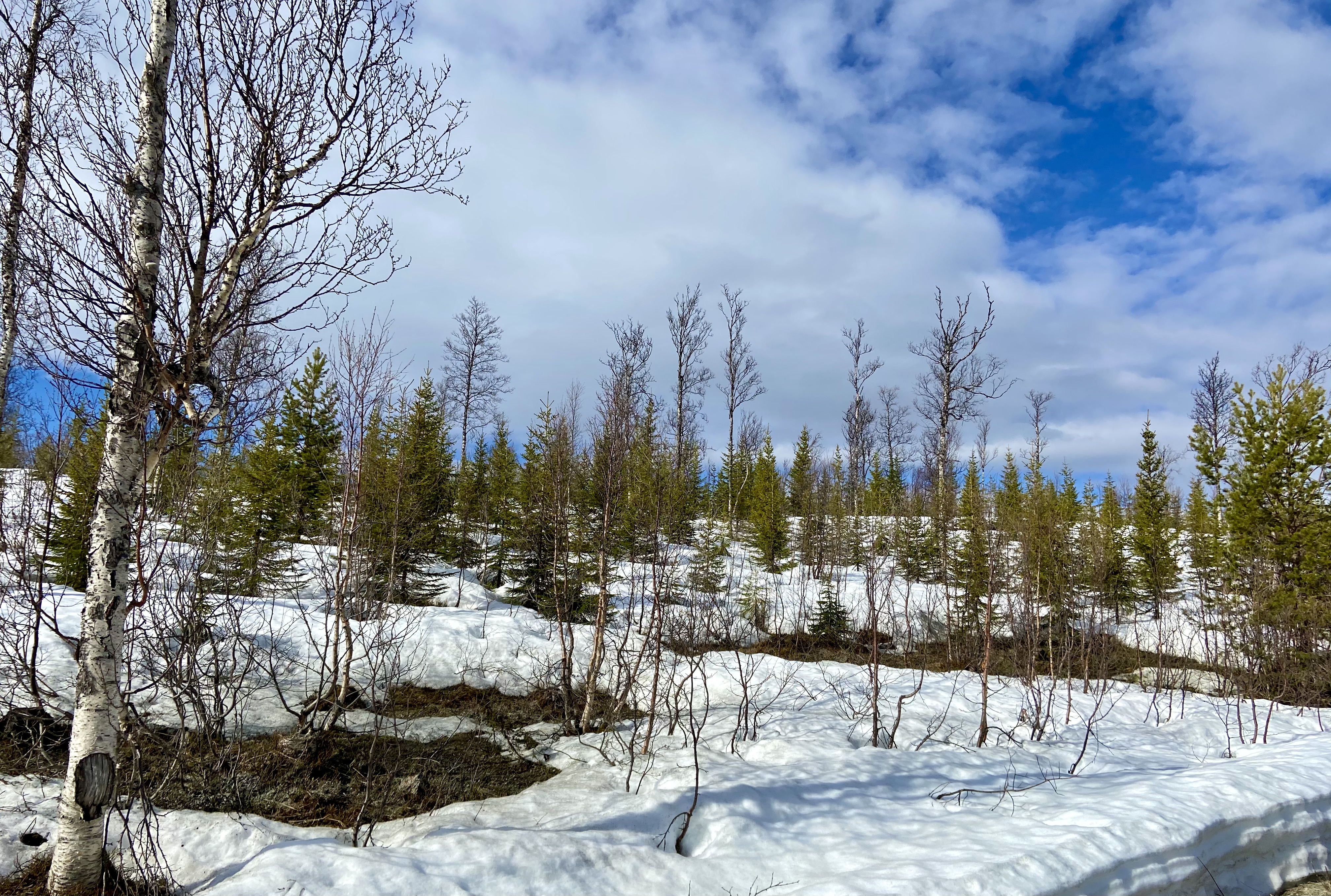
On day two, we took the car up to the highest point we had reached on day one and set off from there. The trees were more sparse up here, clinging on to the thin layer of earth over the rocks. In the lower right corner of the photo, you can get an idea of how thick the snow still is. It’s treacherous to walk through. There’s a crust on the top, which occasionally holds firm, but more often you fall through and find yourself off-balance in a knee-deep, foot-sized hole. As your other foot is similarly wedged, moving it quickly to correct your balance is impossible. I haven’t yet fallen flat on my face, but that’s because I mostly avoid making the attempt.
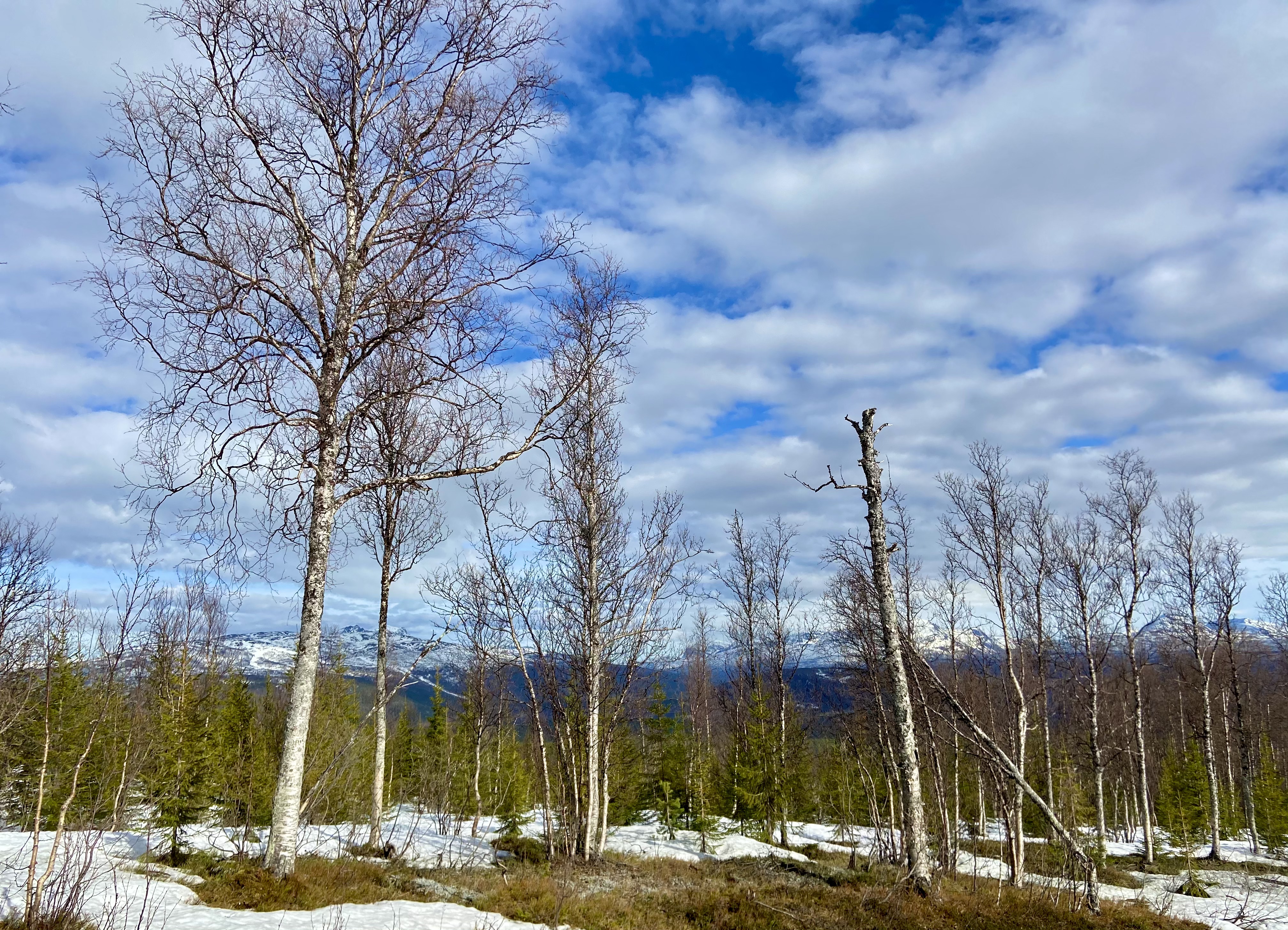
Mountains beyond the trees.
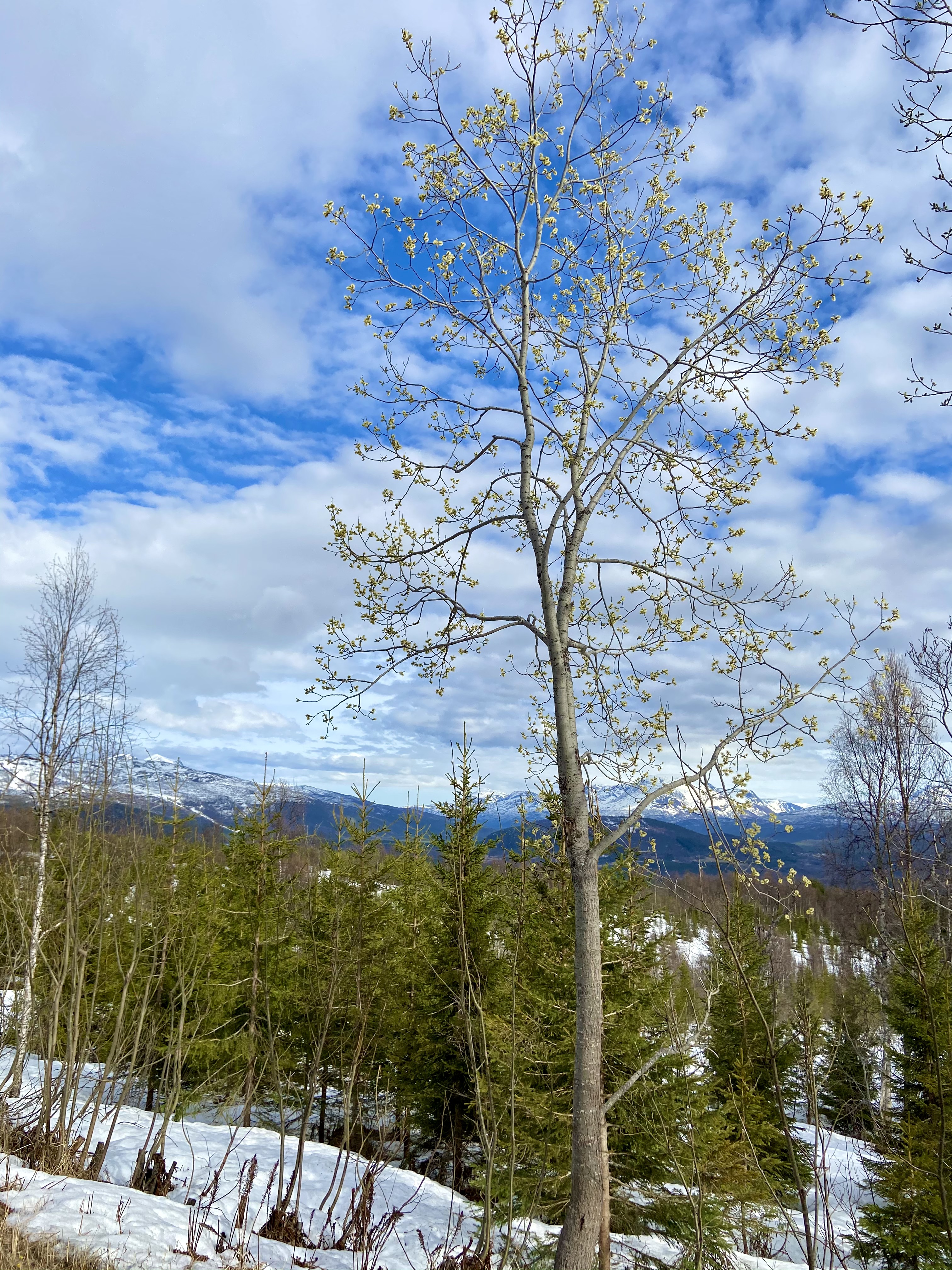
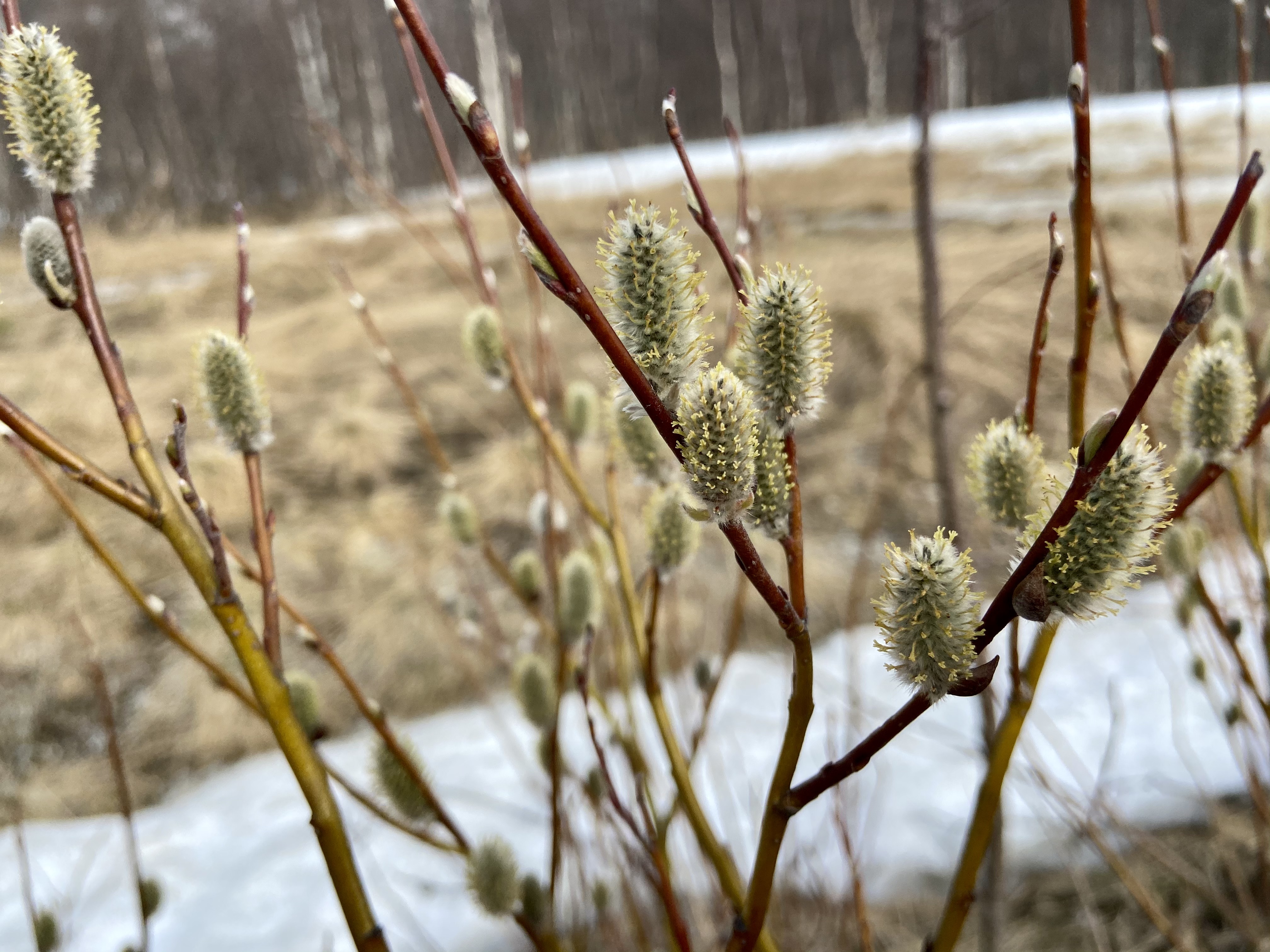
The emerging colours are stunning. After months of white, it feels as if the world is coming to life again. The pussy willow trees are so rife with pollen that it almost looks like blossom. There were birds too, singing in the trees.
Tree in bloom.Day three, close to the top.
By day three, my legs were beginning to flag and so we walked only ten minutes instead of the normal twenty. The sky that day was filled with dramatic clouds, and yet it was still warm enough to walk without a jacket. Then again, five degrees feels warm to me now. There’s no doubt my body has adjusted to the local climate.
The colours of spring.
I came home yesterday and walked here instead, but I confess that I love the new project John has created for me. We will continue walking up the mountain over the next few weeks, and hopefully when the trails on Senja are properly opened up again, we will be able to tackle some of the mountains there.
And, of course, I can’t write this blog and fail to mention the fact that we now have twenty four hours of daylight. I stayed up last night, to see whether there would be midnight sun, but it dipped behind the mountains at eleven fifty. Going to bed is more difficult when it is still so light. It’s also difficult when you wake in the middle of the night and there’s bright sunshine filtering round the edges of the blind and curtains. There’s no way to judge whether it’s morning or not. I have to check the clock each time. Tough to go back to sleep at four in the morning when your eyes are telling you it’s full daylight. Have a great week everyone.
17th May is Norway’s national day. On this day in 1814, the Constitution of Norway was signed at Eidsvoll in Viken County. All round the country, and indeed round the world, Norwegians celebrate.
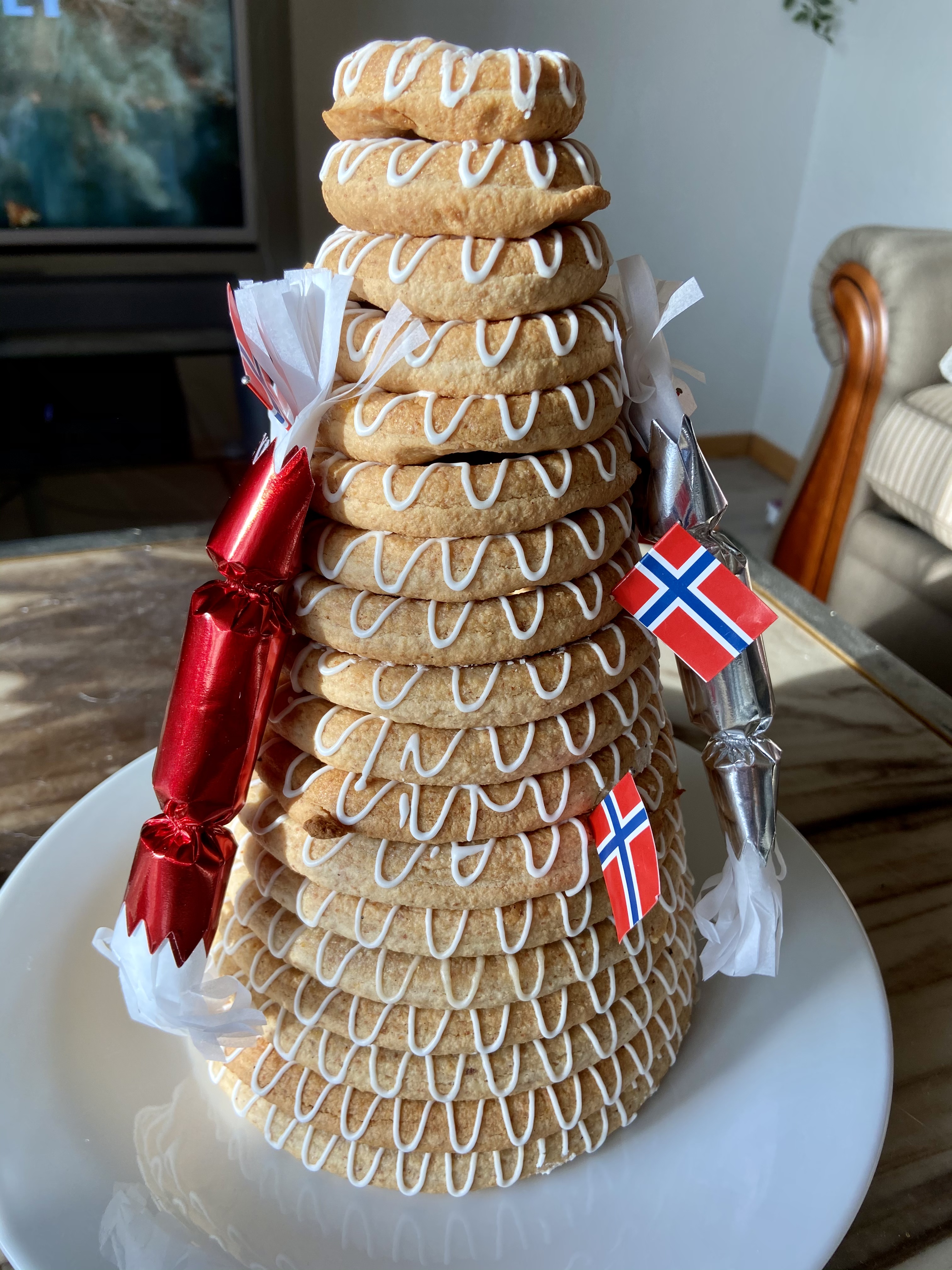
Outside of coronavirus times, the children march through town centres and teenagers in their last year at school don special «Russ» costumes of varying colours. After a month of pranks and dares, both inside and outside of school, they join the parades for their special day. There are various Russ outfits, the most common being dungarees with a Norwegian flag inside the front panel. The straps and flag are often left hanging and the trousers are decorated with slogans and pictures, as you can see with the green-dressed clarinet player standing at the front of the band. Red Russ is the most common, but some wear green, some blue, black or white, often depending on what course of study they are following.
Brass bands are very popular, and as well as the above band playing in the square, there was a marching band which came along the main street before the motor parade. The marching band includes school children who are provided with instruments and lessons after school in return for playing during celebrations.
Russ celebrations have been muted this year and other than the band, the children didn’t march here, but there was a parade of vehicles through the town centre. The emergency services turned out, as did many members of other industries. Ambulances, red cross, farmers and firemen drove through the streets along with motorcyclists and car enthusiasts.
And everywhere, the smart red, blue and white of the Norwegian flag.
Usually there’s a gathering afterwards, perhaps in a community hall, but this year we went home for our hotdogs.
Only another three days and we will reach the point where the sun officially doesn’t drop below the horizon until 24th July. I know now that there will be a delay due to the height of the surrounding mountains. For a few days, it will continue to sink behind them, but after that, on sunny days, we should be able to see the midnight sun.
John told me yesterday about a conversation with a friend. John was trying to express how it felt to see the sun again after the polar night. Although it never reached the point of being dark 24/7 there was an ethereal quality to the light and for a month and a half, there were no shadows, even when the sky was clear. The return of the sun felt like a catharsis. John tells me his friend commented that you have to appreciate the small things, but up here, it didn’t feel small at all.
I feel a bit the same now we are waiting for spring. It’s a long time coming. I’m not sure what I was expecting. After all, I lived in a more southern part of Norway for ten years and spring didn’t arrive until May even there, but with the long daylight hours, it feels strange that things are not further forward. I find myself searching for signs and they are appearing.
All around I hear water running where in winter there was frozen silence. Where there is a rise in the forest floor or a slope that faces the sun, there is a noticeable green tinge. Yellow flowers that look like a cross between daisies and dandelions are pushing through the dirt that has been deposited on the roadsides from five months of snow clearing.
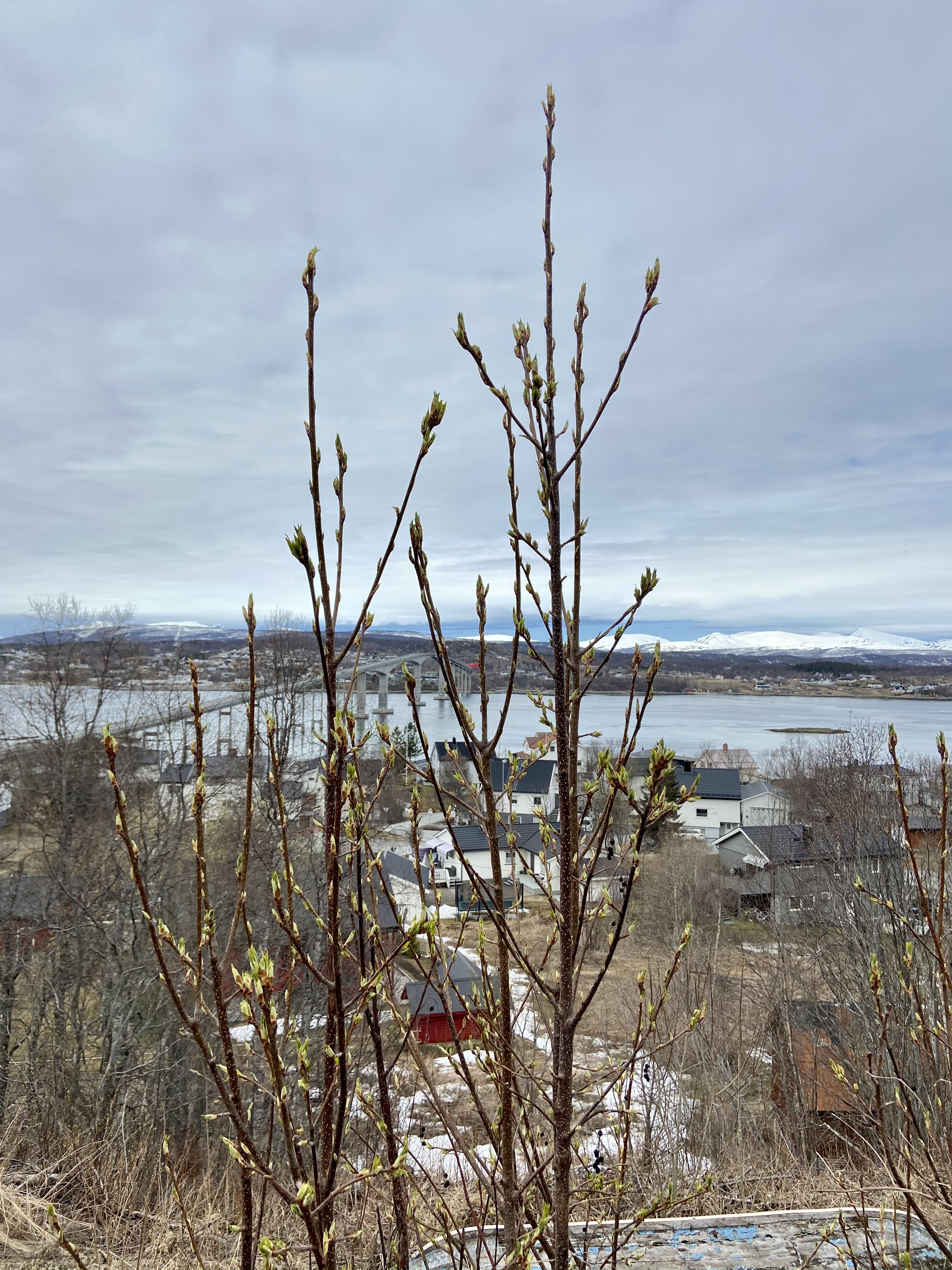
Two days ago, one of the small trees behind the house sprung new leaf buds. I trust that the others will not be far behind. There are a lot of deciduous trees here. The lower slopes of the mountains are swathed in forests and many of them still look black. Surely the change must come soon. I find myself hoping that the lower slopes will be green while the upper slopes are still swathed in snow.
Elsewhere, it seems like winter still has a hold, albeit one that is weakening. Lakes are still frozen, the forests are still filled with snow.
I remember John commenting in August last year that winter never really leaves here. Instead it retreats up into the shadowy corners of the mountains. But that will do for me. Tomorrow is May 17th, which is Norway’s national day. We will be going down into the centre of town to see the children march. As is traditional here, we will be feasting on Norway’s national dish: hot dogs. I hope the sun will be shining for us all.
Last week, I sent the manuscript of a new book I’ve written to a friend. It’s always a nerve wracking moment, showing something you’ve created to another person. Lara is very well read and I was optimistic that if there was any storyline or character that was completely off key, she would tell me.
It’s been a tough project. I started it a couple of years ago in a lull between the last two Hope Meadows books. It’s about a veterinary practice in Scotland: partly wish fulfilment, I think, but also an exploration the life of older women. In this modern world, where women are supposedly able to have everything, they often end up juggling job and family and find themselves trapped in situations rooted in decisions made years ago when their children were young. I was aiming for a cross between James Herriot and Sally Wainwright (the scriptwriter behind the TV series Last Tango in Halifax and Happy Valley) and I hope I’ve achieved it.
To my intense joy (and relief) Lara loved it. Practically minded and knowledgeable, she also pointed out one or two technical points about veterinary practice and rules and regulations. Once I’ve ironed those out, I will be faced with the search for an agent.
In the UK, it’s close to impossible to get a novel published without an agent. In this age of computers, so many people write that all the major publishers have inserted a buffer between them and the great writing public. They will only look at fiction sent to them by an author’s agent, so now I have to look for one. Those who have followed my progress for a very long time might know that I was with Peter Buckman at the Ampersand agency (he put me in contact with Victoria Holmes, who led me through all six Hope Meadows books) but he admitted before we set off that Womens’ Commercial Fiction (which is what I write) wasn’t really his thing, and so at the end of Hope Meadows, we parted. He has since contacted me when he got wind of another vet project, so we remain on good terms, but what I really need is someone I can bounce ideas off, so that is what I’m going to look for.
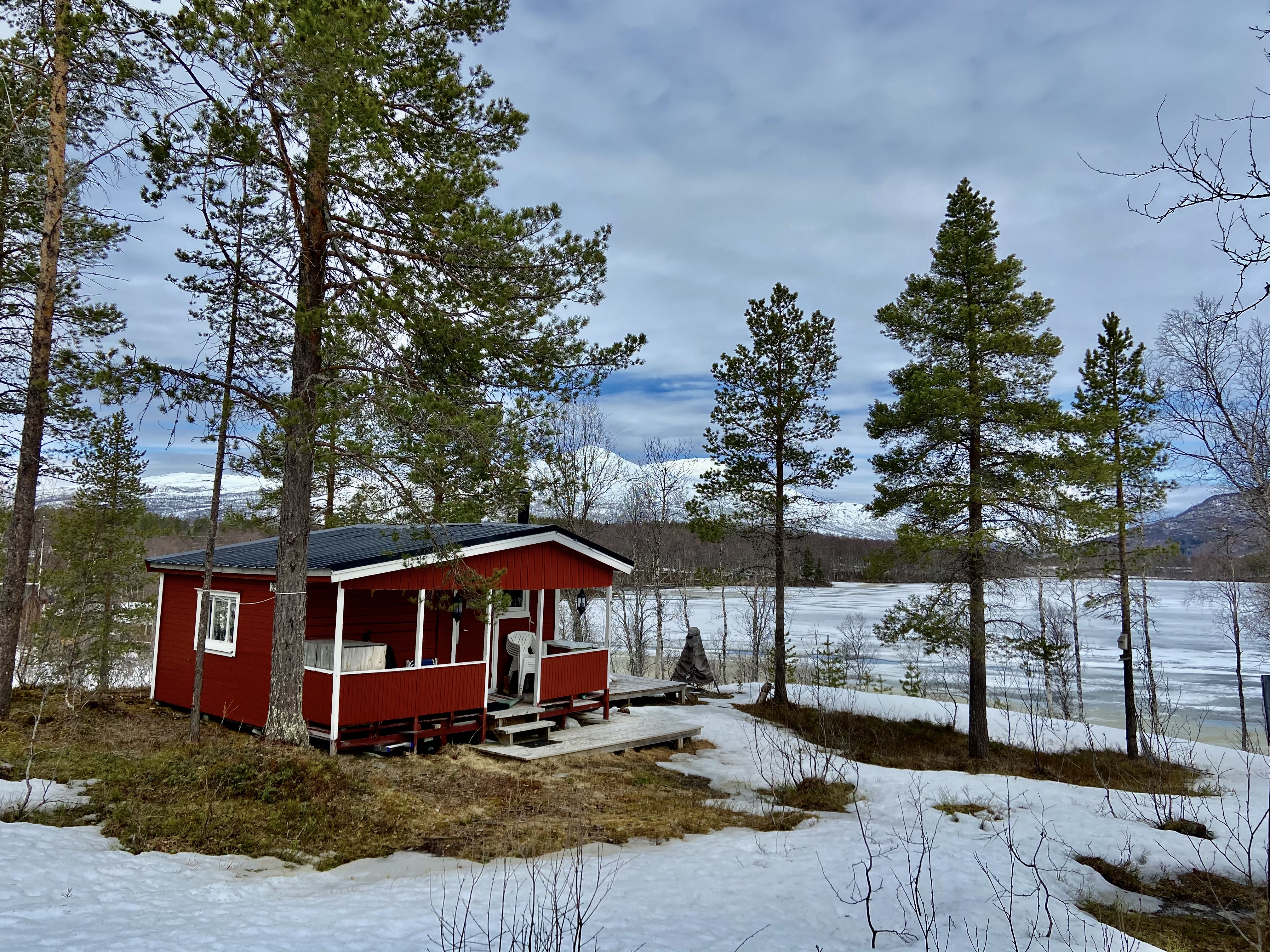
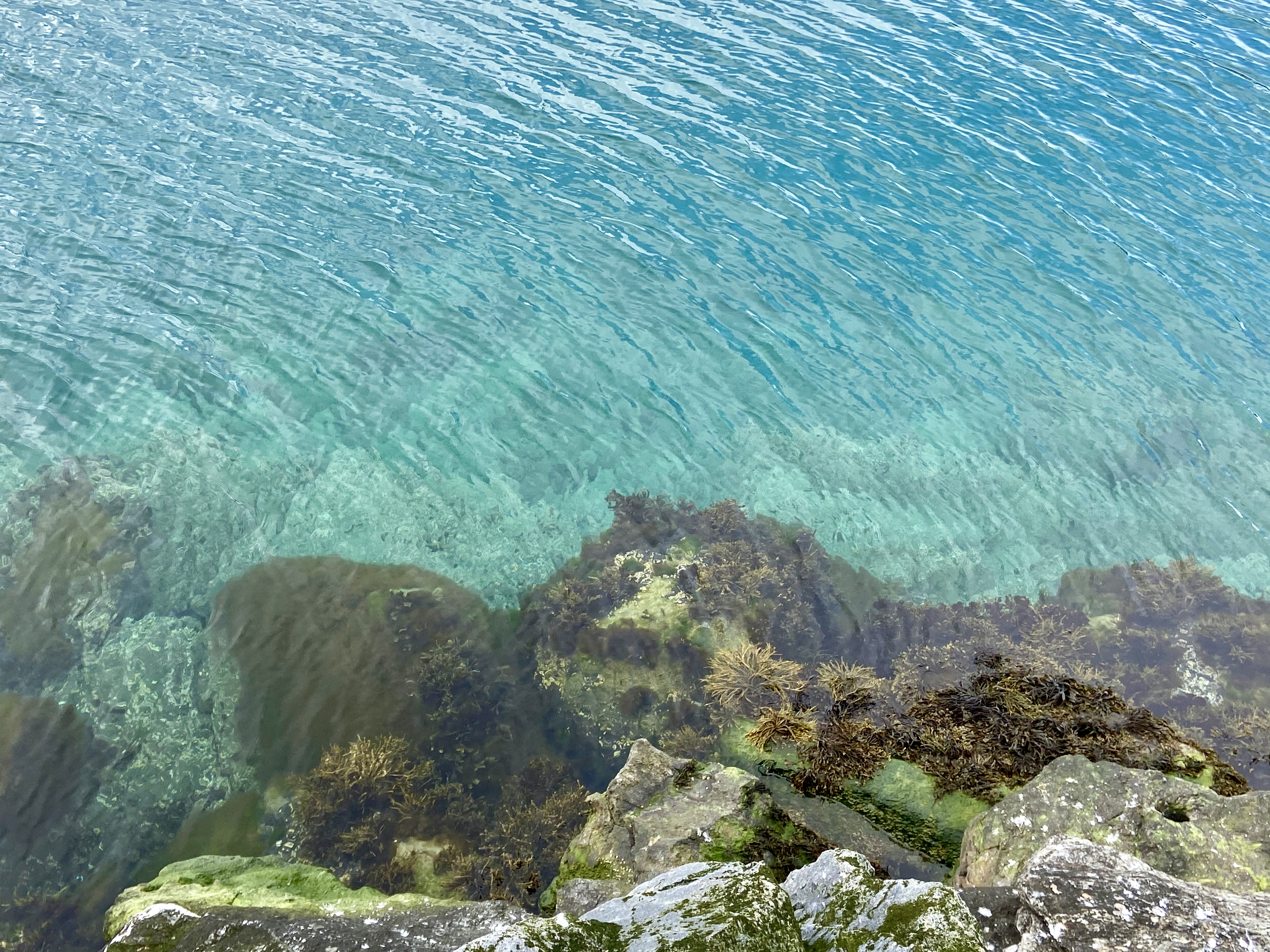
John has been home for the weekend for the past three weeks and as it was lovely weather yesterday morning, I took the afternoon off and we went out with the dog on Senja. Serious walking is out for the moment. The deep snow on the mountains is beginning to melt. Water begins to run underneath it, and so as well as being slushy and almost impossible to walk through, there’s also a risk of avalanches. So for now, we contented ourselves with a stroll near Vangsvik. We found a lovely little harbour where the water was so clear that both John and I thought it would be a lovely place for a scuba dive. Though we have some kit in the flat, it’s so long since I’ve been that I will need to contact a club for retraining if I decide I want to jump back in.
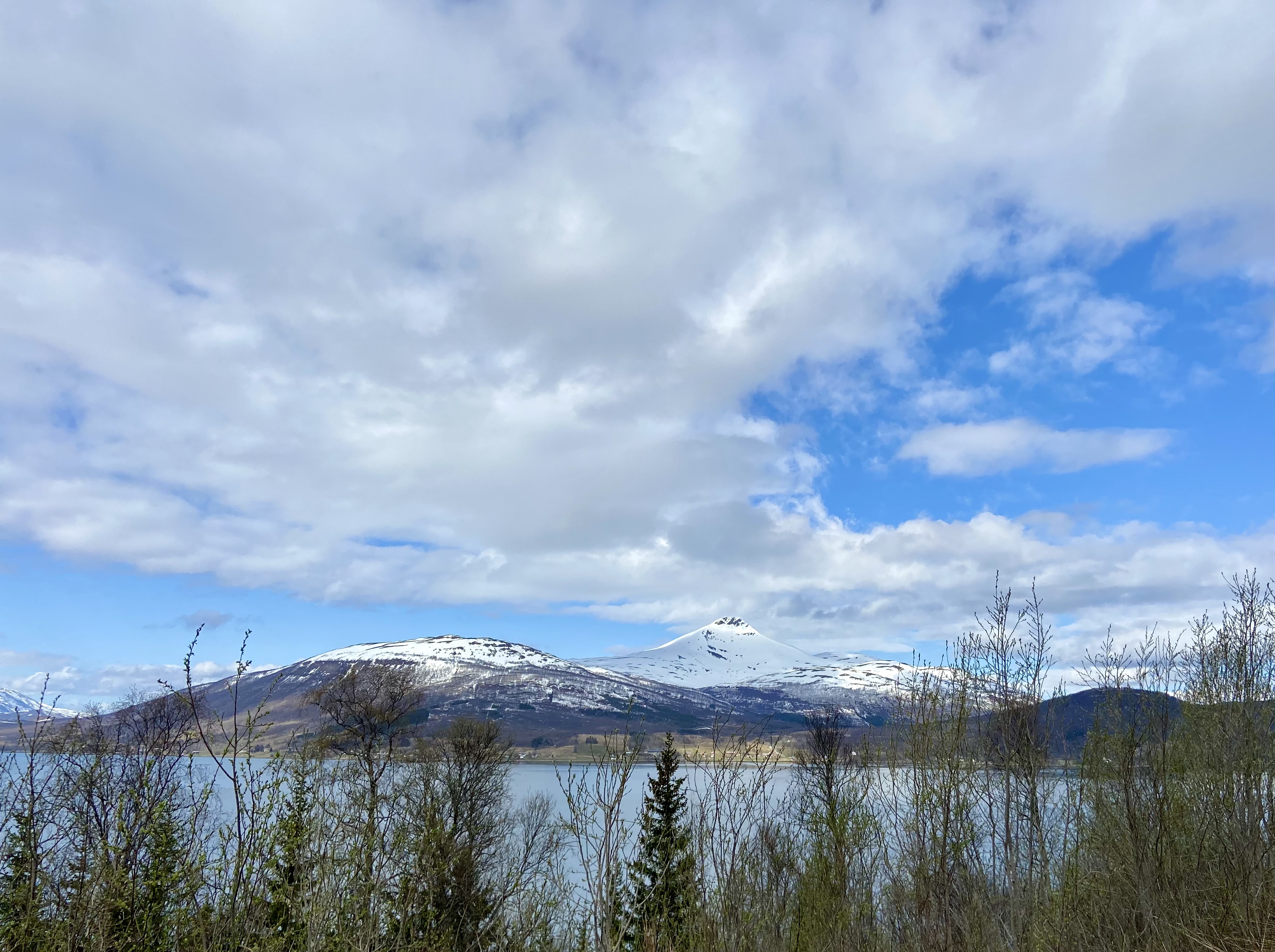
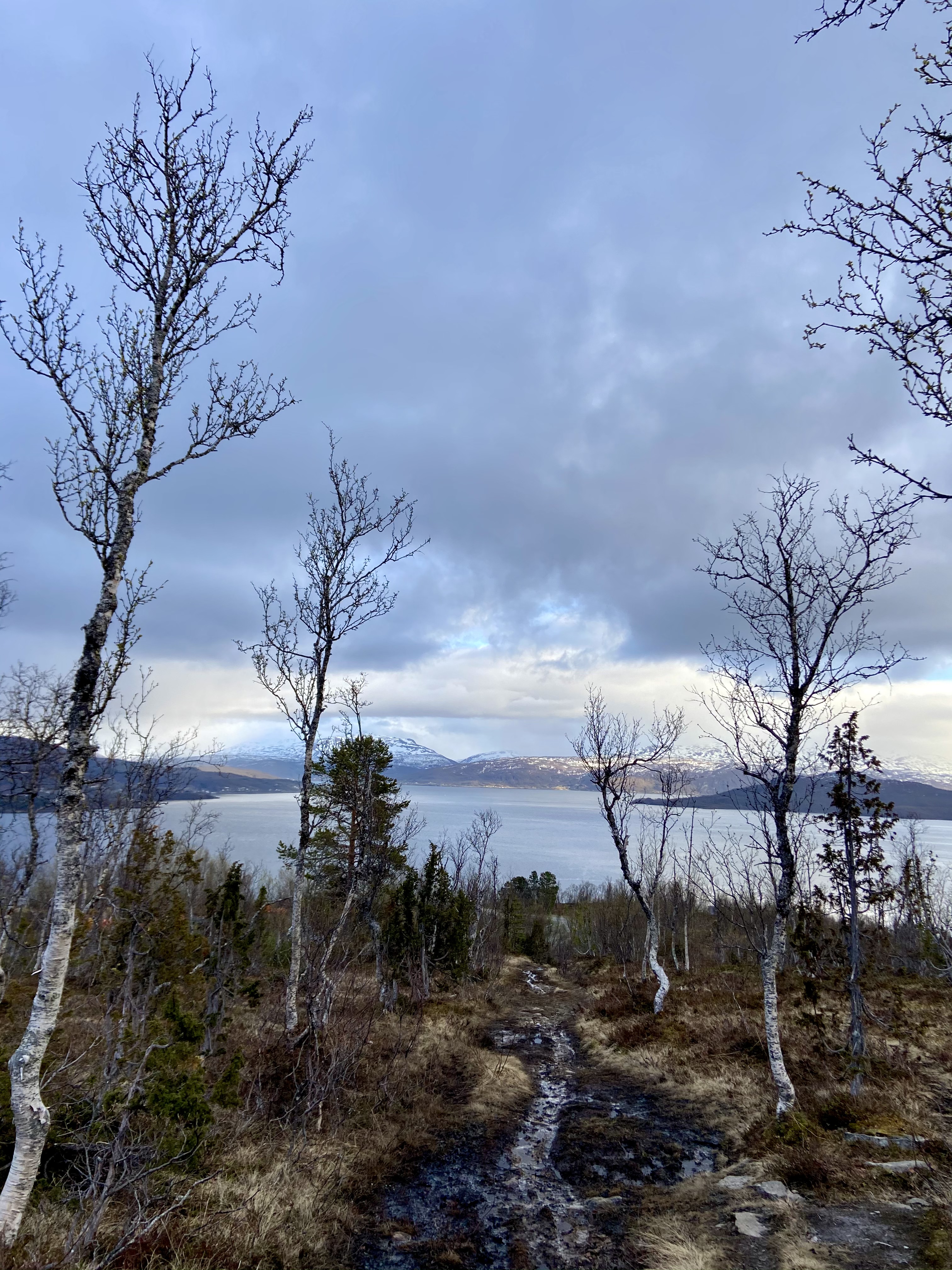
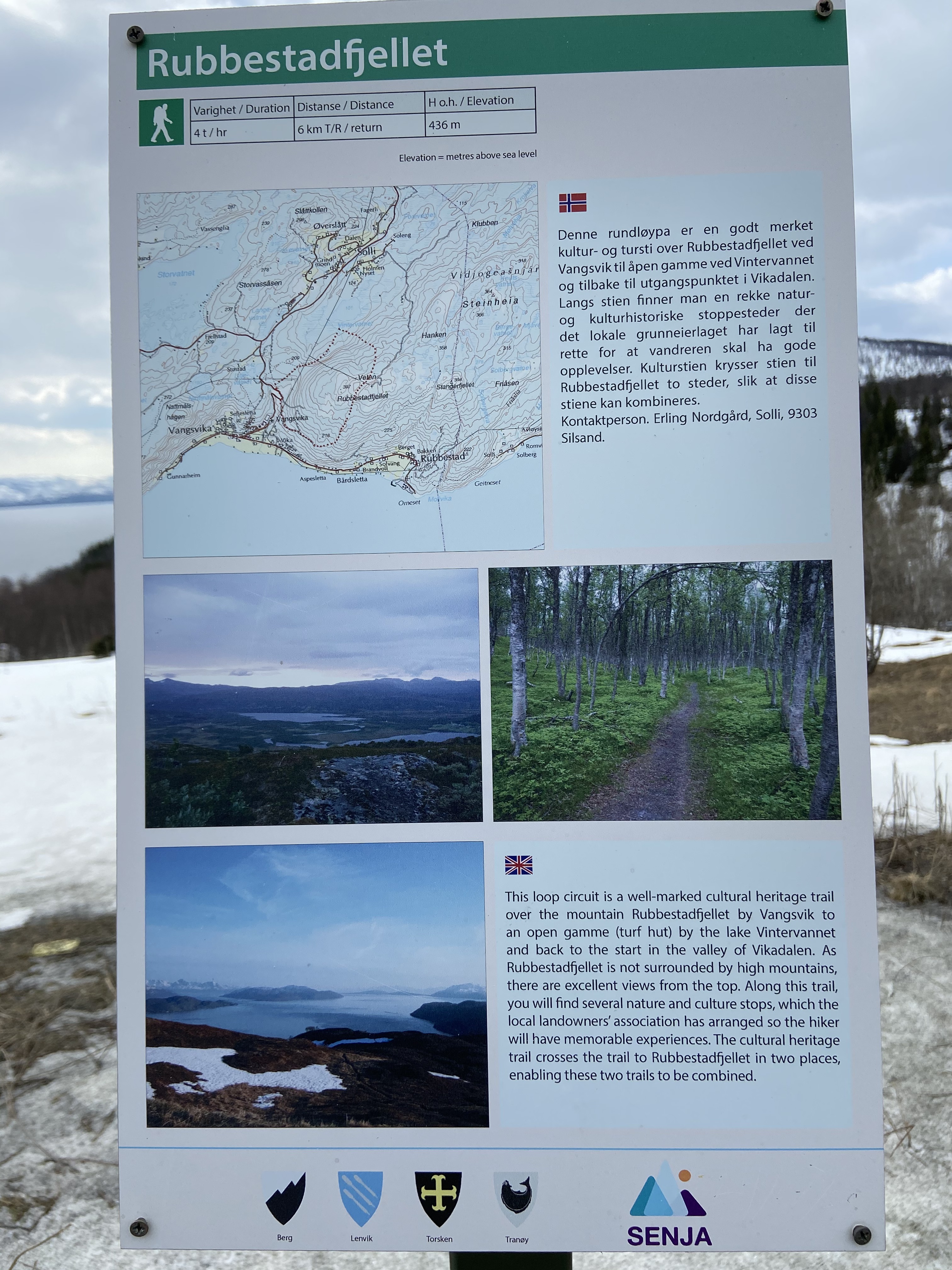
I also stopped on the way back to take some pictures and was delighted to find the start of a hike which I had never noticed before. At four hours (probably five or six at my pace – Norwegians walk everywhere much faster than I do) and with a well marked path, it sounds perfect.
If the view at the beginning is anything to go by, the outlook from the top must be stunning. In a few weeks time, we will have 24 hour daylight, and even though I’ve woken to snow again this morning, it can’t last forever. Though spring is still trying to hide, there are definitely leaf buds on the trees now. Maybe a midnight hike will be in order. Roll on summer!







































 A Vet’s Life