
Sunrise/sunset: 07:51/17:14 Daylength: 9hr23min
I want to start with a quick update on a couple of things. Several people have asked me about the guinea pigs, so I guess I missed out on saying that Bowen, who cut my lawn throughout the summer, agreed to take them for his children. Bowen is from a farming background and is very good with animals, so I have no doubt they are being well cared for.
And earlier in the week, Kaj surprised me in asking whether he could buy the car. We have agreed a price and he will take it over on the last day before I leave. I was slightly nervous until yesterday as he hadn’t driven the car yet, but he took it out for a spin while I was in the meeting and seemed to be very satisfied. I can honestly say that I am delighted. Not only is it extremely convenient for me to have the car right up until the last moment, I also like both Kaj and the car well enough for me to be glad they will be taking lots of road trips together.
Yesterday was like some kind of dream, though it began with a nightmarish tone. I got into work and opened an e-mail from Hilde that asked about a case document that’s been sitting in my inbox for months. I had made some limited moves to follow it up, and had asked for some help, but should have asked for more, rather than naively believing it was something that it was all in hand. Actions should have been taken when it came in and weren’t and that was down to me. There was another case too that had gone wrong. Not entirely my fault this time, but there were things I should have done that again, I forgot. I am rationally aware that I am no longer fully functional, yet on another level, I don’t feel incapacitated enough to take sick leave. Hilde is fortunately so level headed that she is cheerfully dealing with everything, without seemingly allocating blame or changing her opinion of me as a reasonably competent person. That in itself, feels like a miracle.
But from a poor start, the day quickly improved. Some of Konstantin’s old colleagues from Latvia had arranged to visit the abattoir. Konstantin and I spent a few hours last week organising a program for them, which included a tour of the laboratory where they test samples of meat for various bacteria and parasites, a presentation from the Health and Safety Lead, a trip into the big hall where the carcases are skinned and cleaned, and a tour of the lairage, where the live animals are kept. Hilde came too, to welcome the visitors and to tell them a little about Mattilsynet. There was a lot of interesting discussion, ranging from the domestic animal population on Svalbard (almost a thousand dogs, but few other animals, in order to protect the unique environment) to how border control with Russia had changed as a result of recent hostilities.
As well as the official visit to the abattoir, Konstantin had arranged with a local Sami acquaintance to take a trip to see reindeer afterwards. I was due to work on the sheep line yesterday. Ingrid filled in for me while I was in the meeting, but I was expected to take over from her when the visitors left. I had hoped that the sheep line would be finished early enough for me to go with them to see the reindeer, but by the time they were due to leave, there were still too many sheep left. As Ernestas and I went to the line, we met Konstantin in the corridor and I regretfully told him that I wouldn’t be able to go.
However, I had reckoned without the generosity of Vaidotas and Ernestas. Having heard my exchange with Konstantin, Ernestas accosted Vaidotas when he arrived on the line to relieve me half an hour later. Between them, the urged me to go and say goodbye to the reindeer while I had the chance.
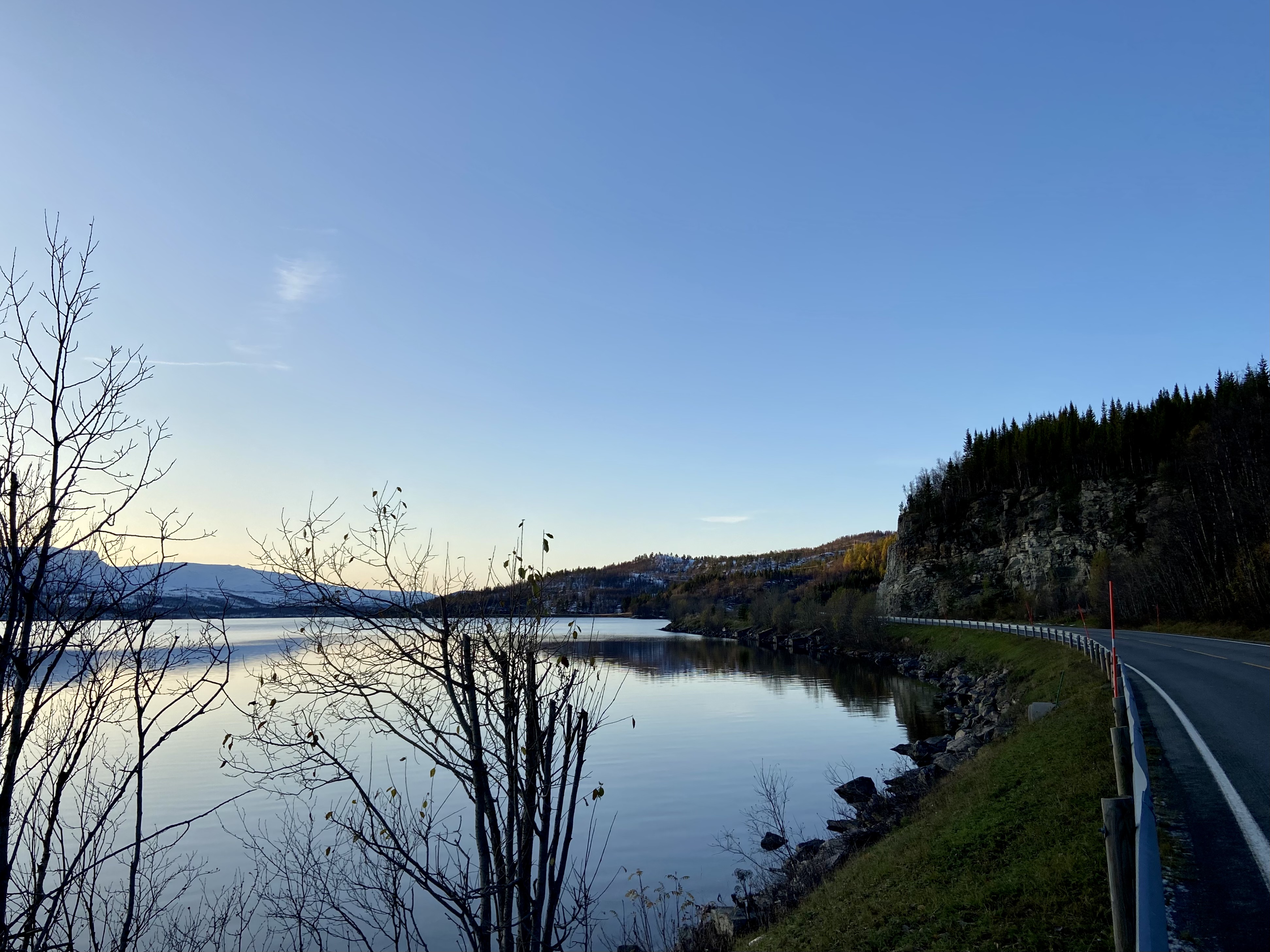
By the time I was ready, almost an hour had passed since Konstantin had left, but I drove out to Andsvatn where the reindeer had been gathered, hoping that I would still catch up with the party. When I pulled up, I couldn’t see Konstantin’s car, but there was a big people carrier there, so I thought they might have all come together. I couldn’t, however, see anyone. There were a few reindeer on the far side of a high fence, through a big, securely tied wooden gate. Konstantin had told me that Per Mathis (who owns the small, family run reindeer abattoir) had told him that visitors were fine, so long as they closed the gates, but this one was so heavy and so securely tied, that I knew I didn’t want to attempt it.
Just as I was about to get back in my car, another car drew up and a woman got out. I asked her whether she knew if Konstantin was still here and explained he and I worked at Mattilsynet and sometimes did meat inspection at Andsvatn. She didn’t know, but assured me someone else would be along shortly, who might know, and sure enough, within a couple of minutes, a youngish man arrived on a snowmobile. He told me that he had no idea if they were still there, but that if I walked round to the back of the building we were parked beside and followed the snowmobile tracks up the hill, I would probably find them, if they were.
By this time, another woman had arrived with her daughter. She had a rucksack with her, which she rearranged and filled with provisions while I watched and I wondered whether she was going to stop the night somewhere. She and I spoke a little, but I found it hard to understand her, or more specifically, what she was referring to. Still, she seemed to know where she was going and seemed happy enough for me to tag along behind them. We walked up the hill together, her with her snow poles and me in my natty red suede boots, that probably were not designed for trudging along snowy trails, but which fortunately had enough grip to serve me well.
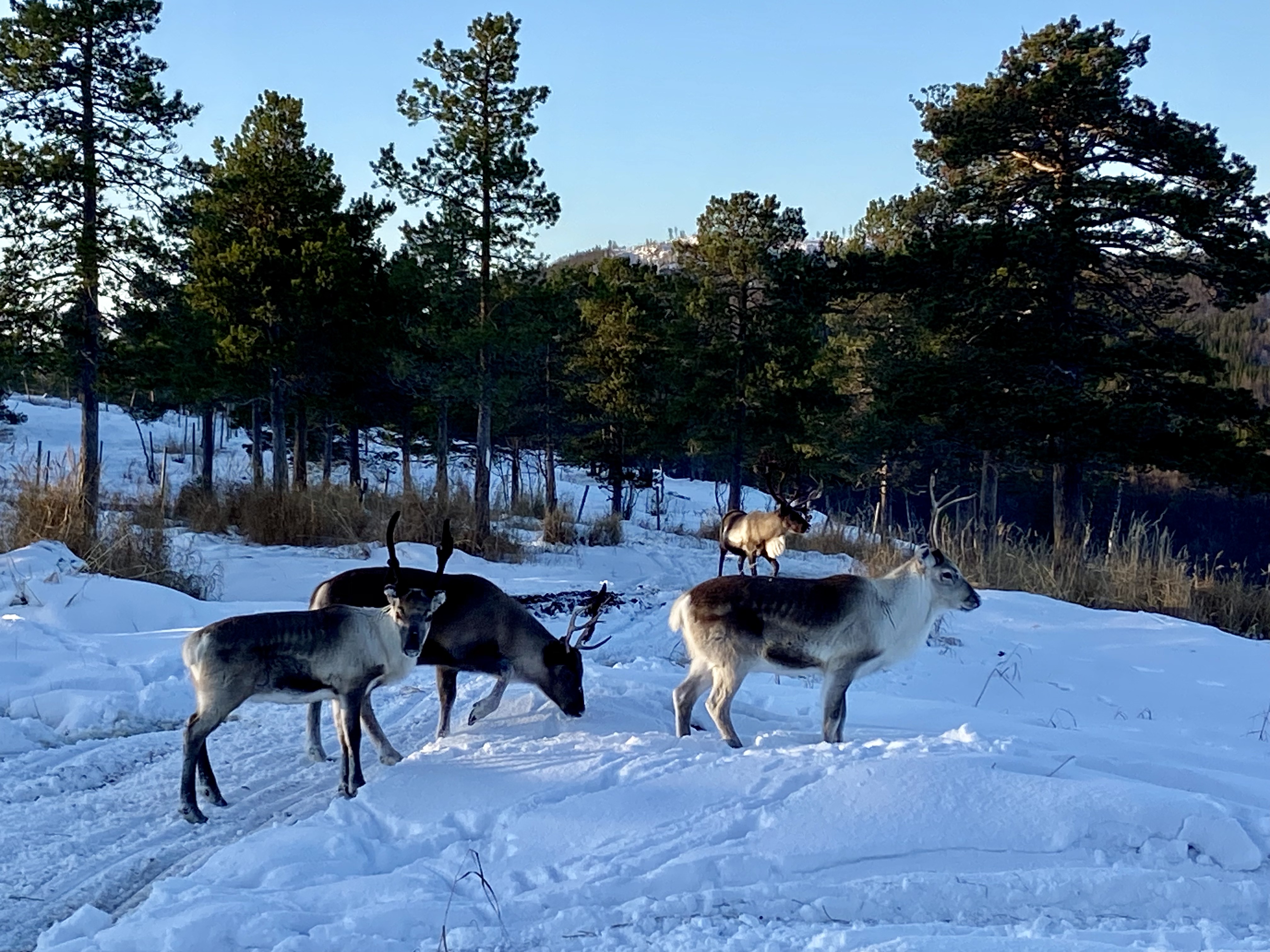
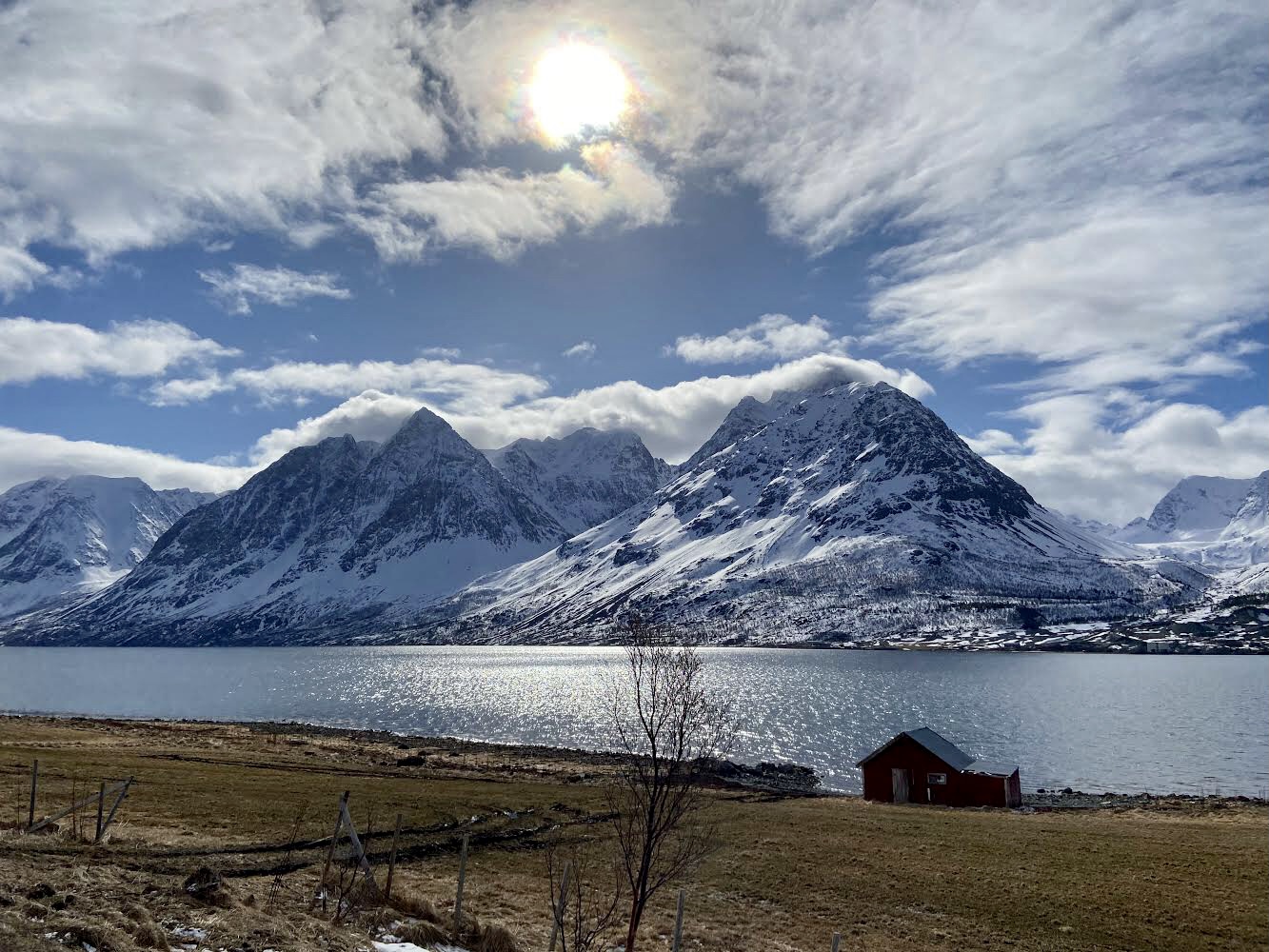
It was a beautiful sunny day, and though they were distant, I could see reindeer in all directions. Many of them were on the move and they were calling to one another – a kind of guttural grunting that sounded primeval under the wonderful blue sky. I felt as if I was entering a kind of dream like state, such was my delight at seeing and hearing these wonderful animals. I was also aware that this was something I was unlikely to experience again, so I was taking my time, drinking it all in.
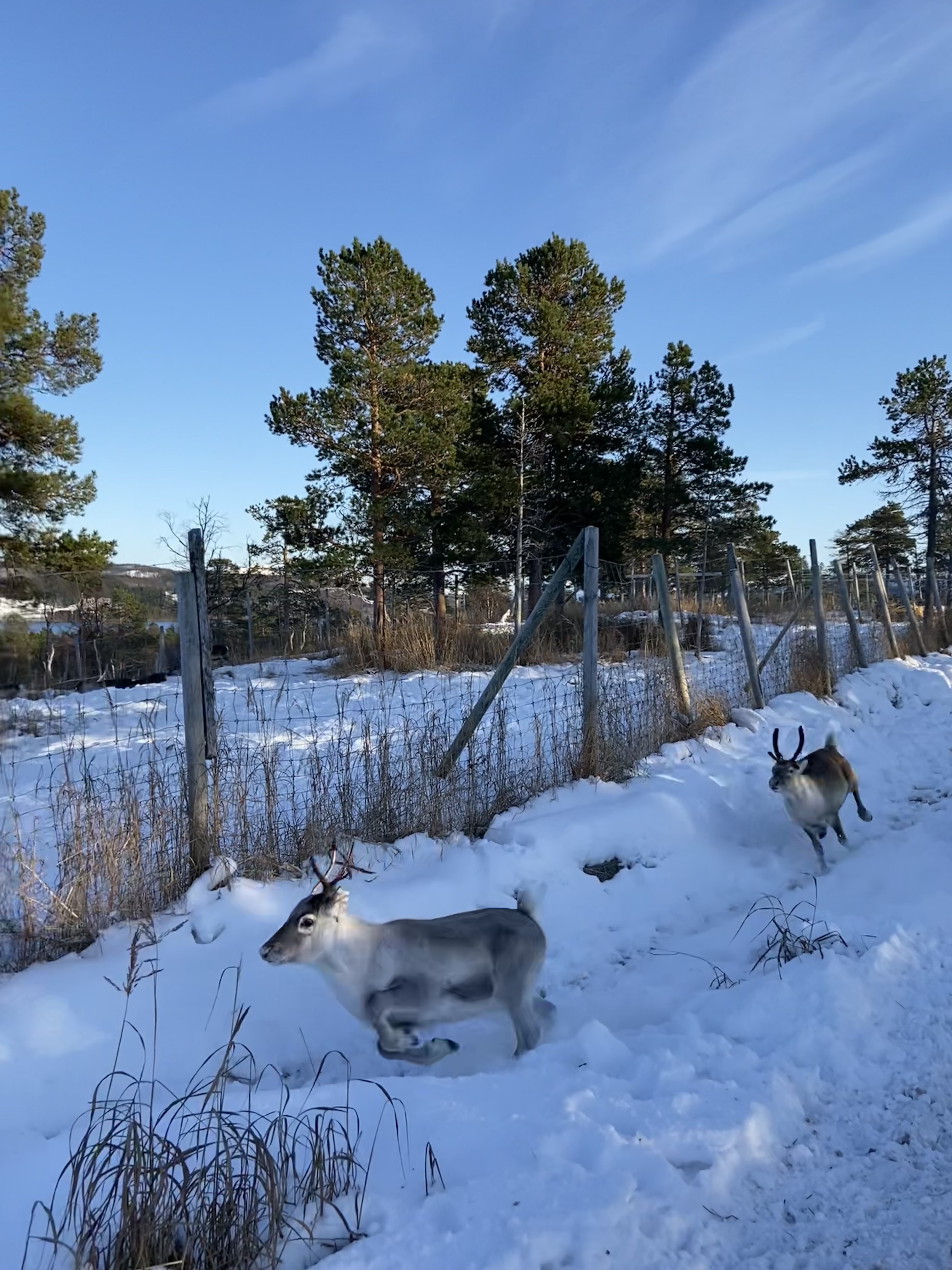
As we walked over the brow of a hill, there was a fence in front of us. Behind it, a few reindeer ran past and then a few minutes later, a couple more. There were reindeer in the field where we were walking too, but still they were distant and I found myself hoping that we would be able to get closer. The tracks turned left here and we followed them between two fences, where there were a few snowmobiles parked. A black and brown dog watched us from one of them, but made no move as we passed. Beyond them, I could see a high wooden fence with a door. And now there were reindeer much closer.
We reached the door in the fence and it opened. The woman and her daughter walked in and I followed them through. To my amazement, I found myself inside a high-walled wooden corral. There were people there, some working, some watching, as well as a few reindeer, though as I looked around, there was no sign of Konstantin and his visitors. Some of the men were wearing traditional Sami dress, brightly coloured tunics and hats with intricate embroidered patterns. Others were wearing traditional Norwegian woollen sweaters, blue with red and white patterns over the shoulders and top of the chest. An older woman wore a brightly coloured fur hat with small flag-like embroidered projections. Unlike me, everyone else was dressed suitably for the temperature.
There was a moment, a long time ago, when my parents lived in the north of Scotland. A friend visited me in the summer holiday and we decided to walk to the local pub, half an hour away. We pushed open the door to the bar, which was filled with people and chatter, and stood there as the voices dropped away and every eye in the pub turned our way. It wasn’t quite that bad, because many people in the corral were working and the reindeer were circling, but the feeling of being an unexpected stranger was not dissimilar. Everyone else here probably knew who everyone else was. Per Mathis might have recognised me, and perhaps one or two others, but I really didn’t know any of the men I worked with two years ago well enough to talk to or recognise, and anyway, they were busy.
But as I looked round, to my enormous relief, I saw a friendly face. Merete who works as a technician at the abattoir was there. She has been off for a long time with a shoulder injury and I had half expected that I wouldn’t see her again, but there she was, opening and closing the gate one handedly, a part of this wonderful extended family scene.

And so I stood a while and watched as the reindeer were sorted. The traditional Sami method for identifying reindeer is to cut nicks in their ears in different places. Each family has a distinctive pattern, though the reindeer’s ears were so furry that it seemed remarkable that they could see which reindeer were theirs and then capture them as they circled past.
Having caught an animal by the antlers, they would tug them over to one of several gates around the corral, each of which led to a different field. Some were injected with wormer, some were marked on their rumps or their legs, and then they were allowed to go. When there were only a few animals left, a gate was opened and the remainder rushed through. Another, bigger gate on the far side was opened. Some of the workers went out , selected another group, isolated them from the herd with a huge tarpaulin that they stretched out between them, and guided the new group into the corral.
And now there were so many reindeer that I could have reached out and touched them as they passed. How beautiful they were, and how wild, with their wary eyes and velvet antlers. I could feel a deep happiness building inside of me, that I was having the honour of witnessing this wonderful gathering. I began to notice other details, like the lavvo – a traditional wigwam-like sami tent – on the far side outside the corral. There must have been a fire inside as there was wood smoke rising from the centre of the canvas roof. There was frost beginning to nip my fingers, but I stood there entranced as the reindeer flowed past me, circling round the corral as they probably have done for hundreds of years.
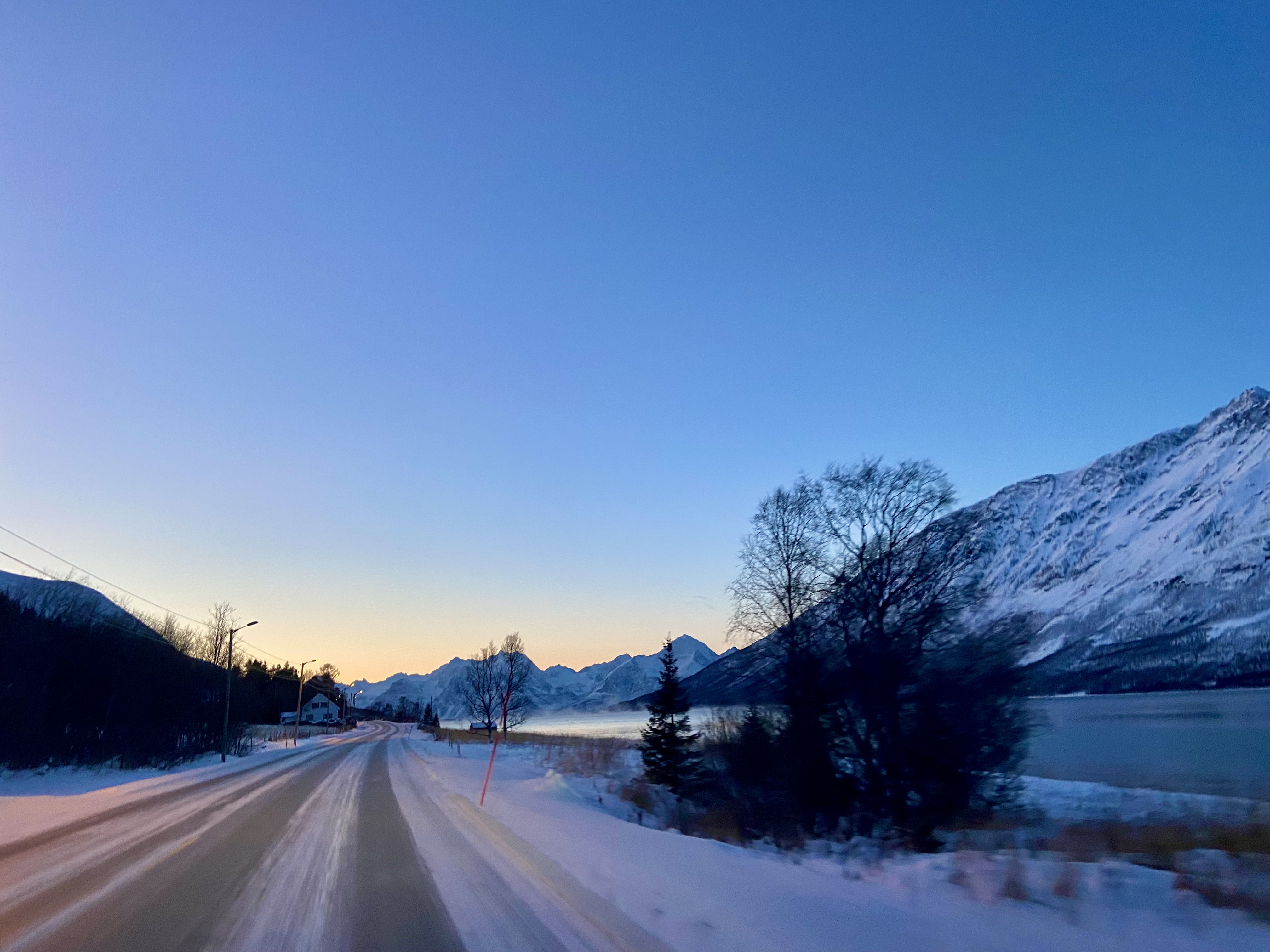
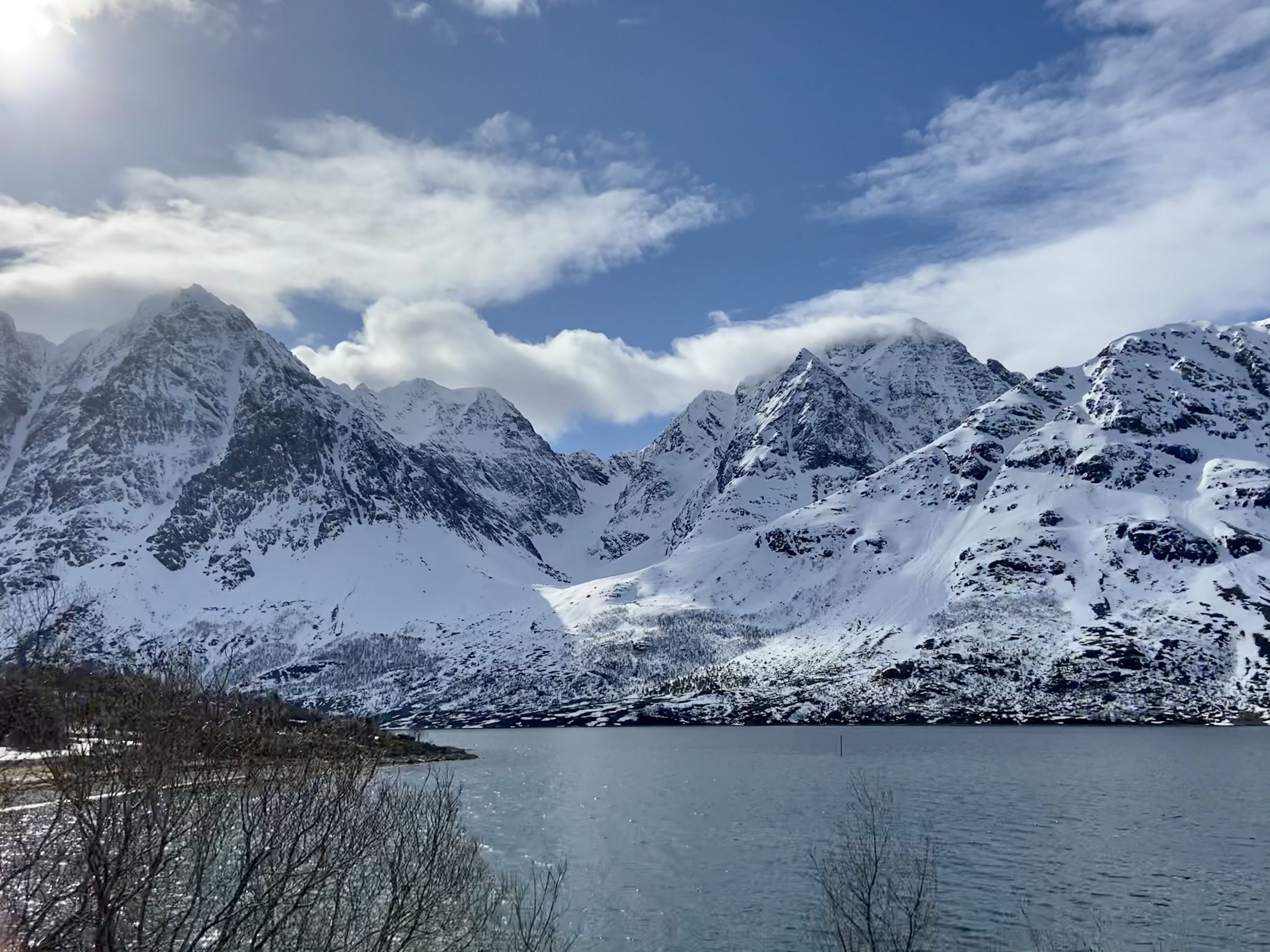
But as the animals were sorted, and the number in the corral dwindled, I began to feel the chill of minus three entering my bones. Merete had gone away to find some entertainment for her toddler godson and there was no sign that she was coming back. Straightening up, I opened the door I hade come in through, stepped back outside the corral and began to make my way back down the hill. I hadn’t taken any photographs inside. This was a family gathering, and not my family. But I took a few photos as I walked back, though as always, when photographing wild(ish) animals, I regretted not having a camera with a zoom lens.
Still, despite the lack of photographs, I hope I have done enough to paint you a picture of what I recognise was one of those once-in-a-lifetime experiences: one that was all the better for being unexpected.
That wonderful feeling of deep happiness is something that will stay with me for a long time.








 A Vet’s Life