Tag Archives: Animal Welfare

Trouble in Paradise

Sunrise/sunset: Up all day.

This isn’t going to be an easy post to write. I tend to keep these entries upbeat, but sometimes there are issues that go so deep that they shouldn’t be ignored. There has been a great deal of discussion over animal welfare in Norway in recent weeks, especially concerning the welfare of pigs. Back in 2019 NRK (the Norwegian national broadcaster) aired an exposé of problematic practices on pig farms in Norway. Using undercover footage taken over five years, it was revealed that despite Norway’s strong legal rules around animal welfare, there were farmers in the pig industry who were flouting them. Some of them seemed to be taking pleasure in the fact that they were doing so.

Mattilsynet responded by increasing welfare visits in Rogaland, the area highlighted in the program, and this year the Pig Welfare Campaign has been rolled out across Norway. I spent a great deal of time at the beginning of the year learning about the program and about signs to watch out for that might indicate that an investigation should be carried out. It is part of my job to monitor the welfare of pigs coming in through the abattoir. There are certain signs that indicate possible welfare breaches which should trigger further investigation. So far, in my time working there, the general condition of the pigs coming through has been high, but it is an important tool in the chain, particularly for pig farms, which produce meat, reared over a relatively short period, and must therefore send animals through the abattoir with much higher frequency than, for example, dairy farmers.

But of course, monitoring procedures at the abattoir are not sufficient to ensure that good welfare is being practiced. It stands to reason that farmers might not send in animals that show clear signs of abusive practices. And despite the increased inspections carried out by Mattilsynet in Rogaland, there was another report aired recently on NRK regarding animal activists who had broken into pig farms and had taken photographs of animal welfare violations.

I confess I have very mixed feelings regarding animal activists. On the one hand, if there are welfare problems within farming, it is important that those are highlighted. But on the other side of the equation, their practices in breaking in place animals at risk. There is a strong commitment to biosecurity in Norwegian farming, which obviously is ignored by those breaking and entering.

According to a virtual Mattilsynet meeting on Friday, those same activists had held pictures showing evidence of animal welfare breaches from as far back as 2016. They had not reported those breaches to the authorities, which would suggest they are more interested in creating a scandal than in addressing those issues. It is important to remember that the aim of these groups is not to improve welfare by working with the farming industry and the authorities, but to close down the animal farming industry altogether.

Accordingly, these groups always highlight the worst. How many farms did they break into? How many of those were farms with very high welfare standards? It would be much more useful to have a balanced view of the whole picture. Without that, it is impossible to tell whether they have revealed that problems are occurring in a very high percentage of farms, or whether there is huge negativity being created around “a few bad apples”.

Mattilsynet have also come under fire. It is said that we are working too slowly in closing down those farms where animal welfare is chronically poor. Perhaps that is true, in some cases, but in many circumstances there has to be a period of assessment, of attempted education and/or enforcement, before taking the huge step of removing someone’s source of income.

These kinds of scandals are always both depressing and demoralising, not least because they are a reminder that there are some very unpleasant people in the world, and that some of them actually seem to revel in creating animal suffering. It frightens me that as well as those who are careless, lazy and ignorant (which I would say are the main drivers of animal welfare issues) there are also a few who are actively malevolent. I try not to dwell on it, but there has been a case in our region which might have fallen into that category. Those people make me feel sick to my stomach and because they will lie and work hard to conceal what they are doing, I think we will never gain full control over what they do.

However, it is important not to dwell too much on the things we can’t fix. I visited a farm on Friday where there were pigs running around in the open air, digging their snouts in the earth and obviously having a great life. Birgit and I carried out the first of our Pig Welfare Campaign visits on the same farm and it was a wonderful salve to the negativity. Reports like the one above can easily make it seem that we have an uphill and sometimes impossible task in trying to police all matters within the animal welfare sphere. But it’s essential to remember there are a lot of good people in the farming industry in Norway, who are doing their very best to uphold the excellent welfare standards that are required in law.

I drove a long way on Friday to complete the visit with Birgit. Despite the distance, it’s important that we work as a team. When I see the links between the scattered offices and the abattoir and all the knowledge held by veterinarians such as Birgit, Thomas, Ammar and Hilde, all of whom have worked in this area for a long time, I am reminded of how important that web of knowledge can be. I’ve been here almost a year now and I am beginning to build up my own map. I will continue to fight for better conditions for all animals in my own capacity. And though my contribution is small, I am not fighting alone.

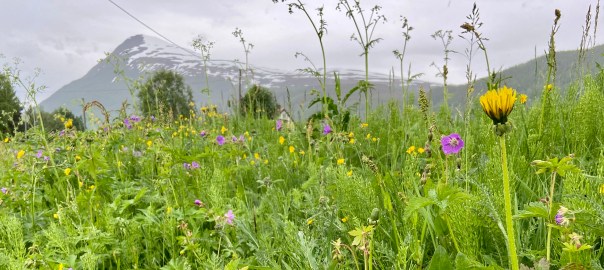
I am going to finish with a few photographs from Friday. As well as all the wonderful flowers that are brightening the verges, I drove along the side of a steep fjord, where the melting snow is creating myriad waterfalls as the twenty four hour sunlight warms the landscape.

Learning

Sunrise/sunset: 04:39/ 20:58. Daylength: 16hr 19mins

I had a phone call this week from a member of the public who had sent a “concern message” and wanted some follow up. In the UK, this is the kind of report someone might send to the RSPCA (SSPCA in Scotland) when they have seen an animal or animals that they are worried about and want someone in authority to do something about it. Here messages are made online via an official form.

One of the challenges in a new job where there is contact with the public is being put on the spot before you are fully genned up on how everything should be managed. Due to coronavirus, the learning process has been slow for me, but I feel I am finally getting a handle on things. Phone calls are rare (I can only remember receiving three or four) and as they can be redirected from a central line, they don’t always go to the person best placed to give an answer.

For me there’s also a language issue. As others who regularly use a language that is not their mother tongue have confirmed, if a topic of conversation arises where the context is unclear, it can take a minute or two to catch up. On one occasion when I was rushing out to a doctor’s appointment, I was called by a man about a visit someone else had made to carry out meat inspection on a wild moose. As I had no context, I thought we were discussing a call Thomas and I had made the day before. Luckily as I was in a hurry, I accidentally redirected them to the appropriate person, but as you can imagine, all the ingredients for creating some kind of Fawlty Towers level farcical misunderstanding are present.

Fortunately there was no such misunderstanding in this case, though having answered the phone without any opportunity to prepare myself, I did manage to forget almost everything I had learned.

I took down what I thought were the salient issues: details of the nature of the report (horses standing in mud with no food) and the name and number of the person who had sent the report.

Running through my head was the knowledge that Thomas would almost certainly know more because the concern messages in our area currently come in to him and he shares the details with or (on one occasion so far) delegates them to me.

I ended the call and thought through my next steps. Obviously I had to call Thomas, but I wanted to work through as much as I could on my own before doing so. There is a shared file within the DyreGo department of all current and ongoing concern messages and so my next step was to look them up. It was at this point, I realised the first of my errors.

Quite often when people make reports, they choose to be anonymous and the online form gives anonymity as a clear option. Ongoing cases are not listed under the details of the person reporting: rather they are recorded under the name and address of the animal owner. None of the cases on the list fitted perfectly. Worse still, I realised that the central bod might not have even redirected the call to our office, but to the wider Troms and Svalbard team. The horses in question could easily be hours away in Tromsø and Thomas might know no more than I did. Still, having done what I could, I went ahead and called him.

Thomas is very patient with me. He told me early on that he wasn’t, but being aware there were many things I couldn’t do, I made an effort to take on the things I could, even if it was something as mundane as coming in early to clean snow off the car we were going to use. Sometimes I get ahead of myself (MATS, the computer system we work with, is very unforgiving if you make an error – it’s designed to work through things in order and going back to correct can be “challenging”) and then he rolls his eyes and tells me not to go so fast, but mostly we laugh together.

We weren’t far into the call when my second error became clear. I had received a request for information from someone who was worried about some animals, and so of course I wanted to help. But as Thomas reminded me, as soon as we begin investigating welfare cases, we are obliged by law to keep all the details secret. Even if I could work out which case it was, I couldn’t tell my enquirer what was happening.

Nevertheless, as he knew no more about this case than I did, he advised me to call one of the members of our team who receive and review all the cases when they first come in. They carry out a preliminary investigation, examine any evidence from previous interactions with the animal owner, assess the severity of any welfare issues highlighted, and then either close the case immediately or pass it on to the nearest office for further assessment.

And so I called Birgit and explained the situation and as well as managing to find and update me on the case, she explained how to deal with the enquiry as well. One of the things the enquirer had asked was whether we’d received the report. I know from dealing with veterinary cases that when calling people, it’s often true that if you haven’t got, or aren’t able to give them the information they want, it’s helpful to have at least one positive point you can emphasise, even if it’s minor in the grand scheme of things. And so I called the enquirer back and explained that I was unable to give details about what was happening, but at least we had received the message and it had been assessed.

I was relieved to have put the enquiry to bed, as it were. I hate having unresolved things hanging over me. But a number of thoughts went through my head following the call about how I could have dealt with it if the caller hadn’t been satisfied with my response. I could have explained more about the processes we have, and perhaps how such a case would be handled.

The initial assessment would look at whether one of our team had investigated similar allegations before and the results. Where there is no history, or where the history indicates the case should be taken further, the case is sent to the local office where the inspectors decide whether it can be handled over the phone – better in these covid times in simple cases where the animal owner can send a picture or video during or shortly after the call to demonstrate whether something is true or untrue – or through a visit.

Some thoughts crossed my mind about that possible visit too. I was called out to a similar case years ago by the SSPCA. They were trying to put together a court case against an owner and I remember going out and looking at all these poor horses, standing up to their knees in mud, and thinking that if it did go to court, I would be happy to stand up for them to try and stop their suffering. But I’m not sure, with hindsight, that I would have done them much good. I can’t remember what examinations I carried out, but I do have vague memories of warnings at vet college that giving evidence in court was something of a specialist activity and we should be wary if we weren’t experienced, which I wasn’t. Perhaps fortunately for me and the horses, it was resolved without reaching court.

It crossed my mind though now, that what Mattilsynet are doing is akin to training me to be the kind of expert witness I needed to be back then. I would no longer go out to such a case and ask for guidance from the SSPCA. I would go out armed with the exact wording of the laws and by-laws that govern animal ownership in Norway.

I also have a better understanding of how you could prove or disprove an allegation. To assess whether a horse or horses were indeed without food, we would start by asking the owner. We would find out through questioning, whether they had enough theoretical knowledge to know how often you should feed a horse and how much. But that would only be the first step.

After that, we would examine the food they had available and how it was stored. We might take pictures of that. More importantly, we would examine and photograph the animal and compare it to a prescriptive scale based on anatomical features. If you can see various bony structures, you can assess where the animal falls on the scale where 1 is way too thin and 9 is very much too fat. We would look at other details as well to assess more general health and welfare. I’m not sure yet about how it would work if we ended up in court (or indeed whether that happens) but all these processes allow us to be very specific in being able to back up our claim that “the animal looks like it is suffering” with verifiable and objective facts to demonstrate that it is.

The great thing is though, that having worked through all that, the next time I get a similar phone call, I will deal with it easily. Even if the enquirer is difficult to work with, I will have a raft of background information to help me deal with it. That is the nature of being a vet. When you start out, almost everything is a challenge, but as you deal with challenges every day, managing them becomes routine.

In my current role, with coronavirus and working from home, I’ve received so much intensive theoretical training that it’s nearly coming out of my ears. This phone call and last week’s practical training with Thomas has led to all that information clicking into context. I am finally beginning to believe I will one day be good at this job. On Monday, I am going on my long-delayed week-long trip to Troms and Svalbard’s most northerly office in Storslett. I hope Birgit is prepared for the onslaught of the three million questions that have become apparent with my increasing knowledge. It’s very true that the more you learn, the more you realise you don’t know.

To finish up, I wanted to talk a little about daylight and about spring. The quality of the light here continues to surprise me. As you can see at the top of the page, we have full daylight for over sixteen hours each day. By the end of the month, there will be just over half an hour of what is called civil twilight around midnight. Civil twilight is the brightest form of twilight where the sun is just below the horizon: the same kind of light we had during the polar night.

The speed with which the changes occur probably shouldn’t surprise me. After all, we had it in the opposite direction only a few months back, but the daylength changes are so fast that the weather doesn’t really keep up. Though there have been a lot of days where the temperature has made it above zero, when rivers of melt water have run down the middle of roads and rushed down newly visible mountain streams, there is still a thick layer of snow on the ground.

Back in Scotland, it wasn’t impossible to have the odd day of snow in April, but it was a rare occurrence. I tend to associate snow with short winter days and near permanent twilight. But now I look out on all this wonderful light and the snow is still on the ground and it’s almost magically white. The picture at the top of the page shows the wonderful warm twilight as the moon rises over Gisundet Sound and the island of Senja. But the day time is equally rare and magical, and I hope that I caught something of that in this second picture.

Have a lovely weekend everybody.

Decisions

Sunrise/sunset: 05:51 / 19:34. Daylength: 13hr 42min.

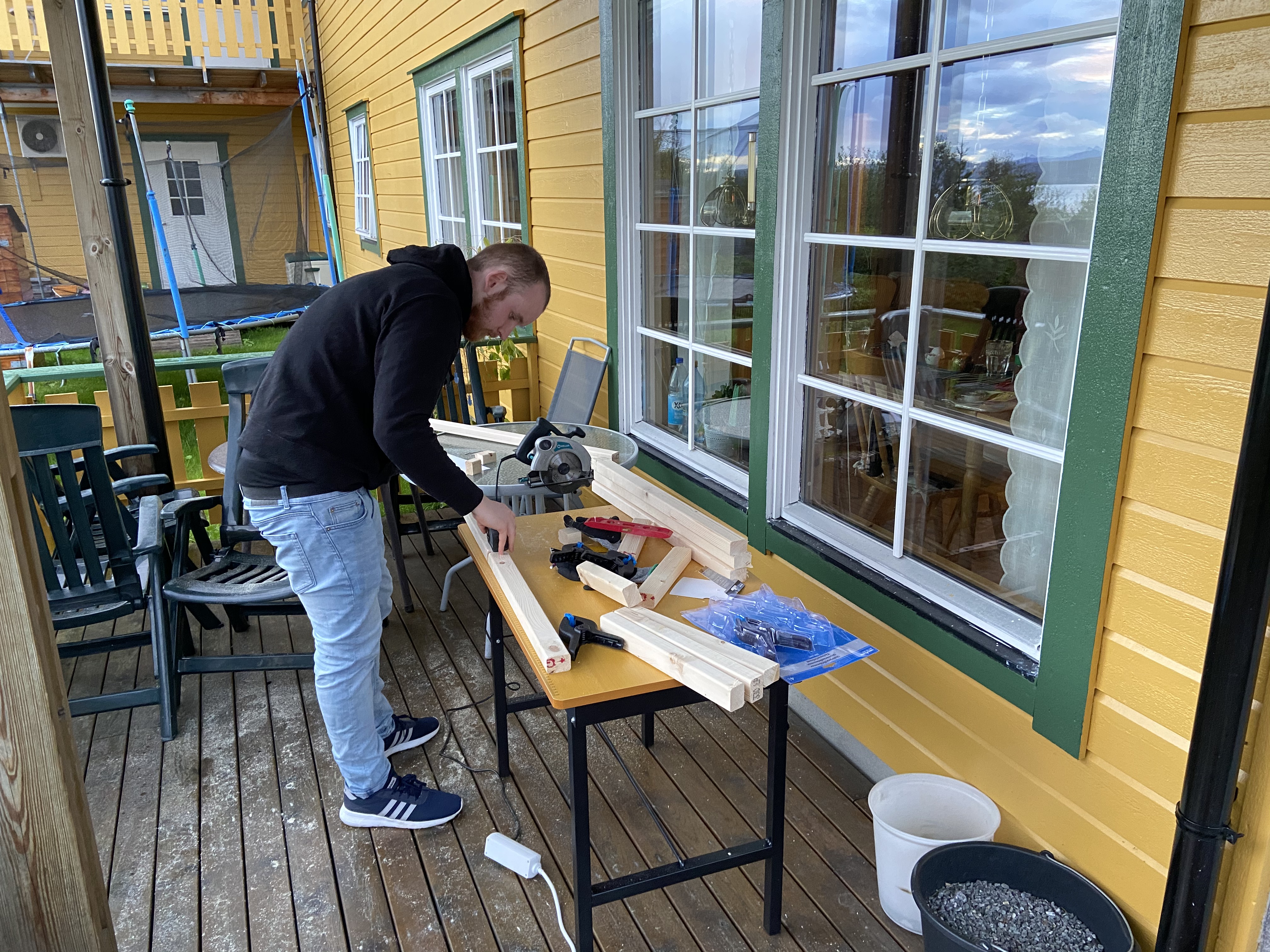
I arrived home on Wednesday to find John outside, sawing wood. He has designed a new winter cage for the guinea pigs and now he is making it.

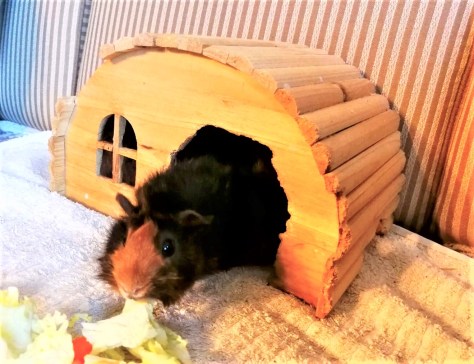
Brownie is growing fast. She’s very lively, rushing around, pop-corning all over the place, and it will be wonderful for both her and Susie to have a lovely big cage to run around in.

It’s been another interesting week at work. During a conversation on Monday about car keys, Hilde dropped in the information that the winter tyres would probably go on the work cars this month. Back in Scotland, autumn conversations often start with the phrase, “The nights are fair drawin’ in.” Here, the more Game of Thrones like, “Winter is coming!” is the message.

Hilde asked me what I’d done at the weekend and I had to confess I hadn’t done much, other than having a film night with John and Andrew. She reminded me of it then, “Winter is coming! You should do things now while you can.”

Obviously as it’s my first time, I have no idea how it’s going to feel, but for now I’m looking forward to it. I’ve always loved winter, though of course there will be a lot more of it than I’m used to. Hilde looked thoughtful after telling me about the winter tyres. “Of course this year, they didn’t come off again till June,” she said with a smile.

I decided I should go for it and tell her about our film night. As Dr Sleep had now arrived on Netflix, the boys were keen to watch it and so was I. After all, it is the sequel to The Shining: one of the most iconic films of all time. We had watched The Shining as well for completeness. As far as film nights go, I thought this more worthy of mention than most.

“We watched Dr Sleep… and The Shining,” I said.

Hilde looked at me. “The Shining? What’s that?” she asked.

“Umm… The Shining,” I muttered again, assuming she perhaps had misheard. Surely even in Norway, The Shining was a film everyone would know, but there was no change in her expression. “It’s a… horror film,” I told her (though I didn’t know the Norwegian for horror, and had to ask). “Stanley Kubrik…”

She was still looking blank.

“Steven King?” I added. Hilde was smiling, but there was no dawning recognition.The conversation drew to a halt. For a moment, I considered pulling out my phone and finding an image of THAT photograph… but the conversation around the table was already moving on.

Thursday was a big day for me as I went out on my first welfare visits. Thomas had received three separate messages about animals that were allegedly being mistreated and he had agreed to take me along so I could see what procedures Mattilsynet follow. A good deal of my time recently has been spent on online courses which outlined some of the ways in which we work. For example, every decision we take regarding the cases we see has to be backed up by an explanation of how we are guided by the law, and we have to be very specific, right down to which clause we are invoking.

On the other side of the equation, we need strong evidence, and more and more, this in provided in the form of photographs. Everything has to be recorded, but for privacy reasons, none of it can be stored on iCloud. This had worried me a little when I had read it. I had no idea how to stop photographs going onto the cloud, other than by switching off all internet connections, but surely as soon as you went to transfer them, the result would be the same. The answer, of course, is that there is an app.

Similarly, with the legal aspect, there is a programme on the computer that you go through with regard to each case. You type in the concerns that have been raised and the computer adds specific areas that are covered by the law. A checklist is then created in the form of a table. So there is a lot of work to do before and after any visit, but for now I was interested in the human side of the task.

Only one of the cases turned out to be difficult in terms of animal welfare.  I can’t really explain in any detail what it was about as the pet owner in question deserves full privacy. I was, however, reminded of a case I saw many years ago, aged 23 in my very first job as a newly minted young vet. I had been called out to put an old lady’s dog to sleep and I spoke to her first, explaining the injection and the overdose and how it might go. I was kneeling beside her to explain and as I pushed myself upright, she laid a hand on my arm and looked up into my eyes. “Can’t you take me with him?” she asked.

I can’t really remember how I reacted. I had a wonderful mature nurse with me, who spoke to her. I don’t think I managed to say a word, but the moment has stayed with me. So all I will say is that managing the end of life care for the pet of an older person can be one of the most emotional and difficult tasks in a veterinary surgeon’s life. Even though animal welfare has to be at the heart of what we do, it is the more human side of the equation that complicates the picture.

We took our leave and then stopped for coffee and discussion before driving to the next visit. It’s a case that will be complicated to resolve, and anyway, it was good to have a break before we carried on. Fortunately, the other two visits were more straightforward and we drove back to the office. It was time to go home, leaving the remaining work and all final decisions for another day.

Killing Time

Sunrise/sunset: 04:57 / 20:37. Daylength: 15hr 40min.

On Monday, Hilde drove me over to the abattoir where I will be spending a good chunk of my working days over the next few weeks. With the short summer and long, hard winter, most of the spring lambs will be brought in before it’s time for the remaining animals to be moved into their winter housing. Vets play an essential part in the process. The health of the animals must be checked before they are humanely killed and the welfare and conditions are carefully monitored.

Afterwards, a team of vets and technicians inspect the meat to check whether it is fit for consumption. This is another chance to check health and welfare. All the information from the checks, both ante and post mortem, is recorded. Nobody could claim it’s glamorous work, but as well as ensuring the animals are treated well in the abattoir, the findings are used to assess whether there might be problems on the farms where the animals were raised. If the animals are too thin, have overgrown feet, or show significant signs of illness, then a message is sent back to the local Mattilsynet office, where their vets will contact the farmer and take measures to improve the situation.

On Monday’s visit I was fitted out with a uniform, boots, a locker and a card to open the door. Hilde brought cake again, and I met a few of the staff.

On Tuesday I drove through again with Thomas. I had met him on my first day at work and he seemed friendly, but I hadn’t seen him since. Now he was to give me my first taste in working in an abattoir in northern Norway.

For my part, I was most interested in the inspection of the live animals. It is hard to spend much time on the internet without seeing horror stories, but my impression over the course of the first week has been that most of the animals coming through are very relaxed. Though the pigs all had balls in their pens to play with, most of them were sleeping when we went to see them. Some of the sheep were more skittish than others, but many of them came and were nibbling on my wellington boots. All animals have fresh water in their pens and any cows that are milking are milked if they are in for any length of time. The surroundings are quite similar to those you’d see on the farm and most farms here in Norway are small, so a lot of the animals are used to being handled.

The slaughter process itself was quick and efficient. Thomas showed me how to time the interval between stunning and bleeding. With the cattle, we checked the animal was unconscious before being moved on to the next stage.

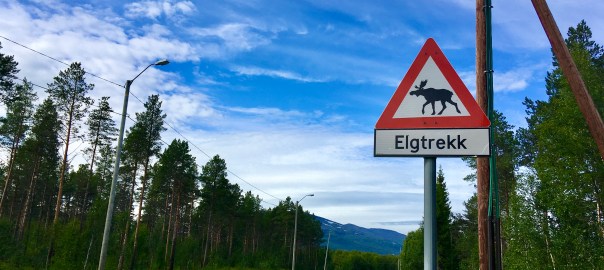
It’s a forty minute drive to get to the abattoir and the road is dotted with warning signs for moose. Thomas told me I would see more of them in the winter, though for now they are elusive. The filling station near the E6 has leaflets explaining what to do and who to call if you hit one. I hope it never happens to me, though it is possible I might be called out to do meat inspection on those too if they are injured and have to be shot.

It’s cooling towards autumn now. It was 4°C when I arrived at work yesterday morning. Though the trees are still clinging to their leaves, they are beginning to fade. The ground flora is wonderfully colourful and intensifying as a multitude of berries appear.

There was only one near miss with technology this week. Thomas handed me over to Ammar on Wednesday and he suggested some reading material. The season (as they call it) will begin very soon, and by then I have to be up to speed with meat inspection for lamb. Back in the office, I had chosen a pin code for the printer. You send your file, retrieve it and then put in your number. I assumed the process was the same in the abattoir, and so I went through the retrieval process and began to put in my four figure number. Luckily Ammar stopped me in time, before I set the printer in action printing out *9250 copies of an eight page document on red meat.

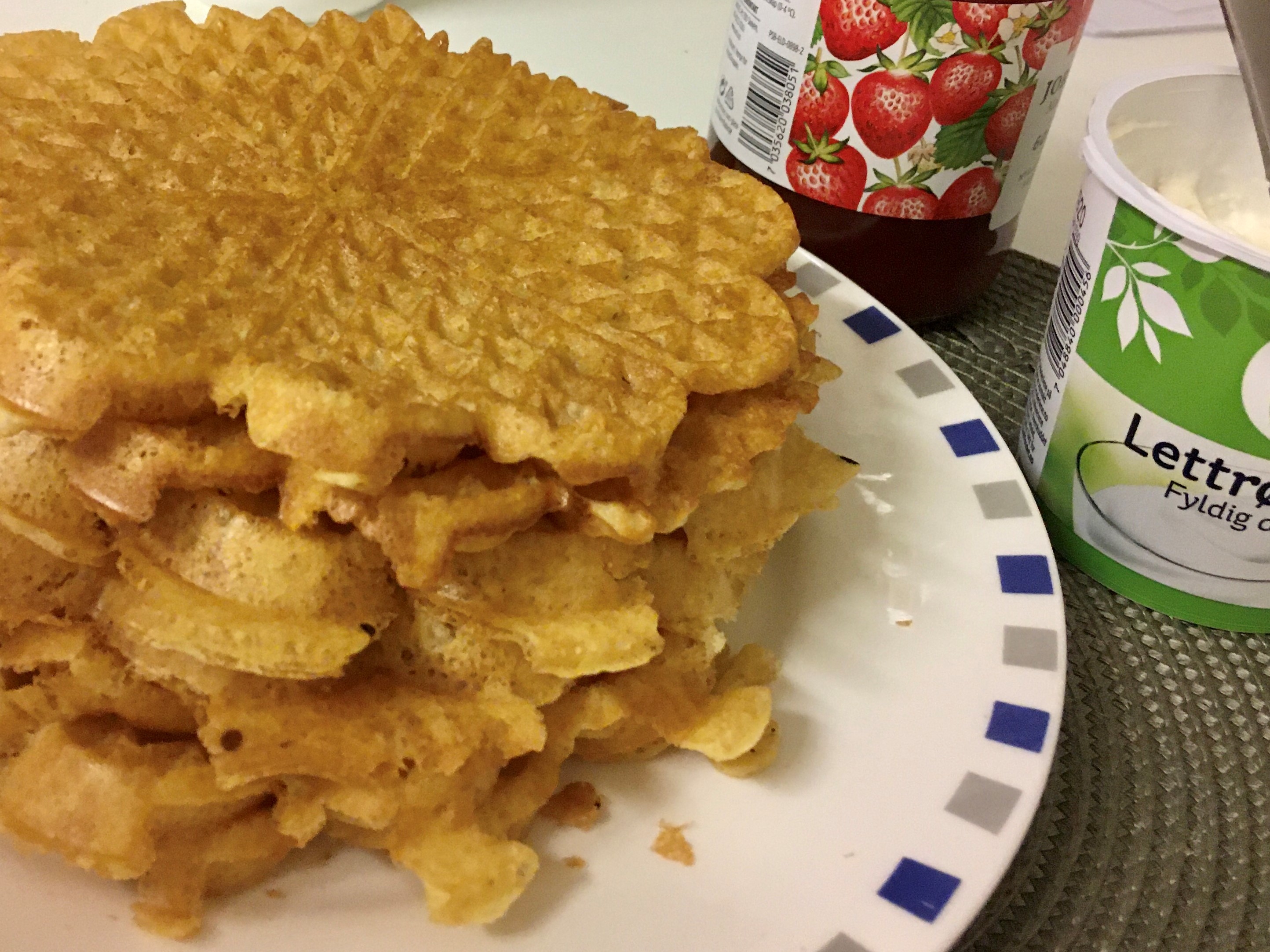
Friday afternoon was rounded off with waffles. In Norway they are traditionally eaten with strawberry jam and soured cream. It took me a while to get used to this combination, but now I love it. And what could be more Norwegian than a mountain of waffles to round off the week?

*Not my actual PIN.