
I had planned, last Sunday, to go and find Torhouse Stone Circle near Wigtown, but by the time the afternoon rolled round, it was so stormy that I decided it might not be stone circle weather. Add in that Wigtown is nearly an hour and a half’s drive; I decided a change of plan was in order.
Searching through the pages of the Historic Environment Scotland webpages, I struggled little. I’d hoped for something truly ancient, or perhaps romantic, but all seemed to be closed, or at a distance or involved a walk. The dark and threatening sky outside my window and the sound of wind in the blocked up chimney told me that this was not a day for too much outdoor exploration.
I finally decided that a visit to Drumcoltran Tower would be the best compromise. It didn’t look especially romantic, but it was only a twenty minute drive. The main objective was to get out of the house and do something more interesting than going to Tesco.
I guess the most interesting thing for me, is that Drumcoltran Tower is pretty much integrated into a modern farm. It doesn’t really fit in with the array of newish barns and housing for stock. There are old farms scattered around the landscape and my favourites are always the ones where the farmhouse has an array of old buildings around a traditional yard. Here there was no sign of a farm house, though there may have been one on the other side of the sheds.
I’m a bit frustrated writing this as it was quite interesting to see the way the new buildings have been built so close to this piece of history. I should have tried to capture that in a photograph, but my habit is to try to capture things at their most attractive, so the best I can do to show you just how close the new buildings are is this picture. There are two, white painted, older buildings remaining, one each side of the tower, but to the right of the grey stones, you can see a modern barn peeking through.

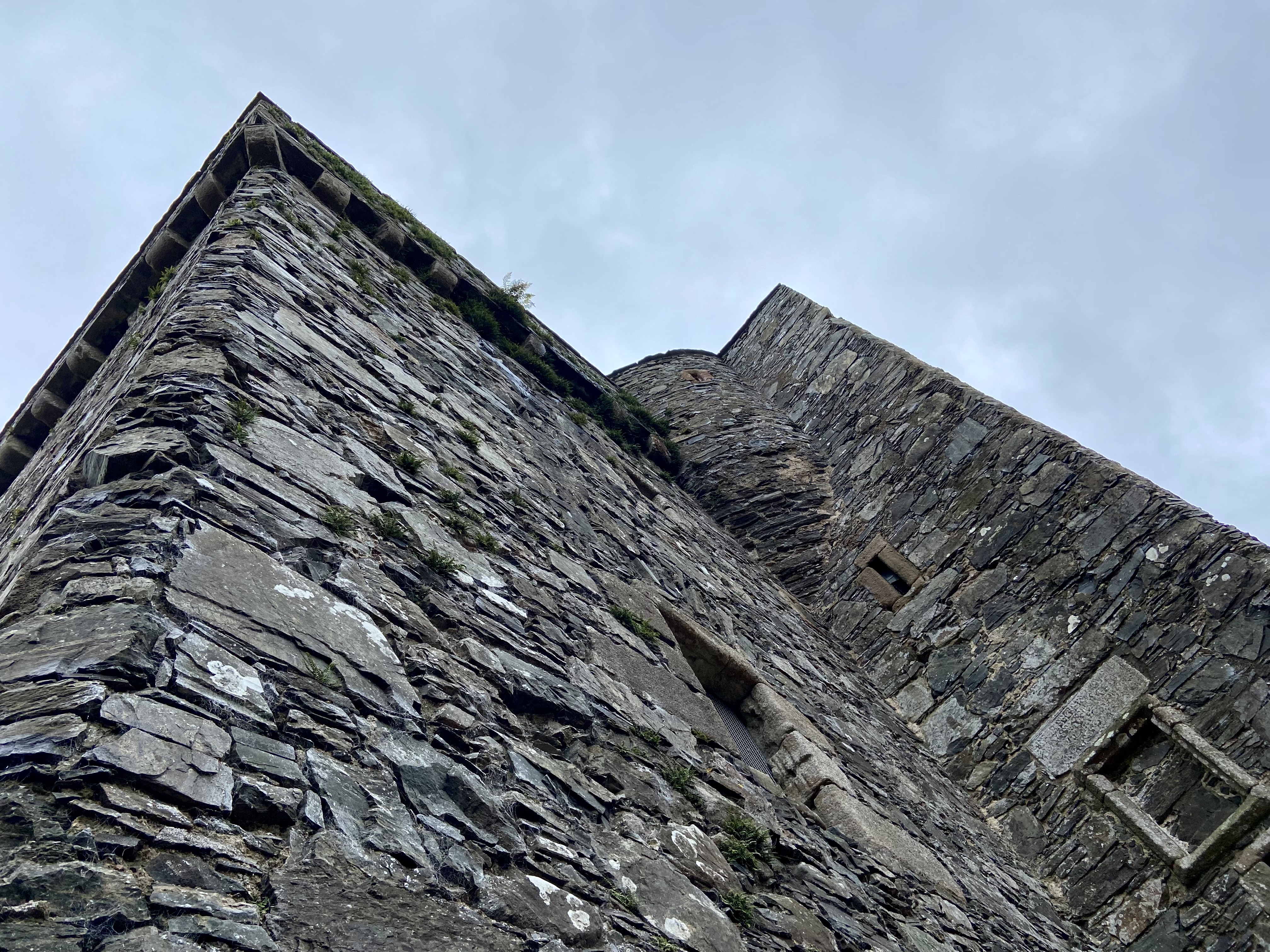
As I walked rounded the corner and glanced up at the iron grey sky above the stone battlements, I felt rather odd. Normally, I visit such places with someone else, but now I was alone. The tower is free to enter and there was no shop or counter where I had to pay. Nobody knew I was here. My car was parked outside, but other than that, there was nothing. If anything were to happen to me, nobody would come looking. But I was here now. It seemed daft to leave again without exploring.
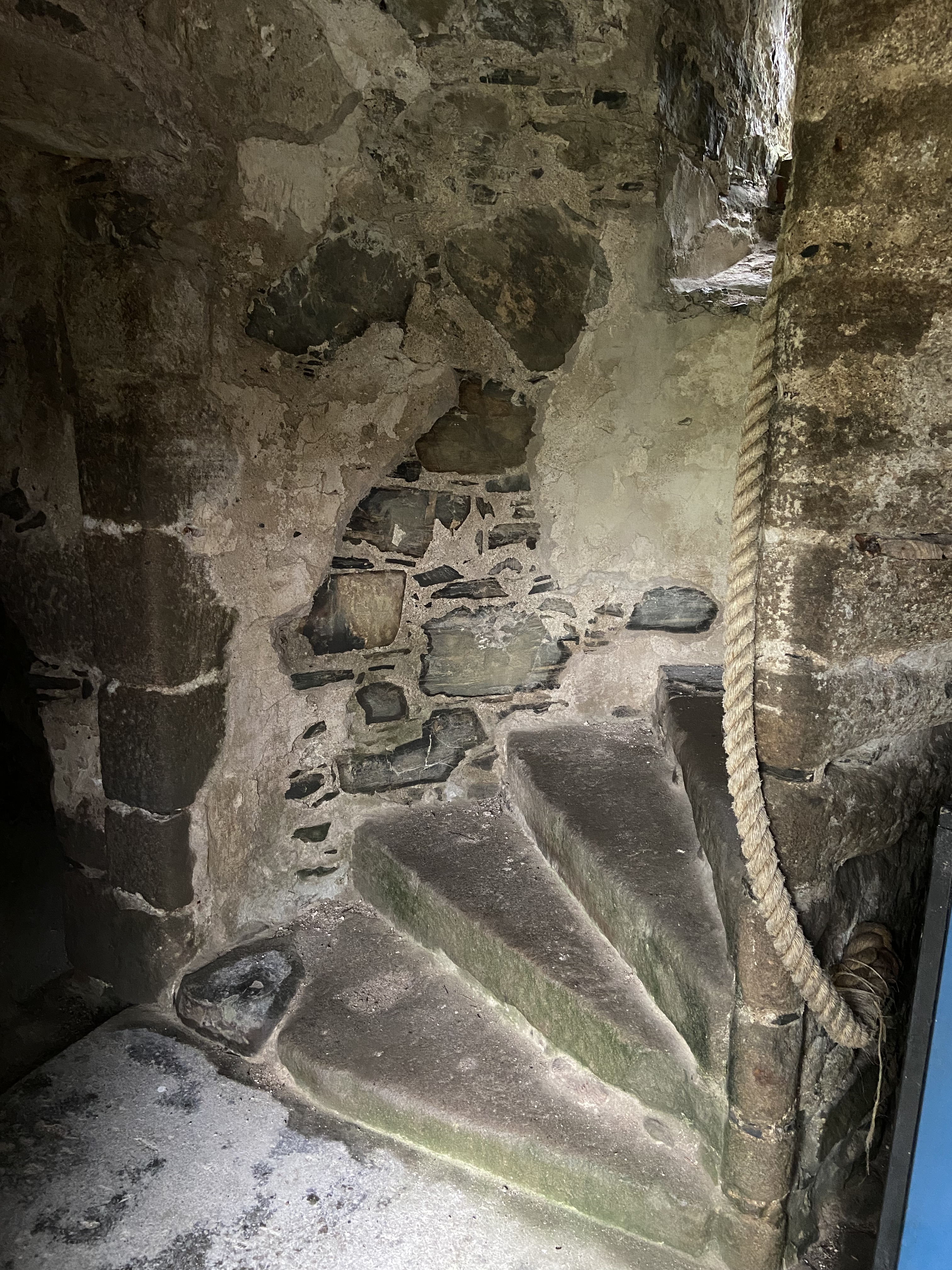
I wish now, that I had taken more photos of the interior. The ground floor had vaulted ceilings and was made up of two rooms, one a kitchen with a huge fireplace, the other storage. There was still some plaster on the walls, but I found it hard to imagine it ever being cosy. As always, I wished I could go back in time and see what it had been like, but it was now only a shell. Ducking my head, I went back out to the spiral stairway and began to climb.
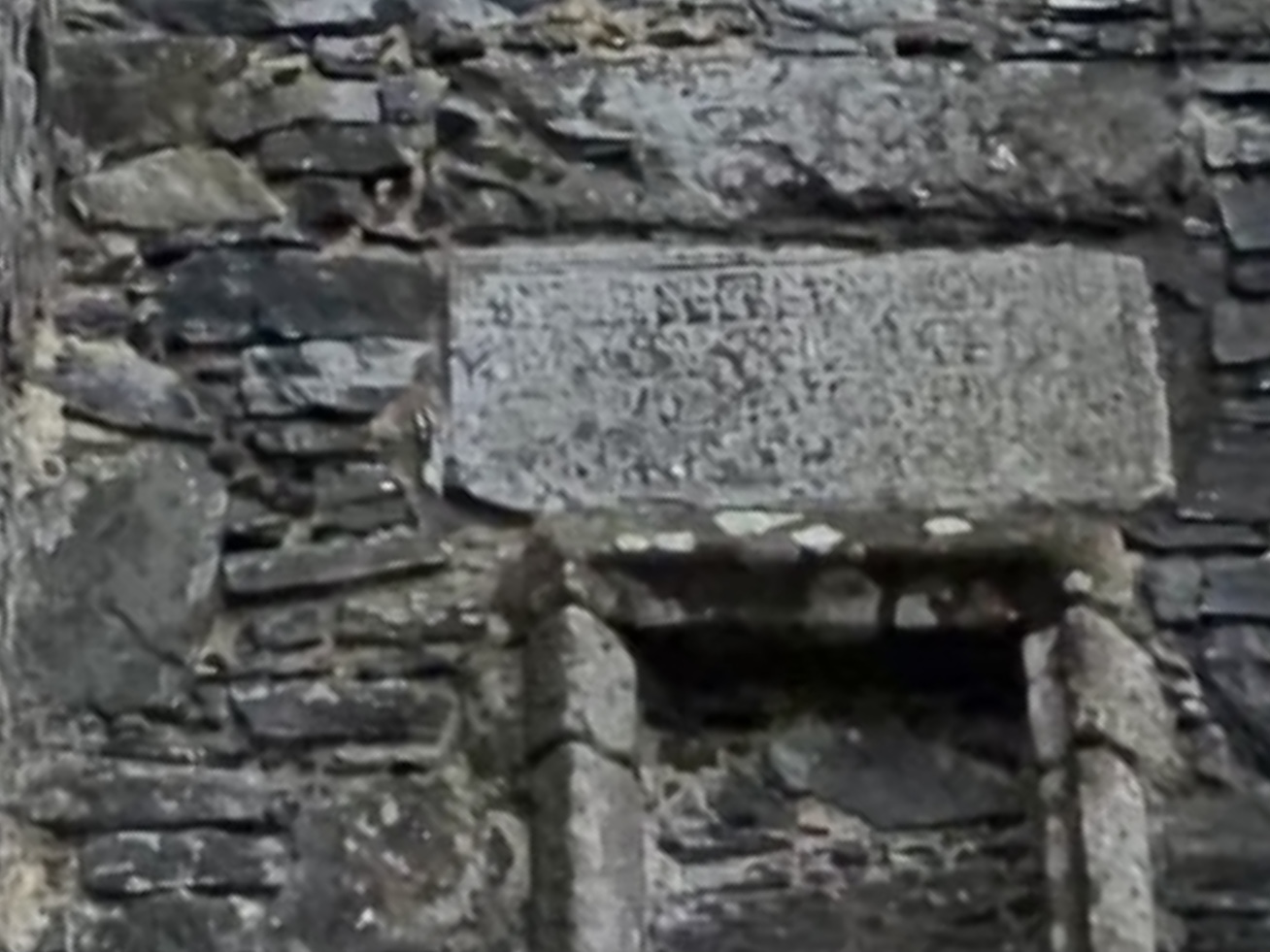
On the first floor, there was a plaque on the wall that told me a little about the tower. It mentioned an inscription above the entrance, which I hadn’t seen. Apparently it was in Latin, which translated read, “Conceal what is secret; speak little; be truthful; avoid wine; remember death; be merciful” which seems to be an odd combination of instructions, though rather suited to this austere tower.
The plaque also told me that the tower had once been a farmhouse and that around it, there would have been a courtyard and buildings, but they lay behind the tower, where now those new sheds lay. Perhaps the stone from those buildings had been used to create the two white-painted buildings that now flank the 16th century tower.
The plaque was on the first floor, which had once, apparently been a single hall, with a great fireplace, but which later, had been split into two, with the two smaller fireplaces that now remained. Looking up, there was the roof, far above, and evidence of another floor, where there had been two bedrooms, each with its own fireplace and apparently a garderobe each. No popping out to an outdoor privy in the middle of the night for these people!
I went back to the spiral stair and climbed again, past the gutted remains of what had been the second floor and upwards until I found a little, closed door that I knew must lead onto the roof. In an unmanned site, such as this, I wondered whether it would be locked, but I pushed it and, to my surprise, it swung open to reveal a narrow walkway between the battlements and the roof.
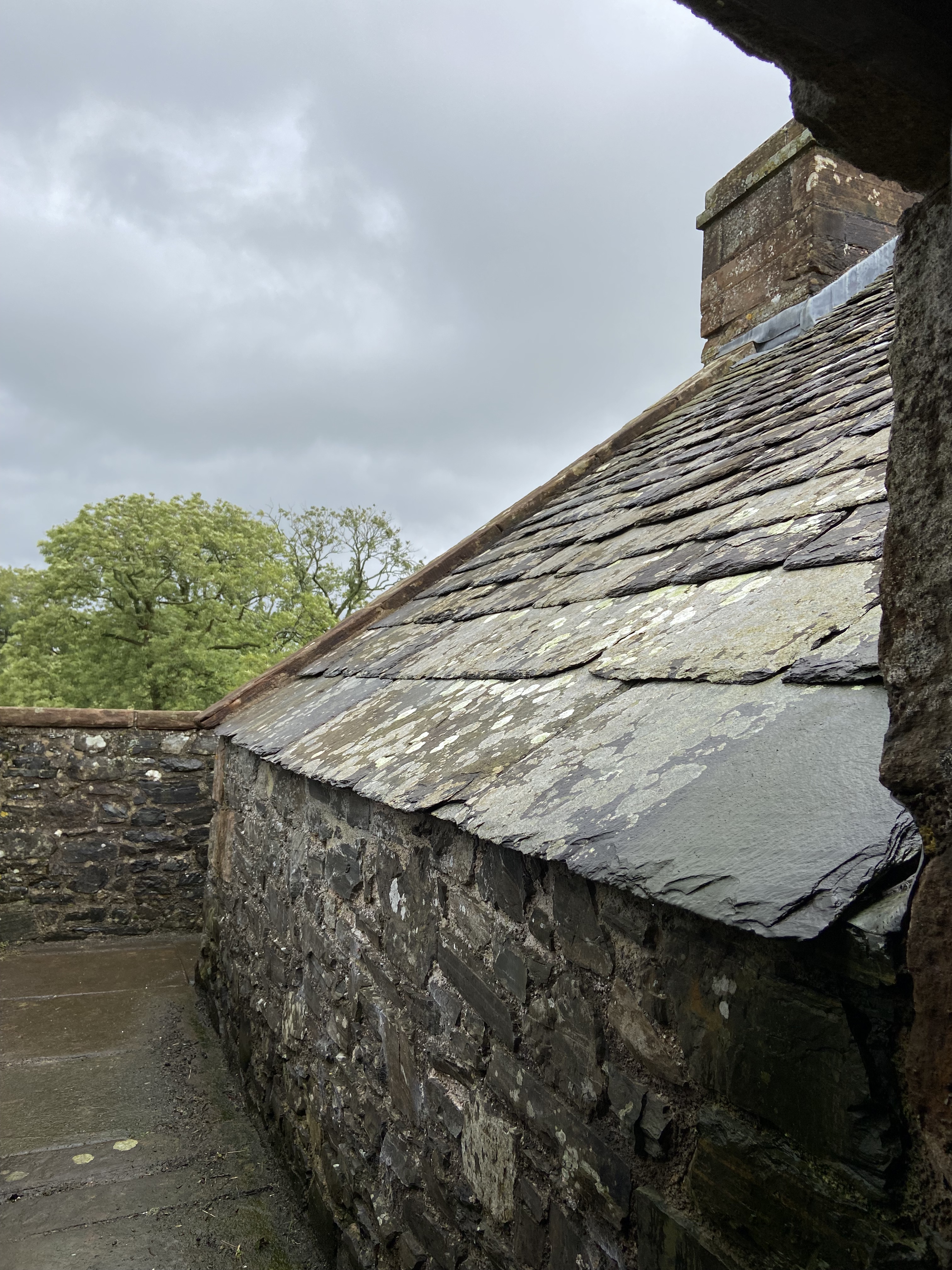
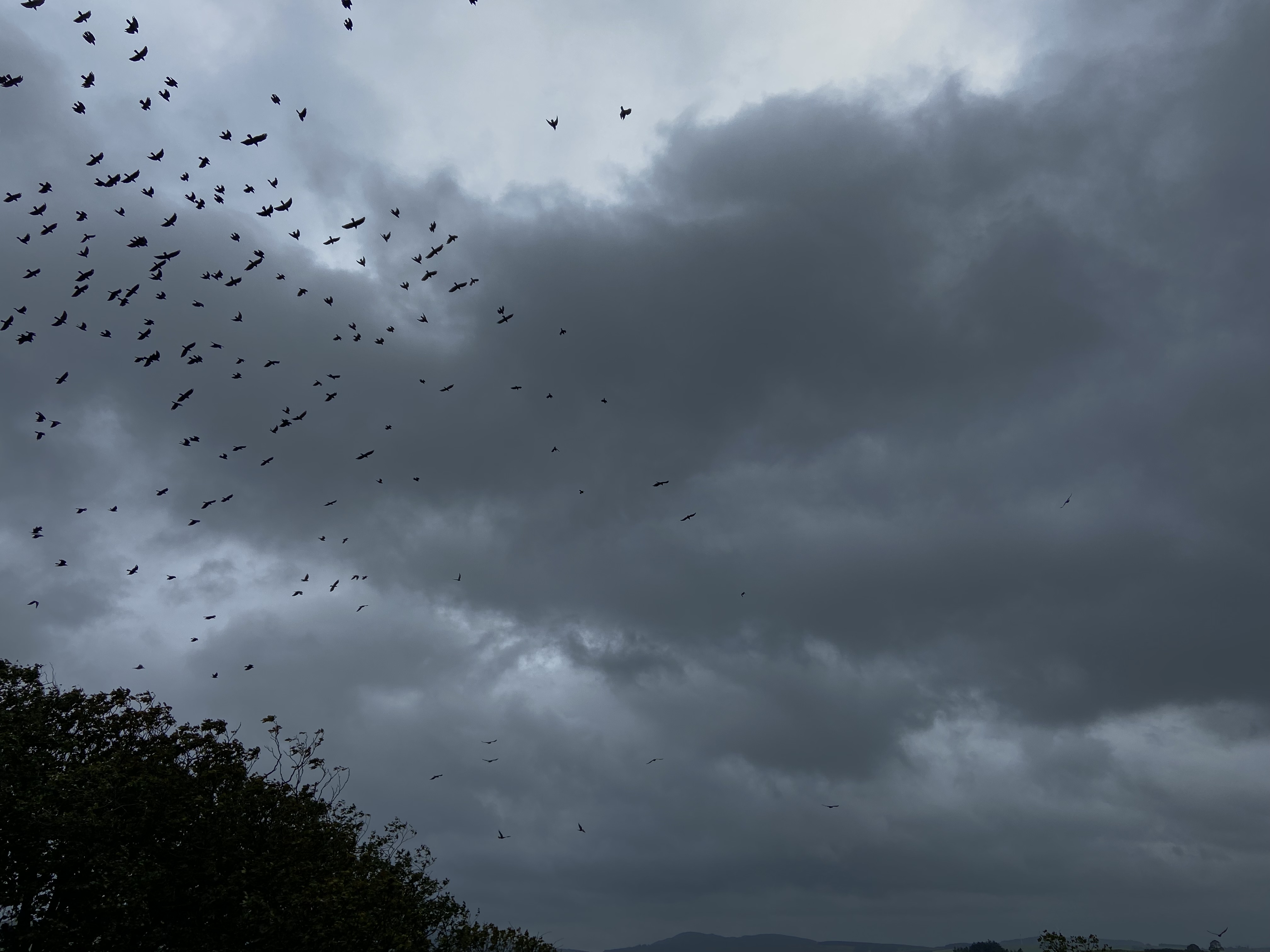
Luckily, the battlements were high enough to lend a sense of safety. Despite the stormy weather and the blowing trees, I felt quite safe as I walked beside the slates and chimneys, enjoying the view. As you can see, in the photograph at the top of the page, there were crows in the treetops nearby and they put on a wonderful show, reeling in the wind below the darkening storm clouds.

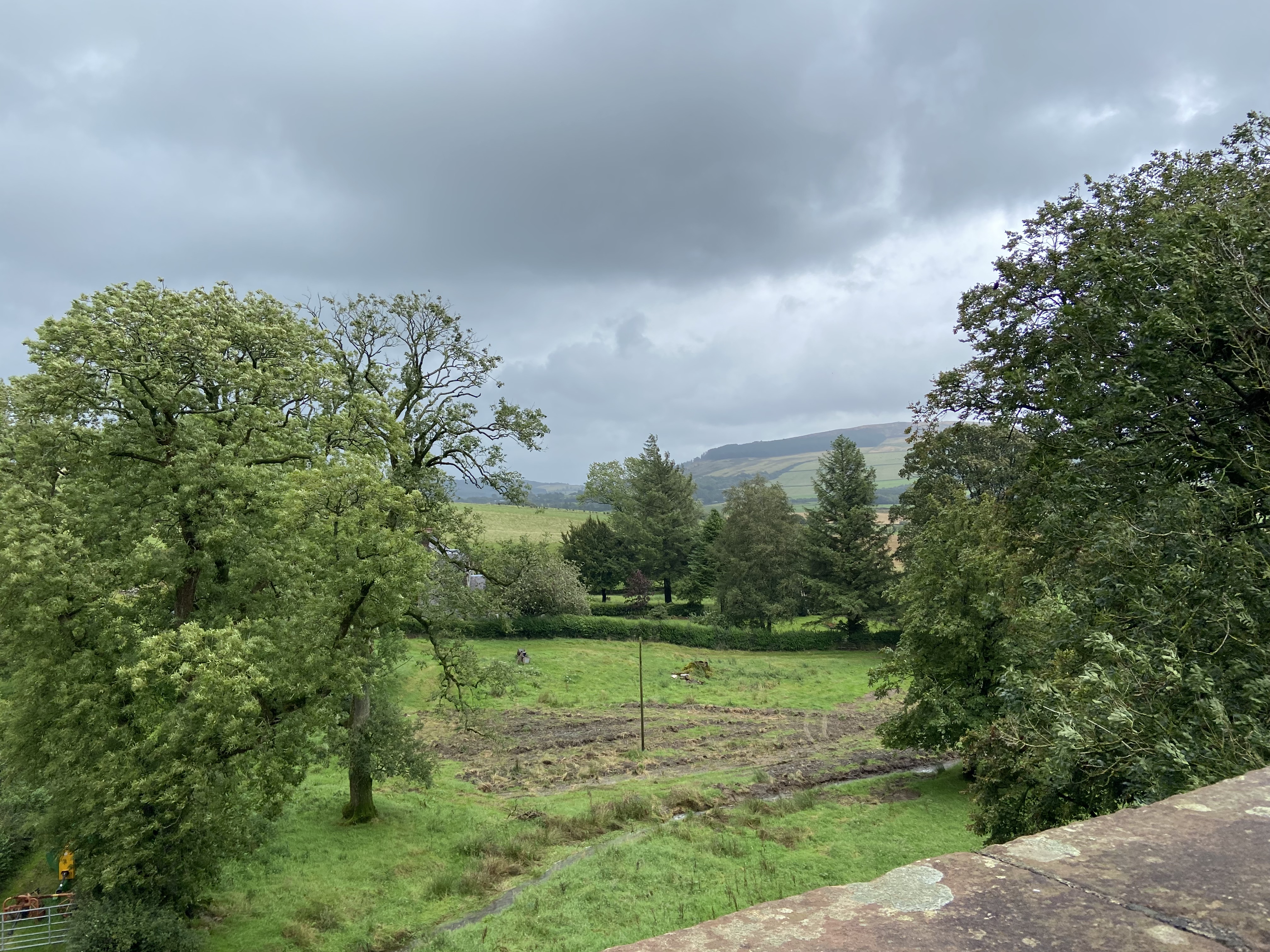
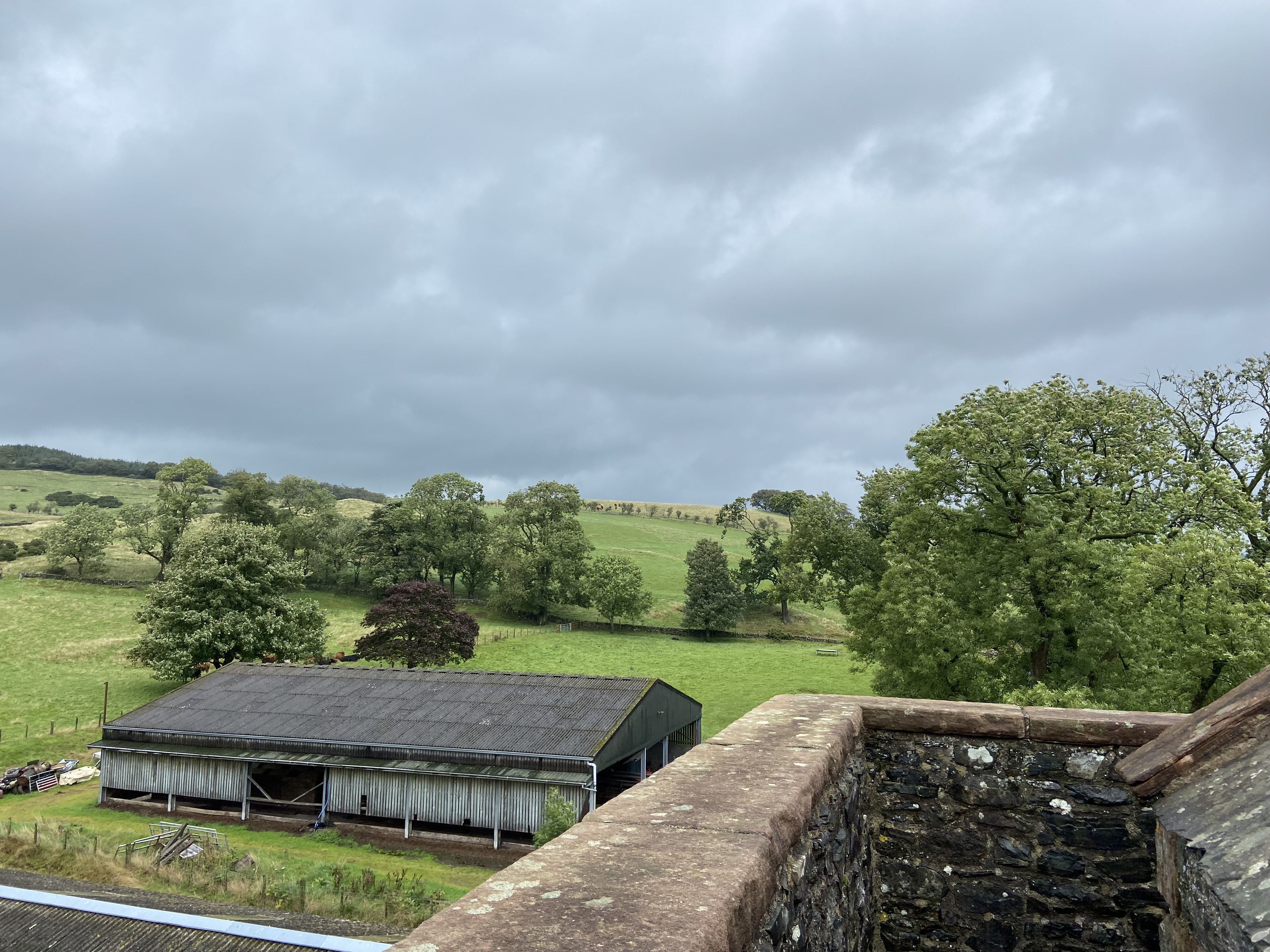
I wasn’t expecting to find much more when I went in, but before going out on the roof, I had seen that the spiral stair continued a little. Half expecting it to go nowhere, I was surprised to find that it led up to a little, resconstructed room, right at the top of the tower. This would have been a watchroom, apparently, and for the first time, I got a sense of this being somewhere you could live. It was a little attic room with a fireplace, under the rafters. The rest of the house was open to the weather, but this had glass in the window, though it was festooned with cobwebs.

I walked back down and sought the inscription that was supposedly written above the door, but couldn’t find it. It was only as I began writing today that I found it, very weathered and impossible to read, in the image looking up that I posted earlier.
As the week has gone by, I have wondered about the tower and how it once might have been. I couldn’t help noticing how chilly it was, with its glassless windows and I wondered whether they would have had glass, or more likely shutters, to keep out the weather. Even with a huge, blazing fire, it would have been impossible to keep warm otherwise.
It seems that it was unlikely there would have been glass here in this type of house, but there would have been shutters of some sort, perhaps of wood, oiled cloth or maybe thin horn. I can’t quite imagine the thin horn, or how it would have been made. The windows on the lower floors would have been smaller back then too. They have been made larger as the house was put to different use, through the ages.
There would have been plaster on the walls too and they would have been painted. It’s easy to forget that, when walking around old castles and buildings. Just because they have stone walls now, that doesn’t mean they were not much better adorned in the past.
I was interested to read that the single storey, white painted shed to the left of the tower in the original picture, was a farmhouse which used to be much larger. It was built in the 18th century and a passage was built, connecting it to the tower. Farm labourers were housed in the tower until about 1900. Then it was used as a farm store, until the 1950s, when it was handed over to historic Scotland.
How odd it is, that the tower, which once must have been the pride of the family, would have been devalued so much over time, but until recently, I guess only the most beautiful buildings would have been preserved as people would want to inhabit them. Drumcoltran has survived because it was sturdily built, I guess, and still useful. Many such towers would have lost their roof and fallen into disrepair, then the stone used again to build something new.
So there it stands, partially preserved, on the edge of a modern farm, an anomaly on the landscape, or perhaps a part of it, left over from very different times.
And now it’s Saturday and I can see the sun outside the window, shining through the blinds. Maybe today, I will take up my original plan and try to find the stone circle. It’s about time I visited Wigtown anyway, since it is officially designated as Scotland’s National Book Town.
Thanks for reading. I hope you have a lovely weekend.

 A Vet’s Life